
Active Learning for Cross-domain Sentiment Classification
Proceedings of the Twenty-Third International Joint Conference on Artificial Intelligence. Pages 2127-2132.
© 2013 International Joint Conferences on Artificial Intelligence
Abstract
In the literature, various approaches have been proposed to address the domain adaptation problem in sentiment classification (also called cross-domain sentiment classification). However, the adaptation performance normally much suffers when the data distributionsin the source and target domains differ significantly. In this paper, we suggest to perform active learning for cross-domain sentiment classification by actively selecting a smallamount of labeled data in the target domain. Accordingly, we propose an novel active learning approach for cross-domain sentiment classification. First, we train two individual classifiers, i.e., the source and target classifiers with the labeled data from the source and target respectively. Then, the two classifiers are employed to select informative samples with the selection strategy of QueryBy Committee (QBC). Third, the two classifier is combined to make the classification decision. Importantly, the two classifiers are trained by fully exploiting the unlabeled data in the target domain with the label propagation(LP) algorithm. Empirical studies demonstrate the effectiveness of our active learning approach for cross-domain sentiment classification over some strong baselines.
- [Aue and Gamon, 2005] Aue A. and M. Gamon. 2005. Customizing Sentiment Classifiers to New Domains: A Case Study. Technical report, Microsoft Research.
- [Blizer et al., 2007] Blitzer J., M. Dredze and F. Pereira. 2007. Biographies, Bollywood, Boom-boxes and Blenders: Domain Adaptation for Sentiment Classification. In Proceedings of ACL-07, pp.440-447.
- [Bollegala et al., 2011] Bollegala D., D. Weir, and J. Carroll. 2011. Using Multiple Sources to Construct a Sentiment Sensitive Thesaurus for Cross-Domain Sentiment Classification. In Proceedings of ACL-11, pp.132-141.
- [Chan and Ng, 2007] Chan Y. and H. Ng. 2007. Domain Adaptation with Active Learning for Word Sense Disambiguation. In Proceedings of ACL-07, pp.49-56.
- [Daumé III, 2007] Daumé III H. 2007. Frustratingly Easy Domain Adaptation. In Proceedings of ACL-07, 256-263.
- Freund et al., 92]
- Freund Y., H. Seung, E. Shamir, and N. Tishby. Informatio Proceeding of NIPS-92n, Prediction, and Query by Committee. In, pp.483-490.
- [He et al., 2011] He Y., C. Lin and H. Alani. 2011. Automatically Extracting Polarity-Bearing Topics for Cross-Domain Sentiment Classification. In Proceeding of ACL-11, pp.123-131.
- [Jiang and Zhai, 2007] Jiang J. and C. Zhai. 2007. Instance Weighting for Domain Adaptation in NLP. In Proceedings of ACL-07, pp.264-271.
- [Li et al., 2010] Li S., C. Huang, G. Zhou and S. Lee. 2010. Employing Personal/Impersonal Views in Supervised and Semi-supervised Sentiment Classification. In Proceedings of ACL-10, pp.414-423.
- [Pan and Yang, 2010] Pan S. and Q. Yang. 2010. A Survey on Transfer Learning. IEEE Transactions on Knowledge and Data Engineering. vol.22(10), pp.1345-1359.
- [Pang and Lee, 2008] Pang B. and L. Lee. 2008. Opinion Mining and Sentiment Analysis: Foundations and Trends. Information Retrieval, vol.2(12), pp.1-135.
- [Pang et al., 2002] Pang B., L. Lee, and S. Vaithyanathan. 2002. Thumbs up? Sentiment Classification using Machine Learning Techniques. In Proceedings of EMNLP-02, pp.79-86.
- [Rai et al., 2010] Rai P., A. Saha, H. Daum´e III and S. Venkatasubramanian. 2010. Domain Adaptation Meets Active Learning. In Proceedings of NAACL-10 Workshop on Active Learning for Natural Language Processing, pp.27-32.
- [Shen et al., 2004] Shen D., J. Zhang, J. Su, G. Zhou and C. Tan. 2004. Multi-Criteria-based Active Learning for Named Entity Recognition. In Proceedings of ACL-04, pp.589-596.
- [Shi et al., 2008] Shi X., W. Fan and J. Ren. 2008. Actively Transfer Domain Knowledge. In Proceedings of ECML/PKDD-08, pp.342-357.
- [Sindhwani and Melville, 2008] Sindhwani V. and P. Melville. 2008. Document-Word Co-Regularization for Semi-supervised Sentiment Analysis. In Proceedings of ICDM-08, pp.1025-1030.
- [Turney, 2002] Turney P. 2002. Thumbs up or Thumbs down? Semantic Orientation Applied to Unsupervised Classification of reviews. In Proceedings of ACL-02, pp.417-424.
- [Wang and Yao, 2011] Wang S. and X. Yao. Relationships Between Diversity of Classification Ensembles and Single-Class Performance Measures. IEEE Transactions on Knowledge and Data Engineering, DOI: 10.1109/TKDE.2011.207. DOI
- [Zhu et al., 2008] Zhu J., H. Wang, T. Yao and B. Tsou. 2008. Active Learning with Sampling by Uncertainty and Density for Word Sense Disambiguation and Text Classification. In Proceedings of COLING-08, pp.1137-1144.
- [Zhu and Ghahramani, 2002] Zhu X. and Z. Ghahramani. 2002. Learning from Labeled and Unlabeled Data with Label Propagation. CMU CALD Technical Report. CMU-CALD-02-107.
References were extracted automatically from the PDF and may contain errors.
Full text extracted automatically from the PDF; figures, tables and equations may differ. The PDF is the version of record.
1 Introduction
Sentiment classification is a task of determining the sentimental orientation (e.g., positive or negative) of a given textual document towards a given topic [Pang et al., 2002; Turney, 2002]. This study has been extensively explored in multiple research communities, such as natural language processing (NLP), data mining and machine learning [Pang and Lee, 2008]. One of the main challenges for sentiment classification is the domain adaptation problem. That is, a sentiment classifier trained with the labeled data from one domain normally performs unsatisfactorily in another domain. To overcome this problem, several studies have been proposed to address the domain adaptation problem in sentiment classification by using some labeled data from the source domain and a large amount of unlabeled data from the target domain [Blitzer et al., 2007; He et al., 2011; Bollegala et al., 2011].
* 1 Corresponding author
Although existing studies have yielded certain progress in domain adaptation on sentiment classification, the adaptation performance normally much suffers when the data distributions in the source and target domains differ significantly. In some cases, the incorporation of unlabeled data in the target domain might even adversely affect the performance in the target domain, a situation often referred to as negative transfer [Pan and Yang, 2010]. For example, [Blitzer et al., 2007] report that when transferring from domain 'Kitchen' to domain 'Book', the obtained performance by the proposed approach (68.6% in accuracy) is even lower than the performance of without using the unlabeled data in the target domain (70.9% in accuracy). The reason of the failure in such situations is that the distributions of the source and target domains become too different to make the adaptation algorithm useful. One possible solution to such dilemma is to annotate a small amount of good labeled data in the target domain to quickly reduce the huge difference between the two domains, which is typically an active learning paradigm. However, active learning in cross-domain sentiment classification faces some unique challenges than active learning in traditional in-domain sentiment classification.
First, one major difference is the size of the involved labeled data. That is, active learning in in-domain classification normally contains only a small amount of labeled data while active learning in cross-domain classification normally contains abundant labeled data in the source domain. The large amount of labeled data brings out novel difficulties in both the sample selection strategy and the classification algorithm for active learning in the cross-domain case.
- Since the initial labeled data in the source domain is in a big scale, the newly-added labeled data from the target domain may become too weak to affect the selection tendency in the merged labeled data. Apparently, this is
not what an effective active learning approach is expected because the newly-added labeled data is from the same domain as the test data, i.e., the target domain, and thus should be more valuable for supervising the selection strategy.
- Given the abundant labeled data from the source domain, the newly-added labeled data from the target domain are normally too few to quickly affect the classification decision. This makes the newly-added labeled data little helpful, especially at the beginning.
Second, another major difference is the usage of the unlabeled data. That is, in-domain classification normally employs the unlabeled data for only selecting the informative samples while cross-domain classification is encouraged to exploit the unlabeled data (from the target domain) in the classification algorithms due to the limited size of the labeled data in the target domain. Therefore, in the case of cross-domain classification, it is also challenging to design a powerful classification algorithm which could fully take advantage of the unlabeled data together with the newly-added labeled data in the target domain.
In this paper, we address above challenges in active learning for cross-domain sentiment classification.
For the first challenge, we use the newly-added labeled data from the target domain to train a separate classifier and apply it in both the sample selection strategy and the classification algorithm. Specifically, we construct two individual classifiers by training the data from the source and target domain separately (referred to as the source and target classifiers respectively). For the sample selection strategy, these two classifiers naturally drive us to adopt the active learning strategy named Query By Committee (QBC) to select the samples that disagree most in terms of the prediction labels. For the classification algorithm, we combine the source and target classifiers to make the classification decision. Besides, we notice that the diversity between the source and target classifiers is an important factor to improve the combination performance [Wang et al., 2001]. Thus, we modify the standard QBC strategy by selecting not only the disagreed samples by the source and target classifiers but also the most uncertain samples by the source classifier.
For the second challenge, we propose a label propagation (LP) -based classification algorithm, which leverages both the labeled and unlabeled data, and apply it to both the source and target classifiers. One big advantage of this approach is its effectiveness for both the source and target classifiers to exploit the unlabeled data in the target domain.
The remainder of this paper is organized as follows. Section 2 overviews the related work. Section 3 proposes our active learning approach for cross-domain sentiment classification. Section 4 evaluates our approach. Finally, Section 5 gives the conclusion and future work.
2 Related Work
This section gives an overview of the related domain adaptation work from both sentiment classification and active learning perspectives.
2.1 Domain Adaptation in Sentiment Classification
Early studies on sentiment classification mainly focus on the single-domain setting [Pang et al., 2002; Turney, 2002]. For detailed discussion on this setting, please refer to [Pang and Lee, 2008].
As for cross-domain sentiment classification, [Aue and Gammon, 2005] pioneer the studies. Although they fail to propose an effective solution, they highlight the importance and difficulty of cross-domain sentiment classification.
Subsequently, [Blitzer et al., 2007] successfully develop a domain adaptation approach, named SCL, for sentiment classification, with the main idea to bridge the knowledge between the source and target domains using some pivotal features.
More recently, [He et al., 2011] employ a topic model, called joint sentiment-topic model (JST), and [Bollegala et al., 2011] create a sentiment sensitive thesaurus, to perform cross-domain sentiment classification. Results from these studies demonstrate comparable performance to SCL.
Unlike above studies, our study pioneers active learning on cross-domain sentiment classification, which greatly improves the adaptation performance with the help of a small amount of labeled data in the target domain.
2.2 Active Learning-based Domain Adaptation
Although domain adaptation has been extensively studied in NLP and machine learning communities, such as [Shen et al. 2004], [Jiang and Zhai, 2007], [Zhu et al., 2008], and [DaumŽ III, 2007], there are only a few studies on active learning-based domain adaptation.
[Chan and Ng, 2007] apply active learning for word sense disambiguation in a domain adaptation setting with focus on considering an uncertainty measurement according to the available labeled data. Similarly, [Shi et al., 2008] propose a framework for active learning on the target domain (named active transferring of domain knowledge therein) with the sample selection strategy on an uncertainty measurement. More recently, [Rai et al., 2010] propose an online active learning approach on domain adaptation, still with the sample selection strategy on an uncertainty measurement.
However, all existing studies do not pay close attention to the newly-added labeled data in the target domain. In comparison, our proposed approach makes full use of the newly-added labeled data in both the sample selection strategy and the classification algorithm.
3 Active Learning for Cross-domain Sentiment Classification
In cross-domain sentiment classification, the test samples come from the target domain while the training data come from a different source domain. In the sequel, we refer the training data in the source domain to as 1 1 {( , )} n s i i i L x y _ _ where d i x ∨R is the d dimensional input vector, and i y is its output label. We also assume that the test samples are available and denoted as 2 1 {( ' , ' )} n T i i i T x y _ _ where ' d i x ∨R is the input. Let ( ) t x and ( ) s x be the marginal distributions of the samples from the target and source domains, respectively. In general, ( ) t x and ( ) s x are different. The task of cross-domain sentiment classification is to leverage the training data s L to predict label ' i y for input ' i x in the target domain. In general, in order to reduce the gap between the source and target domains, another resource, i.e., the unlabeled data in the target domain denoted as 3 1 {( ' , ' )} n T i i i U x y _ _ , is often available for the adaptation classification algorithm.
In this study, we focus on active learning in cross-domain sentiment classification. Naturally, this task contains two main steps, first selecting a small amount of "informative" samples, denoted as 4 1 {( ' , ' )} n T i i i L x y _ _ , from T U for manual annotation, and then training a classifier with the labeled data including s L and T L together with the unlabeled data T U .
For clarity, some important symbols are listed in Table 1.
| Symbol | Definition |
|---|---|
| S L | Labeled source-domain data |
| T L | Labeled target-domain data |
| S f | The source Classifier |
| T f | The target Classifier |
| T U | Unlabeled target-domain data |
| T L ∞ | Newly-added data at each iteration |
| LP-S f | The LP-based source Classifier |
| LP-T f | The LP-based target Classifier |
| T T | Test data in the target domain |
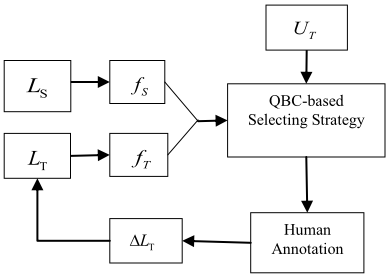
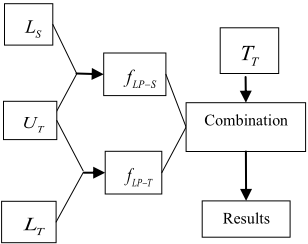
Figure 1 and Figure 2 illustrate the main flows of sample selection and sample classification, where the former employs a QBC-based selection strategy to choose "informative" samples and the latter employs a LP algorithm to make the classification decision for a sample, both with the help of the source and target classifiers. Note that the source and target classifiers in the testing process also exploit the unlabeled data in the target domain with LP algorithm. In the following subsections, we introduce the processes of both the QBC-based sample selection and the LP-based classifiers in details.
3.1 QBC-based Selection Strategy
Query by Committee (QBC) is a group of active learning approaches that employ many copies of "hypotheses" (e.g., coming from randomized learning algorithms) to select an unlabeled example at which their classification predictions are maximally spread [Freund et al., 92]. In our setting, we first use the source classifier S f and the target classifier T f to collaboratively select label-disagreed samples as the selection candidates. Then, we rank the label-disagreed samples according to their uncertainty values by the source classifier. Finally, we select the top-N uncertainty samples as the newly-added data for human annotation.
Input: Labeled source-domain data S L
Unlabeled target-domain data T U
Output: Automatically labeled target-domain data T L
Procedure:
- (a) Initialize T L _⇓
- (b) Train the source classifier S f with S L
- (c) Use S f to select top-N uncertainty samples as T L ∞
- (d) T T T L L L _ 0∞ , and T T T U U L _ 2∞
- (e) Repeat k times
- e1) Train the target classifier T f with T L
- e2) Use both S f and T f to select label-disagreed samples from T U
- e3) Use S f to select top-N uncertainty samples from the label-disagreed samples as T L ∞
Figure 3: QBC-based selection strategy in our approach
4.3 LP-based Classification Algorithm
To well incorporate the knowledge in the unlabeled data for both the source and target classifiers, we adopt a graph-based ranking approach named LP to propagate the labels from the labeled data to the unlabeled data.
The input of the LP algorithm is a graph describing the relationship among each sample pair in the labeled and unlabeled data. Here, the document-word bipartite graph is adopted due to its excellent performance in sentiment classification [Sindhwani and Melville, 2008]. In a bipartite graph, the nodes consists of two parts: documents and all words extracted from the documents. An undirected edge ( , i k d w ) exists if and only if document i d contains word k w . Let ik x be the frequency of word k w in document i d . From the bipartite graph, the probability of walking from document i d to word k w can be calculated as / ik ik k x x ⎠ and the probability of walking from word k w to document j d can be calculated as / jk jk j x x ⎠ . Thus the probability of walking from document i d to document j d though the word k w can be calculated as ( / ) ( / ) ik ik jk jk k j x x x x ⎦ ⎠ ⎠ . When all words are considered, we get the transition probability from i d to j d as:
and the transition probability matrix { } ij M t _ .
Input:
- P: The 2 n⋅ matrix, while ir p represents the probability of document i d (i=1...n) with label r (r=0,1);
- M: The n n ⋅ transition probability matrix
Output:
The unlabeled data with prediction labels
Procedure:
1) Initialize P as 0 P
- Assign each labeled sample with a fixed probability distribution (1, 0) or (0,1) according to its label r;
- Assign each unlabeled sample with a initial probability distribution (0.5, 0.5);
- Loop until P converges;
- Propagate the labels of any vertex to nearby vertices by 1 T t t P M P0 _ ⎦ ;
- Clamp the labeled data, that is, replace the probabilities of the labeled samples in 1 t P 0 with 0 P ;
- Assign each unlabeled instance with a label by computing argmax ir p
r
Figure 4: The LP algorithm
Figure 4 illustrates the LP algorithm [Zhu and Ghahramani, 2002], during which the probabilities of the labeled data are clamped in each loop using their initial ones and act as a force to propagate their labels to the unlabeled data.
Given the above LP algorithm, it is straightforward to train a LP-based source classifier LP-S f and a LP-based target classifier LP-T f .
- Construct the document-word bipartite graph with both the labeled data and the unlabeled data (in the target domain) and get the transition probability matrix;
- Run the LP algorithm as shown in Figure 4 to obtain the labels of unlabeled data;
- Consider the unlabeled data with the predicted labels as pseudo-labeled data;
- Emerge the labeled data and the pseudo-labeled data to train a classifier.
The difference between LP-S f and LP-T f lies in the domains of the labeled data. In fact, the source classifier LP-S f is a domain adaptation classifier while the target classifier LP-T f is an in-domain semi-supervised classifier.
Once the LP-based source and target classifiers are obtained, they are combined to make the prediction decision, as shown in Figure 2, using the standard Bayes rule, i.e.
r
Where ( | ) Source r i p c x and ( | ' ) Target r i p c x denote the posterior possibilities of the prediction sample belonging to the category r c , estimated by the source and target classifiers, respectively
5 Experimentation
We systematically evaluate our active learning approach for cross-domain sentiment classification on a multi-domain dataset 2 [Blitzer et al., 2007].
5.1 Experimental Setting
Dataset: The dataset contains product reviews from four different domains: Book (B), DVD (D), Electronics (E) and Kitchen (K) appliances, each of which contains 1000 positive and 1000 negative labeled reviews. we randomly select 1600 instances from the source domain as labeled data, 1600 instances from the target domain as unlabeled data, and the remaining 400 instances from the target domain are reserved as test data. For different domains of B, D, E and K, the corresponding in-domain classifiers achieve the performance of 81.5%, 80.5%, 83.8% and 86.5% in accuracy, respectively.
Features: Each review text is treated as a bag-of-words and transformed into binary vectors encoding the presence or absence of word unigrams and bigrams.
Classification algorithm: the maximum entropy (ME) classifier implemented with the public tool, Mallet Toolkits 3 .
2 http://www.seas.upenn.edu/~mdredze/datasets/sentiment/
3 http://mallet.cs.umass.edu/
5.2 Performance of LP-based source and target classification
Before investigating the performance of our active learning approach, we first check the effectiveness of the LP-based source classifier LP-S f and target classifier LP-T f .
Since the source classifier LP-S f is a domain adaptation classifier, we implement the state-of-the-art SCL for domain adaptation on sentiment classification [Blitzer et al., 2007] for a comparative study. In this setting, no labeled data is available in the target domain. Table 2 shows that both the SCL and our LP-based classifier outperform the baseline with the average improvements of 1.9% and 2.9% in accuracy, respectively. However, it also shows that the adaptation performance using either SCL or LP remains unsatisfactory, with much lower performance than in-domain classification, when the source and target domains are much different, including E�B, K�B, E�D, K�D, B�E, D�E, B�K, and D�K. In the following experiments on active learning, we will focus on these eight pairs of domain adaptation.
| Baseline | SCL (Blizer et al., 2006) | LP-S f | |
|---|---|---|---|
| B->D | 0.793 | 0.795 | 0.798 |
| B->E | 0.708 | 0.730 | 0.720 |
| B->K | 0.715 | 0.753 | 0.770 |
| D->B | 0.775 | 0.790 | 0.780 |
| D->E | 0.660 | 0.705 | 0.768 |
| D->K | 0.733 | 0.778 | 0.743 |
| E->B | 0.690 | 0.640 | 0.715 |
| E->D | 0.710 | 0.700 | 0.740 |
| E->K | 0.830 | 0.833 | 0.835 |
| K->B | 0.693 | 0.760 | 0.735 |
| K->D | 0.695 | 0.745 | 0.733 |
| K->E | 0.805 | 0.808 | 0.815 |
| Baseline | Personal/Impersonal (Li et al., 2010) | LP-T f | |
|---|---|---|---|
| Book | 0.660 | 0.720 | 0.705 |
| DVD | 0.655 | 0.630 | 0.690 |
| Electronic | 0.740 | 0.760 | 0.775 |
| Kitchen | 0.735 | 0.775 | 0.770 |
Since the target classifier LP-T f is actually a semi-supervised classifier, we implement the state-of-the-art Personal/Impersonal approach for semi-supervised learning on sentiment classification [Li et al., 2010]. Here, we randomly select 200 samples as the initial labeled data. Table 3 shows that our LP-based target classifier achieves comparative performance to the state-of-the-art Personal/Impersonal approach.
5.3 Performance of active learning-based cross-domain sentiment classification
In this section, we systematically evaluate the performance of our active learning approach in cross-domain sentiment classification. As emphasized in Section 4, there are two main steps, i.e., the QBC-based sample selection strategy and the sample classification with classifier combination, in our approach. Accordingly, we name our approach as QBC+Combination. For comparison, we implement following two strong baselines,
- � Random+Combination, which randomly selects the samples from the unlabeled data and uses the classifier combination for prediction. We performs five runs of this approach and report the average performance.
- � Uncertainty+Single, which first actively selects the samples from the unlabeled data with uncertainty sampling, and then emerge the newly-added labeled data and the initial labeled data to train a single LP-based classifier.
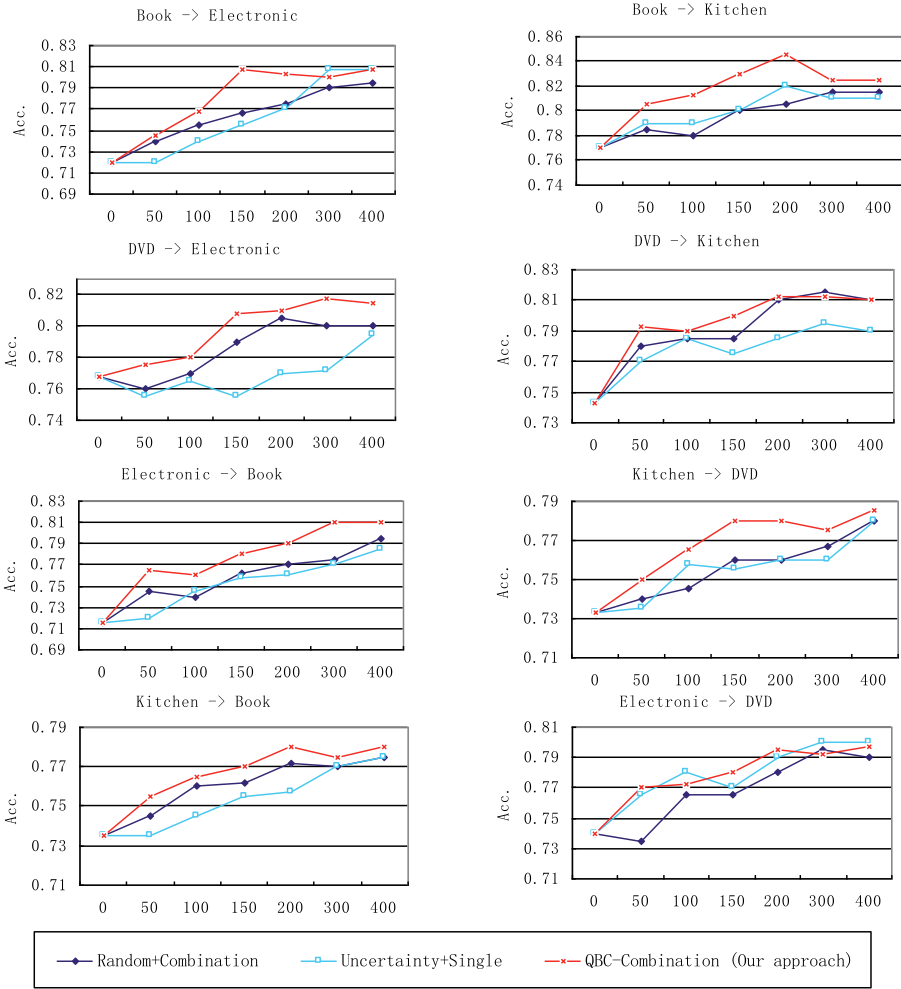
In the implementation, the top 10 informative samples are selected for manual annotation in each iteration (N=10) when QBC+Combination and Uncertainty+Single are employed. Figure 5 illustrates the performances of above three approaches. From Figure 5, we can see that labeling a small amount of samples in the target domain is always helpful. For example, through actively labeling only 200 samples in the target domain, our approach significantly improves the adaptation performances, which even beat those of using in-domain classifiers trained with 1600 labeled samples.
Our approach consistently performs significantly better than either QBC+Combination or Uncertainty+Single in almost all pairs (except E->D) when the selected samples are less than 200 (p-value < 0.01). This verifies the advantage of our approach in both QBC-based sample selection and combination-based sample classification. When more than 200 samples are selected, the performances of above three approaches become similar in some cases.
Although our approach does not provide a significant improvement in E->D because the LP-based target classifier in DVD performs badly in this case, our approach still yields no worse results than the other two approaches.
6 Conclusion
In this paper, we address domain adaptation in sentiment classification when the source and target domains differ significantly. We propose a novel active learning approach for cross-domain sentiment classification by leveraging QBC-based sample selection and combination-based classifier classification. Empirical studies indicate that our proposed approach significantly outperforms the state-of-the-art ones. Furthermore, it shows that with only 200 labeled documents from the target domain, our approach could achieve comparable performances to those in-domain classifiers trained with 1600 labeled documents.
The research on active learning for cross-domain sentiment classification is still in its early stage. In our future work, we will exploit more effective algorithms to improve the performances of the source and target classifiers. Meanwhile, we would like to adapt our active learning approach to other cross-domain tasks in natural language processing.
Acknowledgments
The research work described in this paper has been partially supported by three NSFC grants, No.61003155, and No.60873150, one National High-tech Research and Development Program of China No.2012AA011102, Open Projects Program of National Laboratory of Pattern Recognition, and one project supported by Zhejiang Provincial Natural Science Foundation of China, No.Y13F020030. We also thank the three anonymous reviewers for their helpful comments.
@inproceedings{ijcai2013p314,
  title     = {Active Learning for Cross-domain Sentiment Classification},
  author    = {Li, Shoushan and Xue, Yunxia and Wang, Zhongqing and Zhou, Guodong},
  booktitle = {Proceedings of the Twenty-Third International Joint Conference on
               Artificial Intelligence, {IJCAI-13}},
  publisher = {AAAI Press / International Joint Conferences on Artificial Intelligence},
  editor    = {Francesca Rossi},
  pages     = {2127--2132},
  year      = {2013},
  month     = {8},
  url       = {https://ijcai.org/proceedings/2013/314},
}
TY - CPAPER TI - Active Learning for Cross-domain Sentiment Classification AU - Li, Shoushan AU - Xue, Yunxia AU - Wang, Zhongqing AU - Zhou, Guodong T2 - Proceedings of the Twenty-Third International Joint Conference on Artificial Intelligence, IJCAI-13 PB - AAAI Press / International Joint Conferences on Artificial Intelligence PY - 2013 SP - 2127 EP - 2132 UR - https://ijcai.org/proceedings/2013/314 ER -Copied
Machine-readable versions of this paper, for tools and AI agents:





