
Representation and Reasoning about General Solid Rectangles
Proceedings of the Twenty-Third International Joint Conference on Artificial Intelligence. Pages 905-910.
© 2013 International Joint Conferences on Artificial Intelligence
Abstract
Entities in two-dimensional space are often approximated using rectangles that are parallel to the two axes that define the space, so-called minimum-bounding rectangles (MBRs). MBRs are popular in Computer Vision and other areas as they are easy to obtain and easy to represent. In the area of Qualitative Spatial Reasoning, many different spatial representations are based on MBRs. Surprisingly, there has been no such representation proposed for general rectangles, i.e., rectangles that can have any angle, nor for general solid rectangles (GSRs) that cannot penetrate each other. GSRs are often used in computer graphics and computer games, such as Angry Birds, where they form the building blocks of more complicated structures. In order to represent and reason about these structures, we need a spatial representation that allows us to use GSRs as the basic spatial entities. In this paper we develop and analyze a qualitative spatial representation for GSRs. We apply our representation and the corresponding reasoning methods to solve a very interesting practical problem: Assuming we want to detect GSRs in computer games, but computer vision can only detect MBRs. How can we infer the GSRs from the given MBRs? We evaluate our solution and test its usefulness in a real gaming scenario.
- [AI12, 2012] AI12. Angry Birds: AI Challenge. http://ai2012.web.cse.unsw.edu.au/abc.html, 2012. Link
- [AIBirds, 2013] AIBirds. Angry Birds AI Competition. http://www.aibirds.org/, 2013. Link
- [Allen, 1983] James F. Allen. Maintaining knowledge about temporal intervals. Commun. ACM, 26(11):832-843, November 1983.
- [Balbiani et al., 1998] Philippe Balbiani, Jean-Franc ¸ois Condotta, and Luis Fariñas del Cerro. A model for reasoning about bidemsional temporal relations. In KR, pages 124-130, 1998.
- [Balbiani et al., 1999] Philippe Balbiani, Jean-Franc ¸ois Condotta, and L Fari as del Cerro. A new tractable subclass of the rectangle algebra. In International Joint Conference On Artificial Intelligence, volume 16, pages 442-447, 1999. IJCAI
- [Blum et al., 1970] M. Blum, A. Griffith, and B. Neumann. A stability test for configurations of blocks. 1970.
- [Caldwell, 2005] Douglas R. Caldwell. Unlocking the mys- teries of the bounding box. Coordinates, A(2):120, August 2005.
- [Chaudhuri and Samal, 2007] D Chaudhuri and A Samal. A simple method for fitting of bounding rectangle to closed regions. Pattern recognition, 40(7):1981-1989, 2007.
- [Cohn and Renz, 2008] A.G. Cohn and J. Renz. Qualitative spatial representation and reasoning. Foundations of Arti- ficial Intelligence, 3:551-596, 2008.
- [Cohn et al., 2012] A.G. Cohn, J. Renz, and M. Sridhar. Thinking inside the box: A comprehensive spatial repre- sentation for video analysis. Proceedings of KR, 12, 2012.
- [Düntsch et al., 2001] Ivo Düntsch, Hui Wang, and Steve McCloskey. A relation-algebraic approach to the re- gion connection calculus. Theoretical Computer Science, 255(1):63-83, 2001.
- [Forbus et al., 1987] Kenneth D. Forbus, Paul Nielsen, and Boi Faltings. Qualitative kinematics: A framework. In Proceedings of IJCAI-87, page 430436, 1987. IJCAI
- [Forbus et al., 1991] Kenneth D Forbus, Paul Nielsen, and Boi Faltings. Qualitative spatial reasoning: the clock project. Artificial Intelligence, 51(1):417-471, 1991.
- [Gerevini and Renz, 2002] Alfonso Gerevini and Jochen Renz. Combining topological and size information for spatial reasoning. Artificial Intelligence, 137(1):1-42, 2002.
- [Gottfried, 2003] B. Gottfried. Tripartite line tracks- bipartite line tracks. KI 2003: Advances in Artificial In- telligence, pages 535-549, 2003.
- [Goyal and Egenhofer, 2001] R. Goyal and M. Egenhofer. Similarity of cardinal directions. Advances in Spatial and Temporal Databases, pages 36-55, 2001.
- [Gupta et al., 2010] Abhinav Gupta, Alexei A. Efros, and Martial Hebert. Blocks World Revisited: Image Un- derstanding Using Qualitative Geometry and Mechanics. 2010. [Ligozat, 1998] Gerard Ligozat. Reasoning about cardinal directions. J. Vis. Lang. Comput., 9(1):23-44, 1998.
- [Nakagawa and Rosenfeld, 1979] Yasuo Nakagawa and Azriel Rosenfeld. A note on polygonal and elliptical approximation of mechanical parts. Pattern Recognition, 11(2):133-142, 1979.
- [Rajagopalan and Kuipers, 1994] R. Rajagopalan and B. Kuipers. Qualitative spatial reasoning about objects in motion: Application to physics problem solving. In Arti- ficial Intelligence for Applications, 1994., Proceedings of the Tenth Conference on, pages 238-245. IEEE, 1994.
- [Randell et al., 1992] D.A. Randell, Z. Cui, and A.G. Cohn. A spatial logic based on regions and connection. KR, 92:165-176, 1992.
- [Robertson, 2012] James Robertson. In the wild world of angry birds, man triumphs over machine. http://www.smh.com.au/digital-life/games/in-the-wild- world-of-angry-birds-man-triumphs-over-machine- 20121206-2ay9c.html, 2012. [Rovio, 2013] Rovio. Angry Birds Chrome. http://chrome.angrybirds.com/, 2013. Link
- [Sadeghi Sokeh et al., 2013] H. Sadeghi Sokeh, S. Gould, and J. Renz. Efficient extraction and representation of spa- tial information from video data. In Proceedings of IJCAI- 13, 2013. IJCAI
- [Siskind, 2003] Jeffrey Mark Siskind. Reconstructing force- dynamic models from video sequences. Artificial Intelli- gence, 151(12):91 -154, 2003.
- [Stollnitz et al., 1996] E.J. Stollnitz, T.D. DeRose, and D.H. Salesin. Wavelets for computer graphics: theory and ap- plications. Morgan Kaufmann, 1996.
References were extracted automatically from the PDF and may contain errors.
Full text extracted automatically from the PDF; figures, tables and equations may differ. The PDF is the version of record.
1 Introduction and ProblemDescription
In many real-world problems and tasks we are dealing with entities embedded in two- or three-dimensional space. Their shape, location, and other spatial properties are often important factors in finding a solution to these problems. Representing spatial information and methods and techniques for processing this information are therefore important components of many problems and their solutions. A typical way of representing spatial information is to have a coordinate system and to specify spatial properties of entities in terms of their coordinates. However, when the exact coordinates are not available or not important, we can also use a qualitative spatial representation that makes only those distinctions that are important for a problem [Cohn and Renz, 2008]. For example, when following navigation instructions it is usually sufficient to know which landmarks are to the left or right, in the front or behind the car, but not their exact location. A major advantage of making only the important distinctions is that it can reduce the search space when solving a problem. Instead of searching over all possible coordinates, we only need to search over the different qualitative distinctions.
This paper is motivated by a practical problem that benefits from a qualitative spatial representation in order to reduce the search space for follow-up problem solving. The problem is part of the Angry Birds AI challenge [AI12, 2012; AIBirds, 2013], where the task is to build an AI agent that can autonomously and successfully play the Angry Birds game [Rovio, 2013]. In the game pigs are sheltered by a structure consisting of blocks of different sizes, colours and shapes that roughly behave according to the laws of physics. The player needs to kill the pigs by shooting birds and hitting the pigs either with the birds directly or indirectly with falling blocks. Identifying good shots clearly benefits from an analysis of the sheltering structure.
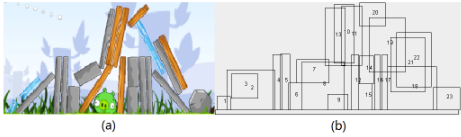
The different objects in the game are detected using a provided computer vision system that places a minimal bounding rectangle(MBR) that is parallel to the game frame around each detected object and classifies the object type (see Figure 1). MBRs are used as they can be detected fast and in a robust way [Caldwell, 2005]. Some methods such as qualitative physics [Rajagopalan and Kuipers, 1994; Forbus et al., 1991], video analysis [Gupta et al., 2010; Siskind, 2003] require precise numerical calculations to solve similar problems. However, trying to detect the actual shapes of the objects is very unreliable and error-prone, as can be seen in this video [Robertson, 2012] where the exact shapes are used. As most of the objects in the sheltering structure are rectangular blocks of different angles called general solid rectangles (GSR), we would like to obtain the actual blocks rather than their MBRs. This should enable a much more accurate analysis of the sheltering structure than using MBRs.
We call the problem we need to solve QualGSR(Θ,R): given a set Θ of MBRs, identify for each MBR an actual contained GSR such that the GSRs do not overlap and form a stable structure under gravity. In order to reduce the search space for the analysis of the sheltering structure, we use a qualitative representation R of the GSRs that only distinguishes important features of GSRs.
This is a difficult problem for a number of reasons. Firstly, there is no existing qualitative representation of angled rectangles, only of rectangles parallel to the axes [Balbiani et al., 1998]. Secondly, the given MBRs are fixed and we know their actual coordinates, i.e., the contained GSR is restricted to a given box. This is different from any qualitative representation and any qualitative reasoning methods previously developed [Gerevini and Renz, 2002; Gottfried, 2003]. We need to combine quantitative with qualitative information in order to solve this. Thirdly, computing stability under gravity in a qualitative way without knowing the exact masses and exact extensions of the GSRs is impossible [Forbus et al., 1987]. Qualitative stability can therefore only be an approximation.
In the following we give a brief introduction to qualitative spatial representation and reasoning (QSR). We present GR-n, a qualitative representation of GSRs that can be adjusted according to the number of required distinctions. We then develop a method for solving the QualGSR(Θ,GSR-10) problem and evaluate it using real Angry Birds instances.
2 Qualitative Spatial Representation and Reasoning (QSR) about Rectangles
A qualitative spatial representation typically takes a domain D of entities of a two- or three-dimensional space (for example points, line segments, or extended regions) and defines a set of binary relations R = {R1, . . . , Rn} where each Ri ⊆ D × D represents a meaningful distinctions of how these entities can be related to each other. It is common to define relations that are jointly exhaustive and pairwise disjoint (JEPD), as between any two entities exactly one such relation holds. JEPD relations are also called atomic or basic relations. Two well-known examples are RCC-8 [Randell et al., 1992] that distinguishes eight topological relations between extended regions, or the Cardinal Direction relations [Ligozat, 1998] that distinguish 8 different direction relations between points in a plane. Knowledge about the relation between two entities x, y can be represented as a constraint xRy where R ∈ 2R. This allows us to specify indefinite knowledge using a union of atomic relations that might hold.
Reasoning about these relations can be done by using weak composition (◦)[D¨untsch et al., 2001]. R ◦ S, for any R, S ∈ 2R, is defined as the union of all atomic relations that can hold between two entities x and y given that xRz and zSy hold for some entity z. Weak composition between atomic relations is usually pre-computed and stored in a composition table. In combination with the operators intersection and converse of relations, weak composition forms a powerful reasoning method that allows us to infer unknown relations, remove impossible relations, or determine consistency of given knowledge. More details on QSR can be found in [Cohn and Renz, 2008].
Rectangles form an important domain in QSR research. Rectangles are easy to represent and easy to obtain, for example using computer vision [Stollnitz et al., 1996; Chaudhuri and Samal, 2007]. Minimum bounding boxes are commonly used to approximate objects [Nakagawa and Rosenfeld, 1979]. In all cases we are aware of, researchers were using rectangles or MBRs that are parallel to the axes defining the space. Probably the best known QSR approach for rectangles is the Rectangle Algebra (RA) [Balbiani et al., 1998; 1999]. It is a simple extension of the Interval Algebra (IA) [Allen, 1983] to two-dimensional space. The IA distinguishes thirteen different binary relations between one-piece intervals on a directed line, typically interpreted as the time line. These atomic relations are defined by the 13 possible configurations of the start and end points of the two intervals, leading to the relations before (b), meets (m), overlaps (o), starts (s), during (d), equal (eq), finishes (f) and their converse relations (bi), (mi), (oi), (si), (di), (fi). When taking two rectangles (or any two one-piece objects) A, B in two-dimensional space, we can use the projection of the two objects to the x and the y axes and obtain two intervals on each axis, one for each object. We can now represent the relationship between the two objects as a pair R = (Rx,Ry) where Rx represents the IA relation on the x-axis and Ry the IA relation on the y-axis. These 13 × 13 = 169 relations form the atomic relations of the Rectangle Algebra. These relations allow us to represent information about the topology and direction of rectangles. Other approaches using rectangles are for example the Cardinal Direction Calculus (CDC) [Goyal and Egenhofer, 2001] or CORE-9 [Cohn et al., 2012; Sadeghi Sokeh et al., 2013].
While such approaches are useful for representing spatial relations between MBRs, they are only an approximation of GSRs and do not help us in representing or reasoning about GSRs. Moreover, in the problems we consider, all MBRs are given, i.e., all atomic relations between MBRs are known and the information is necessarily consistent, so no further reasoning is possible using typical QSR approaches. In the next section we define useful qualitative relations for GSR, both unary relations and binary relations.
3 Representing General Solid Rectangles
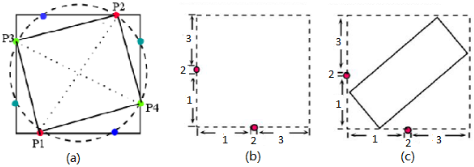
Dealing with general rectangles (GR), i.e., rectangles with any angle, is much harder than dealing with standard MBRs. This becomes obvious when looking at the domain of GRs and how they relate to the domain of MBRs: For each MBR there are infinitly many GRs. Given an MBR M, we can obtain a GR m that is bounded by M, i.e., M is the MBR of m in the following way: 1. Take the centre point p of M and draw a circle c around p that either intersects all four edges or all four corners of M. We call c the auxiliary circle. Clearly there are infinitely many auxiliary circles for any given M. 2. We can now pick one of the two intersecting points at each edge and have to pick the diagonally opposite point of the opposite edge. Connecting these four points gives us a general rectangle, that is there are four different GRs for any M and for any c (see Fig.2(a)). If c intersects the four corners, there is only one GR, the MBR itself. Throughout the paper we use the lower case m to denote an arbitrary GSR and upper case M to represent the MBR of m. We call a GR that is equivalent to its MBR a regular rectangle and one that is different from its MBR an angular rectangle.
3.1 Unary Relations of General Rectangles
Our first task is to distinguish meaningful classes of general rectangles, that is, we decide which GRs can be clustered together and form an equivalence class with respect to these distinctions. Since this depends on the particular application for which we use GRs, we will define adjustable distinctions.
Some natural distinctions for GRs are whether they are leaning to the left or leaning to the right. This is particularly important for the Angry Birds case where we need to infer in which direction a block will most likely fall. A further interesting distinction is whether a rectangle is "slim" or "fat", that is its proportions. In order to make such distinction in arbitrary granularity, we introduce Qualitative Corner Instantiations (QCI) that classify GRs according to how their corners relate to their corresponding MBRs, as described above. We make the following observations:
- Given an MBR M and an auxiliary circle c. Selecting an intersection point on the bottom edge of M and one on the left edge of M uniquely defines a GR m.
- There are always two intersections per edge unless the intersection is at the center of an edge.
We can now select a positive integer k and partition each edge of M into 2k intervals of equal length. These 2k intervals, together with 2k-1 points separating the intervals form 4k-1 qualitative regions (see Fig.2(b) for k = 1). We number these regions consecutively from left to right, and from bottom to top. Region 2k always refers to the center point of each edge. For each edge of M we can specify the qualitative regions that c intersects. Since a GR is uniquely identified by the intersection point we pick on the bottom and the left edges of M, we define QCI as the pair of qualitative regions on the bottom and left edges of M that contain the corners of m. Therefore, QCIk(m) = {(b, l)|1 ≤ b, l ≤ 4k - 1} is a set of unary relations over general rectangles m ∈ GR, where b is the qualitative region on the bottom edge of M and l the qualitative region on the left edge of M. The k denotes how many distinctions we make between the start and the center of each edge of M. Overall there are (4k - 1)2 + 1 atomic unary relations, each combination of the 4k - 1 qualitative regions plus the regular rectangle.
This unary relation allows us to classify GRs. However, if we have a given MBR and we want to explicitly talk about GRs wrt. the given MBR, then we need a new notation. We call this an extended MBR or eMBR and write it as M (i,j) , i, j ∈ {1...4k-1}, where (i, j) corresponds to the unary QCI relation that the general rectangle inM must satisfy. Fig.2(c) shows a possible instantiation of the eMBRM (1,1) .
3.2 Binary Relations between GSRs
We now look at meaningful binary relations between general rectangles. For unary relations it does not make a difference if we consider GRs or GSRs. For binary relations it makes a significant difference as we would need to consider all cases where the GRs overlap. Here, we will only consider binary relations between GSRs as this is what is required for solving our application problem and defer binary relations between GRs to future work.
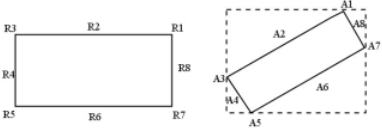
Similar to existing qualitative representations for MBRs, we could define binary qualitative relations between GSRs based on direction, size, or topology. However, we want to develop a representation that is useful for solving the QualGSR problem we defined above. For this we need a more expressive representation that allows us to distinguish if and how two GSRs contact each other, as this allows inferences about the stability of structures. We will focus on different ways of contact and distinguish sectors of GSRs where they can contact each other. These contact sectors correspond to the eight edges and corners of the rectangles and we distinguish between regular and angular GSRs as shown in Fig. 3. We denote them as Ai for angular and Ri for regular GSRs, where i is from 1 to 8 starting at the top right corner in anticlockwise direction. A∗ and R∗ refers to an arbitrary contact sector. For a given GSR m, we write m.Ai as the corresponding sector Ai of m.
When two GSRs m1 and m2 touch each other, then they either touch at a point or along a line segment. This contact will be equal to or part of a contact sector of m1 and a contact sector of m2. Hence, we can write the contact relation between m1 and m2 as the constraints m1(CS1,CS2)m2, where CS1,CS2 ∈ {∅,R1, . . . ,R8,A1, . . . ,A8} are the contact sectors of m1 and m2 where they touch. If they do not touch we use ∅. All contact relations are obviously converse, e.g., the converse of (A2,R5) is (R5,A2). While there are (8 + 8)2 + 1 = 257 different combinations of contact sectors, many of these combinations are not valid for GSRs. For example (R1,R1) is clearly invalid for solid rectangles. Proving which combinations are valid and which ones are not is relatively straightforward. We sketch some of the proofs.
Proposition 1. (A1,A1) is not a valid contact relation.
Proof. Assume the relation m1(A1,A1)m2 holds, i.e., m1.A1 and m2.A1 share the same coordinate. m1.A2 and m1.A8 form a 90 degrees angle and so do m2.A2 and m2.A8. Since m1 and m2 do not overlap, but share their top-most point A1, the angle between m1.A8 and m2.A2 and the angle between m2.A8 and m1.A2 must add up to 180 degrees, and therefore each angle is less than 180 degrees. This means that m1.A1 or m2.A1 cannot be the top-most point of its rectangle, which contradicts the definition of A1.
Proposition 2. (A1,A2) is not a valid contact relation.
Proof. We can reduce this to the (A1,A1) case. Assume m1.A1 touches m2.A2 at point p. We can now generate a GSR m3 with the three corner points p, m2.A3, m2.A5 which is a sub-rectangle of m2. However, m3 and m1 are in relation (A1,A1) which is invalid and contradicts our assumption.
We can use similar proofs for the remaining invalid cases, while we can give example GSRs for the valid contact relations. In total there are 73 valid contact relations: |(A∗, A∗)| + |(A∗, R∗)| ∗ 2 + |(R∗, R∗)| + |(∅, ∅)| = 32 + 16 ∗ 2 + 8 + 1 = 73.
Theorem 3. There are 73 atomic contact relations for GSRs.
3.3 The GSR-n Algebra
We can finally define our new algebra for general solid rectangles. It consists of 73 atomic contact relations, plus n = (4k-1)2 +1 unary relations. Since only the number of unary relation varies, this is what determines the granularity of the algebra. For k = 1 we get 10 different categories of GSRs and hence call the algebra GSR-10.
4 Solving the QualGSR problem
We now use the algebra defined above to solve the QualGSR(Θ,GSR-10) problem, for a given set of MBRs Θ. This problem occurs, for example, when developing an Angry Birds AI agent. The computer vision system provided for the Angry Birds AI competition [AI12, 2012; AIBirds, 2013] can only detect MBRs, while the actual objects are GSRs. Our task is to find for each MBR M ∈ Θ a contained GSR m such that (1) the GSRs do not overlap, and (2) the GSRs are stable under downward gravity. Strictly speaking, M must be an eMBR, which is a fixed MBR with known coordinates (see Section 3.1).
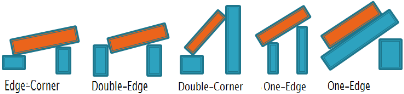
Stability depends on a number of factors such as friction or mass [Blum et al., 1970], and we use the stability conditions that we observed in the Angry Birds game (which are slightly different from real physics). We observed four cases when a GSR is stable and remains static, which depend on how it is supported. The four kinds of support are Edge-Corner, Double-Edge, Double-Corner, One-Edge. Figure 4 shows some examples for each of the supports. They are named by the type of contact sectors which support the GSR. E.g. Edge-Corner means the GSR is supported through one of its edges and one corner.
4.1 Approximating Stability using GSR-10
We now illustrate how the stable configurations can be expressed qualitatively using GR-10 relations. We use EdgeCorner support for GSRs as an example. Under downwards gravity, eMBRs can be classified into three groups.
- M AL contains all the eMBRs whose GSRs will fall to the left if there is only one support at A5. Specifically, M AL = {M (3,3) , M (1,3) , M (2,3) , M (3,2)}
- M AR contains all the eMBRs whose GSRs will fall to the right if there is only one support at A5. Specifically, M AR = {M (1,1) , M (3,1) , M (2,1) , M (1,2)}
- M AN contains all the eMBRs whose GSRs is stable if there is only one support at A5. M AN = M (2,2)
There are several sub-configurations of the Edge-Corner support. For a binary relation written in the form of (Ai, ∗), the asterisk refers to any sector. The following are five conditions, satisfying any of them implies the existence of the Edge-Corner support:
- ∃M AL 1 ∃M ∗ 2 : M AL 1 (A4, ∗)M ∗ 2 ∧∃M ∗ 3 M AL 1 (A5, ∗)M ∗ 3
- ∃M AL 1 ∃M ∗ 2 : M AL 1 (A3, ∗)M ∗ 2 ∧∃M ∗ 3 M AL 1 (A6, ∗)M ∗ 3
- ∃M AR 1 ∃M ∗ 2 : M AR 1 (A5, ∗)M ∗ 2 ∧∃M ∗ 3 M AR 1 (A6, ∗)M ∗ 3
- ∃M AR 1 ∃M ∗ 2 : M AR 1 (A4, ∗)M ∗ 2 ∧∃M ∗ 3 M AR 1 (A7, ∗)M ∗ 3
- ∃M AN 1 , ∃M ∗ 2 : M AN 1 (A5, ∗)M ∗ 2
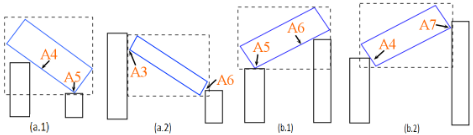
Rule 1 and 2 (Figure 5.a) state that an angular rectangle that tends to fall to the left has Edge-Corner support if it has at least one contact in A4 and one contact in A5 , or A3 and A6. Rule 3 and 4 (Figure 5.b) state that an angular rectangle that tends to fall to the right has Edge-Corner support if it has at least one contact in A5 and one in A6 , or A4 and A7 .
4.2 Locally Consistent Instantiations
In the previous section, some rules were given to verify the stability of GSRs under gravity. The rules are binary constraints between eMBRs. We now show an approach of evaluating such binary constraints. Specifically, given two eMBR instances and a binary relation, we need to determine whether the two instances can satisfy the binary relation. We introduce the Min-Max Procedure to determine the possible binary relations between an arbitrary pair of eMBR instances.
Critical Instantiations
Given an eMBR instance, there is an infinite number of possible GSRs. Among those are two critical instantiations:
The maximum instantiation of an eMBR is the GSR with maximum size. The minimum instantiation of an eMBR is the GSR with minimum size. When the GSR is a regular rectangle, both critical instantiations are the same.
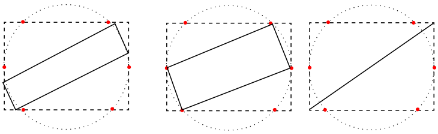
The two critical instantiations can be obtained with the help of the auxiliary circle c (see section 3). Firstly, we need to find out the auxiliary circle with the minimum radius that intersects the four edges of the eMBR. Now every corner of a valid GSR must be located between a corner of the eMBR and the point where c intersects. This not only limits the possible unary relations of a GSR, but also limits the critical instantiations. The maximum instantiation is an area connecting either four intersections according the QCI1 of the eMBR or the four corners . For example, if the eMBR is M (1,1) , then the maximum instantiation can be outlined by the two bottom left and the two up right intersections (see Figure 6). The minimum instantiation is a diagonal from the bottom left to the top right
Maximal and Minimal Effort
Because the instantiations of an eMBR instance can vary from a line segment to a large rectangle and the contact between two arbitrary eMBRs depends on the actual instantiations, it can be observed that whether the two eMBRs can contact depends on the efforts made by the eMBRs on their corresponding instantiations. If both eMBRs make minimum efforts, then the instantiations are likely to be two general rectangles that are disjoint from each other while if both try their best effort to contact each other, then the instantiations might be two general rectangles that are intersecting.
Let M (i,j) , i, j ∈ {1..3} be an arbitrary eMBR instance and CS1 ∈ {∅,R1 . . .R8,A1 . . .A8} be a contact sector of M (i,j) . Emax (M (i,j) ,CS1) denotes an area where M (i,j) makes maximal effort to contact any other GSRs with CS1. If the Emax cannot contact any other GSRs, then there will be no instantiations of the M (i,j) can achieve the contact. In the sequel, Emin (M (i,j) ,CS1) refers to the corresponding area where the minimum effort is made. If the Emin can contact an arbitrary GSR, then all instantiations of the M (i,j) can achieve the contact via the specified sector. The maximal and minimal effort of an eMBR instance depends on the critical instantiations of the eMBR.
Min-Max Evaluation
Given an arbitrary pair of eMBRs, to determine whether a specific binary relation holds between them, the QCI1 information together with their bounding rectangles should be taken into considerations. The Min-Max evaluation can perform this task effectively. For a binary constraint to hold, the following requirements should be satisfied:
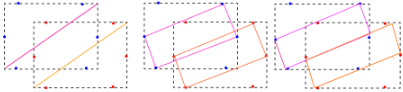
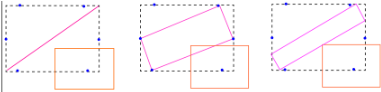
- the maximum efforts of the two eMBRs in the constraint must be intersecting. We call it maximum-maximum case, otherwise maximum-maximum failure
- the minimum efforts of the two eMBRs in the constraint must be disjoint, it is the minimum-minimum case, otherwise minimum-minimum failure
The minimum-minimum failures indicates that no matter how the GSRs are instantiated over the two eMBRs, they will be always penetrating each other. In the sequel, the maximummaximum failures indicates that the contact specified by the binary relation can never be achieved between the two eMBRs. The only way that may solve these failure is to change the unary relations of the eMBRs.
The following are two examples of the min-max evaluation on the constraint M (1,1) 1 (A6,A2)M (1,1) 2 (see Figure 7) and the constraint M (1,1) 1 (A6,R3)M2(see Figure 8)
4.3 Consistent Instantiations
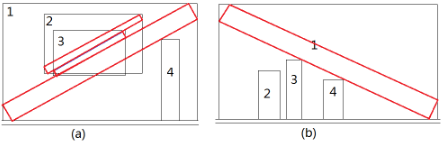
In the previous section, we have shown a local procedure, min-max, for inferring possible pair-wise contacts. To approximate consistency for the whole configuration, we can compute path-consistency, which is a standard method in qualitative reasoning. Figure 9.a shows an example where path-consistency can be checked by weak composition of GR-10 relations. The min-max algorithm returns M (1,1) 1 (A6,A2)M (1,1) 2 ,M 1,1 2 (A6,A2)M (1,1) 3 , and M (1,1) 1 (A6,A2)M (1,1) 3 as one possibility. But this is clearly identified as inconsistent by the path-consistency algorithm because (A6, A2) ∩ ((A6, A2) ◦ (A6, A2)) = ∅. Another possibility returned by min-max is path-consistent and also consistent, as can been seen in red in Figure 9.a. Figure 9.b shows a case where verifying path-consistency requires actual coordinates. In a pair-wise consistent configuration, the boxes with IDs 2, 3, 4 are instantiated as regular rectangles and the big rectangle is instantiated as a GSR that leans to the left, written as M (1,3) . To achieve a consistent scenario, we need to evaluate the heights of the MBRs to determine which subset of the regular rectangles can touch the angular rectangle at the same time. A detection of inconsistency indicates that the vision software makes mistakes because static Angry Birds scenarios should always be consistent.
4.4 AMethod for Solving QualGSR
We propose a method that utilizes GR-10 and all the techniques we mentioned above to identify a stable set of GSRs for a given set of MBRs. Our method first randomly assigns a unique ID for each input MBR. Each MBR maintains a list of its neighbors. The neighbors of a MBR are all other MBRs that intersect or boundary touch the MBR. AMBR is initialized when it has been given a GSR-10 unary relation, which creates an eMBR instance (see Alg.1 line 22). Our method will backtrack by picking up the MBR with the lowest ID from the remaining uninitialized MBRs (see Alg.1 line 19), create an eMBR instance on it, and get possible contacts by performing the min-max check (see Alg.1 line 23) between the eMBR and its initialized neighbors pair-wisely. Branch pruning (see Alg.1 line 26) happens when the algorithm detects that an eMBR cannot be stable when all its neighbors have been initialized. The algorithm will terminate when it finishes a branch where all the MBRs are initialized and stable under valid contacts. To approximate consistency, we used the aforementioned height evaluation and similar approximations (see Section 4.3). This method is exponential in the number of GSRs. But different heuristics can be used to improve the efficiency of our method. For example we can identify cases where a GSR must be an angular rectangle.
4.5 Evaluation in the Angry Birds Context
We implemented our method and applied it to the Angry Birds game where the current computer vision software used for the Angry Birds AI competition can only detect MBRs. Figure 1.a shows a typical Angry Birds level. Clearly, many objects in the level are GSRs. Figure 1.b illustrates a set of corresponding MBRs. In this example, it takes 0.854s (on a CORE i7 with 8GB RAM) for the algorithm to compute a stable scenario using GSRs and the result matches the real scenario. We obtained similar results (see Table.1) for other levels, that is, our method can be used to obtain an accurate representation of a game level that can then be used to analyse its structural properties.
5 Conclusion
In this paper we presented the first qualitative representation of angled rectangles that cannot penetrate each other, so called general solid rectangles (GSR). GSRs are frequently used in computer-generated images such as computer games. We used this representation to solve a practical problem that occurs when we use computer vision to extract GSRs from computer-generated images, but vision can only detect MBRs. We presented a method that can compute GSRs even under the condition that all obtained GSRs must be stable under gravity. This problem is particularly challenging as it requires us to combine qualitative and quantitative spatial information in a way that has not been done before. We tested our method for the popular Angry Birds game and showed that we can extract stable GSRs accurately and reasonably fast.
| Level | Total GSRs | Total Angular GSRs | Time(secs) |
|---|---|---|---|
| 4 | 12 | 2 | 0.249 |
| 5∗ | 22 | 16 | 0.854 |
| 6∗ | 15 | 3 | 0.278 |
| 11∗ | 17 | 4 | 0.317 |
| 13∗ | 24 | 9 | 0.444 |
| 15∗ | 27 | 6 | 0.404 |
| 16∗ | 17 | 6 | 0.286 |
| 18 | 20 | 10 | 0.522 |
Algorithm 1 The Stability Approximation algorithm
1: procedure STABILITYAPPROXIMATION(mbrs) 2: candidates ← {}, id ← 0 3: for mbr ∈ mbrs do 4: id ← id + 1, add (mbr, id) to candidates 5: end for 6: SEARCH(candidates) 7: end procedure 8: procedure SEARCH(candidates) 9: if all mbrs in candidates are initialized and stable then print the result, return true 10: else 11: allCandidates ← REFINE(candidates) 12: for candidates ∈ allCandidates do 13: if SEARCH(candidates) then return true 14: end if 15: end for 16: end if 17: end procedure 18: procedure REFINE(candidates) 19: Set allCandidates, (mbr, id) ← candidates.pop() 20: for unary ∈ GR unary relations do 21: contacts ← (neighbors, {}) 22: embr ← (mbr, id, unary, contacts)- 23: For each neighbor, perform the min-max check with the embr to get the set of possible contacts. Perform consistency approximations. Generate all combinations of contacts by picking up one contact from each contact set.
24:
for contacts ∈ all combinations do
25:
apply contacts on embr and its neighbors
26:
if branch pruning happens then continue
- 27: else copy the candidates list, in the new list update embr's contacts and its neighbors' accordingly, add the new list to allCandidates.
28: end if 29: end for 30: end for 31: return allCandidates 32: end procedure@inproceedings{ijcai2013p139,
title = {Representation and Reasoning about General Solid Rectangles},
author = {Ge, Xiaoyu and Renz, Jochen},
booktitle = {Proceedings of the Twenty-Third International Joint Conference on
Artificial Intelligence, {IJCAI-13}},
publisher = {AAAI Press / International Joint Conferences on Artificial Intelligence},
editor = {Francesca Rossi},
pages = {905--910},
year = {2013},
month = {8},
url = {https://ijcai.org/proceedings/2013/139},
}
TY - CPAPER TI - Representation and Reasoning about General Solid Rectangles AU - Ge, Xiaoyu AU - Renz, Jochen T2 - Proceedings of the Twenty-Third International Joint Conference on Artificial Intelligence, IJCAI-13 PB - AAAI Press / International Joint Conferences on Artificial Intelligence PY - 2013 SP - 905 EP - 910 UR - https://ijcai.org/proceedings/2013/139 ER -Copied
Machine-readable versions of this paper, for tools and AI agents:





