
Input Parameter Calibration in Forest Fire Spread Prediction: Taking the Intelligent Way
Proceedings of the Twenty-Second International Joint Conference on Artificial Intelligence. Pages 2862-2862.
https://doi.org/10.5591/978-1-57735-516-8/IJCAI11-503
© 2011 International Joint Conferences on Artificial Intelligence
Abstract
Imprecision and uncertainty in the large number of input parameters are serious problems in forest fire behaviour modelling. To obtain more reliable forecasts, fast and efficient computational input parameter estimation and calibration mechanisms should be integrated. These have to respect hard real-time constraints of simulations to prevent tragedy. We propose an Evolutionary Intelligent System (EIS) for parameter calibration. Depending on disaster size, required parameter precision, and available computing resources, the hybridisation of an evolutionary algorithm (EA) with an intelligent paradigm (IP) can be configured. Experiments show that EIS generates comparable estimations to standard evolutionary calibration approaches, clearly outperforming the latter in runtime.
- [Abdalhaq et al., 2004] Baker Abdalhaq, Ana Cortés, Tomàs Margalef, and Emilio Luque. Accelerating optimization of input parameters in wildland fire simulation. In Par- allel Processing and Applied Mathematics -PPAM 2003, LNCS, pages 1067-1074. Springer-Verlag, Heidelberg, 2004.
- [Abraham et al., 2008] A. Abraham, C. Grosan, and W. Prdrycz, editors. Engineering Evolutionary Intelli- gent Systems, volume 82 of Studies in Computational Intelligence. Springer-Verlag, Heidelberg, Germany, 2008.
- [Annan and Hargreaves, 2007] J. D. Annan and J. C. Har- greaves. Efficient estimation and ensemble generation in climate modelling. Philosophical Transactions of the Royal Society A: Mathematical, Physical and Engineering Sciences, 365(1857):2077-2088, 2007.
- [Denham et al., 2008] Mónica Denham, Ana Cortés, Tomàs Margalef, and Emilio Luque. Applying a dynamic data driven genetic algorithm to improve forest fire spread pre- diction. In Computational Science -ICCS 2008, LNCS, pages 36-45. Springer-Verlag, Heidelberg, 2008.
- [Rothermel, 1972] Richard C. Rothermel. A mathematical model for predicting fire spread in wildland fuels. Forest Service Research Paper INT-115, U.S. Dept. of Agricul- ture, Ogden, UT, 1972.
- [Wang, 1997] Q. J. Wang. Using genetic algorithms to opti- mise model parameters. Environmental Modelling & Soft- ware, 12(1):27-34, 1997.
- [Wendt et al., 2010a] Kerstin Wendt, Ana Cortés, and Tomàs Margalef. Evolutionary intelligent system for input pa- rameter optimisation in environmental modelling: A case study in forest fire forecasting. In Evolutionary Compu- tation (CEC), 2010 IEEE Congress on, pages 2292-2298, 2010.
- [Wendt et al., 2010b] Kerstin Wendt, Ana Cortés, and Tomàs Margalef. Knowledge-guided genetic algorithm for input parameter optimisation in environmental modelling. Pro- cedia Computer Science, 1(1):1367-1375, 2010. ICCS 2010.
References were extracted automatically from the PDF and may contain errors.
Full text extracted automatically from the PDF; figures, tables and equations may differ. The PDF is the version of record.
1 Introduction
Predicting wildfire behaviour is an art - as much as it is a science. Forest fires are a serious threat to humans and nature from an ecological, social end economic point of view and false and unreliable forecasts may lead to tragedy. The best strategies are needed to quickly and efficiently extinguish an ongoing fire in order to minimise its destructive effects. Wildfire behaviour and growth models are a key component of decision support systems (DSS) in fire event management to predict the fire front for a given time in the near future. Especially computer modelling and simulation tools are used. These are computationally very demanding and require high performance computing (HPC) resources to fulfil stringent real-time constraints such that simulations can be of use during an ongoing event.
Imprecision and uncertainty in the normally large number of input parameters are known and serious problems in fire behaviour modelling and lead to unreliable propagation predictions. Recent advances in measurement technologies and remote sensing remove part of this uncertainty, but installation and maintenance of sufficient sensors remain expensive and are a fundamental hindrance in large areas difficult to access. Furthermore, simulators mainly work with a static set of input parameters not considering changes in parameter values over time. Fewest tools present abilities for real-time data assimilation of altered meteorological data during a running simulation. What is more, the correct or real parameter value set might not result in the best overall simulation output as explained in [Annan and Hargreaves, 2007].
These observations clearly demonstrate the need to embed a computational input parameter calibration system in forest fire behaviour modellers. Proposed methods using standard numerical optimisation techniques are not fully capable of handling high dimensionality, nonlinearity, and irregularities contained in environmental models as mentioned by [Wang, 1997]. Bayesian and stochastic calibration methods generally deliver good results, but are numerically too intensive. They still present shortcomings when applied to real-time problems due to time-consuming evaluation functions, even when making use of parallel and distributed computing. This is why we propose an Evolutionary Intelligent System (EIS) for parame-
∗This research has been supported by the MICINN Spain under contract TIN 2007-64974.
Input Parameter Calibration in Forest Fire Spread Prediction: Taking the Intelligent Way∗
Kerstin Wendt and Ana Cort´es
Departament d'Arquitectura de Computadors i Sistemes Operatius, Escola d'Enginyeria, Universitat Aut `onoma de Barcelona, 08193 Bellaterra (Barcelona), Espa˜na
kerstin.wendt@caos.uab.es
ter calibration. Depending on disaster size, required parameter precision, and available computing resources, the hybridisation of an evolutionary algorithm (EA) with an intelligent paradigm (IP) can be configured to accomplish parameter estimation in a real-time prediction.
2 Completed Research
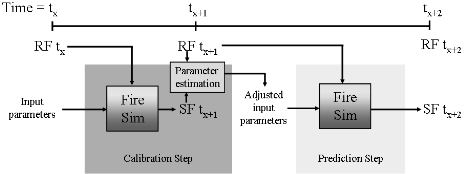
Most wildfire behaviour and spread simulators are based on the Rothermel equation model [Rothermel, 1972] and traditionally work with a set of input parameters, which describe the environmental conditions of the region where the fire takes place including vegetational, climatological and topographical characteristics. Many of the required input parameters are highly dynamic and subject to frequent spatiotemporal changes in the microclimate generated by a fire. Where parameter values cannot be obtained by measurements, fire simulators can rely on input parameter calibration methods to produce more reliable spread predictions. To enable realtime calibration of model input parameters in each time step during an ongoing prediction, the simulator independent twostage prediction scheme shown in Figure 1 was proposed by [Abdalhaq et al., 2004]. The objective is to solve an inverse problem: Find a parameter configuration such that, given this configuration as input, the model output matches real disaster behaviour. Having detected the simulator input that describes best current environmental conditions, the same values, it is argued, could also be used to describe best the immediate future assuming stable meteorological conditions during the following prediction interval.
In recent years it proved of value in various areas to opt for hybrid evolutionary approaches to improve performance and solution quality of standard evolutionary computation techniques. In particular, the guidance of Genetic Algorithms (GA) with problem-specific knowledge during mutation operation showed significant potential. EIS offer a framework for the performance optimisation of EA with the help of an IP (e.g. neural network, fuzzy inference system). They provide attractive tools in solving large-scale and complex real-world problems and are able to handle complexity, imprecision, uncertainty, and vagueness [Abraham et al., 2008]. The architecture of our proposed EIS can be found in Figure 2. An IP is used to speed up GA execution time by guiding the GA towards promising regions in the search space. In case of very limited computing resources, the IP can be applied independently with enormously reduced runtime to generate adjusted input parameters.
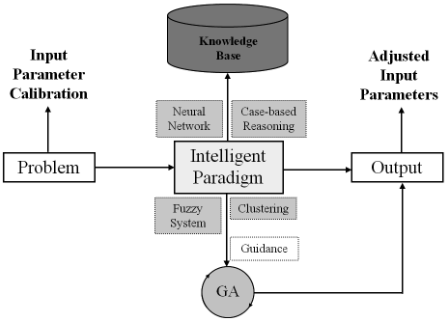
Our research work is based on the dynamic data driven genetic algorithm introduced by [Denham et al., 2008]. In [Wendt et al., 2010b] we elaborated a knowledge base (KB) containing information about historical real fires and synthetical simulated fires where input parameter values are stored together with their corresponding simulator output parameters. Before each prediction step, current fire spread behaviour is obtained from the latest real fire map. This information is used to query the KB. A k-Nearest Neighbour (k-NN) classifier encounters forest fires that performed the most similar compared to the ongoing event and returns their values of highly dynamic input parameters (wind characteristics) to guide the GA. Therefore, we elaborated a weighted heterogeneous distance measure. The embedding of the clustering module as IP into the EIS including its individual delivery of calibrated input parameters with a clearly reduced runtime compared to the guided GA was described in [Wendt et al., 2010a].
3 OngoingWork
Ongoing work comprises the integration of a further IP into the EIS. We will show how a case-based reasoning (CBR) system is able to guide the GA. More importantly, the CBR
module provides separate parameter calibrations of promising quality with a notably decreased runtime. We are also testing our approach with large real cases to prove the benefit and applicability of the suggested system. As we claim our calibration approach to be simulator independent, experiments with additional fire simulators are in progress and we will consider the application in a different field of natural catastrophes, e.g. flood inundation modelling, tropical thunderstorm track prediction.
In summary, all introduced methods were able to generate input parameters and prediction results with similar quality compared to standard evolutionary calibration approaches but with significant runtime savings. Thus, our techniques enable real-time parameter adjustments, particularly in case of largescale disasters, high-resolution prediction maps or when only limited parallel computing resources are available.
@inproceedings{ijcai2011p503,
  title     = {Input Parameter Calibration in Forest Fire Spread Prediction: Taking the Intelligent Way},
  author    = {Wendt, Kerstin and Cortés, Ana},
  booktitle = {Proceedings of the Twenty-Second International Joint Conference on
               Artificial Intelligence, {IJCAI-11}},
  publisher = {AAAI Press/International Joint Conferences on Artificial Intelligence},
  editor    = {Toby Walsh},
  pages     = {2862--2862},
  year      = {2011},
  month     = {7},
  doi       = {10.5591/978-1-57735-516-8/IJCAI11-503},
  url       = {https://doi.org/10.5591/978-1-57735-516-8/IJCAI11-503},
}
TY - CPAPER TI - Input Parameter Calibration in Forest Fire Spread Prediction: Taking the Intelligent Way AU - Wendt, Kerstin AU - Cortés, Ana T2 - Proceedings of the Twenty-Second International Joint Conference on Artificial Intelligence, IJCAI-11 PB - AAAI Press/International Joint Conferences on Artificial Intelligence PY - 2011 SP - 2862 EP - 2862 DO - 10.5591/978-1-57735-516-8/IJCAI11-503 UR - https://doi.org/10.5591/978-1-57735-516-8/IJCAI11-503 ER -Copied
Machine-readable versions of this paper, for tools and AI agents:





