
Exploring Protein Fragment Assembly Using CLP
Proceedings of the Twenty-Second International Joint Conference on Artificial Intelligence. Pages 2590-2594.
https://doi.org/10.5591/978-1-57735-516-8/IJCAI11-431
© 2011 International Joint Conferences on Artificial Intelligence
Abstract
The paper investigates a novel approach, based on Constraint Logic Programming (CLP), to predict potential 3D conformations of a protein via fragments assembly. The fragments are extracted and clustered by a preprocessor from a database of known protein structures. Assembling fragments into a complete conformation is modeled as a constraint satisfaction problem solved using CLP. The approach makes use of a simplified CA-side chain centroid protein model, that offers efficiency and a good approximation for space filling. The approach adapts existing energy models for protein representation and applies a large neighboring search (LNS) strategy. The results show the feasibility and efficiency of the method, and the declarative nature of the approach simplifies the introduction of additional knowledge and variations of the model.
- [Berrera et al., 2003] Marco Berrera, Henriette Molinari, and Federico Fogolari. Amino acid empirical contact en- ergy definitions for fold recognition in the space of contact maps. BMC Bioinformatics, 4:8, 2003.
- [Dal Palù et al., 2004] A. Dal Palù, A. Dovier, and F. Fogo- lari. Constraint logic programming approach to protein structure prediction. BMC Bioinformatics, 5:186, 2004.
- [Dal Palù et al., 2009] A. Dal Palù, A. Dovier, and E. Pon- telli. Logic programming techniques in protein structure determination: Methodologies and results. In Proc. of LPNMR 2009, volume 5753 of LNCS, pages 560-566. Springer, 2009.
- [Dal Palù et al., 2010a] A. Dal Palù, A. Dovier, F. Fogolari, and E. Pontelli. CLP-based protein fragment assembly. TPLP, 10(4-6):709-724, 2010.
- [Dal Palù et al., 2010b] A. Dal Palù, A. Dovier, and E. Pon- telli. Computing approximate solutions of the protein structure determination problem using global constraints on discrete crystal lattices. Int. J. Data Min. Bioinformat- ics, 4(1):1-20, 2010.
- [Fogolari et al., 2007] F. Fogolari, L. Pieri, A. Dovier, L. Bortolussi, G. Giugliarelli, A. Corazza, G. Esposito, and P. Viglino. Scoring predictive models using a reduced representation of proteins: model and energy definition. BMC Structural Biology, 7(15), 2007.
- [Hoang et al., 2004] T. X. Hoang, A. Trovato, F. Seno, J. R. Banavar, and A. Maritan. Geometry and symmetry presculpt the free-energy landscape of proteins. PNAS, 101(21):7960-7964, 2004.
- [Lovell et al., 2003] S. Lovell, I. Davis, W. Arendall, P. de Bakker, J. Word, M. Prisant, J. Richardson, and D. Richardson. Structure validation by c α geometry: φ, ψ and c β deviation. Proteins, 50:437-450, 2003.
- [Raman et al., 2009] S. Raman R. Vernon, J. Thompson, M. Tyka, R. Sadreyev, J. Pei, D. Kim, E. Kellogg, F. Di- Maio, O. Lange, L. Kinch, W Sheffler, B.-H. Kim, R. Das, N. V. Grishin, and D. Baker. Structure prediction for casp8 with all-atom refinement using rosetta. Proteins, 77(S9):89-99, 2009.
- [Shaw, 1998] P. Shaw. Using constraint programming and local search methods to solve vehicle routing problems. In CP '98: Proceedings of the 14th international conference on Principles and Practice of Constraint Programming, volume 1520 of LNCS, pages 417-431. Springer, 1998.
- [Zemla, 2003] A. Zemla. LGA: A method for finding 3D similarities in protein structures. Nucleic acids research, 31(13):3370-3374, 2003.
- [Zhang, 2008] Y. Zhang. Progress and challenges in protein structure prediction. Current Opinion in Structural Biol- ogy, 18:342348, 2008.
References were extracted automatically from the PDF and may contain errors.
Full text extracted automatically from the PDF; figures, tables and equations may differ. The PDF is the version of record.
1 Introduction
Proteins are central components in the way they control and execute the vital functions in living organisms. The functions of a protein are directly related to its peculiar 3D conformation, known as the native conformation or tertiary structure. Such conformation determines how the protein can interact with other molecules and affect the functions of the hosting organism. DNA genes determine uniquely the sequence of elements (amino acids) composing a protein. As a result of advances in DNA sequencing techniques, there is a growing number of protein amino acids sequences (a.k.a. primary structures) of proteins, available in public databases (e.g., UniProtKB/TrEMBL contains more than 13,000,000 protein sequences). On the other hand, knowledge of structural information (e.g., tertiary structures) is lagging behind, with a much smaller number of structures deposited in public databases-e.g., 70, 000 of them are stored in the Protein Data Bank (PDB), www.pdb.org.
For these reasons, one of the most traditional and central problems addressed by research in bioinformatics deals with the protein structure prediction (PSP) problem, i.e., the problem of using computational methods to determine the native conformation of a protein starting from its primary sequence. Several approaches have been explored to address this prob- Enrico Pontelli New Mexico State University Las Cruces, NM USA
epontell@cs.nmsu.edu
lem that we do not investigate here for space limit-see e.g., [Zhang, 2008; Dal Pal`u et al., 2009] for a survey. Some of the most successful approaches to protein folding build on the principle of using substructures. The intuition is that, while the complete folding of a protein may be unknown, it is likely that all possible substructures, if properly chosen, can be found among proteins whose conformations are known. The folding can then be constructed by exploiting relationships among substructures. A notable example of this approach is represented by Rosetta [Raman et al., 2009]-an ab initio protein structure prediction method that uses simulated annealing search to compose a conformation, by assembling substructures extracted from a fragment library; the library is obtained from observed structures stored in the PDB.
In this work, we follow a similar idea, by developing a database of amino acid chains of length 4; these are clustered according to similarity, and their frequencies are drawn from the investigation of a relevant section of the PDB. The database contains the data needed to solve the protein folding problem via fragments assembly. Declarative programming techniques are used to enable rapid prototyping and to generate modular code. Moreover, the problem of assembling substructures is efficiently tackled using the constraint solving techniques provided by CLP on finite domains. This paper has the goal of showing that our approach is feasible. The main advantage, w.r.t. a highly engineered and imperative tool, is the modularity of the constraint system, which offers a convenient framework to test and integrate statistical data from various predictors and databases. Moreover, the constrained search technique itself represents a novel method, compared to popular predictors, and we show its effectiveness in combination with the development of new energy functions and heuristics. The proposed solution includes a general implementation of LNS in CLP, that turned out to be highly effective for the problem at hand. Another contribution is the development of a new energy function based on three components: a contact potential for backbone and side chain centroids interaction, an energy component for backbone conformational preferences, and a component that keeps track of mutual orientation of spatially close fragments.
2 Protein Abstraction
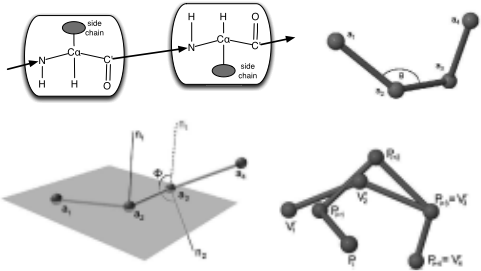
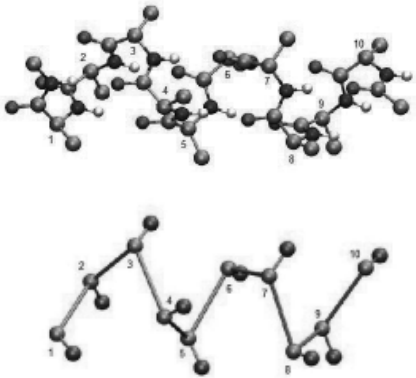
Preliminary notions. We focus on proteins described as sequences of amino acids selected from a set A of the 20 naturally occurring ones. In turn, each amino acid is composed of a set of atoms that constitute the amino acid's backbone (see Fig. 1(a)) and a set of atoms that differentiate amino acids, known as side chain. One of the most important structural properties is that two consecutive Cα atoms have an average distance of 3.8 ˚A. Side chains may contain from 1 to 18 atoms, depending on the amino acid. For computational purposes, instead of considering all atoms composing the protein, we consider a simplified model in which we are interested in the position of the Cα atoms (representing the backbone) and of particular points, known as the centroids of the side chains (Fig. 2). A natural choice for the centroid is the center of mass of the side chain.
It is important to mention that, once the positions of all the Cα atoms and of all the centroids are known, the structure of the protein is already sufficiently determined, i.e., the position of the remaining atoms can be identified almost deterministically with a reasonable accuracy.
Focusing on the backbone and on the Cα atoms, three consecutive amino acids define a bend angle (see θ in Fig. 1(b)). Consider now four consecutive amino acids a1, a2, a3, a4. The angle formed by n2 = (a4 - a3) × (a3 - a2) and n1 = (a3 - a2) × (a2 - a1) is called torsional angle (see φ in Fig. 1(c)). If these angles are known for all the consecutive 4-tuples forming a protein, they uniquely describe the 3D positions of all the Cα atoms of the protein.
Given a spatial conformation of a 4-tuple of consecutive Cα atoms, a small degree of freedom for the position of the side chain is allowed-leading to conformers commonly referred to as rotamers. To reduce the search space, we do not consider such variations. Once the positions of the Cα atoms are known, we deterministically add the positions of the centroids. In particular, the centroid of the i-th residue ( ˆ Ci) is constructed by using the positions of Cαi-1, Cαi and Cαi+1 as reference and by considering the average of the center of mass of the same amino acid type centroids, sampled from a non-redundant subset of the PDB. The parameters that uniquely determine its position are: the average Cαiˆ Ci distance, the average bend angle defined by ˆ Ci, Cαi, Cαi+1 and Cαi-1, Cαi, ˆ Ci, and the torsional angle defined by the 4tuple Cαi-1, Cαi, Cαi+1, ˆ Ci. Even with this simplification, the introduction of the centroids in the model allows us to better cope with the layout in the 3D space and to use a richer energy model. In Fig. 2, we report an example of this abstraction with a fragment with 10 alanine (ALA) amino acids. For these amino acids, the centroids coincide with the only heavy atom of each sidechain. This has been experimentally shown to produce more accurate results, without adding extra complexity w.r.t. a model that considers only the positions of the Cα atoms and without the use of centroids.
Clustering. Although more than 70,000 protein structures are present in the PDB, the complete set of known proteins contains too much redundancy (i.e., very similar proteins deposited in several variants) to be useful for statistical purposes. Therefore we focused on a subset of the PDB called top-500 [Lovell et al., 2003]. This set contains 500 proteins, with 107, 138 occurrences of amino acids. The number of different 4-tuples occurring in the set is precisely 62, 831. Since the number of possible 4-tuples of amino acids is |A|4 = 204 = 160, 000, this means that most 4-tuples do not appear in the selected set; even those that appear, they occur too rarely to provide significant statistical information. For this reason, we decided to cluster amino acids into 9 classes, according to the similarity of the torsional angles of the pseudo bond between two consecutive Cα atoms [Fogolari et al., 2007]. 1
Let γ : A -→ {0, . . . , 8} be the function assigning a class to each amino acid, for i ∈ {0, . . . , 8}, and γ-1 (i) = {a ∈ A : γ(a) = i}. In this work we use γ-1 (0) ={ALA},
1 Note that in reality there is no direct connection among consecutive Cαs, due to the presence of intermediate atoms-thus the pseudo bond between Cαs is a simplification introduced in our model.
γ-1 (1) ={LEU, MET}, γ-1 (2) ={ARG, GLU, GLN, LYS}, γ-1 (3) ={ASN, ASP, SER}, γ-1 (4) ={THR, PHE, HIS, TYR}, γ-1 (5) ={ILE, VAL, TRP}, γ-1 (6) ={CYS}, γ-1 (7) ={GLY}, γ-1 (8) ={PRO}. Using this scheme, the majority of the 94 = 6, 561 4-tuples have a representative in the set (precisely, there are templates for 5, 830 of them).
A second level of approximation is introduced by stating that two occurrences of the same 4-tuple in the set of structures have the "same" form when their Root Mean Square Deviation (rmsd) is ≤ rmsd thr (a given threshold, currently set to 1.0 ˚A).
The program tuple generator creates a set of Prolog facts of the form:
where [g1, g2, g3, g4] ∈ {0, . . . , 8}4 identifies the class of each amino acid, Xα 1 , . . . ,Z α 4 are the coordinates of the Cα atoms of the 4-tuple, FREQ ∈ {0, . . . , 1000} is a frequency factor of the template w.r.t. all occurrences of the 4-tuple g1, . . . , g4 in the set top-500, ID is a unique identifier for this fact, and PID is the first protein found containing this template; this last piece of information will be printed in the file produced as output of the computation, in order to allow one to recover the source of a fragment used for the prediction. Without loss of generality, tuple generator sets Xα 1 = Y α 1 = Z α 1 = 0.
For i = 2, 3, and for each amino acid a ∈ γ-1 (gi), we compute the position of the centroid corresponding to the positions Xα 1 , . . . ,Z α 4 of the Cα atoms, and add it to the gi-centroids list. Let us observe that we do not add the positions of the first and last centroids in the 4-tuples. As a result, at the end of the computation, only the centroids of the first and the last amino acid of the entire protein will be not set; these can be assigned using a straightforward postprocessing step.
It is unlikely that a 4-tuple a1, . . . , a4 that does not appear in the considered training set will occur in a real protein. Nevertheless, in order to handle these cases, if [γ(a1), . . . , γ(a4)] has no statistics associated to it, we map it to the special 4-tuple [-1, -1, -1, -1]. By default, we assign to this unknown tuple the set of the six most common templates among the set of all known templates. Other special 4-tuples are [-2, -2, -2, -2] and [-3, -3, -3, -3]; these are assigned to secondary structure elements (see Sect. 3).
We also introduce an additional collection of Prolog facts, based on the predicate next, which are used to relate pairs of tuple facts. The relation
holds if the triplet g2, g3, g4 in the tuple fact identified by ID1 is the same as the triplet g1, g2, g3 in the tuple fact ID2, and the rmsd between the corresponding Cα positions is at most rmsd thr. Mat is the rotation matrix to align the two sequences.
Statistical energy. The energy function used in this work builds on three components: (1) a contact potential for side chain and backbone contacts, (2) an energy component for each backbone conformation based on backbone conformational preferences observed in the database, and (3) a component that considers the relative orientation of spatially close triplets.
The first component uses the table of contact energies described in [Berrera et al., 2003], modified for the protein model adopted here. In the case of the side chain centroid, each centroid has a radius determined by the structure and mobility of its side chain. Thus, an energy contribution for a pair of side chain centroids is introduced when their distance is equal to the sum of their radii. Larger distances provide a contribution that decays quadratically with the distance.
The torsional angle defined by four consecutive Cα atoms is assigned an energy value defined by the potential of the mean force derived by the distribution of the corresponding torsional angle in the PDB. The procedure has been thoroughly described in [Fogolari et al., 2007].
The third energy component weighs the proper orientation of three consecutive amino acid fragments in order to form hydrogen bonds, following [Hoang et al., 2004]. This energy contribution is introduced when the distance between two three-amino acid fragments is less than 5.8 ˚A. Each fragment identifies a plane, and we are interested in those cases where the planes of the two fragments are almost co-planar and normal to the distance vector i.e., the absolute product of the cosines of the angles between the normals to the two planes among themselves and with the distance vector is greater than 0.5.
Since these components come from independent work, we have experimentally determined their relative weight. We collected some structures predicted by the system, compared against the corresponding known structure in terms of spatial error and energy. We found that the suitable coefficients that maximize the correlation are: 1 for the torsions, 0.4 for the contacts, and 2 for the orientations.
3 Modeling
We have modeled the problem of fragments assembly using constraints over finite domains. The input is a list Primary = [a1, . . . , an] of n amino acids. 2 A list Code of n - 3 variables is used. The i-th variable Ci of Code corresponds to the 4-tuple (γ(ai), γ(ai+1), γ(ai+2), γ(ai+3)) and its possible values are the IDs of the facts of the form:
This set is ordered using the frequency information Freq in decreasing order, and stored in a variable ListDomi.
The next information is used to impose constraints between Ci and Ci+1. Using the combinatorial constraint table, we allow only pairs of consecutive values supported by the next predicate. Recall that, for each allowed combination of values, the next predicate returns the rotation matrix Mi,i+1, which provides the relative rotation when the two fragments are best fit.
A list Tertiary with 6n variables is also used: Xα i , Y α i ,Z α i (resp., XC i , Y C i ,Z C i ) denoting the 3D position of the Cα atoms (resp., of the centroids). These variables have integer values (representing a precision of 10-2 ˚A).
2 We also allow PDB identifiers as inputs; in this case, the primary structure of the protein is retrieved from the PDB.
In order to correlate Code variables and Tertiary variables, consecutive 4-tuples must be constrained. Let us focus on the Cα part; consider two consecutive tuples: ti = ai, ai+1, ai+2, ai+3 (variable Ci), and ti+1 = ai+1, ai+2, ai+3, ai+4, (variable Ci+1). When ti is placed in the space, ti+1 needs to be rotated and translated in order to match the placement of ti. ti+1 is rotated (according to Mat in next) as to best overlap the points in common with ti, and it is translated so that the point ai+3 in ti+1 overlaps the last point of ti.
Let Xα i , Y α i ,Z α i , . . . ,Xα i+4 , Y α i+4 , Z α i+4 be the variables for the coordinates of these Cα atoms, stored in the list Tertiary (Fig. 1(d), where Pi = (Xα i , Y α i ,Z α i )). The constraint introduced rotates and translates the template ti+1 from the reference of Ci (represented by the orthonormal basis matrix Ri) according to the rotation matrix Mi,i+1 to the new reference Ri+1 = Ri × Mi,i+1. Moreover, when placing the template ti+1, the constraint affects only the coordinates of ai+4, since the other variables are assigned by the application of the same constraint for templates tj, j < i + 1. The constraint shifts the rotated version of ti+1 so that it overlaps the third point ⃗V3 with Pi+3. Formally, let ⃗V r k = Ri+1 × ⃗Vk, with k ∈ {1 . . . 4}, be the rotated 4-tuple corresponding to Ci+1. The shift vector ⃗s = Pi+3 - ⃗V r 3 is used to constrain the position of ai+4 as follows: Pi+4 = ⃗s + Ri+1 × ⃗V4. Note that the 3.8 ˚A distance between consecutive amino acids (i.e., ai+3 and ai+4) is preserved, and this constraint allows us to place templates without requiring an expensive rmsd fit among overlapping fragments during the search. Moreover, during a leftmost search, as soon as the variable Ci is assigned, the coordinates Pi+3 are uniquely determined.
Matrix and vector products are handled by FD variables and constraints-by transforming the continuous range [0, 1] to the discrete set {0, . . . , 1, 000}.
For the sake of simplicity, we omit the formal description of the constraints associated to the centroids. The centroids' positions are rotated and shifted accordingly, as soon as the positions of the corresponding Cα atoms are determined.
The Xα 1 , Y α 1 ,Z α 1 , . . . ,Xα n , Y α n ,Z α n part of the Tertiary list relative to the position of the Cα atoms, is also required to satisfy a constraint which guarantees the all distant property [Dal Pal`u et al., 2010b]: the Cα atoms of each pair of non-consecutive amino acids must be distant at least D = 3.2 ˚A. This is expressed by the constraint:
for all i ∈ {1, . . . , n - 2} and j ∈ {i + 2, . . . , n}. Similar constraints are imposed between pairs of Cα and centroids as well as pairs of centroids. In the latter case, in order to account for the differences in volume of each possible side chain, we determine minimal distances that depend on the specific type of amino acid considered.
Additional constraints. A diameter parameter is used to bound the maximum distance between every different pairs Cα atoms (i.e., the diameter of the protein). As we argued in earlier work [Dal Pal`u et al., 2004], an effective diameter value is 5.68n0.38 ˚A.
The native structure of a protein is largely composed of some recurrent local structures (e.g., α-helices and β-sheets) that can be predicted with accuracy greater than 80% using neural networks, or recognized by using other techniques (e.g., analysis of density maps from electron microscopy).
The knowledge and/or prediction of secondary structure arrangements can be included as additional constraints as part of the input -e.g., information indicating that the amino acids i-j form an α-helix. In the processing stage, for k ∈ {i, . . . , j - 3}, a particular tuple [-2, -2, -2, -2] is assigned instead of the tuple [γ(ak), . . . , γ(ak+3)]. These fragments are able to reproduce the helical arrangement when repetitively combined together. Moreover, a list of the possible positions for the centroids of the 20 amino acids is retrieved. Since the domains for these Ck's are singletons, as soon as Ci is considered for value assignment, all the points of the helix are deterministically computed. Including such additional constraints reduces the non-deterministic choices during computation and thus results in a smaller search space. The case of β-strands is analogous.
4 Experimental results
A version of the current CLP implementation, along with a set of experimental tests, is available at www.dimi.uniud. it/dovier/PF/TUPLE. The experimental tests have been performed on an AMD Opteron 2.2GHz Linux Machine. Each computation was performed on a single processor using SICStus Prolog and each computed structure is saved in pdb format which is a standard format for proteins (detailed in the PDB repository) that can be processed by most protein viewers (e.g., Rasmol, ViewerLite, JMol).
The solution search is guided by the instantiation of the Ci variables. These variables are instantiated in leftmost-first order; in turn, the values in their domains are tried starting with the most probable value first. We experimentally observed that other labeling strategies (e.g. first-fail) do not speed up the search, probably due to the weak propagation of the matrix product constraints. Moreover, the energy value is computed by means of a FD constraint that links coordinates variables to amino acids types. These kinds of constraints do not provide effective bounds for pruning the search space when searching for optimal solutions.
In order to further reduce the time to search for solutions, we have developed a logic programming implementation of Large Neighboring Search (LNS) [Shaw, 1998]. LNS is a form of local search, where the search for the successive solutions is performed by exploring a "large" neighborhood. Here we define a general move, where a large number of variables is allowed to change while the others are constrained to previous fragments assignments. Worsening moves are allowed with a probability of 0.1. A timeout mechanism is adopted to terminate the search and the best solution found is returned.
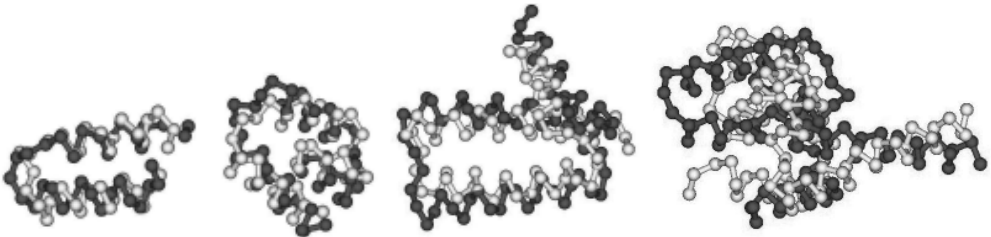
Table 1 and in Fig. 3 show the results for a subset of proteins we tested, ordered by increasing length. The timeout is 2 days for exhaustive search (denoted by enumeration) and 6 hours for LNS. The table reports the best results out of four consecutive runs for each LNS experiment. In Table 1, N denotes the number of amino acids (AA) of the protein PID, T denotes the running time (in seconds) elapsed to find the best structure reported within the time limit. The Energy column stores the energy of that structure and the rmsd column reports the root mean square deviation with respect to the deposited structure for PID. In Fig. 3 the computed and original structures are aligned to show their similarity. For every protein, we impose the secondary structure information as specified in the corresponding PDB annotations. However, we wish to point out that the proteins we tested are not included in the top-500 Database from which we extracted the 4-tuples.
| PID | N | Enumerate 2 days | LNS 6 hours | |||
|---|---|---|---|---|---|---|
| Energy | T | rmsd | Energy | T rmsd | ||
| 1ZDD | 34 | -113891 | 480 | 4.13 | -111619 | 5 3.84 |
| 2K9D | 54 | -211502 | 800 | 7.54 | -212328 | 5 4.44 |
| 1AIL | 69 | -339810 | 2500 | 7.27 | -308206 | 5 20.75 |
| 1JHG | 100 | -525685 | 2000 | 13.82 | -552907 | 52 13.22 |
As one might expect, the branch-and-bound constraintbased enumeration search performs better for smaller proteins, since it is possible to explore a large fraction of the search space within the given time limit. The LNS determines the same local minima in different runs for small proteins.
It is interesting to note that, for smaller chains, the rmsd w.r.t. the native conformation in the PDB is rather small (ca. 4 ˚A); this indicates that the best solutions found capture the fold of the chain, and the determined solutions can be refined using molecular dynamics simulations, as done in [Dal Pal`u et al., 2004]. The same consideration applies to the longer protein 1AIL, as it is possible to observe in Figure 3. Instead, for the protein 1JHG of length 100 a reasonable solution is not found within the current time limits.
5 Discussion
The idea of constraining part of the protein to a specific pattern (i.e. secondary structure shapes) can be extended to different and larger arrangements. Due to evolution, conserved sub-sequences (sequence and structure are similar) usually suggest a common functionality. Some analysis of the PDB can locate the presence of homologous patterns. When studying new protein families usually no structural information about homology is found.
If homologous sub-structures are found, they can be imposed to the target protein with rigid block constraints, namely a large set of atoms can be placed and rotated as a single unit. This provides a fast and yet accurate search strategy, since no non-deterministic choices can be made when searching inside the rigid block, thus resulting in a reduced search space.
Fig. 4 depicts an hypothetical example, where two homologous sequences are identified and imposed as rigid block constraints (left and center). The sequence in between the two blocks (dashed line on the right figure) on the target protein is constrained with tuples and it is free to move in the space. The two blocks can move independently in the space as long as the connecting loop satisfies tuple constraints.
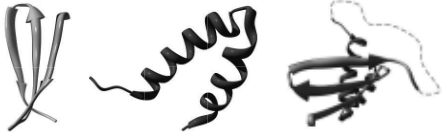
The framework can be extended depending on the type of information available: other analysis could suggest that some rigid blocks may have particular spatial relationships (e.g., α-barrels, β-sheet planar relationships, active site information). These facts could infer some distance constraints among rigid blocks and restrict the search to the placement of the sequence between the fixed rigid blocks. For example, referring to Fig. 4 on the right, the two blocks could be locked in that relative position and no relative movement could be performed. This would reduce drastically the search space, since the non-constrained subsequence would have both ends fixed in space.
Since the constraint system is modular, we believe that the presence of distance constraints can be exploited by the final user to model a variety of protein properties, e.g., loop closure, disulfide bonds, volumes of interest for chain flexibility.
The presence of ad-hoc propagators to filter the search space is essential to perform an efficient exploration of the solution space. Currently, the rotation matrix constraint is the only mean to propagate some spatial information along the chain of amino acids. A chain/backbone propagator that computes the approximated minimal volumes reachable by an amino acid can be effective when combined to a distance constraint propagator.
6 Conclusion
In this paper we presented the design and implementation of a constraint logic programming tool to predict the native conformation of a protein, given its primary structure. The methodology is based on a process of fragments assembly, using templates of length 4 retrieved from a protein database, and clustered according to shape similarity. The constraint solving process takes advantage of a large neighboring search strategy.
The preliminary experimental results confirm the strong potential for this fragment assembly scheme. Rosetta is in fact the state-of-the-art predictor tool (e.g., usually proteins smaller than 50 amino acids are predicted in less than one minute with a rmsd less than 4.2 ˚A). Our method can scale well and further speed-up may be obtained by considering larger fragments as done by tools like Rosetta. The proposed method has a significant advantage over highly tuned schemes like Rosetta-the use of constraint modeling enables the simple addition of ad-hoc constraints and experimentation with different local search moves and energy functions.
The implementation presented here constitutes a proof of concept. For a comparison with the relevant literature, please see [Dal Pal`u et al., 2010a].
A realistic prediction scenario requires several improvements to the current system. The choice of 4-residue fragments will be improved in the next future in two directions: fragments will be chosen based on sequence or profile alignment (rather than exact match) against a non-redundant representative set of sequences whose structure is known; the size of the fragment will be chosen based on the alignment and will not be restricted to 4-residues (rigid blocks).
The reduced representation used here should be replaced by an all-atom representation to predict hydrogen bonds more accurately. We plan to test different energy functions that may better correlate with rmsd w.r.t. the (known) native structures and the computed ones. It is likely that with sequences longer than those considered here predictions will not be equally good in all parts of the molecule, therefore alternative measurements of similarity like GDT-TS [Zemla, 2003] might be more appropriate. We plan to move now to a constraint-based parallel and imperative framework, since we seek a high flexibility and low level access to the constraint solver. We plan to implement crucial data structures in order to be able to run efficient propagators and to pass parallel work with a low communication rate to parallel workers.
Acknowledgments. The work is partially supported by the grants: GNCS-INdAM 2010-11, PRIN 2007M3E2T2, PRIN 20089M932N, NSF HRD-0420407, and NSF IIS-0812267.
@inproceedings{ijcai2011p431,
  title     = {Exploring Protein Fragment Assembly Using CLP},
  author    = {Palù, Alessandro Dal and Dovier, Agostino and Fogolari, Federico and Pontelli, Enrico},
  booktitle = {Proceedings of the Twenty-Second International Joint Conference on
               Artificial Intelligence, {IJCAI-11}},
  publisher = {AAAI Press/International Joint Conferences on Artificial Intelligence},
  editor    = {Toby Walsh},
  pages     = {2590--2594},
  year      = {2011},
  month     = {7},
  doi       = {10.5591/978-1-57735-516-8/IJCAI11-431},
  url       = {https://doi.org/10.5591/978-1-57735-516-8/IJCAI11-431},
}
TY - CPAPER TI - Exploring Protein Fragment Assembly Using CLP AU - Palù, Alessandro Dal AU - Dovier, Agostino AU - Fogolari, Federico AU - Pontelli, Enrico T2 - Proceedings of the Twenty-Second International Joint Conference on Artificial Intelligence, IJCAI-11 PB - AAAI Press/International Joint Conferences on Artificial Intelligence PY - 2011 SP - 2590 EP - 2594 DO - 10.5591/978-1-57735-516-8/IJCAI11-431 UR - https://doi.org/10.5591/978-1-57735-516-8/IJCAI11-431 ER -Copied
Machine-readable versions of this paper, for tools and AI agents:





