
Manipulation in Group Argument Evaluation
Proceedings of the Twenty-Second International Joint Conference on Artificial Intelligence. Pages 121-125.
https://doi.org/10.5591/978-1-57735-516-8/IJCAI11-032
© 2011 International Joint Conferences on Artificial Intelligence
Abstract
Given an argumentation framework and a group of agents, the individuals may have divergent opinions on the status of the arguments. If the group needsto reach a common position on the argumentation framework, the question is how the individual evaluations can be mapped into a collective one. Thisproblem has been recently investigated by Caminada and Pigozzi. In this paper, we investigate the behaviour of two of such operators from a socialchoice-theoretic point of view. In particular, we study under which conditions these operators are Pareto optimal and whether they are manipulable.
- [Brams et al., 2007] S Brams, M Kilgour, and R Sanver. A minimax procedure for electing committees. Public Choice, 132(3-4):401-420, 2007.
- [Caminada and Pigozzi, 2011] M. Caminada and G. Pigozzi. On judgment aggregation in abstract argumentation. Au- tonomous Agents and Multi-Agent Systems, 22(1):64-102, 2011.
- [Caminada, 2006] M.W.A. Caminada. On the issue of rein- statement in argumentation. In JELIA 2006, pages 111- 123. Springer, 2006. LNAI 4160.
- [Coste-Marquis et al., 2007] S. Coste-Marquis, C. Devred, S. Konieczny, M.-C. Lagasquie-Schiex, and P. Marquis. On the merging of Dung's argumentation systems. Artifi- cial Intelligence, 171(10-15):730-753, 2007.
- [Dung, 1995] P. M. Dung. On the acceptability of arguments and its fundamental role in nonmonotonic reasoning, logic programming and n-person games. Artificial Intelligence, 77:321-357, 1995.
- [Konieczny and Perez, 1998] S. Konieczny and R. Pino Perez. On the logic of merging. In Proceedings of KR'98, pages 488-498, 1998.
- [Pigozzi, 2006] G. Pigozzi. Belief merging and the discur- sive dilemma: an argument-based account to paradoxes of judgment aggregation. Synthese, 152(2):285-298, 2006.
- [Rahwan and Larson, 2008] I. Rahwan and K. Larson. Wel- fare properties of argumentation-based semantics. In Pro- ceedings of the 2nd International Workshop on Computa- tional Social Choice (COMSOC), 2008.
- [Rahwan and Tohmé, 2010] I. Rahwan and F. Tohmé. Col- lective argument evaluation as judgment aggregation. In Proc. of 9th AAMAS, 2010.
References were extracted automatically from the PDF and may contain errors.
Full text extracted automatically from the PDF; figures, tables and equations may differ. The PDF is the version of record.
1 Introduction
Individuals may draw different conclusions from the same information. Members of a jury may disagree on the verdict even though each member possesses the same information on the case under discussion. This happens because individuals can hold different reasonable positions on the information they share. Hence, the question is how the group can reach a common stance starting from the positions of each member.
In this paper we are interested in group decisions where members share the same information. One of the principles of argumentation theory is that an argumentation framework can have several extensions/labellings. If the information the group shares is represented by an argumentation framework, and each agent's reasonable position is an extension/labelling of that argumentation framework, the question is how to aggregate the individual positions into a collective one.
Caminada and Pigozzi [Caminada and Pigozzi, 2011] have studied this issue in abstract argumentation and provided three aggregation operators. The key property of these operators is that the collective outcome is 'compatible' with each individual position. That is, an agent who has to defend the collective position in public will never have to argue directly against his own private position.
The aim of this paper is to formalise and examine the intuition that, although every social outcome that is compatible with one's own labelling is acceptable, some outcomes
∗ Supported by the National Research Fund, Luxembourg (LAAMI project).
Mikołaj Podlaszewski
ILIAS / SnT Universit´e du Luxembourg Luxembourg mikolaj.podlaszewski@uni.lu
are more acceptable than others. That is, a collective outcome is more acceptable than another if it is compatible and more similar to one's own position than the other. In order to capture how much the various possible positions differ from each other, we use the notion of distance among labellings. Distance-based approaches have already been used to tackle aggregation problems, like in social choice theory [Brams et al., 2007], belief merging [Konieczny and Perez, 1998] and its application to judgment aggregation [Pigozzi, 2006]. Thus, we say that a collective outcome is more acceptable than another if it is compatible, but the distance to one's own labelling is smaller than the other.
The observations above give rise to two new research questions, to be addressed in the current paper:
(i) Are the social outcomes of the aggregation operators in [Caminada and Pigozzi, 2011] Pareto optimal if preferences between different outcomes are also taken into account?
(ii) Do agents have an incentive to misrepresent their own opinion in order to obtain a more favourable outcome? And if so, what are the effects from the perspective of social welfare?
We focus on the behaviour of two of the three aggregation operators of [Caminada and Pigozzi, 2011]. Pareto optimality is a key principle of welfare economics which intuitively stipulates that a social state cannot be further improved. Thus, the first contribution of the paper is to study whether the compatible social outcomes selected by our aggregation operators are Pareto optimal. In order to investigate Pareto optimality, we consider the submitted labelling as the individual's most preferred option. By using a notion of distance, we derive the individual preference ordering over the other permissible labellings. We show that the two aggregation operators are Pareto optimal, when a certain distance is used.
The second contribution is on the manipulability of the aggregation operators. Manipulability is usually considered to be an undesirable property of social choice decision rules. If an aggregation rule is manipulable, an individual may, upon learning the preferences of the other agents, misrepresent his input to ensure a social outcome that is better for him than it would have been had he voted sincerely. Our findings show that, while the two operators are manipulable, the sceptical aggregation operator guarantees that an agent who lies does not only ensure a preferable outcome for himself, but even promotes social welfare, what we call a benevolent lie.
Section 2 outlines the abstract argumentation theory. In Section 3 we define preferences over the individual evalutations. Pareto optimality and manipulability issues are addressed in Section 4 and 5 respectively. Section 6 concludes.
2 Preliminaries
2.1 Argumentation preliminaries
Definition 1 (Argumentation framework). Let U be the universe of all possible arguments. An argumentation framework is a pair (Ar , def ) where Ar is a finite subset of U and def ⊆ Ar ×Ar.
We say that an argument A defeats (or attacks) an argument B iff (A,B) ∈ def . For example, in Fig. 1, we have that A attacks B and that B attacks C.

Following [Caminada and Pigozzi, 2011], we use the argument labellings approach of [Caminada, 2006] rather than Dung's original extension approach [Dung, 1995]. The idea of a labelling is to associate with each argument exactly one label, which can either be in, out or undec. The label in indicates that the argument is explicitly accepted, out indicates that the argument is explicitly rejected, and undec indicates that one abstains from an explicit position on the argument.
Definition 2 (Labelling). Let (Ar, def ) be an argumentation framework. A labelling is a total function L : Ar -→ {in, out, undec}.
We write in(L) for {A | L(A) = in}, out(L) for {A | L(A) = out} and undec(L) for {A | L(A) = undec}. Sometimes, we write a labelling L as a triple (Args1,Args2,Args3) where Args1 = in(L), Args2 = out(L) and Args3 = undec(L). When it only matters whether an agent has a clear position (in or out) on an argument, we write dec(L) for in(L) ∪ out(L).
Although labellings allow one to express any position on which arguments are accepted, rejected or left undecided, some of these positions are more reasonable than others. Basically, the task of an argumentation semantics is to provide a criterion for determining which positions can be considered to be reasonable. Several such semantics have been defined in the literature, but we will consider only the following ones. 1
Definition 3 (Illegal arguments). Let L be a labelling of argumentation framework (Ar, def ) and let A ∈ Ar. We say:
- A is illegally in iff A is labelled in but not all its defeaters are labelled out
- A is illegally out iff A is labelled out but it does not have a defeater that is labelled in
- A is illegally undec iff A is labelled undec but either all its defeaters are labelled out or it has a defeater that is labelled in.
1 For an explanation of why this is not a too restrictive assumption, the reader is referred to [Caminada and Pigozzi, 2011].
For example, argument A of Fig. 1 is in as it has no defeaters. Argument B must be out since it has a defeater (argument A) and its defeater is in. Finally, argument C is in since its only defeater (argument B) is out.
Definition 4 (Admissible labelling). An admissible labelling is a labelling without arguments that are illegally in and without arguments that are illegally out.
Definition 5 (Complete labelling). A complete labelling is a labelling without arguments that are illegally in, without arguments that are illegally out and without arguments that are illegally undec.
The basic difference between an extension [Dung, 1995] and a labelling is that an extension only represents the arguments that are accepted, whereas a labelling also represents the arguments that are rejected or left undecided. So labellings provide a slightly more expressive though equivalent way to express Dung's theory of argumentation. For results on how labellings relate to extensions, see [Caminada, 2006]
In essence, a labelling based semantics can be seen as a function that, given an argumentation framework, yields zero or more labellings, each of which can be seen as a reasonable position that one can take on an argumentation framework.
2.2 Aggregation problem
We are now ready to formally summarize the problem of aggregation of individual labellings into a collective position on a given argumentation framework. The definitions and results in this section are from [Caminada and Pigozzi, 2011].
Given a set of individuals N = {1, . . . , n}, we need to define a general labellings aggregation operator OAF that assigns a collective labelling LColl to each profile P = {L1, . . . , Ln} of individual admissible labellings.
Definition 6 (Labelling aggregation operator OAF ). Let Labellings be the set of all possible labellings of argumentation framework AF = (Ar, def ). A general labellings aggregation operator is a function OAF : 2Labellings - {∅} → Labellings such that OAF ({L1, . . . , Ln}) = LColl.
We are interested in aggregation operators that produce a collective outcome compatible with the individual opinions. The idea is to ensure that each member can publicly defend the common decision without having to directly go against his own position. Two notions of compatibility have been introduced in [Caminada and Pigozzi, 2011].
Definition 7 (Less or equally committed ⊑). Let L1 and L2 be two labellings of argumentation framework AF = (Ar , def ). We say that L1 is less or equally committed as L2 (L1 ⊑ L2) iff in(L1) ⊆ in(L2) and out(L1) ⊆ out(L2).
Definition 8 (Compatible labellings ≈). Let L1 and L2 be two labellings of argumentation framework (Ar, def ). We say that L1 is compatible with L2 (denoted as L1 ≈ L2) iff in(L1) ∩ out(L2) = ∅ and out(L1) ∩ in(L2) = ∅.
The intuition is that, in order to be compatible, two labellings cannot have in - out conflicts. It can be noted that ⊑ is a partial order on labellings, whereas ≈ is not transitive. It holds that if L1 ⊑ L2, then L1 ≈ L2. We are now ready to state the sceptical and credulous aggregation operators.
Definition 9 (Sceptical initial aggregation operator sioAF ). Let Labellings be the set of all possible labellings of argumentation framework AF = (Ar, def ). The sceptical initial aggregation operator is a function sioAF : 2Labellings - {∅} → Labellings such that
sioAF ({L1, . . . , Ln}) = {(A, in) | ∀i ∈ {1, . . . , n} : Li(A) = in}∪ {(A, out) | ∀i ∈ {1, . . . , n} : Li(A) = out}∪ {(A, undec) | ∃i ∈ {1, . . . , n} : Li(A) ̸= in ∧ ∃j ∈ {1, . . . , n} : Lj(A) ̸= out}.
The idea is that the group initially labels an argument in (resp. out) if all individual participants agree that the argument is in (resp. out). Otherwise it is undec. This procedure does not preserve admissibility. This means that it may return a labelling with illegally in or illegally out arguments. This is why, after the initial aggregation, a second iterative phase follows, where all the illegally in or out arguments are relabelled to undec. Formally, this is defined as follows:
Definition 10 (Down-admissible labelling). Let L be a labelling of argumentation framework AF = (Ar, def ). The down-admissible labelling of L is the biggest element of the set of all admissible labellings that is less or equally committed than L.
The down-admissible labelling is defined according to the partial order given by ⊑. Such element always exists and is unique [Caminada and Pigozzi, 2011]. We can now define the sceptical operator that ensures admissible outcomes.
Definition 11 (Sceptical aggregation operator soAF ). Let Labellings be the set of all labellings of argumentation framework AF = (Ar , def ). The sceptical aggregation operator is a function soAF : 2Labellings - {∅} → Labellings such that soAF ({L1, . . . ,Ln}) is the down-admissible labelling of sioAF ({L1, . . . , Ln}).
The aggregation operator above produces social outcomes that are less or equally committed to all the individual labellings. This result is also maximal:
Theorem 1. Let L1, . . . ,Ln (n ≥ 1) be labellings of argumentation framework AF = (Ar, def ). Let Lso be soAF ({L1, . . . ,Ln}). It holds that Lso is the biggest admissible labelling such that for every i ∈ {1, . . . , n}: Lso ⊑ Li.
The second aggregation operator is the credulous one.
Definition 12 (Credulous initial aggregation operator cioAF ). Let Labellings be the set of all possible labellings of argumentation framework AF = (Ar, def ). The credulous initial aggregation operator is a function cioAF : 2Labellings - {∅} → Labellings such that
cioAF ({L1, . . . , Ln}) = {(A, in) | ∃i ∈ {1, . . . , n} : Li(A) = in ∧ ¬∃j ∈ {1, . . . , n} : Lj(A) = out}∪ {(A, out) | ∃i ∈ {1, . . . , n} : Li(A) = out ∧ ¬∃j ∈ {1, . . . , n} : Lj(A) = in}∪ {(A, undec) | ∀i ∈ {1, . . . , n} : Li(A) = undec ∨ (∃j ∈ {1, . . . , n} : Lj = in ∧ ∃k ∈ {1, . . . , n} : Lk = out)}.
The idea is that the group initially labels an argument A in (resp. out) if there is someone who believes A is in (resp. out) and nobody thinks A is out (resp. in). A is labelled undec in all other cases. The admissibility problem reappears here and is solved again by an iterative second phase where all illegally in and out arguments are relabelled undec.
Definition 13 (Credulous aggregation operator coAF ). Let AdmLabellings be the set of all admissible labellings of argumentation framework AF = (Ar , def ). The credulous aggregation operator is a function coAF : 2AdmLabellings - {∅} → AdmLabellings such that coAF ({L1, . . . ,Ln}) is the down-admissible labelling of cioAF ({L1, . . . , Ln}).
It holds that the credulous outcome labelling (Lco = coAF ({L1, . . . ,Ln})) is compatible with all the individual labellings, i.e. Lco ≈ Li (for each i ∈ {1, . . . , n}).
3 Preferences
In order to investigate Pareto optimality and strategyproofness we need to assume that agents have preferences over the possible collective outcomes.
We write L ≥i L′ to denote that agent i prefers labelling L to L′ . We write L ∼i L′ , and say that i is indifferent between L and L′ , iff L ≥i L′ and L′ ≥i L. Finally, we write L >i L′ (agent i strictly prefers L to L′ ) iff L ≥i L′ and not L ∼i L′ .
We assume that the labelling submitted by each agent is his most preferred one and, hence, the one he would like to see adopted by the whole group. The order over the other possible labellings is generated according to the distance from the most preferred one. For this purpose, we now define Hamming sets and Hamming distance among labellings.
Definition 14 (Hamming set ⊖). Let L1 and L2 be two labellings of argumentation framework (Ar, def ). We define the Hamming set between these labellings as L1⊖L2 = {A | L1(A) ̸= L2(A)}.
Definition 15 (Hamming distance |⊖|). Let L1 and L2 be two labellings of argumentation framework (Ar, def ). We define the Hamming distance between these labellings as L1 |⊖| L2 = |L1 ⊖ L2|.
The Hamming set is the set of arguments on which two labellings differ, whereas the Hamming distance is the number of arguments on which two labellings differ. Since the labellings have only three values, we can use this lemma.
Lemma 1. Let (Ar, def ) be an argumentation framework and L1 and L2 two labellings:
Proof.
- Follows from the fact that in(L), out(L) and undec(L) partition the domain of any labelling L.
- and c) are obtained by eliminating the empty sets in
We are now ready to define an agent's preference given by the Hamming set and the Hamming distance as follows.
Definition 16 (Hamming set based preference ≥i,⊖). Let (Ar, def ) be an argumentation framework, Labellings the set of all its labellings and ≥i the preference of agent i. We say that agent i's preference is Hamming set based (written as ≥i,⊖) iff ∀L, L′ ∈ Labellings, L ≥i L′ ⇔ L⊖Li ⊆ L′ ⊖Li where Li is the agent's most preferred labelling.
Definition 17 (Hamming distance based preference ≥i,|⊖|). Let (Ar, def ) be an argumentation framework, Labellings the set of all its labellings and ≥i the preference of agent i. We say that agent i's preference is Hamming distance based (written as ≥i,|⊖|) iff ∀L, L′ ∈ Labellings, L ≥i L′ ⇔ L |⊖| Li ≤ L′ |⊖| Li where Li is the agent's most preferred labelling.
The Hamming set based preference yields a partial order, whereas the Hamming distance based preference yields a total preorder. We now prove two lemmas establishing the relations between less or equally committed labellings and Hamming set/distance based preferences over labellings.
Lemma 2. Let L, L′ and Li be three labellings such that L ⊑ L′ ⊑ Li. If Li is the most preferred labelling of agent i and his preference is Hamming set or Hamming distance based, then L′ ≥i,⊖ L and L′ ≥i,|⊖| L respectively.
Proof. From L ⊑ L′ , we have that dec(L) ⊆ dec(L′ ), which is equivalent to undec(L′ ) ⊆ undec(L) because undec is the complement of dec. From this it follows that undec(L′ )∩dec(Li) ⊆ undec(L)∩dec(Li). Since L ⊑ Li and L′ ⊑ Li (by assumption and transitivity of ⊑), we can use Lemma 1b to obtain L′ ⊖Li ⊆ L⊖Li. By definition we have that L′ ≥i,⊖ L and L′ ≥i,|⊖| L.
Lemma 3. Let L, L′ and Li be three labellings and let L ⊑ Li. If Li is the most preferred labelling of agent i, his preference is Hamming set based and L′ ≥i,⊖ L, then L ⊑ L′ .
Proof. L′ ≥i,⊖ L implies L′ ⊖Li ⊆ L⊖Li which implies L(A) = Li(A) ⇒ L′ (A) = Li(A) for any argument A (i). L ⊑ Li implies L(A) = Li(A) for any A ∈ dec(L) (ii). From (i) and (ii) it follows that L(A) = L′ (A) for any A ∈ dec(L). Hence L ⊑ L′ .
We now have the machinery to represent individual preferences over the collective outcomes. We can now turn to the first research question of the paper, i.e., whether the sceptical and credulous aggregation operators are Pareto optimal.
4 Pareto optimality
Pareto optimality is a fundamental social welfare principle that guarantees that it is not possible to improve a social outcome, i.e. it is not possible to make one individual better off without making at least one other person worse off. In order to address the question of whether the sceptical and the credulous aggregation operators are Pareto optimal, we first need to define when a labelling Pareto dominates another labelling.
Definition 18 (Pareto dominance). Let N = 1, . . . , n be a group of agents with preferences ≥i, i ∈ N. L Pareto dominates L′ if ∀i ∈ N, L ≥i L′ and ∃j ∈ N,L >j L′ .
A labelling is Pareto optimal if it is not dominated by any other labelling.
Definition 19 (Pareto optimality). Labelling L is Pareto optimal if there is no L′ ̸= L such that ∀i ∈ N, L′ ≥i L and ∃j ∈ N, L′ >j L.
We say that an aggregation operator is Pareto optimal if all its outcomes are Pareto optimal. In particular, candidates for dominance are admissible and less or equally committed labellings in the case of the sceptical operator, and compatible labellings in the case of the credulous operator.
Theorem 2. If individual preferences are Hamming set based, then the sceptical aggregation operator is Pareto optimal when choosing from the admissible labellings that are smaller or equal (w.r.t ⊑) to each of the participants' individual labellings.
Proof. Let P be a profile of admissible labellings, LSO = soAF (P) and LX some admissible labelling with the property ∀i ∈ N,LX ⊑ Li. From Theorem 1 we know that LSO is the biggest admissible labelling with such property, so LX ⊑ LSO. So ∀i ∈ N, LX ⊑ LSO ⊑ Li. From Lemma 2 we have LSO ≥i LX for any i. So no agent strictly prefers LX and hence there is no labelling that dominates LSO.
Theorem 3. If individual preferences are Hamming distance based, then the sceptical aggregation operator is Pareto optimal when choosing from the admissible labellings that are smaller or equal (w.r.t ⊑) to each individual labellings.
Proof. In the proof of Theorem 2 Hamming set may be replaced by Hamming distance because it is only used in Lemma 2, which works for Hamming distance as well.
Theorem 4. If individual preferences are Hamming set based, then the credulous aggregation operator is Pareto optimal when choosing from the admissible labellings that are compatible (≈) to each of the participants' labellings.
Proof. Let P be a profile of admissible labellings, LCO = coAF (P ), LCIO = cioAF (P ). Assume by contradiction that there exists some admissible labelling LX with the property ∀i ∈ N, LX ≈ Li that dominates LCO.
First notice that compatibility ensures that there are no in/out conflicts between LX and LCO. If there is a conflict between agents' labellings on some argument, then both LX and LCO need to label it undec. If there exists an agent whose labelling decides on some argument and other agents' labellings agree or retain from decision, LCO and LX also agree or retain from decision. If all agents retain from decision on some argument, LCO by definition also retains, and LX may label freely. Let us take A ∈ dec(LX). Then, there needs to be an agent with a labelling that agrees on A. Otherwise all agents' labellings would be undecided on such argument and, according to definition, LCO would not decide either. But then all agents' labellings will agree on such argument with LCO and disagree with LX, so no agent will strongly prefer LX, which contradicts with domination. So there exists at least one agent whose labelling agrees with LX on A. Other agents' labellings also need to agree on A or label it undec because of the compatibility of LX. Then by definition LCIO(A) = LX(A). This holds for any argument A ∈ dec(LX), so we have LX ⊑ LCIO. But LX is admissible and, by Theorem 1, LCO is the biggest admissible labelling less or equally committed as LCIO. So we have LX ⊑ LCO ⊑ LCIO. LX must be different from LCO to dominate it. Let A be an argument on which these labellings differ. From the previous it follows that A ∈ undec(LX) and A ∈ dec(LCO). LCO decides on an argument only if there exists an agent that decides on such argument. But then this agent will agree on A with LCO and disagree with LX, so it will not prefer LX. This is in contradiction with dominance. Hence, such dominating labelling cannot exist.
Observation 1. The credulous aggregation operator is not Pareto optimal when the preferences are Hamming distance based. In Fig. 2 both labellings LCO and LX are compatible with both L1 and L2, but LX is closer when applying Hamming distance. L1 ⊖ LCO = L2 ⊖ LCO = {A, B, E, F, G}, so Hamming distance is 5, whereas L1 ⊖ LX = L2 ⊖ LX = {A, B, C, D}, so Hamming distance is 4.
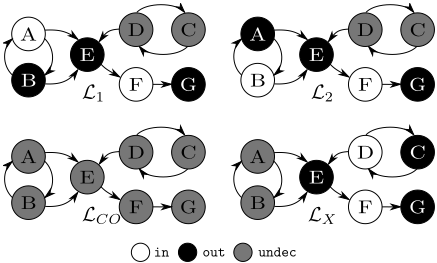
We summarise our results in Table 1. We are now ready to address the second research question of the paper, i.e., whether the credulous and sceptical operators are manipulable.
| Sceptical Operator | Credulous Operator | |
|---|---|---|
| Hamming set | Yes (Theorem 2) | Yes (Theorem 4) |
| Hamming dist. | Yes (Theorem 3) | No (Observation 1) |
5 Strategic manipulation
When an agent knows the positions of the other agents, he may have an incentive to submit an insincere position. If an aggregation rule is manipulable, an agent may obtain a social outcome that is closer to his actual preferences by submitting an insincere input. Hence, an important question to address when dealing with aggregation procedures is to study whether they are strategy-proof (i.e. non-manipulable).
In order to talk about manipulability, we first need to denote a profile in which a labelling has been changed. We recall that by profile we refer to a set of individual labellings {L1, . . . ,Ln}. Profile PLk/L′k is profile P where agent k's labelling Lk has been changed to L′k .
Definition 20 (Strategic lie). Let P be a profile and Lk ∈ P the most preferred labelling of an agent with preference ≥k. Let O be any aggregation operator. A labelling L′k such that O(PLk/L′k ) >i O(P) is called a strategic lie .
Definition 21 (Strategy-proof operator). An aggregation operator O is strategy-proof if strategic lies are not possible.
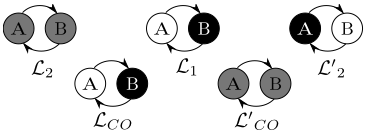
Observation 2. The credulous aggregation operator is not strategy-proof. In Fig.3 the agent with labelling L2 can insincerely report L′2 to obtain his preferred labelling. This makes an agent with labelling L1 worse off. The example is valid for both Hamming set and Hamming distance based preferences.
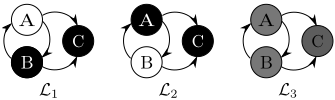
Observation 3. The sceptical aggregation operator is not strategy-proof. Consider the three labellings in Fig. 4. Labelling L1 of agent 1 when aggregated with L2 gives labelling L3, which differs on all three arguments. But, when the agent strategically lies and reports labelling L2 instead, the result of the aggregation is the same labelling L2, which differs only on two arguments {A, B}. The example is valid for both Hamming set and Hamming distance based preferences.
Surprisingly, however, this lie does not harm the other agent. On the contrary, it improves the social outcome for both the agents. In order to study this kind of situation, we now introduce the distinction between malicious and benevolent lies.
Definition 22 (Malicious lie). Let O be some aggregation operator and P a profile. We say that a strategic lie L′k is malicious iff, for some agent j ̸= k, O(P) >j O(PLk/L′k ).
Definition 23 (Benevolent lie). Let O be some aggregation operator and P a profile. We say that a strategic lie L′k is benevolent iff, for any agent i O(PLk/L′k ) ≥i O(P) and there exists an agent j ̸= k, O(PLk/L′k ) >j O(P).
Theorem 5. Consider the sceptical aggregation operator and Hamming set based preferences. For any agent, his strategic lies are benevolent.
Proof. Let P be a profile, and L′k a strategic lie of agent k. Denote LSO = soAF (P ) and L′SO = soAF (PLk/L′k ). Agent k's preference is L′SO >k LSO (i). We will show that for any agent i ̸= k, we have L′SO >i LSO. Since the sceptical aggregation operator produces social outcomes that are less or equally committed to all the individual labellings, we have that L′SO ⊑ Li for all i ̸= k (ii). Similarly, we have LSO ⊑
Lk (iii). From (i) and (iii), by Lemma 3, we have that LSO ⊑ L′SO (iv). From (iv) and (ii) we have LSO ⊑ L′SO ⊑ Li for all i ̸= k. Finally, we can apply Lemma 2 to obtain L′SO ≥i LSO for all i ̸= k (v). We showed that lie is not malicious, nowwe show that it is benevolent. (iii) implies undec(Lk) ⊆ undec(LSO) (vi). (i) and (vi) implies ∃A ∈ dec(Lk) : A ∈ undec(LSO) ∧ A ∈ dec(L′SO ) (vii). From (vii), (ii) and (v) L′SO >i LSO for i ̸= k.
Theorem 6. Consider the sceptical aggregation operator and Hamming distance based preferences. For any agent, his strategic lies are benevolent.
Proof. Let P be a profile, and L′k a strategic lie of agent k whose most preferred labelling is Lk. Denote LSO = soAF (P) and L′SO = soAF (PLk/L′k ). We will show that, if L′SO is strictly preferred to LSO by agent k, then it is also strictly preferred by any other agent. Without loss of generality we can take agent j, j ̸= k,whose most preferred labelling is Lj. Let us partition the arguments into the following disjoint groups: A = dec(LSO)\dec(L′SO ) (decided arguments that became undecided), B = dec(L′SO ) \ dec(LSO) (undecided arguments that became decided), C = dec(L′SO ) ∩ dec(LSO) (arguments decided in both labellings), D = undec(L′SO ) ∩ undec(LSO) (arguments undecided in both labellings). Labellings LSO and L′SO agree on the arguments in D (which are labeled undec) and C, whose arguments are labeled in or out. On the arguments in C there are no in-out conflicts between LSO and L′SO as the sceptical aggregation operator guarantees social outcomes less or equally committed than Lj. Therefore, only arguments from A and B have an impact on Hamming distance. Both labellings Lk and Lj agree with LSO on the arguments in A because LSO decides on those arguments and is less or equally committed than both labellings. L′SO remains undecided on the arguments in A so both labellings Lk and Lj disagrees with L′SO on A. L′SO is less or equally committed than Lj so, as above, we obtain that on the arguments in B, Lj agrees with L′SO and disagrees with LSO. On the contrary, L′SO does not have to be less or equally committed than Lk and so, for agent k, some of the arguments from B increase the distance and some of them decrease it. If agent k prefers L′SO to LSO, then the number of the arguments decreasing the distance must be greater than the number of those increasing by more than |A|. But for agent j all the arguments from B are decreasing the distance, as Lj agrees with L′SO on the whole B. So, if agent k gains by switching to labelling L′SO , agent j needs to gain by at least the same.
We summarise our results in Table 2.
| Sceptical | Credulous | |
|---|---|---|
| Hamming set | No (Obs. 3) but benev. (Th. 5) | No, and not benev. (Obs. 2) |
| Hamming dist. | No (Obs. 3) but benev. (Th. 6) | No, and not benev. (Obs. 2) |
6 Conclusion and related work
The study of aggregation problems in abstract argumentation is recent. [Coste-Marquis et al., 2007] present an approach to merge Dung's argumentation frameworks. The argumentation frameworks to be merged may be different, that is agents may ignore arguments put forward by other agents.
Given an argumentation framework, [Rahwan and Tohm´e, 2010] address the question of how to aggregate individual labellings into a collective position. By drawing on a general impossibility theorem from judgment aggregation, they prove an impossibility result and provide some escape solutions. Relevant for the present paper is another work by [Rahwan and Larson, 2008], where they explore welfare properties of collective argument evaluation.
In this paper we have analyzed the sceptical and credulous aggregation operators from a social welfare perspective. We have studied under which conditions these operators are Pareto optimal and whether they are manipulable. In future, we plan to consider focal set oriented agents, that is, agents who care only about a subset of the argumentation framework. We also plan to investigate distances that assign higher values to in-out conflicts than to in-undec or out-undec.
@inproceedings{ijcai2011p32,
  title     = {Manipulation in Group Argument Evaluation},
  author    = {Caminada, Martin and Pigozzi, Gabriella and Podlaszewski, Mikolaj},
  booktitle = {Proceedings of the Twenty-Second International Joint Conference on
               Artificial Intelligence, {IJCAI-11}},
  publisher = {AAAI Press/International Joint Conferences on Artificial Intelligence},
  editor    = {Toby Walsh},
  pages     = {121--125},
  year      = {2011},
  month     = {7},
  doi       = {10.5591/978-1-57735-516-8/IJCAI11-032},
  url       = {https://doi.org/10.5591/978-1-57735-516-8/IJCAI11-032},
}
TY - CPAPER TI - Manipulation in Group Argument Evaluation AU - Caminada, Martin AU - Pigozzi, Gabriella AU - Podlaszewski, Mikolaj T2 - Proceedings of the Twenty-Second International Joint Conference on Artificial Intelligence, IJCAI-11 PB - AAAI Press/International Joint Conferences on Artificial Intelligence PY - 2011 SP - 121 EP - 125 DO - 10.5591/978-1-57735-516-8/IJCAI11-032 UR - https://doi.org/10.5591/978-1-57735-516-8/IJCAI11-032 ER -Copied
Machine-readable versions of this paper, for tools and AI agents:





