
Interfacing Virtual Agents with Collaborative Knowledge: Open Domain Question Answering Using Wikipedia-Based Topic Models
Proceedings of the Twenty-Second International Joint Conference on Artificial Intelligence. Pages 1896-1901.
https://doi.org/10.5591/978-1-57735-516-8/IJCAI11-317
© 2011 International Joint Conferences on Artificial Intelligence
Abstract
This paper is concerned with the use of conversational agents as an interaction paradigm for accessing open domain encyclopedic knowledge by means of Wikipedia. More precisely, we describe a dialogue-based question answering system for German which utilizes Wikipedia-based topic models as a reference point for context detection and answer prediction. We investigate two different per- spectives to the task of interfacing virtual agents with collaborative knowledge. First, we exploit the use of Wikipedia categories as a basis for identifying the broader topic of a spoken utterance. Second, we describe how to enhance the conversational behavior of the virtual agent by means of a Wikipedia-based question answering component which incorporates the question topic. At large, our approach identifies topic-related focus terms of a user’s question, which are subsequently mapped onto a category taxonomy. Thus, we utilize the taxonomy as a reference point to derive topic labels for a user’s question. The employed topic model is thereby based on explicitly given concepts as represented by the document and category structure of the Wikipedia knowledge base. Identified topic categories are subsequently combined with different linguistic filtering methods to improve answer candidate retrieval and reranking. Results show that the topic model approach contributes to an enhancement of the conversational behavior of virtual agents.
- [Adafre and van Genabith, 2009] Sisay Fissaha Adafre and Josef van Genabith. A hybrid filtering approach for ques- tion answering. In Proceedings of the 14th International Lexical Functional Grammar Conference (LFG-09), Cam- bridge, UK, 2009.
- [Ahn et al., 2004] David Ahn, Valentin Jijkoun, Gilad Mishne, Karin Mller, Maarten de Rijke, and Stefan Schlobach. Using wikipedia at the trec qa track. In Pro- ceedings of TREC 2004, 2004.
- [Bizer et al., 2009] Christian Bizer, Jens Lehmann, Georgi Kobilarov, Sören Auer, Christian Becker, Richard Cyga- niak, and Sebastian Hellmann. Dbpedia -a crystalliza- tion point for the web of data. Web Semant., 7:154-165, September 2009.
- [Breuing, 2010] Alexa Breuing. Improving human-agent conversations by accessing contextual knowledge from wikipedia. In Proceedings of the 2010 IEEE/WIC/ACM International Conference on Web Intelligence and Intelli- gent Agent Technology -Volume 03, WI-IAT '10, pages 428-431, Washington, DC, USA, 2010. IEEE Computer Society.
- [Buscaldi and Rosso, 2006] David Buscaldi and Paolo Rosso. Mining Knowledge from Wikipedia from the question answering task. In Proceedings of the 5th International Conference on Language Resources and Evaluation (LREC 2006), Genoa, Italy, 2006.
- [Cimiano and Kopp, 2010] P. Cimiano and S. Kopp. Access- ing the web of data through embodied virtual characters. Semantic Web Journal, 2010.
- [Cramer et al., 2006] Irene Cramer, Jochen L. Leidner, and Dietrich Klakow. Building an evaluation corpus for ger- man question answering by harvesting wikipedia, 2006.
- [Cunningham et al., 2002] H. Cunningham, D. Maynard, K. Bontcheva, and V. Tablan. GATE: A framework and graphical development environment for robust NLP tools and applications. In Proceedings of the 40th Anniversary Meeting of the Association for Computational Linguistics, 2002.
- [Fissaha Adafre et al., 2007] Sisay Fissaha Adafre, Valentin Jijkoun, and Maarten de Rijke. Fact discovery in wikipedia. In Proceedings of the IEEE/WIC/ACM Inter- national Conference on Web Intelligence, WI '07, pages 177-183, Washington, DC, USA, 2007. IEEE Computer Society.
- [Furbach et al., 2008] Ulrich Furbach, Ingo Glöckner, Her- mann Helbig, and Björn Pelzer. Loganswer -a deduction- based question answering system (system description). In Proceedings of the 4th international joint conference on Automated Reasoning, IJCAR '08, pages 139-146, Berlin, Heidelberg, 2008. Springer-Verlag.
- [Gabrilovich and Markovitch, 2007] Evgeniy Gabrilovich and Shaul Markovitch. Computing Semantic Relatedness using Wikipedia-based Explicit Semantic Analysis. Proceedings of the 20th International Joint Conference on Artificial Intelligence, pages 6-12, 2007. IJCAI
- [Giampiccolo et al., 2007] Danilo Giampiccolo, Pamela Forner, Jesús Herrera, Anselmo Peñas, Christelle Ay- ache, Corina Forascu, Valentin Jijkoun, Petya Osenova, Paulo Rocha, Bogdan Sacaleanu, and Richard F. E. Sutcliffe. Overview of the clef 2007 multilingual question answering track. In CLEF, pages 200-236, 2007.
- [Hatcher et al., 2010] Erik Hatcher, Otis Gospodnetic, and Mike McCandless. Lucene in Action. Manning, 2nd re- vised edition. edition, 2010.
- [Kaisser, 2008] Michael Kaisser. The qualim question an- swering demo: supplementing answers with paragraphs drawn from wikipedia. In Proceedings of the 46th Annual Meeting of the Association for Computational Linguistics on Human Language Technologies: Demo Session, HLT- Demonstrations '08, pages 32-35, Morristown, NJ, USA, 2008. Association for Computational Linguistics.
- [Katz et al., 2002] Boris Katz, Sue Felshin, Deniz Yuret, Ali Ibrahim, Jimmy J. Lin, Gregory Marton, Alton Jerome McFarland, and Baris Temelkuran. Omnibase: Uniform access to heterogeneous data for question answering. In Natural Language Processing and Information Systems, 6th International Conference on Applications of Natural Language to Information Systems, NLDB 2002, Stock- holm, Sweden, June 27-28, 2002, Revised Papers, volume 2553 of Lecture Notes in Computer Science, pages 230- 234. Springer, 2002.
- [Koehler et al., 2008] Florian Koehler, Hinrich Schütze, and Michaela Atterer. A question answering system for ger- man. experiments with morphological linguistic resources. In Proceedings of the International Conference on Lan- guage Resources and Evaluation, LREC 2008, 26 May -1 June 2008, Marrakech, Morocco, 2008.
- [Kopp et al., 2005] S. Kopp, L. Gesellensetter, N. Krämer, and I. Wachsmuth. A conversational agent as museum guide -design and evaluation of a real-world application. In Panayiotopoulos and others (Eds.), editors, Intelligent Virtual Agents, LNAI 3661, pages 329-343, Berlin, 2005. Springer.
- [Lagus and Kuusisto, 2002] Krista Lagus and Jukka Kuu- sisto. Topic identification in natural language dialogues using neural networks. In Proceedings of the 3rd SIGdial workshop on Discourse and dialogue -Volume 2, SIG- DIAL '02, pages 95-102, Stroudsburg, PA, USA, 2002. Association for Computational Linguistics.
- [Lopez et al., 2010] Vanessa Lopez, Andriy Nikolov, Marta Sabou, Victoria S. Uren, Enrico Motta, and Mathieu d'Aquin. Scaling up question-answering to linked data. In Proceedings of the EKAW -Knowledge Engineering and Management by the Masses -17th International Con- ference, EKAW 2010, Lisbon, Portugal, October 11-15, 2010., pages 193-210, 2010.
- [Neumann and Sacaleanu, 2004] Günter Neumann and Bog- dan Sacaleanu. A Cross Language Question Answering System for German and English. In Carol Peters, Julio Gonzalo, Martin Braschler, and Michael Kluck, editors, Comparative Evaluation of Multilingual Information Ac- cess Systems, volume 3237 of Lecture Notes in Computer Science, pages 101-109. Springer Berlin / Heidelberg, 2004.
- [Schank, 1977] Roger C. Schank. Rules and topics in con- versation. Cognitive Science, 1(4):421-441, 1977.
- [Schmid, 1994] Helmut Schmid. Probabilistic part-of- speech tagging using decision trees. In Proceedings of the International Conference on New Methods in Language Processing, Manchester, UK, 1994.
- [Schönhofen, 2009] Peter Schönhofen. Identifying docu- ment topics using the wikipedia category network. Web Intelli. and Agent Sys., 7:195-207, April 2009.
- [Sonntag, 2009] Daniel Sonntag. Introspection and adapt- able model integration for dialogue-based question an- swering. In Proceedings of the 21st international jont conference on Artifical intelligence, pages 1549-1554, San Francisco, CA, USA, 2009. IJCAI
- [Tunstall-Pedoe, 2010] William Tunstall-Pedoe. True knowledge: Open-domain question answering using structured knowledge and inference. AI Magazine, 31(3):80-92, 2010.
- [Waltinger and Mehler, 2009] Ulli Waltinger and Alexander Mehler. Social semantics and its evaluation by means of semantic relatedness and open topic models. In Proceed- ings of the 2009 IEEE/WIC/ACM International Joint Con- ference on Web Intelligence and Intelligent Agent Technol- ogy -Volume 01, WI-IAT '09, pages 42-49, Washington, DC, USA, 2009. IEEE Computer Society.
- [Zheng, 2002] Zhiping Zheng. Answerbus question answer- ing system. In Proceedings of the second international conference on Human Language Technology Research, HLT '02, pages 399-404, San Francisco, CA, USA, 2002.
References were extracted automatically from the PDF and may contain errors.
Full text extracted automatically from the PDF; figures, tables and equations may differ. The PDF is the version of record.
1 Introduction
In recent years, the field of Question Answering (QA) has evolved considerably in the scientific community [Giampiccolo et al., 2007]. In general, QA is a task within the areas of Information Retrieval (IR) and Natural Language Processing (NLP) that aims to automatically answer a natural language question as asked by a user. The expected answer may thereby refer to a single word or expression (e.g. Q: "Who invented Coca-Cola?" ↦→A: "John Stith Pemberton"), or to an entire sentence (e.g. Q: "Who is John Pemberton?" ↦→A: "John Stith Pemberton was an American druggist and the inventor of Coca-Cola."). In this context, most QA systems are using a collection of natural language documents (e.g. local or web-based text corpus) for document retrieval, and apply selective methods in order to extract a single answer or a list of answer candidates. Using open domain encyclopedic information as a knowledge base, such as provided by the Wikipedia project, has captured the attention of QA researchers lately [Ahn et al., 2004; Buscaldi and Rosso, 2006]. However, most of the proposed Wikipedia-based QA systems focus primarily on the document collection of Wikipedia for answer retrieval, thus disregard the complex hierarchical representation of knowledge by means of its category taxonomy, which can also be valuable in the context of QA systems.
In this paper, we approach the Wikipedia collection from a different point of view. We exploit the use of the Wikipedia category taxonomy as a reference point for identifying the broader topic of a user's question in order to deduce from the topic to a set of expected answer candidates. More precisely, we are heading towards accessing and activating only those areas of our knowledge base (e.g. sentences and phrases categorized by a certain set of categories) which are primarily topically relevant to the subject of the question. As an example, consider the following user-agent-based QA scenario:
After the user entered a natural language question, the agent activates his reasoning module by means of analyzing both, the question structure (e.g. Who ↦→Person), and the subject matter (e.g. Coca-Cola ↦→Soft drink). Building on that a query expansion (e.g. invented ↦→inventor) is combined with the identified subject labels to retrieve the answer candidate. Consequently, the subject context, as represented by the Wikipedia categories, will be memorized by the agent for the next dialog. Since our QA component is employed within an existing architecture of the virtual human Max [Kopp et al., 2005], this approach contributes to an enhancement of the agent's conversational behavior for two reasons: First, knowledge awareness enables our virtual agent to access and explore the rich knowledge of the collaborative network in a more structured manner by means of utilizing the category taxonomy of Wikipedia as a reference point. Dialogue-based QA obviously plays an important role here[Sonntag, 2009]. Second, subject awareness enables the agent to identify and to label a user's utterance (question) by its topic during the dialogue [Breuing, 2010]. Overall, we thereby aim to realize a more human-tailored access, as argued by [Cimiano and Kopp, 2010], to and with the aid of the rich knowledge drawn from Wikipedia, and consequentially we aim to improve the interaction with human dialogue partners.
The rest of the paper is structured as follows: In Section 2 we review related work. Section 3 describes the method of the QA system using Wikipedia-based topic models and outlines the implementation within the architecture of our conversational agent. In Section 4 we present the results of an experiment. Finally, Section 5 summarizes and concludes the paper.
2 RelatedWork
QA has been a popular research topic in recent years. Though, most of the unrestricted accessible QA applications, such as the web-based QA systems QuALiM [Kaisser, 2008] or LogAnswer [Furbach et al., 2008], focus on presenting online a weighted list of answer candidates rather than presenting only one (exact) answer. However, to frame only a single answer is a mandatory precondition within our system architecture. In general, we can identify three different branches of QA systems with reference to their comprised knowledge base. Most popular, several technologies are using web-based search engines [Kaisser, 2008; Adafre and van Genabith, 2009], such as Google or Yahoo, and/or interlink static knowledge bases with web crawlers for document retrieval and answer candidate ranking, such as the START system [Katz et al., 2002] or Answerbus [Zheng, 2002]. Other systems [Tunstall-Pedoe, 2010; Lopez et al., 2010] build on combining RDF resources , such as the DBpedia collection [Bizer et al., 2009], with a reasoning component for answer prediction. The third branch of QA systems uses semi-structured resources, such as the Wikipedia collection [Ahn et al., 2004; Buscaldi and Rosso, 2006; Fissaha Adafre et al., 2007; Furbach et al., 2008], as a knowledge base.
With respect to QA systems that are using German as the target language, only few are accessible: [Neumann and Sacaleanu, 2004] presented a cross-language QA system for German and English. Their approach uses an English system in combination with machine translation in order to build a so-called bag-of-objects representation. Subsequently, the subset of objects a query and an answer candidate have in common are used in order to assess the answer candidates (accuracy of up to 15%). Our system also uses an overlap measure for candidate ranking, though not involving machine translation but shallow parsing. The method of [Buscaldi and Rosso, 2006] uses Wikipedia category information in order to determine a set of question-related articles within the Wikipedia collection. The results show an improvement of 14.5% in recall. Their system is in parts similar to the system presented here in terms of using category information as a reference point to improve the answer retrieval. However, it differs in that we are not using string comparison for category selection, but employing a Wikipedia-based topic model involving taxonomy traversal.
[Koehler et al., 2008] presented a QA system for German using a web search engine as a backend. In addition, a morphological linguistic resource is used in order to convert nouns into verbs and vice versa to increase the recall (precision: 20.9%; recall 86.0%). We adapted their linguistic method by incorporating a lexical resource for query extension. Most recently, [Furbach et al., 2008] presented LogAnswer, an open domain question answering system, which uses the Wikipedia dataset as the knowledge base and employs an automated theorem prover to infer correct sentences to natural language questions (precision of 54.8% for support passages). Similar to their approach, our system also uses a sentence-based representation of the Wikipedia document collection as a knowledge base, but additionally regards the category taxonomy to infer answer sentences.
With reference to the topic labeling task of utterances, [Lagus and Kuusisto, 2002] presented an approach using neural networks in order to recognize the subject of a long dialogue. We adapt their approach in focusing on topic and focus words who occur in the individual utterances. However, our method differs in that we are not using these features as a semantic representation of a topic, but as a reduced representation of a question's subject, which is consequently mapped onto the category taxonomy. That is, our topic labels refer not necessarily to term features that occurred within the spoken dialogue. In this context, a related approach is the so-called Explicit Semantic Analysis as proposed by [Gabrilovich and Markovitch, 2007]. Their approach utilizes the articles of the document collection of Wikipedia as proxies for a concept-based representation of natural language texts. That is, they classify documents with respect to an explicitly given set of Wikipedia articles. Related to it are the method of [Sch¨onhofen, 2009] and the Open Topic Model approach [Waltinger and Mehler, 2009], which both utilize the Wikipedia category taxonomy for the topic labeling task. The latter is in most parts similar to our method, however, it differs in that we are not using natural language text documents as an input representation but utilize focus terms from utterances only.
3 Question Answering usingWikipedia-based Topic Models
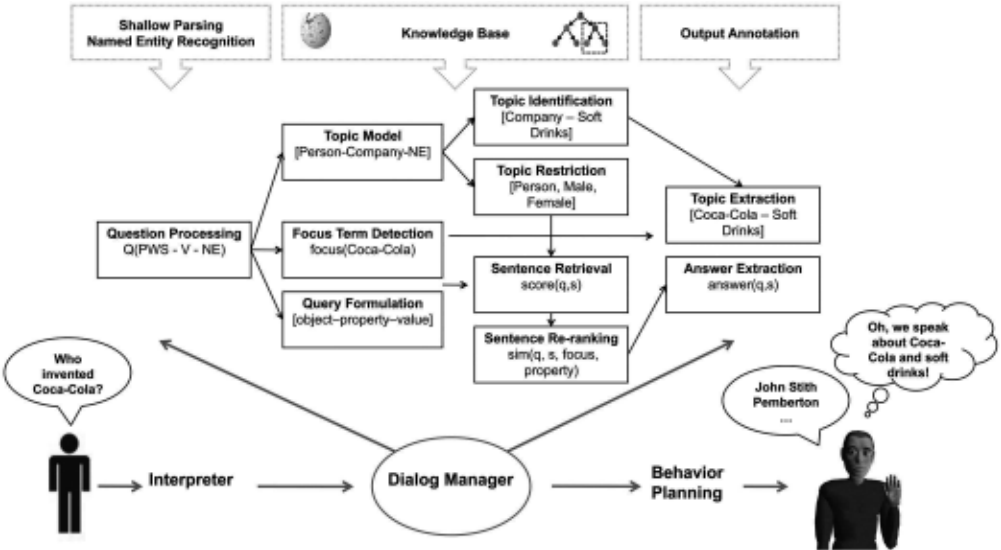
The overall method for the Question Answering using Wikipedia-based topic models can be subdivided into several phases within the processing pipeline: (1) question processing; (2) focus term detection; (3) topic identification; (4) query formulation; (5) sentence retrieval; (6) answer extraction. Figure 1 gives an overview of our approach and the corresponding modules. Since this system will be employed within an existing architecture of an embodied conversational agent, there are several specifications to meet. The first challenge is the runtime property of the entire QA component. The system must respond within a few seconds, even if the knowledge base consists of more than 30 million entries. The second challenge refers to the robustness in confidence of answer extraction. That is, to have a plausible conversation with a virtual agent, it is critical to present rather no answer and consequently to fall back on the existing dialog manager, than to output a (completely) wrong statement. Therefore, in terms of evaluation metrics, we focus on precision instead of recall. A third challenge for QA with conversational agents is answer presentation. Unlike other QA applications, the system needs to answer natural language questions via the virtual agent. This means that it is not adequate to present an answer or a list of answer candidates with supporting passages using a (hyper-) text representation, but we need to vocalize the answer using speech synthesis. In the following we describe the processing stages of the system.
3.1 Question Processing
At first, the question processing module is activated. All incoming natural language queries (questions) are linguistically analyzed using the shallow processing tool TreeTagger [Schmid, 1994]. It consists of several pre-processing components for tokenization, sentence boundary detection, Part-ofSpeech (PoS) tagging and lemmatization. In addition, an embedded chunk parser defines the type of the syntactic chunks (e.g. NC, PC or VC) that occur in the question. Chunker and PoS-Tagger were trained on the German Negra treebank using the STTS tagset 1 . Named Entity Recognition is done using a rule-based approach as provided by the ANNIE module within the GATE framework [Cunningham et al., 2002]. Therefore, each question is represented by the chunk structure and its corresponding wordform, lemma, PoS and named entity class information as determined by the shallow parser.
Thereupon, the question type of the input query is identified. In this context, the analyzed query representation is matched against several classification patterns, which have been pre-defined for a set of comprised question types (see Table 1) using the dataset of [Cramer et al., 2006] for building the question classification rule set. More precisely, we have annotated for each question type a number of Wikipedia categories, where we expect to find the list of answer candidates by means of their taxonomy membership. For example, a question starting with the terms 'Who is ...' is most likely to be a question about a specific person. In this case, our method activates, at first, only those knowledge base entries, which are annotated by the Wikipedia categories 'people','male' or 'female'. At second, in the case of a mismatch, the entire knowledge base is activated for answer retrieval.
3.2 Focus TermDetection
Focus term detection builds upon the shallow parsing component. The goal of this module is to identify topically relevant words in the utterances [Lagus and Kuusisto, 2002, pp. 95].
1 http://www.sfs.uni-tuebingen.de/Elwis/stts/stts.html
| Question type: | Expected Answer Features: | Expected Position: | Expected Category: |
|---|---|---|---|
| Who - [Wer, Wie heisst] | NN, NE followed by VAFIN | first sentence / title | people, male, female,... |
| What - [Was, Womit] | PDS, PRELS followed by NN, NE | first sentence / title | topic model categories |
| Where - [Wo, Wohin] | APPR followed by NE, NN | first sentence / title | country, city,... |
| When - [Wann] | expression of dates, CARD | paragraph | topic model categories |
| Howmany - [Wie viele] | CARD, expression of length (e.g. meter, km,...) | paragraph | topic model categories |
This is done, in order to have a topic-based input representation of a user's question - which is needed for the Wikipediabased topic model. The idea, from sentence to topic, follows thereby primarily the definition of [Schank, 1977, pp. 422], who argues that a topic is any object, person, location, action, state, or time that is mentioned in the sentence to be responded to. In our context, we see the set of topically relevant terms within an utterance, defined as focus terms, as a proxy of a question's topic. Focus term detection is processed by means of the analyzed syntactic chunks. More precisely, we utilize the concatenated noun and prepositional chunks (NC,PC) by their PoS-Tag (NE) as our topic representation. For example, the question 'Who invented Coca-Cola?' is represented by the single focus term 'Coca-Cola'. The extracted focus terms are further used as an input for the topic identification module.
3.3 Topic Identification
The purpose of the topic identification component is to equip our virtual agent with a topic-based reasoning module and consequently to assist the topic-based answer retrieval. In this context, we aim to map any given input question onto the category taxonomy of Wikipeda, where the graph structure of the taxonomy is used to derive the broader subject from the input query and the category nodes are used as distinctive labels of the question topic. A recent example of such a topic model is presented through the Open Topic Model [Waltinger and Mehler, 2009] in which natural language documents are classified with respect to Wikipedia categories. At large, their approach maps any given input stream q onto a high-dimensional real-valued concept space, Cwiki, using Wikipedia articles as proxies for concepts.
The entries of the resultant vector cart ∈ Cwiki of q reflect thereby the strength of association between q and the respective Wikipedia articles. In a further processing step, they utilize the set of top-ranked articles from cart to retrieve associated category nodes from Ctopic:
At last, the graph structure of the category taxonomy is used to identify topic-related concepts within a certain scale of generalization. In our QA application, we adopted their approach, though not using natural language documents but the focus term representation (see Table 2), as described in the previous section.
3.4 Query Formulation
In order to enhance the recall of the sentence retrieval component, the input question is expanded to a set of search query variants. This is done by means of triple extraction, in terms of object-property-value detection, using the shallow parsed chunk representation. The object thereby refers to the focus term representation, the property to the verbal chunk of the question, and the value to the answer we are looking for. In addition, this module also takes the inflectional and derivational morphology of the terms into account. That is, verbs and nouns are replaced by their lemma and synonyms utilizing a manually annotated lexical dictionary using data from the Wiktionary 2 project. For example, the question 'Who invented Coca Cola?' is translated into the following triple queries: ['Coca-Cola','invent','?'], ['CocaCola','invented','?'], ['Coca-Cola','inventor','?'], and so on.
| Question: | Who invented Coca-Cola? |
|---|---|
| Focus term: | Coca-Cola |
| Top-ranked articles: | 1. The Coca-Cola Company |
| 2. Coca-Cola | |
| 3. Coca | |
| Top-ranked topics: | 1. Soft drink |
| 2. Beverage company | |
| 3. Company (Atlanta) |
| Type: | Quantity: |
|---|---|
| articles | 1.063.772 |
| paragraphs | 6.649.455 |
| sentences | 30.890.452 |
| categories | 88.749 |
3.5 Sentence Retrieval
The sentence retrieval component utilizes the German Wikipedia dump as a QA knowledge base. More precisely, we use Apache Lucene [Hatcher et al., 2010] to index the document collection, utilizing 1.063.772 articles and 88.883 categories (see Table 3). The entire corpus was linguistically analyzed and subdivided into 30.890.452 sentences. That is, each sentence poses as a Lucene document that consists of seven fields: Title, which contains the title of the Wikipedia article in which the sentence occurred; Text, which stores the individual sentence; Chunk, which stores the shallow parsed representation; Position, which lists the position of the sentence in the article; Backlink, which stores the number of hyperlinks pointing to the respective sentence (article); Header, which utilizes the headings of (sub-)sections within the article; sand finally Category, which stores the Wikipedia categories attached to the title page. For sentence retrieval, we apply the MultiFieldQueryParser using the Lucene search score:
2 http://de.wiktionary.org/
where tf(t ∈ s) correlates to the terms frequency in the currently scored sentence s; idf(t) represents the inverse document frequency applied to the sentence representation. tb is a search time boost of term t in the query q, applied to focus terms only. norm(t, s) encapsulates a few (indexing time) boosts and length factors with reference to Lucene's document and field boost property [Hatcher et al., 2010].
Note that we combine all query variants, obtained from the query formulation, the question processing, and the Wikipedia-based topic model component, to one query. In addition, category labels, as assigned from the latter module, are used as a mandatory parameter for the sentence retrieval task. This means that the type and the topic of a question influences significantly the query formulation process. Thus, answer candidates are filtered by their article position, expected answer features, and taxonomy membership (see Table 1). To give an example, for the question "Who is John Pemberton?", we 'activate/query' only those sentences in which the focus terms John and Pemberton occur in the first sentence of the respective article (Position:1) and which are additionally affiliated to one of the following topics: Category:Male, Category:Female, Category:Human name disambiguation pages (question type), Category:American chemists, Category:Coca-Cola (topic model).
3.6 Answer Extraction
In the current QA setup, we disregard the task of answer paraphrasing and extract the final answer by means of its sentence-based representation. Moreover, we only use the top-ranked sentence as an output for our conversational agent. To give an example answer 3 :
John Pemberton [a] (1831-1888) was an American druggist and the inventor [p] of Coca-Cola [o].
Sentence re-ranking is performed by combining four different evidence scores. First, we normalize the Lucene retrieval similarity. Second, we score the lexical overlap between the question and the answer candidate using the Jaccard similarity index:
where the size of the intersection between the sentence s and the query q gets divided by the size of their union. Note that we use the object and property chunks only as a set-based representation of q. Third, we score the normalized word index distance of object (o) and property (p) in the answer candidate, defined as
3 http://en.wikipedia.org/wiki/John Pemberton (disambiguation)
Fourth, we apply the word index distance to the object (o) and the expected answer candidate (a) within the sentence. The rationale behind the latter heuristic scores is that we favor shorter sentences as answers by means of their syntactic structure (object-property and object-answer distance). Note that for re-ranking the respective lemma representation of s, q (o, p), and a is used. Subsequently, all evidence scores are summated and normalized. In addition, in the case of an am-
| Title: | Frequency Backlinks: |
|---|---|
| John Pemberton (inventor) | 198 |
| John C. Pemberton (general) | 113 |
| John Pemberton (footballer) | 53 |
| John Pemberton (anthropologist) | 17 |
biguous question, such as "Who is John Pemberton? 4 ", we apply a backlink strategy for answer retrieval. That is, we use the hyperlink topology of Wikipedia as a proxy for commonsense knowledge (see Table 4). Consequently, we only use the top ranked sentence as the predicted answer candidate.
4 Evaluation
For the evaluation of the system we utilized 200 questions from the CLEF-2007 monolingual QA task, using German as the target language (best-in-class exact answer accuracy results by DFKI 39.29% and Freie Uni Hagen 28,57%) [Giampiccolo et al., 2007]. However, the conducted evaluation setup differs slightly to the CLEF task. First, we manually performed the anaphora-resolution challenge within the evaluation dataset. Second, we evaluated the answers by means of their sentence representation only. That is, the exact answer has not been extracted, but had to be included in the answer sentence as determined by the system. Results grouped by question type are displayed in Table 5. The results show that the topic model approach allows to achieve an overall accuracy of 44% for the lenient task.
| Question Type | Frequency | Accuracy |
|---|---|---|
| All | 88/200 | 44.0 |
| Factoid | 65/164 | 39.6 |
| Definition | 21/28 | 75.0 |
| List | 2/8 | 25.0 |
Even though the evaluation indicates a mediocre performance for list-based and factoid-based question types with respect to definition-based question types, such as "Who is ..."
4 There exist six different John Pemberton in the Wikipedia dataset.
or "What is ...", the method presented in this paper performs very well (accuracy of 75%). Obviously, list-based question types are a hardly feasible task within this kind of evaluation setup, since the exact answer list has to occur within one sentence. With respect to the results for factoid-question types, we can identify with an accuracy of 39.6 that our QA system achieves only average results. The evaluation showed that there are two main reasons for this: First, the combination of an incorrectly deduced Wikipedia-based topic model and the question type classification has led to an inaccurate category selection within the sentence retrieval module. More precisely, in 72 cases of the 112 answers, which were classified as incorrect (64.0%), the QA system returns no answer at all. Second, the system rates an incorrect sentence misleadingly as correct , if the sentence has all 'ingredients' of a plausible answer. As for example, consider the following question from the CLEF task: Who was the director of "Gone with the wind"? The system returns: Gone with the Wind: As a director 'George Cukor' started. 5 However, the actual director of the movie was Victor Felming, who replaced Cukor after less than three weeks of shooting. This information is mentioned in the next sentences of the used Wikipedia article. This example clearly shows the drawbacks of the sentence-based QA approach, which disregards the sentence context (e.g., analyzing the entire section or paragraph) for answer prediction. Currently, we focus on integrating additionally the RDF dataset from the DBpedia project [Bizer et al., 2009], in order to overcome the shortcomings of the factoid-question types. At large, one of the main effects of the Wikipedia-based topic model QA approach determined in the evaluation is that utilizing category filtering and re-ranking leads the system to rather return no answer instead of retrieving a wrong one, which has a positive effect in our framework. That is, in 160 cases of the 200 questions (80.0%) from the CLEF dataset, the QA system returns either the correct or no answer. A second effect is that the system favors shorter and more general answers (definition) due to the global topic categories and the overlap re-ranking. This contributes to the performance of definition-based question types. The satisfying results (accuracy of 75%) for the latter question types can be traced back to the good performance of the Open Topic Model and the underlying structure of our knowledge base representation (e.g., sentence positions within the articles). In this context, we can state that by the access to definitions of more than one million entities, our approach contributes to the exploration of collaborative knowledge via virtual agents.
5 Conclusion
In this paper we examined two different aspects for the task of interfacing virtual agents with collaborative knowledge. First, we explored the use of Wikipedia categories as a basis for identifying the broader topic within a dialog. The proposed approach identified topic-related focus terms of a user's question, which were subsequently mapped onto the category taxonomy of Wikipedia using a Wikipedia-based topic model. Second, we described a question answering framework for German which utilizes the category taxonomy as a reference point for context detection and answer prediction. Results showed, with an average accuracy of 44%, that Wikipedia is a useful resource to enhance the conversational behavior of our virtual agent. In the future, we envision to explore the usefulness of taking the topic context within longer dialogues of human-agent interaction into account. Moreover, we plan to enhance the answer re-ranking model by means of syntactic relation patterns, to integrate an additionally RDF query component, and to perform a comprehensive evaluation of the system using different QA reference datasets for the German language.
5 The original German answer: "Als Regisseur begann 'George Cukor' mit der Arbeit."
Acknowledgments
We gratefully acknowledge financial support of the German Research Foundation (DFG) through EC 277 Cognitive Interaction Technology (KnowCIT) at Bielefeld University.
@inproceedings{ijcai2011p317,
  title     = {Interfacing Virtual Agents with Collaborative Knowledge: Open Domain Question Answering Using Wikipedia-Based Topic Models},
  author    = {Waltinger, Ulli and Breuing, Alexa and Wachsmuth, Ipke},
  booktitle = {Proceedings of the Twenty-Second International Joint Conference on
               Artificial Intelligence, {IJCAI-11}},
  publisher = {AAAI Press/International Joint Conferences on Artificial Intelligence},
  editor    = {Toby Walsh},
  pages     = {1896--1901},
  year      = {2011},
  month     = {7},
  doi       = {10.5591/978-1-57735-516-8/IJCAI11-317},
  url       = {https://doi.org/10.5591/978-1-57735-516-8/IJCAI11-317},
}
TY - CPAPER TI - Interfacing Virtual Agents with Collaborative Knowledge: Open Domain Question Answering Using Wikipedia-Based Topic Models AU - Waltinger, Ulli AU - Breuing, Alexa AU - Wachsmuth, Ipke T2 - Proceedings of the Twenty-Second International Joint Conference on Artificial Intelligence, IJCAI-11 PB - AAAI Press/International Joint Conferences on Artificial Intelligence PY - 2011 SP - 1896 EP - 1901 DO - 10.5591/978-1-57735-516-8/IJCAI11-317 UR - https://doi.org/10.5591/978-1-57735-516-8/IJCAI11-317 ER -Copied
Machine-readable versions of this paper, for tools and AI agents:





