
A Practical Automata-Based Technique for Reasoning in Expressive Description Logics
Proceedings of the Twenty-Second International Joint Conference on Artificial Intelligence. Pages 798-803.
https://doi.org/10.5591/978-1-57735-516-8/IJCAI11-140
© 2011 International Joint Conferences on Artificial Intelligence
Abstract
In this work we describe the theoretical foundations and the implementation of a new automata-based technique for reasoning over expressive Description Logics that is worst-case optimal and lends itself to an efficient implementation. In order to show the feasibility of the approach, we have realized a working prototype of a reasoner based upon these techniques. An experimental evaluation of this prototype shows encouraging results.
- [Baader and Sattler, 2001] Franz Baader and Ulrike Sattler. An overview of tableau algorithms for description logics. Studia Logica, 69(1):5-40, 2001.
- [Baader and Tobies, 2001] Franz Baader and Stephan To- bies. The inverse method implements the automata ap- proach for modal satisfiability. In Proc. of the Int. Joint Conf. on Automated Reasoning (IJCAR 2001), pages 92- 106, 2001.
- [Baader et al., 2007] Franz Baader, Diego Calvanese, Deb- orah McGuinness, Daniele Nardi, and Peter F. Patel- Schneider, editors. The Description Logic Handbook: Theory, Implementation and Applications. Cambridge University Press, 2nd edition, 2007.
- [Calvanese et al., 2002] Diego Calvanese, Giuseppe De Gi- acomo, and Maurizio Lenzerini. 2ATAs make DLs easy. In Proc. of the 15th Int. Workshop on Description Logic (DL 2002), volume 53 of CEUR, http://ceur-ws. org/, pages 107-118, 2002. Link
- [Calvanese et al., 2007] Diego Calvanese, Thomas Eiter, and Magdalena Ortiz. Answering regular path queries in ex- pressive description logics: An automata-theoretic ap- proach. In Proc. of the 22nd AAAI Conf. on Artificial In- telligence (AAAI 2007), pages 391-396, 2007.
- [Carbotta, 2010] Domenico Carbotta. A practical automata- based technique for reasoning in expressive description logics. Master's thesis, Fakultät für Informatik, Technis- che Universität Wien, October 2010. Available at http: //www.emcl-study.eu/graduates.html. Link
- [Davis et al., 1962] M. Davis, G. Logemann, and D. Love- land. A machine program for theorem proving. Commu- nications of the ACM, 5:394-397, 1962.
- [De Giacomo and Lenzerini, 1994] Giuseppe De Giacomo and Maurizio Lenzerini. Boosting the correspondence be- tween description logics and propositional dynamic logics. In Proc. of the 12th Nat. Conf. on Artificial Intelligence (AAAI'94), pages 205-212, 1994. [Eén and Sörensson, 2003] Niklas Eén and Niklas Sörensson. An extensible SAT-solver. In Proc. of the 6th Int. Conf. on Theory and Applications of Satisfia- bility Testing (SAT 2003), volume 2919 of LNCS, pages 502-518. Springer, 2003.
- [Gardiner et al., 2006] Tom Gardiner, Ian Horrocks, and Dmitry Tsarkov. Automated benchmarking of descrip- tion logic reasoners. In Proc. of the 19th Int. Workshop on Description Logic (DL 2006), volume 189 of CEUR, http://ceur-ws.org/, 2006. Link
- [Hustadt et al., 2008] Ullrich Hustadt, Boris Motik, and Ul- rike Sattler. Deciding expressive description logics in the framework of resolution. Information and Computation, 206(5):579-601, 2008.
- [Motik et al., 2009] Boris Motik, Rob Shearer, and Ian Hor- rocks. Hypertableau reasoning for description logics. J. of Artificial Intelligence Research, 36:165-228, 2009.
- [Shearer et al., 2008] Rob Shearer, Boris Motik, and Ian Horrocks. HermiT: A highly-efficient OWL reasoner. In Proc. of the 5th Int. Workshop on OWL: Experiences and Directions (OWLED 2008), volume 432 of CEUR, http: //ceur-ws.org/, 2008. Link
- [Sirin and Parsia, 2006] Evren Sirin and Bijan Parsia. Pel- let system description. In Proc. of the 19th Int. Workshop on Description Logic (DL 2006), volume 189 of CEUR, http://ceur-ws.org/, 2006. Link
- [Tobies, 2001] Stephan Tobies. Complexity Results and Practical Algorithms for Logics in Knowledge Represen- tation. PhD thesis, LuFG Theoretical Computer Science, RWTH-Aachen, Germany, 2001.
- [Tsarkov and Horrocks, 2006] Dmitry Tsarkov and Ian Hor- rocks. FaCT++ description logic reasoner: System de- scription. In Proc. of the 3rd Int. Joint Conf. on Automated Reasoning (IJCAR 2006), pages 292-297, 2006.
- [Vardi and Wilke, 2007] Moshe Vardi and Thomas Wilke. Automata: From logics to algorithms. In Proc. of the Au- tomata and Logic Workshop (WAL 2007), pages 645-753, December 2007.
- [Vardi, 1997] Moshe Y. Vardi. Why is modal logic so ro- bustly decidable. In DIMACS Series in Discrete Math- ematics and Theoretical Computer Science, volume 31, pages 149-184. American Mathematical Society, 1997.
- [Vardi, 1998] Moshe Y. Vardi. Reasoning about the past with two-way automata. In Proc. of the 25th Int. Coll. on Au- tomata, Languages and Programming (ICALP'98), vol- ume 1443 of LNCS, pages 628-641. Springer, 1998.
- [Voronkov, 2001] Andrei Voronkov. How to optimize proof- search in modal logics: New methods of proving redun- dancy criteria for sequent calculi. ACM Trans. on Compu- tational Logic, 2(2):182-215, 2001.
References were extracted automatically from the PDF and may contain errors.
Full text extracted automatically from the PDF; figures, tables and equations may differ. The PDF is the version of record.
1 Introduction
Description Logics (DLs) [Baader et al., 2007] are a wellestablished family of logics designed for knowledge representation and reasoning. In DLs, the domain of interest is represented in terms of concepts and roles, denoting unary and binary predicates, respectively. Knowledge about the domain is represented in a knowledge base, which is constituted in general by a set of (inclusion) assertions between concepts and roles In expressive DLs, there is no limitation on the form of inclusion assertions, and it is well known that this makes reasoning EXPTIME-hard in general, though decidable and EXPTIME-complete in many significant cases [Baader et al., 2007].
Domenico Carbotta and Magdalena Ortiz
Institute of Information Systems Vienna Univ. of Technology Favoritenstraße 9-11, Vienna, Austria
ortiz@kr.tuwien.ac.at, domenico.carbotta@gmail.com
The automata-based approach is based on translating a knowledge base (KB) whose satisfiability is to be checked into some variant of automata on infinite trees that accepts tree-shaped models of the KB, and checking such an automaton for non-emptiness. This approach is powerful and flexible. It is acknowledged that it provides a very robust basis for showing worst-case optimal complexity upper bounds, and has been applied for a wide range of expressive DLs and reasoning services (cf. [De Giacomo and Lenzerini, 1994; Tobies, 2001; Calvanese et al., 2002; 2007] and their references). Interestingly, however, up to now such techniques have resisted implementation, since they essentially require to fully construct an exponentially large automaton, and therefore exhibit a best-case exponential behaviour. An exception is the inverse tableaux method reported in [Voronkov, 2001], which according to [Baader and Tobies, 2001] can be considered as an implementation of an automata-based algorithm for satisfiability in modal with global axioms, which essentially correspond to DL inclusion assertions.
A reason for the robust decidability of DLs (shared with Modal Logics) is the fact that they enjoy the tree-model property [Vardi, 1997]. This property is either directly or indirectly at the basis of a variety of different techniques that have been proposed for reasoning in expressive DLs, the most prominent of which are tableaux-based calculi [Baader and Sattler, 2001; Motik et al., 2009] resolution-based techniques [Hustadt et al., 2008], and techniques based on automata on infinite trees [Vardi, 1998; Calvanese et al., 2002]. Although not computationally optimal, tableau techniques provide the basis for most of the currently implemented state-of-the-art DL reasoning systems, such as FACT [Tsarkov and Horrocks, 2006], RACER [Baader et al., 2007], PELLET [Sirin and Parsia, 2006], and HERMIT [Shearer et al., 2008].
∗This work was partially supported by the Austrian Science Fund (FWF) grant P20840, and by the EU under the ICT Collaborative Project ACSI (Artifact-Centric Service Interoperation), grant agreement n. FP7-257593.
We develop here theoretical results that represent a first significant step towards the development of practical automatabased techniques for reasoning in expressive DLs. Our core contribution is a technique for an incremental construction of the state space of a non-deterministic looping tree automaton, which accepts the same trees as an alternating looping tree automaton that directly encodes the KB. At each step of the incremental construction, part of the computation can be delegated to efficient off-the-shelf SAT solvers. The method is worst-case exponential in general, but it lends itself to an efficient implementation. In this paper we deal with TBoxes constituted by arbitrary inclusion assertions between concepts expressed in the propositionally complete DL ALC, extended with functional roles. We have chosen a relatively simple DL in order to keep presentation and notation simple, however our results extend to more expressive DLs, e.g., to those containing inverse roles.
To the feasibility of our approach, we have realized a first working prototype of a reasoner that is based upon these techniques. Our prototype is not yet in the league of current stateof-the-art systems for expressive DLs, but shows already encouraging results in experimental evaluations.
For space reasons, full proofs are omitted here, but they can be found in [Carbotta, 2010], together with more detailed explanations and additional examples.
2 Preliminaries
We recall the syntax and semantics of the DL ALC f , which extends ALC with global functionality, and give some preliminaries on automata on infinite trees.
2.1 The Description Logic ALC f
Given two disjoint sets of atomic concepts and atomic roles, the syntax of ALC f concepts is specified in Table 1, as usual. We use A, P , and C, to denote atomic concepts, atomic roles, and concepts, respectively. We use ⊤ as an abbreviation for A⊔¬A, for some atomic concept A. The semantics is defined in terms of interpretations I = (ΔI, ·I ). The interpretation function ·I maps each atomic concept to a subset of ΔI and each atomic role to a binary relation over ΔI , and is extended to all concepts as shown in Table 1. We use sub(C) to denote the set of all subconcepts of a concept C. By nnf(C) we denote the negation normal form (NNF) of C (i.e., ¬ is applied only to atomic concepts). In what follows we assume w.l.o.g. that all concepts are in NNF.
An inclusion assertion is an expression of the form C ⊑ D, where C and D are concepts, and a functionality assertion is an expression of the form (func P), where P is a role. An interpretation I is a model of C ⊑ D if CI ⊆ DI , and it is a model of (func P) if every individual in ΔI has at most one P-successor, that is, for every d ∈ ΔI there is at most one d′ ∈ ΔI such that (d, d′ ) ∈ P I . A TBox T is a set of inclusion and functionality assertions; an interpretation I is a model of T (denoted I |= T ) if it is a model of every assertion in T .
A concept C is satisfiable in a TBox T if T has a model I such that CI ̸= ∅. Other standard reasoning problems, such as satisfiability of a TBox, satisfiability of a concept, or logical implication of an inclusion assertion, can be reduced to satisfiability of a concept in a TBox in the usual way [Baader et al., 2007].
2.2 Tree Automata
For 0 ≤ i ≤ k, we use [i : k] to denote {i, . . . , k}. As usual, a k-ary tree N is a (possibly infinite) prefix-closed subset of [1 : k]∗ . Its root is the empty word ε and the elements of N are called nodes. A node v · c ∈ N is a child of v, and v is the parent of v · c. By convention, v · 0 = v. A leaf node has no children. A path is a sequence of nodes from N where every node is the parent of the next one in the sequence, and a branch is a path starting from the root that either ends in a leaf node or is infinite. An alphabet is a finite set Σ, and a Σ-labeled k-ary tree is a tuple T = (N, τ), where N is a k-ary tree and τ : N → Σ is a labeling function.
| Syntax | Semantics |
|---|---|
| ¬C | (¬C)I =ΔI \ CI |
| C1 ⊓C2 | (C1 ⊓C2)I = C1 I ∩ C2 I |
| C1 ⊔C2 | (C1 ⊔C2)I = C1 I ∪ C2 I |
| ∀P.C | (∀P.C)I ={d ∈ ΔI | ∀d′ .(d, d′ ) ∈ P I→d′ ∈ CI } |
| ∃P.C | (∃P.C)I ={d ∈ ΔI | ∃d′ .(d, d′ ) ∈ P I ∧ d′ ∈ CI } |
We denote by PBF(X) the set of positive boolean formulas that can be built using ∧ and ∨ from the symbols in X ∪ {f, t}. For ϕ ∈ PBF(X) and Y ⊆ X, we say that Y satisfies ϕ, written Y |= ϕ, if setting to true the symbols in Y makes ϕ true in the usual sense.
An alternating looping tree automaton (ATA) is a tuple A = (Σ,Q, q0, k, δ), where Σ is the input alphabet, Q is the (finite) set of states, q0 ∈ Q is the initial state, k ∈ N is the branching degree, and δ : Q× Σ → PBF([0 : k] ×Q) is the transition function. Given a Σ-labeled k-ary tree T = (N, τ), a run of A over T is a N × Q-labeled tree R = (NR, ρ) such that: (1) ρ(ε) = (ε, q0); and (2) for every r ∈ NR, if ρ(r) = (v, q), there exists a set of index-state pairs {(i1, q1), . . . , (in, qn)}, for n ≥ 0, that satisfies δ(q, τ(v)) and such that r · j ∈ NR and ρ(r · j) = (v · ij, qj), for every j ∈ [1 : k]. We denote by L(A) the language accepted by A, i.e., the set of all Σ-labeled k-ary trees over which there exists a run of A.
If the transition function of an ATA A does not include atoms whose first component is 0, and additionally for every pair (q, σ) ∈ Q×Σ, no clause in the disjunctive normal form of δ(q, σ) contains two atoms with the same first component, we call A a nondeterministic tree automaton (NTA).
3 Automata for ALC f
We first illustrate the classical approach to reasoning in expressive DLs based on alternating automata on infinite trees for concept satisfiability in ALC f [Vardi, 1998; Calvanese et al., 2002]. We then show how to adapt this approach so as to make it implementable.
Let Tf = {C1 ⊑ D1, . . . , Cn ⊑ Dn} be an ALC f TBox, and let C and R be respectively the sets of atomic concepts and atomic roles that appear in Tf . Let Rf ⊆ R be the set of functional roles of Tf , i.e., those roles that appear in Tf in a functionality assertion, and let T be the ALC TBox obtained by removing from Tf all functionality assertions. Let C0 be an ALC concept defined over C and R.
Let CT = nnf(bigsqcapCi⊑Di∈T ¬Ci ⊔ Di) be the internalized version of T , let E be the set of all the existential subconcepts of CT and C0 that do not refer to a role from Rf , and let k = |E| + |Rf |. Fix an arbitrary bijection idx from E ∪ Rf to [1 : k]. We make use of the following result, which follows directly from the standard tree-model property of ALC f .
Theorem 3.1 (Canonical witness). If the concept C0 is satisfiable in Tf , there exists a canonical witness I = (ΔI, ·I ) that satisfies the following properties:
- ΔI is a k-tree.
- For every role P ∈ R and every pair (a, b) ∈ P I , b = a · c, for some c ∈ [1 : k].
- I is a model of T , and therefore C I T =ΔI.
- ε ∈ C I 0 .
- For every existential subconcept ∃P.C ∈ E and every node v ∈ ΔI, let v′ = v · idx(∃P.C):
- if v∈(∃P.C)I , then v′∈ΔI, (v, v′ )∈P I and v′∈C I ; - otherwise, v′ /∈ ΔI.
- For every functional role P ∈ Rf and every node v ∈ (∃P.⊤)I , let v′ = v · idx(∃P.C). Then v′ ∈ ΔI and (v, v′ ) ∈ P I .
By virtue of the previous theorem, we can decide whether C0 is satisfiable in Tf by (i) constructing a tree automaton that recognizes a suitable encoding of the canonical witnesses, and (ii) checking whether it accepts a non-empty language.
In the following, let Σ = 2C ∪ {σne}, with σne a fresh symbol, intuitively labeling dummy nodes of the tree. Given a canonical witness I = (ΔI , ·I ), we define its tree-encoding treeEnc(I) = ([1 : k]∗ , τ) as a Σ-labeled k-tree whose labeling τ is defined as follows:
- for every v ∈ ΔI, let τ(v) = {A ∈ C | v ∈ AI };
- for every v ∈ [1 : k]∗ \ΔI, let τ(v) = σne.
Let Aut(Tf ,C0) = (Σ,Q, q0, k, δ) be an ATA with Q = {q0, qtbox , qne} ∪ sub(C0) ∪ sub(CT ), where qtbox is a state used to check that T is satisfied, and qne is a state used to check that the descendants of dummy nodes are also dummy. To define δ, consider the function all : R→ 2[1:k] defined as
Intuitively, all(P) is the set containing the indices of all the existential subconcepts that mention the role P. Then:
where c ∈ 2C , A ∈ C, and P ∈ R
Intuitively, a run of this automaton consists of two execution threads. One, starting from the state C0, checks whether the root of the tree is a model of the given concept; the second one, starting from the state qtbox, checks whether the current node is a model of CT and propagates itself to all the "real" child nodes (those not denoted by the σne symbol).
The following result is an immediate consequence of the classical results on the automata-theoretic approach to satisfiability on modal logics and DLs (see, e.g., [Vardi and Wilke, 2007]):
Theorem 3.2. The automaton Aut(Tf , C0) accepts a tree iff it is the tree-encoding of a canonical witness of C0 in Tf .
Hence we can reduce the problem of concept satisfiability to an emptiness check of an ATA.
Theorem 3.3. An ALC concept C0 is satisfiable in an ALC f TBox Tf iff L(Aut(Tf , C0)) ̸= ∅.
3.1 Emptiness of an Automaton
We now address the problem of efficiently checking emptiness of an ATA. To this aim, rather than relying on emptiness testing procedures known from the literature, we devise a simple algorithm that allows for optimizations and that lies at the core of our practical decision procedure.
Definition 3.4. We say that an ATA A = (Σ,Q, q0, k, δ) is zero-layered if there exists a total ordering ≺ on the states such that, for any two states q, q′ and any symbol c, if q ≺ q′ then the atom (0, q) does not appear in δ(q′ , c). We say that A is a zero-free looping tree automaton (ZFA) if the transition function does not contain atoms whose first component is 0.
Every zero-layered ATA A = (Σ, Q, q0, k, δ) can be transformed into a ZFA accepting the same language. To do so, we define by mutual recursion a transition function δzf : Q×Σ → PBF([1 : k] ×Q), called the zero-closure of δ, and a substitution σq,c, for every state q and every symbol c:
Informally, the substitution σq,c collapses all the zerotransitions involving states that follow q in the total ordering, by repeatedly replacing every atom of the form (0, q′ ) with the PBF that specifies the transition for q′ and character c. We use δzf as the transition function of the desired ZFA.
Proposition 3.5. Let A = (Σ,Q, q0, k, δ) be a zero-layered ATA, and Azf = (Σ,Q, q0, k, δzf). Then Azf is a ZFA and L(Azf ) = L(A).
Example 3.1. Consider the automaton A = ({0, 1}, {q0, q1, qa, qb, qh}, q0, 2, δ), where δ is defined as follows:
and the missing entries are assumed to be f.
The automaton A is zero-layered: the ordering q0 ≺ q1 ≺ qa ≺ qb is one of the possible relations satisfying the requirement.
The value of δzf can be derived as follows:
It is easy to check that the ZFA A′ = ({0, 1}, {q0, q1, qa, qb}, q0, 2, δzf) accepts the same language as A.
The next step in our decision procedure transforms a ZFA into an NTA by applying a variant of the subset construction.
We let δn : 2Q × Σ → PBF([1 : k] × 2Q) be defined as:
Proposition 3.6. Let Azf = (Σ, Q, q0, k, δzf ) be a ZFA, and An = (Σ, 2Q, {q0}, k, δn). Then An is an NTA and L(An) = L(Azf ).
Intuitively, a run of An "collapses" a run of Azf : if Azf visits a node w of the input two times, in states q and q′ , An will visit it once in the state {q, q′ }. The transition function ensures that the labeling of the successors satisfies the transition condition for both q and q′ .
Example 3.2. Consider the automaton A′ obtained in Example 3.1. We will calculate the value of δn({q1, qh}, 1) as follows.
The models of δzf(q1, 1) ∧ δzf(qh, 1) are all the supersets of the set {(1, q0), (2, q0)}. As a consequence, δn({q1, qh}, 1) has the following form:
On the other hand, δzf(qh, 0) is unsatisfiable. As a consequence, δzf ({q1, qh}, 0) = f.
By Theorem 3.3, satisfiability of a concept C0 in an ALC f TBox Tf can be reduced to checking non-emptiness of the ATA Aut(Tf ,C0). We observe that such an ATA is zerolayered. To see this, we can consider the following ordering of its states: (i) q0 precedes every other state; (ii) qtbox precedes every other state, except for q0; (iii) qne is preceded by every other state; (iv) for any two states C,C′ ∈ sub(CT ) ∪ sub(C0), if C ′ is a subconcept of C then C ′ ≺ C.
By virtue of this observation, and Propositions 3.5 and 3.6, we can concentrate on the emptiness problem for NTAs. Given an NTA An = (Σ, Ω, ω0, k, δn), let step : 2Ω → 2Ω be the function defined as:
Intuitively, step(Ω′ ) contains all the states in Ω′ that can be satisfied by a model containing only atoms from [1 : k] ×Ω′ .
Let Ωfix be the greatest fixed point of step, i.e., the biggest subset of Ω such that step(Ωfix) = Ωfix. The function step is monotone decreasing, and by the Knaster-Tarski fixed point theorem, the greatest fixed point Ωfix exists and can be calculated as Ωfix = step|Ω| (Ω).
The emptiness test for An then reduced to computing Ωfix and testing whether it contains ω0. Indeed, it is possible to show that, for every state ω′ ∈ Ωfix, one can build a tree such that An accepts the tree when started in state ω′ . By applying this to the initial state of An we get the following result.
Theorem 3.7. Let An = (Σ, Ω, ω0, k, δn) be an NTA, and let Ωfix be constructed as above. Then L(An) ̸= ∅ iff ω0 ∈ Ωfix.
Example 3.3. Consider an NTA An = ({a, b}, {ω0, ω1, ω2, ω3, ω4}, ω0, 2, δn), where the function δn is defined as follows:
and all the missing entries are equal to f. The algorithm can proceed as follows:
We have therefore reached the greatest fixpoint. The state ω0 belongs to Ωfix: according to our procedure, the language recognized by the automaton is not empty.
Indeed, it is easy to check that An accepts the tree T = ({1, 2}∗ , τ), where τ is defined as follows:
3.2 Complexity Considerations
Given a ALC f TBox Tf and a concept C0, the ATA Aut(Tf ,C0) is zero-layered and has a number of states that is linear in the combined size K of Tf and C0. The zeroelimination procedure can be performed in polynomial time, and results in a ZFA having the same number of states as the original ATA. The transformation of this ZFA into an NTA results in exponential blowup of the state space.
Computing the value of step(Ω′ ) for a set Ω′ ⊆ Ω is polynomial in the size of Ω′ . As a consequence, computing step|Ω| (Ω) takes time polynomial in the size of Ω, and hence single exponential in K. We obtain therefore a procedure for deciding the non-emptiness of an ATA whose complexity is exponential in the number of states of the original ATA Aut(Tf , C0), and hence in K.
As a consequence, by using this automata-based procedure we can decide the satisfiability of C0 in Tf in exponential time. This result matches the well known EXPTIME complexity of the reasoning problem [Baader et al., 2007].
4 A Practical Decision Procedure
The algorithm described in the previous section has a major drawback: it requires the NTA to be fully constructed beforehand. This would lead to a quick exhaustion of the available memory: e.g., in order to decide any property of a small TBox containing 30 axioms, we would need to construct, store, and inspect an NTA that potentially has 260 states. Since TBox reasoning in ALC is EXPTIME-hard [Baader et al., 2007], this exponential blowup is unavoidable. However, we can try to reduce the portion of the state space that we actually inspect in order to obtain an answer.
Given a zero-layered ATA A = (Σ,Q, q0, k, δ), let δn be the transition function and 2Q the state space of the NTA obtained according to the procedure shown in Section 3.1. We formulate an iterative procedure that operates on subsets of 2Q containing so-called active and dead sets of states. The main idea can be described as follows:
- The set Dead contains sets of states that are provably not in step2|Q| (2Q);
- At each step, we will move from Act to Dead those sets of states that could be satisfied only by using sets of states that are already in Dead;
- Next, we will add enough sets of states to Act such that every state in (the previous value of) Act is satisfied by sets that only contain states in Act.
More precisely, our algorithm proceeds as follows.
- Let i = 0, Act0 = {{q0}}, and Dead0 = ∅.
- Let Succi : Acti → (2Q)k be a function that associates to each set of states ω ∈ Acti an (arbitrarily chosen) k-tuple of sets of states that satisfied the following conditions:
- If i > 0 and Succi-1(ω) does not contain elements fromDeadi, the k-tuple Succi-1(ω);
- otherwise, a k-tuple ⃗y ∈ (2Q \ Deadi)k such that makeSet(⃗y) |= ∨c∈Σ δn(ω, c), where makeSet((ω1, . . . , ωk)) = {(1, ω1), . . . , (k, ωk)};
- If no such k-tuple exists, the special symbol ⊥.
- Let ˜Di = {ω ∈ Acti | Succi(ω) = ⊥}.
- If q0 ∈ ˜Di, return f.
- Let ˜ Ai = {ω′ | ω′ appears in Succi(ω), ω ∈ Acti \ ˜Di}.
- Let Deadi+1 = Deadi ∪ ˜Di .
- Let Acti+1 = (Acti \ ˜Di) ∪ ˜ Ai .
- If Acti+1 = Acti, return t.
- Increase i and go to Step 2.
There are 2|Q| sets of states. In the worst case, they get added to the active set one at a time, and successively moved to the dead set one at a time. We can therefore claim:
Proposition 4.1 (Termination). The above algorithm terminates after at most 2|Q|+1 iterations.
At every step i of the decision procedure, the intermediate results Acti and Deadi obey the following invariants: (i) Acti ∩ Acti+1 ⊆ step(Acti+1); (ii) Deadi ∩ Ωfix = ∅. Invariant (ii) makes it possible to terminate the algorithm as soon as {q0} is declared dead, since we know that the answer will be negative without the need to reach the fixpoint. Hence, we only reach the fixpoint if {q0} is not declared dead.
Suppose the procedure terminates after j steps, i.e., Actj = Actj+1. Invariant (i) can therefore be rewritten as Actj ⊆ step(Actj). By definition, step(Actj) ⊆ Actj; as a consequence, Actj = step(Actj) = step2|Q| (Actj). Since step is a monotone increasing function and Actj ⊆ 2Q, it follows that step2|Q| (Actj) ⊆ Ωfix and, therefore, Actj ⊆ Ωfix. Hence:
Theorem 4.2 (Correctness). Let A = (Σ,Q, q0, k, δ) be a zero-layered ATA. Then L(A) ̸= ∅ iff the above algorithm returns t.
4.1 Tuning the Transition Function
At each iteration of the previous algorithm, computing Succi might require a huge number of operations on formulas of the form ∨c∈Σ δn(ω, c). We introduce now a different formulation of the transition function that makes it easier to compute Succi by delegating most of the work to a SAT solver.
Consider the ATA Aut(Tf ,C0) = (Σ,Q, q0, k, δ), as defined in Section 3. We start by noticing that, for non-atomic concepts (existentials, universals, unions and disjunctions), the value of the transition function does not depend on the current symbol. For atomic and negated atomic concepts, the value of the transition function depends on the presence (resp., absence) of an atomic concept in the current symbol, rather than on the "whole" symbol.
Let SPBF([1 : k] × Q, C) be the language of the (semipositive) boolean formulas built over the symbols from [1 : k] ×Q ∪ C, with the additional constraints that only atoms from C are allowed to appear under the scope of a negation operator. We use these formulas to model the transition function in a more succinct form, by removing the redundancies described above. Let Δ : Q → SPBF([1 : k] ×Q, C) be a function defined as follows:
Let ˆΔ : 2Q → SPBF([1 : k] ×Q, C) be the function such that ˆΔ({qne}) = t, and ˆΔ(ω) = ∧q∈ω Δ(q) for ω ̸= {qne}. Let An = (Σ, 2Q, {q0}, k, δn) be the NTA derived from Aut(T ,C0) by applying the zero-elimination procedure and the subset construction, as described in Section 3.1. For every symbol c ∈ 2C , let ξ(c) be the substitution that maps every symbol A ∈ c to t and every other symbol in C \ c to f.
Theorem4.3. Let δzf be the zero-closure of δ. For every state q ∈ Q and every symbol c ∈ 2C , δzf (q, c) = Δ(q)ξ(c).
We can observe that, for any set of states ω ∈ 2Q and any symbol c ∈ 2C , a set Γ′ ⊆ [1 : k] ×2Q models δn(ω, c) iff the set Γ = group-1 (Γ′ ) models the formula Δ(ω)ξ(c). A simple argument shows that, for any set of states ω ∈ 2Q, a set Γ′ ⊆ [1 : k] × 2Q models the formula ∨c∈Σ δn(ω, c) iff there exists a symbol c′ such that the set {c′ } ∪ group-1 (Γ′ ) models the formula ˆΔ(ω).
This property of ˆΔ makes it possible to skip the explicit computation of the function δn. In order to calculate Succi(ω), the reasoner can therefore proceed as follows:
- Let E = ∅;
- Find a set Y /∈ E such that Y |= ˆΔ(ω);
- If no such set exists, then Succi(ω) = ⊥;
- Let ΩY = {⋃{ω | (j, ω) ∈ Y } | j ∈ [1 : k]};
- If ΩY ∩ Deadi = ∅, then Succi(ω) = Y ;
- Otherwise, let E = E ∪ {Y } and return to step 2.
The second step can be delegated to a SAT solver - a software tool that, given a propositional formula, sequentially produces all its models. While being worst-case exponential (they have to solve a NP-complete problem on a deterministic machine), SAT solvers are able to efficiently handle formulas containing thousands of variables.
Our formulas include a number of variables that is at most linear in the size of the inputs (T , C0), often much smaller. Hence, by using a SAT solver to handle this part of the problem, we can take advantage of decades of research and optimization and obtain a good level of performance.
5 Experimental Evaluation
The TREEHUG reasoner implements the decision procedure described in Section 4, with some simple optimizations.
The core of the reasoner is written in Scala, a language that integrates features of object-oriented and functional programming, and that interfaces seamlessly with Java. The work of calculating models for ˆΔ is delegated to the MiniSAT SAT solver [E´en and S¨orensson, 2003]. MiniSAT is based on the DPLL algorithm [Davis et al., 1962], with many enhancements to the handling of several commonly occurring patterns. The interface between these two components is a custom-built JNI library written in C++, that creates, manages and wraps MiniSAT instances. The resulting decoupling between the reasoner and the SAT solver makes it possible to switch to a different SAT library, and enables us to take advantage of low-level operations to speed up some tasks (e.g., feeding a large formula to the solver).
The system accepts TBoxes and concept expressions written in the Manchester syntax, the OWL 2 Functional Syntax and the KRSS syntax 1 . The values of ˆΔ are computed lazily (only when necessary), and directly in CNF. New instances of MiniSAT are spawned as necessary, fed with the clauses and polled for satisfying assignments, which get processed (as shown in the previous section) to calculate the successor sets Succi. The set of active states is monitored by a reference-counting garbage collection system, which gets rid of failed computation branches and decreases the amount of work done for each iteration.
5.1 Benchmarks
The reasoning algorithm proposed in this work has an unavoidably high worst-case complexity. The hope is, however, that the system performs well in realistic applications, in line with what holds for other DL reasoners [Baader et al., 2007]. To verify this claim, however, we would have to test the performance of the system with a wide range of 'real-world' ontologies, similarly to the approach taken in [Gardiner et al., 2006]. Within the limitations of the current prototype, though, this approach is not yet feasible. As a consequence we have opted for a set of synthetic benchmarks taken from the DL'98 System Comparison session, which were formulated to test systems which were in a similar stage of development as our prototype. We ran our tests on a 2.4 GHz Intel Core 2 Duo with 4 GB of RAM, running Mac OS X 10.6. As it is much faster than the one on which FaCT was tested in 1998, we have reduced the maximum running time for our prototype to 10 seconds instead of the original 100 seconds.
1 http://www.w3.org/TR/owl2-overview/
| Problem | TREEHUG | FaCT 1.5 | ||
|---|---|---|---|---|
| class | Unsat | Sat | Unsat | Sat |
| branch | 11 | 11 | 6 | 4 |
| d4 | 21 | 8 | 21 | 8 |
| dum | 21 | 21 | 21 | 21 |
| grz | 21 | 16 | 21 | 21 |
| lin | 6 | 21 | 21 | 21 |
| path | 21 | 21 | 8 | 6 |
| ph | 5 | 6 | 6 | 7 |
| poly | 21 | 21 | 21 | 21 |
| t4p | 21 | 21 | 21 | 21 |
| Total | 148 | 146 | 146 | 130 |
The results show that the performance of our prototype is comparable to, and often better than, that of FaCT, whose development was arguably at a more advanced stage.
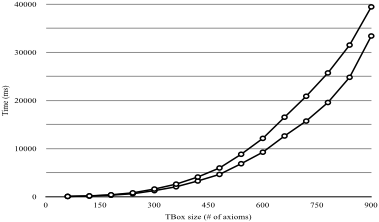
In addition to the DL'98 benchmarks, we have also developed a battery of synthetic benchmarks aimed at checking the scalability of TREEHUG. In these tests we used small "modules" of three axioms to build a TBox of an arbitrary size, and asked TREEHUG to check the satisfiability of a concept within a given TBox. Specifically, let T be a TBox containing assertions of the following form:
for every i ∈ [1 : k]. Let T ′ = T ∪ {Cn+1 ⊑ ⊥}. We ask TREEHUG to check whether the concept C1 is satisfiable in T (which is true) and in T ′ (which is false). The results we have obtained are shown in Figure 1.
6 Conclusions
In this work we have described a new automata-based technique for reasoning in expressive DLs. The resulting algorithm can decide the consistence of a concept in a TBox in exponential time, and is thus worst-case optimal. More remarkably, unlike previous automata based approaches, our algorithm seems well suited for implementation: we have indeed developed a prototype reasoner, and its experimental evaluation reveals promising results.
Our approach can be extended to cover a wider range of DLs, beyond ALC f . In particular, it is possible to use this approach to handle any DL for which reasoning can be reduced to testing emptiness of looping tree automata: this includes languages up to SHIQ, but excludes constructs such as regular roles. It does not seem feasible to adapt this algorithm for DLs with nominals, since they break the tree model property on which automata-theoretic approaches rely. On the other hand, we could extend our technique also to reason in the presence of ABoxes, e.g., by using an encoding of the ABox similar to the one presented in [Calvanese et al., 2007]. The actual efficiency of the algorithm in this scenario remains to be evaluated.
Our prototype is still in the initial development phase, and its performance lags behind that of other established and highly optimized DL reasoners. Still, it gives a first positive answer to the long-standing open question of the practical applicability of techniques based on automata on infinite trees to reasoning in expressive DLs.
@inproceedings{ijcai2011p140,
  title     = {A Practical Automata-Based Technique for Reasoning in Expressive Description Logics},
  author    = {Calvanese, Diego and Carbotta, Domenico and Ortiz, Magdalena},
  booktitle = {Proceedings of the Twenty-Second International Joint Conference on
               Artificial Intelligence, {IJCAI-11}},
  publisher = {AAAI Press/International Joint Conferences on Artificial Intelligence},
  editor    = {Toby Walsh},
  pages     = {798--803},
  year      = {2011},
  month     = {7},
  doi       = {10.5591/978-1-57735-516-8/IJCAI11-140},
  url       = {https://doi.org/10.5591/978-1-57735-516-8/IJCAI11-140},
}
TY - CPAPER TI - A Practical Automata-Based Technique for Reasoning in Expressive Description Logics AU - Calvanese, Diego AU - Carbotta, Domenico AU - Ortiz, Magdalena T2 - Proceedings of the Twenty-Second International Joint Conference on Artificial Intelligence, IJCAI-11 PB - AAAI Press/International Joint Conferences on Artificial Intelligence PY - 2011 SP - 798 EP - 803 DO - 10.5591/978-1-57735-516-8/IJCAI11-140 UR - https://doi.org/10.5591/978-1-57735-516-8/IJCAI11-140 ER -Copied
Machine-readable versions of this paper, for tools and AI agents:





