
Where Are the Really Hard Manipulation Problems? The Phase Transition in Manipulating the Veto Rule
Proceedings of the Twenty-First International Joint Conference on Artificial Intelligence. Pages 324-328.
© 2009 International Joint Conferences on Artificial Intelligence
Abstract
Voting is a simple mechanism to aggregate the preferences of agents. Many voting rules have been shown to be NP-hard to manipulate. However, a number of recent theoretical results suggest that this complexity may only be in the worst-case since manipulation is often easy in practice. In this paper, we show that empirical studies are useful in improving our understanding of this issue. We demonstrate that there is a smooth transition in the probability that a coalition can elect a desired candidate using the veto rule as the size of the manipulating coalition increases. We show that a rescaled probability curve displays a simple and universal form independent of the size of the problem. We argue that manipulation of the veto rule is asymptotically easy for many independent and identically distributed votes even when the coalition of manipulators is critical in size. Based on this argument, we identify a situation in which manipulation is computationally hard. This is when votes are highly correlated and the election is hung. We show, however, that even a single uncorrelated voter is enough to make manipulation easy again.Toby Walsh
- [Achlioptas, 1999] D. Achlioptas. Threshold phenomena in ran- dom graph colouring and satisfiability. PhD thesis, Dept. of Computer Science, University of Toronto, 1999.
- [Bartholdi and Orlin, 1991] J.J. Bartholdi and J.B. Orlin. Single transferable vote resists strategic voting. Social Choice and Wel- fare, 8(4):341-354, 1991.
- [Bartholdi et al., 1989] J.J. Bartholdi, C.A. Tovey, and M.A. Trick. The computational difficulty of manipulating an election. Social Choice and Welfare, 6(3):227-241, 1989.
- [Cheeseman et al., 1991] P. Cheeseman, B. Kanefsky, and W.M. Taylor. Where the really hard problems are. In Proc. of 12th IJCAI, 331-337, 1991. IJCAI
- [Coleman and Teague, 2007] T. Coleman and V. Teague. On the complexity of manipulating elections. In Proc. of 13th Aus- tralasian Theory Symposium, 2007.
- [Conitzer and Sandholm, 2006] V. Conitzer and T. Sandholm. Nonexistence of voting rules that are usually hard to manipulate. In Proc. of 21st Nat. Conf. on AI, AAAI, 2006.
- [Conitzer et al., 2007] V. Conitzer, T. Sandholm, and J. Lang. When are elections with few candidates hard to manipulate. JACM, 54, 2007.
- [Frank et al., 1998] J. Frank, I.P. Gent and T. Walsh. Asymptotic and Finite Size Parameters for Phase Transitions: Hamiltonian Circuit as a Case Study. Inf. Process. Lett. 65(5): 241-245, 1998.
- [Friedgut et al., 2008] E. Friedgut, G. Kalai, and N. Nisan. Elec- tions can be manipulated often. In Proc. 49th FOCS, 2008.
- [Gent et al., 1995] I.P. Gent, E. MacIntyre, P. Prosser and T. Walsh. Scaling Effects in the CSP Phase Transition. In Proc. CP-95, 70-87, 1995.
- [Gent and Walsh, 1994] I.P. Gent and T. Walsh. The SAT Phase Transition. In Proc. ECAI 1994, 1994.
- [Gent and Walsh, 1996a] I.P. Gent and T. Walsh. Phase Transitions and Annealed Theories: Number Partitioning as a Case Study. In Proc. ECAI 2006, 2006.
- [Gent and Walsh, 1996b] I.P. Gent and T. Walsh. The TSP Phase Transition. Artificial Intelligence, 88(1-2): 349-358, 1996.
- [Gent and Walsh, 1998] I.P. Gent and T. Walsh. Analysis of heuristics for number partitioning. Computational Intelligence, 14(3):430-451, 1998.
- [Karmarkar et al., 1986] N. Karmarkar, R. Karp, J. Lueker, and A. Odlyzko. Probabilistic analysis of optimum partitioning. J. of Applied Probability, 23:626-645, 1986.
- [Korf, 1995] R. Korf. From approximate to optimal solutions: A case study of number partitioning. In Proc. of 14th IJCAI, 1995. IJCAI
- [Lang et al., 2007] J. Lang, M. Pini, F. Rossi, K. Venable and T. Walsh. Winner Determination in Sequential Majority Voting. In Proc. of 20th IJCAI, 1372-12377, 2007. IJCAI
- [Mitchell et al., 1992] D. Mitchell, B. Selman, and H. Levesque. Hard and Easy Distributions of SAT Problems. In Proc. of 10th Nat. Conf. on AI, AAAI, 1992.
- [Pini et al., 2007] M. Pini, F. Rossi, K. Venable and T. Walsh. In- completeness and Incomparability in Preference Aggregation. In Proc. of 20th IJCAI, 1464-1469, 2007. IJCAI
- [Pini et al., 2008] M. Pini, F. Rossi, K. Venable and T. Walsh. Dealing with Incomplete Agents' Preferences and an Uncertain Agenda in Group Decision Making via Sequential Majority Vot- ing. In Proc. of 11th KR, 571-578, 2008.
- [Procaccia and Rosenschein, 2007a] A. D. Procaccia and J. S. Rosenschein. Average-case tractability of manipulation in voting via the fraction of manipulators. In Proc. of AAMAS-07, 2007.
- [Procaccia and Rosenschein, 2007b] A. D. Procaccia and J. S. Rosenschein. Junta distributions and the average-case complex- ity of manipulating elections. JAIR, 28:157-181, 2007.
- [Vandegriend and Culberson, 1998] B. Vandegriend and J. Culber- son. The G(n,m) phase transition is not hard for the Hamiltonian cycle problem. JAIR, 9:219-245, 1998.
- [Walsh, 2002] T. Walsh. From P to NP: COL, XOR, NAE, 1-in-k, and Horn SAT. In Proc. of 17th Nat. Conf. on AI, AAAI, 2002.
- [Walsh, 2007] T. Walsh. Uncertainty in Preference Elicitation and Aggregation. In Proc. of 22nd Nat. Conf. on AI, AAAI, 2007.
- [Walsh, 2008] T. Walsh. Complexity of terminating preference elic- itation. In Proc. of 7th Int. Joint Conf. on Autonomous Agents and Multiagent Systems, 2008.
- [Xia and Conitzer, 2008a] Lirong Xia and Vincent Conitzer. Gen- eralized scoring rules and the frequency of coalitional manipula- bility. In Proc. of 9th ACM Conf. on Electronic Commerce, 2008.
- [Xia and Conitzer, 2008b] Lirong Xia and Vincent Conitzer. A suf- ficient condition for voting rules to be frequently manipulable. In Proc. of 9th ACM Conf. on Electronic Commerce, 2008.
References were extracted automatically from the PDF and may contain errors.
Full text extracted automatically from the PDF; figures, tables and equations may differ. The PDF is the version of record.
1 Introduction
The Gibbard-Satterthwaite theorem proves that, under some simple assumptions, most voting rules are manipulable. That is, it may pay for an agent not to report their preferences truthfully. One possible escape from this result was proposed by Bartholdi, Tovey and Trick [Bartholdi et al., 1989]. Whilst a manipulation may exist, perhaps it is computationally too difficult to find. Many results have subsequently been proven showing that various voting rules are NP-hard to manipulate under different assumptions including: an unbounded number of candidates; a small number of candidates but weighted votes; and uncertainty in the distribution of votes. See, for instance, [Bartholdi et al., 1989; Bartholdi and Orlin, 1991; Conitzer et al., 2007]. There is, however, increasing concern that worst-case results like these may not reflect the difficulty of manipulation in practice. Indeed, a number of recent theoretical results suggest that manipulation may often be computationally easy [Conitzer and Sandholm, 2006; Procaccia and Rosenschein, 2007b; Xia and Conitzer, 2008a; Friedgut et al., 2008; Xia and Conitzer, 2008b].
∗NICTA is funded by the Australian Government through the Department of Broadband, Communications and the Digital Economy and the Australian Research Council.
In this paper we show that, in addition to attacking this question theoretically, we can profitably study it empirically. There are several reasons why empirical analysis is useful. First, theoretical analysis is often asymptotic so does not show the size of hidden constants. In addition, elections are typically bounded in size. Can we be sure that asymptotic behaviour is relevant for the finite sized electorates met in practice? Second, theoretical analysis is often restricted to particular distributions (e.g. independent and identically distributed votes). Manipulation may be very different in practice due to correlations between votes. For instance, if all preferences are single-peaked then there are voting rules which cannot be manipulated. It is in the best interests of all agents to state their true preferences. Third, many of these theoretical results about the easiness of manipulation have been hard won and are limited in their scope. For instance, Friedgut et al. were not able to extend their result beyond three candidates [Friedgut et al., 2008]. An empirical study may quickly suggest if the result extends to more candidates. Finally, empirical studies may suggest new avenues for theoretical study. For example, the experiments reported here suggest a simple and universal form for the probability that a coalition is able to elect a desired candidate. It would be interesting to try to derive this form theoretically.
2 Background
We suppose that there are n agents who have voted and a coalition of m additional agents who wish to manipulate the result. When the manipulating coalition is small, they have too little weight to be able to change the result. On the other hand, when the coalition is large, they are sure to be able to make their desired candidate win. Procaccia and Rosenschein proved that for most scoring rules and a wide variety of distributions over votes, when m = o(√n), the probability that a manipulating coalition can change the result tends to 0, and when m = ω(√n), the probability that they can manipulate the result tends to 1 [Procaccia and Rosenschein, 2007a]. They offer two interpretations of this result. On the positive side, they suggest it may focus attention on other distributions which are computationally hard to manipulate. On the negative side, they suggest that it may strengthen the argument that manipulation problems are easy on average.
More recently, Xia and Conitzer have shown that for a large class of voting rules, as the number of agents grows, either the probability that a coalition can manipulate the result is very small (as the coalition is too small), or the probability that they can easily manipulate the result to make any alternative win is very large [Xia and Conitzer, 2008a]. They leave open only a small interval in the size of the coalition for which the coalition is large enough to be able to manipulate but not obviously large enough to be able to manipulate the result easily. More precisely, for a wide range of voting rules including scoring rules, STV, Copeland and maximin, with votes which are drawn independently and with an identical distribution that is positive everywhere, they identify three cases:
- if m = O(np ) for p < 12 then the probability that the result can be changed is O( 1 √n );
- if m = Ω(np ) for p > 12 and o(n) and votes are uniform then the probability that the result can be manipulated is 1 - O(e-Θ(n2p-1 ) ) using a simple greedy procedure;
- if m = Θ(√n) then they provide no result.
In this paper, we shall provide empirical evidence to help close this gap and understand what happens when the coalition is of a critical size that grows as Θ(√n).
3 Finding manipulations
We focus on the veto rule. This is a scoring rule in which each agent gets to cast a veto against one candidate. The candidate with the fewest vetoes wins. We suppose that tie-breaking is in favor of the manipulators. However, it is easy to relax this assumption. There are several reason why we start this investigation into the complexity of manipulation with the veto rule. First, the veto rule is very simple to reason about. This can be contrasted with other voting rules that are computationally hard to manipulate. For example, the STV rule is NP-hard to manipulate [Bartholdi and Orlin, 1991] but this complexity appears to come from reasoning about what happens between the different rounds. Second, the veto rule is on the borderline of tractability since constructive manipulation of the rule by a coalition of weighted agents is NP-hard but destructive manipulation is polynomial [Conitzer et al., 2007]. Third, as the next theorem shows, number partitioning algorithms can be used to compute a successful manipulation of the veto rule. More precisely, manipulation of an election with 3 candidates and weighted votes (which is NP-hard [Conitzer et al., 2007]) can be directly reduced to 2-way number partitioning. We therefore compute manipulations in our experiments using the efficient CKK algorithm [Korf, 1995].
Theorem 1 There exists a successful manipulation of an election with 3 candidates by a weighted coalition using the veto rule iff there exists a partitioning of W ∪ {|a - b|} into two bags such that the difference between their two sums is less than or equal to a+b-2c+∑i∈W i where W is the multiset of weights of the manipulating coalition, a, b and c are the weights of vetoes assigned to the three candidates by the non-manipulators and the manipulators wish the candidate with weight c to win.
Proof: It never helps a coalition manipulating the veto rule to veto the candidate that they wish to win. The coalition does, however, need to decide how to divide their vetoes between the candidates that they wish to lose. Consider the case a ≥ b. Suppose the partition has weights w - Δ/2 and w + Δ/2 where 2w = ∑i∈W∪{|a-b|} i and Δ is the difference between the two sums. The same partition of vetoes is a successful manipulation iff the winning candidate has no more vetoes than the next best candidate. That is, c ≤ b + (w - Δ/2). Hence Δ ≤ 2w + 2b - 2c = (a - b) + 2b - 2c + ∑i∈W i = (a + b - 2c)+2 ∑i∈W i. In the other case, a < b and Δ ≤ (b + a - 2c)+ ∑i∈W i. Thus Δ ≤ a + b - 2c + ∑i∈W i. ✷
Similar arguments can be given to show that the manipulation of a veto election of p candidates can be reduced to finding a p - 1-way partition of numbers, and that manipulation of any scoring rule with 3 candidates and weighted votes can be reduced to 2-way number partitioning. However, manipulating elections with greater than 3 candidates and scoring rules other than veto or plurality appears to require other computational approaches.
4 Uniform votes
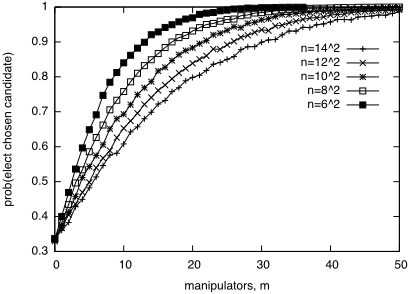
We consider the case that the n agents veto uniformly at random one of the 3 possible candidates, and vetoes carry weights drawn uniformly from (0, k]. When the coalition is small in size, it has too little weight to be able to change the result. On the other hand, when the coalition is large in size, it is sure to be able to make a favored candidate win. There is thus a transition in the manipulability of the problem as the coalition size increases (see Figure 1).
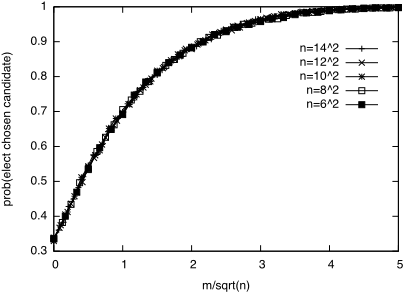
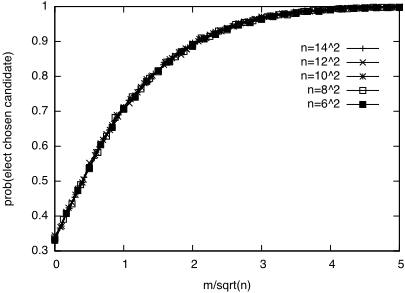
Based on [Procaccia and Rosenschein, 2007a; Xia and Conitzer, 2008a], we expect the critical coalition size to increase as √n. In Figure 2, we see that the phase transition displays a simple and universal form when plotted against m/√n. The phase transition appears to be smooth, with the probability varying slowly and not approaching a step function as problem size increases. We obtained a good fit with 123 e-m/√n . Other smooth phase transitions have been seen with 2-coloring [Achlioptas, 1999], 1-in-2 satisfiability and Not-All-Equal 2-satisfiability [Walsh, 2002]. It is interesting to note that all these decision problems are polynomial.
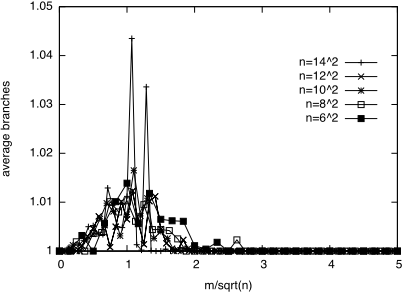
The theoretical results mentioned earlier leave open how hard it is to compute whether a manipulation is possible when the coalition size is critical. Figure 3 displays the computational cost to find a manipulation (or prove none exists) using the efficient CKK algorithm. Even in the critical region where problems may or may not be manipulable, it is easy to compute whether the problem is manipulable. All problems are solved in a few branches. This contrasts with phase transition behaviour in problems like satisfiability [Cheeseman et al., 1991; Mitchell et al., 1992; Gent and Walsh, 1994], constraint satisfaction [Gent et al., 1995], number partitioning [Gent and Walsh, 1996a; 1998] and the traveling salesman problem [Gent and Walsh, 1996b] where the hardest problems occur around the phase transition.
5 Why hard problems are rare
Based on our reduction of manipulation problems to number partitioning, we give a heuristic argument why hard manipulation problems become vanishing rare as n ❀ ∞ and m = Θ(√n). The basic idea is simple: by the time the coalition is large enough to be able to change the result, the variance in scores between the candidates is likely to be so large that computing a successful manipulation or proving none is possible will be easy.
Suppose that the manipulators want candidates A and B to lose so that C wins, and that the non-manipulators have cast vetoes of weight a, b and c for A, B and C respectively. Without loss of generality we suppose that a ≥ b. There are three cases to consider. In the first case, a ≥ c and b ≥ c. It is then easy for the manipulators to make C win since C wins whether they veto A or B. In the second case, a ≥ c > b. Again, it is easy for the manipulators to decide if they can make C win. They all veto B. There is a successful manipulation iff C now wins. In the third case, a < c and b < c. The manipulators must partition their m vetoes between A and B so that the total vetoes received by A and B exceeds those for C. Let d be the deficit in weight between A and C and between B and C. That is, d = (c-a)+(c-b) = 2c-a-b. We can model d as the sum of n random variables drawn uniformly with probability 1/3 from [0, 2k] and with probability 2/3 from [-k, 0]. These variables have mean 0 and variance 2k2 /3. By the Central Limit Theorem, d tends to a normal distribution with mean 0, and variance s2 = 2nk2 /3. For a manipulation to be possible, d must be less than w, the sum of the weights of the vetoes of the manipulators. By the Central Limit Theorem, w also tends to a normal distribution with mean μ = mk/2, and variance σ2 = 2mk2 /3.
A simple heuristic argument due to [Karmarkar et al., 1986] and also based on the Central Limit Theorem upper bounds the optimal partition difference of m numbers from (0, k] by O(k√m/2m). In addition, based on the phase transition in number partitioning [Gent and Walsh, 1998], we expect partitioning problems to be easy unless log2(k) = Θ(m). Combining these two observations, we expect hard manipulation problems when 0 ≤ w - d ≤ α√m for some constant α. The probability of this occurring is:
As e-z ≤ 1 for z > 0, this is upper bounded by:
Since the integral is bounded by 1, m = Θ(√n) and log2(k) = Θ(m), this upper bound varies as:
Thus, we expect hard instances of manipulation problems to be exponentially rare. Since even a brute force manipulation algorithm takes O(2m) time in the worst-case, we do not expect the hard instances to have a significant impact on the average-case as n (and thus m) grows. We stress this is only a heuristic argument. It makes assumptions about the complexity of manipulation problems (in particular that hard instances should lie within the narrow interval 0 ≤ w - d ≤ α√m). These assumptions are currently only supported by empirical observation and informal argument. However, the experimental results reported in Figure 3 support these conclusions.
6 Varying weights
The theoretical analyses of manipulation in [Procaccia and Rosenschein, 2007a; Xia and Conitzer, 2008a] suggest that the probability of an election being manipulable is largely independent of k, the size of the weights attached to the vetoes. Figure 4 demonstrates that this indeed appears to be the case in practice. When weights are varied in size from 28 to 216 ,
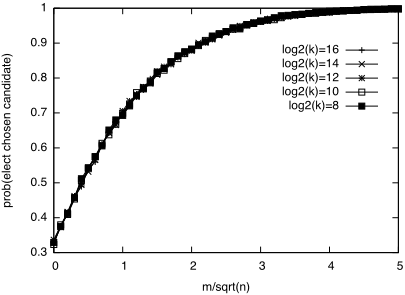
the probability does not appear to change. In fact, the probability curve fits the same simple and universal form plotted in Figure 2. We also observed that the cost of computing a manipulation or proving that none is possible did not change as the weights were varied in size.
7 Normally distributed votes
What happens with other distributions of votes? The theoretical analyses of manipulation in [Procaccia and Rosenschein, 2007a; Xia and Conitzer, 2008a] suggest that there is a critical coalition size that increases as Θ(√n) for many types of independent and identically distributed random votes. Similarly, our heuristic argument about why hard manipulation problems are vanishingly rare depends on application of the Central Limit Theorem. It therefore works with other types of independent and identically distributed random votes.
We shall consider therefore another type of independent and identically distributed vote. In particular, we study an election in which weights are independently drawn from a normal distribution. Figure 5 shows that there is again a smooth phase transition in manipulability. We also plotted Figure 5 on top of Figures 2 and 4. All curves appear to fit the same simple and universal form. As with uniform weights, the computational cost of deciding if an election is manipulable was small even when the coalition size was critical. Finally, we varied the parameters of the normal distribution. The probability of electing a chosen candidate as well as the cost of computing a manipulation did not appear to depend on the mean or variance of the distribution.
8 Correlated votes
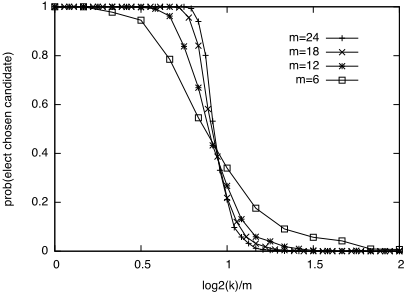
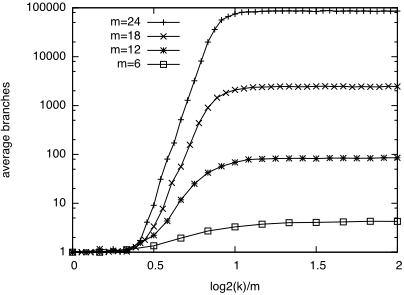
We conjecture that one place to find hard manipulation problems is where votes are more correlated. For example, consider a "hung" election where all n agents veto the candidate that the manipulators wish to win, but the m manipulators have exactly twice the weight of vetoes of the n agents. This election is finely balanced. The favored candidate of the manipulators wins iff the manipulators perfectly partition their vetoes between the two candidates that they wish to lose. In Figure 6, we plot the probability that the mmanipulators can make their preferred candidate win in such a "hung" election as we vary the size of their weights k. Similar to number partitioning [Gent and Walsh, 1998], we see a rapid transition in manipulability around log2(k)/m ≈ 1. In Figure 7, we observe that there is a rapid increase in the computationally complexity to compute a manipulation around this point.
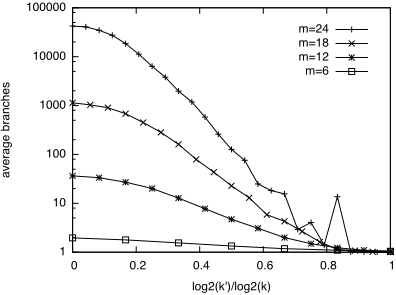
What happens when the votes are less correlated? We consider an election which is perfectly hung as before except for one agent who votes at random between the three candidates. In Figure 8, we plot the cost of computing a manipulation as the weight of this single random veto increases. Even one uncorrelated vote is enough to make manipulation easy if it has the same magnitude in weight as the vetoes of the manipulators. This suggests that we will only find hard manipulation problems in when votes are highly correlated.
9 Other related work
There have been a number of other recent theoretical results about the computational complexity of manipulating elections. For instance, Procaccia and Rosenschein give a simple greedy procedure that will find a manipulation of a scoring rule for any "junta" distribution of weighted votes in polynomial time with a probability of failure that is an inverse polynomial in n [Procaccia and Rosenschein, 2007b]. A "junta" distribution is concentrated on the hard instances.
As a second example, Friedgut, Kalai and Nisan prove that if the voting rule is neutral and far from dictatorial and there are 3 candidates then there exists an agent for whom a random manipulation succeeds with probability Ω( 1n ) [Friedgut et al., 2008]. Xia and Conitzer showed that, starting from different assumptions, a random manipulation would succeed with probability Ω( 1n ) for 3 or more candidates for STV, for 4 or more candidates for any scoring rule and for 5 or more candidates for Copeland [Xia and Conitzer, 2008b].
Coleman and Teague provide polynomial algorithms to compute a manipulation for the STV rule when either the number of voters or the number of candidates is fixed [Coleman and Teague, 2007]. They also conducted an empirical study which demonstrates that only relatively small coalitions are needed to change the elimination order of the STV rule. They observe that most uniform and random elections are not trivially manipulable using a simple greedy heuristic.
Finally, similar phenomena have been observed in the phase transition for the Hamiltonian cycle problem [Frank et al., 1998; Vandegriend and Culberson, 1998]. If the number of edges is small, there is likely to be a node of degree smaller than 2. There cannot therefore be any Hamiltonian cycle. By the time that there are enough edges for all nodes to be of degree 2, there are likely to be many possible Hamiltonian cycles and even a simple heuristic can find one. Thus, the phase transition in the existence of a Hamiltonian cycle is not associated with hard instances of the problem. The behavior seen here is similar. By the time the coalition is large enough to manipulate the result, the variance in scores between the candidates is likely to be so large that computing a successful manipulation or proving none is possible is easy.
10 Conclusions
We have studied whether computational complexity is a barrier to the manipulation for the veto rule. We showed that there is a smooth transition in the probability that a coalition can elect a desired candidate as the size of the manipulating coalition is varied. We demonstrated that a rescaled probability curve displays a simple universal form independent of problem size. Unlike phase transitions for other NPcomplete problems, hard problems are not associated with this transition. Finally, we studied the impact of correlation between votes. We showed that manipulation is hard when votes are highly correlated and the election is "hung". However, even one uncorrelated voter was enough to make manipulation easy again.
What lessons can be learnt from this study? First, there appears to be an universal form for the probability that a coalition can manipulate the result. Can we derive this theoretically? Second, whilst we have focused on the veto rule, similar behavior is likely with other voting rules. It would, for instance, be interesting to study a more complex rule like STV which is NP-hard to manipulate without weights. Third, is there a connection between the smoothness of the phase transition and problem hardness? Sharp phase transitions like that for satisfiability are associated with hard decision problems, whilst smooth transitions are associated with easy instances of NP-hard problems and with polynomial problems like 2-colorability. Fourth, these results demonstrate that empirical studies improve our understanding of manipulation. It would be interesting to consider similar studies for related problems like preference elicitation [Walsh, 2007; 2008; Lang et al., 2007; Pini et al., 2007; 2008].
@inproceedings{ijcai2009p62,
  title     = {Where Are the Really Hard Manipulation Problems? The Phase Transition in Manipulating the Veto Rule},
  author    = {Walsh, Toby},
  booktitle = {Proceedings of the Twenty-First International Joint Conference on
               Artificial Intelligence, {IJCAI-09}},
  publisher = {International Joint Conferences on Artificial Intelligence},
  editor    = {Craig Boutilier},
  pages     = {324--328},
  year      = {2009},
  url       = {https://ijcai.org/proceedings/2009/62},
}
TY - CPAPER TI - Where Are the Really Hard Manipulation Problems? The Phase Transition in Manipulating the Veto Rule AU - Walsh, Toby T2 - Proceedings of the Twenty-First International Joint Conference on Artificial Intelligence, IJCAI-09 PB - International Joint Conferences on Artificial Intelligence PY - 2009 SP - 324 EP - 328 UR - https://ijcai.org/proceedings/2009/62 ER -Copied
Machine-readable versions of this paper, for tools and AI agents:





