
Representation and Synthesis of Melodic Expression
Proceedings of the Twenty-First International Joint Conference on Artificial Intelligence. Pages 1475-1479.
© 2009 International Joint Conferences on Artificial Intelligence
Abstract
A method for expressive melody synthesis is presented seeking to capture the prosodic (stress and directional) element of musical interpretation. An expressive performance is represented as a note-level annotation, classifying each note according to a small alphabet of symbols describing the role of the note within a larger context. An audio performance of the melody is represented in terms of two time-varying functions describing the evolving frequency and intensity. A method is presented that transforms the expressive annotation into the frequency and intensity functions, thus giving the audio performance. The problem of expressive rendering is then cast as estimation of the most likely sequence of hidden variables corresponding to the prosodic annotation. Examples are presented on a dataset of around 50 folk-like melodies, realized both from hand-marked and estimated annotations.Christopher Raphael
- [Blood and Patterson, 1992] Peter Blood and Annie Patter- son. Rise Up Singing. Sing Out!, Bethlehem, PA, 1992.
- [Breiman et al., 1984] L. Breiman, J. Friedman, R. Olshen, and C. Stone. Classification and Regression Trees. Wadsworth and Brooks, Monterey, CA, 1984.
- [Friberg et al., 2006] A. Friberg, R. Bresin, and J. Sundberg. Overview of the kth rule system for musical performance. Advances in Cognitive Psychology, 2(2-3):145-161, 2006.
- [Goebl et al., 2008] Werner Goebl, Simon Dixon, Giovanni De Poli, Anders Friberg, Roberto Bresin, and Gerhard Widmer. Sense in expressive music performance: Data acquisition, computational studies, and models, chapter 5, pages 195-242. Logos Verlag, Berlin, may 2008.
- [Roads, 1996] Curtis Roads. The Computer Music Tutorial. MIT Press, 1996.
- [Sundberg, 2006] J. Sundberg. The kth synthesis of singing. Advances in Cognitive Psychology. Special issue on Music Performance, 2(2-3):131-143, 2006.
- [Todd, 1995] N. P. M. Todd. The kinematics of musical ex- pression. Journal of the Acoustical Society of America, 97(3):1940-1949, 1995.
- [Widmer and Goebl, 2004] Gerhard Widmer and Werner Goebl. Computational models for expressive music per- formance: The state of the art. Journal of New Music Re- search, 33(3):203-216, 2004.
- [Widmer and Tobudic, 2003] Gehard Widmer and A. Tobu- dic. Playing mozart by analogy: Learning multi-level tim- ing and dynamics strategies. Journal of New Music Re- search, 33(3):203-216, 2003.
- [Zhu and Hastie, 2004] J. Zhu and T. Hastie. Classification of gene microarrays by penalized logistic regression. Bio- statistics, 5(3):427-443, 2004.
References were extracted automatically from the PDF and may contain errors.
Full text extracted automatically from the PDF; figures, tables and equations may differ. The PDF is the version of record.
1 Introduction
A traditional musical score represents music symbolically in terms of notes, formed from a discrete alphabet of possible pitches and durations. Human performance of music often deviates substantially from the score's cartoon-like recipe, by inflecting, stretching and coloring the music in ways that bring it to life. Expressive music synthesis seeks algorithmic approaches to this expressive rendering task, so natural to humans.
A successful method for expressive synthesis would breathe life into the otherwise sterile performances that accompany electronic greeting cards, cellphone ring tones, and other mechanically rendered music. It would allow scorewriting programs - now as common with composers as word processors are to writers - to play back compositions in pleasing ways that anticipate the composer's musical intent. Expressive synthesis would provide guiding interpretive principles for musical accompaniment systems and give composers of computer music a means of algorithmically inflecting their music. Utility aside, we are attracted to this problem as a basic example of human intelligence, often thought to be uniquely human. While humans may be the only ones that can appreciate expressively inflected music, we doubt the same is true for the construction of musical expression.
∗This work supported by NSF grants IIS-0739563 and IIS0812244
Most past work on expressive synthesis, for example [Widmer and Goebl, 2004], [Goebl et al., 2008], [Todd, 1995], [Widmer and Tobudic, 2003], as well as the many RENCON piano competition entries, has concentrated on piano music for one simple reason: a piano performance can be described by giving the onset time, damping time, and initial loudness of each note. Since a piano performance is easy to represent, it is easy to define the task of expressive piano synthesis as an estimation problem: one must simply estimate these three numbers for each note. In contrast, we treat here the synthesis of melody, which finds its richest form with "continuously controlled" instruments, such as the violin, saxophone or voice. This area has been treated by a handful of authors, perhaps with most success by the KTH group [Sundberg, 2006], [Friberg et al., 2006]. These continuously controlled instruments simultaneously modulate many different parameters leading to wide variety of tone color, articulation, dynamics, vibrato, and other musical elements, making it difficult to represent the performance of a melody. However, it is not necessary to replicate any of these familiar instruments to effectively address the heart of the melody synthesis problem. We will propose a minimal audio representation we call the theremin, due to its obvious connection with the early electronic instrument by the same name [Roads, 1996]. Our theremin controls only time-varying pitch and intensity, thus giving a relatively simple, yet capable, representation of a melody performance.
The efforts cited above are examples of what we see as the most successful attempts to date. All of these approaches map observable elements in the musical score, such as note length and pitch, to aspects of the performance, such as tempo and dynamics. The KTH system, which represents several decades of focused effort, is rule-based. Each rule maps various musical contexts into performance decisions, which can be layered, so that many rules can be applied. The rules were chosen, and iteratively refined, by a music expert seeking to articulate and generalize a wealth of experience into performance principles, in conjunction with the KTH group. In contrast, the work of [Widmer and Goebl, 2004], [Widmer and Tobudic, 2003] takes a machine learning perspective by automatically learning rules from actual piano performances. We share the perspective of machine learning. In the latter example, phrase-level tempo and dynamic curve estimates are combined with the rule-based prescriptions through a casebased reasoning paradigm. That is, this approach seeks musical phrases in a training set that are "close" to the phrase being synthesized, using the tempo and dynamic curves from the best training example. As with the KTH work, the performance parameters are computed directly from the observable score attributes with no real attempt to describe any interpretive goals such as repose, passing tone, local climax, surprise, etc.
Our work differs significantly from these, and all other past work we know of, by explicitly trying to represent aspects of the interpretation itself. Previous work does not represent the interpretation, but rather treats the consequences of this interpretation, such as dynamic and timing changes. We introduce a hidden sequence of variables representing the prosodic interpretation (stress and grouping) itself by annotating the role of each note in the larger prosodic context. We believe this hidden sequence is naturally positioned between the musical score and the observable aspects of the interpretation. Thus the separate problems of estimating the hidden annotation and generating the actual performance from the annotation require shorter leaps, and are therefore easier, than directly bridging the chasm that separates score and performance.
Once we have a representation of interpretation, it is possible to estimate the interpretation for a new melody. Thus, we pose the expressive synthesis problem as one of statistical estimation and accomplish this using familiar methodology from the statistician's toolbox. We present a deterministic transformation from our interpretation to the actual theremin parameters, allowing us to hear both hand labeled and estimated interpretations. We present a data set of about 50 handannotated melodies, as well as expressive renderings derived from both the hand-labeled and estimated annotations. A brief user study helps to contextualize the results, though we hope readers will reach independent judgments.
2 The Theremin
Our goal of expressive melody synthesis must, in the end, produce actual sound. We focus here on an audio representation we believe provides a good trade-off between expressive power and simplicity.
Consider the case of a sine wave in which both frequency, f (t), and amplitude, a(t), are modulated over time:
These two time-varying parameters are the ones controlled in the early electronic instrument known as the theremin. Continuous control of these parameters can produce a variety of musical effects such as expressive timing, vibrato, glissando, variety of attack and dynamics. Thus, the theremin is capable of producing a rich range of expression. One significant aspect of musical expression which the theremin cannot capture is tone color - as a time varying sine wave, the timbre of the theremin is always the same. Partly because of this weakness, we have allowed the tone color to change as a function of amplitude, leading to the model
where the {Ah} are fixed functions, monotonically increasing in the first argument. The model of Eqn. 2 produces a variety of tone colors, but still retains the simple parameterization of the signal in terms of f (t) and a(t). The main advantage this model has to that of Eqn. 1 is that subtle changes in a(t) are more easily perceived, in effect giving a greater effective dynamic range.
Different choices of the Ah functions lead to various instrumental timbres that resemble familiar instruments on occasion. If this happens, however, it is purely by accident, since we do not seek to create something like a violin or saxophone. Rather we simply need a sound parameterization that has the potential to create expressive music.
3 Representing Musical Interpretation
There a number of aspects to musical interpretation which we cannot hope to do justice to here, though we describe several to help place the current effort in a larger context.
Music often has a clearly defined hierarchical structure composed of small units that group into larger and larger units. Conveying this structure is one of the main tasks of interpretation including the clear delineation of important structural boundaries as well as using contrast to distinguish structural units. Like good writing, not only does the interpretation need to convey this top-down tree-like structure, but it must also flow at the lowest level. This flow is largely the domain of what we call musical prosody - the placing, avoidance, and foreshadowing of local (note-level) stress. This use of stress often serves to highlight cyclical patterns as well as surprises, directing the listener's attention toward more important events. A third facet of musical interpretation is affect - sweet, sad, calm, agitated, furious, etc. The affect of the music is more like the fabric the interpretation is made of, as opposed to hierarchy and prosody, which are more about what is made from the fabric.
Our focus here is on musical prosody, clearly only a piece of the larger interpretive picture. We make this choice because we believe the notion of "correctness" is more meaningful with prosody than with affect, in addition to the fact that musical prosody is somewhat easy to isolate. The music we treat consists of simple melodies of slow to moderate tempo where legato (smooth and connected) phrasing is appropriate. Thus the range of affect or emotional state has been intentionally restricted, though still allowing for much diversity. In addition, the melodies we choose are short, generally less than half a minute and tend to have simple binary-treelike structure.
We introduce now a way of representing the desired musicality in a manner that makes clear interpretive choices and conveys these unambiguously. Our representation labels each melody note with a symbol from a small alphabet,
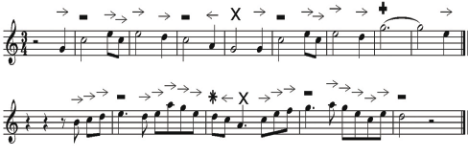
describing the role the note plays in the larger context. These labels, to some extent, borrow from the familiar vocabulary of symbols musicians use to notate phrasing in printed music. The symbols {l-, l×, l+} all denote stresses or points of "arrival." The variety of stress symbols allows for some distinction among the kinds of arrivals we can represent: l- is the most direct and assertive stress; l× is the "soft landing" stress in which we relax into repose; l+ denotes a stress that continues forward in anticipation of future unfolding, as with some phrases that end in the dominant chord. Examples of the use of these stresses, as well as the other symbols are given in Figure 1. The symbols {l→, l∗} are used to represent notes that move forward towards a future goal (stress). Thus these are usually shorter notes we pass through without significant event. Of these, l→ is the garden variety passing tone, while l∗ is reserved for the passing stress, as in a brief dissonance, or to highlight a recurring beat-level emphasis. Finally, the l← symbol denotes receding movement as when a note is connected to the stress that precedes it. This commonly occurs when relaxing out of a dissonance en route to harmonic stability. We will write x = x1, . . . , xN with xn ∈ A for the prosodic labeling of the notes.
These concepts are illustrated with the examples of Amazing Grace and Danny Boy in Figure 1. Of course, there may be several reasonable choices in a given musical scenario, however, we also believe that most labellings do not make interpretive sense and offer evidence of this is Section 7. Our entire musical collection is marked in this manner and available for scrutiny at http://www.music.informatics.indiana.edu/papers/ijcai09.
4 FromLabeling to Audio
Ultimately, the prosodic labeling of a melody, using symbols from A, must be translated into the amplitude and frequency functions we use for sound synthesis. We describe here how a(t) and f (t) are computed from the labeled melody and the associated musical score.
Let tn for n = 1, . . . ,N be the onset time for the nth note of the melody, in seconds. With the exception of allowing extra time for breaths, these times are computed according to a literal interpretation of the score. We let
where c0 is the frequency, in Hz., of the C lying 5 octaves below middle C. Thus, a unit change in either the note profile, f nt (t), or the vibrato profile, f vib(t), represents a semitone.
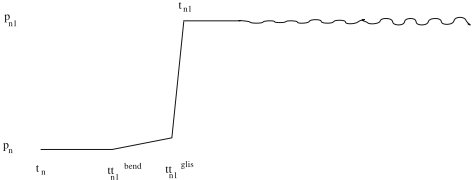
f nt is then given by setting
where pn is the "MIDI" pitch of the nth note (semitones above c0). We extend f nt to all t using linear interpolation. Thus, in an effort to achieve a sense of legato, the pitch is slightly bent in the direction of the next pitch before inserting a glissando to the next pitch. Then we define
where the ramp function, r(t) is defined by
and 1v(xn) is an indicator function that determines the presence or absence of vibrato. Vibrato is applied to all notes except "short" ones labeled as l→ or l←, though the vibrato parameters, αva , αvo depend on the note length. f (t) is sketched from tn to tn+1 in Figure 2.
We represent the theremin amplitude by a(t) = aatk (t)ain (t) where aatk (t) describes the attack profile of the notes and ain(t) gives the overall intensity line. aatk (t) is chosen to create a sense of legato through aatk (t) = ∑Nn=1 ψ(t - tn) where the shape of ψ is chosen to deemphasize the time of note onset.
ain (t) describes the intensity of our sound over time and is central to creating the desired interpretation. To create ain(t) we first define a collection of "knots" {τ jn} where n = 1, . . . , N and j = 1, . . . , J = J (n). Each note, indexed by n, has a knot location at the onset of the note, τ 1 n = tn. However, stressed notes will have several knots, τ 1 n , . . . , τ J n , used to shape the amplitude envelope of the note in different ways, depending on the label xn. We will write λjn = ain (τ jn ) to simplify our notation.
The values of ain at the knot locations, {λjn}, are created by minimizing a penalty function H (λ; x) where λ is the collection of all the {λjn}. The penalty function depends on our labeling, x, and is defined to be
secs
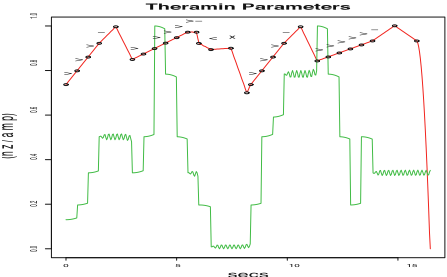
Figure 3: The functions f (t) (green) and ain (t) (red) for the first phrase of Danny Boy. These functions have different units so their ranges have been scaled to 0-1 to facilitate comparison. The points {(τ k n , λkn)} are indicated in the figure as well as the prosodic labels {xn}.
where each Qπ term is a quadratic function, depending on only one or two of the components of λ. In general, the objectives of the {Qπ} may conflict with one another, which is why we pose the problem as optimization rather than constraint satisfaction.
For example, if xn = l→ we want the amplitude to increase over the note. Thus we define a term of Eqn. 3
to encourage the difference in amplitude values to be about →α> 0 while →β > 0 gives the importance of this goal. →α may depend on the note length. Similarly, if xn = l← we define a term of Eqn. 3
to encourage the decrease in amplitude associated with receding notes. In the case of xn = l∗ we have
where ∗ α0> 0 and ∗ α1> 0 encourage the nth note to have greater amplitude than either of its neighbors. If xn = l- we have J (n) = 2 and a term
-
-
with an identical form, but different constants for the other two stresses l+ and l×. Such terms seek an absolute value for the peak intensity. An analogous term seeks to constrain the intensity to a low value for the first note labeled as l→ following a stress or receding label.
There are several other situations which we will not exhaustively list, however, the general prescription presented here continues to hold. Once we have included all of the {Qπ} terms, it is a simple matter to find the optimal λ by solving the linear equation ∇H = 0. We then extend ain(t) to all t by linear interpolation with some additional smoothing. Figure 3 shows an example of ain (t) and f (t) on the same plot.
5 Does the Labeling Capture Musicality?
The theremin parameters, f (t), a(t), and hence the audio signal, s(t), depend entirely on our prosodic labeling, x, and the musical score, through the mapping described in Section 4. We want to understand the degree to which x captures musically important interpretive notions. To this end, we have constructed a dataset of about 50 simple melodies containing a combination of genuine folk songs, folk-like songs, Christmas carols, and examples from popular and art music of various eras. The melodies were chosen to have simple chords, simple phrase structure, all at moderate to slow tempo, and appropriate for legato phrasing. Familiar examples include Danny Boy, Away in a Manger, Loch Lomond, By the Waters of Babylon, etc.
Each melody is notated in a score file giving a symbolic music representation, described as a note list with rhythmic values and pitches, transposed to the key of C major or A minor. The files are prefaced by several lines giving relevant global information such as the time signature, the mode (major or minor), and tempo. Measure boundaries are indicated in the score, showing the positions of the notes in relation to the measure-level grid. Chord changes are marked using text strings describing the functional role of the chord, such as I,IV,V,V/V, annotated by using a variety of sources including guitar tabs from various web collections and the popular "Rise Up Singing" [Blood and Patterson, 1992] folk music fake book, while some were harmonized by the author. Most importantly, each note is given a symbol from our alphabet, A, prescribing the interpretive role of the note, painstakingly hand-labeled by the author. We used a single source of annotation hoping that this would lead to maximally consistent use of the symbols. In addition, breaths (pauses) have also been marked.
We rendered these melodies into audio according to our hand-marked annotations and the process of Section 4. For each of these audio files we provide harmonic context by superimposing sustained chords, as indicated in the scores. While we hope that readers will reach independent conclusions, we found many of the examples are remarkably successful in capturing the relevant musicality.
We do observe some aspects of musical interpretation that are not captured by our representation, however. For example, the interpretation of Danny Boy clearly requires a climax at the highest note, as do a number of the musical examples. We currently do not represent such an event through our markup. It is possible that we could add a new category of stress corresponding to such a highpoint, though we suspect that the degree of emphasis is continuous, thus not well captured by a discrete alphabet of symbols. Another occasional shortcoming is the failure to distinguish contrasting material, as in O Come O Come Emmanuel. This melody has a Gregorian chant-like feel and should mostly be rendered with calmness. However, the short outburst corresponding to the word "Rejoice" takes on a more declarative affect. Our prosodically-oriented markup simply has no way to represent such a contrast of styles. There are, perhaps some other general shortcomings of the interpretations, though we believe there is quite a bit that is "right" in them, especially considering the simplicity of our representation of interpretation.
6 Estimating the Interpretation
The essential goal of this work is to algorithmically generate expressive renderings of melody. Having formally represented our notion of musical interpretation, we can generate an expressive rendering by estimating the hidden sequence of note-level annotations, x1, . . . , xN. Our estimation of this unobserved sequence will be a function of various observables, y1, . . . , yN, where the feature vector yn = y1n, . . . , yJn measures various attributes of the musical score at the nth note.
Some of the features we considered measure surface level attributes such as the time length of the given note, as well as the first and second differences of pitch around the note. Some are derived from the most basic notion of rhythmic structure given by the time signature: from the time signature we can compute the metric strength of the onset position of the note, which we tabulate for each onset position in each time signature. We have noted that our score representation also contains the functional chords (I, V, etc.) for each chord change. From this information we compute boolean features such as whether the note lies in the chord or whether the chord is the tonic or dominant. Other features include the beat length, indicators for chord changes, and categorical features for time signature.
Our fundamental modeling assumption is that our label sequence has a Markov structure, given the data:
where zn = (yn, yn-1). This assumption could be derived by assuming that the sequence of pairs (x1, y1), . . . , (xN , yN ) is Markov, though the conditional assumption of Eqn. 4 is all that we need. The intuition behind this assumption is the observation (or opinion) that much of phrasing results from a cyclic alternation between forward moving notes, {l→, l∗}, stressed notes, {l-, l+, l×}, and optional receding notes {l←}. Usually a phrase boundary is present as we move from either stressed or receding states to forward moving states. Thus the notion of state, as in a Markov chain, seems to be relevant. However, it is, of course, true that music has hierarchical structure not expressible through the regular grammar of a Markov chain. Perhaps a probabilistic context-free grammar may add additional power to the type of approach we present here.
We estimate the conditional distributions p(xn|xn-1, zn) for each choice of xn-1 ∈ A, as well as p(x1|y1), using our labeled data. We will use the notation
for l ∈ A. In training these distributions we split our score data into |A| groups, Dl = {(xli, zli)}, where Dl is the collection of all (class label, feature vector) pairs over all notes that immediately follow a note of class l.
Our first estimation method makes no prior simplifying assumptions and follows the familiar classification tree methodology of CART [Breiman et al., 1984]. That is, for each Dl we begin with a "split," z j > c separating Dl into two sets: D0 l = {(xli, zli) : z j li > c} and D1 l = {(xli, zli) : z j li ≤ c}. We choose the feature, j, and cutoff, c, to achieve maximal "purity" in the sets D0 l and D1 l as measured by the average entropy over the class labels. We continue to split the sets D0 l and D1 l , splitting their "offspring," etc., in a greedy manner, until the number of examples at a tree node is less than some minimum value. pl(x|z ) is then represented by finding the terminal tree node associated with z and using the empirical label distribution over the class labels {xli} whose associated {zli} fall to the same terminal tree node.
We also tried modeling pl(x|z ) using penalized logistic regression [Zhu and Hastie, 2004]. CART and logistic regression give examples of both nonparametric and parametric methods. However, the results of these two methods were nearly identical, so we will not include a parallel presentation of the logistic regression results in the sequel.
Given a piece of music with feature vector z1, . . . , zN,we can compute the optimizing labeling
using dynamic programming. To do this we define p∗1 (x1) = p(x1|y1) and
for n = 2, . . . ,N. We can then trace back the optimal path by ˆxN = argmaxxN p∗n(xN) and ˆxn = an+1(ˆxn+1) for n = N - 1 . . . , 1.
7 Results
We estimated a labeling for each of the M = 50 pieces in our corpus by training our model on the remaining M - 1 pieces and finding the most likely labeling, ˆ x1, . . . , ˆxN, as described above. When we applied our CART model we found that the majority of our features could be deleted with no loss in performance, resulting in a small set of features consisting of the metric strength of the onset position, the first difference in note length in seconds, and the first difference of pitch. When this feature set was applied to the entire data set there were a total of 678/2674 errors (25.3%) with detailed results as presented in Figure 4.
The notion of "error" is somewhat ambiguous, however, since there really is no correct labeling. In particular, the choices among the forward-moving labels: {l∗, l→}, and stress labels: {l-, l×, l+} are especially subject to interpretation. If we compute an error rate using these categories, as indicated in the table, the error rate is reduced to 15.3%. The logistic regression model led similar results with analogous error rates of 26.7% and also 15.3%.
One should note a mismatch between our evaluation metric of recognition errors with our estimation strategy. Using a forward-backward-like algorithm it is possible to compute p(xn|y1, . . . , yN). Thus if we choose ¯xn = argmaxxn∈A p(xn|y1, . . . , yN), then the sequence ¯x1, . . . , ¯xN minimizes the expected number of estimation errors
| l∗ | l→ | l← | l- | l× | l+ | total | |
|---|---|---|---|---|---|---|---|
| l∗ | 135 | 112 | 0 | 18 | 2 | 0 | 267 |
| l→ | 62 | 1683 | 8 | 17 | 0 | 0 | 1770 |
| l← | 3 | 210 | 45 | 6 | 2 | 0 | 266 |
| l- | 49 | 48 | 4 | 103 | 15 | 0 | 219 |
| l× | 5 | 32 | 2 | 65 | 30 | 0 | 134 |
| l+ | 0 | 3 | 0 | 12 | 3 | 0 | 18 |
| total | 254 | 2088 | 59 | 221 | 52 | 0 | 2674 |
We have not chosen this latter metric because we want a sequence that behaves reasonably. It the sequential nature of the labeling that captures the prosodic interpretation, so the most likely sequence ˆx1, . . . , ˆxn seems like a more reasonable choice.
In an effort to measure what we believe to be most important - the perceived musicality of the performances - we performed a small user study. We took a subset of the most well-known melodies of the dataset and created audio files from the random, hand, and estimated annotations. We presented all three versions of each melody to a collection of 23 subjects who were students in the Jacobs School of Music, as well as some other comparably educated listeners. The subjects were presented with random orderings of the three versions, with different orderings for each user, and asked to respond to the statement: "The performance sounds musical and expressive" with the Likert-style ratings 1=strongly disagree, 2=disagree, 3=neutral, 4=agree, 5=strongly agree, as well as to rank the three performances in terms of musicality. Out of a total of 244 triples that were evaluated in this way, the randomly-generated annotation received a mean score of 2.96 while the hand and estimated annotations received mean scores of 3.48 and 3.46. The rankings showed no preference for the hand annotations over the estimated annotations (p = .64), while both the hand and estimated annotations were clearly preferred to the random annotations (p = .0002, p = .0003).
Perhaps the most surprising aspect of these results is the high score of the random labellings - in spite of the meaningless nature of these labellings, the listeners were, in aggregate, "neutral" in judging the musicality of the examples. We believe the reason for this is that musical prosody, the focus of this research, accounts for only a portion of what listeners respond to. All of our examples were rendered with the same sound engine of Section 4 which tries to create a sense of smoothness in the delivery with appropriate use of vibrato and timbral variation. We imagine that the listeners were partly swayed by this appropriate affect, even when the use of stress was not satisfactory. The results also show that our estimation produced annotations that were, essentially, as good as the hand-labeled annotations. This demonstrates, to some extent, a success of our research, though it is possible that this also reflects a limit in the expressive range of our interpretation representation. Finally, while the computer-generated interpretations clearly demonstrate some musicality, the listener rating of 3.46 - halfway between "neutral" and "agree" - show there is considerable room for improvement.
While we have phrased the problem in terms of supervised learning from a hand-labeled training set, the essential approach extends in a straightforward manner to unsupervised learning. This allows, in principle, learning with much larger data sets and richer collections of hidden labels. We look forward to exploring this direction in future work, as well as treating richer grammars than the basic regular grammars of hidden Markov models.
@inproceedings{ijcai2009p247,
  title     = {Representation and Synthesis of Melodic Expression},
  author    = {Raphael, Christopher},
  booktitle = {Proceedings of the Twenty-First International Joint Conference on
               Artificial Intelligence, {IJCAI-09}},
  publisher = {International Joint Conferences on Artificial Intelligence},
  editor    = {Craig Boutilier},
  pages     = {1475--1479},
  year      = {2009},
  url       = {https://ijcai.org/proceedings/2009/247},
}
TY - CPAPER TI - Representation and Synthesis of Melodic Expression AU - Raphael, Christopher T2 - Proceedings of the Twenty-First International Joint Conference on Artificial Intelligence, IJCAI-09 PB - International Joint Conferences on Artificial Intelligence PY - 2009 SP - 1475 EP - 1479 UR - https://ijcai.org/proceedings/2009/247 ER -Copied
Machine-readable versions of this paper, for tools and AI agents:





