
A Structural Approach to Reasoning with Quantified Boolean Formulas
Proceedings of the Twenty-First International Joint Conference on Artificial Intelligence. Pages 596-601.
© 2009 International Joint Conferences on Artificial Intelligence
Abstract
In this paper we approach the problem of reasoning with quantified Boolean formulas (QBFs) by combining search and resolution, and by switching between them according to structural properties of QBFs. We provide empirical evidence that QBFs which cannot be solved by search or resolution alone, can be solved by combining them, and that our approach makes a proof-of-concept implementation competitive with current QBF solvers.Luca Pulina, Armando Tacchella
- [Benedetti, 2005] M. Benedetti. sKizzo: a Suite to Evalu- ate and Certify QBFs. In 20th Int.l. Conf. on Automated Deduction, volume 3632 of LNCS, pages 369-376, 2005.
- [Biere, 2004] A. Biere. Resolve and Expand. In 7th Intl. Conf. on Theory and Applications of Satisfiability Testing, volume 3542 of LNCS, pages 59-70, 2004.
- [Bodlaender, 1996] H.L. Bodlaender. A Linear-Time Al- gorithm for Finding Tree-Decompositions of Small Treewidth. SIAM J. of Computation, 25(6):1305-1317, 1996.
- [Cadoli et al., 1998] M. Cadoli, A. Giovanardi, and M. Schaerf. An algorithm to evaluate quantified boolean formulae. In 15th Nat.l Conf. on Artificial Intelligence, pages 262-267, 1998.
- [Chen and Dalmau, 2005] H. Chen and V. Dalmau. From Pebble Games to Tractability: An Ambidextrous Con- sistency Algorithm for Quantified Constraint Satisfaction. In In proc. of 19th Int.l workshop on Computer Science Logic, volume 3634 of LNCS, pages 232-247, 2005.
- [Eén and Biere, 2005] N. Eén and A. Biere. Effective Pre- processing in SAT through Variable and Clause Elimina- tion. In 8th Intl. Conf. on Theory and Applications of Sat- isfiability Testing, vol. 3569 of LNCS, pages 61-75, 2005.
- [Giunchiglia et al., 2006] E. Giunchiglia, M. Narizzano, and A. Tacchella. Clause-Term Resolution and Learning in Quantified Boolean Logic Satisfiability. Artificial Intel- ligence Research, 26:371-416, 2006.
- [Gottlob et al., 2000] G. Gottlob, N. Leone, and F. Scarcello. A comparison of structural CSP decomposition methods. Artificial Intelligence, 124:243-282, 2000. IJCAI
- [Gottlob et al., 2005] G. Gottlob, G. Greco, and F. Scar- cello. The Complexity of Quantified Constraint Satisfac- tion Problems under Structural Restrictions. In 19th Int.l Joint Conference on Artificial Intelligence, pages 150- 155, 2005. IJCAI
- [Kleine-Büning et al., 1995] H. Kleine-Büning, M. Karpin- ski, and A. Flögel. Resolution for Quantified Boolean Formulas. Information and Computation, 117(1):12-18, 1995.
- [Larrosa and Dechter, 2003] J. Larrosa and R. Dechter. Boosting Search with Variable Elimination in Constraint Optimization and Constraint Satisfaction Problems. Con- straints, 8(3):303-326, 2003.
- [Pan and Vardi, 2004] G. Pan and M.Y. Vardi. Symbolic De- cision Procedures for QBF. In 10th Int.l Conf. on Princi- ples and Practice of Constraint Programming, pages 453- 467, 2004.
- [Pan and Vardi, 2006] G. Pan and M.Y. Vardi. Fixed- Parameter Hierarchies inside PSPACE. In 21st IEEE Sym- posium on Logic in Computer Science, pages 27-36, 2006.
- [Peschiera et al., 2008] C. Peschiera, L. Pulina, and A. Tac- cchella. Sixth QBF solvers evaluation (QBFEVAL), 2008. http://www.qbfeval.org/2008. Link
- [Pulina and Tacchella, 2008] L. Pulina and A. Tacchella. Treewidth: a useful marker of empirical hardness in quan- tified Boolean logic encodings. In 15th Int.l Conf. on Logic for Programming, Artificial Intelligence, and Reasoning, volume 5330 of LNCS, 2008.
- [Rish and Dechter, 2000] I. Rish and R. Dechter. Resolution versus search: Two strategies for sat. Journal of Auto- mated Reasoning, 24(1/2):225-275, 2000.
- [Samulowitz and Bacchus, 2006] H. Samulowitz and F. Bac- chus. Binary Clause Reasoning in QBF. In In proc. of Ninth Int.l Conf. on Theory and Applications of Satisfiabil- ity Testing, volume 4121 of LNCS, pages 353-367, 2006.
- [Yu and Malik, 2005] Y. Yu and S. Malik. Verifying the Cor- rectness of Quantified Boolean Formula(QBF) Solvers: Theory and Practice. In Conference on Asia South-Pacific Design Automation, pages 1047-1051, 2005.
References were extracted automatically from the PDF and may contain errors.
Full text extracted automatically from the PDF; figures, tables and equations may differ. The PDF is the version of record.
1 Introduction
The development of the first practically efficient QBF solver can be traced back to [Cadoli et al., 1998], wherein a searchbased solver is proposed. Since then, researchers have proposed improvements to the basic search algorithm including, e.g., backjumping and learning [Giunchiglia et al., 2006], as well as different approaches to the problem including, e.g., skolemization [Benedetti, 2005], and resolution [Biere, 2004; Pan and Vardi, 2004]. However, in spite of such efforts, current QBF reasoners still cannot handle many instances of practical interest. This is witnessed, e.g., by the results of the 2008 QBF solver competition (QBFEVAL'08) where even the most sophisticated solvers failed to decide encodings obtained from real-world applications [Peschiera et al., 2008].
In this work, we consider search and resolution for QBFs, and we propose a new approach that combines them dynamically. The key point of our approach is to implicitly leverage graph abstractions of QBFs to yield structural features which support the decision between search and resolution. As for the choice of a particular feature, it is known, see, e.g., [Rish and Dechter, 2000], that resolution on plain Boolean formulas may require computational resources that are exponential in the treewidth. 1 This connection has been studied also for quantified formulas in [Chen and Dalmau, 2005; Gottlob et al., 2005; Pan and Vardi, 2006]. In particular, in [Chen and Dalmau, 2005], an extension of treewidth is shown to be related to the efficiency of reasoning about quantified Boolean constraints, of which QBFs are a subclass. This result tells us that treewidth is a promising structural parameter to gauge resolution and search: Resolution is the choice when treewidth is relatively small, and search is the alternative when treewidth is relatively large. Switching between the two options may occur as long as search is able to obtain subproblems whose treewidth is smaller than the one of the original problem. In practice, QBFs of some interest for applications may have thousands of variables, and thus even approximations of treewidth - a well-known NPcomplete problem - are too expensive to compute on-thefly [Pulina and Tacchella, 2008]. Also, while deciding if treewidth is bounded by a constant can be done in asymptotic linear time [Bodlaender, 1996], an actual implementation of such algorithm would be too slow to be of practical use. In this paper we show how these issues can be overcome by considering alternative parameters that are both computable without a prohibitive overhead, and informative as much as treewidth in many situations.
∗We wish to thank the Italian Ministry of University and Research for its financial support, and the anonymous reviewers for helpful suggestions on how to improve the paper.
1 Induced width, as defined in [Rish and Dechter, 2000], is shown to be equivalent to treewidth in [Gottlob et al., 2000].
To test our approach, we implemented it in STRUQS (for "Stru"ctural "Q"BF "S"olver), a proof-of-concept tool consisting of less than 2K lines of C++ code. We have experimented with STRUQS on the QBFEVAL'08 dataset [Peschiera et al., 2008], which is comprised of more than three thousands QBF encodings in various application domains - the largest publicly available collection of QBFs to date. Here, we show that exploiting dynamic combination of search and resolution enables STRUQS to solve QBFs which, all other things being equal, cannot be solved by the search and resolution components of STRUQS alone. Moreover, STRUQS is competitive with respect to current QBF solvers, as it would have ranked third best among QBFEVAL'08 competitors if considering the number of problems solved within a given amount of resources. While approaches similar to ours have been proposed for plain Boolean satisfiability in [Rish and Dechter, 2000], and for non-quantified constraint satisfaction in [Larrosa and Dechter, 2003], we notice that this is the first time that a structural approach combining search and resolution is designed, implemented and empirically tested for QBFs. Learning in search-based QBF solvers such as, e.g., QUBE [Giunchiglia et al., 2006] and YQUAFFLE [Yu and Malik, 2005], can also be seen as a way to integrate resolution and search. However, as shown in [Giunchiglia et al., 2006], this is true of a particular form of control strategy for general resolution known as tree resolution, while here we focus on variable elimination instead. Moreover, since STRUQS features backjumping, and backjumping is essentially space-bounded tree resolution, we could say that our work extends the above contributions in this sense. The solver 2CLSQ [Samulowitz and Bacchus, 2006] is another example of integration between search and resolution. Also in this case, the contribution is limited to a specific form of resolution, namely hyper-binary resolution, which is seen as a useful complement to the standard unit clause resolution step performed by most search-based QBF solvers, and not as an alternative resolution-based decision procedure as we do in STRUQS.
The paper is structured as follows. In Section 2 we lay down the foundations of our work considering relevant definitions and known results. In Section 3 we define the basic STRUQS algorithms, including search, resolution and their combination. In Section 4 we describe our experiments and in Section 5 we summarize our current results and future research directions.
2 Groundwork
A variable is an element of a set P of propositional letters and a literal is a variable or the negation thereof. We denote with |l| the variable occurring in the literal l, and with l the complement of l, i.e., ¬l if l is a variable and |l| otherwise. A clause C is an n-ary (n ≥ 0) disjunction of literals such that, for any two distinct disjuncts l, l′ of C, it is not the case that |l| = |l′ |. A propositional formula is a k-ary (k ≥ 0) conjunction of clauses. A quantified Boolean formula is an expression of the form Q1z1 . . .QnznΦ where, for each 1 ≤ i ≤ n, zi is a variable, Qi is either an existential quantifier Qi = ∃ or a universal one Qi = ∀, and Φ is a propositional formula in the variables Z = {z1, . . . , zn}; the expression Q1z1 . . . Qnzn is the prefix and Φ is the matrix; a literal l is existential if |l| = zi for some 1 ≤ i ≤ n and ∃zi belongs to the prefix, and it is universal otherwise. A prefix p = Q1z1 . . .Qnzn can be viewed as the concatenation of h quantifier blocks, i.e., p = Q1Z1 . . .QhZh, where the sets Zi with 1 ≤ i ≤ h are a partition of Z, and consecutive blocks have different quantifiers. To each variable z we can associate a level l(z) which is the index of the corresponding block, i.e., l(z) = i for all the variables z ∈ Zi. We also say that variable z comes after a variable z′ in p if l(z) ≥ l(z′ ).
The semantics of a QBF ϕ can be defined recursively as follows. A QBF clause is contradictory exactly when it does not contain existential literals. If ϕ contains a contradictory clause then ϕ is false. If ϕ has no conjuncts then ϕ is true. If ϕ = Qzψ is a QBF and l is a literal, we define ϕl as the QBF obtained from ψ by removing all the conjuncts in which l occurs and removing l from the others. Then we have two cases. If ϕ is ∃zψ, then ϕ is true exactly when ϕz or ϕ¬z are true. If ϕ is ∀zψ, then ϕ is true exactly when ϕz and ϕ¬z are true. The QBF decision problem (QSAT) can be stated as the problem of deciding whether a given QBF is true or false.
Given a QBF ϕ on the set of variables Z = {z1, . . . , zn}, its Gaifman graph has a vertex set equal to Z with an edge
(z, z′ ) for every pair of different elements z, z′ ∈ Z that occur together in some clause of ϕ. A scheme for a QBF ϕ having prefix p is a supergraph (Z,E) of the Gaifman graph of ϕ along with and ordering z′1 , . . . , z′n of the elements of Z such that (i) the ordering z′1 , . . . , z′n preserves the order of p, i.e., if i < j then z′j comes after z′i in p, and (ii) for any z′k , its lower numbered neighbors form a clique, that is, for all k, if i < k, j < k, (z′i , z′k ) ∈ E and (z′j , z′k ) ∈ E, then (z′i , z′j ) ∈ E. The width wp(ϕ) of a scheme is the maximum, over all vertices zk, of the size of the set {i : i < k, (zi, zk) ∈ E}, i.e., the set containing all lower numbered neighbors of zk. The treewidth twp(ϕ) of a QBF ϕ is the minimum width over all schemes for ϕ.
Clause resolution [Kleine-B¨uning et al., 1995] for a QBF ϕ is an operation whereby given two clauses Q∨x and R∨¬x of ϕ, the clause min(Q∨R) can be derived, where (i) Q and R are disjunctions of literals, (ii) x is an existential variable, (iii) Q and R do not share any literal l such that l occurs in Q and l occurs in R, and (iv) min(C) is obtained from C by removing the universal literals coming after all the existential literals in C. Variable elimination is a control strategy for resolution defined as follows. Given a QBF ϕ on the set of variables Z = {z1, . . . , zn}, we consider a scheme for ϕ and the associated elimination ordering Z ′ = {z′1 , . . . , z′n }. Starting from z = z′n and scanning the elimination ordering in reverse, we eliminate the variables as follows. If z is existential, and assuming that ϕ contains k > 0 clauses in the form Q ∨ z and h > 0 clauses in the form R ∨ ¬z, then we add O(kh) clauses to ϕ obtained by performing all the resolutions on z. In the case where either k = 0 or h = 0, no operation is performed. If z is universal, we simply skip to the next variable. If all the variables in ϕ can be eliminated without generating a contradictory clause, then ϕ is true, else it is false.
Backtracking search [Cadoli et al., 1998] for a QBF ϕ is a depth-first exploration of an AND-OR tree defined as follows. Initially, the current QBF is ϕ. If the current QBF is of the form ∃xψ then we create an OR-node, whose children are obtained by checking recursively whether ϕx is true or ϕ¬x is true. If the current QBF is of the form ∀yψ then we create an AND-node, whose children are obtained by checking recursively whether both ϕy and ϕ¬y are true. We call ϕl a branch (also, an assignment), and since we explore the tree in a depth-first fashion, a node wherein only the first branch was taken is said to be open, and closed otherwise. The leaves are of two kinds: If the current QBF contains a contradictory clause we have a conflict, while if the current QBF contains no conjuncts we have a solution. Backtracking from a conflict amounts to reaching back to the deepest open OR-node: if there is no such node, then ϕ is false; backtracking from a solution amounts to reaching back to the deepest open ANDnode: if there is no such node, then ϕ is true.
Unit propagation [Cadoli et al., 1998] is an optimization that can be added on top of basic variable elimination and search. A clause C is unit in a QBF ϕ exactly when (i) C contains only one existential literal l (unit literal) and, (ii) all the universal literals in C come after l in the prefix of ϕ. If ϕ contains a unit literal l, then ϕ is true if and only if ϕl is true.
Unit propagation is the process whereby we keep assigning unit literals until no more such literals can be found.
Backjumping is an optimization that can be added on top of search. According to [Giunchiglia et al., 2006] the computation performed by a QBF search algorithm corresponds to a particular kind of deductive proof, i.e., a tree wherein clause resolution and term resolution alternate, where a term is a conjunction of literals, and term resolution is the "symmetric" operation of clause resolution - see [Giunchiglia et al., 2006] for details. The clause/term tree resolution proof corresponding to search for a QBF ϕ can be reconstructed as follows. In case of a conflict, there must be two clauses, say Q ∨ x and R ∨ ¬x such that all the literals in Q and R have been deleted by previous assignments. We can always resolve such clauses to obtain the working reason min(Q∨R) - where Q∨x and R∨¬x are the initial working reasons. The other clauses can be derived from the working reason when backtracking over any existential literal l such that |l| occurs in the working reason. There are three cases: (i) If l is a unit literal, then there is a clause C where l occurs - the reason of assigning l - and we obtain a new working reason by resolving the current one with C; (ii) If l is an open branch, then proof reconstruction stops, because we must branch on l, and the reason of this assignment is the current working reason; (iii) If l is a closed branch, then its reason was computed before, and it can be treated as in (1). In case of a solution, the initial working reason is a term which is the conjunction of (a subset of) all the literals assigned from the root of the search tree, down to the current leaf, i.e., a Boolean implicant of the matrix of ϕ. The other terms can be derived when backtracking over any universal literal l such that l is in the working reason, considering cases (ii) and (iii) above, and using term instead of clause resolution. 2 Given the above, it is easy to see that closing branches over existential (resp. universal) literals that do not appear in the current working reason is useless, i.e., they are not responsible for the current conflict (resp. solution). Backjumping can thus be described as the process whereby useless branches are skipped while backtracking.
3 Implementing the structural approach
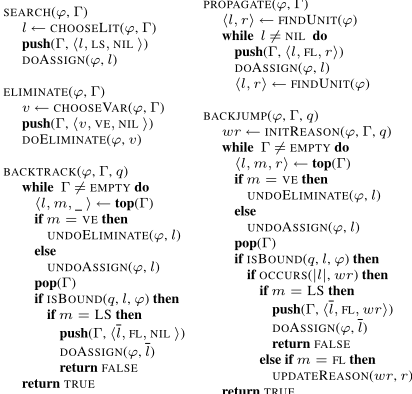
In Figure 1 we present STRUQS basic routines in pseudocode format. All the routines take as by-reference parameters the data structure ϕ which encodes the input QBF, and a stack Γ which keeps track of the steps performed. We consider the following primitives for ϕ:
- DOASSIGN(ϕ, l) implements ϕl as per Section 2, where clauses and literals are disabled rather than deleted.
- DOELIMINATE(ϕ, v) implements variable elimination as per Section 2, with the addition that clauses subsumed by some clause already in ϕ are not added - a process named forward subsumption in [Biere, 2004]; as in the case of DOASSIGN, the eliminated variables and the clauses where they occur are disabled.
2 Case (1) will not apply unless terms are learned, and thus unit propagation may involve universal variables as well - see [Giunchiglia et al., 2006] for the technical details.
- FINDUNIT(ϕ), returns a pair 〈l, r〉 if l is a unit literal in ϕ and r is a unit clause in which l occurs, or a pair 〈NIL , NIL 〉 if no such literal exists in ϕ.
- CHOOSELIT(ϕ, Γ) returns a literal l subject to the constraint that all the remaining variables of ϕ which do not appear in Γ come after |l|.
- CHOOSEVAR(ϕ, Γ) returns a variable v subject to the constraint that v comes after all the remaining variables of ϕ which do not appear in Γ.
Because updates in DOASSIGN and DOELIMINATE are not destructive, we can further assume that their effects can by "undo" functions, i.e., UNDOASSIGN and UNDOELIMINATE.
The routines SEARCH and ELIMINATE (Figure 1, top-left) perform one step of search and variable elimination, respectively. SEARCH (resp. ELIMINATE), asks CHOOSELIT (resp. CHOOSEVAR) for a literal l (resp. a variable v) and then it (i) pushes l (resp. v) in the stack and (ii) it updates ϕ. In both cases step (i) amounts to push a triple 〈u,m, r〉 in Γ where r is always NIL , u is the literal being assigned or the variable being eliminated, and m is the mode of the assignment, where LS ("L"eft "S"plit) indicates an open branch in the search tree, and VE ("V"ariable "E"limination) indicates the corresponding resolution step. The task of PROPAGATE (Figure 1, top-right) is to perform unit propagation in ϕ. For each unit literal l, PROPAGATE pushes a record 〈l, FL, r〉 in Γ, where l and r are the results of FINDUNIT, and the mode is always FL ("F"orced "L"iteral). BACKTRACK (Figure 1 bottom-left) and BACKJUMP (Figure 1, bottom-right) are alternative backtracking procedures to be invoked at the leaves of the search tree with an additional parameter q, where q = ∃ if the current leaf is a conflict, and q = ∀ otherwise. BACKTRACK goes back in the stack Γ, popping records for search (LS) or deduction steps (VE, FL), and undoing the corresponding effects on ϕ. Notice that, if BACKTRACK is a component of a plain search solver, then VE-type records will not show up in Γ. BACKTRACK stops when an open branch (LS) corresponding to a literal l bound by the quantifier q is found (ISBOUND(q, l, ϕ)=TRUE). In this case, BACKTRACK closes the branch by assigning l with mode FL and returning FALSE to indicate that search should not stop. On the other hand, if all the records are popped from Γ without finding an open branch then search is over and BACKTRACK returns TRUE. BACKJUMP implements backjumping as per Section 2 on top of the following primitives:
- INITREASON(ϕ, Γ, q) initializes the working reason wr. If q = ∃, then we have two cases: (i) If top(Γ) is a FL-type record, then wr is any clause in ϕ which is contradictory because all of its existential literals have been disabled. (ii) If top(Γ) is a VE-type record, this means that a contradictory clause C has been derived when eliminating a variable, and thus wr is C. If q = ∀, then wr is a term obtained considering a subset of the literals in Γ such that the number of universal literals in the term is minimized - VE-type records are disregarded in this process.
- UPDATEREASON(wr, r) updates wr by resolving it with r, i.e., the reason of the assignment which is being undone.
When BACKJUMP is invoked in lieu of BACKTRACK, it first initializes the working reason, and then it pops records from Γ until either the stack is empty, or some open branch is found - the return values in these cases are the same as BACKTRACK. BACKJUMP stops at open branches (LS) only if they correspond to some literal l which is bound by the quantifier q and such that |l| occurs in the current working reason wr (OCCURS(|l|, wr)=TRUE). Also, when popping records 〈l, FL, r〉 such that l occurs in the working reason, the procedure UPDATEREASON is invoked to update the current working reason wr. As described in Section 2, all the literals bound by q that are not in the current working reason are irrelevant to the current conflict/solution and are simply popped from Γ without further ado.
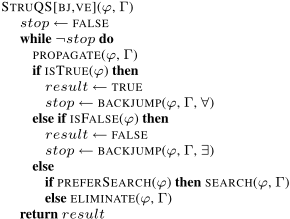
On top of the basic algorithms of Figure 1, we define five different versions of STRUQS: Three "single" versions, namely STRUQS[BJ], STRUQS[BT], and STRUQS[VE], and two "blended" ones, namely STRUQS[BT,VE] and STRUQS[BJ,VE]. The single solvers implement basic reasoning algorithms and are provided for reference purposes, while the blended ones implement our structural approach. 3 The pseudo-code of STRUQS[BJ,VE] is detailed in Figure 2 where we consider some additional primitives on ϕ: ISTRUE(ϕ) returns TRUE exactly when all clauses in ϕ have been disabled; ISFALSE(ϕ) returns TRUE exactly when there is at least one contradictory clause in ϕ; finally, PREFERSEARCH(ϕ) is some heuristic to choose between search and variable elimination. The other versions of STRUQS can be obtained from the code in Figure 2 as follows. If PREFERSEARCH always returns TRUE, then we obtain the search solver STRUQS[BJ], and if it always returns FALSE, then we obtain the variable elimination solver STRUQS[VE]. Replacing BACKJUMP with BACKTRACK, we obtain STRUQS[BT,VE], and if we further assume that PREFERSEARCH always returns TRUE, then we obtain STRUQS[BT].
We now consider the implementation of PREFERSEARCH for the blended versions of STRUQS. As discussed in Section 1, PREFERSEARCH needs to be based on parameters which are informative, yet computable without a prohibitive overhead. To this end, in PREFERSEARCH we resort to the following criteria:
- Given the current ϕ and Γ, check if there is any existential variable x which respects CHOOSEVAR's constraints, and such that the number of clauses generated by DOELIMINATE(ϕ, x) is less than the number of clauses containing x in ϕ.
- If condition (1) is met for some x, then consider the number of clauses where x occurs, say nx, and the number of clauses where ¬x occurs, say n¬x, and compute the diversity of x as the product nxn¬x; check if the diversity of x is less than a predefined threshold div.
If both conditions above are met for some x, then PREFERSEARCH returns FALSE, and CHOOSEVAR is instructed to return x. If either condition is not met, then PREFERSEARCH returns TRUE. In this case, CHOOSELIT tries to pick a literal l which respects CHOOSELIT's constraints, and such that |l| is a node in the neighborhood of some variable x tested by PREFERSEARCH. If no such literal can be found, then CHOOSELIT returns a literal l such that |l| has the maximum degree among all the candidate literals of ϕ. We mention here that condition (1) is proposed in [E´en and Biere, 2005] to control variable elimination during preprocessing of plain Boolean encodings, and diversity is introduced in [Rish and Dechter, 2000] to efficiently account for structure of Boolean formulas. Intuitively, in our implementation condition (1) provides the main feedback that implicitly considers the treewidth of the current formula: If variable elimination becomes less efficient, then this means that the structure of the current QBF is probably less amenable to this kind of approach. Condition (2) fine tunes (1): Whenever some variable x meets condition (1), but nxn¬x is too large, the elimination of x is forbidden as it could be too costly. Finally, the search heuristic in CHOOSELIT is modified in order to use search for breaking large clusters of tightly connected variables. If this cannot be done, then CHOOSELIT falls back to assigning the variable which is most constrained.
3 The source code of STRUQS is available at http://www. mind-lab.it/projects.
4 Putting the structural approach to the test
All the experimental results that we present are obtained on a family of identical Linux workstations comprised of 10 Intel Core 2 Duo 2.13 GHz PCs with 4GB of RAM. The resources granted to the solvers are always 600s of CPU time and 3GB of memory. To compare the solvers we use the QBFEVAL'08 dataset, which is comprised of 3326 formulas divided into 17 suites and 71 families (suites may be comprised of more than one family). All the formulas considered are QBF encodings of some automated reasoning task [Peschiera et al., 2008]. In the following, we say that solver A dominates solver B whenever the set of problems solved by A is a superset of the problems solved by B; we say that two solvers are incomparable when neither one dominates the other.
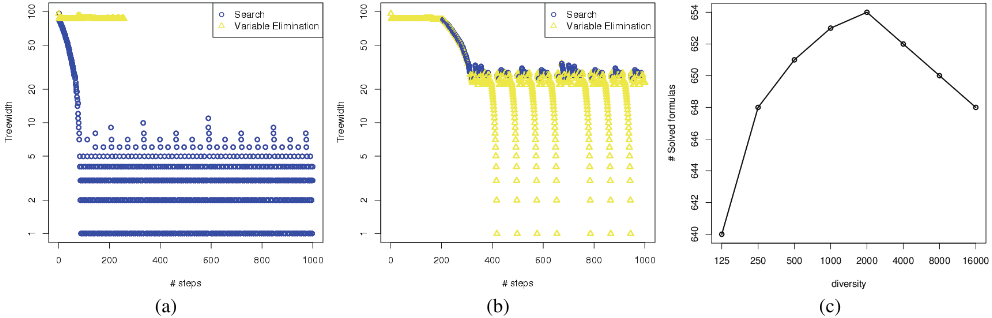
Our first experiment aims to provide an empirical explanation on why alternating between search and resolution can be effective. In Figure 3 (a,b) we present two plots showing the connection between the behaviour of STRUQS and the treewidth 4 of a formula during the solution process. The plots have been obtained by running various versions of STRUQS on the instance test5 quant5 - family jmc quant, suite Katz in the QBFEVAL'08 dataset. We consider test5 quant5 because it is the smallest instance (358 variables, 941 clauses, 3 quantifier blocks) which is solved by STRUQS[BJ,VE], and it is not solved by STRUQS[BJ] and STRUQS[VE]. Looking at Figure 3 (a), we can see that STRUQS[VE] (triangle dots) is able to decrease slightly treewidth (from an initial estimate of 96 to a final estimate of 86), but it can go as far as a few hundred steps before exhausting resources. On the other hand, STRUQS[BJ] (circle dots) can decrease substantially treewidth, but it gets trapped into structurally simpler subproblems, without managing to solve the input QBF after about 9 × 10⁶ steps, when it reaches the time limit. 5 From Figure 3 (b) we can see that STRUQS[BJ,VE] changes its behavior according to the current value of treewidth, i.e., PREFERSEARCH implicitly takes into account structure. In the first 206 steps, only variable elimination is performed (triangle dots). Then, as this approach becomes untenable, search (circle dots) is exploited to obtain structurally simpler subproblems. Comparing the two plots, it is clear that PREFERSEARCH prevents search to go "too deep", because as soon as ˆ twp(ϕi) becomes small, PREFERSEARCH reckons that variable elimination alone can deal with ϕi. Overall, STRUQS[BJ,VE] solves test5 quant5 in less than 4 × 10⁵ steps, of which about 25% are search steps. Another interesting phenomenon is that even when search is prevailing - for ˆ twp(ϕ) values roughly in between 75 and 25 - PREFERSEARCH still gives a chance to variable elimination. In these cases, variable elimination plays essentially the same role of unit propagation, i.e., it stops in advance the exploration of irrelevant portions of the search space.
4 More precisely, we consider an approximation of treewidth, computed as described in [Pulina and Tacchella, 2008].
In the above experiment, PREFERSEARCH turns out to be effective in switching between variable elimination and search with a specific value of the threshold div (2000). Since different values of div influence the behaviour of PREFERSEARCH, it is reasonable to ask howmuch a particular setting of div will influence the performance of STRUQS, if at all, and which is the best setting, at least in the dataset that we consider. In figure 3 (c) we present the result of running STRUQS[BJ,VE] with various settings of the parameter div on the formulas in the QBFEVAL'08 dataset which cannot be solved by either STRUQS[VE] or STRUQS[BJ] alone (660 formulas). In particular, we consider an initial value div = 125 and we increase it by a 2× factor until div = 16000, each time running STRUQS[BJ,VE] on the above dataset. The plot in Figure 3 clearly shows that (i) div ≈ 2000 appears to be the best setting in the QBFEVAL'08 dataset, and that (ii) only 15 instances separate the performance of the best STRUQS[BJ,VE] setting (div = 2000) with respect to the worst one (div = 125). In all the experiments hereafter shown, we set div = 2000.
5 Only the first 103 steps are shown in plots of Figure 3 (a,b). The hidden portions of STRUQS[BJ] and STRUQS[BJ,VE] behave as they do in the last few hundred steps shown.
| Solver | Performance | |||
|---|---|---|---|---|
| # | Time | #LS (×105 ) | #VE (×105 ) | |
| STRUQS[BJ,VE] | 1304 | 63141 | 656 | 1407 |
| STRUQS[BT,VE] | 1019 | 41900 | 1744 | 1731 |
| STRUQS[BJ] | 614 | 31543 | 11478 | - |
| STRUQS[VE] | 528 | 12834 | - | 3 |
| STRUQS[BT] | 380 | 10855 | 35594 | - |
As we anticipated, there is a number of instances that can be solved by STRUQS[BJ,VE], but cannot be solved by the corresponding single solvers. Our next experiment is to compare all STRUQS versions to see whether blended solvers have an edge over single ones. Indeed, a quick glance at the results shown in Table 1 reveals that blended solvers are always superior to single ones. In more detail, STRUQS[BT] can solve 11% of the dataset, STRUQS[VE] can deal with 16% of it, and STRUQS[BJ] tops at 18%. Only 273 problems (8% of the dataset) are solved by both STRUQS[BT] and STRUQS[VE], which are incomparable. On the other hand, STRUQS[BJ] dominates STRUQS[BT] and it is incomparable with STRUQS[VE]. As for the blended versions, we see that STRUQS[BT,VE] is more efficient than all the single versions: It can solve 31% of the dataset, which is more than the set of problems solved by at least one of STRUQS[BT] and STRUQS[VE] (635). STRUQS[BJ,VE] turns out to be the most efficient among STRUQS versions: It can solve 39% of the dataset, which is also more than the set of problems solved by at least one of STRUQS[BJ] and STRUQS[VE] (800). If we normalize the number of search steps performed by the solvers considering the problems that are solved, we see a 10× gap between STRUQS[BT,VE] and STRUQS[BJ], while the same gap between STRUQS[BJ] and STRUQS[BT] is only 5×. This means that combining search and variable elimination turns to be efficient per se, and even more efficient than boosting search with backjumping. If we look at variable elimination steps, we can see a substantial increase in the normalized number of steps: nearly 300× (resp. 200×) gap between STRUQS[VE] and STRUQS[BT,VE] (resp. STRUQS[BJ,VE]). Indeed, variable elimination is used more in STRUQS[BT,VE] and STRUQS[BJ,VE] than in STRUQS[VE], but this happens on subproblems that are structurally simpler, as there is only a 1.7× (resp. 2×) gap in normalized CPU time between STRUQS[VE] and STRUQS[BT,VE] (resp. STRUQS[BJ,VE]). Notice also that STRUQS[BJ,VE] performs less search and variable elimination steps than STRUQS[BT,VE], and this appears to be the net effect of backjumping.
| Solver | Solved | True | False | |||
|---|---|---|---|---|---|---|
| # | Time | # | Time | # | Time | |
| AQME | 2434 | 43987 | 977 | 19747 | 1457 | 24240 |
| QUBE6.1 | 2144 | 32414 | 828 | 18248 | 1316 | 14166 |
| SKIZZO | 1887 | 40864 | 631 | 17550 | 1256 | 23314 |
| STRUQS[BJ,VE] | 1304 | 63141 | 576 | 32685 | 728 | 30456 |
| QUBE3.0 | 1077 | 16700 | 406 | 6536 | 671 | 10164 |
| NENOFEX | 985 | 22360 | 459 | 13853 | 526 | 8507 |
| QUANTOR | 972 | 15718 | 485 | 10418 | 487 | 5300 |
| SSOLVE | 965 | 23059 | 450 | 9866 | 515 | 13193 |
| YQUAFFLE | 948 | 16708 | 389 | 9058 | 559 | 7650 |
| 2CLSQ | 780 | 21287 | 391 | 13234 | 389 | 8053 |
| QMRES | 704 | 13576 | 360 | 7722 | 344 | 5853 |
One last set of considerations about Table 1 regards dominance relationships. In particular, STRUQS[BT,VE] is incomparable with both STRUQS[BT] and STRUQS[VE]. In the case of STRUQS[BT], there are 6 problems in the suite Ansotegui which can be solved by STRUQS[BT], but not by STRUQS[BT,VE]. Indeed, the size of these problems is such that variable elimination becomes prohibitive too quickly for PREFERSEARCH to notice. STRUQS[VE] can solve 162 problems that STRUQS[BT,VE] cannot solve, where the bulk of such problems (121) is from the suite Pan: in these formulas, condition (1) of PREFERSEARCH is almost always unmet, and yet they turn out to be very difficult for search. Relaxing condition (1) of PREFERSEARCH can have positive effects on these formulas, but it can also severely degrade the performance of STRUQS[BT,VE] on other suites. STRUQS[BJ,VE] dominates STRUQS[BT,VE] and STRUQS[BT], but is incomparable with STRUQS[BJ] and STRUQS[VE]. In particular, there are 52 problems solved by STRUQS[BJ] that STRUQS[BJ,VE] cannot solve, whereof 40 are from the family blackbox-01X-QBF. These instances are characterized by the largest number of quantifier blocks among formulas in the dataset, and search is already quite efficient on them. STRUQS[VE] can solve 68 formulas on which STRUQS[BJ,VE] fails, of which 67 are from the suite Pan and have the same peculiarities mentioned about STRUQS[BT,VE].
In Table 2 we conclude this section by comparing STRUQS[BJ,VE] with state-of-the-art QBF solvers. We have considered all the competitors of QBFEVAL'08, namely AQME, QUBE6.1, NENOFEX, QUANTOR, and SSOLVE. To them, we have added the solvers SKIZZO [Benedetti, 2005] which is representative of skolemization-based approaches, QUBE3.0 [Giunchiglia et al., 2006] which is the same as QUBE6.1 but without preprocessing, YQUAFFLE [Yu and Malik, 2005] and 2CLSQ [Samulowitz and Bacchus, 2006] which are also search-based solvers, and QMRES [Pan and Vardi, 2004] which features symbolic variable elimination. Although STRUQS[BJ,VE] is just a proof-of-concept solver, Table 2 reveals that it would have ranked third best considering only the participants to QBFEVAL'08, and it ranks as fourth best in Table 2. Moreover, there are 24 instances that can be solved only by STRUQS[BJ,VE]. If we consider that AQME is a multi-engine solver combining the ability of several engines (including QUBE6.1 and SKIZZO), and that both QUBE6.1 and SKIZZO are fairly sophisticated pieces of software, we can conclude that STRUQS[BJ,VE] performances are very satisfactory. Indeed, STRUQS is somewhat limited by the straigthforward implementation of operations such as, e.g., .forward subsumption. On one hand, disabling forward subsumption brings to 1114 the number of problems solved by STRUQS[BJ,VE]. On the other hand, forward subsumption accounts for 8% of the total time spent by STRUQS[BJ,VE] on the formulas that it can solve, but for 20% of the total time on the formulas that it cannot solve. Increasing the time limit to 1200 seconds allows STRUQS[BJ,VE] to solve about one hundred additional problems, indicating that the efficiency of basic operations is currently a limiting factor for STRUQS.
5 Conclusions and future work
Summing up, the combination of search and resolution featured by STRUQS seems to offer a gateway to effective reasoning in QBFs. The two key results of our work are (i) showing that the blended solvers STRUQS[BT,VE] and STRUQS[BJ,VE] outperform the single ones, and (ii) showing that STRUQS[BJ,VE] is competitive with other state-ofthe-art solvers. We believe that these results can be improved by pursuing an efficient implementation of STRUQS. The fact that STRUQS, however unsophisticated, is able to solve 24 problems that cannot be solved by other state-of-the-art QBF solvers is promising in this sense. Also, STRUQS[BJ,VE] used as a SAT solver on a subset of 790 QBFEVAL'08 formulas can solve 668 problems within one hour of CPU time and it is competitive with, e.g., MINISAT which can solve 787 of them, while STRUQS[BJ] and STRUQS[VE] top at 553 and 145 problems solved, respectively. Other improvements would be leveraging different structural features and approximations thereof, and/or integrating inductive techniques to synthesize (sub)instance-based PREFERSEARCH policies.
@inproceedings{ijcai2009p105,
  title     = {A Structural Approach to Reasoning with Quantified Boolean Formulas},
  author    = {Pulina, Luca and Tacchella, Armando},
  booktitle = {Proceedings of the Twenty-First International Joint Conference on
               Artificial Intelligence, {IJCAI-09}},
  publisher = {International Joint Conferences on Artificial Intelligence},
  editor    = {Craig Boutilier},
  pages     = {596--601},
  year      = {2009},
  url       = {https://ijcai.org/proceedings/2009/105},
}
TY - CPAPER TI - A Structural Approach to Reasoning with Quantified Boolean Formulas AU - Pulina, Luca AU - Tacchella, Armando T2 - Proceedings of the Twenty-First International Joint Conference on Artificial Intelligence, IJCAI-09 PB - International Joint Conferences on Artificial Intelligence PY - 2009 SP - 596 EP - 601 UR - https://ijcai.org/proceedings/2009/105 ER -Copied
Machine-readable versions of this paper, for tools and AI agents:





