
Improving Author Coreference by Resource-Bounded Information Gathering from the Web
Proceedings of the Twentieth International Joint Conference on Artificial Intelligence. Pages 429-433.
© 2007 International Joint Conferences on Artificial Intelligence
Abstract
Accurate entity resolution is sometimes impossible simply due to insufficient information. For example, in research paper author name resolution, even clever use of venue, title and co-authorship relations are often not enough to make a confident coreference decision. This paper presents several methods for increasing accuracy by gathering and integrating additional evidence from the web. We formulate the coreference problem as one of graph partitioning with discriminatively-trained edge weights, and then incorporate web information either as additional features or as additional nodes in the graph. Since the web is too large to incorporate all its data, we need an efficient procedure for selecting a subset of web queries and data. We formally describe the problem of resource bounded information gathering in each of these contexts, and show significant accuracy improvement with low cost.
- [Bansal et al., 2002] N. Bansal, S. Chawla, and A. Blum. Correla- tion clustering. In The 43rd Annual Symposium on Foundations of Computer Science (FOCS), pages 238-247, 2002.
- [Demaine and Immorlica, 2003] Erik D. Demaine and Nicole Im- morlica. Correlation clustering with partial information. In RANDOM-APPROX, page 1, 2003.
- [Dong et al., 2004] Xinyi Dong, Alon Y. Halevy, Ema Nemes, Ste- fan B. Sigurdsson, and Pedro Domingos. Semex: Toward on-the- fly personal information integration. In Workshop on Information Integration on the Web (IIWEB), 2004.
- [Etzioni et al., 2004] O. Etzioni, M. Cafarella, D. Downey, S. Kok, A. Popescu, T. Shaked, S. Soderland, D. Weld, and A. Yates. Web-scale information extraction in knowitall. In Proceedings of the International WWW Conference, New York. ACM, May 2004.
- [Han et al., 2005] Hui Han, Hongyuan Zha, and Lee Giles. Name disambiguation in author citations using a k-way spectral cluster- ing method. In ACM/IEEE Joint Conference on Digital Libraries (JCDL 2005), 2005.
- [Kapoor and Greiner, 2005] Aloak Kapoor and Russell Greiner. Learning and classifying under hard budgets. In ECML, pages 170-181, 2005.
- [McCallum and Li, 2003] A. McCallum and W. Li. Early results for named entity recognition with conditional random fields, feature induction and web-enhanced lexicons. In Proceedings of CoNLL, pages 188-191, 2003.
- [McCallum and Wellner, 2003] Andrew McCallum and Ben Well- ner. Object consolidation by graph partitioning with a conditionally-trained distance metric. KDD Workshop on Data Cleaning, Record Linkage and Object Consolidation, 2003.
- [McCallum and Wellner, 2004] A. McCallum and B. Wellner. Con- ditional models of identity uncertainty with application to noun coreference. In Neural Information Processing (NIPS), 2004.
- [Roy and McCallum, 2001] Nicholas Roy and Andrew McCallum. Toward optimal active learning through sampling estimation of error reduction. In Proc. 18th International Conf. on Machine Learning, pages 441-448.
- Morgan Kaufmann, 2001.
- [Thompson et al., 1999] C. A. Thompson, M. E. Califf, and R. J. Mooney. Active learning for natural language parsing and infor- mation extraction. In ICML, page 406, 1999.
- [Zilberstein and Lesser, 1996] Shlomo Zilberstein and Victor Lesser. Intelligent information gathering using decision mod- els. Technical Report 96-35, Computer Science Department University of Massachusetts at Amherst, 1996.
- [Zilberstein, 1996] Shlomo Zilberstein. Resource-bounded reason- ing in intelligent systems. ACM Comput. Surv, 28, 1996.
References were extracted automatically from the PDF and may contain errors.
Full text extracted automatically from the PDF; figures, tables and equations may differ. The PDF is the version of record.
1 Introduction
Machine learning and web mining researchers are increasingly interested in using search engines to gather information for augmenting their models, e.g. [Etzioni et al., 2004], [McCallum and Li, 2003], [Dong et al., 2004]. However, it is impossible to query for the entire web, and this gives rise to the problem of efficiently selecting which queries will provide the most benefit. We refer to this problem as resourcebounded information gathering from the web.
We examine this problem in the domain of entity resolution. Given a large set of entity names (each in their own context), the task is to determine which names are referring to the same underlying entity. Often these coreference merging decisions are best made, not merely by examining separate pairs of names, but relationally, by accounting for transitive dependencies among all merging decisions. Following previous work, we thus formulate entity resolution as graph partitioning with edge weights based on many features with parameters learned by maximum entropy [McCallum and Wellner, 2004], and in this paper explore a relational, graph-based approach to resource-bounded information gathering.
The specific entity resolution domain we address is research paper author coreference. The vertices in our coreference graphs are citations, each containing an author name with the same last name and first initial. 1 Coreference in this domain is extremely difficult. Although there is a rich and complex set of features that are often helpful, in many situations they are not sufficient to make a confident decision. Consider, for example, the following two citations both containing a "D. Miller."
- Mark Orey and David Miller, Diagnostic Computer Systems for Arithmetic, Computers in the School, volume 3, #4, 1987
- Miller, D., Atkinson, D., Wilcox, B., Mishkin, A., Autonomous Navigation and Control of a Mars Rover, Proceedings of the 11th IFAC Symposium on Automatic Control in Aerospace, pp. 127-130, Tsukuba, Japan, July 1989.
The publication years are close; and the titles both relate to computer science, but there is not a specific topical overlap; "Miller" is a fairly common last name; and there are no co-author names in common. Furthermore, in the rest of the larger citation graph, there is not a length-two path of coauthor name matches indicating that some of the co-authors here may have themselves co-authored a third paper. So there is really insufficient evidence to indicate a match despite the fact that these citations do refer to the same "Miller".
In this paper, we present two different mechanisms for augmenting the coreference graph partitioning problem by incorporating additional helpful information from the web. In both cases, a web search engine query is formed by conjoining the titles from two citations. The first mechanism changes the edge weight between the citation pair by adding a feature indicating whether or not any web pages were returned by the query. The second mechanism uses one of the returned pages (if any) to create an additional vertex in the graph, for which edge weights are then calculated to all the other vertices. The additional transitive relations provided by the new vertex can provide significant helpful information. For example, if the new vertex is a home page listing all of an author's publications, it will pull together all the other vertices that should be coreferent.
1 Future work will address the problem of correctly merging names with typographic errors in the first initial and last name.
Gathering such external information for all vertex pairs in the graph is prohibitively expensive, however. Thus, methods that acknowledge time, space and network resource limitations, and effectively select just a subset of the possible queries are of interest. Learning and inference under resource limitations has been studied in various forms. For example, the value of information, as studied in decision theory, measures the expected benefit of queries [Zilberstein and Lesser, 1996]. Budgeted learning, rather than selecting training instances, selects new features [Kapoor and Greiner, 2005]. Resource-bounded reasoning studies the trade offs between computational commodities and value of the computed results [Zilberstein, 1996]. Active learning aims to request human labeling of a small set of unlabeled training examples [Thompson et al., 1999], for example, aiming to reduce label entropy on a sample [Roy and McCallum, 2001].
In this paper we employ a similar strategy, and compare it with two baseline approaches, showing on 7 different data sets that leveraging web queries can reduce F1 error by 13.03%, and furthermore that, by using our proposed resource-bounded approach, 53.5% of this gain can be achieved with about 1% of the web queries. We also suggest that our problem setting will be of interest to theoretical computer science, since it is a rich extension to correlational clustering [Bansal et al., 2002; Demaine and Immorlica, 2003].
2 Conditional Entity ResolutionModels
We are interested in obtaining an optimal set of coreference assignments for all mentions contained in our database. In our approach, we first learn maximum entropy or logistic regression models for pairwise binary coreference classifications. We then combine the information from these pairwise models using graph-partitioning-based methods so as to achieve a good global and consistent coreference decision. We use the term, "mention" to indicate the appearance of an author name in a citation and use xi to denote mention i = 1, . . . , n. Let yij represent a binary random variable that is true when mentions xi and xj refer to the same underlying author "entity." For each pair of mentions we define a set of l feature functions fl(xi, xj, yi,j) acting upon a pair of mentions. From these feature functions we can construct a local model given by
where Zx = ∑y exp(λlfl(xi, xj, yij)). In McCallum and Wellner [2003] a conditional random field with a form similar to (1) is constructed which effectively couples a collection of pairwise coreference models using equality transitivity functions f∗(yij , yjk, yik) to ensure globally consistent configurations. These functions ensure that the coupled model assigns zero probability to inconsistent configurations by evaluating to -∞ for inconsistent configurations and 0 for consistent configurations. The complete model for the conditional distribution of all binary match variables given all mentions x can then be expressed as
As in Wellner and McCallum [2002], the parameters λ can be estimated in local fashion by maximizing the product of Equation 1 over all edges in a labeled graph exibiting the true partitioning. When fl(xi, xj, 1) = -fl(xi, xj, 0) it is possible to construct a new undirected and fully connected graph consisting of nodes for mentions, edge weights ∈ [-∞,∞] defined by ∑l λl(xi, xj, yij) and with sign defined by the value of yij. In our work here we define a graph in a similar fashion as follows.
Let G0 =< V0, E0 > be a weighted, undirected and fully connected graph, where V0 = {v1, v2, ..., vn} is the set of vertices representing mentions and E0 is the set of edges where ei =< vj , vk > is an edge whose weight wij is given by P(yij = 1|xi, xj) - P(yij = 0|xi, xj) or the difference in the probabilities that that the citations vj and vk are by the same author. Note that the edge weights defined in this manner are in [-1,+1]. The edge weights in E0 are noisy and may contain inconsistencies. For example, given the nodes v1, v2 and v3, we might have a positive weight on < v1, v2 > as well as on < v2, v3 >, but a high negative weight on < v1, v3 >. Our objective is to partition the vertices in graph G0 into an unknown number of M nonoverlapping subsets, such that each subset represents the set of citations corresponding to the same author. We define our objective function as F = ∑ij wijf(i, j) where f(i, j) = 1 when xi and xj are in the same partition and -1 otherwise.
[Bansal et al., 2002] provide two polynomial-time approximation schemes (PTAS) for partitioning graphs with mixed positive and negative edge weights. We obtain good empirical results with the following stochastic graph partitioning technique, termed here N-run stochastic sampling.
Algorithm 1. - N-Run Stochastic Sampling:
We define a distribution over all edges in G0, P(wi) ∝ ewi T where T acts as temperature. At each iteration, we draw an edge from this distribution and merge the two vertices. Edge weights to the new vertex formulated by the merge are set to the average of its constituents and the distribution over the edges is recalculated. Merging stops when no positive edges remain in the graph. This procedure is then repeated r = 1...N times and the partitioning with the maximum F is then selected.
3 Coreference Leveraging theWeb
Now, consider that we have the ability to augment the graph with additional information using two alternative methods:
| (A)..., H. Wang, ... Background Initialization..., ICCV,...2005. |
| (B)..., H. Wang, ... Tracking and Segmenting People..., ICIP, 2005. |
| (C)..., H. Wang, ... Gaussian Background Modeling..., ICASSP, 2005. |
| (D)..., H. Wang, ... Facial Expression Decomposition..., ICCV, 2003. |
| (E)..., H. Wang, ... Tensor Approximation..., SIGGRAPH. 2005. |
| (F)..., H. Wang, ... High Speed Machining..., ASME, (JMSE), 2005. |
(1) changing the weight on an existing edge, (2) adding a new vertex and edges connecting it to existing vertices. This new information can be obtained by querying some external source, such as a database or the web.
The first method may be accomplished in author coreference, for example, by querying a web search engine as follows. Clean and concatenate the titles of the citations, issue this query and examine attributes of the returned hits. In this case, a hit indicates the presence of a document on the web that mentions both these titles and hence, some evidence that they are by the same author. Let fg be this new boolean feature. This feature is then added to an augmented classifier that is then used to determine edge weights.
In the second method, a new vertex can be obtained by querying the web in a similar fashion, but creating a new vertex by using one of the returned web pages as a new mention. Various features f(·) will measure compatibility between the other "citation mentions" and the new "web mention," and with similarly estimated parameters λ, edge weights to the rest of the graph can be set.
In this case, we expand the graph G0, by adding a new set of vertices, V1 and the corresponding new set of edges, E1 to create a new, fully connected graph, G′ . Although we are not interested in partitioning V1, we hypothesize that partitioning G′ would improve the optimization of F on G0. This can be explained as follows. Let v1, v2ϵV0, v3ϵV 1, and the edge < v1, v2 > has an incorrect, but high negative edge weight. However, the edges < v1, v3 > and < v2, v3 > have high positive edge weights. Then, by transitivity, partitioning the graph G′ will force v1 and v2 to be in the same subgraph and improve the optimization of F on G0.
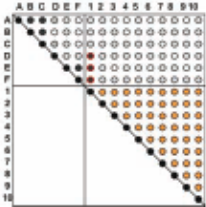
As an example, consider the references shown in Fig.1. Let us assume that based on the evidence present in the citations, we are fairly certain that the citations A, B and C are by H. Wang 1 and that the citations E and F are by H. Wang 2. Let us say we now need to determine the authorship of citation D. We now add a set of additional mentions from the web, {1, 2, .. 10}. The adjacency matrix of this expanded graph is shown in Fig. 2. The darkness of the circle represents the level of affinity between two mentions. Let us assume that the web mention 1 (e.g. the web page of H. Wang 1) is found to have strong affinity to the mentions D, E and F. Therefore, by transitivity, we can conclude that mention D belongs to the group 2. Similarly, values in the lower right region could also help disambiguate the mentions through double transitivity.
4 Resource BoundedWeb Usage
Under the constraint on resources, however, we must select only a subset of edges in E0, for which we can obtain the corresponding piece of information ii. Let Es ⊂ E0, be this set and Is be the subset of information obtained that corresponds to each of the elements in Es. The size of Es is determined by the amount of resources available. Our objective is to find the subset Es that will optimize the function F on graph G0 after obtaining Is and applying graph partitioning.
Similarly, in the case of expanded graph G′ , given the constraint on resources, we must select V ′ s ⊂ V1, to add to the graph. Note that in the context of information gathering from the web, |V1| is in the billions. Even in the case when |V1| is much smaller, we may choose to calculate the edge weights for only a subset of E1. Let E′s ⊂ E1 be this set. The sizes of V ′ s and E′s are determined by the amount of resources available. Our objective is to find the subsets V ′ s and E′s that will optimize the function F on graph G0 by applying graph partitioning on the expanded graph. We now present the procedure for the selection of Es.
Algorithm 2. - Centroid Based Resource Bounded Information Gathering and Graph Partitioning For each cluster of vertices that have been assigned the same label under a given partitioning, we define the centroid as the vertex vc with the largest sum of weights to other members in its cluster. Denote the subset of vertex centroids obtained from clusters as Vc. (We can also optionally pick multiple centroids from each cluster.) We begin with graph G0 obtained from the base features of the classifier. We use the following criteria for finding the best order of queries: expected entropy, gravitational force, uncertainty-based and random. The uncertainty criteria uses the entropy of the binary classifier for each edge. For each of these criteria, we follow this procedure.
- Partition graph G0 using N-run stochastic sampling.
- From the highest scoring partitioned graph G∗i , find the subset of vertex centroids Vc
- Construct Es as the set of all edges connecting centroids in Vc.
- Order edges Es into index list I based on the criteria.
- Using index list I, for each edge ei ⊂ Es
- (a) Execute the web query and evaluate additional features from result
- (b) Evaluate classifier for edge ei with the additional features and form graph Gi from graph Gi-1
- (c) Using graph Gi, perform N-run stochastic sampling and compute performance measures
Criterion 1 - Expected Entropy
- Force merge of the vertex pair of ei to get a graph Gp
- PeformN-run stochastic sampling on Gp. This gives the probabilities pi for each of the edges in Gp
- Calculate the entropy, Hp of the graph Gp as follows: Hp = - Pi Pi log Pi
- Force split of the vertex pair of ei to get a graph Gn
- Repeat steps 2-3 to calculate entropy, Hn for graph Gn
- The expected entropy, Hi for the edge ei is calculated as: Hi = (Hp)+(Hn) 2 (Assuming equal probabilities for both outcomes)
Criterion 2 - Gravitational Force
This selection criteria is inspired by the inverse squared law of the gravitational force between two bodies. It is defined as F = Γ M1∗M2 d2 , where Γ is a constant, M1 and M2 are analogous to masses of two bodies and d is the distance between them. This criteria ranks highly partitions that are near each other and large, and thus high-impact candidates for merging. Let vj and vk be the two vertices connected by ei. Let Cj and Ck be their corresponding clusters. We calculate the value of F as described above, where M1 and M2 are the number of vertices in Cj and Ck respectively. We define d = 1 xwi , where wi is the weight on the edge ei and x is a parameter that we tune for our method.
5 Theoretical Problem
There has been recent interest in the general problem of correlational clustering [Bansal et al., 2002; Demaine and Immorlica, 2003]. We now present a new class of problems that are concerned with resource bounded information gathering under graph partitioning.
Consider the matrix as presented in Fig.2. Suppose we care about the partitioning in the upper left part of the matrix, and all the values in the upper right part of the matrix are hidden. As we have seen before, obtaining these values would impact the graph partitioning in the section that we care about.
Now, suppose, we have access to an adversarial oracle, who unveils these values in the requested order. In the worst case, no useful information is obtained till the last value is unveiled. In the best case, however, requesting a small fraction of the values, leads to perfect partitioning in the section that we care about. The question that we now ask is, what is the best possible order to request these values. Making reasonable assumptions about the nature of the oracle and imposing restrictions on the edge weights makes this problem interesting and useful. This is one way to formulate this problem. This paper opens up many such possibilities for the theory community.
6 Experimental Results
6.1 Dataset and Infrastructure
We use the Google API for searching the web. The data sets used for these experiments are a collection of hand labeled citations from the DBLP and Rexa corpora (see table 1). The portion of DBLP data, which is labeled at Pennstate University is referred to as 'Penn'. Each dataset refers to the citations authored by people with the same last name and first initial. The hand labeling process involved carefully segregating these into subsets where each subset represents papers written by a single real author.
| Corpus | # Sets | # Authors | # Citations | # Pairs |
| DBLP | 18 | 103 | 945 | 43338 |
| Rexa | 8 | 289 | 1459 | 207379 |
| Penn | 7 | 139 | 2021 | 455155 |
| Rbig | 18 | 103 | 1360 | 126205 |
The 'Rbig' corpus consists of a collection of web documents which is created as follows. For every dataset in the DBLP corpus, we generate a pair of titles and issue queries to Google. Then, we save the top five results and label them to correspond with the authors in the original corpus. The number of pairs in this case corresponds to the sum of the products of the number of web documents and citations in each dataset.
All the corpora are split into training and test sets roughly based on the total number of citations in the datasets. We keep the individual datasets intact because it would not be possible to test graph partitioning performance on randomly split citation pairs.
6.2 Baseline, Web Information as a Feature and Effect of Graph Partitioning
The maximum entropy classifier described in Section 2 is built using the following features. We use the first and middle names of the author in question and the number of overlapping co-authors. The US census data helps us determine how rare the last name of the author is. We use several different similarity measures on the titles of the two citations like the cosine similarity between the words, string edit distance, TF-IDF measure and the number of overlapping bigrams and trigrams. We also look for similarity in author emails, institution affiliation and the venue of publication if available. We use a greedy agglomerative graph partitioner in this set of experiments and are interested in investigating the effect of using a stochastic partitioner.
The baseline column in Table 2 shows the performance of this classifier. Note that there is a large number of negative examples in this dataset and hence we prefer pairwise F1 over accuracy as the main evaluation metric. Table 2 shows that graph partitioning significantly improves pairwise F1. We also use area under the ROC curve for comparing the performance of the pairwise classifier, with and without the web feature.
Note that these are some of the best results in author coreference and hence qualify as a good baseline for our experiments with the use of web. It is difficult to make direct comparison with other coreference schemes [Han et al., 2005] due to the difference in the evaluation metrics.
Table 2 compares the performance of our model in the absence and in the presence of the Google title feature. As described before, these are two completely identical models, with the difference of just one feature. The F1 values improve significantly after adding this feature and applying graph partitioning.
| Method | AROC | Acc | Pr | Rec | F1 | |
|---|---|---|---|---|---|---|
| Baseline DBLP | class. | .847 | .770 | .926 | .524 | .669 |
| part. | - | .780 | .814 | .683 | .743 | |
| W/ Google DBLP | class. | .913 | .883 | .907 | .821 | .862 |
| part. | - | .905 | .949 | .830 | .886 | |
| Baseline Rexa | class. | .866 | .837 | .732 | .651 | .689 |
| part. | - | .829 | .634 | .913 | .748 | |
| W/ Google Rexa | class. | .910 | .865 | .751 | .768 | .759 |
| part. | - | .877 | .701 | .972 | .814 | |
| Baseline Penn | class. | .688 | .838 | .980 | .179 | .303 |
| part. | - | .837 | .835 | .211 | .337 | |
| W/ Google | class. | .880 | .913 | .855 | .672 | .752 |
| Penn | part. | - | .918 | .945 | .617 | .747 |
6.3 Expanding the Graph by AddingWeb Mentions
In this case, we augment the citation graph by adding documents obtained from the web. We build three different kinds of pairwise classifiers to fill the entries of the matrix shown in Fig 2. The first classifier, between two citations, is the same as the one described in the previous section. The second classifier, between a citation and a web mention, predicts whether they both refer to the same real author. The features for this second classifier include, occurrence of the citation's author and coauthor names, title words, bigrams and trigrams in the web page. The third classifier, between two web mentions, predicts if they both refer to the same real author or not. Due to the sparsity of training data available at this time, we set the value of zero in this region of the matrix, indicating no preference. We now run the greedy agglomerative graph partitioner on this larger matrix and finally, measure the results on the upper left matrix.
We compare the effects of using web as a feature and web as a mention on the DBLP corpus. We use the Rbig corpus for this experiment. Table 3 shows that the use of web as a mention improves the performance on F1. Note that alternative query schemes may yield better results.
| Data | Acc. | Pr. | Rec. | F1 |
|---|---|---|---|---|
| Baseline | .7800 | .8143 | .6825 | .7426 |
| Web Feature | .9048 | .9494 | .8300 | .8857 |
| Web Mention | .8816 | .8634 | .9462 | .9029 |
6.4 Applying the Resource Bounded Criteria for Selective Querying
We now turn to the experiments that use different criteria for selectively querying the web. We present the results on test datasets from DBLP and Rexa corpora. As described earlier in Section 4, the query candidates are the edges connecting centroids of initial clustering. We use multiple centroids and pick top 20% tightly connected vertices in each cluster. We experiment with ordering these query candidates according to the four criteria: expected entropy, gravitational force, uncertainty-based and random. For each of the queries in the proposed order, we issue a query to Google and incorporate the result into the binary classifier with an additional feature.
| Method | Precision | Recall | F1 |
|---|---|---|---|
| Merge Only | |||
| Expected Entropy | 73.72 | 87.92 | 72.37 |
| Gravitational Force | 63.10 | 92.37 | 64.55 |
| Uncertainty | 64.95 | 87.83 | 63.54 |
| Random | 63.97 | 89.46 | 64.23 |
| Merge and Split | |||
| Expected Entropy | 76.19 | 58.56 | 60.90 |
| Gravitational Force | 64.10 | 53.06 | 53.56 |
| Uncertainty | 66.56 | 54.45 | 55.32 |
| Random | 66.45 | 50.47 | 52.27 |
| No Merge | |||
| Expected Entropy | 91.46 | 38.46 | 51.06 |
| Gravitational Force | 91.53 | 37.84 | 50.47 |
| Uncertainty | 87.01 | 41.91 | 52.70 |
| Random | 86.96 | 43.77 | 54.03 |
If the prediction from this classifier is greater than a threshold (t = 0.5), we force merge the two nodes together. If lower, we have two choices. We can impose the force split, in accordance with the definition of expected entropy. We call this approach "split and merge". The second choice is to not impose the force split, because, in practice, Google is not an oracle and absence of co-occurence of two citations on the web is not an evidence that they refer to different people. We call this approach "merge only". The third choice is to simply incorporate the result of the query into the edge weight.
After each query, we rerun the stochastic partitioner and note the precision, recall and F1. This gives us a plot for a single dataset. Note that the number of proposed queries in each dataset is different. We get an average plot by sampling the result of each of the datasets for a fixed number of points, n (n = 100). We interpolate when queries fewer than n are proposed. We then average across these datsets and calculate the area under these curves, as shown in Table 4.
These curves measure the effectiveness of a criteria in achieving maximum possible benefit with least effort. Hence, a curve that rises the fastest, and has the maximum area under the curve is most desired. Expected entropy approach, gives the best performance on F1 measure, as expected.
It is interesting to note that the gravitational-force-based criteria does better than the expected entropy criteria on recall, but worse on the precision. This is because this approach captures the sizes of the two clusters and hence tends to merge large clusters, without paying much attention to the 'purity' of the resulting clusters. The expected entropy approach, on the other hand, takes this into account and hence emerges as the best method. The force-based approach is a much faster approach and it can be used as a heuristic for
Resource Bounded Use of Web Mentions
very large datasets.
Both the criteria work better than uncertainty-based and random, except an occasional spike. All four methods are sensitive to the noise in data labeling, result of the web queries and sampling in stochastic graph partitioning, as reflected by the spikes in the curves. However, these results show that expected entropy approach is the best way to achieve maximum returns on investment and proves to be a promising approach to solve this class of problems, in general.
6.5 Resource Bounded Querying for Additional Web Mentions
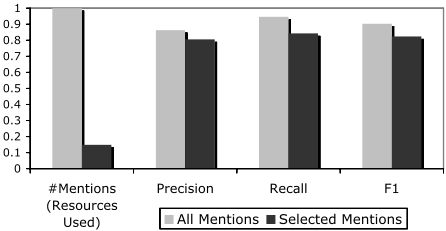
We now present the results for efficiently querying the web and adding new mentions to the graph. We start with initial partitioning of citations for data sets in the DBLP corpus. We then pick up to two or three tightly connected citations in each cluster, clean their titles and remove stop words to form a query. Fig. 3 shows the comparison of the result of these queries with the result of performing all pairwise queries. By adding only 14.86% of the nodes to the graph, we can achieve 91.25% of the original F1. In other words, we gain most of the benefit by using a small fraction of the queries. Note that the resulting graph is smaller and hence is faster to process.
7 Conclusions and FutureWork
We have formulated a new class of problems: resource bounded information gathering from the web in the context of correlational clustering, and have proposed several methods to achieve this goal in the domain of entity resolution. Our current approach yields positive results and can be applied for coreference of other object types, e.g. automatic product categorization. We believe that this problem setting has the potential to bring together ideas from the areas of active learning, relational learning, decision theory and graph theory, and apply them in a real world domain.
In future work we will explore alternative queries, (including input from more than two citations), as well as various new ways of efficiently selecting candidate queries. We are interested in investigating more sophisticated querying criteria in the case of web-as-a-mention. Additional theoretical work in the form of new formulations and bound proofs for these methods are also anticipated.
8 Acknowledgments
This work was supported in part by the Center for Intelligent Information Retrieval, in part by The Central Intelligence Agency, the National Security Agency and National Science Foundation under NSF grant #IIS-0326249, and in part by the Defense Advanced Research Projects Agency (DARPA), through the Department of the Interior, NBC, Acquisition Services Division, under contract number NBCHD030010, and Microsoft Research under the Memex funding program. Any opinions, findings and conclusions or recommendations expressed in this material are the authors' and do not necessarily reflect those of the sponsor. We thank Aron Culotta, Avrim Blum, Sridhar Mahadevan, Katrina Ligett and Arnold Rosenberg for interesting discussions.
@inproceedings{ijcai2007p67,
  title     = {Improving Author Coreference by Resource-Bounded Information Gathering from the Web},
  author    = {Kanani, Pallika H. and McCallum, Andrew and Pal, Chris},
  booktitle = {Proceedings of the Twentieth International Joint Conference on
               Artificial Intelligence, {IJCAI-07}},
  publisher = {International Joint Conferences on Artificial Intelligence},
  editor    = {Manuela M. Veloso},
  pages     = {429--433},
  year      = {2007},
  url       = {https://ijcai.org/proceedings/2007/67},
}
TY - CPAPER TI - Improving Author Coreference by Resource-Bounded Information Gathering from the Web AU - Kanani, Pallika H. AU - McCallum, Andrew AU - Pal, Chris T2 - Proceedings of the Twentieth International Joint Conference on Artificial Intelligence, IJCAI-07 PB - International Joint Conferences on Artificial Intelligence PY - 2007 SP - 429 EP - 433 UR - https://ijcai.org/proceedings/2007/67 ER -Copied
Machine-readable versions of this paper, for tools and AI agents:





