
Infeasibility Certificates and the Complexity of the Core in Coalitional Games
Proceedings of the Twentieth International Joint Conference on Artificial Intelligence. Pages 1402-1406.
© 2007 International Joint Conferences on Artificial Intelligence
Abstract
This paper characterizes the complexity of the core in coalitional games. There are different proposals for representing coalitional games in a compact way, where the worths of coalitions may be computed in polynomial time. In all those frameworks, it was shown that core non-emptiness is a co-NP-hard problem. However, for the most general of them, it was left as an open problem whether it belongs to co-NP or it actually is an harder problem. We solve this open problem in a positive way; indeed, we are able to show that, for the case of transferable payoffs, the problem belongs to co-NP for any compact representation of the game where the worths of coalitions may be computed in polynomial time (also, non-deterministic polynomial time), encompassing all previous proposals of this kind. This is proved by showing that games with empty cores have small infeasibility certificates. The picture is completed by looking at coalitional games with non-transferable payoffs. We propose a compact representation based on marginal contribution nets. Also in this case, we are able to settle the precise complexity of core non-emptiness, which turns out to be Σ2-complete.
- [Aumann and Hart, 1992] Robert J. Aumann and Sergiu Hart, editors. Handbook of Game Theory. Vol 1 (1992), Vol 2 (1994) and Vol 3 (2002). North-Holland.
- [Aumann, 2005] Robert J. Aumann. War and peace. The Nobel Foundation, 2005. Nobel Prize Lecture.
- [Conitzer and Sandholm, 2004] Vincent Conitzer and Tuo- mas Sandholm. Computing shapley values, manipulating value division schemes, and checking core membership in multi-issue domains. AAAI-04, 219-225, AAAI-Press.
- [Conitzer and Sandholm, 2006] Vincent Conitzer and Tuo- mas Sandholm. Complexity of constructing solutions in the core based on synergies among coalitions. AIJ, 170(6- 7):607-619, 2006.
- [Danzer et al., 1963] L. Danzer, B. Grünbaum, and V. Klee. Helly's theorem and its relatives. In Proc. of Symposia in Pure Mathematics 7, 101-180, AMS, 1963.
- [Deng and Papadimitriou, 1994] Xiaotie Deng and Chris- tos H. Papadimitriou. On the complexity of cooperative game solution concepts. Mathematics of Operations Re- search, 19(2):257-266, 1994.
- [Grünbaum, 1967] Branko Grünbaum. Convex Polytopes, volume XVI of Pure and Applied Mathematics. John Wi- ley & Sons, NY, 1967.
- [Ieong and Shoham, 2005] Samuel Ieong and Yoav Shoham. Marginal contribution nets: a compact representation scheme for coalitional games. In Proc. of EC '05, 193-202, Vancouver, Canada, ACM Press, 2005.
- [Osborne and Rubinstein, 1994] Martin J. Osborne and Ariel Rubinstein. A Course in Game Theory. The MIT Press, MA, 1994.
- [Papadimitriou, 1994] Christos H. Papadimitriou. Computa- tional Complexity. Addison Wesley, Reading, MA, 1994.
- [Papadimitriou, 2001] Christos H. Papadimitriou. Algo- rithms, games, and the Internet. STOC, 2001.
References were extracted automatically from the PDF and may contain errors.
Full text extracted automatically from the PDF; figures, tables and equations may differ. The PDF is the version of record.
1 Introduction
Coalitional games model situations where groups of players can cooperate in order to obtain certain worths, and have been extensively used to study applicative scenarios in economics and social sciences [Aumann and Hart, 1992]. Also, coalitional games are interesting in distributed AI, multi-agent systems and electronic commerce [Ieong and Shoham, 2005; Conitzer and Sandholm, 2004].
In coalitional games, a nonempty set of players joining together is called a coalition. The coalition including all the
∗Partially supported by ICAR-CNR within the research lab Logica of the Technology District for Logistics funded by Regione Calabria and conducted by R&D.LOG Consortium.
†Partially supported by ICAR-CNR within the Project Knowledge technology and innovative services (ICT.P04.002).
‡Partially supported by ICAR-CNR within the Project High quality software (ICT.P05.002).
Luigi Palopoli† and Francesco Scarcello‡
D.E.I.S., Universit`a della Calabria Via P. Bucci 41/c, I-87030, Rende, Italy {palopoli, scarcello}@deis.unical.it
players is called grand-coalition. The players know the worth that any coalition would get. A feasible solution for a coalitional game is an allowed way to assign worths (also payoffs) to all players. In the literature, a number of definitions of a feasible solution have been described. Each of them propose some way to assign worths to single players. Note that, in this formal context, the actions taken by players are not modeled.
There are two basic types of coalitional games [Osborne and Rubinstein, 1994]: Coalitional Games with transferable payoffs (or TU Games) and Coalitional Games with nontransferable payoffs (or NTU Games). In the former type of games, players forming a coalition can obtain a certain amount of worth they can distribute among themselves. In the latter type, a coalition guarantees a specific set of consequences that assign to its players a set of possible payoffs.
For both game types, a fundamental issue is distributing payoffs amongst participating players, which mirrors in several interesting applications [Aumann and Hart, 1992]. And, in fact, several ways of distributing utilities have been proposed, which are usually referred to as solution concepts (see, e.g., [Aumann and Hart, 1992] for a list of definitions). One solution concept is that of the core, which forces distributions that are, in a sense, "stable", that is, no subsets of players improve their worths by leaving the grand-coalition. The core, which can be seen as an analogous of the Nash equilibrium for coalitional games [Osborne and Rubinstein, 1994], is probably the most important solution concept defined for such games (see, e.g., [Aumann, 2005]). Therefore, it is a significant issue singling out those games featuring a nonempty core, that are, games where the worth distribution can be arranged in such a way that the grand-coalition is "stable". On the other hand, analyzing the computational complexity of solution concepts of games is an important class of problems for computer science [Papadimitriou, 2001].
In order to represent and reason about coalitional games, a way to represent the associations of coalitions with their worths is needed: doing it explicitly is unfeasible, since listing all those associations would require exponential space in the number of players. In this sense, the literature proposes a number of compact representation schemes of the worth function. For instance, Papadimitriou and Deng (1994) consider TU games where players are encoded as nodes in an arcweighted graph, and the worth of a coalition s is computed as the sum of the weights of the arcs connecting players in s.
A more general and more expressive representation for TU games has been recently proposed by Ieong and Shoham (2005), where the encoding is done using marginal contribution nets, i.e., finite sets of weighted rules, where the coalition worth is given by the sum of the weights of the logical rules triggered by its members. In both these settings, checking non-emptiness of the core was shown to be co-NP-hard, whereas in the latter-more general-setting it was left as an open problem to settle its precise complexity.
In dealing with this open question, this paper provides an answer to the rather more general question of establishing the complexity of checking core non-emptiness (in both the transferable and the non-transferable payoffs settings) for all those compact game representations satisfying the (quite weak) constraint that the associated worth function is computable in FNP (and, thus, as a special case, in polynomial time, as in the two above mentioned frameworks).
Note that our representation scheme encompasses all other compact schemes we are aware of but the one described in [Conitzer and Sandholm, 2006] for TU games, where computing the worth of a coalition is harder than FNP-the interested reader is referred to that paper for a thorough overview about compact representation schemes. Note, moreover, that for some of such compact representation schemes, the complexity of checking core non-emptiness was already established [Conitzer and Sandholm, 2006; Deng and Papadimitriou, 1994] (for instance, it is shown to be co-NP-complete in the setting given in [Deng and Papadimitriou, 1994]).
In order to prove our complexity results for TU games, we show that if the game core is empty, then there exists a small infeasibility certificate that proves it, thereby showing that for games of the quite general form we consider here, the problem of checking core non-emptiness is in co-NP (Note that this provides the answer to the problem left open in [Ieong and Shoham, 2005]). This is done by providing some results about the properties of polyhedra induced by games.
Furthermore, we consider NTU games, by defining a new compact game form, which is obtained by generalizing marginal contribution nets [Ieong and Shoham, 2005] to the non-transferable payoffs setting. For such games, we are able to show that checking core non-emptiness is ΣP2 -hard, and also that this problem can be solved in ΣP2 even for general games of this form, thereby settling the ΣP2 -completeness of the problem in the non-transferable payoffs setting.
2 Preliminaries
In this section we define our formal framework of reference.
2.1 Transferable Payoffs
Games of interest in this paper are formally defined next.
Definition 2.1. A Coalitional Game with transferable payoffs is a pair 〈N, v〉 where
- N is the finite set of players;
- v is a function that associates with every coalition s a real number v(s) (the worth of s) (v : 2N → ℜ).
An outcome for a coalitional game specifies payoffs for all players. A solution concept is a way to select "reasonable"
outcomes for a coalitional game: the core is one of the best known, as it represents a stable solution, from which players have no incentive to deviate. Let n = |N|. A profile ¯x for N is a vector of reals (¯x1, . . . , ¯xn), which represents a possible way to assign payoffs to players. For a coalition of players s ⊆ N, define ¯x(s) ≡ ∑i∈s ¯xi. Then, ¯x is said a feasible payoff profile if ¯ x(N) = v(N), that is, payoffs distributed among the players should be equal to the payoff available for the grand-coalition. The core is defined as follows:
Definition 2.2. The core of a coalitional game with transferable payoffs 〈N, v〉 is the set of all feasible payoff profiles ¯x such that, for all coalitions s ⊆ N, ¯x(s) ≥ v(s).
It immediately follows from the definition above that the core is the set of all vectors ¯x ∈ ℜn that satisfy the following 2n inequalities:∑
where the last inequality, combined with its opposite in (2.1), enforces the feasibility of computed profiles.
2.2 Non-transferable Payoffs
In coalitional NTU games each coalition is associated to a set of possible outcomes or consequences:
Definition 2.3. A Coalitional Game without transferable payoff is a four-tuple 〈N,X, v, (≿i)i∈N 〉, where:
- N is a finite set of players;
- X is the set of all possible consequences;
- v : s → 2X is a function that assigns, to any coalition s ⊆ N of players, a set of consequences v(s) ⊆ X;
- (≿i)i∈N is the set of all preference relations ≿i on X, for each player i ∈ N.
It is easy to see that coalitional games with transferable payoffs can be seen as special cases of coalitional games without transferable payoffs [Osborne and Rubinstein, 1994]. Also, the definition of the core for those latter games is an extension of that given in definition 2.2:
Definition 2.4. The core of the coalitional game without transferable payoffs 〈N,X, v, (≿i)i∈N 〉 is the set of all ¯ x ∈ v(N) such that there is no coalition s ⊆ N with a ¯ y ∈ v(s) such that ¯ y ≻i ¯ x for all i ∈ s.
3 Compact Representations
We now discuss compact representation forms, beginning with marginal contribution nets [Ieong and Shoham, 2005].
Rules in a marginal contribution net are in the form
where a pattern is a conjunction that may include both positive and negative literals, with each literal denoting a player. A rule is said to apply to a coalition s if all the player literals occurring positively in the pattern are also in s and all the player literals occurring negatively in the pattern do not belong to s. When more than one rule applies to a coalition, the value for that coalition is given by the contribution of all those rules, i.e., by the sum of their values. Vice versa, if no rule applies to a given coalition, then the value for that coalition is set to zero by default. For example, with rules:
we obtain v({a}) = 3 (the third rule applies), v({b}) = 2 (the second rule applies), and v({a, b}) = 5 + 2 = 7 (both the first and the second rules apply). Using this representation scheme, games can be much more succinct than the so called characteristic form, where all the 2n - 1 values of the worth function should be explicitly listed. In any case, given such a game encoding G and any coalition s, the worth v(s) can be computed in linear time, that is, in O(||G|| + ||s||), which is also O(||G||), where ||G|| denotes the size of G. As observed in [Ieong and Shoham, 2005], their representation scheme is fully expressive, in that it allows to represent any TU coalitional game, and there are games where it is exponentially more succinct than previous proposals, such as the multi-issue representation of [Conitzer and Sandholm, 2004]. For completeness, note that there are games where the size of any possible marginal nets encoding has almost the same size as the characteristic form.
Next, we are going to introduce a new and general compact representation scheme of coalitional games, a scheme where it is just required the worth function to be computable in FNP, that is, computable in polynomial time by a non-deterministic Turing transducer [Papadimitriou, 1994].
Formally, let C be a class of games with transferable (resp., non-transferable) payoffs as defined by a certain given encoding scheme. Define the worth (consequence) relation for C as the set of tuples WC = {〈G, s,w〉 | G ∈ C, vG(s) = w} (resp., WC = {〈G, s,w〉 | G ∈ C,w ∈ vG(s)}). We say that WC is polynomial-time computable if there is a positive integer k and a deterministic polynomial time transducer M that, given any game encoding G ∈ C and a coalition s of players of G, outputs a value w (resp. all consequences w) such that 〈G, s, w〉 ∈ WC in at most ||〈G, s〉||k steps.
We say that WC is non-deterministically polynomial-time computable if there is a positive integer k such that WC is kbalanced and k-decidable, as defined below. A worth (consequence) relationWC is k-balanced if ||w|| ≤ ||〈G, s〉||k , while it is said k-decidable if there is a non-deterministic Turing machine that decidesWC in at most ||〈G, s, w〉||k time. It then follows that there is a non-deterministic Turing transducer M that may compute in O(||〈G, s〉||k ) time the worth v(s) (resp. some consequence in v(s)) of any coalition s of players of G. Indeed, M guesses such a value w and a witness y of the correctness of this value (note that WC ∈ NP), and then verifies in deterministic polynomial time that 〈G, s,w〉 ∈ WC, possibly exploiting the witness y.
Definition 3.1. Let C(R) be the class of all games encoded according to some compact representation R. We say that R is a (non-deterministic) polynomial-time compact representation if the worth relation for C(R) is (non-deterministically) polynomial-time computable.
For instance, the extension of the marginal nets framework to games with non-transferable payoffs, presented in Section 6, is a non-deterministic polynomial-time compact representation, whereas both the above mentioned schemes of [Deng and Papadimitriou, 1994] and of [Ieong and Shoham, 2005] are polynomial time representations since, given a game G encoded either as a weighted graph, or as a marginal contribution net, and given any coalition s, the worth of s in G can be computed in polynomial time in the size of G and s.
Our membership proofs for the core non-emptiness problem will be given in the most general setting of non-deterministic polynomial-time compact representations.
4 Separating Polyhedra
Because of (2.1) and (2.2), the core of a coalitional game with transferable payoffs and n players is a polyhedral set of ℜn. In this section, we prove some nice properties of polyhedral sets that will be useful to deal with such games.
4.1 Preliminaries on Polyhedral Sets
We next give some useful definitions and facts about polyhedral sets. We refer the interested reader to any book on this subject for further readings (see, e.g., [Gr¨unbaum, 1967]).
Let n > 0 be any natural number. A Polyhedral Set (or Polyhedron) P of ℜn is the intersection of a finite set S of closed halfspaces of ℜn. Note that in this paper we always assume, unless otherwise stated, that n > 0. We denote this polyhedron by Pol(S) and we denote S by Half(P ).
Recall that a hyperplane H of ℜn is a set of points {x ∈ ℜn|aT x = b}, where a ∈ ℜn and b ∈ ℜ. The closed halfspace H + is the set of points {x ∈ ℜn|aT x ≥ b}. We say that these points satisfy H +. We denote the points that do not satisfy this halfspace by H -, i.e., H - = ℜn \ H + = {x ∈ ℜn|aT x < b}. Note that H - is an open halfspace. We say that H determines H + and H -. Define the opposite of H as the set of points ¯H = {x ∈ ℜn|a′T x = b′}, where a′ = -1·a and b′ = -1 · b. Note that ¯H + = H - ∪H, since it is the set of points {x ∈ ℜn|aT x ≤ b}.
Let P be a polyhedron and H a hyperplane. Then, H cuts P if both H + and H - contain points of P , and we say that H passes through P, if there is a non-empty touching set C = H∩P. Furthermore, we say that H supports P, or that it is a supporting hyperplane for P , if H does not cut P , but passes through P, i.e., it just touches P, as the only common points of H and P are those in their intersection C.
Moreover, we say that H + is a supporting halfspace for P if H is a supporting hyperplane for P and P ⊆ H +. Note that P ⊆ Pol(S) for any set of halfspaces S ⊆ Half(P), since the latter polyhedron is obtained from the intersection of a smaller set of halfspaces than P. We say that such a polyhedron is a supporting polyhedron for P .
Recall that, for any set A ⊆ ℜn, its dimension dim(A) is the dimension of its affine hull. For instance, if A consists of two points, or it is a segment, its affine hull is a line and thus dim(A) = 1. By definition, dim(∅) = -1, while single points have dimension 0.
A set F ⊆ P is a face of P if either F = ∅, or F = P, or if there exists a supporting hyperplane HF of P such that F
is their touching set, i.e., F = HF ∩P. In the latter case, we say that F is a proper face of P . A facet of P is a proper face of P with the largest possible dimension, that is, dim(P)-1. The following facts are well known [Gr¨unbaum, 1967]:
- For any facet F of P , there is a halfspace H + ∈ Half(P ) such that F = H + ∩ P . We say that H + generates F .
- For any proper face F of P, there is a facet F ′ of P such that F ⊆ F ′ .
- If F and F ′ are two proper faces of P and F ⊂ F ′ , then dim(F ) < dim(F ′ ).
4.2 Separating Polyhedra from a Few Supporting Halfspaces
Lemma 4.1. Let P be a polyhedron of ℜn with dim(P ) = n, and H + F a supporting halfspace of P whose touching set is F . Then, there exists a set of halfspaces HF ⊆ Half(P) such that |HF | ≤ n - dim(F), H + F is a supporting halfspace of Pol(HF ), and their touching set C is such that F ⊆ C.
Proof. (Rough Sketch.) The proof is by induction. Base case: If dim(F) = n-1 we have that the touching face F = H + F ∩P is a facet of P . Thus, from Fact 1, F is generated by some halfspace H + ⊆ Half(P) such that H + ∩ P = F, as for HF . Since dim(F) = dim(H) = dim(HF ) = n - 1, it easily follows that in fact H = HF holds. Thus, H + F is trivially a supporting halfspace of H +, and this case is proved: just take HF = {H +} and note that |HF | = 1.
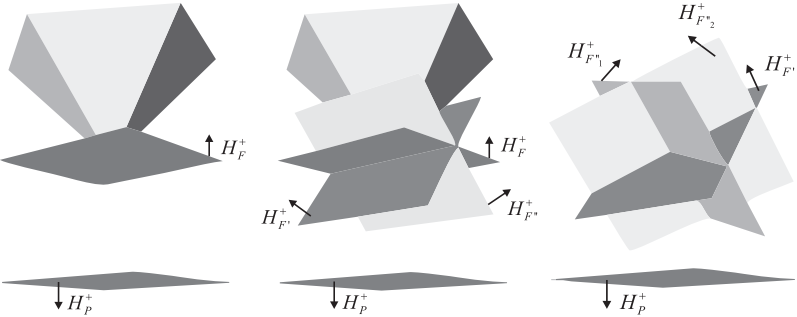
Inductive step: By the induction hypothesis, the property holds for any supporting halfspace H + F ′ of P such that its touching face F ′ has a dimension d ≤ dim(F ′ ) ≤ n - 1, for some d > 0. We show that it also holds for any supporting halfspace H + F of P, whose touching face F has a dimension dim(F) = d-1. For space limitations, we just give the proof idea, with the help of Figure 1. Since F is not a facet, from Fact 2 there exists a facet F ′ of P such that F ⊂ F ′ . In the three-dimensional example shown in Figure 1, F is the vertex at the bottom of the diamond, and F ′ is some facet on its "dark side." Let C = HF ∩HF ′ , and consider the rotation of HF about C on the opposite direction w.r.t. HF ′ that first touches P , say HF ′′ . As shown in Figure 1, the face F ′′-an edge of the diamond-properly includes F and its dimension is at least d > dim(F), by fact 3. It can be shown that, given such a pair of halfspaces H + F ′ and H + F ′′ , it holds that H + F is a supporting halfspace of the polyhedron Pol(H + F ′ , H + F ′′ ), which is called roof. Formally, the proof proceeds by exploiting the induction hypothesis. Intuitively, consider HF ′′ : we want a set HF supported by H + F and consisting of just halfspaces taken fromHalf(P), and H + F ′′ does not belong to this set, because it does not generate a facet of P. However, we can see that it is a supporting halfspace for H + F ′′ 1 ∩ H + F ′′ 2 -the roof, which correspond to faces having higher dimension than F ′′ . In the running example, they are both facets of the diamond, and hence the property immediately holds (base case). In general, the procedure may continue, encountering each time at least one facet by fact 2, and one more face with a higher dimension than the current one by fact 3. Eventually, in our example we get HF = {H + F ′ , H + F ′′ 1 ,H + F ′′ 2 }. Moreover, recall that dim(F ′ ) = n-1 and dim(F ′′ ) > dim(F ) = d-1. Then, by the induction hypothesis, |HF | ≤ |HF ′ | + |HF ′′ | = 1+|HF ′′ | ≤ 1+n-dim(F ′′) ≤ 1+n-d = n-dim(F ).
5 Small Emptiness Certificates for the Core
In this section, we prove our main results on TU games.
With a little abuse of notations, since coalitions correspond to the inequalities (2.1) and hence to the associated halfspaces of ℜn, hereafter we use these terms interchangeably.
Definition 5.1. Let G = 〈N, v〉 be a game with transferable payoffs. A coalition set S ⊆ 2N is a certificate of emptiness (or infeasibility certificate) for the core of G if the intersection of Pol(S) with the grand-coalition halfspace (2.2) is empty.
The definition above is motivated by the following observation. Let P be the polyhedron of ℜn obtained as the intersection of all halfspaces (2.1). Since S is a subset of all possible coalitions, P ⊆ Pol(S). Therefore, if the intersection of Pol(S) with the grand-coalition halfspace (2.2) is empty, the intersection of this halfspace with P is empty, as well.
Theorem 5.2. Let G = 〈N, v〉 be a game with transferable payoffs. If the core of G is empty, there is a certificate of emptiness S for it such that |S| ≤ |N|.
Proof. (Sketch.) Let n = |N| and P be the polyhedron of ℜn obtained as the intersection of all halfspaces (2.1). Since we are not considering the feasibility constraint (2.2), there is no upper-bound on the values of any variable xi, and thus it is easy to see that P ̸= ∅ and dim(P) = n.
Let H + P be the halfspace defined by the grand-coalition inequality (2.2). If the core of G is empty, the whole set of inequalities has no solution, that is, P ∩H + P = ∅.
Let ¯H + F be the halfspace parallel to H + P that first touches P, that is, the smallest relaxation of H + P that intersect P. Consider the opposite H + F of ¯H + F , as shown in Figure 1, on the left. By construction, H + P ∩ H + F = ∅, HF = ¯HF is a supporting hyperplane of P, and H + F is a supporting halfspace of P. Let F be the touching set of HF with P, and let d = dim(F). In Figure 1, it is the vertex at the bottom of the diamond P . From Lemma 4.1, there is a set of halfspaces S ⊆ Half(P), with |S| ≤ n - d, such that H + F is a supporting halfspace for Pol(S). It follows that H + P ∩ Pol(S) = ∅, whence S is an infeasibility certificate for the core of G. Finally, note that the largest cardinality of S is n, and corresponds to the case dim(F) = 0, that is, to the case where the face F is just a vertex. Therefore the maximum cardinality of the certificate is n. In our three-dimensional example, such a certificate is {H + F ′ , H + F ′′ 1 ,H + F ′′ 2 }, as shown in Figure 1.
Note that the above proof is constructive and has a nice geometrical interpretation. However, for the sake of completeness, we point out that-as we have recently found-the above result on infeasibility certificates may be also obtained as a consequence of Helly's Theorem on the intersection of families of convex sets [Danzer et al., 1963], whose proof is rather different, as it relies on algebraic techniques.
Exploiting the above property, we can now state our general result on the complexity of core non-emptiness for any (non-deterministic) polynomial-time compact representation.
Theorem5.3. Let Rbe a non-deterministic polynomial-time compact representation. Given any coalitional game with transferable payoffs G ∈ C(R), deciding whether the core of G is not empty is in co-NP.
Proof. Let G = 〈N, v〉 be a game with transferable payoffs. If its core is empty, fromTheorem5.2, there is an infeasibility certificate S, with |S| ≤ n, where n is the number of players of G. For the sake of presentation, let us briefly sketch the case of a polynomial-time deterministic representation R. In this case, a non-deterministic Turing machine may check in polynomial time that the core is empty by performing the following operations: (i) guessing the set S, i.e., the coalitions of players corresponding to the halfspaces in S; (ii) computating (in deterministic polynomial time) the worth v(s), for each s ∈ S, and for the grand-coalition N; and (iii) checking that Pol(S) ∩ H + P = ∅, where H + P is the halfspace defined by the grand-coalition inequality (2.2). Note that the last step is feasible in polynomial time, as we have to solve a linear system consisting of just n + 1 inequalities.
The case of a non-deterministic polynomial-time compact representation R is a simple variation where, at step (ii), for each s ∈ S, the machine should also guess the value w = v(s) and a witness y that 〈G, s, w〉 ∈ WC(R).
The above result settles the precise complexity of the core non-emptiness problem for marginal contribution nets, as asked for in [Ieong and Shoham, 2005].
Corollary 5.4. Given a coalitional game with transferable payoffs encoded as a marginal contribution net, deciding whether its core is not empty is co-NP-complete.
6 Non-Transferable Payoffs Increase the Complexity
For games where the payoffs cannot be transferred among the players, core non-emptiness turns out to be harder than in the case of transferable payoffs we have studied above.
First, for NTU games we next define a notation similar to that of marginal contribution nets, to describe the consequences of these games in a compact form.
Also here, games are described by associating player patterns with consequences, a coalition worth being thus characterized by the sums of the contributions of the rules whose patterns are satisfied by the players in the coalition.
Definition 6.1. A marginal contribution net for game with non-transferable payoffs is a finite set of rules of the form
where pattern is a conjunction of positive and negative player literals, and consequences is a set of possible payoff addenda for the players in the coalition that trigger this rule, that is, for players occurring as positive literals in pattern.
Formally, given such a rule r, we say that a coalition s of players meets its pattern, if each player occurring positively in pattern also occurs in s, and none of the players occurring negatively in pattern occurs in s. The consequences of r are a set of vectors assigning an increment (either positive or negative) to some players occurring positively in pattern. All other players get no increment out of this vector. Syntactically, we thus specify only the contributions for the players to be incremented (see example below). For each player p, there is a default implicitly specified rule, which is triggered by the player p and assigns to it the (initial) value 0. Then, the only consequence of coalitions that do not meet any non-default rule is the outcome assigning payoff 0 to all their players.
Let s be a coalition and R the set of rules that s meets. The set of consequences v(s) of s is the set of all imputation vectors that can be obtained by taking the sum of any tuple of vectors ¯ x1, . . . , ¯x|R|, with each ¯xi belonging to the consequences of some rule ri ∈ R.
Example 6.2. Let us consider a game involving players a, b and c. Then, consider the rules
Then the set of consequences v({a}) is the singleton {(0, 0, 0)}, since only the implicit default rules apply. On the other hand, v({a, b}) = {(1, 4, 0), (2, 5, 0)}, v{b, c} = {(0, 0, 0)}, and v({a, b, c}) = {(1, 0, 0), (2, 1, 0)}.
Theorem6.3. Let Rbe a non-deterministic polynomial-time compact representation. Given any coalitional game with non-transferable payoffs G ∈ C(R), deciding whether the core of G is not empty is in ΣP2 . In particular, it is ΣP2 - complete if R is the marginal contribution nets framework. However, if R is a deterministic polynomial-time compact representation, the problem is in co-NP.
Proof. (Rough Sketch.) (Membership in ΣP2 ). Let G = 〈N, X, v, (≿i)i∈N 〉 be a game in C(R) with non-transferable payoffs. A non-deterministic Turing machine with an oracle in NP may decide in polynomial time that the core is not empty as follows: (i) guessing the profile w ∈ v(N) and of a witness y that w is a consequence of v(N); (ii) exploiting y, checking in polynomial time that 〈G,N, w〉 ∈ WC(R); and (iii) exploiting the oracle, checking that w belongs to the core. Indeed, it is easy to see that the latter problem is in co-NP.
(Membership in co-NP). If R is a deterministic polynomial-time compact representation, a non-deterministic Turing machine M may decide in polynomial time that the core is empty as follows. It computes in polynomial time all consequences of the grand-coalition and guesses, for each w ∈ v(N), a witness yw that w is not in the core. Then, exploiting these witnesses, M checks in polynomial time that all such profiles do not belong to the core.
(ΣP2 -hardness). The reduction is from the problem of deciding the validity of 2QBF formulae in 3DNF. Let Φ = ∃α∀βφ(α, β), where α and β are vectors of boolean variables, and φ(α, β) is a boolean formula in 3DNF. From Φ, we build in polynomial time the following NTU game GΦ, encoded as a marginal contribution net. The players of GΦ are: two players aTi and aFi , called existential players, corresponding to each variable αi of Φ; two players bTi and bFi , called universal players, for each variable βi of Φ; a player di for each disjunct δi of Φ; and two more players sat and good, where the former is related to the satisfiability of φ(α, β), while the latter is a player that receives a penalty -B in coalitions that do not behave as we would like to, where B is a fixed number larger than any value that any coalitions may achieve.
For any literal ℓ occurring in some disjunct of the formula, denote by p(l) the corresponding player of the game. E.g., if ℓ = ¬αi, then p(ℓ) = aFi ; if ℓ = αi, then p(ℓ) = aTi . Then, the consequences for coalitions in GΦ are defined through the following rules:
Then, it can be shown that Φ is valid if and only GΦ has a non empty core. First note that any imputation vector for the grand-coalition N assigns 1 to universal players, disjunct players, and to sat and good. For any pair of existential players aTi and aFi , they get either 0 or 1 but never the same value. Then, we can associate with such a configuration of existential players a truth-value assignment for the corresponding boolean variables: if ¯ x is an imputation vector, define σ¯x such that σ¯x(αi) = true if aTi takes 0 in ¯ x, and σ¯x(αi) = false if aFi takes 0 in ¯x. Intuitively, if the formula is valid then σ¯x is a witness of validity, and there is such an imputation vector ¯x in the core. Indeed, in this case, to improve the payoff for all of its members, a coalition should avoid to include sat. However, this is impossible if Φ is valid.
@inproceedings{ijcai2007p226,
  title     = {Infeasibility Certificates and the Complexity of the Core in Coalitional Games},
  author    = {Malizia, Enrico and Palopoli, Luigi and Scarcello, Francesco},
  booktitle = {Proceedings of the Twentieth International Joint Conference on
               Artificial Intelligence, {IJCAI-07}},
  publisher = {International Joint Conferences on Artificial Intelligence},
  editor    = {Manuela M. Veloso},
  pages     = {1402--1406},
  year      = {2007},
  url       = {https://ijcai.org/proceedings/2007/226},
}
TY - CPAPER TI - Infeasibility Certificates and the Complexity of the Core in Coalitional Games AU - Malizia, Enrico AU - Palopoli, Luigi AU - Scarcello, Francesco T2 - Proceedings of the Twentieth International Joint Conference on Artificial Intelligence, IJCAI-07 PB - International Joint Conferences on Artificial Intelligence PY - 2007 SP - 1402 EP - 1406 UR - https://ijcai.org/proceedings/2007/226 ER -Copied
Machine-readable versions of this paper, for tools and AI agents:





