
Market Based Resource Allocation with Incomplete Information
Proceedings of the Twentieth International Joint Conference on Artificial Intelligence. Pages 1193-1197.
© 2007 International Joint Conferences on Artificial Intelligence
Abstract
Although there are some research efforts toward resource allocation in multi-agent systems (MAS), most of these work assume that each agent has complete information about other agents. This research investigates interactions among selfish, rational, and autonomous agents in resource allocation, each with incomplete information about other entities, and each seeking to maximize its expected utility. This paper presents a proportional resource allocation mechanism and gives a game theoretical analysis of the optimal strategies and the analysis shows the existence of equilibrium in the incomplete information setting. By augmenting the resource allocation mechanism with a deal optimization mechanism, trading agents can be programmed to optimize resource allocation results by updating beliefs and resubmitting bids. Experimental results showed that by having a deal optimization stage, the resource allocation mechanism produced generally optimistic outcomes (close to market equilibrium).
- [Bredin et al., 2003] J. Bredin, R. Maheswaran, O. Imer, T. Basar, D. Kotz, and D. Rus. Computational markets to regulate mobile-agent systems. Autonomous Agents and Multi-Agents Systems, 6(3):235-263, 2003.
- [Chevaleyre et al., 2006] Yann Chevaleyre, Paul E. Dunne, Ulle Endriss, Jerome Lang, Michel Lemaitre, Nico- las Maudet, Julian Padget, Steve Phelps, Juan A. Rodriguez-Aguilar, and Paulo Sousa. Issues in multi- agent resource allocation. Informatica, 31:3-31, 2006.
- [Clearwater and Clearwater, 1996] Scott H. Clearwater and S. H. Clearwater, editors. Market-based control-a paradigm for distributed resource allocation. World Scientific, 1996.
- [Endriss and Maudet, 2005] Ulle Endriss and Nicolas Maudet. On the communication complexity of multilat- eral trading: extended report. Journal of Autonomous Agents and Multiagent Systems, 11(1):91-107, 2005.
- [Endriss et al., 2006] Ulle Endriss, Nicolas Maudet, Fariba Sadri, and Francesca Toni. Negotiating socially opti- mal allocations of resources. Journal of Artificial Intel- ligence Research, 25:315-348, 2006.
- [Johari et al., 2005] R. Johari, S. Mannor, and J. Tsitsiklis. Efficiency loss in a network resource allocation game: the case of elastic supply. IEEE Transactions on Auto- matic Control, 50(11):1712-1724, 2005.
- [Maheswaran and Bas ¸ar, 2003] R. Maheswaran and T. Bas ¸ar. Nash equilibrium and decentralized ne- gotiation in auctioning divisible resources. Group Decision and Negotiation, 12(5):361-395, 2003.
- [Rosenschein and Zlotkin, 1994] J. Rosenschein and G. Zlotkin. Rules of encounter: designing conventions for automated negotiation among computers. MIT Press, Cambridge, MA, 1994.
- [Sim, 2005] K. M. Sim. Equilibria, prudent compromises, and the "waiting" game. IEEE Trans. on Systems, Man and Cybernetics, Part B, 33(3):712-724, Jun. 2005.
References were extracted automatically from the PDF and may contain errors.
Full text extracted automatically from the PDF; figures, tables and equations may differ. The PDF is the version of record.
1 Introduction
In systems involving multiple autonomous agents, it is often necessary to decide how scarce resources should be allocated. The allocation of resources within a system of autonomous agents, is an exciting area of research at the interface of computer science and economics [Johari et al., 2005]. Market mechanisms have been advocated as an effective method to control electronic resources and been used in resource allocation [Clearwater and Clearwater, 1996]. These resource allocation mechanisms which mostly rely on derived concepts from cooperative game theory often assume that agents share the same desires and have complete information about the world [Clearwater and Clearwater, 1996; Maheswaran and Bas¸ar, 2003; Johari et al., 2005; Bredin et al., 2003]. Under such settings, there is much related work concerning issues in resource allocation like complexity, preference, procedure, etc [Chevaleyre et al., 2006; Endriss et al., 2006; Endriss and Maudet, 2005].
Generally, agents are assumed to be self-interested and have incomplete information. The assumption of incomplete Zhiqi Shen School of EEE Nanyang Technological Univ. zqshen@ntu.edu.sg information is intuitive because in practice, agents have private information, and for strategic reasons, they do not reveal their strategies, constraints, or preferences [Sim, 2005]. In [Rosenschein and Zlotkin, 1994, p.54], it was noted that the strategy of a trading agent corresponds to its internal program, and extracting the true internal decision process would be difficult. Moreover, when selfish agents have competing interests, they may have incentive to deviate from protocols or to lie to other agents about their preferences.
Against this background, this paper studies resource allocation in multi-agent systems in which each agent 1) is selfish and 2) has incomplete information about the other entities in the world. We consider divisible or share auctions as a market mechanism to solve the resource allocation problem. Inherent in the settings we are considering is the competition among agents attempting to gain access to limited resources (e.g., sensor resources in distributed sensing networks). Trading agents automatically select the appropriate strategies based on their beliefs about other entities and we give a gametheoretic analysis of selfish agents' optimal strategies.
This paper also introduces a deal optimization mechanism in which agents can recursively update their beliefs and resubmit bids. The result of resource allocation with incomplete information may be not as good as that with complete information. The intuition is that sometimes it may be prudent to look for and consider other more promising opportunities that may arise after a resource allocation game completes. To optimize deals, each agent updates its belief about other entities based on past interaction and resubmits a new bid. After getting the resource allocation result of the latest auction, an agent reports how much it loses or wins in the past auction and then the auctioneer reallocates utilities.
The remainder of this paper is organized as follows. Section 2 introduces the resource allocation problem. Section 3 discusses trading agents' optimal actions in resource allocation. In section 4, the deal optimization mechanism will be presented and analyzed. Section 5 examines the performance of the proposed mechanism through experimentation. Section 6 summarizes related work. In the final section, some conclusions are presented and ideas for future work are outlined.
2 The resource allocation problem
This paper considers allocation of divisible resources (e.g., sensor resource or network bandwidth) among selfish intelligent agents. We begin with N agents competing for a resource with a fixed finite capacity C. The resource is allocated using an auction mechanism, where the partitions depend on the relative signals or bids sent by the agents. We assume that each agent submits a signal si to the resource. Then, s = [s1, s2, . . . , sN] represents all bids of competing agents. A divisible auction consists of two mappings. The first is from the bids, s, to a partition, x(s), where xi(s) ∈ [0,C] is the resource share allocated to the ith bidding agent. The second is from the bids, s, to a cost vector, c(s, x) where ci(s, x) is the cost associated with the ith agent obtaining xi(s).
In our auction mechanism design, we want our allocations to be proportionally fair by weight. This holds if the allocation x∗ satisfies:
for any x where ∑i=N i=1 xi = C where si denote the weights. This can be achieved by the following allocation rule:
In terms of cost of computation, we note that it takes O(N) operations to perform the allocation presented in (1), which is the minimal cost for making variable allocations to N agents. The cost for each agent is
In this auction mechanism, if the feedback from the resource is the sum of all bids, an agent can immediately verify if it has been given an accurate allocation. If an agent knows the received allocation xi and its own bid si, any bid total suggested by the auctioneer other than ∑j sj can be immediately identified as a signal of an inaccurate allocation or a lying auctioneer. Furthermore, under this cost structure, each agent pays the same price per unit resource received.
We assume that each agent has a valuation vi(xi) for receiving an allocation xi. This valuation may be a characterization of the estimated performance as a function of a given share of the resource. Each performance measure is translated to an equivalent value (money in this paper) that can be compared with cost. Another derivation of the valuation could come from the estimated value of the sales that could be generated by obtaining a given share of the resource.
We also assume the valuation function vi(xi) is concave (i.e., v′′ i (xi) ≤ 0, ∀xi ∈ [0,C] ), strictly increasing (i.e., v′i (xi) > 0, ∀xi ∈ [0,C] ), and continuously differentiable, with domain xi > 0, ∀xi ∈ [0, C]. Each agent's utility is the difference between the valuation and cost of its allocation:
Definition 1 (Resource allocation problem) Given the centralized control of the system, a natural problem for the network manager (auctioneer) to try to solve is the following optimization problem:
Even though the resource allocation is accomplished via an auction mechanism, we note that ultimately each agent pays the same price per unit resource obtained. The auction can then be interpreted as a resource sold at a uniform price where the price is determined by the agents. The price per unit of the resource is θ/C, where θ = ∑j sj, and each agent receives an allocation in proportion to that price.
Definition 2 (Demand function) The demand function, di(θ), is defined as the quantity of resource that the agent would desire if the price was θ. This is generated by an agent's unique optimal response in a way such that si = di(θ)θ is the agent's reaction to s-i = (C - di(θ))θ. The demand function is expected to be differentiable decreasing function of its argument and the existence of one implies the existence of a well-defined inverse.
We have a resource allocation mechanism where N users are bidding to obtain a portion of an offered resource. If the resulting allocation does not lie on the user's optimal demand curve, the user will change its bid. An immediate question is whether there exists a set of bids {si} that is a Nash equilibrium, i.e., a set of bids such that no single user wishes to deviate from its bid given that the bids of all the other users remain the same. To answer this question, we note that this is equivalent to asking whether there exists a value for the sum of total bids, θ, such that ∑Ni=1 di(θ) = C. This equivalence is valid because all of the offered capacity is partitioned among the users proportional to their bids and the optimal demand function represents a percentage of the offered capacity.
Theorem 1 [Maheswaran and Bas¸ar, 2003] Given any set of continuous functions di(θ)Ni=1 where di(0) = C ∀θ > θi, and di(θ1) > di(θ2) ∀θ1 < θ2 < θi is true for i = 1, . . . ,N, then there exists a unique value θ∗ such that ∑Ni=1 di(θ∗ ) = C.
Proof: Let d(θ) = ∑Ni=1 di(θ). Then d(θ) is a continuously decreasing function whose maximum value is d(θ) = NC > C. Let θmax = maxiθi. We have d(θmax) = 0. Applying the Intermediate Value Theorem for d(θ) on [0, θmax], we know that there exists at least one θ∗ such that d(θ) = ∑Ni=1 di(θ) = C. Let us assume that there are at least two values of θ where d(θ) = C. Let us choose two of these values, θ∗ 1 and θ∗ 2 where θ∗ 1 < θ∗ 2 . Then, we have di(θ∗ 1) < di(θ∗ 2)∀i = 1, . . . ,N which implies that di(θ∗ 1 ) < di(θ∗ 2 ). But we have di(θ∗ 1 ) = di(θ∗ 2 ) = C, which is a contradiction and thus we can have only one θ where d(θ) = ∑Ni=1 di(θ) = C. ⊓⊔
3 Agents' optimal strategy with incomplete information
This work assumes that agents have incomplete information about the deadlines, reserve proposals, strategies, and time preferences of other agents. Each agent has two parameters denoted as < ui, si >. The outcome of resource allocation depends on each agent's two parameters. The information state, Υi, of an agent i is the information it has about the resource allocation parameters. An agent's own parameters are known to it, but the information it has about another agent is not complete. We define Υi as:
where ui is the agent i's utility function and f-i is a probability distribution function that denotes the agent i's beliefs about the sum of other agents' bids. f-i(x) represents that the agent i's prior estimation of the probability of that the sum of other agents' bids is x. Here we assume that agents have uncertain information about each other's bids. Moreover, the agents do not know other trading partners' utility functions or strategies and, therefore, an agent and another agent may have different utility preferences.
We describe how optimal bids are obtained for players that are utility maximizers. Since utility is a function of values of allocated resource and bids, these strategies optimize both. Without loss of generality, the discussion is from the perspective of the agent i (although the same analysis can be taken from the perspective of another agent).
The outcome of resource allocation depends on all the agents' strategies. Given the agent i's belief about other agents' bids, the expected utility it can gain with a bid si is given as:
The optimal strategy for the agent i is the bid that generates the highest expected utility for it. Therefore, the optimal bid soi for the agent i is:
Definition 3 (Optimal response function) Given the information state Υi of the ith agent, we define the optimal response function Γi(Υi) = soi = argmaxsi EUi(si,Υi) as the ith agent's optimal bid. Moreover, there is only one optimal bid for the agent i with its belief Υi.
In the same way, we can get the optimal bid for all the agents participating in resource allocation. It's been shown before that there is a unique Nash equilibrium when agents have complete information about other entities. Given the optimal strategies of all the agents with incomplete information, a natural question is whether there is still an allocation of the resource such that no single agent wishes to deviate from its bids given that the other agents remain the same.
Theorem 2 Given agents' belief set [Υ1,Υ1, . . . ,ΥN], agents' optimal bids [so1, so2, . . . , soN ] constitute a unique Nash equilibrium if and only if, given other agents' bids [so1 , . . . , soi-1 , soi+1 , . . . , soN ], any agent i's optimal bid is soi = Γi(Υ′i ) where Υ′i =< ui, f ′-i > in which f ′-i (∑j̸=i soj ) = 1 and f ′-i (x ̸= ∑j̸=i soj ) = 0.
Proof: The proof is straightforward. Let Υ′i =< ui, f ′-i > in which f ′-i (∑j̸=i soj ) = 1 and f ′-i (x ̸= ∑j̸=i soj ) = 0.
Algorithm: Deal optimization mechanism
- while t < Tmax do
- for all agents i do
- update information state Υti
- resubmit bid Γti (Υti )
- end for
- auctioneer reports the auction result to all agents
- for all agents i do
- report the utility ρti it would like to contribute or request
- end for
- if ∑Ni=1 ρti > 0
- auctioneer redistributes utilities
- end if
- t ++
- end while
Figure 1: The deal optimization mechanism algorithm.
Given the other agents' bids [so1, so2, . . . , soN ], the agent i's optimal bid is Γi(Υ′i ). If the agent i's bid soi ̸= Γi(Υ′i ), it has incentive to violate the bid soi by proposing a new bid Γi(Υ′i ). Therefore, agents' optimal strategies converge to a Nash equilibrium if and only if soi = Γi(Υ′i ). ⊓⊔
4 Deal optimization mechanism
We have analyzed the convergence condition of selfish agents' optimal strategies. Given agents' optimal strategies, the outcome (even the equilibrium result) of resource allocation may be not as good as the equilibrium result when agents' have complete information about one another. Therefore, we try to optimize the auction based resource allocation mechanism in last section by continuing the auction. If a new allocation of resource is better (each agent's utility doesn't get worse) than the kept solution, replace the solution with the current one.
The algorithm of deal optimization is given in Fig. 1. Tmax is the maximum round of optimization. t is initially set to 0. In each round of deal optimization, each agent i first updates its belief about the bids of the other agents using Bayesian learning mechanism. Then each agent re-submits its bid to the auctioneer and the auctioneer reports the resource allocation result to all agents. Compared with the kept allocation of resource, some agents may have higher utilities with the new allocation and some may loose utilities. Each rational agent will accept the new allocation if and only if its utility with the new allocation isn't worse than that with the kept allocation. Thus each agent will report the utility ρti that it would like to contribute (or request) to other agents in order to make every agent accept the new allocation. If ∑Ni=1 ρti > 0, the auctioneer re-distributes all agents' utilities and the new allocation can replace the old allocation; otherwise, the new allocation cannot replace the old allocation. After re-distribution of agents' utilities, deal optimization proceeds to another round on the condition that t < Tmax.
1) Belief update (step 3): The agent i's information state Υti =< ui, f t-i > represents the agent i's belief about itself and other agents' bids at the tth round deal optimization. The utility function ui will be the same during deal optimization. But the probability distribution f t-i will evolve with the process of resource allocation. Let the ith agent's belief about the other agents' bids before resource allocation be f r-i and let sr = [sr1 , sr2 , . . . , srN ] be agents' bids in resource allocation. Let st = [st1 , st2 , . . . , stN ] be agents' bids at round t.
At round t > 0, the ith agent updates its belief Υt-1 -i at the t - 1th round of deal optimization using the sum st-1 -i = ∑j̸=i st-1 j of other agents' bids at the t - 1th round of deal optimization. Note that at round t = 0, the ith agent updates its belief Υr-i during resource allocation using the sum sr-i = ∑j̸=i srj of other agents' bids in resource allocation.
This work utilizes a well known machine learning mechanism-Bayesian learning mechanism. In classical statistics, Bayesian theorem of continuous random variable has the form as follows:
where π(θ) is the prior distribution density function. π(x|θ) is the conditional density of X when the random variable θ is given, i.e., samples information. π(θ|x) is the conditional distribution density function of θ when samples X = (X1,X2, . . . ,Xn) are given, i.e., posterior distribution of θ. We make use of Bayesian learning mechanism for an agent to get the sum of the other agents' bids.
The conjugate prior distribution of the mean of normal distribution (variance is known) is normal distribution. Suppose X1, X2, . . . , Xn are samples of normal distribution N(θ, σ2 ), where σ2 is known and θ is unknown. Let another normal distribution N(θ, τ 2 ) be the prior distribution of θ.
Assume that σ0 2 = σ2 /n, x = ∑ni=1 xi/n. The posterior distribution of θ, i.e., π(θ|x), calculated by Bayesian theorem is N(μ1, σ1 2 ), where
We can find that the posterior mean μ1 averages the prior mean and the mean of the samples weighted according to their precision. σ0 2 is the variance of the mean of samples x, and σ0-2 is the precision of the mean of samples x. τ 2 is the variance of the prior distribution N(μ, τ 2 ), and τ -2 is the precision of μ. The smaller τ 2 is, the greater the proportion of the prior mean to the posterior mean is. On the other hand, the greater the number n of samples is, the smaller σ0 2 /n is, and the greater the proportion of x to the posterior mean is. Especially if n increases infinitely, the proportion of the prior mean to the posterior mean is little.
More reasonably, the posterior information combines the prior information and the samples' information. With the premise of conjugate priors, the posterior can be used as prior in successive combinations with new samples using the Bayesian theorem. When the procedure is repeated, the impact of samples is more and more important and the posterior information is closer to fact with little noise of the samples.
To learn the sum s-i of the other agents' bids of an agent i using Bayesian learning mechanism, we just need to let s-i be θ and the sum of other agents' bids be X1,X2, . . . ,Xn. Finally, the sum s-i of the other agents' bids we gain is closer to the real value θ.
2) Bid generation (step 4): After updating its belief, an agent i submits its optimal bid Γi(Υti ) = argmaxsti EUi(sti ,Υti ) to the auctioneer.
3) Allocation result report (step 6): After agents report their bids st = [st1 , st2 , . . . , stN ]. The auctioneer allocates the resource using the mechanism in (1) and reports the result xt = [xt1, xt2, . . . , xtN ] of allocation to all agents.
4) Agent response (step 8): Let the kept allocation of resource is skept and agents's utilities are [ukept 1 , ukept 2 , . . . , ukept N ]. 1 Each rational agent will agree to accept the new allocation [xt1 , xt2 , . . . , xtN ] of resource if and only if ui(st ) + pti ≥ ukept i , 2 where pti is the payment the agent i receives in the tth round of optimization. Here, pti < 0 means that agent i pays the amount of -pti to other agents, while pti > 0 means that it receives the amount of pti from other agents. It follows that ∑Ni=1 pti = 0. The sum of all payments is 0, i.e., the overall amount of money present in the system does not change.
After notified the new allocation xt in the tth round of optimization, an agent i should make a decision on how much (ρti < 0 means that an agent want to receive money ρti from other agents and ρti > 0 means that an agent want to pay money ρti to other agents) it should ask for or contribute based on its utility of the kept allocation ukept i and the utility ui(xt ) of the current allocation. There are two scenarios: 1) ui(st ) < ukept i , i.e., the agent i's utility decreases once it accepts the new allocation without receiving money from other agents. Therefore, the rational agent i should request money from the system to make up its loss in utility, i.e., ρti ≤ ui(st )-ukept i < 0. With the decrease of ρti (requests for more outside utility), the agent has to face higher possibility of failure of optimization; 2) ui(st ) ≥ ukept i , i.e., the agent i's utility remains the same or increases if it accepts the new allocation without receiving (or paying) money from (or to) other agents. The ith agent can request money from other agents or pay to other agents to make every agent accept the new allocation and it also follows that ρti ≤ ui(st ) - ukept i . Similarly, the agent i has to face higher (especially when ρti < 0) possibility of failure of optimization with the decrease of ρti .
1 The kept allocation before the first round of deal optimization is [xr1, xr2, . . . , xrN] and, correspondingly, agents' utilities are [ur1, ur2, . . . , urN]
2 We consider an agent i will accept the new allocation st if ui(st ) + pti = ukept i in a semi-competitive environment.
On the one hand, the increase of ρti ≤ ui(st ) - ukept i will increase the ith agent's utility if the optimization at round t is successful; on the other hand, the increase of ρti ≤ ui(st ) - ukept i will increase the possibility of the failure of the optimization. Thus, the ith agent has to make a tradeoff between increasing its utility and lowering the failure probability of optimization. Let ζ t i (ρti ) be the possibility of the failure of the optimization if the ith agent reports ρti to the auctioneer and ψt i (ρti ) be the utility increase the ith agent gains if the optimization is successful while reporting ρti to the auctioneer. We assume that the agent has knowledge of the values of ζ t i (ρti ) and ψt i (ρti ). Then the agent will report the optimal value of ρti to the auctioneer and it follows that:
5) Utility reallocation (step 11):
After all agents report the utilities they want to contribute or request, auctioneer decides to distribute the utilities among all the agents. Let Ϝt+ = ∑ρti >0 ρti be sum of the money all agents intend to contribute and Ϝt= ∑ρti <0 -ρti be sum of the money all agents intend to request. If Ϝt+ < Ϝt- (i.e., ∑Ni=1 ρti < 0), this round optimization fails due to the collected money cannot satisfy the needs of the agents that request for payment. The kept allocation and agents' utilities remain the same.
If Ϝt+ ≥ Ϝt- (i.e., ∑Ni=1 ρti ≥ 0), the collected money can satisfy the needs of the agents that request for payment and this round of optimization is successful. The amount pti of utility the ith agent receives is defined as:
If Ϝt+ ≥ Ϝt-, the allocation xt = [xt1 , xt2 , . . . , xtN ] of resource at round t replaces the kept allocation and each agent has a new utility ui(st ) + pti .
Theorem 3 The deal optimization mechanism is individually-rational.
Proof: A mechanism is individually rational if there is an incentive for agents to join it rather than opting out of it. For rational agents, we just need to prove that each agent's utility will not be decreased at any round of optimization.
The statement is true for a round of unsuccessful optimization as each agent's utility remains the same. Assume the deal optimization at round t is successful. The ith agent's utility before optimization is ukept i and its utility after optimization is ui(st )+pti . As it follows that ρti ≤ ui(st )-ukept i when the agent i reports it desire to the auctioneer. Considering (4), it follows that
⊓⊔
Theorem 4 The social welfare will not be decreased at any round of optimization.
Proof: We can gain the theorem directly from theorem 3. ⊓⊔
5 Experimentation
In order to perform empirical evaluations, we have developed a simulation testbed consists of a virtual e-Marketplace, a society of trading agents and a controller (manager) was implemented. The controller generates agents, randomly determines their parameters (e.g., their roles as auctioneers or bidders, initial beliefs, reserve bids), and simulates the entrance of agents to the virtual e-Marketplace.
To evaluate the performance of the proposed resource allocation mechanism in a wide variety of test environments, agents are subject to different market densities and different optimization deadlines. Both market density and optimization deadline are generated randomly following a uniform distribution. Market density depends on average number of agents generated per round. By experimental tuning, it was found that when the number of agents is higher than 1000, there was little or no difference in performance of resource allocation. Therefore, the number of agents between the range of 2-20 (respectively, 100-200 and 800-1000) is considered as sparse (respectively, moderate range and dense).
The optimization deadline is randomly selected from [0, 40]. The range of [0, 40] for deadline is adopted based on experimental tuning and agents' behaviors. In current experimental setting, it was found that for optimization deadline > 40, there was little or no difference in performance of resource allocation and the results of resource allocation are close to the optimal results.
Agents' beliefs about other agents are affected by the above two input data and evolve with the process of resource allocation. For example, in a dense market, an agent will believe that the higher probability of the sum of other agents' bids is higher than that in a sparse market.
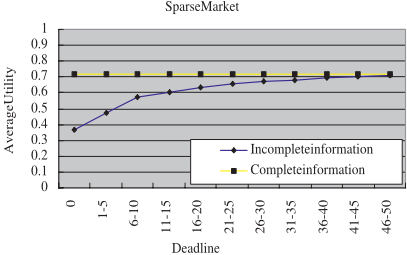
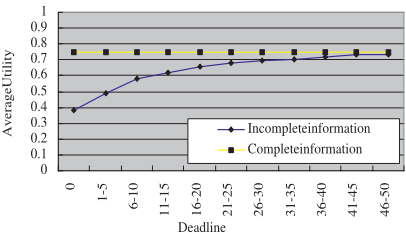
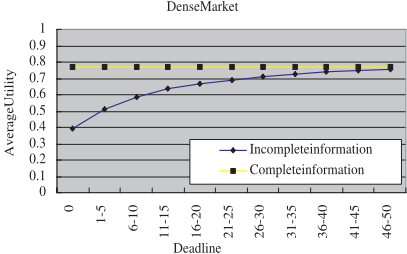
We evaluate the efficiency of the mechanism in terms of maximizing the total utility of agents participating in resource allocation. The mean efficiency of the market (averaged over 2000 independent resource allocation scenarios) in different environments and are shown in Figs. 2, 3, and 4. The resource allocation results without deal optimization are compared with that with deal optimization and the optimal allocation when agents have complete information.
From experimental results in Figs. 2, 3, and 4, it can be found that, when agents are subject to different market densities, agents' utilities increase with the increase of the optimization deadline and the average utilities are close to the optimal allocation when the optimization deadline is longer than 30. For example, in Fig. 3, when the optimization deadline is between 31 and 35, the average utilities are 0.70, which is close to the optimal utility 0.74 when agents have complete information. We can also find that agents' unities increase more and more slowly with the increase of the optimization deadline. In addition, with a same optimization deadline, agents' utilities in a dense market are better than that in a moderate or sparse market. The results correspond to the in-
ModerateMarket
tuition that social welfare will increase with more and more entities.
6 Conclusion
This research investigates a market based mechanism for resource allocation. The main contributions of this research include: 1) Unlike related work (e.g., [Clearwater and Clearwater, 1996; Maheswaran and Bas¸ar, 2003; Johari et al., 2005; Bredin et al., 2003]) in which agents are assumed to have complete information, this research investigates agents' rational strategies in resource allocation mechanism when agents have incomplete information; 2) We propose a deal optimization mechanism which can enhance the performance of resource allocation and trading agents can be programmed to optimize transaction deals by updating beliefs and resubmitting bids; 3) We evaluate the performance of the proposed approach by experimentation. Experimental results showed that by having a deal optimization stage, the resource allocation produced generally optimistic outcomes close to the optimal outcome.
Finally, a future agenda of this work is considering other variables or constraints (for example, budget constraint, time constraint) into our mechanism.
7 Acknowledgement
This research is partially supported by the project sponsored by the National Grid Office/A*STAR of Singapore (Grant number is 052 015 0024).
@inproceedings{ijcai2007p193,
  title     = {Market Based Resource Allocation with Incomplete Information},
  author    = {An, Bo and Miao, Chunyan and Shen, Zhiqi},
  booktitle = {Proceedings of the Twentieth International Joint Conference on
               Artificial Intelligence, {IJCAI-07}},
  publisher = {International Joint Conferences on Artificial Intelligence},
  editor    = {Manuela M. Veloso},
  pages     = {1193--1197},
  year      = {2007},
  url       = {https://ijcai.org/proceedings/2007/193},
}
TY - CPAPER TI - Market Based Resource Allocation with Incomplete Information AU - An, Bo AU - Miao, Chunyan AU - Shen, Zhiqi T2 - Proceedings of the Twentieth International Joint Conference on Artificial Intelligence, IJCAI-07 PB - International Joint Conferences on Artificial Intelligence PY - 2007 SP - 1193 EP - 1197 UR - https://ijcai.org/proceedings/2007/193 ER -Copied
Machine-readable versions of this paper, for tools and AI agents:





