
Searching for Interacting Features
Proceedings of the Twentieth International Joint Conference on Artificial Intelligence. Pages 1156-1160.
© 2007 International Joint Conferences on Artificial Intelligence
Abstract
Feature interaction presents a challenge to feature selection for classification. A feature by itself may have little correlation with the target concept, but when it is combined with some other features, they can be strongly correlated with the target concept. Unintentional removal of these features can result in poor classification performance. Handling feature interaction can be computationally intractable. Recognizing the presence of feature interaction, we propose to efficiently handle feature interaction to achieve efficient feature selection and present extensive experimental results of evaluation.
- [Alizadeh and et al., 2000] A. Alizadeh and et al. Distinct types of diffuse large B-cell lymphoma identified by gene expression pro- filing. Nature, 403:503-511, 2000.
- [Almuallim and Dietterich, 1994] H. Almuallim and T. G. Diet- terich. Learning boolean concepts in the presence of many ir- relevant features. Artificial Intelligence, 69(1-2):279-305, 1994.
- [Bell and Wang, 2000] D. A. Bell and H. Wang. A formalism for relevance and its application in feature subset selection. Machine Learning, 41(2):175-195, 2000.
- [Blake and Merz, 1998] C.L. Blake and C.J. Merz. UCI repository of machine learning databases, 1998.
- [Blum and Langley, 1997] A. L. Blum and P. Langley. Selection of relevant features and examples in machine learning. Artificial Intelligence, 97:245-271, 1997.
- [Dash and Liu, 1997] M. Dash and H. Liu. Feature selection for classification. Intelligent Data Analysis: An International Jour- nal, 1(3):131-156, 1997.
- [Fleuret, 2004] Franois Fleuret. Fast binary feature selection with conditional mutual information. J. Mach. Learn. Res., 5:1531- 1555, 2004.
- [Gilad-Bachrach et al., 2004] Ran Gilad-Bachrach, Amir Navot, and Naftali Tishby. Margin based feature selection -theory and algorithms. In ICML 2004.
- [Guyon and Elisseeff, 2003] I. Guyon and A. Elisseeff. An intro- duction to variable and feature selection. J. Mach. Learn. Res., 3:1157-1182, 2003.
- Hall, 2000
- M. A. Hall. Correlation-based feature selection for dis- crete and numeric class machine learning. In ICML, 2000.
- [Irina Rish, 2001] Jayram Thathachar Irina Rish, Joseph L. Heller- stein. An analysis of data characteristics that affect naive bayes performance. Technical report, IBM T.J. Watson, 2001.
- [Jakulin and Bratko, 2003] Aleks Jakulin and Ivan Bratko. Analyz- ing attribute dependencies. In PKDD, 2003.
- [Jakulin and Bratko, 2004] Aleks Jakulin and Ivan Bratko. Testing the significance of attribute interactions. In ICML, 2004.
- [Jakulin, 2005] Aleks Jakulin. Machine Learning Based on At- tribute Interactions. PhD thesis, University of Ljubljana, 2005.
- [John et al., 1994] G. H. John, R. Kohavi, and K. Pfleger. Irrelevant feature and the subset selection problem. In ICML, 1994.
- [Kononenko, 1994] I. Kononenko. Estimating attributes : Analysis and extension of RELIEF. In ECML, 1994.
- [Robnik-Sikonja and Kononenko, 2003] M. Robnik-Sikonja and I. Kononenko. Theoretical and empirical analysis of Relief and ReliefF. Machine Learning, 53:23-69, 2003.
- [Witten and Frank, 2005] I. H. Witten and E. Frank. Data Mining -Pracitcal Machine Learning Tools and Techniques with JAVA Implementations. Morgan Kaufmann Publishers, 2 edition, 2005.
- [Yu and Liu, 2003] L. Yu and H. Liu. Feature selection for high- dimensional data: a fast correlation-based filter solution. In ICML, 2003.
References were extracted automatically from the PDF and may contain errors.
Full text extracted automatically from the PDF; figures, tables and equations may differ. The PDF is the version of record.
1 Introduction
The high dimensionality of data poses a challenge to learning tasks such as classification. In the presence of many irrelevant features, classification algorithms tend to overfit training data [Guyon and Elisseeff, 2003; Dash and Liu, 1997]. Many features can be removed without performance deterioration [Gilad-Bachrach et al., 2004]. Feature selection is one effective means to remove irrelevant features [Blum and Langley, 1997]. Optimal feature selection requires an exponentially large search space (O(2N ), where N is the number of features) [Almuallim and Dietterich, 1994]. Researchers often resort to various approximations to determine relevant features (e.g., relevance is determined by correlation between individual features and the class) [Hall, 2000; Yu and Liu, 2003]. However, a single feature can be considered irrelevant based on its correlation with the class; but when combined with other features, it becomes very relevant. Unintentional removal of these features can result in the loss of useful information and thus may cause poor classification performance. This is studied in [Jakulin and Bratko, 2003] as attribute interaction. For example, MONK1 is a data set involving feature interaction. There are six features in MONK1 and the target concept of MONK1 is: (A1 = A2) or (A5 = 1). Here A1 and A2 are two interacting features. Considered individually, the correlation between A1 and the class C (similarly for A2 and C) is zero, measured by mutual information. Hence, A1 or A2 is irrelevant when each is individually evaluated. However, if we combine A1 with A2, they are strongly relevant in defining the target concept.
An intrinsic character of feature interaction is its irreducibility [Jakulin and Bratko, 2004], i.e., a feature could lose its relevance due to the absence of its interacting feature(s).
Existing efficient feature selection algorithms usually assume feature independence [Dash and Liu, 1997; Hall, 2000]. Because of the irreducible nature of feature interactions, these algorithms cannot select interacting features such as A1 and A2 in MONK1. Others attempt to explicitly address feature interactions by finding some low-order interactions (2- or 3way). In [Jakulin and Bratko, 2003], the authors suggest to use interaction gain as a practical heuristic for detecting attribute interaction. Using interaction gain, their algorithms can detect if datasets have 2-way (one feature and the class) and 3-way (two features and the class) interactions. They further provide in [Jakulin and Bratko, 2004] a justification of the interaction information, and replace the notion of 'high' and 'low' in [Jakulin and Bratko, 2003] with statistical significance and illustrate the significant interactions in the form of interaction graph. Below we apply four feature selection algorithms to synthetic data with known interaction and observe how they fare: FCBF [Yu and Liu, 2003], CFS [Hall, 2000], ReliefF [Kononenko, 1994], and FOCUS [Almuallim and Dietterich, 1994], all available in WEKA [Witten and Frank, 2005].
Motivating examples: Synthetic data with known feature interaction. Four synthetic data sets are used to examine how various algorithms deal with known feature interactions in feature selection. The first data set is Corral [John et al., 1994], having six boolean features A0,A1,B0,B1, I,R. The class Y is defined by Y = (A0 ∧ A1) ∨ (B0 ∧ B1) and features A0,A1,B0,B1 are independent of each other. Feature I is irrelevant to Y and its values have a uniform random distribution; and feature R is correlated with Y 75% of the time and is redundant. The other three training data sets are MONKs data. Their target Concepts are: (1) MONK1: (A1 = A2) or (A5 = 1); (2) MONK2: Exactly two of A1 = 1,A2 = 1,A3 = 1,A4 = 1,A5 = 1,A6 = 1; and (3) MONK3: (A5 = 3 and A4 = 1) or (A5 ̸= 4 and A2 ̸= 3) (5% class noise added to the training data).
Results are presented in Table 1. For Corral, all four algorithms remove the irrelevant feature I, but only FOCUS removes the redundant feature R. Features A0,A1 and B0,B1 interact with each other to determine the class label of an instance. CFS, FCBF and ReliefF cannot remove R because R
| Relevant Features | FCBF | CFS | ReliefF | FOCUS | |
|---|---|---|---|---|---|
| Corral | A0,A1,B0,B1 | A0,A1,B0,B1, R | A0, , , , R | A0,A1,B0,B1, R | A0,A1,B0,B1 |
| Monk1 | A1,A2,A5 | A1, ,A3,A4,A5 | , , A5 | A1 , A2, A5 | A1, A2 , A5 |
| Monk2 | A1,A2,A3,A4, A5, A6 | , , ,A4, A5, A6 | , , ,A4, A5, A6 | A1,A2,A3,A4, A5, A6 | A1,A2,A3,A4, A5, A6 |
| Monk3 | A2,A4,A5 | A2, ,A5,A6 | A2, , A5 | A2,A4,A5 | A1,A2,A4,A5 |
is strongly correlated (75%) with Y . For all the three MONKs data sets, ReliefF can find true relevant features 1 as seen in Table 1. Both FCBF and CFS perform similarly, and FCBF finds more features. FOCUS can handle feature interaction when selecting features. However, as an exhaustive search algorithm, FOCUS finds irrelevant feature A1 for MONK3 due to 5% noise in the data. In a sense, it overfits the training data. FOCUS is also impractical because finding moderately high-order interactions can be too expensive, as ∑mi=1 (Ni ) can be too large, when dimensionality N is large.
In this work, we design and implement an efficient approach to deal with feature interactions. Feature interactions can be implicitly handled by a carefully designed feature evaluation metric and a search strategy with a specially designed data structure, which together take into account interactions among features when performing feature selection.
2 Interaction and Data Consistency
One goal of feature selection is to remove all irrelevant features. First, we define feature relevance as in [John et al., 1994]. Let F be the full set of features, Fi be a feature, Si = F - {Fi} and P denote the conditional probability of class C given a feature set.
Definition 1 (Feature Relevance) A feature Fi is relevant iff
Otherwise, feature Fi is said to be irrelevant.
Definition 1 suggests that a feature can be relevant only when its removal from a feature set will reduce the prediction power. From Definition 1, it can be shown that a feature is relevant due to two reasons: (1) it is strongly correlated with the target concept; or (2) it forms a feature subset with other features and the subset is strongly correlated with the target concept. If a feature is relevant because of the second reason, there exists feature interaction. Feature interaction is characterized by its irreducibility [Jakulin and Bratko, 2004]. A kth feature interaction can be formalized as:
Definition 2 (kth order Feature Interaction) F is a feature subset with k features F1, F2, . . . , Fk. Let C denote a metric that measures the relevance of the class label with a feature or a feature subset. Features F1, F2, . . ., Fk are said to interact with each other iff: for an arbitrary partition F = {F1, F2, F3, . . ., Fl} of F, where l ≥ 2 and Fi ̸= φ, we have
Identifying either relevant features or a kth order feature interaction requires exponential time. Definitions 1 and 2
1 Interestingly, using the full data sets ReliefF missed A1, A5 for MONK2, A1 for MONK3.
cannot be directly applied to identify relevant or interacting features when the dimensionality of a data set is high. Many efficient feature selection algorithms identify relevant features based on the evaluation of the correlation between the class and a feature (or a selected feature subset). Representative measures used for evaluating relevance include: distance measures [Kononenko, 1994; Robnik-Sikonja and Kononenko, 2003], information measures [Fleuret, 2004], and consistency measures [Almuallim and Dietterich, 1994], to name a few. Using these measures, feature selection algorithms usually start with an empty set and successively add "good" features to the selected feature subset, the so-called sequential forward selection (SFS) framework. Under this framework, features are deemed relevant mainly based on their individually high correlations with the class, and relevant interacting features of high order may be removed [Hall, 2000; Bell and Wang, 2000], because the irreducible nature of feature interaction cannot be attained by SFS.
Recall that finding high-order feature interaction using relevance (Definitions 1 and 2) entails exhaustive search of all feature subsets. In order to avoid exponential time complexity, we derive a feature scoring metric based on the consistency hypothesis proposed in [Almuallim and Dietterich, 1994] to approximate the relevance measure as in Definition 1. With this metric, we will design a fast filter algorithm that can deal with feature interaction in subset selection.
Let D be a data set of m instances, D = {d1, d2, . . . , dm}, and F be the feature space of D with n features, F = {F1, F2, . . . , Fn}, we have the following:
Definition 3 (Inconsistent Instances) If two instances di and dj in D have the same values except for their class labels, di and dj are inconsistent instances or the two matching instances are inconsistent.
Definition 4 (Inconsistent-Instances Set) D ⊆ D, D is an inconsistent-instances set iff ∀ di, dj ∈ D, i ̸= j, either di and dj are inconsistent or they are duplicate. D is a maximal inconsistent-instances set, iff ∀d ∈ D and d /∈ D, D ∪ {d} is not an inconsistent-instances set.
Definition 5 (Inconsistency Count) Let D be an inconsistent-instances set with k elements d1, d2,. . . , dk, and c1, c2, . . . , ct are the class labels of D, we partition D into t subsets S1, S2, . . . , St by the class labels, where Si = {dj| dj has label ci}. The inconsistency count of D is:
Definition 6 (Inconsistency Rate) Let D1, D2, . . ., Dp denote all maximal inconsistent-instances sets of D, the inconsistency rate (ICR) of D is:
Definition 7 (Consistency Contribution) or c-contribution Let π denote the projection operator which retrieves a subset of columns from D according to the feature subset, the c-contribution (CC) of feature Fi for F is defined as:
It is easy to verify that the inconsistency rate is monotonic in terms of the number of features, i.e., ∀Si, Sj, Si ⊆ Sj ⇒ ICR(πSi (D)) ≥ ICR(πSj (D)). Hence, c-contribution of a feature is always a non-negative number with the zero meaning no contribution. C-contribution of a feature Fi is a function of F - {Fi}, where F is the set of features for D. C-contribution of a feature is an indicator about how significantly the elimination of that feature will affect consistency. C-contribution of an irrelevant feature is zero. C-contribution can be considered as an approximation of the metric in Definition 1 by using inconsistency rate as an approximation of P , the conditional probability of class C given a feature set.
The monotonic property of inconsistency rate suggests that the backward elimination search strategy fits c-contribution best in feature selection. That is, one can start with the full feature set and successively eliminating features one at a time based on their c-contributions. Backward elimination allows every feature to be evaluated with the features it may interact with. Hence, backward elimination with c-contribution should find interacting features. However, backward elimination using inconsistency rate or c-contribution has two problems. The first problem is that it is very costly as it needs to calculate inconsistency rate for each potentially removable feature. As in the work of FOCUS [Almuallim and Dietterich, 1994], FOCUS relies on exhaustive search. It is impractical to do so when the dimensionality is reasonably large, which separates this work from FOCUS. We will design a specific data structure next to achieve efficient calculation of c-contribution for our algorithm INTERACT. The second problem is that c-contribution measure is sensitive to which feature is selected to compute first, the so-called the feature order problem. This is because features evaluated first for their consistency are more likely to be eliminated first.
Solutions to the two problems will enable c-contribution to be used in building an efficient algorithm of backward elimination. We present our solutions and the algorithm next.
3 Eliminating Irrelevant Features
We first present our solutions that form two pillar components for the algorithm INTERACT and then discuss its details.
3.1 Efficient update of c-contribution
C-contribution relies on the calculation of inconsistency rate. With the monotonicity of inconsistency rate, the following two properties are true after a feature fi is eliminated from a set {f1, .., fi, ..., fn} where i = 1, 2, ..., n: (I) all inconsistent instances sets are still inconsistent; and (II) each maximal inconsistent instances set will be either of equal size or bigger. Based on these two properties, we implement a hashing mechanism to efficiently calculate c-contribution: Each instance is inserted into the hash table using its values of those features in Slist as the hash key, where Slist contains the ranked features that are not yet eliminated (Slist initialized with the full set of features). Instances with the same hash key will be insert into the same entry in the hash table. And the information about the labels is recorded. Thus each entry in the hash table corresponds to a maximal inconsistency set of πSlist (D). Hence, the inconsistency rate of πSlist (D) can be obtained by scanning the hash table. Property (I) says that in order to generate an entry in the hash table for a new Slist (after eliminating a feature), it is not necessary to scan the data again, but only the current hash table. Property (II) suggests that after each iteration of elimination, the number of entries of the hash table for new Slist should decrease. Therefore, the hashing data structure allows for efficient update of c-contribution iterative feature elimination.
3.2 Dealing with the feature order problem
We now consider the feature order problem in applying ccontribution. If we can keep removing the current, most irrelevant feature, we will likely retain the most relevant ones in the remaining subset of selected features. Assuming that a set of features can be divided into subset S1 including relevant features, and subset S2 containing irrelevant ones. By considering to remove features in S2 first, features in S1 are more likely to remain in the final set of selected features. Therefore, we apply a heuristic to rank individual features using symmetrical uncertainty (SU) in an descending order such that the (heuristically) most relevant feature is positioned at the beginning of the list. SU is often used as a fast correlation measure to evaluate the relevance of individual features [Hall, 2000; Yu and Liu, 2003]. This heuristic attempts to increase the chance for a strongly relevant feature to remain in the selected subset. Let H(X) and H(X,C) denote entropy and joint entropy respectively, and M(X, C) = H(C)+H(X)- H(X, C) the mutual information measuring the common information shared between the two variables. SU between the class label C and a feature Fi is:
This ranking heuristic cannot guarantee that the interacting features are ranked high. For MONK1, for example, SU(A1, C) = SU(A6, C) = 0. Either one can be evaluated first for its c-contribution. Since CC(A1, F) > CC(A6, F), A6 is eliminated. We will experimentally examine the ranking effect in Section 4.2.
3.3 INTERACT - An algorithm
The above solutions pave the way for c-contribution to be used in feature selection. We present an algorithm, INTERACT, that searches for interacting features. It is a filter algorithm that employs backward elimination to remove those features with no or low c-contribution. The details are shown in Figure 1: Given a full set with N features and a class attribute C, it finds a feature subset Sbest for the class concept. The algorithm consists of two major parts. In the first part (lines 1-6), the features are ranked in descending order based on their SU values. In the second part (lines 7-16), features are evaluated one by one starting from the end of the ranked feature list. Function getLastElement() returns the feature
input:
F: the full feature set with features F1, F2, . . . , FN C: the class label δ: a predefined threshold output: Sbest: the best subset 1 Slist = NULL 2 for i=1 to N do 3 calculate SUFi,c for Fi 4 append Fi to Slist 5 end 6 order Slist in descending values of SUi,c 7 F = getLastElement(Slist) 8 repeat 9 if F <>NULL then 10 p = CC(F, Slist) // c-contribution 11 if p ≤ δ then 12 remove F from Slist 13 end 14 end 15 F = getNextElement(Slist, F) 16 until F == NULL 17 Sbest = Slist 18 return Sbestin the end of the list, Slist. If c-contribution of a feature is less than δ, the feature is removed, otherwise it is selected. Function getNextElement(Slist, F) returns the next unchecked feature just preceding F in the ranked feature list (line 15). The algorithm repeats until all features in the list are checked. δ is a predefined threshold (0 < δ < 1). Features with their c-contribution < δ are considered immaterial and removed. A large δ is associated with a high probability of removing relevant features. Relevance is defined by c-contribution: the higher value of CC(F, Slist) indicates that F is more relevant. δ = 0.0001 if not otherwise mentioned. The parameter can also be tuned using the standard cross validation.
Time complexity of INTERACT: The first part of the algorithm has a linear time complexity of O(NM), where N is the number of features and M is the number of instances of a given data set. For the second part of the algorithm, the calculation of a feature's c-contribution using a hash table takes also O(NM). For N features, the time complexity of INTERACT is O(N 2M). This is the worst case analysis. Its average time complexity is less because (1) we only use the hash table of current Slist in the calculation of ccontribution, and (2) the number of the entries in the hash table decreases after each iteration. If we assume it decreases to a percentage of the initial size, where 0 < a < 1, then in N iterations, the overall time complexity of INTERACT is O(NM(1 - aN+1 )/(1 - a)) (the proof is omitted). In other words, INTERACT is expected to be comparable with heuristic algorithms such as FCBF [Yu and Liu, 2003].
4 Empirical Study
We empirically evaluate the performance of INTERACT in search of interacting features. For the four synthetic data sets with known feature interaction (Table 1), INTERACT finds only the relevant features (δ = 0.05). Now we evaluate INTERACT using benchmark data sets in comparison with some representative feature selection algorithms with the following aspects: (1) number of selected features, (2) predictive accuracy with feature selection, and (3) run time. We also examine how effective the two solutions (given in Sections 3.1 and 3.2) are through a lesion study by removing one of them at a time from INTERACT.
| Data Set | F | I | C | Data Set | F | I | C |
|---|---|---|---|---|---|---|---|
| lung-cancer | 56 | 32 | 3 | vehicle | 18 | 846 | 4 |
| zoo | 16 | 101 | 7 | kr-vs-kp | 36 | 3196 | 2 |
| wine | 13 | 178 | 3 | ||||
| soy-large | 35 | 306 | 19 | internet-ads | 1558 | 3278 | 2 |
| cmc | 9 | 1473 | 3 | 45×4026+2C | 4026 | 45 | 2 |
4.1 Experiment setup
In our experiments, we choose four representative feature selection algorithms for comparison. They are FCBF [Yu and Liu, 2003], CFS [Hall, 2000], ReliefF [Kononenko, 1994], and FOCUS [Almuallim and Dietterich, 1994]. All are available in the WEKA environment [Witten and Frank, 2005]. INTERACT is implemented in the WEKA's framework. It will be made available upon request. All the experiments were conducted in the WEKA environment.
From 28 data sets, [Jakulin, 2005] identified 10 data sets having feature interactions without selecting interacting features. Here we focus on our discussion on the 10 data sets 2 . The datasets are from the UCI ML Repository [Blake and Merz, 1998]. We also include another two datasets in the experiment: the 'internet-ads' data from the UCI ML Repository, and the '45×4026+2C' data from [Alizadeh and et al., 2000]. The information about the 9 data sets (without 3 MONKS data sets) is summarized in Table 2. For each data set, we run all 5 feature selection algorithms and obtain selected feature subsets of each algorithm. For data sets containing features with continuous values, if needed, we apply the MDL discretization method (available in WEKA). We remove all index features if any. In order to evaluate whether the selected features are indeed good, we apply two effective classification algorithms C4.5 and a linear Support Vector Machine (SVM) 3 (both available fromWeka) before and after feature selection and obtain prediction accuracy by 10-fold cross-validation (CV). Although C4.5 itself evaluates features (one at a time), its performance is sensitive to the given sets of features (e.g., its accuracy rates on MONK1 are 88.88% and 75.69% for (A1,A2, and A5) and for all 6 features, respectively). Because of FOCUS's exponential time complexity, we only provide those results of FOCUS obtained in 3 hours of dedicated use of the PC. INTERACT, FCBF, CFS and ReliefF all complete their runs in seconds. This is consistent with our understanding and expectation of these algorithms.
2 In which 3 data sets are MONKs data. We consider them synthetic data and discussed them earlier separately.
3 Since Naive Bayes Classifier (NBC) assumes conditional independence between features [Irina Rish, 2001], selecting interacting features or not has limited impact on it. Our experimental results of NBC conform to the analysis and will be presented elsewhere due to the space limit.
| Data Set | IN | FC | CFS | RE | FO | FS |
|---|---|---|---|---|---|---|
| lung-cancer | 6 | 6 | 11 | 22 | 4 | 56 |
| zoo | 5 | 8 | 9 | 14 | 5 | 16 |
| wine | 5 | 10 | 8 | 11 | 5 | 13 |
| soy-large | 13 | 13 | 21 | 32 | NA | 35 |
| cmc | 9 | 2 | 3 | 5 | 9 | 9 |
| vehicle | 18 | 4 | 11 | 7 | 18 | 18 |
| kr-vs-kp | 29 | 7 | 3 | 8 | NA | 36 |
| internet-ads | 49 | 38 | 11 | 2 | NA | 1558 |
| 45×4026+2C | 3 | 64 | 42 | 15 | NA | 4026 |
| average | 15.22 | 16.89 | 13.22 | 12.89 | 8.20 | 640.78 |
4.2 Results and discussion
Number of selected features. Table 3 presents the numbers of features selected by the five algorithms. All algorithms significantly reduced the number of features in many cases (e.g., from 56 to as few as 6). The average numbers of selected features for the 9 data sets are 15.22 (INTERACT), 16.89 (FCBF), 13.22 (CFS), 12.89 (ReliefF), and 640.78 (Full Set). For four data sets (indicated by NA in the table), FOCUS did not finish after 3 hours. For the 4 synthetic data sets with known relevant features (Table 1), INTERACT selected only the relevant ones. Next we examine the effect of this reduction on accuracy.
Predictive accuracy before and after feature selection. For the 9 data sets with known interactions, we obtained predictive accuracy rates by 10-fold cross validation using C4.5 and SVM. The results are shown in the two sub-tables of Table 5. For both classifiers, the reduction of features by INTERACT obtains results comparable with using all features: average accuracy 83.58% (INTERACT) vs. 79.74% (Full Set) for C4.5, and 82.88% (INTERACT) vs. 81.04% (Full Set) for SVM. Comparing INTERACT with other feature selection algorithms, INTERACT performs consistently better for C4.5 with better average accuracy. For SVM, INTERACT is comparable with other feature selection algorithms. One exception is the 'soy-large' data for the result of SVM. We notice that the data set has 35 features, 306 instances, and 19 classes (Table 2); INTERACT identifies 13 features (Table 3) - the smallest number of selected features (FCBF also selected 13 features). We surmise that it may be too easy for the inconsistency measure to be satisfied with a small feature subset when each class has a small number of instances. In sum, for both classifiers, INTERACT can help achieve better or similar accuracy, and hence, INTERACT is effective in search of interacting features.
The effect of feature ranking. INTERACT ranks features before backward elimination of features begins. As a part of the lesion study, we remove the ranking component from INTERACT to form a version INTERACT\R. We summarize the results here due to the space limit: INTERACT is always better than or equivalent to INTERACT\R; the average 10-fold CV accuracy for C4.5 and SVM for (INTERACT, INTERACT\R) are (83.58,78.69) and (82.88 78.54), respectively. Noticing that INTERACT ranks features using SU and FCBF employs SU, we observe in Table 5 that FCBF does not perform as well as INTERACT in selecting interacting features. The results suggest that the combination of SU and c-contribution helps INTERACT to achieve its design goal. Clearly, using SU is a heuristic. There could be other alternatives to rank the features. Studying the effects of different ranking algorithms is one line of our on-going research.
| Data Set | IN | FC | CFS | Re | FO |
|---|---|---|---|---|---|
| lung-cancer | 0.09 | 0.02 | 0.05 | 0.02 | 2.31 |
| zoo | 0.08 | 0.01 | 0.01 | 0.02 | 0.81 |
| wine | 0.09 | 0.02 | 0.02 | 0.02 | 0.33 |
| soy-large | 0.14 | 0.06 | 0.05 | 0.09 | NA |
| cmc | 0.14 | 0.02 | 0.03 | 0.11 | 2.81 |
| vehicle | 0.20 | 0.05 | 0.06 | 0.11 | 976.58 |
| kr-vs-kp | 1.31 | 0.27 | 0.31 | 0.61 | NA |
| internet-ads | 150.86 | 60.484 | 54.344 | 31.359 | NA |
| 45×4026+2C | 20.30 | 1.02 | 323.25 | 1.50 | NA |
| average | 19.25 | 6.88 | 42.01 | 3.76 | 196.57 |
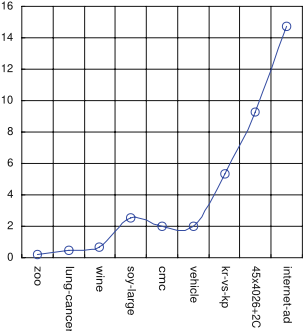
The effect of the data structure. We devised a hashing data structure to speed up the time consuming calculation of c-contribution during feature selection. Here we examine how effective the data structure is by comparing the run time of INTERACT with that of INTERACT\D which does not employ the hashing data structure. Since data size is a determining factor for run time, we first reorganize the 9 data sets according to their sizes (approximated by N ∗ M - number of features multiplied by number of instances without considering feature types such as nominal or continuous). Figure 2 shows the ratios using time of INTERACT as the base: TINTERACT\D divided by TINTERACT . It shows that the run time difference between INTERACT and INTERACT\D is more pronounced for larger data sets.
Run time comparison. Table 4 records the run time for each feature selection algorithm. Except for FOCUS, all algorithms finished their runs within the given time. The algorithms are ordered as ReliefF, FCBF, INTERACT, CFS and FOCUS: ReliefF is the fastest, and FOCUS is the slowest if it finishes the run within 3 hours.
| Data Set | INTERACT | FCBF | CFS | ReliefF | FOCUS | WholeDS | |||||
|---|---|---|---|---|---|---|---|---|---|---|---|
| Acc | Acc | p-val | Acc | p-val | Acc | p-val | Acc | p-val | Acc | p-val | |
| C4.5 | |||||||||||
| lung-cancer | 75.00 | 50 | 0.01+ | 43.75 | 0.00+ | 65.63 | 0.06 | 37.5 | 0.01+ | 46.88 | 0.02+ |
| zoo | 91.09 | 92.08 | 0.72 | 91.09 | 1.00 | 91.09 | 1.00 | 91.09 | 1.00 | 92.08 | 0.78 |
| wine | 96.63 | 93.82 | 0.05+ | 93.82 | 0.05+ | 83.15 | 0.00+ | 93.26 | 0.05+ | 93.82 | 0.05+ |
| soy-large | 82.03 | 84.31 | 0.25 | 84.31 | 0.17 | 84.31 | 0.31 | NA | NA | 85.95 | 0.11 |
| cmc | 52.14 | 51.93 | 0.89 | 54.11 | 0.08 | 50.17 | 0.10 | 52.27 | 0.17 | 52.27 | 0.17 |
| vehicle | 73.05 | 57.68 | 0.00+ | 69.62 | 0.00+ | 67.73 | 0.00+ | 73.05 | 1.00 | 73.05 | 1.00 |
| kr-vs-kp | 99.19 | 94.02 | 0.00+ | 90.43 | 0.00+ | 90.43 | 0.00+ | NA | NA | 99.44 | 0.31 |
| internet-ads | 96.46 | 95.85 | 0.08 | 95.76 | 0.03+ | 91.52 | 0.00+ | NA | NA | 96.4 | 0.79 |
| 45×4026+2C | 86.67 | 80.00 | 0.23 | 77.78 | 0.14 | 86.67 | 1.00 | NA | NA | 77.78 | 0.19 |
| Average | 83.58 | 77.74 | 77.85 | 78.97 | 69.43 | 79.74 | |||||
| Win/Loss | 4/0 | 5/0 | 4/0 | 2/0 | 2/0 | ||||||
| SVM | |||||||||||
| lung-cancer | 62.50 | 53.13 | 0.32 | 62.50 | 1.00 | 62.50 | 1.00 | 31.25 | 0.01+ | 37.50 | 0.03+ |
| zoo | 93.07 | 92.08 | 0.72 | 96.04 | 0.19 | 96.04 | 0.19 | 93.07 | 1.00 | 96.04 | 0.19 |
| wine | 96.63 | 98.31 | 0.08 | 96.63 | 1.00 | 84.83 | 0.01+ | 89.89 | 0.04+ | 97.75 | 0.17 |
| soy-large | 83.33 | 87.91 | 0.01- | 92.16 | 0.00- | 92.16 | 0.00- | NA | NA | 91.18 | 0.00- |
| cmc | 48.74 | 44.87 | 0.05+ | 49.97 | 0.37 | 44.33 | 0.02+ | 48.68 | 0.34 | 48.68 | 0.34 |
| vehicle | 73.88 | 42.08 | 0.00+ | 57.21 | 0.00+ | 50.35 | 0.00+ | 73.88 | 1.00 | 73.88 | 1.00 |
| kr-vs-kp | 95.90 | 94.06 | 0.00+ | 90.43 | 0.00+ | 90.43 | 0.00+ | NA | NA | 95.93 | 0.94 |
| internet-ads | 96.34 | 95.97 | 0.08 | 95.94 | 0.02+ | 90.57 | 0.00+ | NA | NA | 97.28 | 0.01- |
| 45×4026+2C | 95.56 | 100.00 | 0.12 | 100.00 | 0.12 | 95.56 | 1.00 | NA | NA | 91.11 | 0.39 |
| Average | 82.88 | 78.71 | 82.32 | 78.53 | 67.35 | 81.04 | |||||
| Win/Loss | 3/1 | 3/1 | 5/1 | 2/0 | 1/2 | ||||||
5 Conclusions
We recognize the need to study feature interaction in subset selection using some synthetic data sets, and propose to search for interacting features employing c-contribution to measure feature relevance. We investigated the key issues hindering the use of consistency measures and developed INTERACT that handles feature interaction and efficiently selects relevant features. It ranks features to overcome the feature order problem. INTERACT implements a special hashing data structure to avoid repeated scanning of a data set by taking advantage of the intrinsic properties of the ccontribution measure, which results in a significant speed-up of the algorithm. The efficiency and effectiveness of INTERACT are demonstrated through theoretical analysis as well as extensive experiments comparing with representative feature selection algorithms using the synthetic and real-world data sets with known feature interactions. Experimental results show that INTERACT can effectively reduce the number of features, and maintain or improve predictive accuracy in dealing with interacting features. This work presents promising initial efforts on searching efficiently for interacting features.
@inproceedings{ijcai2007p187,
  title     = {Searching for Interacting Features},
  author    = {Zhao, Zheng and Liu, Huan},
  booktitle = {Proceedings of the Twentieth International Joint Conference on
               Artificial Intelligence, {IJCAI-07}},
  publisher = {International Joint Conferences on Artificial Intelligence},
  editor    = {Manuela M. Veloso},
  pages     = {1156--1160},
  year      = {2007},
  url       = {https://ijcai.org/proceedings/2007/187},
}
TY - CPAPER TI - Searching for Interacting Features AU - Zhao, Zheng AU - Liu, Huan T2 - Proceedings of the Twentieth International Joint Conference on Artificial Intelligence, IJCAI-07 PB - International Joint Conferences on Artificial Intelligence PY - 2007 SP - 1156 EP - 1160 UR - https://ijcai.org/proceedings/2007/187 ER -Copied
Machine-readable versions of this paper, for tools and AI agents:





