
Generalizing the Bias Term of Support Vector Machines
Proceedings of the Twentieth International Joint Conference on Artificial Intelligence. Pages 919-923.
© 2007 International Joint Conferences on Artificial Intelligence
Abstract
Based on the study of a generalized form of representer theorem and a specific trick in constructing kernels, a generic learning model is proposed and applied to support vector machines. An algorithm is obtained which naturally generalizes the bias term of SVM. Unlike the solution of standard SVM which consists of a linear expansion of kernel functions and a bias term, the generalized algorithm maps predefined features onto a Hilbert space as well and takes them into special consideration by leaving part of the space unregularized when seeking a solution in the space. Empirical evaluations have confirmed the effectiveness from the generalization in classification tasks.
- [Beatson et al., 2000] R.K. Beatson, W.A. Light, and S. Billings. Fast solution of the radial basis function interpolation equations: Domain decomposition methods. SIAM J. Sci. Comput., 22:1717-1740, 2000.
- [Bertero et al., 1988] M. Bertero, C. De Mol, and E.R. Pike. Linear inverse problems with discrete data: II. stability and regularisation. Inverse Probl., 4(3):573-594, 1988.
- [De Vito et al., 2005] E. De Vito, L. Rosasco, A. Capon- netto, U. De Giovannini, and F. Odone. Learning from examples as an inverse problem. J. Mach. Learn. Res., 6:883-904, 2005.
- [Evgeniou et al., 2000] T. Evgeniou, M. Pontil, and T. Pog- gio. Regularization networks and support vector machines. Adv. Comput. Math., 13:1-50, 2000.
- [Girosi, 1998] F. Girosi. An equivalence between sparse ap- proximation and support vector machines. Neural Com- put., 10(6):1455-1480, 1998.
- [Hofmann, 1999] T. Hofmann. Probabilistic latent semantic analysis. In UAI'99, 1999.
- [Light and Wayne, 1999] W. Light and H. Wayne. Spaces of distributions, interpolation by translates of a basis function and error estimates. J. Numer. Math., 81:415-450, 1999.
- [McCallum, 1996] A.K. McCallum. Bow: A toolkit for statistical language modeling, text retrieval, classification and clustering. http://www.cs.cmu.edu/∼mccallum/bow, 1996. Link
- [Micchelli, 1986] C.A. Micchelli. Interpolation of scattered data: Distances, matrices, and conditionally positive defi- nite functions. Constr. Approx., 2:11-22, 1986.
- [Morozov, 1984] V.A. Morozov. Methods for Solving Incor- rectly Posed Problems. Springer-Verlag, 1984.
- [Poggio and Girosi, 1990a] T. Poggio and F. Girosi. Net- works for approximation and learning. Proc. IEEE, 78:1481-1497, 1990.
- [Poggio and Girosi, 1990b] T. Poggio and F. Girosi. Reg- ularization algorithms for learning that are equivalent to multilayer networks. Science, 247:978-982, 1990.
- [Poggio and Smale, 2003] T. Poggio and S. Smale. The mathematics of learning: Dealing with data. Not. Am. Math. Soc, 50:537-544, 2003.
- [Rifkin, 2002] R.M. Rifkin. Everything Old is New Again: A Fresh Look at Historical Approaches in Machine Learn- ing. PhD thesis, Massachusetts Institute of Technology, 2002.
- [Roweis and Saul, 2000] S.T. Roweis and L.K. Saul. Nonlin- ear dimensionality reduction by locally linear embedding. Science, 290:2323-2326, 2000.
- [Smola et al., 1998] A.J. Smola, T.T. Frieß, and B. Schölkopf. Semiparametric support vector and linear programming machines. In NIPS 11, 1998.
- [Tenenbaum et al., 2000] J.B. Tenenbaum, V. de Silva, and J.C. Langford. A global geometric framework for non- linear dimensionality reduction. Science, 290:2319-2323, 2000.
- [Tikhonov and Arsenin, 1977] A.N. Tikhonov and V.Y. Ars- enin. Solutions of Ill-Posed Problems. Winston and Sons, 1977.
- [Vapnik, 1998] V.N. Vapnik. Statistical Learning Theory. John Wiley and Sons, 1998.
- [Wahba, 1990] G. Wahba. Spline Models for Observational Data. SIAM, 1990. Figure 3: Text categorization accuracies on four major sub- sets of 20-newsgroups dataset. The classification accuracies are reported by trying training sets with different sizes.
References were extracted automatically from the PDF and may contain errors.
Full text extracted automatically from the PDF; figures, tables and equations may differ. The PDF is the version of record.
1 Introduction
Support vector machines (SVM) have been shown to perform well in many machine learning applications. Based on Vapnik's seminal work in statistical learning theory[Vapnik, 1998], the algorithm starts with the ideas of separating hyperplanes and margins. Given the data (xi; yi)mi=1 where xi ∈ Rd and yi ∈ {+1,-1}, one searches for the linear hyperplane that separates the positive and negative samples with the largest margin (the distance from the hyperplane to the nearest data point). In the nonseparable case, a soft margin method is used to choose a hyperplane that splits the examples as cleanly as possible. Using a kernel Kx (x′ ) = K (x, x′ ) (a positive definite function) to extend the algorithm to the nonlinear case, an optimal hyperplane is found which has a simple representation as a linear expansion of kernel functions and a constant
where each ci is a real number and b is called a bias term.
In the case of nonseparability, some meanings of the margin motivation are lost. [Girosi, 1998; Evgeniou et al., 2000; Poggio and Smale, 2003] suggest a different view of SVM based on a framework championed by Poggio and other researchers[Poggio and Girosi, 1990a; 1990b] which implicitly treats learning as an approximation problem and tries to find a solution to a regularized minimization problem
in HK for some γ > 0. This expression represents a tradeoff between the empirical error as calculated by the loss function V , and "smoothness" of the solution as represented by the norm of f in a reproducing kernel Hilbert space (RKHS) HK which is induced by a kernel K. γ ‖f‖2K is also called a regularizer. SVM can be partially derived from this framework with the choice of a hinge loss function V (y, f (x)) ≡ max(1-yf (x) , 0). The only incompatibility comes from the bias term b, which makes the combined model (1) generally not in HK any more.
In this paper, we follow the regularization point of view. Based on the study of a generalized regularizer which leaves part of the hypothesis space unregularized and a specific trick in constructing kernels, we propose a new learning scheme which allows user to predefine features, and uses these features and kernel expansions to derive a solution in the hypothesis space, instead of considering kernel expansions only as in existing kernel-based methods. When the idea is applied to SVM, we obtain an algorithm which naturally generalizes the bias term of SVM. The generalized term linearly combines the predefined features instead of being a constant only. Different from the empirical results that the existence of the bias term does not make much significance in practice[Rifkin, 2002], we will show the term is not trivial any more when it is generalized, and appropriate choices of the term will improve the applicability of the algorithm.
The paper is organized as follows. In section 2, we investigate a generalized regularizer in the regularized learning framework and study its associated solution when it is applied to SVM. In section 3, after introducing a kernel construction trick, with which predefined features are mapped onto an RKHS, we further clarify the mathematical details in deriving SVM. A new algorithm is proposed in section 4 based on the previous discussions. Empirical results are demonstrated in section 5. Finally, section 6 presents our discussions and conclusions.
2 Generalized Regularized Learning
Suppose HK is the direct sum of two subspaces: HK = H0⊕ H1, where H0 = span (ϕ1, · · · , ϕℓ) is spanned by ℓ (≤ m) linearly independent features. We consider the generalized regularized learning by minimizing
where P1f is the orthogonal projection of f onto H1 and γ ‖P1f‖2K is called a generalized regularizer. When the model is applied to SVM, we consider V as the hinge loss function mentioned above. By introducing slake variables ξi corresponding to the empirical error at point xi, our problem becomes
satisfying
where 〈·, ·〉K denotes the inner product in HK. We derive the dual quadratic program by using the technique of Lagrange multipliers:
We want to minimize L with respect to f and ξi and maximize w.r.t. αi and ζi, subject to the constraints of the primal problem and nonnegativity constraints on αi and ζi. Taking derivative w.r.t. ξi and setting it to zero, we have
Substituting (5) into (4), we have
Suppose f ∗ is the minimizer to (6). For any f ∈ HK, let f = f ∗ + δg where δ ∈ R and g ∈ HK. We have
By taking derivative w.r.t. δ, we have
Since f ∗ is the minimizer, we have ∂L ∂δ |δ=0 = 0. Then the problem becomes
The equation holds for all g ∈ HK. Specifically, letting g = Kx (·) gives
by the reproducing property of kernels. Or,
f ∗ - P1f ∗ is the orthogonal projection of f ∗ onto H0, and hence it can be represented as ∑ℓp=1 λpϕp. So we have,
where λp ∈ R and ci = 1 2γ αiyi.
The derived minimizer in (7) satisfies the reproduction property. Suppose (xi; yi)mi=1 comes from a model that is perfectly linearly related to {ϕ1, · · · , ϕℓ}, it is desirable to get back a solution independent of other features. As an evident result of (3), the property is satisfied. The parameters c1, · · · , cm in (7) will all be zero, which makes the regularizer in (3) equal to zero. As will be shown in the experiments, this property often has the effect of stabilizing the results from different choices of kernels and regularization parameters practically.
3 Mapping Predefined Features onto RKHS
By decomposing a hypothesis space HK and studying a generalized regularizer, we have proposed a generalized regularized learning model and derived its associated solution which consists of a linear expansion of kernel functions and predefined features. In this section, we will introduce a kernel construction trick which maps kernel functions and predefined features simultaneously onto a Hilbert space. Then we will show the mathematical details in deriving SVM with a generalized bias term.
3.1 AKernel Construction Trick
Given features {ϕ1, · · · , ϕℓ} and a strictly positive definite function Φ, let us consider the following reproducing kernel
where
{ϕ′1 , · · · , ϕ′ℓ } defines a linear transformation of the predefined features {ϕ1, · · · , ϕℓ} w.r.t. {x1, · · · xℓ}:
and satisfies
This trick was studied in [Light and Wayne, 1999] to provide an alternative basis for radial basis functions and first used in a fast RBF interpolation algorithm[Beatson et al., 2000]. A sketch of properties peripheral to our concerns includes
where 1 ≤ p, q ≤ ℓ, and ℓ + 1 ≤ i, j ≤ m. Another useful property is that the matrix H = (H (xi, xj))mi,j=ℓ+1 is strictly positive definite, which will be used in the following computations.
By property (12), we can see that predefined features {ϕ1, · · · , ϕℓ} are explicitly mapped onto HK, which has a subspace H0 = span (ϕ′1 , · · · , ϕ′ℓ ) = span (ϕ1, · · · , ϕℓ). By property (13), {ϕ′1, · · · , ϕ′ℓ } also forms an orthonormal basis of H0.
3.2 Computation
Using the kernel defined in (8) and (9) and its properties in (12) and (14), the minimizer in (7) can be rewritten as:
where ˜λ1, · · · , ˜λℓ, ˜ cℓ+1, · · · , ˜ cm are m parameters to be determined. Furthermore, from the orthogonal property (15) between ϕ′p and Hxi , we have
By property (16), we have
where ˜c = (˜ cℓ+1, · · · , ˜ cm)T . Substituting it into (6), we obtain in a matrix representation
where ˜ λ = (˜λ1, · · · , ˜λℓ)T , α = (α1, · · · , αm)T , α1 = (α1, · · · , αℓ)T , α2 = (αℓ+1, · · · , αm)T , Y1 = diag (y1, · · · , yℓ), Y2 = diag (yℓ+1, · · · , ym), E1 = (ϕ′p (xi))ℓ,ℓ p=1,i=1 , E2 = (ϕ′p (xi))ℓ,m p=1,i=ℓ+1 and 1 is a vector of ones with appropriate size. Taking derivative w.r.t. ˜λ, we obtainE1Y1α1 + E2Y2α2 = 0. (20)
Taking derivative w.r.t. ˜c and setting it to zero, we have
H is strictly positive definite and hence invertible. So we have
Substituting it back into (21), we have
So, the problem becomes
satisfying
The first box constraint comes from (5) and the nonnegativity of α, requiring 0 ≤ αi ≤ 1m (1 ≤ i ≤m). The second equality constraint comes from (20). YT 2 HY2 is a strictly positive definite matrix, and the problem becomes a standard quadratic program(QP). Comparing with SVM's QP[Vapnik, 1998], the new problem requires ℓ equality constraints instead of one equality constraint. This seems to burden the computations. Actually, because the major computations in solving the QP come from the box constraint, these equality constraints will not affect the computations much.
˜
The solution of ˜c is obtained after α by (22). Then λ comes from a linear program,
satisfying
4 AGeneralized Algorithm
4.1 Algorithm
Based on the discussions above, an algorithm which generalizes the bias term of SVM is proposed as follows:
- Start with data (xi; yi)mi=1 .
- For ℓ (≤m) predefined linearly independent features {ϕ1, · · · , ϕℓ} of the data, define {ϕ′1 , · · · , ϕ′ℓ } according to equation (10).
- Choose a symmetric, strictly positive definite function Φx (x′ ) = Φ (x, x′ ) which is continuous on Rd × Rd . Get Hx according to equation (9).
- Define f : Rd →R by
where the solution of ˜ cℓ+1, · · · , ˜ cm comes from a quadratic program (23) and equation (22), and ˜λ1, · · · , ˜λℓ is obtained by solving a linear program (25).
4.2 Virtual Samples
The new algorithm needs the construction of an orthonormal basis {ϕ′1 , · · · , ϕ′ℓ } from predefined features {ϕ1, · · · , ϕℓ} w.r.t. ℓ samples via a linear transformation. However, algorithms, which search for linear hyperplanes to separate the data, are often not invariant to linear transformations. To provide the invariance, we consider an alternative approach that avoids the transformation.
We introduce ℓ virtual points xv1 , · · · , xvℓ satisfying
The label yvq of each virtual point xvq is defined to be 0. We study the following problem:
where
It can be easily seen that ϕ1, · · · , ϕℓ have formed an orthonormal basis of H0 w.r.t. the virtual points and there is no need to compute ϕ′1 , · · · , ϕ′ℓ any more. The new regularized minimization problem in (27) is equivalent to the original one in (3) with a hinge loss. The introduction of the virtual points does not change the scope of the classification problem while having avoided the linear transformation to construct an orthonormal basis.
5 Experiments
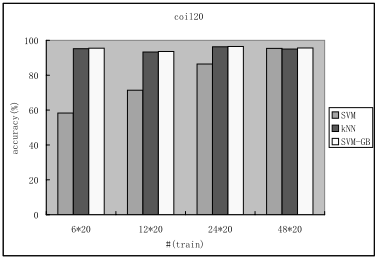
To evaluate the effectiveness brought by the generalized bias term, two groups of empirical results are reported. The first group of experiments focused on the reproduction property of the generalized bias term. It used Columbia university image library (coil-20) dataset 1 for image classification. The dataset has 1, 440 images x1, · · · , x1440 evenly distributed in 20 classes. After preprocessing, each image was represented as a 32 × 32 = 1024 dimensional vector with each component having a value between 0 and 255 indicating the gray level at each pixel. Four experiments were performed. Each experiment used the first 6, 12, 24 and 48 images respectively within each class for training and the rest for testing.
Using recently developed nonlinear dimensionality reduction technqiues[Tenenbaum et al., 2000; Roweis and Saul, 2000], we found that these images actually form a manifold with a much lower dimension than the original 1, 024 dimensions. With the prior knowledge, twenty features ϕ1, · · · , ϕ20 were predefined as follows:
where 1 ≤ p ≤ 20, 1 ≤ i ≤ 1440, 3NN (x) defines the three nearest neighbors in geodesic distance to x, and trainp is the set of training images with class label p. The geodesic distance was computed by the graph shortest path algorithm as in [Tenenbaum et al., 2000]. Defining features in this way, we implicitly used a kNN classifier as a generalized bias term. Similar ideas can be generalized to combining different approaches other than kNN.
Figure 1 compares classification accuracies among SVM, kNN, and the new algorithm (denoted by SVM-GB). An insightful study of the results may find that the 20 predefined features have dominated the learned SVM-GB solution due to the reproduction property, and made the performance of the algorithm similar to kNN which shows better performance than standard SVM on this dataset.
1 http://www1.cs.columbia.edu/CAVE/software/
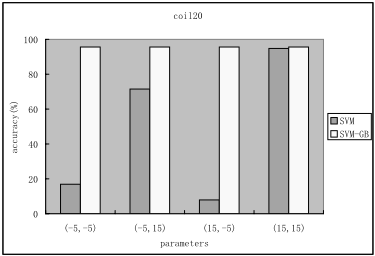
The reproduction property also helps to lessen the sensitivity of the algorithm to the choices of kernels and the regularization parameter γ. To illustrate the effect, another experiment was conducted using 48×20 training images. Instead of using cross validation for parameter selection, four groups of kernel and regularization parameters were fixed. Figure 2 depicts the results. The generalized bias termmakes SVM-GB more stable to the variations of kernel and regularization parameters. This property is especially useful concerning the practical situations where arbitrariness exists in designing kernels for some applications.
To further study the performance of the new algorithm, the second group of experiments was conducted on text categorization tasks using 20-newsgroups dataset 2 . The dataset collects UseNet postings into twenty newsgroups and each group has about 1, 000 messages. We experimented with its four major subsets. The first subset has five groups (comp.*), the second four groups (rec.*), the third four groups (sci.*) and the last four groups (talk.*).
For the dataset, we removed all but the 2, 000 words with highest mutual information with the class variable by rainbow package[McCallum, 1996]. Each document was represented by bag-of-words (BoW) which treats individual words as features. A linear kernel coupled with 10 predefined features ϕ1, · · · , ϕ10, which were obtained by probabilistic latent semantic analysis (pLSA) [Hofmann, 1999], was used as input for SVM-GB. Experiments were carried out with different number (100˜3, 200) of training documents for each subset. One experiment consisted of ten runs and the average accuracy was reported. In each run, the data were separated by the xval-prep utility accompanied in C4.5 package 3 .
As a comparison, SVM was tested with a linear kernel, which is a commonly used method for text categorizations. For completeness, both BoW and pLSA representations of documents were experimented. As can been seen in figure 3, although SVM with pLSA representation performs well when the number of training samples is small, the approach loses its advantage when the training set increases to a moderate size. SVM-GB reports the best performance when we have 800 training documents or more. It is also shown that SVM- GB has better results than SVM in BoW representation in all experiments, which gives us the belief that the embedding of pLSA features improves the accuracy.
2 http://www.cs.cmu.edu/˜TextLearning/datasets.html
3 http://www.rulequest.com/Personal/c4.5r8.tar.gz
6 Discussion and Conclusion
The idea of regularized learning can be traced back to modern regularization theory[Tikhonov and Arsenin, 1977; Morozov, 1984], which states that the existence of a regularizer helps to provide a unique stable solution to ill-posed problems. In this paper, we have considered the usage of a generalized regularizer in kernel-based learning. One straightforward reason that part of the hypothesis space is left unregularized in the new regularizer is due to a well-accepted fact that finite dimensional problems are often well-posed[Bertero et al., 1988; De Vito et al., 2005] and do not always need regularization, as in the case of learning problems defined in a subspace spanned by a number of predefined features. Similar idea was explored in spline smoothing[Wahba, 1990] that leaves polynomial features unregularized. In kernel-based learning, the most similar to our work is the semiparametric SVM model[Smola et al., 1998], which combines a set of unregularized basis functions with SVM. However, to our knowledge, few algorithms and applications have been investigated for machine learning tasks from a unified RKHS regularization viewpoint in a general way.
With the new regularizer and a specific trick in constructing kernels, predefined features are explicitly mapped onto a Hilbert space and taken into special consideration during the learning, which differentiates our work from standard kernel-based approaches that only consider kernel expansions and a constant in learning. For projecting predefined features onto an RKHS, the idea of a conditionally positive definite function[Micchelli, 1986] is lurking in the background, which goes beyond the discussion of this paper.
When applying the idea to SVM, we have developed a new algorithm which can be regarded as having generalized the bias term of SVM. With domain specific knowledge in predefining features, this generalization makes the bias term not trivial any more. As confirmed by the experimental results, correct choices of features help to improve the accuracy and make the algorithmmore stable in terms of sensitivity to the selection of kernels and regularization parameters.
Acknowledgments
This research was partially supported by RGC Earmarked Grant #4173/04E and #4132/05E of Hong Kong SAR and RGC Research Grant Direct Allocation of the Chinese University of Hong Kong.
@inproceedings{ijcai2007p148,
  title     = {Generalizing the Bias Term of Support Vector Machines},
  author    = {Li, Wenye and Leung, Kwong-Sak and Lee, Kin-Hong},
  booktitle = {Proceedings of the Twentieth International Joint Conference on
               Artificial Intelligence, {IJCAI-07}},
  publisher = {International Joint Conferences on Artificial Intelligence},
  editor    = {Manuela M. Veloso},
  pages     = {919--923},
  year      = {2007},
  url       = {https://ijcai.org/proceedings/2007/148},
}
TY - CPAPER TI - Generalizing the Bias Term of Support Vector Machines AU - Li, Wenye AU - Leung, Kwong-Sak AU - Lee, Kin-Hong T2 - Proceedings of the Twentieth International Joint Conference on Artificial Intelligence, IJCAI-07 PB - International Joint Conferences on Artificial Intelligence PY - 2007 SP - 919 EP - 923 UR - https://ijcai.org/proceedings/2007/148 ER -Copied
Machine-readable versions of this paper, for tools and AI agents:





