
A Three-Stage Neural Model for Attribute Based Classification and Indexing of Fly Ashes
Proceedings of the Twentieth International Joint Conference on Artificial Intelligence. Pages 871-875.
© 2007 International Joint Conferences on Artificial Intelligence
Abstract
The primary objective of this work is to categorize the available fly ashes in different parts of the world into distinct groups based on its compositional attributes. Kohonen's self-organizing feature map and radial basis function networks are utilized for the classification of fly ashes in terms of its chemical parameters. The basic procedure of the methodology consists of three stages: (1) apply self-organizing neural net and delineate distinct groups of fly ashes and identify the group sensitive attributes; (2) find mean values of sensitive attributes of the elicited groups and augment them as start-up prototypes for k-means algorithm and find the refined centroids of these groups; (3) incorporate the centroids in a two layer radial basis function network and refine the delineation of the groups and develop an indexing equation using the weights of the stabilized network. Further, to demonstrate the utility of this classification scheme, the so formed groups were correlated with their performance in High Volume Fly Ash Concrete System [HVFAC]. The categorization was found to be excellent and compares well with Canadian Standard Association's [CSA A 3000] classification scheme.
- [Ho and Lewis, 1985] D. W. S Ho and R.K.Lewis, "Effectiveness of fly ash for strength and durability of concrete", Cement and Concrete research, 15:793-800, 1985.
- [Bilodeau and Malhotra, 2000] Alian Bilodeau and V.Mohan Malhotra , "High Volume Fly Ash System: Concrete solution for sustainable development", ACI Materials Journal, 97(1): 41-48,2000.
- [Mullick, 2005] A.K.Mullick, "Use of fly ash in structural concrete: Part II-How much?", Indian Concrete Journal, 10- 14, 2005.
- [Diamond, 1984] Sidney Diamond, "The Utilization of Fly ash", Cement and concrete Research, 14: 455-462, 1984.
- [Mehta, 1985] P.K.Mehta, "Influence of fly ash characteristics on the strength of Portland-F l y a s h Table 6: Coefficients of GI equation as determined by RBFN net. Table 5: Salient details of RBFN Table 7: Range of group sensitive attributes and their performance evaluation [7][11-30].
- mixtures", Cement and Concrete Research, 15: 669-674, 1985.
- [Adeli, 2001] Hojjat Adeli, "Neural Networks in Civil Engineering: 1989-2000", Computer-Aided Civil and Infrastructural Engineering, 16: 126-142, 2001.
- [Cal, 1995] Yudong Cal 1995, "Soil classification by neural network", Advances in Engineering software, 22: 95- 97,1995.
- [Thomas et al, 1999] Thomas,M.D.A.,Shehata,M.H. and Shashiprakash,S.G., The use of fly ash in concrete: Classification by composition, Cement,Concrete and aggregates,21(2):105-110, December1999.
- [Kohonen, 1997] Kohonen, T., Self-Organizing Maps, 2nd ed., Springer-Verlag, Berlin, 1997.
- [Oppenheim and Willsky, 1983] Oppenheim, A.V& Willsky1983, A.S. , Signals and Systems, Prentice-Hall, Upper Saddle River, NJ, 145-146,1983.
- [Demuth and Beale, 1997] Demuth,H, and Beale, M, Matlab Neural Network Tool Box User's guide, Version 2, The Mathworks,1997.
- [Schalkoff, 1992] Schalkoff, R., Pattern recognition: Statistical, Structural and Neural Approaches, John Wiley and Sons, New York,1992.
- [Swamy, 1985] R.N.Swamy, "Utilization of fly ash: a challenge to concrete technology-1", Indian Concrete Journal, 119-122,1985.
- [Sivasundaram and Malhotra, 2004] Sivasundaram and V.M.Malhotra, "High-performance high volume fly ash concrete", The Indian Concrete Journal, 13-20,November 2004.
- [Ozvildirim and Halsted, 1994] Celik Ozyildirim and Woodrow J.Halsted, "Improved Concrete quality with combinations of fly ash and silica fume", ACI Materials Journal, 91(6): No 6, 587-594,1994.
- [Fournier et al, 2004] B.Fournier, D.Lu, J.P.Charland and J.Li, "Evaluation of Indian fly ashes for use in HVFA concrete Part I-Characterization", The Indian Concrete Journal, 22-30, November 2004.
- [Bilodeau et al, 1994] A.Bilodeau,V.Sivasundaram, K.E.painter and V.M.Mahotra, "Durability of Concrete incorporating high volumes of fly ash from sources in the U.S.",ACI Materials Journal, 91: 3-12,1994.
- [Langley et al, 1989] Wilbert S.Langley, Georges G.Carette and V.M.Malhotra, "Structural Concrete incorporating high volumes of ASTM Class fly ash", ACI Materials Journal, 86: 507-514,1989.
- [Sivasundaram et al, 1991] V.Sivasundaram,G.G.carette and V.M.Malhotra, "Mechanical properties and resistance to diffusion of chloride ions of concretes incorporating high volumes of ASTM class F-fly ashes from seven different sources", ACI Materials Journal, 88:12-28,1991.
- [Ravina and Mehta, 1988] Dan Ravina and P.K.Mehta, "Compressive strength of low cement/high fly ash concrete", Cement and Concrete research, 18: 571- 583,1988.
- [Zhang et al, 1997] Yamei Zhang, Wei Sun and Lianfei Shang, "Mechanical properties of high-performance concrete made with high-calcium high sulphate fly ash", Cement and Concrete research, 27(7):1093-1098,1997.
- [Naik and Singh, 1997] Tarun R. Naik and Shiw S.Singh, "Influence of fly ash on setting and hardening characteristics of concrete systems", ACI Materials Journal, 94(5): 355-360,1997.
- [Naik et al, 1997] Tarun R. Naik , Shiw S.Singh and Bruce Ramme, "Mechanical properties and durability of concrete made with blended fly ash", ACI Materials Journal, 95(4): 454-460,1997.
- [Naik and Ramme,1990] Tarun R. Naik and Bruce Ramme, "Effects of high-lime fly ash content on water demand, time of set and compressive strength of concrete", ACI Materials Journal, 87(6): 619-626,1990.
- [Sivasundaram et al, 1990] V. Sivasundaram, G.G.Carette and V.M.Malhotra, "Long term strength development of high-volume fly ash concrete", Cement and Concrete Composites, 12: 263-270,1990.
- [Slanicka, 1991] S.Slanicka, "The influence of fly ash fineness on the strength of concrete", Cement and Concrete Research, 21: 285-296,1991.
- [Siddique, 2004] Rafat Siddique , "Performance characteristics of high-volume class-F fly ash concrete", Cement and Concrete Research, 34: 487-493,2004.
- [Papadakis et al, 2002] V.G.Papadakis, S.Antiohos and S.Tsimas, "Supplementary cementing materials in concrete, part-II: A fundamental estimation of the efficiency factor", Cement and Concrete research, 32: 1533-1538,2002.
- [Poon et al, 2000] C.S.Poon, L.Lam and Y.L.Wong , "A study on high strength concrete prepared with large volumes of low calcium fly ash". Cement and Concrete Research, 30: 447-455,2000.
- [Zhang et al, 1999] Min-Hong Zhang, Alian Bilodeau, V.M.Malhotra, K.S.Kim and Jin Choon Kim, "Concrete Incorporating Supplementary Cementing materials. Effect on Compressive strength and resistance to chloride ion penetration", ACI Materials Journal, 96: 181-189,1999.
- [Malhotra, 1990] V.M.Malhotra, "Durability of concrete incorporating high-volume of low-calcium (ASTM class F) Fly ash", Cement &Concrete Composites, 12: 271- 277,1990.
- [Okine, 2001] Nii O.Attoh-Okine, "Grouping pavement Condition variables for Performance Modeling Using Self- Organizing maps", Computer-Aided Civil and Infrastructure Engineering, 16:112-125,2001.
- [Park and Sandberg, 1991] Park,J and Sandberg,I.W., Universal approximation using radial basis function networks, Neural Computation,3:246-257,1991.
- [Chen et al, 1991] Chen,S.,Cowan,C.F.N. and Grant,P.M., Orthogonal least squares learning algorithm for radial basis f u n c t i o n n e t w o r k , IEEE Transaction on Neural networks, 2(2):1013-32,1991.
References were extracted automatically from the PDF and may contain errors.
Full text extracted automatically from the PDF; figures, tables and equations may differ. The PDF is the version of record.
1 Introduction
Cement is the most cost and energy -intensive component of concrete. The unit cost of concrete can be reduced by partial replacement of cement with fly ash. Fly ash is the byproduct of the combustion of pulverized coal and is collected by mechanical and electrostatic separators from the fuel gases of power plants where coal is used as a fuel. High-volume fly ash concrete has emerged as construction material in its own right. Published literature contains a large amount of data on properties of structural concretes containing 10 to 30 percent fly ash by weight of the total cementitious material (i.e. cement + fly ash) .For most structural applications except mass concrete, the fly ash content is often limited to 20-30%. The quality of fly ash is often specified by standards in terms of fineness, loss on ignition and limitation of its chemical constituents. However, to the concrete technologist and the design engineer, the more important factors are the influences of fly ash on properties such as workability, heat of hydration, strength or durability. Besides the effects of fly ash on the properties of concrete, fly ash also affects the cost of the concrete product.
The cost of fly ash is generally one-third [Ho and Lewis, 1985]. High volume fly ash concrete [HVFAC] is ideally suited for rigid pavement construction to meet the projected needs of interstate highway & major constructions in India [Bilodeau and Malhotra, 2000;Mullik, 2005]. This paper reports an attempt made to classify the fly ashes into groups using the available data. Such grouping of data is useful for a concrete technologist for expeditious use of certain kinds of fly ashes in HVFAC system. However, chemical composition of fly ashes is considered in this work as they play a significant role in fly ash concrete and also there is variability in their proportions.
2. Specific Attributes of Fly Ashes
There exists a considerable variability in concrete related characteristics of fly ashes between typical low-calcium and typical high-calcium fly ashes. At present ASTM specifications call low calcium as "class F" fly ashes and high-calcium as "class-C" fly ashes. Low calcium fly ashes have their origin in bituminous coal while high calcium fly ashes are due to burning of coals with high limestone. However, this classification is solely based on percentage of calcium oxide present. The differences in chemical composition of these two kinds of fly ashes is palpable. The silica contents of high calcium fly ashes are somewhat variable [Mullik,2005]. Alumina contents may not be as variable.Iron oxide contents of low calcium are usually higher than that of high calcium fly ashes. A Cao content upto 29% is reported .Fly ashes with intermediate Cao contents have their origin in sub bituminous coal.The remaining chemical constituents like MgO, SO3, K 2O, Na2O3 and TiO2 are considered to be of less importance , but this is not necessarily so[Diamond, 1984]. The MgO contents of high calcium fly ashes are usually quite high. Higher SO3 contents in high Many low calcium fly ashes have substantially more K2O than Na2O. On the other hand, many high calcium fly ashes have more Na2O than K2O. It is concluded that except for calcium content variations of other chemical constituents of fly ash appeared to have no effect on its reactivity [Mehta, 1985]. The particle size distribution is important parameter governing the reactivity of fly ash. For low calcium fly ashes the reactivity was found to be directly proportional to the amount of particles <10mm, and inversely proportional to particles >45mm. High calcium fly ashes seem to be relatively less sensitive to particle size distribution [Mehta, 1985].
3. Significance of the Work
There have been many reported applications of neural networks in civil engineering [Adeli, 2001]. In particular, an attempt to classify soils by using feed forward neural network with back propagation learning algorithm is also reported [Cal, 1995]. The primary objective of this work is to categorize fly ashes from different sources into distinct groups as guided by self-organized feature maps considering chemical constituents as inputs. The main purpose of classifying fly ashes for use in concrete is to distinguish between ashes that have different effects on the properties of fresh and hardened concrete. In ASTM C618 these are referred to as Class F and Class C fly ash. Whereas in the Canadian Standard Association's CSA A 3000, the approach adopted was to use the total calcium content (expressed as mass % of calcium oxide) as the basis of classification. The three categories of ash characterized as being low, intermediate and high calcium content. Accordingly, the classes have been named as F-type with CaO at less that 8%, CI-type with CaO between 8% to 20% and CH-type with CaO more than 20%. However, both the approaches rely on percentage of CaO as the sole criterion for classification. This is because; many researchers have demonstrated that the role of fly ash in concrete is strongly influenced by the calcium content of the ash. Thomas et all[1999] provide a rationale for CSA A3000 approach.
In this study, Kohonen's self-organizing feature map and radial basis function networks have been integrated in a cascading fashion. The data for the classification was garnered from standard published references. The basic procedure of the methodology consists of three stages:
- Apply Kohonen's self-organizing neural net and delineate distinct groups of fly ashes in terms of winning neurons and identify the group sensitive attributes.
- Find mean attribute values of sensitive parameters of the elicited groups and augment them as start-up prototypes for k-means algorithm and find the refined centroids of these groups.
- Incorporate the so obtained centroids in a two-layer radial basis function network and refine the delineation of the groups and develop an indexing equation using the weights of the stabilized network.
Further, to demonstrate the utility of this classification scheme, the so formed groups were then correlated with their performance in High Volume Fly Ash Concrete System [HVFAC].
4. Kohonen's Feature Maps
The se l f -organizing map (TPFM) network performs unsupervised learning [Kohonen, 1997]. It is a neural network that forms clusters of neurons that reflect similarities in the input vector. It is a mapping that is defined implicitly and not explicitly. This is desirable because this investigation is not restricted to any particular application or predefined categories. Input vectors are presented sequentially in time without specifying the output. Because of this fact, there is no way of predicting which neuron will be associated with a given class of input vectors. This mapping is accomplished after training the network. The network has a sequential structure starting with the d input vectors (input neurons) x, which are received by the n neurons in parallel and are scaled by the weight vector w. Thus the weight matrix is the size of n neurons by d inputs. A thorough treatment of the network is beyond the scope of this paper. Elaborative presentations about the network are found in references [Kohonen, 1997; Oppenheim and Willsky, 1983; Demuth and Beale, 1997; Schalkoff, 1992].
4.1 Application
The chemical composition of fly ashes plays a significant role in HVFAC. But, the important factor that has hindered the widespread use of ashes is their variability. No two ashes are completely alike. The need to characterize them in terms of their chemical and host of other parameters relevant to engineering use is urgent and real [Swamy, 1985]. However, in this study, only chemical attributes of the fly ashes were considered.
Data for this classification work was availed from the listed references [Sivasundaram and Malhotra,2004;Ozvildirim and Halsted,1994; Fornier et al,2004; Bilodeau et al ,1994; Langley et al,1989, Sivasundaram et al,1991; Ravina and Mehta,1988; Zhang et al,1997; Naik ans Singh,1997;Naik et al ,1997; Naik and Ramme,1990;Sivasundaram et al,1990; Slanicka,1991; Siddique,2004; Papadakis et al,2002; Poon et al ,2000; Zhang et al,1999; Malhotra,1990]. In all, about 80 sets of data were gathered. To begin with, eight chemical attributes, viz., Sio2, Al2O3, Fe2O3, CaO, MgO, Na2O3, K2O, SO3 or TiO2 of fly ash were considered for classification. Among these attributes, the sulphur dioxide is predominant in high calcium fly ashes and was found to be not appreciable in low calcium fly ashes. The reverse was the trend in the case of Titanium oxide i.e, appreciable percentage of titanium oxide was reported in low calcium fly ashes. Therefore, they are together taken as one attribute. Among these 80 data sets, eight records were rejected due to non-availability of data concerned to some chemical compositions. Some referenc e s even contained the information about the source of the fly ash also. The remaining 72 data sets were normalized and shuffled using a random sampling.
Two start with; three topologies i.e., 8-16, 8-24 and 8-32 were considered to pick out the best possible one. The number of output neurons was set as multiples of input neurons. It is recommended that [Okine 2001] before learning process starts, network coefficients should be sized and ascertained. These parameters govern the networklearning rate, learning iteration, process and weight updating, etc. The following are the parameters that must be ascertained before training the network:
Kohonen output neurons: This is the estimation of number of kohonen cells. The output neurons were considered as multiples of input neurons. Three combinations 8-16, 8-24 and 8-32 were explored. Later, inputs were reduced to 4.
Learning coefficient: The learning coefficient must be estimated before the network actually undergoes learning. After sufficient learning cycles, it was e stimated that the learning rate would start from 0.2 for the best training of the network to achieve good results.
Number of steps: This is the number of learning iterations. After observing the performance of the network after sufficient training and comparison of results, it was assumed to be 10,000.
Neighborhood size: The neighborhood size is used in the self-organizing phase of the learning when the winning PE and all its neighbors move toward the input PE. Neighborhood size of 5 was used in all the topologies mentioned. Later, the size was reduced to 3.
Epoch size. Epoch is the presentation of the whole training set. The parameters are summarized in table 1.
| Coefficients | Values |
|---|---|
| Learning Coefficient | 0.2 |
| Neighborhood size | 3 |
| Epoch Size | 100 |
| Learning Iterations | 10000 |
4.2 Group Sensitive Attributes
A host of first trials with eight attributes were proved to be elusive in terms of distinct numbered winning neurons designating the grouping. However, three groups were predominantly seen, with more than one neuron indexing to the same group. On successive elimination of some chemical attributes, the classification started converging. Four chemical attributes, i.e., SiO2, Al2O3, CaO and SO3/ TiO2 were found to be sensitive in the classification process. To validate this observation, three different net topologies 4-8, 4-12 and 4-16 were tested with randomly arranged data sets. All the topologies conclusively proved that these attributes are indeed more crucial in the classification. However, the results of the first topology (48) were considered. A stastical picture of the group sensitive attribute data is presented in table 2. It should be noted that, these data sets do not fit a normal distribution pattern.
| Parameter | SiO2 | Fe2O3 | CaO | SO3/TiO2 |
|---|---|---|---|---|
| Mean | 49.15 | 8.5 | 9.35 | 1.50 |
| Median | 49.5 | 5.65 | 4.45 | 1.45 |
| Standard Deviation | 9.40 | 7.68 | 9.8 | 1.24 |
| Variance | 88.32 | 59.03 | 96.06 | 1.53 |
| Kurtosis | -0.93 | 5.08 | -0.63 | 10.48 |
| Skewness | -0.33 | 2.35 | 0.90 | 2.60 |
| Range | 33.0 | 36.6 | 28.9 | 7.8 |
| Min | 63.0 | 39.7 | 29.2 | 7.9 |
| Max | 30.0 | 3.1 | 0.3 | 0.1 |
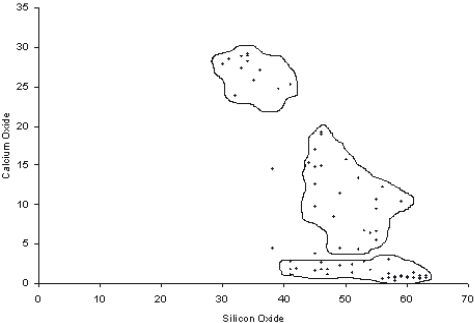
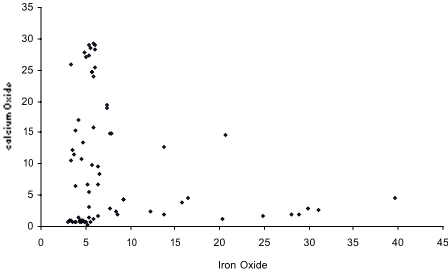
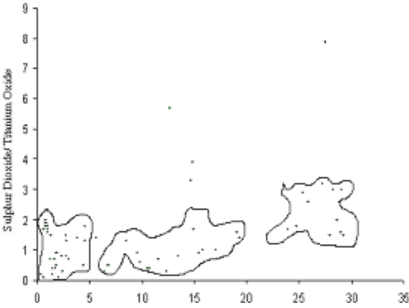
The published research work on high volume fly ash concrete emphasizes that the percentage of calcium oxide in fly ash as the decisive parameter in long-term performance of high volume fly ash concrete. Therefore, the sensitivity of classification lies in the correlation of other attributes with that of calcium oxide. Figure 1 shows correlation between calcium oxide and silicon oxide. In this plot, higher percentage of calcium oxide corresponds to lower amount of silicon dioxide and vice versa with moderate percentage ranges of both in the midst. In fig 2, the correlation between calcium oxide and ferric oxide is not that marked. There is a fair correlation between calcium oxide and sulphur oxide/titanium oxide as portrayed in fig 3.
The average values of group sensitive attributes after successful running of the Kohoen's network are presented in table 3. These centers were selected as the initial prototypes during the execution of k-means algorithm. Thus, expediting the self-organized net for guessing number of groups.
| Attributes (%) | Group-1 | Group-2 | Group3 |
|---|---|---|---|
| SiO2 | 58.8 | 49.1 | 39.7 |
| Fe2O3 | 5.4 | 9.5 | 8.7 |
| CaO | 2.92 | 7.5 | 22.3 |
| SO3/TiO2 | 0.6 | 1.2 | 2.5 |
5. K-Means Algorithm
The simplicity of the k-means clustering algorithm, combined with its capability to produce good results, makes it the most widely known clustering method. The purpose of applying the k-means clustering algorithm is to find a set of clustered centers and a partition of training data into subclasses. Normally, the center of each cluster is initialized to a randomly chosen input datum. Then each training datum is assigned to the cluster that is nearest to itself. In this case, the initial prototypes were those found by selforganizing network. After training data have been assigned to a new cluster unit, the new center of a cluster represents the average of the training data associated with that cluster unit. After all the new clusters have been calculated, the process is repeated until it converges. The refined prototypic values of three groups after the successful execution of kmeans algorithm are presented in table 4.
| Attributes(%) | Group-1 | Group-2 | Group3 |
|---|---|---|---|
| SiO2 | 50.32 | 42 | 38.8 |
| Fe2O3 | 7.75 | 14.28 | 5.43 |
| CaO | 4.03 | 12.19 | 23.825 |
| SO3/TiO2 | 0.44 | 1.58 | 2.77 |
6. Radial Basis Function Neural Network
Radial basis function networks were first introduced as a technique for real -valued multivariate interpolation problems [Schalkoff, 1997]. A detailed discussion on this network is beyond the scope of this paper. Useful deliberations on this network are cited in references [Park and Sandberg, 1991;Chen et al, 1991]. The following are the three steps of the hybrid learning method for an RBFNN;
- Find the cluster centers of the radial basis function; use the K-means clustering algorithm.
- Find the width of the radial basis function.
- Find the weights; use LMS.
7. Results of Classification
Table 5 gives salient details of RBFN network adopted for the purpose. Table 6 gives the coefficients that are to be used in indexing equation (3). The coefficients are the averaged weights of the hidden layer after several runs of the network.. The general form of the group index (GI) equation is;
Where aij and bi are the constants as estimated by RBFNN. Any input vector is represented as x, yi is the center that is to be adopted from table 4.
8. Conclusions
This paper presented an analytical oriented, attribute-based model for classification of fly ashes into three groups using SOFM and RBFN. Using the weights of a stabilized RBFN, an indexing equation has been developed. The equation consists of predetermined group centers (prototypes) and the coefficients aij and bj. The performance evaluation of the groups with the corresponding range of values of group sensitive attributes is presented in table 7. It is felt that, from the end user (scientists and engineers) point of view, outcome of the model is significant on following counts;
- § The classification considers four sensitive chemical attributes of fly ashes.
- § This classification highlights the correlation among certain group sensitive attributes like Silicon oxide, Calcium oxide, Sulphur oxide and Titanium oxide.
- § With the indexing equation and known attribute values of a given fly ash, it is possible to provide a first hand information about the properties of the fly ash and how & where it should be used for a given application.
| No of input layer neurons | 4 |
| No of neurons in hidden layer | 3 |
| The basis function. | Gaussian. |
| No of output neurons | 1 |
| Width of cluster as given by s | 14.42 |
| for group 1, 2 and 3 respectively | 14.42 |
| 23.75 | |
| The bias input | 1 |
| Group Index | ai j | bj (bias) | ||
|---|---|---|---|---|
| 1 | 0.4805 | 0.1277 | 0.1376 | 0.4845 |
| 2 | 0.8165 | 0.3926 | 0.3937 | 0.8514 |
| 3 | 1.0084 | 0.7767 | 0.7684 | 1.1829 |
| Group Index: 1 | |||
|---|---|---|---|
| SiO2 | Fe2O3 | CaO | SO2 /TiO2 |
| 50-63 | 3.0-7.0 | 0.6-5.0 | 0.8-2.0 |
Considered to be true pozzolana with little or no cementitious properties. Heat of hydration is in the range 150-250 kJ/kg. Used as a micro-aggregate, very low strength development at early ages. No pozzolonic activity. High sulphate resistance. For mass concrete, the replacement could be up to 60%, for high strength concrete it could be only up to 20%. Low workability and demand for large quantities of super plasticiser .Low resistance to freezing and thawing.
| Group Index: 2 | |||
|---|---|---|---|
| 38-50 | 6.0-10.5 | 4.5-16.00 | 0.4-0.8 |
Heat of hydration is in the range 200-300 kJ/kg. Replacement up to 50%. Significant improvement in strength after 90 to 365 days. Decrease in average pore diameter in concrete. Excellent durability against freezing and thawing. High-to-moderate resistance to sulphates. Strength of concrete is sensitive to particle size distribution in fly ash, low elastic modulus value, and demands high dosages of super plasticiser for good workability. Reactivity is governed by fineness.
| Group Index: 3 | |||
|---|---|---|---|
| 29-39 | 8.0-16.00 | 16-29 | 2-3 |
Heat of hydration is in the range 250-350 kJ/kg. Higher early age strength development due to increased reactivity. Excellent mechanical properties of concrete and durability against freezing and thawing. Reduced permeability and chloride diffusivity. However, high expansion with high SO3, severe volume instability, appearance of ettringite in some cases, excellent compressive and flexural strength. Less resistance to chemical attack with regards to sulphates and alkali-silica reaction. Most of the fly ashes of this category can be used for structural grade concrete in quantities up to 40% replacement of cement.
@inproceedings{ijcai2007p140,
  title     = {A Three-Stage Neural Model for Attribute Based Classification and Indexing of Fly Ashes},
  author    = {Jayaram, M. A. and Nataraja, M. C. and Ravikumar, C. N.},
  booktitle = {Proceedings of the Twentieth International Joint Conference on
               Artificial Intelligence, {IJCAI-07}},
  publisher = {International Joint Conferences on Artificial Intelligence},
  editor    = {Manuela M. Veloso},
  pages     = {871--875},
  year      = {2007},
  url       = {https://ijcai.org/proceedings/2007/140},
}
TY - CPAPER TI - A Three-Stage Neural Model for Attribute Based Classification and Indexing of Fly Ashes AU - Jayaram, M. A. AU - Nataraja, M. C. AU - Ravikumar, C. N. T2 - Proceedings of the Twentieth International Joint Conference on Artificial Intelligence, IJCAI-07 PB - International Joint Conferences on Artificial Intelligence PY - 2007 SP - 871 EP - 875 UR - https://ijcai.org/proceedings/2007/140 ER -Copied
Machine-readable versions of this paper, for tools and AI agents:





