
Maximum Margin Coresets for Active and Noise Tolerant Learning
Proceedings of the Twentieth International Joint Conference on Artificial Intelligence. Pages 836-840.
© 2007 International Joint Conferences on Artificial Intelligence
Abstract
We study the problem of learning large margin halfspaces in various settings using coresets and show that coresets are a widely applicable tool for large margin learning. A large margin coreset is a subset of the input data sufficient for approximating the true maximum margin solution. In this work, we provide a direct algorithm and analysis for constructing large margin coresets. We show various applications including a novel coreset based analysis of large margin active learning and a polynomial time (in the number of input data and the amount of noise) algorithm for agnostic learning in the presence of outlier noise. We also highlight a simple extension to multi-class classification problems and structured output learning.
- D. Angluin. Queries and concept learning. Machine Learn- ing, 2(4):319-342, 1987.
- M. Badoiu and K.L. Clarkson. Smaller core-sets for balls. In SODA, pages 801-802, 2003.
- C. Campbell, N. Cristianini, and A.J. Smola. Query learning with large margin classifiers. In Proceedings of the Seven- teeth ICML, pages 111-118, 2000.
- S. Dasgupta. Analysis of a greedy active learning strategy. In NIPS, volume 17, pages 337-344. MIT Press, 2005.
- Y. Freund and R.E. Schapire. A decision-theoretic general- ization of on-line learning and an application to boosting. J. Comput. Syst. Sci., 55(1):119-139, 1997.
- C. Gentile. A new approximate maximal margin classification algorithm. JMLR, 2:213-242, 2001.
- T. Joachims. Training linear svms in linear time. In Proceed- ings of the Twelfth ACM SIGKDD, New York, 2006.
- M. Kearns, M. Li, L. Pitt, and L. Valiant. Recent results on boolean concept learning. In Proceedings of the Fourth International Workshop on Machine Learning, pages 337- 352, 1987.
- A. Kowalczyk. Maximal margin perceptron. In Advances in Large Margin Classifiers. MIT Press, Cambridge MA, 2000.
- M. Kearns and R. Schapire. Efficient distribution-free learn- ing of probabilistic concepts. In Computational Learn- ing Theory and Natural Learning Systems, Constraints and Prospect, volume 1. The MIT Press, 1994.
- Y. Li and P.M. Long. The relaxed online maximum margin algorithm. Machine Learning, 46(1-3):361-387, 2002.
- E. Osuna, R. Freund, and F. Girosi. Improved training algo- rithm for support vector machines. NNSP, 1997.
- J. Platt. Sequential minimal optimization: A fast algorithm for training support vector machines. Technical Report 98- 14, Microsoft Research, April 1998.
- I. Tsochantaridis, T. Hofmann, T. Joachims, and Y. Altun. Support vector machine learning for interdependent and structured output spaces. In Proceedings of the twenty-first ICML, page 104. ACM Press, 2004.
- S. Tong and D. Koller. Support vector machine active learning with applications to text classification. JMLR, 2:45-66, 2002.
- I.W. Tsang, J.T. Kwok, and P. Cheung. Core vector machines: Fast svm training on very large data sets. JMLR, 6:363- 392, 2005.
- V.N. Vapnik. Estimation of Dependences Based on Empirical Data. Springer Series in Statistics. Springer, New York, 1982.
- V.N. Vapnik. The nature of statistical learning theory. Springer Verlag, Heidelberg, DE, 1995.
References were extracted automatically from the PDF and may contain errors.
Full text extracted automatically from the PDF; figures, tables and equations may differ. The PDF is the version of record.
1 Introduction
Large margin techniques are the basis for both practical algorithms and theoretic analysis in machine learning. Algorithmically, the most notable example is the support vector machine (SVM) [Vap95] that finds a maximum-margin separation of a given data set. The SVM has proven very successful in practice and theoretically, a large margin separation implies good generalization performance [KS94].
The SVM has a simple representation and a straightforward implementation - find the set of support vectors that uniquely define the maximum margin separation. Amazingly, this approach simultaneously allows the classifier to be represented with a (potentially small) subset of the input data and, through the use of kernel functions, to utilize an arbitrarily powerful hypothesis space. If a small support set can be found, then one can guarantee high performance on unseen Dav Zimak†‡ Yahoo! Inc. Santa Clara, CA davzimak@yahoo-inc.com data when using a hypothesis class with unbounded complexity. Unfortunately, there is no guarantee that the size of the support set will be small. Additionally, the running time of the SVM algorithm to find an exact solution to the large margin problem is O(m3 ) time and O(m2 ) space using m examples and is infeasible for large datasets.
∗Work on this paper was partially supported by a NSF CAREER award CCR-0132901.
†Work on this paper was partially supported by NSF grants ITRIIS-0085980 and IIS-9984168.
‡Much of this work was done while at the University of Illinois.
1 Throughout the paper, we often present only proof sketches due to lack of space. The full proofs appear in Technical Report UIUCDCS-R-2006-2784 available from the University of Illinois Computer Science Department.
Most practical algorithms, such as chunking [Vap82], decomposition [OFG97], and sequential minimal optimization (SMO) [Pla98], reduce the problem to manageable subtasks are heuristic solutions which may converge slowly. Furthermore, the running time remains crucially dependent on the number of support vectors in the solution. Alternatively, recent work has focused on on-line approaches to approximate the maximum-margin algorithms [Kow00; Gen01; LL02]. On-line algorithms are iterative solutions that add examples to the large margin solution based on various conditions - all related to the relative margin of the example under consideration. As a result, they can bound the number of examples necessary to guarantee a large margin separation.
In this paper we relax the requirement that we find the unique maximum margin separation. Specifically, we find an approximate maximum margin separation - a hyperplane that separates all of the input data with margin larger than (1 - ϵ)ρ∗ , where ρ∗ is best achievable. We use the coreset method first described in [BC03] and extended to the maximum margin setting in [TKC05]. A coreset for a maximum margin separating hyperplane is a subset, C ∈ D of examples such that the maximum margin hyperplane on C is an approximate maximum margin separating hyperplane on D. In some sense, it captures all of the necessary information for the approximation just as the set of support vectors does for the true maximum margin separating hyperplane.
This paper studies the running time of a simple coreset algorithm for binary and structured-output classification and the use of the coreset as an analysis tool for active learning and noise-tolerant learning in the agnostic setting. In previous work, the coreset was constructed as a reduction to finding a coreset for a different problem - the minimum enclosing ball [BC03]. In Section 3, we show a direct algorithm for finding a coreset of size at most |C| = O((R/ρ∗)2/ϵ) in time O(nd|C| + |C|T (|C|)) where R and ρ∗ measure the size of the example set and the quality of the maximum-margin classifier and T (|C|) is the time to run an SVM black-box on |C| examples. This improves previous bounds by a factor 1/ϵ and provides an explicit running time to the algorithm.
In Section 4 we analyze one of the most effective active learning algorithms based on the maximummargin principal [TK02] and give a running time and a (1 - ϵ)-approximation guarantee. We show that in time O( d|C| ϵe (ln |C| + ln 1δ )+|C|T (|C|)) one can compute a coreset C of size at most |C| = O((R/ρ∗)2/ϵ2 ) such that with high confidence, 1 -δ, the classifier producedwill have large margin and small, ϵe, error. In Section 5, we analyze learning with outlier noise. Roughly speaking, a set of outliers is a small subset of the input data such that, if removed would yield the correct maximum-margin classifier. Thus if we assume there are k outliers, the best maximum margin classifier is well-defined. We show a polynomial time algorithm for learning the maximum margin separation in this setting. Finally, in Section 6 we highlight an important connection between the coreset algorithm and recent work for learning SVM for structured output [THJA04]. Indeed, we can view SVM struct as a coreset algorithm.
2 Preliminaries
We are given D = {(x1, y1), . . . , (xM, yM)}, a labeled training set of cardinality M drawn from some distribution DX ,Y , where xm ∈ X are the examples in a inner-product space and ym ∈ Y are labels. For most of the paper, we assume a real valued input, X = Rd , and binary output, Y = {-1, 1}. However, in Section 6 we note an important extension to the structured output domain.
In this paper, we use the maximum margin principle to discover a hypothesis h ∈ H represented by a halfspace h(x) = argmaxy∈{-1,1} y(w · x), where w ∈ Rd. The binary margin (or geometric margin), ρ(w, x, y) = y(w · x), for an example, x, is defined as the distance from the example to the discriminating hyperplane w · x = 0. Notice that a negative margin is indicative of a misclassified example. The margin of hypothesis h is ρ(h, D) = min(x,y)∈D ρ(w, x, y).
Therefore, given a sample, D, the maximum margin hypothesis (hyperplane) is
is the uniform length hyperplane with maximum margin over the data.
Definition 2.1 ((1 - ϵ)-Approximation) A hypothesis h is a (1 - ϵ)-approximation to the optimal hypothesis h∗ if ρ(h, D) ≥ (1 - ϵ)ρ(h∗ , D).
Definition 2.2 (Maximummargin coreset) A maximum margin coreset is a set of examples C = C(ϵ, ρ) ⊂ D such that h = L(C) is a (1 - ϵ)-approximation to h∗ = L(D).
3 Coreset Learning Algorithm
Large margin coresets were first introduced in [TKC05] to form the Core Vector Machine (CVM). In that work, they reduced finding a maximum margin hyperplane to finding the minimum enclosing ball of a set of points around the origin.
Algorithm CORESET SVM INPUT: S = ((x1, y1), . . . , (xm, ym)), Approximation parameter ϵ ∈ (0, 1) where S ∈ {Rd × {-1, 1}}m OUTPUT: A classifier h ∈ H begin Set C = ((x1, y1)) For i = 1 . . . T Set hi = SVM(C) Set ρi = ρ(hi , C) (xmin, ymin) = argmin(x,y)∈S\C ρ(hi, x, y) if ρ(hi, xmin, ymin) < (1 - ϵ)ρi C = C ⋃(xmin, ymin) else return hi Return SVM(C) endFor the latter task, there exists a coreset algorithm that runs in time linear in the number of points [BC03]. In this section, we provide very similar results with a slight (factor 1/ϵ) improvement by providing a direct algorithm and analysis.
In Figure 1, the simplified coreset algorithm is presented for learning binary labeled data in a noise-free setting. The coreset C is built iteratively. At each step, we construct the true maximum margin classifier, hi = SVM(C) and use it to find the example with the smallest (or negative) margin. This example is then added to the coreset and the process repeats. It is possible to tell that hi is a (1 - ϵ)-approximation by observing the ratio between the margin on the coreset, ρ(hi, C), and the margin on the entire data set, ρ(hi,D). If this ratio is small enough then the margin of hi on the entire data set is sufficiently large and the algorithm halts.
Lemma 3.1 Let ρ∗ = ρ(L(D),D) be the optimal margin for data set D ∈ {Rd × {-1, 1}}M of size M. Given a parameter, ϵ ∈ (0, 1), one can compute a coreset C of size |C| = O((R/ρ∗ )2 /ϵ) in time O(nd|C| + |C|T (|C|)), where R = max(x,y)∈D ||x||.
Proof sketch: We show using a simple geometric argument that each time an example is added to the coreset, the margin on the next integration decreases by at least a constant factor. That is,
where αi = ρi - ρ(hi, xi) measures how much the added example violates the current margin guess using the current hypothesis hi. Then, it can be shown that the decreasing sequence of margins will be smaller than ρi ≤ (1 + ϵ)ρ after at most 64R2 ρ2 ϵ steps. Once the margin is small enough, we show that it quickly decreases and outputs a (1 - ϵ)-approximation to the maximum margin classifier.
At each step, the algorithm in Figure 1 adds the example with the smallest margin to the coreset. However, the algorithm is easily modified such that any example with margin small enough can suffice. Specifically, if we know that each example (x, y) added to the coreset is such that ρ(hi, x, y) < (1-ϵ)ρi, but not necessarily the example with minimum margin, the algorithm still converges, but with a larger coreset.
Corollary 3.2 Let ρ∗ = ρ(L(D),D) be the optimal margin for data set D ∈ {Rd × {-1, 1}}M of size M. Given a parameter, ϵ ∈ (0, 1), one can compute a coreset C of size |C| = O((R/ρ∗)2/ϵ2 ) in time O(nd|C|+|C|T (|C|)), where R = max(x,y)∈D ||x||.
Proof sketch: If, rather than add the minimummargin example at each step, we add any example with small enough margin, ρ(hi, x, y) < ρiϵ, then we can simplify the simple geometric proof sketch for Lemma 3.1 and show that
Then, similarly to Lemma 3.1, we use this decreasing sequence to prove the result.
3.1 RelatedWork
Central to the coreset algorithms presented here, is the idea of iteratively building a working set of examples by carefully selecting examples to add at each step. In the online learning literature, this idea has appeared in work related to the coreset approach.
Indeed, even the perceptron algorithm can be viewed as building a working set. At each iteration, an example, (xi, yi), is added to the working set if yi(wi · xi) < 0. The hypothesis is a linear sum of elements in the set.
Various approximate algorithms for online learning have also been proposed. In [Kow00], Kowalczyk proposed a perceptron-like update rule, with various criteria for choosing which example to update. One of them is exactly the minimum margin approach used in coresets. After only O( R2 ϵ2 log R2 ) updates, the algorithm would converge to a (1 - ϵ)-approximate classifier - a result very similar to ours, modulo 1/ϵ and log R terms. At roughly the same as Kowalczyk's algorithm, two additional algorithms were proposed: the Relaxed Online Maximum Margin Algorithm (ROMMA) and the Approximate Large Margin Algorithm (ALMAp). ROMMA is an online algorithm that learns a (1 - ϵ)-approximate maximum margin separation. Both have similar selection criteria, and perform similarly in practice. ALMAp also provides a mistake bound of O( R2 ϵ2 ρ2 ).
Recently a new algorithm, SVM-Perf, was introduced and implemented [Joa06] with similar O( 1 ϵ2 ) bounds. SVM-Perf is presented as a cutting-plane algorithm, where at each iteration a cutting-plane is found that represents a fixed subset of the training examples. The coreset methods are a special case of the cutting-plane algorithm where each cutting plane is described by a single example. Indeed, this very clever algorithm converges very fast. Many experimental results are presented that show the fast convergence time in practice, and we think this work helps support our claim that coreset-based algorithms can be practical.
4 MaximumMargin Active Learning
In active learning, the learner is presented with a set of unlabeled data, U = {x1, . . . , xm} and an oracle, ORACLE : X → {-1, 1} that provides a label to any example x ∈ U consistent with a large margin hypothesis. The goal is to learn exactly this maximum margin separation using a limited number of oracle queries.
Recently, iterative algorithms for active learning SVM have been proposed [TK02; CCS00]. After presenting a slight modification of these algorithms using coresets and introducing an explicit stopping criteria, we show that the algorithm converges quickly to a (1 - ϵ)-approximation of the true maximum margin hypothesis that exists given all labels (with high probability).
4.1 Coreset Active Learning Algorithm
In Figure 2, the active learning algorithm from [TK02] is adapted by adding a verification stage. The algorithm runs in iterations, where at each step, the unlabeled example that is closest to the decision boundary is added to the coreset. However, if there are no examples near the decision boundary (i.e. they are further than the current large-margin guess), we may think that all labels are classified correctly and thus the algorithm can halt. Of course, since the labels are unknown, it is possible that there are still a large number of misclassified examples. At this point the algorithm enters a verification phase, VERIFY(), where examples are sampled uniformly at random from the entire data set according to UNIFORMRANDOM() and labeled using ORACLE().
It is important to note that the algorithm presented in Figure 2 repeatedly cycles over the unlabeled dataset to find the single example closest to the decision boundary. This is easily modified to two important cases when the number of examples is very large (i.e. m >> |C|) or when there is an infinite stream of examples (i.e. m =∞). In these cases, any example, x where |ρ(hi, x, y)| < (1 - ϵ)ρi can be added to the coreset and the algorithm can halt after enough examples are seen without making a mistake. Indeed Lemma 4.2 below applies to these more general cases.
4.2 Analysis
Algorithm 2 seeks the true maximum margin hypothesis of the data that would be found if all of the labels were known. Here, we show that with high probability (1 - δ), it finds a (1-ϵa)-approximation to this hypothesis. Unfortunately, it is impossible to guarantee error free learning (see Section 4.3), so we must accept a small, ϵe, prediction error.
The analysis follows from two facts. First, there exists a coreset that can be constructed by adding examples that lie close to the decision boundary. Any example with very small margin (< (1 - ϵa)ρi) will improve the approximation irrespective of the actual label. Second, the verification stage will halt either because it has found an example with very small (i.e. negative) margin that will improve the coreset or because enough examples have been seen with no mistakes.
Algorithm ACTIVE CORESET SVM INPUT: Data U = (x1, . . . , xm) ∈ {Rd}m OUTPUT: A classifier h′ : Rd → {-1, 1} begin Set C = ∅ Repeat until Halt Set hi = SVM(C) Set ρi = ρ(hi, C) xmin = argminx∈U\C ρ(hi, x, y) if miny∈{-1,1} |ρ(hi, xmin, y)| < (1 - ϵ)ρi ymin = ORACLE(xmin) C = C ⋃(xmin, ymin) else(xv, yv) = VERIFY(U \ C, hi) if xv = NULL return hi and Halt elseC = C ⋃(xv, yv) else Return SVM(C) and Halt endAlgorithm VERIFY INPUT: Data U = (x1, . . . , xm) ∈ {Rd }m A classifier h : Rd → {-1, 1} OUTPUT: (x, y) ∈ Rd × {-1, 1} or NULL begin for i = 1 . . . T do x = UNIFORMRANDOM(U ) y = ORACLE(x) if ρ(h, x, y) < 0 Return (x, y) Return NULL endFigure 2: (a) Active learning using coresets. Abusing notation, U \ C = (x ∈ U|(x, ORACLE(x)) ̸∈ C). (b) Verify procedure. UNIFORMRANDOM(U ) returns a random example from the unlabeled set. ORACLE(x) returns the correct label for x and UNIFORMRANDOM(U ) selects an example fromU uniformly at random.
In the latter case, we can apply the following lemma, adapted from [KLPV87; Ang87] that shows learning from membership queries can be used to give PAC-bounds.
Lemma 4.1 If L is a conservative on-line algorithm with mistake bound M and access to an example oracle ORACLE() drawing examples i.i.d. from distribution D, then after at most Mϵ (ln M + ln 1δ ) calls to ORACLE(), with confidence 1 - δ, L produces a hypothesis with expected error less than ϵ on examples drawn from D.
Using Lemma 4.1 and Corollary 3.2, we bound the running time of this algorithm to converge to an approximate solution.
Lemma 4.2 Let D = ORACLE(U ), be the entire labeled data set and ρ∗ = ρ(L(D),D) be the optimal margin for data set D of size M. Given parameters, δ, ϵe, ϵa ∈ [0, 1], one can compute a coreset C of size at most O((R/ρ∗)2/ϵ2a ) in time O( d|C| ϵe (ln |C| + ln 1δ ) + |C|T (|C|)), where R = max(x,y)∈D ||x||. The total number of calls to ORACLE() is less than O( |C| ϵe (ln |C| + ln 1δ )), and T(m) is the running time of the SVM for m examples.
Proof: The coreset will be at most |C| = O((R/ρ∗)2/ϵ2a) as a result of Corollary 3.2 by noticing that each time an example, (x, y) is added to the coreset, ρ(hi, x, y) < (1 - ϵ)ρi - either because an unlabeled example is added in Line (1) in Algorithm 2 (a) or because a labeled example is added in Line (2) in Algorithm 2 (b). In the former we know that ρi - |ρ(hi, x, y)| > ϵρi, and in the latter we know that ρ(hi, x, y) < 0.
Since we know that at most |C| examples will be added to the coreset, and at each iteration, the margin of the current working hypothesis decreases we can use Lemma 4.1 to bound the total number of Oracle queries in 1 ϵe (ln |C| + ln 1δ ) to ensure 1-δ confidence that the classifier has at most ϵe mistakes. Therefore, the total number of calls to ORACLE() is at most O(|C| + |C| 1 ϵe (ln |C| + ln 1δ )) = O(|C| 1 ϵe (ln |C| + ln 1δ )). The running time follows since SVMmust be run each time an example is added to the coreset.
4.3 RelatedWork
Previously, the efficacy of maximum margin active learning algorithms were explained because by choosing the example closest to the decision boundary, the version space will be approximately halved [TK02] 2 . More precisely, it was argued that because at each iteration the version space is an intersection of half-spaces in the kernelized feature space. If we assume that each example is of constant size (i.e. ||x|| = 1) then the hypothesis with maximum margin separation is a point in the version space at the center of the largest enclosed ball in this polytope. Therefore, by choosing an example with small margin, it is hoped that it comes close to bisecting the enclosed ball and also the version space.
If one could guarantee that the version space was indeed halved at each iteration, then the algorithm would converge quickly to the true maximum margin hypothesis [TK02; FS97] Unfortunately, no such guarantee can be made, either in practice or in theory, thus the "halving" argument falls short to adequately explain the practical success of choosing the minimum absolute margin example at each iteration.
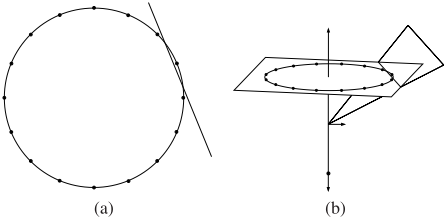
In addition, as first presented in [Das05] a zero-error active learning algorithm is impossible without requesting the label of all examples. To see this, we consider a sample of examples spread at a constant interval on the surface of a circle in R2 . See Figure 3 for an illustration. The concept represented by Figure 3(a) is one where a single example is negative and the rest are positive. The maximum margin separation thus separates a single example from the rest. Consider any algorithm that computes the maximum margin separation of any labeled subset of this data. Unless the single negative example is included in the labeled subset, then there is no hope of achieving an approximate large-margin separation that correctly classifies all examples in the data set. Therefore, if an adversary controls the oracle, by simply answering "+" to every query until the final query, the learner is forced to ask the label of every example.
2 In [TK02] it is assumed that ||x|| = 1 for all examples. While relaxing this assumption does cause a different view of the versions space and changes the motivation, it does not affect their results. Indeed, here, we propose an alternate justification that does not depend on the version space.
5 Agnostic Learning with Outlier Noise
Learning in the presence of noise is of great interest. While there are many definitions of noise, such as attribute, label, and malicious noise, we consider a very general model, outlier noise. One can think of outlier noise in the following way: without the "noisy" examples, a "clean" function could be learned. Thus if the noisy examples could be identified a priori, we could learn the true maximum margin classifier. In some sense, many types of noise can be viewed as outlier noise, so the analysis presented in this section can be widely applied. We show a polynomial time algorithm for learning an approximate maximum margin hyperplane in the presence of outliers.
Definition 5.1 (Outlier Set) Consider a data set D = {(xi, yi)}Mi=m of binary (y ∈ {-1, 1}) examples. For any set of outliers, V ⊆ D, we can consider the maximummargin hyperplane, hD′ = L(D′ ), on the examples D′ = D\V . Then an outlier set of size k is a subset, Vk, of size k that achieves maximum margin on the remaining data
Because a coreset exists for the "clean" data and we know that there are at most k (or a fixed fraction) outliers, we avoid exponential running time by subsampling based on the
Algorithm OUTLIER SVM INPUT: Data D = ((xm, ym))M1 ∈ {Rd ×{-1, 1}}M OUTPUT: A classifier h : Rd → {-1, 1} begin Set R = max(x,y)∈D ||x|| For i = 0, 1, 2, . . . ρ = R/2i Set c = ⌈32 R2 ϵρ2 ⌉ For each subset Ds ∈ (Dc ) hs = SVM(C) hmax = argmaxs ρk(hs, D) if ρk(hmax,D) > ρ Return hmax and Halt. end(a) OUTLIER SVM
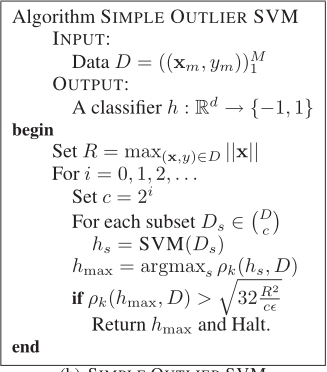
Figure 4: (a) Approximate maximum-margin learning with outlier noise. ρk(h,D) returns the margin of the example in D that is smaller than the margin of all but k examples (i.e. the k + 1-th smallest margin). (b) Simple algorithm. An alternate description of the algorithm that simply doubles the size of the sub-sample sets at each iteration.
expected coreset size. This provides an extremely simple polynomial-time algorithm for learning with noise.
Lemma 5.2 Let ρk = ρ(L(D \ Vk),D \ Vk) be the optimal margin for data set D of size M with k outliers. Given a parameter, ϵ, one can compute a separating hyperplane with margin (1 - ϵ)ρk on D \ Vk in polynomial time O(dT (c)M c+1 log M ), where c = O((R/ρk)2 /ϵ). and R = max(x,y)∈D ||x||.
Proof sketch:Because the clean data, D\Vk), contains a coreset of size c = O((R/ρk)2 /ϵ) from Lemma 3.1, it suffices to find this set and observe that there are at most k outliers. It is possible to examine all (Mc ) subsets of the input data. For each one, create the maximum margin hypothesis using an SVM black-box and measure the margin obtained by removing the k examples with minimum margin (or negative margin). Then, one of these hypotheses will have the maximum margin and have at most k outliers. Finally, since the margin is unknown a-priori, we must repeat the above procedure for exponentially decreasing guesses and stop once we see only k outliers with margin as large as the guess.
6 Structured Output Learning
Structured output learning is one of the most important new areas in machine learning. Structured output can be sequences, trees, rankings and general structures and are ubiquitous in important applications in areas from NLP to web search to biology. Machine learning have begun to address these problems. Here, we show a common modeling approach for structured output learning and highlight the connection to standard maximum margin learning.
Structured classifiers produce complex, structured output Y = Y 1 × . . . ×Y L, where Y l ∈ {1, . . . ,K}. It is common to write the decision rule as
where Φ(x, y) represents features of each (example, label) pair. Therefore, the maximum margin hypothesis (hyperplane) is
where
As a result, the algorithms and analysis presented in this paper extend to the structured output setting.
6.1 RelatedWork
Indeed, the SVM was recently extended to the structured output domain. SVM struct [THJA04] is an algorithm that runs in iterations, each time adding (x, y, y′ )-triples to the working set. Indeed, they use exactly the same Φ(x, y, y′ ) feature vector used here. Then, the working hypothesis is updated (in the dual) by optimizing over the Lagrange multipliers, similar to the Sequential Minimal Optimization (SMO) procedure introduced by Platt [Pla98]. They also show a bound of O( R2 ϵ2 ρ2 ) on the size of the working set.
7 Conclusions
In this paper, we give a simple coreset algorithm with an improved bound on the coreset size. We are mainly concerned with running time analysis of various algorithms. Using coresets, we give bounds for maximum margin active learning and structured output learning. We also formulate a novel and polynomial time algorithm for learning in the agnostic (noisy) setting. Coresets are a very general tool in approximation algorithms and we have shown that they have important uses in maximummargin learning and analysis. We think that this is the tip of the iceberg, and envision that coresets will find many more applications in machine learning.
@inproceedings{ijcai2007p134,
  title     = {Maximum Margin Coresets for Active and Noise Tolerant Learning},
  author    = {Har-Peled, Sariel and Roth, Dan and Zimak, Dav},
  booktitle = {Proceedings of the Twentieth International Joint Conference on
               Artificial Intelligence, {IJCAI-07}},
  publisher = {International Joint Conferences on Artificial Intelligence},
  editor    = {Manuela M. Veloso},
  pages     = {836--840},
  year      = {2007},
  url       = {https://ijcai.org/proceedings/2007/134},
}
TY - CPAPER TI - Maximum Margin Coresets for Active and Noise Tolerant Learning AU - Har-Peled, Sariel AU - Roth, Dan AU - Zimak, Dav T2 - Proceedings of the Twentieth International Joint Conference on Artificial Intelligence, IJCAI-07 PB - International Joint Conferences on Artificial Intelligence PY - 2007 SP - 836 EP - 840 UR - https://ijcai.org/proceedings/2007/134 ER -Copied
Machine-readable versions of this paper, for tools and AI agents:





