
Probabilistic Reasoning with Hierarchically Structured Variables
Proceedings of the Nineteenth International Joint Conference on Artificial Intelligence. Pages 1391-1396.
© 2005 International Joint Conferences on Artificial Intelligence
Abstract
Many practical problems have random variables with a large number of values that can be hierarchically structured into an abstraction tree of classes. This paper considers how to represent and exploit hierarchical structure in probabilistic reasoning. We represent the distribution for such variables by specifying, for each class, the probability distribution over its immediate subclasses. We represent the conditional probability distribution of any variable conditioned on hierarchical variables using inheritance. We present an approach for reasoning in Bayesian networks with hierarchically structured variables that dynamically constructs a flat Bayesian network, given some evidence and a query, by collapsing the hierarchies to include only those values necessary to answer the query. This can be done with a single pass over the network. We can answer the query from the flat Bayesian network using any standard probabilistic inference algorithm such as variable elimination or stochastic simulation. The domain size of the variables in the flat Bayesian network is independent of the size of the hierarchies; it depends on how many of the classes in the hierarchies are directly associated with the evidence and query. Thus, the representation is applicable even when the hierarchy is conceptually infinite.
- [Boutilier et al., 1996] C. Boutilier, N. Friedman, M. Gold- szmidt, and D. Koller. Context-specific independence in Bayesian networks. In Proceeding of Twelfth Conf. on Un- certainity in Artificial Intelligence (UAI-96), pages 115- 123, 1996.
- [Geiger et al., 1990] D. Geiger, T. Verma, and J. Pearl. d- separation: From theorems to algorithms. In Proceeding of Fifth Conf. on Uncertainity in Artificial Intelligence (UAI- 90), pages 139-148, 1990.
- [Gordon and Shortliffe, 1985] J. Gordon and E.H. Shortliffe. A method of managing evidential reasoning in a hierarchi- cal hypothesis space. Artificial Intelligence, 26:323-57, 1985.
- [Koller and Pfeffer, 1998] D. Koller and A. Pfeffer. Prob- abilistic frame-based systems. In Proceedings of the 15th National Conference on Artificial Intelligence (AAAI), pages 580-587, 1998.
- [Mackworth et al., 1985] A.K. Mackworth, J.A. Mulder, and W.S. Havens. Hierarchical arc consistency: exploiting structured domains in constraint satisfaction problems. In Computational Intelligence, volume 1(3), 1985.
- [Pearl, 1986] J. Pearl. On evidential reasoning in a hierarchy of hypotheses. Artificial Intelligence, 28:9-15, 1986.
- [Pearl, 1988] J. Pearl. Probabilistic reasoning in intelligent systems: networks of plausible inference. Morgan Kauf- mann Publishers Inc., 1988.
- [Shenoy and Shafer, 1986] P.P. Shenoy and G. Shafer. Prop- agating belief functions with local computations. IEEE Expert, 1:43-52, 1986.
- [Zhang and Poole, 1994] N.L. Zhang and D. Poole. A simple approach to Bayesian network computation. In Proc. of the 10th Candian Conference on Artificial Intelligence, 1994.
References were extracted automatically from the PDF and may contain errors.
Full text extracted automatically from the PDF; figures, tables and equations may differ. The PDF is the version of record.
1 Introduction
Many problem domains have discrete variables with a large number of values that can be represented a priori as an abstraction hierarchy (or an is-a hierarchy or taxonomic hierarchy) [Pearl, 1986; Mackworth et al., 1985]. We call these variables hierarchical variables. Taxonomic hierarchies allow us to manage effectively the large state space of a variable because they allow facts and regularities to be revealed both at high and low levels of abstraction. In taxonomic hierarchies the information from high-level abstractions are automatically inherited by more specific concepts. Abstraction hierarchies also allow us to answer more abstract queries. As an example of a hierarchical variable, consider a random variable LT that describes the species of living things. The large number of
David Poole
Department of Computer Science University of British Columbia http://www.cs.ubc.ca/spider/poole/ poole@cs.ubc.ca
values of LT (i.e., millions of species) can be classified according to Linnaean taxonomy hierarchy. 1 Living things are divided into kingdoms (e.g., plantae, animalia), classes (e.g., mammals, birds, fish), all the way down to species.
In this paper, we look at two related problems with hierarchical variables in Bayesian networks. The first is the compact representation of conditional probability distributions. The second is how to exploit that representation in probabilistic inference for computational gain. We assume that the tree hierarchy of the values is fixed and does not change with the context.
To compute a posterior probability, given some evidence in a Bayesian network that has both simple and hierarchical variables, we construct a flat Bayesian network by collapsing the hierarchies and including only those values necessary to answer the query. We can answer the query from the flat Bayesian network using any standard inference algorithm. The domain size of the variables in the flat Bayesian network is independent of the size of the hierarchies; it depends on how many of the classes in the hierarchy are directly associated with the evidence and query.
2 Hierarchical Variables
We divide the discrete random variables into two categories: simple variables and hierarchical variables. We call Bayesian networks that have both simple and hierarchical variables hierarchical Bayesian networks. 2 We use upper case letters to denote simple random variables (e.g., X1, X2, X) and the actual value of these variables by small letters (e.g., a, b, x1). The domain of X, written Val (X), is the set of values that X can take on.
A hierarchical variable is a variable in which subsets of the values of the variable are represented hierarchically in a tree [Pearl, 1986]. We refer to a node in the tree as a class. The nodes in the tree represent subsets of the values of the variable. The root of the tree represents the set of all the values of the variable. The children of a node correspond to a partitioning of the set of values of the node. Thus, the subsets represented by the children of a class must be mutually disjoint and any class represents the union of its children in the tree.
1 http : //www.wikipedia.org/wiki/Linnaean_taxonomy
2 The term hierarchical Bayesian network used in this paper is different than the term hierarchical Bayesian model used in statistics.
If a class Cj is a child of Ci, we say that Cj is an immediate subclass of Ci. The subclass relation is the symmetric transitive closure of the immediate subclass relation. That is, Cj is a subclass of Ci, writtenCj ≤ Ci, if Cj is a descendant of Ci in the abstraction hierarchy (or is Ci). The inverse of subclass is superclass. The conjunction of two classes Cj and Ck , written as Cj ∧Ck, denotes the set intersection of Cj and Ck. This is empty unless one is a superclass of the other.
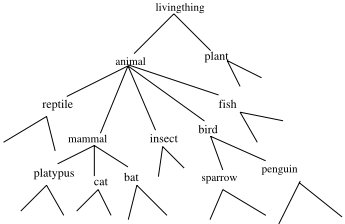
We denote the hierarchical variables using boldface uppercase letters (e.g., LT). For example, a part of the tree hierarchy of valuesof variableLTis shown inFigure1. tree(LT)denotes the tree hierarchy of LT.
3 Conditional Probabilities of Hierarchical Bayesian Networks
There are two main issues to be considered to represent hierarchical Bayesian networks:
- C1: specifying the conditional probability for hierarchical variables;
- C2: specifying howvariables are conditioned on hierarchical parents.
The simplest case of C1 is how to specify the prior probability of a hierarchical variable. The simplest case of C2 is how to specify the conditional probability of a simple variable conditioned on a hierarchical variable. The more complicated cases are built from these simpler cases.
3.1 Prior Probability for Hierarchical Variables
The prior probability of a hierarchical variable can be specified in a top-down manner. For each class that has subclasses, we specify a probability distribution over its immediate subclasses. For example, suppose we want to specify the prior over the hierarchical variable LT as shown in Figure 1. The root of the hierarchy is the class livingthing. We specify the probability distribution over its immediate subclasses:
P(plant|livingthing) = 0.6
We can specify the probability distribution over the immediate subclasses of animal. Suppose we have as part of this distribution:
P(mammal|animal) = 0.3 P(bird|animal) = 0.2, etc.
We can specify the probability of an immediate subclass of mammal given mammal, with probabilities such as:
We can compute the prior probability of any class in a recursive manner by multiplying the probability of class given its immediate superclass and the probability of its immediate superclass. The root has probability 1 (as it represents the set of all values). For example, given the probabilities as above, P(bat) can be computed as follows:
In this representation, computing the probability of any class is linear in the depth of the class in the hierarchy and otherwise is not a function of the hierarchy's size.
3.2 Hierarchical Variable Is the Parent of a Simple Variable
Suppose that H is a hierarchical variable, F is a simple variable, and H is the only parent of F. We can exploit any hierarchical structure by assuming that the influence on F is local in the hierarchy of H. To specify the conditional probability distribution (CPD) P(F|H) we use the notion of a default probability distribution. The default probability distribution of F for class Cj , written Pd(F|Cj), is assumed to be inherited by all subclasses of Cj, unless overridden by a more specific default probability distribution. We can represent P(F|H) by specifyingPd(F|Cj) for some classesCj in the hierarchy ofH. We call such classes Cj the exceptional classes of H. The idea of using "inheritance" with abstraction hierarchies is similar to the use of "context specific independence" for the compact representation of the CPTs in a Bayesian network [Boutilier et al., 1996].
To make this properly defined, we need to ensure that every terminal node in the tree hierarchy of H is covered by some default probability distribution. The union of all of the sets of values associated with the exceptional classes must equal Val(H). This condition holds trivially if the root class is an exceptional class for F. If the root class is not an exceptional class, there must be an exceptional class along every path from the root.
The conditional probability of F for any class Ck of H, P(F|Ck), can be computed as follows:
- if Ck does not have any exceptional subclasses, P(F|Ck) is inherited from the default probability distribution of F for the lowest exceptional superclass Cj of Ck. Thus,
- otherwise, P(F|Ck) can be derived from its children
Example: Consider a Bayesian network in which a hierarchical variable LT is the only parent of a simple variable FLYING with domain {flying, ¬flying}. To represent P(FLYING|LT), we need to define the default probability distributions over FLYING for the exceptional classes of LT. For example, we can state that livingthings have a low probability of flying by default, but bird and insect are exceptional because they have a high probability of flying. From the children of class mammal, a bat is exceptional because it has a high probability of flying. From the children of class bird, a penguin is exceptional because it has a very low probability of flying. Thus, to represent P(FLYING|LT) we could have:
Pd (flying|livingthing) = 0.00001 Pd (flying|bird) = 0.5 Pd (flying|bat) = 0.3 Pd (flying|penguin) = 0.000001 Pd (flying|insect) = 0.4Note that P(flying|livingthing) ̸ = 0.00001 as the class livingthing contains bird and bat that each have a much higher probability of flying.
3.3 The General Case
The general case is when a random variable (hierarchical or simple) can have any number and any kind of variables as parents. To represent the CPD of a hierarchical variable H conditioned on its parents, we assume that each class in the hierarchy of H has a probability distribution over its immediate subclasses that is conditioned on (some of) the parents of H. We can treat each of these classes as a simple variable. Thus, the problem of representing a (conditional) probability distribution over a hierarchical variable reduces to the problem of representing a (conditional) probability distribution over simple variables.
Let F be a simple variable that has both simple and hierarchical parents. Suppose pa s (F) denotes the simple parents of F and suppose pa h (F) denotes the hierarchical parents of F. Let X denote an assignment of a class to each hierarchical parent of F; we call X a parent context. X = ( c 1 x , . . . , c n x ) , where c i x is a class in the tree hierarchy of the i th hierarchical parent of F.
To represent P ( F|pa s (F) ∧ pa h (F) ) we specify the default probability distribution over F for different combinations of values for simple parents, pa s (F), and some parent contexts. The given parent contexts (parent contexts for which the default distribution over F has been defined) can be represented in a concept hierarchy Cp of partial ordering Cp = (Zp,≤), where Zp is the set of given parent contexts. A parent context X ∈ Zp is a super parent context of parent context Y, written Y ≤ X, if ∀i, c i y ≤ c i x . The conditional distribution over F for a parent context X is inherited from the default probability distribution of F for the 3 super parent context Z of X in Zp that is not overridden by a more specific default probability distribution of F for parent context Y such that X ≤ Y < Z.
Example: Consider the Bayesian network shown in Figure 2
3 We assume that there is only one most-specific super parent context. If there are more than one most-specific compatible parent contexts, with different default probability distributions, there must be a default distribution that disambiguates the two default distributions. We are thus forcing the user to disambiguate cases in which there would otherwise be a problem of multiple inheritance.
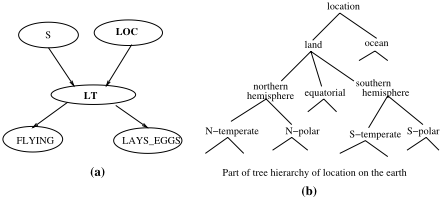
(a). The hierarchical variable LOC represents the location on earth. The simple variable S represents the season. Figure 2 (b) shows the part of the hierarchy of the location. We consider that S has only two values: (northern hemisphere) summer (May - October) and winter (November - April). The probability distribution of class animal of LT over its immediate subclasses can be conditioned on some of its parents. Suppose the distribution of class animal in the equatorial region is independent of season, so for parent context X = (equatorial) we could have a default distribution such as:
Pd (reptile|animal ∧ X) = 0.1 Pd (insect|animal ∧ X) = 0.4Pd(mammal|animal ∧ X) = 0.2, etc.
In the polar regions the distribution of class animal over its children depends on the season, so for parent context X = (N - polar) we could have a default distribution such as:
Pd (reptile|animal ∧ S = summer ∧ X) = 0.01 Pd (mammal|animal ∧ S = summer ∧ X) = 0.04Pd (insect|animal ∧ S = summer ∧ X) = 0.7, etc.
4 Construction of a Flat Bayesian Network
An observation about a hierarchical variable H can be positive or negative. An observation about H is positive when we observe that H is Cobs, where Cobs is a class in the hierarchy of H. This means that H has a value vh such that vh ∈ Cobs. An observation about H is negative when we observe that H is ¬Cobs. This means that H has a value vh such that vh ̸∈ Cobs. Without loss of generality, we can assume that there is always one positive observation about H, denoted by Cpos. For example, suppose we have two positive observations C1 and C2 about H. If classes C1 and C2 are disjoint then observations about H are not consistent. If C1 is a subclass of C2, C1∧C2 equals C1. If there are only negative observations about H, we assume root class is the positive observation. There can be multiple negative observations about H that are descendants of Cpos in the hierarchy of H.
We assume a query asks either for a distribution over a simple variable or for the probability of a particular class in a hierarchical variable.
Given some evidence (a set of observations) and a query, we construct a flat Bayesian network, B f , from a hierarchical Bayesian network B h by replacing each hierarchical variable with a simple variable whose domain includes only those values necessary to answer the query. The state space of a hierarchical variable H can be abstracted because, for a given problem, only certain classes of H are supported directly by the evidence or relevant to the query. To construct B f from B h given some evidence and a query, we traverse B h from the leaves upwards, prune those variables irrelevant to answer the query, and abstract the hierarchical variables. We abstract the hierarchical variables as part of a pass to remove variables that are irrelevant to the query. From the bottomup, you can recursively prune any variable that has no children and is not observed or queried [Geiger et al., 1990; Pearl, 1988] as well as abstract hierarchical variables when their children have been abstracted. We can then answer the query from the flat Bayesian network using any standard probabilistic inference algorithm.
4.1 Abstraction of Hierarchical Variables
Let H be a hierarchical variable with values Val(H). The abstraction of the domain of H, denoted by part(H), is a partition of Val(H). That is, part(H) is a set of subsets of Val(H) such that all sets in part(H) are mutually disjoint and the union of all the sets equals Val(H). We refer to a set in part(H) as an abstract value of H. An abstraction of hierarchical variable H, denoted by H a , is a simple variable with domain Val(H a ) = part(H).
4.2 Finding a SafeAbstraction
In this section we describe a simple algorithm Flat_Bayes for constructing a flat Bayesian network B f from a hierarchical Bayesian network B h given some evidence and a query. A safe abstraction has the same posterior distribution over the query variable in B f as in B h . To develop a safe abstraction for efficient inference, the following constraints are followed in Flat_Bayes: 1. For every evidence or query, there must be an abstract value that directly associates with that evidence/query and conveys its effect. 2. All abstract values must be mutually disjoint and exclusive. The algorithm Flat_Bayes consists of three phases:
Phase0:
If a query asks for the probability of a particular class in hierarchical variable H, we create an extra binary child Q of H, which is true exactly when the query is true (i.e., Pd(Q = true|Croot) = 0 and Pd(Q = true|Cq) = 1, where Croot is the root class and Cq is the query class in the tree hierarchy of H). The variable Q has the same probability as the query class. We thus reduce the problem to one of computing the probability of a simple variable.
Phase1: Abstract
In this phase Flat_Bayes traverses B h from the leaves upwards. It prunes a variable that is not queried or observed and does not have any children [Geiger et al., 1990; Pearl, 1988]. For each unpruned hierarchical variable H, the algorithm computes its abstraction H a as follows:
Case1: H is not observed
The hierarchical variable H can be a parent of several simple variables. 4 We need to find the exceptional classes Ck of H
4 Note that because of the bottom-up nature of the algorithm, H can only have simple children at this stage of the algorithm.
with respect to each of these children (i.e., classes that are associated with the evidence or the query). The domain of H a is the set of non-empty abstract values for each exceptional class. The algorithm computes the abstract value, v a , for every exceptional class Ck as follows:
- v a = Ck, if Ck does not have any exceptional strict subclasses.
- Otherwise, v a = Ck -C1 - . . . -Cm, where C1, . . . , Cm are the highest exceptional strict subclasses of Ck. This set difference represents the set of all of the values that are in Ck and are not covered by other abstract values.
The abstract values that are empty are removed from the domain of H a . To recursively abstract the parents of H, the algorithm finds those strict super classes of the exceptional classes Ck , which are affected by H's parents.
Case2: H is observed
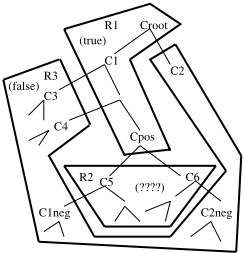
The observations about H divide its tree hierarchy into three regions R1, R2, and R3. R1 includes the classes that are true for the observation (superclasses of Cpos), R2 includes the classes that we know nothing about, and R3 includes the classes that we know are false. For example, suppose we have one positive (Cpos) and two negative (C1neg, C2neg) observations about H as shown in Figure 3. The regions R1, R2, and R3 are shown by the bold lines in Figure 3. We do not need to distinguish between the values of H that we know are false. The values of H can be partitioned into two disjoint and exclusive subsets: one (vfalse) corresponds to all the values that are false and another (vnotknow) corresponds to all the values we know nothing about. Thus,
If H also has children, we need to partition its abstract value vnotknow into subsets based on the evidence from its children. We need to find the exceptional classes Ck of H with respect to its children that are in region R2 in the hierarchy of H. We can compute the abstract value vo a that corresponds to each exceptional class Ck in the same way as described in Case1, but we need to remove all the false values. Thus,
vo a = v a - {negative observations that are subclasses ofCk}
Let vo a 1 , . . . , vo a k be the non-empty abstract values that correspond to exceptional classes Ck. Let vr = vo a 1 ∪ . . . ∪ vo a k . Then, Val(H a ) = { vo a 1 , . . . , vo a k , vnotknow - vr , vfalse }
To recursively abstract the parents of H, the algorithm finds those strict super classes of exceptional classes Ck and Cpos that are affected by H's parents.
Phase2: Construct tables
The algorithm constructs the CPT for variables X a of a flat network. Let pa a (X a ) denote the abstracted parents of X a . We compute P(X a = v a |pa s (X a ) = Vs ∧ pa a (X a ) = V) for each value v a of X a and for each assignment Vs of pa s (X a ) and V of pa a (X a ) for the following two cases:
Case1: X a is not abstracted but it has abstracted parents As discussed in Section 3.3, P(X a = v a |pa s (X a ) = Vs ∧ pa a (X a ) = V) is inherited from the default distribution of X a for the parent context C, C ∈ Zp, V ≤ C and ̸ ∃Y ∈ Zp such that V ≤ Y < C, where Zp is the set of parent contexts for which the default distribution of X a has been defined.
Case2: X a is an abstracted variable
As discussed in Section 3.1, to compute P(Ck|Delta1) we need the probability distribution of all the super classes of Ck over their immediate subclasses for parent context V. As discussed in Section 3.3, we can treat each of these classes as a simple variable. Thus, the probability distribution of a class over its immediate subclasses for parent context V can be computed in the same way as described in Case1.
The evidence for observed hierarchical variable H is translated into the corresponding abstract variable H a of B f . The evidence Eh for H a inB f is the disjunction of all those abstract values of H that are not false for the observation.
The domain size of the variables in B f is independent of the size of the hierarchies; it depends on how many classes in their hierarchy are exceptional with respect to their relevant 5 children in B h . The running time to construct B f depends on both the depth and number of the exceptional classes. After constructing B f we can answer the query from B f using any standard probabilistic inference algorithm, for example, variable elimination algorithm [Zhang and Poole, 1994] or stochastic simulation.
4.3 Correctness of Flat Bayesian Network
Let B h be a hierarchical Bayesian network that has n discrete random variables, X = {X1, . . . , Xn}, and we want to answer some probabilistic query, P (Q|E), where Q, E ⊆ X. Q denotes the query variables. We observed that E is in the set e, e ⊆ domain(E), E ∈ e is the evidence. From B h we can recursively prune any variable that has no children, and is not observed or queried [Geiger et al., 1990; Pearl, 1988].
5 Variables irrelevant to the query are pruned by Flat_Bayes.
Let X1, . . . , Xs be the non-query non-observed random variables of B h . pa(Xi) denotes the parents of variable Xi. The marginal P(Q ∧ E) can be computed as follows:
Lemma 4.1 The posterior probability P(Q|E) computed from a Bayesian network after replacing its variables Xk by their abstractions X a k is the same as if it is computed without replacing Xk, if the X a k are constructed from the partitions part(Xk) that have the following property :
Proof Sketch Summing over all the values of Xk is equivalent to summing over the partition of the values of Xk. Thus,
If (1) is true, we can distribute the product out of the innermost sum from the RHS of the above equality, leaving the term ∑v∈V P(Xk = v|pa(Xk )), which is equal to P(V |pa(Xk )). Thus (2) is equal to
It is straightforward to incorporate evidence E and query Q into the proof.
Lemma 4.2 The algorithm Flat_Bayes partitions the values of the hierarchical variables Xk of B h such that all its children satisfies the Equation (1).
Proof Sketch Let part(Xk) denote the abstraction of the domain of hierarchical variable Xk computed by Flat_Bayes. X a k denotes the abstraction of Xk. If Xk is observed, Flat_Bayes removes a set V, V ∈ part(Xk), such that all values in V are false. Flat_Bayes constructs the conditional probability tables for variables X a k of a flat Bayesian network using "inheritance" for the following two cases:
Case1: X a k is not abstracted but some of its parents are
As discussed in Phase2, P(X a k = v a |pa s (X a k ) = Vs ∧ pa a (X a k ) = V), V ∈ part(pa h (Xk)), is inherited from the default distribution of X a k for the parent context C ∈ Zp, V ≤ C and ̸ ∃Y ∈ Zp such that V ≤ Y < C. Thus, ∀v ∈ V, P(X a k |pa s (X a k ) = Vs ∧ pa a (X a k ) = v) = Pd(Xk|pa s (Xk) = Vs ∧ C). This implies Equation (1).
Case2: X a k is abstracted
As discussed in Phase2, to compute P(X a k = v a |pa s (X a k ) = Vs ∧ pa a (X a k ) = V) we need the conditional distribution of classes Cj, Cj ∈ tree(Xk), over their immediate subclasses. We can treat a class Cj, Cj ∈ tree(Xk), as a simple variable. Thus, the proof follows fromCase1.
Theorem 4.1 The posterior probability P(Q|E) computed from a flat Bayesian network as constructed by Flat_Bayes is equal to the posterior probability computed from a hierarchical Bayesian network.
Proof Sketch The theorem follows fromLemmas 4.1 and 4.2.
5 Experiments
We implement our Flat_Bayes algorithm on top of the variable elimination (VE) algorithm, we call it Flat_Bayes + VE. To get an idea of the performance of Flat_Bayes+VE compared to VE, we investigate how the performance of both algorithms vary with the number of hierarchical variables in the Bayesian network, with the depth of the tree hierarchies of the hierarchical variables, and with the depth of the exceptional classes.
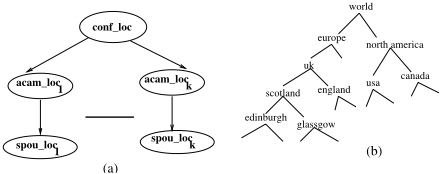
To test the algorithms, we consider a simple conference domain. In this domain, the location of an academic is influenced by the location of the conference and the location of the spouse of the academic is influenced by the location of the academic. Let there be k academics. We assume that the locations of the different academics are not independent; they depend on the conference location. We consider that all location variables (conference location or person locations) have the same domain and are hierarchical variables. The Bayesian network representation of this domain is shown in Figure 4 (a). The part of the tree hierarchy for the location is shown in Figure 4 (b). Here we have 2k + 1 hierarchical random variables. The hierarchical random variable conf_loc denotes the conference location. The hierarchical random variables acam_loc1, . . . , acam_lock denote the locations of the academics, and spou_loc1, . . . , spou_lock denote the locations of their spouses respectively.
To specify the conditional probability P(acam_lock|conf_loc), we need to specify the default distribution of each class in the hierarchy of acam_lock over its immediate subclasses for some parent contexts (for some classes in the hierarchy of conf_loc). We assume the conference location influences each academic's location very locally; we need to specify the default distribution of the classes over their immediate subclasses for very few parent contexts.
Example: Suppose we know that the academic is in the UK but don't know whether he is in Scotland, Wales or England. Now, knowing that the conference is taking place in the UK but not where in the UK, doesn't provide us any information about the location of the academic in the UK. However, if we know that the conference is taking place somewhere in Scotland, we can state that there is a high probability that the academic is in Scotland. We assume that knowing the conference location in Scotland (e.g., in Edinburgh), doesn't provide us any extra information about where they may be if not in Scotland. Thus, we could have a default probability distribution of the class uk in the hierarchy of acam_lock over its immediate subclasses conditioned on conf_loc such as:
Pd (scotland|uk ∧ conf_loc = scotland) = 0.8
Pd (scotland|uk ∧ conf_loc = england) = 0.3
Pd (scotland|uk ∧ conf_loc = world) = 0.4
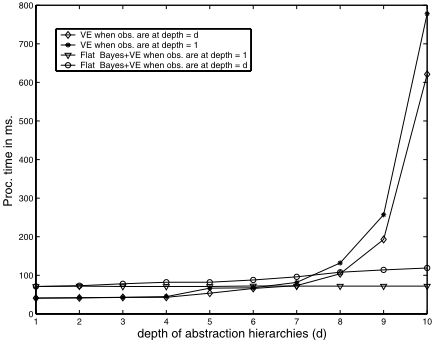
For the experiments, we observe the locations of the spouses and we want to compute where the conference is taking place. To determine how the inference time depends on the number of hierarchical variables, we vary k from 1 to 8. We represent the abstraction hierarchy of all location variables by a binary tree of depth d where d is a parameter. To determine how inference time depends on the depth of the hierarchy (d) we vary d from 1 to 10 with a step of 1. To determine how the inference time depends on the depth of the exceptional classes, for each value of d we vary the depth of the observation for the observed variables from 1 to d. We compute the posterior distribution of conf_loc by applying only VE and Flat_Bayes + VE.
Figure 5 shows the average inference time of both VE and Flat_Bayes + VE for the belief network that has only 2 academics as a function of the depth of the tree, and depth of the observations. Figure 6 shows the average inference time of both VE and Flat_Bayes + VE as a function of the number of academics and the depth of observations; here we consider the depth of the hierarchy is 8. Figure 5 shows that the inference time for Flat_Bayes +VE doesn't depend on the depth of the hierarchy but increases linearly as the depth of the observations increases. This increase is because the depth of the observations for spou_lock variables changes the depth and the number of exceptional classes for acam_lock and conf_loc.
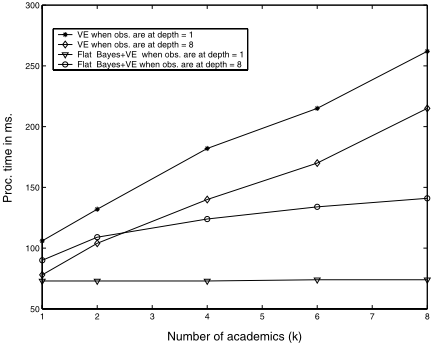
Note that VE takes less time as the depth of observation increases. This is because the domain of spou_lock variable reduces as the depth of the observation increases. The results shown in Figures 5 and 6 give us some indication of the overhead of constructing a flat Bayesian network and cases in which it may be more effective to use it rather than VE alone.
6 RelatedWork
There is very limited work on combining taxonomic hierarchies and probabilistic reasoning. The problem of evidential reasoning in a taxonomic hierarchy of hypotheses was first studied by Gordon and Shortliffe [1985] using the DempsterShafer (D-S) theory. Shenoy and Shafer [1986] improved the algorithm proposed by Gordon and Shortliffe and showed that belief functions can be propagated using local computations. Pearl [1986] provides a method for the same problem using Bayesian formalism. In all of these, a very restricted naive Bayes classifier network form was considered. In this paper we concentrate on general Bayesian networks that have both hierarchical and simple variables. Pearl's method involves traversing the whole hierarchy for each observation. We show in this paper that we do not need to do this. In more recent work, Koller and Pfeffer [1998] describe a representation language for combining frame-representation systems and Bayesian networks for representing complex structured domains. They are looking at different aspects of the problem, concentrating on multiple objects, combining first-order logic representation with probabilities.
7 Conclusion
Having the values of a variable hierarchically structured can make reasoning more efficient than reasoning over the set of all values. We show how, given a query and observations, we can dynamically construct a flat Bayesian network from the given hierarchical Bayesian network that can be used in any standard probabilistic inference algorithm. The size of the flat network is independent of the size of the hierarchies; it depends on how many of the classes in the hierarchy are exceptional with respect to children that are observed or have observed descendants in a Bayesian network. Thus it is possible to have hierarchical variables with unbounded or infinite domains. For example, with a spatial hierarchy, as long as we have a way to compute the probability distribution over subclasses, there is no reason not to have a hierarchy that is infinitely detailed. It is only when we ask a query of a class or make observations that we need to restrict the size of the hierarchy.
Acknowledgments
This work was supported by NSERC Discovery Grant OGPOO44121. Thanks to Valerie McRae, Mark Crowley and Ben D'Andrea for proofreading.
@inproceedings{ijcai2005p64,
  title     = {Probabilistic Reasoning with Hierarchically Structured Variables},
  author    = {Sharma, Rita and Poole, David},
  booktitle = {Proceedings of the Nineteenth International Joint Conference on
               Artificial Intelligence, {IJCAI-05}},
  publisher = {International Joint Conferences on Artificial Intelligence},
  editor    = {Leslie Pack Kaelbling and Alessandro Saffiotti},
  pages     = {1391--1396},
  year      = {2005},
  url       = {https://ijcai.org/proceedings/2005/64},
}
TY - CPAPER TI - Probabilistic Reasoning with Hierarchically Structured Variables AU - Sharma, Rita AU - Poole, David T2 - Proceedings of the Nineteenth International Joint Conference on Artificial Intelligence, IJCAI-05 PB - International Joint Conferences on Artificial Intelligence PY - 2005 SP - 1391 EP - 1396 UR - https://ijcai.org/proceedings/2005/64 ER -Copied
Machine-readable versions of this paper, for tools and AI agents:





