
Using AI and simulations to design and control space habitats
Proceedings of the Nineteenth International Joint Conference on Artificial Intelligence. Pages 1507-1507.
© 2005 International Joint Conferences on Artificial Intelligence
Abstract
This paper describes a dynamic simulation of a space habitat. The simulation is configurable and controllable via external programs. Several groups have been using the simulation to study the impact of artificial intelligence tools on space habitat design and control. We outline some of the AI challenges and invite the AI community to use our simulation to further NASA’s exploration goals.
- [Biswas et al., 2004] Gautam Biswas, Eric Jan Manders, John Ramirez, Nagabhusan Mahadevan, and Sherif Able- wahed. Online model-based diagnosis to support au- tonomous operation of an advanced life support system. Habitation: International Journal for Human Support Re- search, 10(1), 2004.
- [Bonasso et al., 2003] R. Peter Bonasso, David Kortenkamp, and Carroll Thronesbery. Intelligent control of a water re- covery system. AI Magazine, 24(1), 2003.
- [Klein et al., 2004] Theresa Klein, Devika Subramanian, David Kortenkamp, and Scott Bell. Using reinforcement learning to control life support systems. In Proceedings In- ternational Conference on Environmental Systems, 2004.
- [Kortenkamp and Bell, 2003] David Kortenkamp and Scott Bell. Simulating advanced life support systems for in- tegrated controls research. In Proceedings International Conference on Environmental Systems, 2003.
- [Kortenkamp et al., 2005] David Kortenkamp, Scott Bell, and Luis Rodriguez. Simulating lunar habitats and activ- ities to derive system requirements. In Proceedings 1st AIAA Space Exploration Conference, 2005.
- [Muscettola et al., 2005] Nicola Muscettola, Charles Fry, David Kortenkamp, and Scott Bell. Planner-based control of advanced life support systems. In to appear in Proceed- ings International Conference on Environmental Systems, 2005. [National Aeronautics and Space Administration, 2004 ] National Aeronautics and Space Administration. Ex- ploration systems interim strategy. Technical Report NP-2004-07-362-HQ, NASA Headquarters, 2004.
- [Wu and Garibay, 2004] Annie S. Wu and Ivan I Garibay. Genetic algorithm optimization of life support system con- trol. IEEE Transactions on Systems, Man, and Cybernet- ics, 34(3), 2004.
References were extracted automatically from the PDF and may contain errors.
Full text extracted automatically from the PDF; figures, tables and equations may differ. The PDF is the version of record.
1 Introduction
NASA has embarked on a new exploration strategy that will return people to the moon and eventually to Mars [National Aeronautics and Space Administration, 2004]. Two key aspects of this strategy are sustainability and autonomy. The former means that these will not be single-shot missions, but a continued, evolving presence by humans outside of lowearth orbit. The latter means that the missions will be more self-reliant and less dependent on a standing army of earthbased controllers. Achieving both of these aspects requires significant advances in intelligent software systems. In this paper we present an integrated simulation of a space habitat that allows for testing of artificial intelligence approaches.
1.1 Space habitats
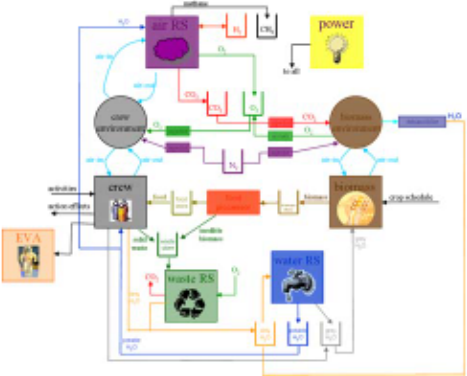
The function of a space habitat is to provide a livable environment to the crew. A typical space habitat will have subsystems that provide oxygen and remove carbon dioxide; that provide potable water; that provide food; that remove solid waste; and that provide power. In addition, a biomass subsystem may supply crops that can be turned into food and also help with other life support functions. Figure 1 shows such a habitat configuration. Many of the subsystems impact each other creating complex interactions and dependencies. Since the cost of placing materials on a lunar or planetary surface is so high, minimizing the consumables required to provide life support functions is important. Recycling or regenerating resources, often achieved by using biological-based subsystems, adds additional complexity but reduces overall habitat mass. In the next section we present a dynamic simulation of such an integrated, closed habitat system.
2 BioSim
BioSim is a discrete-event simulation of a space habitat [Kortenkamp and Bell, 2003]. Each of the life support components of a habitat are modeled as processes that consume certain resources and produce other resources. For example, the water recovery system model consumes dirty water and power and produces potable water. Crew members are also modeled - they consume and produce resources just as other life support components. All of the components, including crew members and crops, if any, exist in one or several environments that consists of a volume of mixed gases. Figure 1 shows the different models that compose our simulation and the resources that pass between the models. BioSim is implemented in Java.
2.1 Configuring BioSim
BioSim can be configured to simulate a wide variety of different habitats. This includes the number, genders and ages of crew members, the size of the habitat environments, atmospheric pressure, capacities of tanks, initial levels of consumables, processing capacity of life support modules and many other variables. Initial setup is configured via an XML file that is read in when BioSim is started.
2.2 Controlling BioSim
BioSim has sensors and actuators that connect to various controllable elements and allow for real-time control. Sensors read simulation values, such as oxygen levels in the environment. Actuators set flow-rates of resources between components. Higher level actuators control more abstract variables such as the crew schedule, extravehicular activities (EVAs), crop harvesting, crop planting and equipment maintenance. Crop management is a particular focus in BioSim and up to nine different crops can be planted and harvested. Each has their own model for oxygen production, carbon dioxide consumption, water consumption and food production. Sensors and actuators are accessible via CORBA method calls so that control programs can be created in most programming languages and connected as clients to the BioSim server. We have defined BioSim control methods that let you advance BioSim in one hour increments or advance BioSim until the mission has ended. Malfunctions can be injected into any of the components of BioSim at any time.
3 Habitat design
One use of artificial intelligence tools is in the design of an optimal habitat for a specific exploration mission. As an example, let's take a 90 day lunar mission with a crew of four and one eight hour EVA per day. The goal is to find an optimal habitat configuration that meets those mission objectives, i.e., provides sufficient life support to the crew. A habitat configuration includes sizing each of the life support components (e.g., water processing, air processing, crops, power, etc.), sizing tank capacities, deciding on initial levels of consumables, sizing the air volume of the crew habitat, etc. An optimal configuration is defined as one that meets the mission goals with minimum mass. We have defined mass values for all of the variables in a habitat configuration. Essentially, this is a search through a large space of possible habitat designs to find an optimal solution. Many artificial intelligence search techniques would be applicable, including genetic algorithms and reinforcement learning. Several groups are already using BioSim to experiment in this area [Kortenkamp et al., 2005; Wu and Garibay, 2004].
4 Habitat control
A second use of artificial intelligence tools is the control of the habitat. That is, given a predefined habitat configuration develop a control policy that optimizes resource utilization and reduces buffer sizes. The control policy adjusts resource flow rates, crew schedules, crop planting and harvesting schedules and EVA schedules to meet mission objectives with minimum resource utilization. Habitat control will involve dealing with real-time control issues such as water production, air production, etc. as well as planning and scheduling around time and resource constraints. Several groups are looking at different approaches to this problem [Bonasso et al., 2003; Muscettola et al., 2005; Klein et al., 2004]. Habitat control also involves diagnosing faults in the habitat and devising a recovery strategy. Gautam Biswas at Vanderbilt has been using BioSim to test modelbased approaches to fault diagnosis [Biswas et al., 2004]. Another research area is distributed control, for example, determining whether market-based approaches are valid for habitat control and finding what advantages they provide. Distributed control architecture will need to look at integration of control across the various subsystems of the habitat and integration of different artificial intelligence techniques.
5 Conclusion
With a renewed mission to head back to the moon and then to Mars, NASA needs the artificial intelligence community's help in achieving its exploration mission objectives in a cost effective and safe manner. BioSim provides a portable testbed for researchers to test their ideas and demonstrate relevance to NASA. BioSim also provides a baseline in which a standardized set of configurations, malfunctions and metrics can be established and used to compare control approaches. BioSim can be obtained from http://www.traclabs.com/biosim.
@inproceedings{ijcai2005p320,
  title     = {Using AI and simulations to design and control space habitats},
  author    = {Kortenkamp, David and Bell, Scott},
  booktitle = {Proceedings of the Nineteenth International Joint Conference on
               Artificial Intelligence, {IJCAI-05}},
  publisher = {International Joint Conferences on Artificial Intelligence},
  editor    = {Leslie Pack Kaelbling and Alessandro Saffiotti},
  pages     = {1507--1507},
  year      = {2005},
  url       = {https://ijcai.org/proceedings/2005/320},
}
TY - CPAPER TI - Using AI and simulations to design and control space habitats AU - Kortenkamp, David AU - Bell, Scott T2 - Proceedings of the Nineteenth International Joint Conference on Artificial Intelligence, IJCAI-05 PB - International Joint Conferences on Artificial Intelligence PY - 2005 SP - 1507 EP - 1507 UR - https://ijcai.org/proceedings/2005/320 ER -Copied
Machine-readable versions of this paper, for tools and AI agents:





