
Collective Object Identification
Proceedings of the Nineteenth International Joint Conference on Artificial Intelligence. Pages 1636-1636.
© 2005 International Joint Conferences on Artificial Intelligence
Abstract
- [Collins, 2002] M. Collins. Discriminative training methods for hidden Markov models: Theory and experiments with perceptron algorithms. In Proc. EMNLP-02, pages 1-8, 2002.
- [Fellegi and Sunter, 1969] I. Fellegi and A. Sunter. A theory for record linkage. Journal of the American Statistical Association, 64:1183-1210, 1969.
- [Greig et al., 1989] D. M. Greig, B. T. Porteous, and A. H. Seheult. Exact maximum a posteriori estimation for binary images. Jour- nal of the Royal Statistical Society, Series B, 51:271-279, 1989.
- [Lafferty et al., 2001] J. Lafferty, A. McCallum, and F. Pereira. Conditional random fields: Probabilistic models for segmenting and labeling sequence data. In Proc. 18th ICML, pages 282-289, 2001.
References were extracted automatically from the PDF and may contain errors.
Full text extracted automatically from the PDF; figures, tables and equations may differ. The PDF is the version of record.
Collective Object Identi�cation
Parag Singla Pedro Domingos
Seattle, WA 98195-2350, U.S.A.
Department of Computer Science and Engineering University of Washington
{parag, pedrod}@cs.washington.edu
In many domains, the objects of interest are not uniquely identi�ed, and the problem arises of determining which observations correspond to the same object. For example, in information extraction and NLP we need to determine which noun phrases refer to the same entity. When merging multiple databases, a problem of keen interest to many large scienti�c projects, businesses, and government agencies, we need to determine which records represent the same entity and should therefore be merged. This problem, �rst placed on a �rm statistical footing by Fellegi and Sunter [1969], is known by the name of object identi�cation, record linkage, de-duplication and others. Most approaches described to solve this problem are variants of the original Fellegi-Sunter model, in which object identi�cation is viewed as a classi�cation problem: given a vector of similarity scores between the attributes of two observations, classify it as �Match� or �Non-match.� A separate match decision is made for each candidate pair, followed by transitive closure to eliminate inconsistencies. Typically, a logistic regression model is used. We call this the standard model.
Making match decisions separately ignores that information gleaned from one match decision may be useful in others. For example, if we �nd that a paper appearing in Proc. IJCAI03 is the same as a paper appearing in Proc. 18th IJCAI, this implies that these two strings refer to the same venue, which in turn can help match other pairs of IJCAI papers. In this paper, we propose an approach which accomplishes this propagation of information. Our approach makes decisions collectively, performing simultaneous inference for all candidate match pairs, and allowing information to propagate from one candidate match to another via the attributes (or �elds) they have in common. Our model is based on conditional random �elds [Lafferty et al., 2001]. We call our model the collective model. Figure 1(a) shows a four-record bibliography database and 1(b) shows the corresponding graphical representation for the candidate pairs (b1, b2) and (b3, b4) in the collective model. There are three types of nodes in the �gure. Record-match nodes are Boolean-valued and they correspond to asking the question �Is record bi the same as record bj?� Field-match nodes are also Boolean-valued and they correspond to asking the question �Do �eld values bi.F and bj .F , for the �eld F, represent the same underlying property?� Field-similarity nodes are real-valued nodes taking values in the domain [0, 1] and they encode how similar two �eld values are, according to a pre-de�ned similarity measure. The values of these nodes can be directly computed from data, and hence they are also called the evidence nodes. Intuitively, an edge between two nodes represents the fact their values directly in�uence each other. Note how dependencies �ow through the shared �eld-match node corresponding to the venue �eld. Inferring that b1 and b2 refer to the same underlying paper will lead to the inference that the corresponding venue strings �Proc. IJCAI-03� and �Proc. 18th IJCAI� refer to the same underlying venue, which in turn might provide suf�cient evidence to merge b3 and b4. In general, our model can capture complex interactions between candidate pair decisions, potentially leading to better object identi�cation.
| Record | Title | Author | Venue |
|---|---|---|---|
| b1 | Object Identification using CRFs | Linda Stewart | Proc. AAAI-05 |
| b2 | Object Identification using CRFs | Linda Stewart | Proc. 20th AAAI |
| b3 | Learning Boolean Formulas | Bill Johnson | Proc. AAAI-05 |
| b4 | Learning of Boolean Expressions | William Johnson | Proc. 20th AAAI |
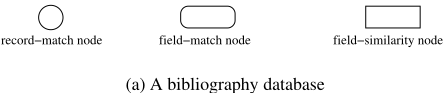
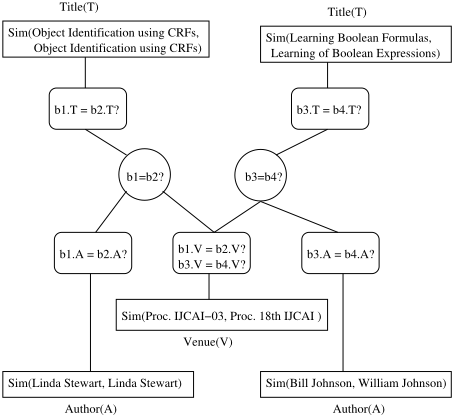
Figure 1: Example of collective object identi�cation. For clarity, we have omitted the edges linking the record-match nodes to the corresponding �eld-similarity nodes.
For random �elds where maximum clique size is two and all non-evidence nodes are Boolean, the inference problem can be reduced to a graph min-cut problem, provided certain constraints on the parameters are satis�ed [Greig et al., 1989]. Our formulation of the problem satis�es these constraints. Since min-cut can be solved exactly in polynomial time, we have a polynomial-time exact inference algorithm for our model. We follow the standard approach of gradient descent to learn the parameters. Calculating the exact derivative is intractable as it involves an expectation over an exponential number of con�gurations. We use a voted perceptron algorithm [Collins, 2002], which approximates this expectation by the feature counts of the most likely con�guration, which we �nd using our polynomial-time inference algorithm with the current parameters.
Combining models is often a simple way to improve accuracy. We combine the standard and collective models using logistic regression. For each record-match node in the training set, we form a data point with the outputs of the two models as predictors, and the true value of the node as the response variable. We then apply logistic regression to this dataset. Notice that this still yields a conditional random�eld.
We performed experiments on real and semi-arti�cial databases, comparing the performance of (a) the standard Fellegi-Sunter model using logistic regression, (b) the collective model, and (c) the combined model.
The �rst set of experiments was on Cora database, which is a collection of 1295 different citations to computer science research papers. We cleaned it up by correcting some labels and �lling in missing values. This cleaned version contains references to 132 different research papers. We used the author, venue, and title �elds. The second set of experiments was done on the BibServ.org database, which is the result of merging citation databases donated by its users, Citeseer, and DBLP. We experimented on the user-donated subset of BibServ, which contains 21,805 citations. Table 1 reports the results for these databases. The combined model gives the best performance on both Cora and BibServ, followed by the collective model. Transitive closure helps these on Cora but hurts all models on BibServ (where recall was close to 100% even without transitive closure). The best combined model outperforms the best standard model in F-measure by about 2% on Cora and 3% on BibServ.
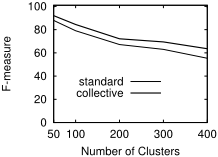
To further observe the behavior of the algorithms, we generated variants of the Cora database by taking distinct �eld values from the original database and randomly combining them to generate distinct papers. Figures 2(a) and 2(b) compare the performance of the collective and standard models as number of clusters and level of distortion in the data are
| Model | Cora | BibServ | ||
|---|---|---|---|---|
| Before | After | Before | After | |
| Standard | 86.9% | 84.7% | 82.7% | 68.5% |
| Collective | 87.4% | 88.9% | 82.8% | 73.6% |
| Combined | 85.8% | 89.0% | 85.6% | 76.0% |
- (a) F-measure vs. number of clusters
- (b) F-measure vs. distortion level
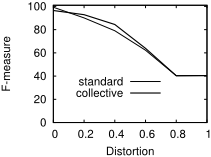
Figure 2: Experimental results on semi-arti�cial data.
varied, respectively. 1 The collective model clearly dominates the standard model over a broad range of number of clusters and level of distortion.
In summary, determining which observations correspond to the same object is a key problem in information integration, citation matching, natural language, vision, and other areas. We have developed a collective approach to this problem, where information propagates among related decisions via shared �eld values, and shown experimentally that it outperforms the standard one of making decisions independently.
Acknowledgments
This research was partly supported by ONR grant N0001402-1-0408, by a gift from the Ford Motor Co., and by a Sloan Fellowship awarded to the second author.
@inproceedings{ijcai2005p315,
  title     = {Collective Object Identification},
  author    = {Singla, Parag and Domingos, Pedro M.},
  booktitle = {Proceedings of the Nineteenth International Joint Conference on
               Artificial Intelligence, {IJCAI-05}},
  publisher = {International Joint Conferences on Artificial Intelligence},
  editor    = {Leslie Pack Kaelbling and Alessandro Saffiotti},
  pages     = {1636--1636},
  year      = {2005},
  url       = {https://ijcai.org/proceedings/2005/315},
}
TY - CPAPER TI - Collective Object Identification AU - Singla, Parag AU - Domingos, Pedro M. T2 - Proceedings of the Nineteenth International Joint Conference on Artificial Intelligence, IJCAI-05 PB - International Joint Conferences on Artificial Intelligence PY - 2005 SP - 1636 EP - 1636 UR - https://ijcai.org/proceedings/2005/315 ER -Copied
Machine-readable versions of this paper, for tools and AI agents:
 Welcome
 Future Conferences
 AI Journal Division
 IJCAI Proceedings
 About IJCAI
 IJCAI Awards