
It’s About Time
Proceedings of the Nineteenth International Joint Conference on Artificial Intelligence. Pages 1511-1511.
© 2005 International Joint Conferences on Artificial Intelligence
Abstract
- [Dennett and Kinsbourne, 1992] Daniel C. Dennett and Mar- cel Kinsbourne. Time and the observer: The where and when of consciousness in the brain. Behavioral and Brain Sciences, 15(2):183-247, 1992.
- [Dennett, 1991] Daniel C. Dennett. Consciousness Ex- plained. Penguin, London, 1991.
- [Geldard and Sherrick, 1972] F. A. Geldard and C. E. Sher- rick. The cutaneous 'rabbit': A perceptual illusion. Sci- ence, 178:178-179, 1972.
- [Geldard, 1977] F. A. Geldard. Cutaneous stimulis, vibra- tory and saltatory. Journal of Investigative Dermatology, 69:83-87, 1977.
- [Kieras and Meyer, 1997] David E. Kieras and David E. Meyer. An overview of the EPIC architecture for cognition and performance with application to human-computer in- teraction. Human-Computer Interaction, 12(4):391-438, 1997.
- [Kinsbourne, 1994] Marcel Kinsbourne. Models of con- sciousness: Serial or parallel in the brain? In M. S. Gaz- zaniga, editor, The Cognitive Neurosciences, pages 1321- 1330. MIT Press, Cambridge, MA, 1994.
- [Kolers and von Grünau, 1976] P. A. Kolers and M. von Grünau. Shape and color in apparent motion. Vision Re- search, 16:329-335, 1976.
- [Libet, 1985] Benjamin Libet. Unconscious cerebral initia- tive and the role of conscious will in voluntary action. Be- havioral and Brain Sciences, 8:529-566, 1985.
- [Mitchell, 1993] Melanie Mitchell. Analogy-Making as Per- ception: a computer model. MIT Press, Cambridge, MA, 1993.
References were extracted automatically from the PDF and may contain errors.
Full text extracted automatically from the PDF; figures, tables and equations may differ. The PDF is the version of record.
1 Introduction
A number of experimental studies, e.g., [Geldard and Sherrick, 1972; Kolers and von Gr¨unau, 1976] have suggested that interpretations of events can override direct sensory evidence. For example, for some sequences of perceptual events of short duration, the interpretation of individual events in the sequence depends on the characteristics of the sequence as a whole. This 'backwards referral in time', in which later events influence the perception of earlier events, is difficult to account for within a serial model of cognition without incorporating implausible delays (basically delaying sensory experience "until all the data is in").
Dennett and Kinsbourne [1991; 1992] have proposed the Multiple Drafts theory as a way of modelling such cognitive processes. The Multiple Drafts theory is based on a parallel, distributed view of cognition, in which large numbers of processes work independently on multiple interpretations of data simultaneously. These are the multiple drafts. Eventually a single draft may become dominant, but no draft is ever entirely safe from revision.
2 The Temporal Abstraction Network Architecture
We present a cognitive architecture for perceptual processing which draws on aspects of the Multiple Drafts theory. Our Temporal Abstraction Network (TAN) architecture consists of a set of processes, each with its own state, represented by a time-limited buffer, along with a procedure for drawing inferences based on the current contents of the buffer. These processes are connected together via a bus architecture, allowing the conclusions drawn by one process to form the inputs to other processes (including themselves), see Figure 1.
Each process has an input buffer with specified capacity and duration. Duration is the maximum length of time elements can remain in the buffer before they are forgotten. Capacity is the number of items that may be present in the buffer at any given time. The duration and capacity of a buffer are independent of each other, e.g., a buffer may have large capacity but short duration or small capacity but longer duration. New inputs are added to the buffer in first in first out fashion-items arriving at a full buffer cause the oldest items in the buffer to be overwritten.
Each inference process also contains a set of production
It's About Time
Neil Madden and Brian Logan
University of Nottingham School of Computer Science and Information Technology Jubilee Campus, Triumph Road, Nottingham, NG8 1BB. ¶nem,bsl♦@cs.nott.ac.uk
rules that are used to spot patterns in input data, and draw conclusions based on these patterns. Conclusions are written to an output bus that transmits them to the input buffers of other processes. In this way, data can be abstracted as it progresses through the network of connected processes, with different abstractions persisting for different lengths of time. We envisage that processes further up a chain (further from the initial percepts) would have buffers spanning a larger duration of time than the lower level processes, allowing the system as a whole to remember more abstract conclusions, while most of the details are forgotten.
The bus connection architecture allows a single conclusion from a low-level process to be delivered to multiple higherlevel processes, allowing for multiple drafts to be formed based on the same data, potentially producing different conclusions or interpretations.
3 The Cutaneous "Rabbit" Model
We have used the architecture outlined above to model a number of perceptual phenomena. In this section we briefly describe one such model: the cutaneous "rabbit". Geldard and Sherrick's cutaneous "rabbit" experiments [1972; 1977] illustrate a perceptual phenomenon called sensory saltation. In the experiments a series of short 'taps' (of about 2ms duration) were delivered to different locations on the arm of a subject - for instance, five taps at the wrist, followed by five between wrist and elbow, and then five more at the elbow. Subjects reported that the taps had been more or less evenly spaced along their arm- as if a little rabbit was hopping up the arm. Variation in the interval between taps (inter-stimulus interval, ISI) causes differences in the perceived effect. If the ISI exceeds approximately 200ms the taps are perceived at their correct locations. With an ISI of 20ms or less, some taps 'disappear', with say 15 taps being perceived as just 6.
Our model aggregates information about individual taps into information about a sequence of taps (see Figure 1), allowing the agent to reason about and predict the behaviour of an object over time. At the lowest level, the model processes sensory information to determine the presence of a single tap. This process has a buffer duration of about 20ms and a capacity of just a single element (in this case, the 'element' is actually a collection of low-level data). If more than one tap occurs within this time-frame, then the newer tap simply overwrites any previous tap. This is consistent with the experimental results which indicate that taps occurring within about 20ms of each other are merged with the location of the newer tap dominating.
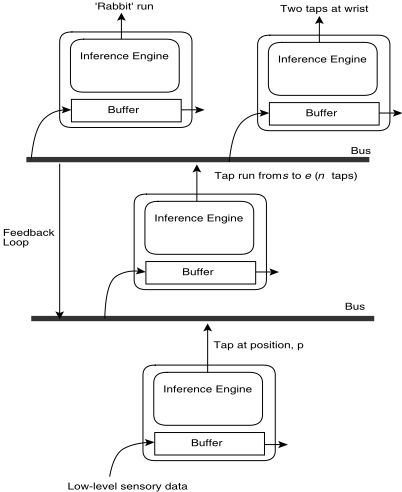
The intermediate level processing has a buffer of duration of 200ms and a capacity of 2 elements. When a tap arrives at an empty buffer (which can happen at most once every 20 ms) a new aggregate conclusion is generated, taking the position of the tap as the start and end position of the 'run', and initialising the count of taps in this run. This conclusion is passed to the output bus, where it is transmitted to other processes, but also, via a feedback loop, back to the input bus of the intermediate level process. If a subsequent tap arrives before this aggregate fact expires from the buffer (i.e., within 200ms) then a new conclusion is formed which adjusts the end point of the run to the new tap position and increases the tap count by 1. The buffer duration ensures that any gap of 200ms or more causes the previous 'run' to be forgotten, and thus any subsequent tap will be perceived as the start of a new run, which is consistent with the experimental data.
At the highest level of processing (top left in the Figure), a process with a two element buffer detects the end of a tap run by comparing the start position of sequential tap-run inputs. It is the output from this process that is eventually used to generate a report of the experience. It is important to note that although the intermediate-level buffer has a duration of 200ms it is not necessary to delay conclusions for 200ms. Instead, the process produces a conclusion whenever a new tap is felt (at most, once every 20ms), and these conclusions can be acted upon immediately.
4 Discussion
There are a number of parallel models of cognition (e.g. CopyCat, EPIC) which have some similarities to the Multiple Drafts theory. However these models generally involve some serial component where "everything comes together". For instance, in CopyCat [Mitchell, 1993] multiple parallel processes operate in a stochastic manner on a single workspace, creating a single solution to a problem; in EPIC [Kieras and Meyer, 1997] there is a single central executive which acts to coordinate the parallel processes.
In contrast, our Temporal Abstraction Network architecture has no global coordinating or integrating facility. However, abandoning a single central executive process does not mean that information cannot be brought together locally for integration. The TAN architecture is capable of local (serial) integration while maintaining multiple simultaneous drafts: information flow can diverge as easily as converge. This approach is in contrast to that of Dennett and Kinsbourne who suggest that the only alternative to the Cartesian theatre is a strictly parallel architecture, where local integration is replaced by a more chaotic Pandemonium approach (e.g., [Kinsbourne, 1994]).
In future work we plan to concentrate on extending the architecture to account for action selection, as well as expanding on the details of how reports are generated. One interesting area for future research will be to look at Libet's controversial experimental results [Libet, 1985] on voluntary action.
@inproceedings{ijcai2005p313,
  title     = {It’s About Time},
  author    = {Madden, Neil and Logan, Brian},
  booktitle = {Proceedings of the Nineteenth International Joint Conference on
               Artificial Intelligence, {IJCAI-05}},
  publisher = {International Joint Conferences on Artificial Intelligence},
  editor    = {Leslie Pack Kaelbling and Alessandro Saffiotti},
  pages     = {1511--1511},
  year      = {2005},
  url       = {https://ijcai.org/proceedings/2005/313},
}
TY - CPAPER TI - It’s About Time AU - Madden, Neil AU - Logan, Brian T2 - Proceedings of the Nineteenth International Joint Conference on Artificial Intelligence, IJCAI-05 PB - International Joint Conferences on Artificial Intelligence PY - 2005 SP - 1511 EP - 1511 UR - https://ijcai.org/proceedings/2005/313 ER -Copied
Machine-readable versions of this paper, for tools and AI agents:





