
Inter-Agent Communication: A Cost-Reduction Approach Using an Autonomous Mobile Mailbox
Proceedings of the Nineteenth International Joint Conference on Artificial Intelligence. Pages 1666-1666.
© 2005 International Joint Conferences on Artificial Intelligence
Abstract
In this paper, we consider a mobile mailbox communication scheme to reduce inter-agent communication costs. We employ a mailbox mobility strategy based on the ability of the mailbox to predict variations in inbound message rates and to migrate, if necessary, to a potentially better position in the network.
- [Feng et al., 2001] X. Feng, J. Cao, J. Lu, and H. Chan, "An Efficient Mailbox-Based Algorithm for Message Delivery in Mobile Agent Systems", 5 th IEEE International Conference on Mobile Agents, Atlanta, USA, Dec. 2001.
- [Cao et al., 2002a] J. Cao, X. Feng, J. Lu, and S. K. Das, "De- sign of Flexible and Reliable Mobile Agent Communication Protocols", 22 nd IEEE International Conference on Distributed Computing Systems, Vienna, Austria, July, 2002.
- [Cao el al., 2002b] J. Cao, X. Feng, J. Lu, and S. K. Das, "Reli- able Message Delivery for Mobile Agents: Push or Pull", Pro- ceedings of the 9 th International Conference on Parallel and Distributed Systems, Taiwan, China, 2002.
- [Cavrak et al., 2004] I. Cavrak, A. Stranjak and M. Zagar, "Autonomous Mobile Mailbox Model for Communication Cost Reduction", 26 th International Conference on Information Technology Interfaces,ITI'04, Dubrovnik, Croatia, June 2004.
References were extracted automatically from the PDF and may contain errors.
Full text extracted automatically from the PDF; figures, tables and equations may differ. The PDF is the version of record.
1 Introduction
Effective and efficient communication between mobile agents requires a different approach than the one employed in traditional distributed system communication, as difficulties may be encountered when tracking the location of the target agent, together with message delivery reliability issues. In [Feng et al., 2001] [Cao et al., 2002a], a nonautonomous mailbox based message delivery protocol is proposed. As the mailbox can travel independently of its owner, there is the possibility to reduce the costs of message delivery to an agent but the mailbox does not decide about its own migration.
In this paper, we consider performance of autonomous mailbox agent whose migration strategy is influenced by reducing the costs of message delivery from senders to a receiver or target agent, which is the owner of the mailbox [Cavrak et al., 2004]. Cost reduction mainly relies on lower mailbox mobility rates and in choosing optimal relay network positions, cutting the inbound message delivery costs.
2 Cost Model
The communication network is designed as a fully connected, undirected, weighted graph. We employ the assumption that the costs associated with messages transferred from senders to the receiver using the mailbox depend on the following:
Cost of message transfer from sender to mailbox in the time interval [ti - Te, ti]:
where b i p c is associated with the cost of transfer of one message between host p i h (agent ap location) and host hp (mailbox location), while λp(ti) is the amount of messages sent by agent ap in the time period considered.
Cost of mailbox registration and deregistration procedure in the synchronised push model when mailbox moves from host hb to host hb*:
where Q is a ratio between the delivery cost of one control and one data message (Q<1). Whenever mailbox changes location it requests and waits for synchronisation release confirmation (2 messages) and sends resynchronisation request on arrival (1 message).
Cost of mailbox migration depends on the number of messages (collected in time interval [T1,T2]) present in the mailbox's internal buffer at the moment of migration from host hb to host hb*:
Cost of mailbox position update at corresponding Home object:
where cb*h is the cost incurred by sending one message from the future mailbox's host hb* to host hh where the Home object is placed.
Cost of message transfer from mailbox to the receiver associated with the cost of pulling the collected messages within time interval [T1,T2] by the receiver agent:
where cbr is the cost of transfer of one message between host hb where the mailbox is located, and the host hr where the receiver is located.
3 Mailbox Migration Strategy and Model
The mailbox holds the data that include network topology and communication costs, the number of message sources and their network locations, and the set of hosts where the receiver agent will be located. Reducing the cost of communication by planning optimal mailbox positions during the course of system execution is the main task.
At simulated time ti, a mailbox does the following: (a) predicts message rate vector λ(ti+Te) for all senders using extrapolated straight line fit method, (b) based on those predictions, calculates Ctrns(ti+Te) for all possible mailbox positions within the network and finds future position that will incur the minimal cost. (c) based on cost calculations, migrates to the next proposed host or remains on the current one.
4 Simulation and Results
A simulated mobile agent system consists of n hosts and m agents that are distributed randomly in the fully connected network. Message rate functions of sender agents are randomly picked from the set of functions such as periodic step function, constant function and periodic triangular function superimposed with positive or negative random errors. Efficiency of the mailbox is defined as a ratio between total costs occurred in the system with mobile mailbox and total costs in the system without the mailbox.
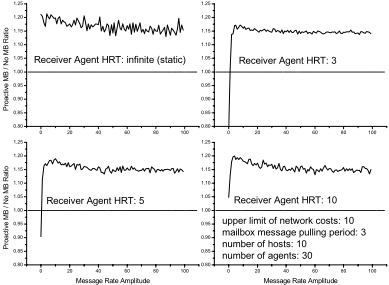
Figure 1 shows the dependency between the efficiency of the mailbox and the message rate amplitude of sender agents in a heterogeneous network. Increasing the network heterogeneity, the usability of the mailbox is still justified even with increased host residence time (HRT) of the receiver agent, if the message rate amplitude is low. The heterogeneous network will decrease the influence of a two-stage communication effect as the ratio between paths used for message delivery from senders to the receiver agent in the system with the mailbox when compared with the system without the mailbox will be lower than the system with the homogeneous network.
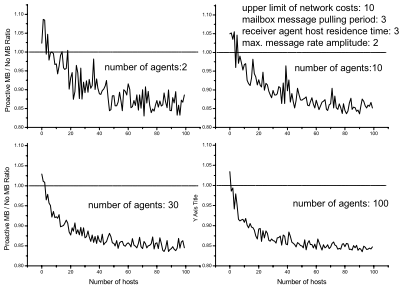
Figure 2 shows the dependency between the efficiency of the mailbox and the number of hosts in the network. The number of hosts has a significant influence on the efficiency of the mailbox. In a network with fewer hosts, the mailbox is not provided with enough opportunities to mitigate the effect induced by a two-stage communication process and that is the reason the ratio is above 1. Increasing the number of hosts, the mailbox is offered more alternatives to deliver messages with lower costs. The higher number of sender agents will increase the dispersion of message sources in the network which will decrease the likelihood for the mailbox to be "too far" from agents. It will result in a more even message transfer cost over various positions of the mailbox. The efficiency of the mailbox will be less variable as the number of sender agents increases and the graph will be smoother. The number of agents does not significantly influence the efficiency of the mailbox as both the mailbox and the receiver agent need to synchronise with them whenever the migration occurs, and those costs do not affect the efficiency ratio.
5 Conclusion
In this paper, we investigated performance of a novel approach for message-delivery cost-reduction in mobile agent systems. The approach uses an autonomous mobile mailbox acting as an intermediary message relay station. Intelligent behaviour of the mailbox relies on its ability to predict incoming message rates on-the-fly and decide about potential migration accordingly. Its migration strategy is motivated by a desire to reduce the costs of message delivery to the agent to which it belongs. Possible cost savings are achieved through lower mailbox mobility rates as well as deciding about optimal mailbox position within the network.
@inproceedings{ijcai2005p295,
  title     = {Inter-Agent Communication: A Cost-Reduction Approach Using an Autonomous Mobile Mailbox},
  author    = {Stranjak, Armin and Cavrak, Igor and Zagar, Mario},
  booktitle = {Proceedings of the Nineteenth International Joint Conference on
               Artificial Intelligence, {IJCAI-05}},
  publisher = {International Joint Conferences on Artificial Intelligence},
  editor    = {Leslie Pack Kaelbling and Alessandro Saffiotti},
  pages     = {1666--1666},
  year      = {2005},
  url       = {https://ijcai.org/proceedings/2005/295},
}
TY - CPAPER TI - Inter-Agent Communication: A Cost-Reduction Approach Using an Autonomous Mobile Mailbox AU - Stranjak, Armin AU - Cavrak, Igor AU - Zagar, Mario T2 - Proceedings of the Nineteenth International Joint Conference on Artificial Intelligence, IJCAI-05 PB - International Joint Conferences on Artificial Intelligence PY - 2005 SP - 1666 EP - 1666 UR - https://ijcai.org/proceedings/2005/295 ER -Copied
Machine-readable versions of this paper, for tools and AI agents:





