
Redesign Support Framework based on Hierarchical Multiple Models
Proceedings of the Nineteenth International Joint Conference on Artificial Intelligence. Pages 1570-1570.
© 2005 International Joint Conferences on Artificial Intelligence
Abstract
A redesign support framework for complex technical processes is described in this paper. This framework employs a multi-model hierarchical representation of the process to be redesigned together with a case-based reasoning engine that helps us to decide the elements of the process that should be modified. This framework has been tested in the chemical engineering domain.
- [Chittaro et al., 1993] Chittaro, L., Guida, G., Tasso, C. and Toppano, E. Functional and Teleological Knowledge in the Multimodeling Approach for Reasoning About Physical Systems: A case study in diagnosis. IEEE Trans. on Sys, Man & Cyb. 23(6), pp. 1718-1751, 1993.
- [Douglas, 1988] Douglas J.M. Conceptual design of chemi- cal process, Mc Graw Hill, New York, 1988.
- [Larsson, 1996] Larsson, J.E. Diagnosis based on explicit means-end models, Artificial Intelligence 80, 29-93. 1996.
- [Turton et al., 1998] Turton R., R.C. Bailie, W.B. Whiting and J.A. Shaeiwitz, Analysis, synthesis and design of chemical process, Prentice-Hall, New Jersey, 1998.
References were extracted automatically from the PDF and may contain errors.
Full text extracted automatically from the PDF; figures, tables and equations may differ. The PDF is the version of record.
1 Introduction
In this paper a redesign support framework is proposed. This framework integrates model-based reasoning and casebased reasoning techniques. The original process is modelled hierarchically exploiting means-end and part-whole concepts of MFM [Larsson, 1996] and Multi-modelling [Chittaro et al., 1993] approaches. A CBR system is used to obtain alternative process sections, which can be adapted into the original process. Therefore, this framework allows us to model the process; to identify process components suitable for redesign; to obtain alternative components and; finally to adapt these components into the original process. This procedure can be seen as a reverse engineering activity where abstract models at different levels are generated from a detailed description of the existing process to reduce the complexity of the process. The framework has been applied on the chemical engineering domain, by means of three prototypes: HEAD, AHA!, and RETRO.
2 The Redesign Framework
The proposed framework (see Figure 1) consists of four main stages, which can be summarised as follows:
- Design-description acquisition. This stage consists of:
- Data acquisition. Knowledge about the structure and behaviour of all components of the process is automatically extracted from a numerical simulator. Therefore, human intervention is avoided and the simulator ensures that data is consistent.
- Functional identification. This is the modelling stage. The data extracted from the simulator is used to auto-
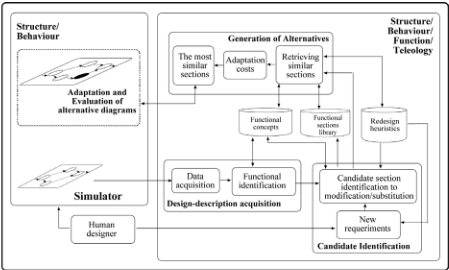
matically generate the hierarchical models. Based on the data extracted from the simulator, the functional and teleological models can be inferred.
A unit that encapsulates these four types of knowledge is generated for each physical equipment. Furthermore, an ontology of functions and equipments (not necessarily with formal specification) have to be specified. This ontology is used to define a priority order of functions. Given the priority of functions of units and on their goals, it is possible to identify incrementally the functional sections of the process. The grouping of functions generates metaunits and identifies a functional section. Units/metaunits with lower priority functions are "absorbed" by units/meta-units with higher priority functions. This forms a tree of functions of the process. The connections between such functions denote the causal relations between the process variables and the goals.
- Candidate identification. The aim of this stage is to identify the units or meta-units that have to be modified to fulfil the new redesign objectives. Therefore, the design description of the process and the new set of specifications that the process must satisfy are required. The process variable to focus on, according to the new requirements of the process, must be set. Then a diagnosis algorithm is used to identify the units/meta-units that affect such process variables.
The diagnosis algorithm [Larsson, 1996] applies causal reasoning to identify the units/meta-units where the process variables do not achieve the needed values. No simulation is required; the algorithm uses the ontological assumptions and the values of such variables. As result, a small list of the most possible "faulty" units/meta-units is obtained. Based on any identified unit/meta-unit, their corresponding "cause" and "consequence" units are identified. "Cause" unit/meta-unit is the unit/meta-unit that provides the actual operational conditions to the involved process variables in the function of the unit/meta-unit of interest. "Consequence" unit/meta-unit is the unit/meta-unit affected by the operational conditions given by the unit/meta-unit of interest. The "causes" and "consequences" units/metaunits are important in the adaptation and evaluation stage.
- Generation of alternatives. From the identified unit/meta-unit in the previous stage, similar units/metaunits can be suggested. New units/meta-units are generated from others similar processes. This can be achieved by a CBR system. The retrieving stage of the CBR system corresponds to this stage, and the rest of stages refer to the two last stages of the redesign framework (the adaptation and evaluation stages).
We apply a hierarchical case-based reasoning approach. Then each unit and meta-unit is considered a ground case and an abstract case respectively. A ground case is a case located at the lowest level in the hierarchy and represents a specific unit. An abstract case is a case represented at a higher level of abstraction and corresponds to a meta-unit. Thus the unit or meta-unit identified in the previous stage is the target case. Similar units/meta-units (source cases) are retrieved from a case library according to its similarity respect to the target case. Numerical, symbolic and hierarchical similarity measures are used. As result, a set of the most similar units/meta-units is obtained. The human designer may test them in the adaptation and evaluation stage.
- Adaptation and evaluation. The reuse, revision, and retention stages of the CBR cycle correspond to the adaptation and evaluation stages in the redesign framework. Retention is not considered an explicit stage in the framework but is carried out.
The most similar units/meta-units proposed in the previous stage must be adapted and evaluated in the process of interest until obtain an appropriate alternative process design. Both stages are not systematised in the redesign framework.. Since the aim of the redesign framework is to deal with complex technical process, the adaptation and revision of the most similar cases require complex simulations. The human designer must carry out them manually by means of the simulator used in the data acquisition To facilitate the adaptation, an adaptation cost is computed to suggest the "adaptability" of the chosen unit/meta-unit. This adaptation cost is based on the differences between the chosen unit (source case) and the cause and consequence units/meta-units identified with the diagnosis algorithm. Thus, the cost is a normalised value denoting the difference on the values of the process variables involved in the performance of the unit and the values of the process variables involved in the performance of the neighbour units/meta-units. The adaptation cost will have a value between 0 and 1. Values close to 0 means that the adaptation is difficult.
Note that this framework does not redesign processes either automatically or autonomously. The aim is to support human designers to understand a process and facilitate the redesign activities. Also any assumption on some specific domain has been considered, but the domain must allow a well-defined structure on functions.
3 Evaluation and conclusions
This framework has been implemented and applied to the chemical engineering process domain over 20 chemical processes (consequently the number of ground and abstract cases is higher). Interesting results have been. The functional ontology developed includes concepts from the wellknown chemical process design methodologies developed by Douglas [Douglas, 1988] and Turton [Turton et al., 1998]. The numerical simulators employed were Hysys and Aspen.
The central point of this framework is the hierarchical multi-model representations used in all redesign activities. The framework implements a hybrid approach of problem solution: means-end and part-whole model-based methodologies. This framework integrates model-based reasoning and case-based reasoning. The framework aims to support human designers to understand the process and to guide them in the redesign process by suggesting components or sections to be modified or substituted.
@inproceedings{ijcai2005p289,
  title     = {Redesign Support Framework based on Hierarchical Multiple Models},
  author    = {López-Arévalo, Ivan and Rodríguez-Martínez, A. and Aldea, Arantza and Bañares-Alcántara, René and Jiménez, Laureano},
  booktitle = {Proceedings of the Nineteenth International Joint Conference on
               Artificial Intelligence, {IJCAI-05}},
  publisher = {International Joint Conferences on Artificial Intelligence},
  editor    = {Leslie Pack Kaelbling and Alessandro Saffiotti},
  pages     = {1570--1570},
  year      = {2005},
  url       = {https://ijcai.org/proceedings/2005/289},
}
TY - CPAPER TI - Redesign Support Framework based on Hierarchical Multiple Models AU - López-Arévalo, Ivan AU - Rodríguez-Martínez, A. AU - Aldea, Arantza AU - Bañares-Alcántara, René AU - Jiménez, Laureano T2 - Proceedings of the Nineteenth International Joint Conference on Artificial Intelligence, IJCAI-05 PB - International Joint Conferences on Artificial Intelligence PY - 2005 SP - 1570 EP - 1570 UR - https://ijcai.org/proceedings/2005/289 ER -Copied
Machine-readable versions of this paper, for tools and AI agents:





