
Value-Centric Trust Model with Improved Familiarity Measurement
Proceedings of the Nineteenth International Joint Conference on Artificial Intelligence. Pages 1670-1670.
© 2005 International Joint Conferences on Artificial Intelligence
Abstract
Formalization of familiarity contributes to formalization of trust through a value-centric trust model. However, familiarity was assumed to be the similarity of values (fixed for two agents), and stability of the trust model was relatively low. To increase the stability, we propose an improved familiarity measurement. Experiments are carried out to compare the stability of the trust model with the improved familiarity measurement and with the fixed familiarity value. It is observed that the stability is increased by 33.47% through the improved familiarity measurement.
- [Carter and Ghorbani, 2004] Jonathan Carter and Ali A. Ghorbani. Towards a formalization of value-centric trust in agent societies. Journal of Web Intelligence and Agent Systems, 2(3):167-184, 2004.
- [Zhang and Ghorbani, 2004] Jie Zhang and Ali A. Ghorbani. Familiarity and trust: Measuring familiarity with a web site. In Proceedings of the 2nd Annual Conference on Pri- vacy, Trust and Security (PST 2004), pages 23-28, Octo- ber 2004.
References were extracted automatically from the PDF and may contain errors.
Full text extracted automatically from the PDF; figures, tables and equations may differ. The PDF is the version of record.
1 Introduction
Trust has always been bundled with familiarity to become a popular topic in the fields of psychology, sociology, and computer science. The relationship between trust and familiarity has been further clarified through the value-centric trust model proposed by Carter and Ghorbani [Carter and Ghorbani, 2004]. The newmodel proposes that trust is a combination of self-esteem, reputation, and familiarity within a multiagent system (MAS) context. Trust is also multidimensional in that it can be facilitated through familiarity. Familiarity was assumed to be the similarity of values. In consequence, stability of the trust model is relatively low. However, people in nature prefer relatively stable societies. To increase stability of the trust model, we propose an improved familiarity measurement by exploring a variety of human factors that may affect the feeling of familiarity.
The rest of the paper is organized as follows. Section 2 describes the four major factors affecting familiarity in agent societies. The way of measuring familiarity is proposed in Section 3. Experimental results are presented and discussed in Section 4. Finally, the conclusions of the present study are presented in Section 5.
2 Factors Affecting Familiarity
Familiarity is affected by four major factors: prior experience, repeated exposure, level of processing, and forgetting rate [Zhang and Ghorbani, 2004]. Prior experience is determined by knowledge of similar agents in the agent society.
Repeated exposure is represented by how many transactions are established between the two agents. Level of processing is determined by the quantity of widgets in each transaction. Forgetting rate is calculated by the interval between the last transaction and the current transaction, and the factor of the agent society.
3 FamiliarityMeasurement
For an agent society A with n agents, A = {a1, a2, ..., an}, let F(ai, aj) and S(ai, aj) represent the familiarity and similarity between agents ai and aj, respectively. The initial familiarity value that the agent ai has with the agent aj can be calculated through the formula as follows:
The value of familiarity can be calculated from the knowledge that the agent ai has about the agent aj as follows:
where Fc(ai, aj) and Kc(ai, aj) represent the familiarity value and the knowledge value that the agent ai has from the perspective of the agent aj before the current, c, transaction, respectively.
Since the familiarity value is affected by the previous level of processing and the forgetting rate, and it is determined by the agent's knowledge, a simple formula for updating the agent's knowledge may be as follows:
where Kp(ai, aj) represents the knowledge value that agent ai had about agent aj before the previous transaction, Lp(ai, aj) is the level of processing of agents ai and aj during the previous transaction, and Rp(ai, aj) represents the forgetting value since the previous transaction. The initial knowledge value of agent ai, K0(ai, aj) can be determined by Equations 1 and 2.
The formula to calculate the previous level of processing of the agents ai and aj may be calculated by:
where Qp represents the quantity of widgets in the previous transaction and l represents the learning coefficient. The value of l may differ for different agent societies.
The forgetting value of agent ai and agent aj can be calculated as follows:
where m represents the memory coefficient. △tp represents the time difference between the current transaction and the previous transaction of agents ai and aj.
4 Analysis of Stability
The stability of the model is considered with respect to trustworthiness ranking. Both the two kinds of familiarity measurements, improved familiarity measurement and fixed familiarity value calculated by the similarity of two agents, are implemented and embedded in the trust model. For later use, TMIFM is defined as the trust model with improved familiarity measurement, and TMFFV is defined as the trust model with fixed familiarity value. Within this work, stability is connected to the idea of ranking. The stability refers to the degree of change of rankings of sellers. Thus, Stability is measured through an examination of the average variance of the selling agents' ranks on a daily basis.
| Test # | TMIFM | TMFFV | Percentage Difference |
|---|---|---|---|
| 1 | 3.92 | 5.77 | 32.06% |
| 2 | 5.61 | 7.91 | 29.08% |
| 3 | 6.11 | 10.12 | 39.62% |
| 4 | 5.36 | 8.62 | 37.82% |
| 5 | 4.00 | 4.96 | 19.35% |
| 6 | 3.94 | 5.61 | 29.77% |
| 7 | 4.39 | 7.75 | 43.35% |
| 8 | 5.11 | 9.51 | 46.27% |
| 9 | 4.47 | 6.10 | 26.72% |
| 10 | 6.35 | 7.00 | 9.29% |
| Average | 4.73 | 7.11 | 33.47% |
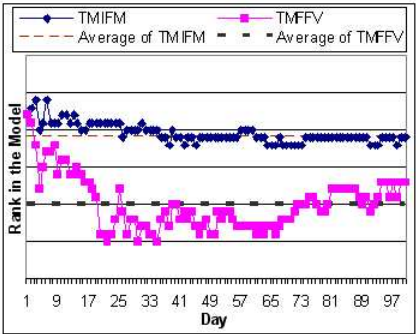
The comparative stability of TMIFM and TMFFV is presented in Table 1. On average, the average variance of TMIFM is 33.47% lower than that of TMFFV, which means that the former is more stable than the latter. The result can be further illustrated by analyzing the change of rank of any given agent as shown in Figure 1. From this figure, it is obvious that the variance of the rank produced by TMIFM is lower than that produced by TMFFV. Therefore, TMIFM is more stable than TMFFV.
The reason that TMIFM has higher stability can be explained by analyzing two phenomena in both of the two trust models. One phenomenon is that agents are pushed faster to the right spot that they should be on in TMIFM than in TMFFV, which can be seen from Figure 1. The agent in TMIFM nearly reaches the average line earlier (approximately on day 15) than in TMFFV (approximately on day 40). This happens because that the improved familiarity measurement increases the speed of pushing the agent to the right spot. Another phenomenon is that once agents have been given a spot, they remain close to that spot. This phenomenon can also be seen in Figure 1. From day 25 on, the rank of the agent in TMIFM stays close to the average line, whereas the rank of the agent in TMFFV keeps changing. This happens because the selling agents with higher/lower rank have more/less possibility of being selected to establish transactions with buying agents in both TMIFM and TMFFV.
5 Conclusions
We proposed the improved familiarity measurement by exploring the factors mainly affecting familiarity. The four factors include prior experience, repeated exposure, level of processing, and forgetting rate. We then devised a convenient way to measure and update familiarity value. The improved familiarity measurement has been integrated into the valuecentric model. Experiments were carried out to compare the stability of the trust model with the improved familiarity measurement and with the fixed familiarity value. Experimental results shew that the stability has been increased by 33.47% through the improved familiarity measurement.
6 Acknowledgments
This work was funded by the National Science and Engineering Research Council of Canada (NSERC) to Dr. Ali A. Ghorbani through grant RGPIN 227441.
@inproceedings{ijcai2005p283,
  title     = {Value-Centric Trust Model with Improved Familiarity Measurement},
  author    = {Zhang, Jie and Ghorbani, Ali A.},
  booktitle = {Proceedings of the Nineteenth International Joint Conference on
               Artificial Intelligence, {IJCAI-05}},
  publisher = {International Joint Conferences on Artificial Intelligence},
  editor    = {Leslie Pack Kaelbling and Alessandro Saffiotti},
  pages     = {1670--1670},
  year      = {2005},
  url       = {https://ijcai.org/proceedings/2005/283},
}
TY - CPAPER TI - Value-Centric Trust Model with Improved Familiarity Measurement AU - Zhang, Jie AU - Ghorbani, Ali A. T2 - Proceedings of the Nineteenth International Joint Conference on Artificial Intelligence, IJCAI-05 PB - International Joint Conferences on Artificial Intelligence PY - 2005 SP - 1670 EP - 1670 UR - https://ijcai.org/proceedings/2005/283 ER -Copied
Machine-readable versions of this paper, for tools and AI agents:





