
Discovering Time Differential Law Equations Containing Hidden State Variables and Chaotic Dynamics
Proceedings of the Nineteenth International Joint Conference on Artificial Intelligence. Pages 1642-1643.
© 2005 International Joint Conferences on Artificial Intelligence
Abstract
This paper proposes a novel approach to discover simultaneous time differential law equations having high plausibility to represent first principles underlying objective processes. The approach has the power to identify law equations containing hidden state variables and/or representing chaotic dynamics without using any detailed domain knowledge.
- [Berge et al., 1984] Pierre Berge, Yves Pomeau, and Chris- tian Vidal. Order in Chaos -For understanding turbulent flow. Hermann, Paris, France, 1984.
- [Bradley et al., 1998] Elizabeth A. Bradley, Agnes A. O'Gallagher, and Janet E. Rogers. Global solutions for nonlinear systems using qualitative reasoning. Annals of Mathematics and Artificial Intelligence, 23:211-228, 1998.
- [Doucet et al., 2000] Arnaud Doucet, Simon Godsill, and Christophe Andrieu. On sequential monte carlo sampling methods for bayesian filtering. Statistics and Computing, 10:197-208, 2000.
- [Dzeroski and Todorovski, 1995] Saso Dzeroski and Ljupco Todorovski. Discovering dynamics: from inductive logic programing to machine discovery. Journal of Intelligent Information Systems, 4:89-108, 1995.
- [Falkenhainer and Michalski, 1986] Brian C. Falkenhainer and Ryszard S. Michalski. Integrating quantitative and qualitative discovery: The abacus system. Machine Learn- ing, 1:367-401, 1986.
- Haykin, 2001
- Simon S. Haykin. Kalman Filtering and Neural Networks. John Wiley & Sons, Inc., Hoboken, New Jersey, 2001.
- [Langley et al., 1987] Pat W. Langley, Herbert A. Simon, Gary L. Bradshaw, and Jan M. Zytkow. Scientific Discov- ery; Computational Explorations of the Creative Process. MIT Press, Cambridge, Massachusetts, 1987.
- [Langley et al., 2003] Pat Langley, Dileep George, Stephen Bay, and Kazumi Saito. Robust induction of process models from time-series data. In Proceedings of the Twentieth International Conference on Machine Learning, pages 432-439, Menlo Park, California, August 2003. The AAAI Press.
- [Luce, 1959] Duncan R. Luce. On the possible psychologi- cal laws. Psychological Review, 66(2):81-95, 1959.
- [Todorovski and Dzeroski, 1997] Ljupco Todorovski and Saso Dzeroski. Declarative bias in equation discovery. In Proceedings of the Fourteenth International Conference on Machine Learning, pages 376-384, San Mateo, California, July 1997.
- Morgan Kaufmann. [Washio and Motoda, 1997] Takashi Washio and Hiroshi Motoda. Discovering admissible models of complex sys- tems based on scale-types and identity constraints. In Pro- ceedings of the Fifteenth International Joint Conference on Artificial Intelligence, pages 810-817, Nagoya, Japan, August 1997.
References were extracted automatically from the PDF and may contain errors.
Full text extracted automatically from the PDF; figures, tables and equations may differ. The PDF is the version of record.
1 Introduction
A set of well known pioneering approaches of scientific law equation discovery is called BACON family [Langley et al., 1987]. They try to figure out a static equation on multiple quantities over a wide state range under a given laboratory experiment. Some approaches introduced unit dimension constraints and "scale-type constraints" to limit the search space to mathematically admissible equations reflecting the first principles [Falkenhainer and Michalski, 1986],[Washio and Motoda, 1997]. Especially, the scale-type constraints have wider applicability since it does not require any unit information of quantities. Subsequently, LAGRANGE addressed the discovery of "simultaneous time differential law equations" reflecting the dynamics of objective processes under "passive observations" where none of quantities are experimentally controllable [Dzeroski and Todorovski, 1995]. Its extended version called LAGRAMGE introduced domain knowledge of the objective process to limit the search space within plausible law equations [Todorovski and Dzeroski, 1997]. Extended IPM having similar functions with LAGRAMGE further identified plausible law equations containing "hidden state variables" when the variables are known in the domain knowledge [Langley et al., 2003]. PRET identified "chaotic dynamics" under similar conditions with these approaches where rich domain knowledge is available [Bradley et al., 1998]. However, scientists and engineers can develop good models of the objective dynamics without using the discovery approaches in many practical cases when the detailed domain knowledge is available. Accordingly, the main applications of the discovery approaches are to identify simultaneous time differential equations reflecting the first principles under passive observation and "little domain knowledge."
A3 The support of JSPS Grant-in-aid for Scientifc Research, No.16300045 is acknowledged.
In this paper, we propose a novel approach called SCALETRACK (SCALE-types and state TRACKing based discovery system) to discover a model of an objective process under the following requirements.
- The model is simultaneous time differential equations representing the dynamics of an objective process.
- The model is not an approximation but a plausible candidate to represent the underlying first principles.
- The model is discovered from passively observed data without using domain knowledge specific to the objective process.
- The model can include hidden state variables.
- The model can represent chaotic dynamics.
2 Outline
2.1 Basic Problem Setting
We adopt the following "state space model" of objective dynamics and measurements without loss of generality.
where the first equation is called a "state equation" and the second a "measurement equation." DC is called a state vector, CUB4DCB5 a system function, DA a process noise vector, DD a measurement vector, BV a measurement matrix, DB a measurement noise and D8 a time index. CUB4DCB5 is not limited to linear formulae in general. BV is represented by a linear transformation matrix, since the measurement facilities are artificial and linear in most cases. If BV is column full rank, the values of all state variables are estimated by solving the measurement equation with DC. Otherwise, some state variables are not estimated within the measurement equation, and these variables are called "hidden state variables." In the scientific law equation discovery, CUB4DCB5 is initially unknown, and even DC is not known correctly. Only a state subvector DC BC B4AI DCB5 and a submatrix BV BC B4AI BVB5 are initially known. To derive BV from BV BC , SCALETRACK must identify the dimension of DC at first. Then, it searches plausible candidates of CUB4DCB5 from the measurement time series data.
2.2 Entire Approach
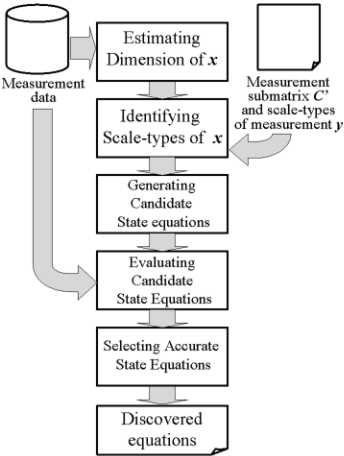
The entire approach of SCALETRACK is outlined in Figure 1. Given a set of measurement time series data, the dimension of DC is identified through a statistical analysis called "correlation dimension analysis" [Berge et al., 1984]. For each element of DD, its time trajectory is mapped to a phase space constructed by time lagged values of the element, and the degree of freedom, i.e., the dimension of DC, embedded in the time trajectory is estimated by computing the sparseness of the trajectory in the space.
Once the dimension is known, all possible combinations of scale-types of the elements in DC are enumerated based on scale-type constraints, the known measurement submatrix BV BC and the scale-types of the elements in DD. The representative scale-types of quantities are ratio scale and interval scale. The examples of the ratio scale quantities are physical mass and absolute temperature where each has an absolute origin, while the examples of the interval scale quantities are temperature in Celsius and sound pitch where their origins are not absolute and arbitrary changed by human's definitions. Due to these natures, the quantitative relations among the quantities are strongly constrained [Luce, 1959], and these constraints are used to determine the scale types of the elements in DC from DD. After every combination of the scale types in DC is derived, the candidate formulae of a state equation are generated for each combination based on "Extended Product Theorem" [Washio and Motoda, 1997] limiting the admissible formulae of the equation based on the scale-type constraints.
Subsequently, through a set of state tracking simulations called "SIS/RMC filter" on the given measurement time series data, the parameter values and the states in every candidate state equation are estimated [Doucet et al., 2000]. This state tracking has many advantages comparing with the other nonlinear state tracking approaches such as the conventional Extended Kalman Filter [Haykin, 2001] and the qualitative reasoning based PRET [Bradley et al., 1998]. The former using the linearization of the state equations does not work well when the equations include some singular points and/or some state regions having strong sensitivity to the tracking error. The latter faces a combinatorial explosion of qualitative states when the dimension and/or the complexity of the state space structure are high. In contrast, SIS/RMC filter does not require any approximation to be spoiled by the singularity and the strong nonlinearity, and does not face the combinatorial explosion of the states to be considered, because it tracks the state probability distributions by using its direct and sequential Monte Carlo integration within Bayesian framework. In our approach, the estimated parameter values are rounded off to integers when the values are close enough to the integers within the expected estimation errors, since the parameters tend to be integers in many physical processes. Finally, some state equations providing highly accurate tracking in terms of "Mean Square Error (MSE)" are selected as the plausible candidates of first principle based and dynamic state space models of the objective process.
2.3 Implementation
The evaluation of candidate state equations by the SIS/RMC filter is the most time consuming step. Any search can not be skipped, since the search space is nonmonotonic. We experienced that one run of stand alone SCALETRACK to discover a simple state equation took more than a month even if we used an efficient algorithm. Accordingly, the current SCALETRACK introduced a simple grid computing framework using a PC cluster consisting of a control server and 10 personal computers where each has an Athlon XP 1900+ (1.6 GHz) CPU and 2GB RAM. The server computes the first three steps and then allocates the task to evaluate 10% of candidate state equations to each computer. Because this task is mutually independent, and occupies the most of computation in SCALETRACK, this implementation accelerates the run speed almost 10 times.
| case | AN | CRD8 (h) | AR DB B4B1B5 | ||||
|---|---|---|---|---|---|---|---|
| B4AR DB BP BDBMBCB1B5 | BCBMBD | BCBMBH | BDBMBC | BEBMBC | BHBMBC | ||
| RR | 2.21 | 1.5 | B7 | A6 | A6 | A6 | A0 |
| RRH | 2.21 | 5.5 | A6 | A6 | A0 | A0 | A0 |
| RI | 2.19 | 4.0 | B7 | A6 | A6 | A6 | A0 |
| RIH | 2.19 | 5.5 | B7 | A6 | A0 | A0 | A0 |
3 Result
3.1 Basic Performance Evaluation
The evaluation is made in terms of scale-types of state variables, hidden state variables and measurement noise levels by using the following two dimensional artificial formulae.
where DD BD BP DC BD and DD BE BP DC BE are ratio scale.
where DD BD BP DC BD is ratio scale and DD BE BP DC BE interval scale. Table 1 shows the evaluation result. All state variables are observed in RR and RI. Whereas, the measurement variable DD BE is not available in RRH and RIH respectively, and hence a hidden state variable exists in these cases. The correlation dimension analysis properly estimated the dimension AN of state vectors as nearly BE in each case. The computation times CRD8 required for RRH, RI and RIH were longer than that of RR, because the variety of admissible formulae containing interval scale variables is larger than that of ratio scale variables. The result in that the formula having the correct shape is top ranked by the accuracy is marked by B7. If the correct formula is derived within the top five solutions, it is marked by A6, otherwise it is marked by A0. The table shows that almost AR DB BP BEBMBCB1 relative noise is acceptable for no hidden state cases, while noise less than BDBMBCB1 is required for hidden state cases. Since BCBMBHA0BEBMBCB1 noise is the most widely seen in many applications, the performance of SCALETRACK is practical for no hidden state cases and some hidden state cases.
3.2 Discovery of Chaos
The state equation to be discovered is the following Altered Rossler Chaos equation.
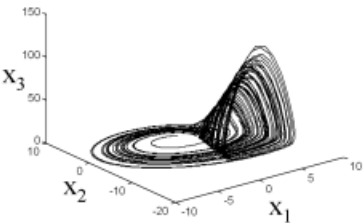
This has an attractor in a B4DC BD BN DC BE BN DC BF B5-phase space as depicted in Figure 2. All state variables are interval scale, and can be measured through the corresponding interval scale measurement variables respectively. AN BP BFBMBFBF was obtained in the correlation dimension analysis, and hence the state equations consisting of three state variables were searched. The required computation time was 15.0 hours, and the following most accurate state equation was resulted. This formula has an identical shape with the original except some discrepancies of coefficients. This indicates the high ability of SCALETRACK to discover the Chaotic dynamics reflecting the underlying first principles.
4 Conclusion
SCALETRACK achieved three advantages which have not been addressed in any past work of mathematics, physics and engineering not limited to scientific discovery. The first is the discovery of simultaneous time differential equations having plausibility to represent first principles. The second is the discovery of hidden state variables. The third is the discovery of chaotic dynamics. These discoveries are done without using detailed domain knowledge. These advantages are essentially important in many scientific and engineering fields due to the wide existence of such dynamics in nature.
@inproceedings{ijcai2005p249,
  title     = {Discovering Time Differential Law Equations Containing Hidden State Variables and Chaotic Dynamics},
  author    = {Washio, Takashi and Adachi, Fuminori and Motoda, Hiroshi},
  booktitle = {Proceedings of the Nineteenth International Joint Conference on
               Artificial Intelligence, {IJCAI-05}},
  publisher = {International Joint Conferences on Artificial Intelligence},
  editor    = {Leslie Pack Kaelbling and Alessandro Saffiotti},
  pages     = {1642--1643},
  year      = {2005},
  url       = {https://ijcai.org/proceedings/2005/249},
}
TY - CPAPER TI - Discovering Time Differential Law Equations Containing Hidden State Variables and Chaotic Dynamics AU - Washio, Takashi AU - Adachi, Fuminori AU - Motoda, Hiroshi T2 - Proceedings of the Nineteenth International Joint Conference on Artificial Intelligence, IJCAI-05 PB - International Joint Conferences on Artificial Intelligence PY - 2005 SP - 1642 EP - 1643 UR - https://ijcai.org/proceedings/2005/249 ER -Copied
Machine-readable versions of this paper, for tools and AI agents:





