
Approximating Game-Theoretic Optimal Strategies for Full-scale Poker
Proceedings of the Eighteenth International Joint Conference on Artificial Intelligence. Pages 661-667.
© 2003 International Joint Conferences on Artificial Intelligence
Abstract
The computation of the first complete approximations of game-theoretic optimal strategies for fullscale poker is addressed. Several abstraction techniques are combined to represent the game of 2player Texas Hold' em, having size 0(10 18 ), using closely related models each having size 0(10 7 ). Despite the reduction in size by a factor of 100 billion, the resulting models retain the key properties and structure of the real game. Linear programming solutions to the abstracted game are used to create substantially improved poker-playing programs, able to defeat strong human players and be competitive against world-class opponents.
- [Billings et al., 2002] D. Billings, A. Davidson, J. Schaeffer, and D. Szafran. The challenge of poker. Artificial Intelli- gence, 134(1-2):201-240, 2002. 668
- [Billings, 2000] D. Billings. The first international roshambo programming competition. International Computer Games Association Journal, 23(1):3-8, 42-50, 2000.
- [Koller and Megiddo, 1992] D. Koller and N. Megiddo. The complexity of two-person zero-sum games in extensive form. Games and Economic Beh., 4(4):528-552, 1992.
- [Koller and Pfeffer, 1997] D. Koller and A. Pfeffer. Repre- sentations and solutions for game-theoretic problems. Ar- tificial Intelligence, pages 167-215, 1997.
- [Koller et al., 1994] D. Koller, N. Megiddo, and B. von Sten- gel. Fast algorithms for finding randomized strategies in game trees. STOC, pages 750-759, 1994.
- [Kuhn, 1950] H. W. Kuhn. A simplified two-person poker. Contributions to the Theory of Games, 1:97-103, 1950.
- [Nash, 1950] J. Nash. Equilibrium points inn-person games. National Academy of Sciences, 36:48-49, 1950.
- [Sakaguchi and Sakai, 1992] M. Sakaguchi and S. Sakai. Solutions of some three-person stud and draw poker. Mathematics Japonica, pages 1147-1160, 1992.
- [Selby, 1999] A. Selby. Optimal heads-up preflop poker. 1999. www.archduke.demon.co.uk/simplex. Link
- [Shi and Littman, 2001] J. Shi and M. Littman. Abstrac- tion models for game theoretic poker. In Computers and Games, pages 333-345. Springer-Verlag, 2001.
- [Sklansky and Malmuth, 1994] D. Sklansky and M. Mal- muth. Texas Hold' em for the Advanced Player. Two Plus Two Publishing, 2nd edition, 1994.
- [Takusagawa, 2000] K. Takusagawa. Nash equilibrium of Texas Hold' em poker, 2000. Undergraduate thesis, Com- puter Science, Stanford University.
- [von Neumann and Morgenstern, 1944] J. von Neumann and 0. Morgenstern. Theory of Games and Economic Behav- ior. Princeton University Press, 1944.
References were extracted automatically from the PDF and may contain errors.
Full text extracted automatically from the PDF; figures, tables and equations may differ. The PDF is the version of record.
1 Introduction
Mathematical game theory was introduced by John von Neu mann in the 1940s, and has since become one of the founda tions of modem economics [von Neumann and Morgenstern, 1944]. Von Neumann used the game of poker as a basic model for 2-player zero-sum adversarial games, and proved the first fundamental result, the famous minimax theorem. A few years later, John Nash added results for N-player non cooperative games, for which he later won the Nobel Prize [Nash, 1950]. Many decision problems can be modeled using game theory, and it has been employed in a wide variety of domains in recent years.
Of particular interest is the existence of optimal solutions, or Nash equilibria. An optimal solution provides a random ized mixed strategy, basically a recipe of how to play in each possible situation. Using this strategy ensures that an agent will obtain at least the game-theoretic value of the game, re gardless of the opponent's strategy. Unfortunately, finding exact optimal solutions is limited to relatively small problem sizes, and is not practical for most real domains.
This paper explores the use of highly abstracted mathemat ical models which capture the most essential properties of the real domain, such that an exact solution to the smaller prob lem provides a useful approximation of an optimal strategy for the real domain. The application domain used is the game of poker, specifically Texas Hold'em, the most popular form of casino poker and the poker variant used to determine the world champion at the annual World Series of Poker.
Due to the computational limitations involved, only simpli fied poker variations have been solved in the past (e.g. [Kuhn, 1950; Sakaguchi and Sakai, 1992]). While these are of the oretical interest, the same methods are not feasible for real games, which are too large by many orders of magnitude ([Koller and Pfeffer, 1997]).
[Shi and Littman, 2001] investigated abstraction tech niques to reduce the large search space and complexity of the problem, using a simplified variant of poker. [Takusagawa, 2000] created near-optimal strategies for the play of three specific Hold'em flops and betting sequences. [Selby, 1999] computed an optimal solution for the abbreviated game of prejlop Hold' em.
Using new abstraction techniques, we have produced vi able "pseudo-optimal" strategies for the game of 2-player Texas Hold'em. The resulting poker-playing programs have demonstrated a tremendous improvement in performance. Whereas the previous best poker programs were easily beaten by any competent human player, the new programs are capa ble of defeating very strong players, and can hold their own against world-class opposition.
Although some domain-specific knowledge is an asset in creating accurate reduced-scale models, analogous methods can be developed for many other imperfect information do mains and generalized game trees. We describe a general method of problem reformulation that permits the indepen dent solution of sub-trees by estimating the conditional prob abilities needed as input for each computation.
This paper makes the following contributions:
- Abstraction techniques that can reduce an 0(10 18 ) poker search space to a manageable 0(10 7 ), without losing the most important properties of the game.
- A poker-playing program that is a major improvement over previous efforts, and is capable of competing with world-class opposition.
2 Game Theory
Game theory encompasses all forms of competition between two or more agents. Unlike chess or checkers, poker is a game of imperfect information and chance outcomes. It can be represented with an imperfect information game tree hav ing chance nodes and decision nodes, which are grouped into information sets.
Since the nodes in this tree are not independent, divide and-conquer methods for computing sub-trees (such as the alpha-beta algorithm) are not applicable. For a more detailed description of imperfect information game tree structure, see [Koller and Megiddo, 1992].
A strategy is a set of rules for choosing an action at ev ery decision node of the tree. In general, this will be a ran domized mixed strategy, which is a probability distribution over the various alternatives. A player must use the same pol icy across all nodes in the same information set, since from that player's perspective they are indistinguishable from each other (differing only in the hidden information component).
The conventional method for solving such a problem is to convert the descriptive representation, or extensive form, into a system of linear equations, which is then solved by a lin ear programming (LP) system such as the Simplex algorithm. The optimal solutions are computed simultaneously for all players, ensuring the best worst-case outcome for each player.
Traditionally, the conversion to normal form was accom panied by an exponential blow-up in the size of the prob lem, meaning that only very small problem instances could be solved in practice. [Koller et al., 1994] described an alter nate LP representation, called sequence form, which exploits the common property of perfect recall (wherein all players know the preceding history of the game), to obtain a system of equations and unknowns that is only linear in the size of the game tree. This exponential reduction in representation has re-opened the possibility of using game-theoretic analy sis for many domains. However, since the game tree itself can be very large, the LP solution method is still limited to moderate problem sizes (normally less than a billion nodes).
3 Texas Hold' em
A game (or hand) of Texas Hold' em consists of four stages, each followed by a round of betting:
Preftop: Each player is dealt two private cards face down (the hole cards).
Flop: Three community cards (shared by all players) are dealt face up.
Thrn: A single community card is dealt face up.
River: A final community card is dealt face up.
After the betting, all active players reveal their hole cards for the showdown. The player with the best five-card poker hand formed from their two private cards and the five public cards wins all the money wagered (ties are possible).
The game starts off with two forced bets (the blinds) put into the pot. When it is a player's turn to act, they must ei ther bet/raise (increase their investment in the pot), check/call (match what the opponent has bet or raised), or fold (quit and surrender all money contributed to the pot).
The best-known non-commercial Texas Hold' em program is Poki. It has been playing online since 1997 and has earned an impressive winning record, albeit against generally weak opposition [Billings et al., 2002]. The system's abilities are based on enumeration and simulation techniques, expert knowledge, and opponent modeling. The program's weak nesses are easily exploited by strong players, especially in the 2-player game.
4 Abstractions
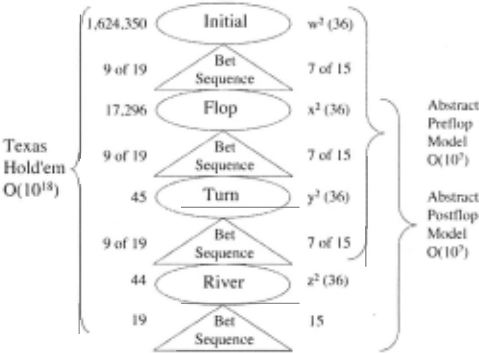
Texas Hold'em has an easily identifiable structure, alternat ing between chance nodes and betting rounds in four distinct stages. A high-level view of the imperfect information game tree is shown in Figure 1.
Hold'em can be reformulated to produce similar but much smaller games. The objective is to reduce the scale of the problem without severely altering the fundamental structure of the game, or the resulting optimal strategies. There are many ways of doing this, varying in the overall reduction and in the accuracy of the resulting approximation.
Some of the most accurate abstractions include suit equiv alence isomorphisms (offering a reduction of at most a factor of 4! = 24), rank equivalence (only under certain conditions), and rank near-equivalence. The optimal solutions to these ab stracted problems will either be exactly the same or will have a small bounded error, which we refer to as near-optimal so lutions. Unfortunately, the abstractions which produce an ex act or near-exact reformulation do not produce the very large reductions required to make full-scale poker tractable.
A common method for controlling the game size is deck reduction. Using less than the standard 52-card deck greatly reduces the branching factor at chance nodes. Other methods include reducing the number of cards in a player's hand (e.g. from a 2-card hand to a 1-card hand), and reducing the num ber of board cards (e.g. a 1-card flop), as was done by [Shi and Littman, 2001] for the game of Rhode Island Hold'em. [Koller and Pfeffer, 1997] used such parameters to generate a wide variety of tractable games to solve with their Gala sys tem.
We have used a number of small and intermediate sized games, ranging from eight cards (two suits, four ranks) to 24 cards (three suits, eight ranks) for the purpose of studying abstraction methods, comparing the results with known exact or near-optimal solutions. However, these smaller games are not suitable for use as an approximation for Texas Hold' em, as the underlying structures of the games are different. To produce good playing strategies for full-scale poker, we look for abstractions of the real game which do not alter that basic structure.
The abstraction techniques used in practice are powerful in terms of reducing the problem size, and subsume those previously mentioned. However, since they are also much cruder, we call their solutions pseudo-optimal, to emphasize that there is no guarantee that the resulting approximations will be accurate, or even reasonable. Some will be low-risk propositions, while others will require empirical testing to de termine if they have merit.
4.1 Betting round reduction
The standard rules of limit Hold' em allow for a maximum of four bets per player per round. 1 Thus in 2-player limit poker there are 19 possible betting sequences, of which two do not occur in practice. 2 Of the remaining 17 sequences, 8 end in a fold (leading to a terminal node in the game tree), and 9 end in a call (carrying forward to the next chance node). Using k = check, b = bet, f = fold, c = call, r = raise, and capital letters for the second player, the tree of possible betting sequences for each round is:
kK kBf kBc kBrF kBrC kBrRf kBrRc kBrRrF kBrRrC bF bC bRf bRc bRrF bRrC bRrRf bRrRc
We call this local collection of decision nodes a betting tree, and represent it diagramatically with a triangle.
With betting round reduction, each player is allowed a maximum of three bets per round, thereby eliminating the last two sequences in each line. The effective branching factor of the betting tree is reduced from nine to seven. This does not appear to have a substantial effect on play, or on the expected value (EV) for each player. This observation has been verified experimentally. In contrast, we computed the corresponding postflop models with a maximum of two bets per player per round, and found radical changes to the optimal strategies, strongly suggesting that that level of abstraction is not safe.
4.2 Elimination of betting rounds
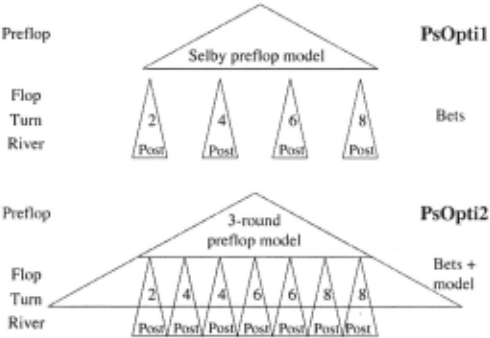
Large reductions in the size of a poker game tree can be ob tained by elimination of betting rounds. There are several ways to do this, and they generally have a significant impact on the nature of the game. First, the game may be truncated, by eliminating the last round or rounds. In Hold'em, ignor ing the last board card and the final betting round produces a 3-round model of the actual 4-round game. The solution to the 3-round model loses some of the subtlety involved in the true optimal strategy, but the degradation applies primarily to advanced tactics on the turn. There is a smaller effect on the flop strategy, and the strategy for the first betting round may have no significant changes, since it incorporates all the out comes of two future betting rounds. We use this particular abstraction to define an appropriate strategy for play in the first round, and thus call it a prefiop model (see Figure 2).
1 Some rules allow unlimited raises when only two players are involved. However, occasions with more than three legitimate raises are relatively rare, and do not greatly alter an optimal strategy.
2 Technically, a player may fold even though there is no outstand ing bet. This is logically dominated by not folding, and therefore does not occur in an optimal strategy, and is almost never seen in practice.
The effect of truncation can be lessened through the use of expected value leaf nodes. Instead of ending the game abruptly and awarding the pot to the strongest hand at that moment, we compute an average conclusion over all possible chance outcomes. For a 3-round model ending on the turn, we roll-out all 44 possible river cards, assuming no further betting (or alternately, assuming one bet per player for the last round). Each player is awarded a fraction of the pot, cor responding to their probability of winning the hand. In a 2round preflop model, we roll-out all 990 2-card combinations of the turn and river.
The most extreme form of truncation results in a 1-round model, with no foresight of future betting rounds. Since each future round provides a refinement to the approximation, this will not reflect a correct strategy for the real game. In par ticular, betting plans that extend over more than one round, such as deferring the raise of a very strong hand, are lost entirely. Nevertheless, even these simplistic models can be useful when combined with expected value leaf nodes.
Alex Selby computed an optimal solution for the game of prefiop Hold' em, which consists of only the first betting round followed by an EV roll-out of the five board cards to deter mine the winner [Selby, 1999]. Although there are some se rious limitations in the strategy based on this 1-round model, we have incorporated the Selby pre flop system into one of our programs, PsOptil, as described later in this section.
In contrast to truncating rounds, we can bypass certain early stages of the game. We frequently use postflop mod els, which ignore the preflop betting round, and use a single fixed flop of three cards (see Figure 1).
It is natural to consider the idea of independent betting rounds, where each phase of the game is treated in isolation. Unfortunately, the betting history from previous rounds will almost always contain contextual information that is critical to making appropriate decisions. The probability distribution over the hands for each player is strongly dependent on the path that led to that decision point, so it cannot be ignored without risking a considerable loss of information. However, the naive independence assumption can be viable in certain circumstances, and we do implicitly use it in the design of PsOptil to bridge the gap between the 1-round preflop model and the 3-round postflop model.
Another possible abstraction we explored was merging two or more rounds into a single round, such as creating a com bined 2-card tum/river. However, it is not clear what the ap propriate bet size should be for this composite round. In any case, the solutions for these models (over a full range of possi ble bet sizes), all turned out to be substantially different from their 3-round counterparts, and the method was therefore re jected.
4.3 Composition of preflop and postflop models
Although the nodes of an imperfect information game tree are not independent in general, some decomposition is possible. For example, the sub-trees resulting from different preflop betting sequences can no longer have nodes that belong to the same information set. 3 The sub-trees for our postflop models can be computed in isolation, provided that the appropriate preconditions are given as input. Unfortunately, knowing the correct conditional probabilities would normally entail solv ing the whole game, so there would be no advantage to the decomposition.
For simple postflop models, we dispense with the prior probabilities. For the postflop models used in PsOptiO and PsOptil, we simply ignore the implications of the pre flop betting actions, and assume a uniform distribution over all possible hands for each player. Different postflop solutions were computed for initial pot sizes of two, four, six, and eight bets (corresponding to preflop sequences with zero, one, two, or three raises, but ignoring which player initially made each raise). In PsOptil, the four postflop solutions are simply ap pended to the Selby preflop strategy (Figure 2). Although these simplifying assumptions are technically wrong, the re sulting play is still surprisingly effective.
A better way to compose postflop models is to estimate the conditional probabilities, using the solution to a preflop model. With a tractable preflop model, we have a means of estimating an appropriate strategy at the root, and thereby de terrnine the consequent probability distributions.
In Ps0pti2, a 3-round preflop model was designed and solved. The resulting pseudo-optimal strategy for the pre flop (which was significantly different from the Selby strat egy) was used to determine the corresponding distribution of hands for each player in each context. This provided the nec essary input parameters for each of the seven preflop betting sequences that carry over to the flop stage. Since each of these postflop models has been given (an approximation ot) the perfect recall knowledge of the full game, they are fully compatible with each other, and are properly integrated un der the umbrella of the preflop model (Figure 2). In theory, this should be equivalent to computing the much larger tree, but it is limited by the accuracy and appropriateness of the proposed preflop betting model.
4.4 Abstraction by bucketing
The most important method of abstraction for the computa tion of our pseudo-optimal strategies is called bucketing. This is an extension of the natural and intuitive concept that has been applied many times in previous research (e.g. [Sklansky and Malmuth, 1994] [Takusagawa, 2000] [Shi and Littman, 2001]). The set of all possible hands is partitioned into equiv alence classes (also called buckets or bins). A many-to-one mapping function determines which hands will be grouped together. Ideally, the hands should be grouped according to strategic similarity, meaning that they can all be played in a similar manner without much loss in EV.
If every hand was played with a particular pure strategy (ie. only one of the available choices), then a perfect mapping function would group all hands that follow the same plan, and
3 To see this, each decision node of the tree can be labeled with all the cards known to that player, and the full path that Jed to that node. Nodes with identical labels differ only in the hidden informa tion, and are therefore in the same information set. Since the betting history is different for these sub-trees, none of the nodes are inter dependent.
17 equivalence classes for each player would be sufficient for each betting round. However, since a mixed strategy may be indicated for optimal play in some cases, we would like to group hands that have a similar probability distribution over action plans.
One obvious but rather crude bucketing function is to group all hands according to strength (ie. its rank with respect to all possible hands, or the probability of currently being in the lead). This can be improved by considering the roll-out of all future cards, giving an (unweighted) estimate of the chance of winning the hand.
However, this is only a one-dimensional view of hand types, in what can be considered to be an N -dimensional space of strategies, with a vast number of different ways to classify them. A superior practical method would be to project the set of all hands onto a two-dimensional space con sisting of (roll-out) hand strength and hand potential (sim ilar to the hand assessment used in Poki, [Billings et al. , 2002]). Clusters in the resulting scattergram suggest reason able groups of hands to be treated similarly.
We eventually settled on a simple compromise. With n available buckets, we allocate n - 1 to roll-out hand strength. The number of hand types in each class is not uniform; the classes for the strongest hands are smaller than those for mediocre and weak hands, allowing for better discrimination of the smaller fractions of hands that should be raised or re raised.
One special bucket is designated for hands that are low in strength but have high potential, such as good draws to a flush or straight. This plays an important role in identifying good hands to use for bluffing (known as semi-bluffs in [Sklansky and Malmuth, 1994 ]). Comparing postflop solutions that use six strength buckets to solutions with five strength plus one high-potential bucket, we see that most bluffs in the latter are taken from the special bucket, which is sometimes played in the same way as the strongest bucket. This confirmed our expectations that the high-potential bucket would improve the selection of hands for various betting tactics, and increase the overall EV.
The number of buckets that can be used in conjunction with a 3-round model is very small, typically six or seven for each player (ie. 36 or 49 pairs of bucket assignments). Obviously this results in a very coarse-grained abstract game, but it may not be substantially different from the number of distinctions an average human player might make. Regardless, it is the best we can currently do given the computational constraints of this approach.
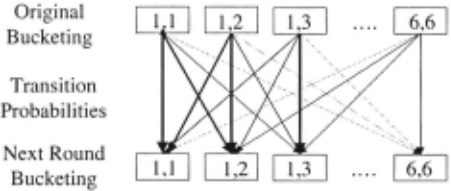
The final thing needed to sever the abstract game from the underlying real game tree are the transition probabilities. The chance node between the flop and tum represents a particular card being dealt from the remaining stock of 45 cards. In the abstract game, there are no cards, only buckets. The effect of the tum card in the abstract game is to dictate the probability of moving from one pair of buckets on the flop to any pair of buckets on the tum. Thus the collection of chance nodes in the game tree is represented by an ( n x n) to ( n x n) tran sition network as shown in Figure 3. For postflop models, this can be estimated by walking the entire tree, enumerating all transitions for a small number of characteristic flops. For preflop models, the full enumeration is more expensive (en compassing all { 48 choose 3} = 17296 possible flops), so it is estimated either by sampling, or by (parallel) enumeration of a truncated tree.
For a 3-round postflop model, we can comfortably solve abstract games with up to seven buckets for each player in each round. Changing the distribution of buckets, such as six for the flop, seven for the tum, and eight for the river, does not appear to significantly affect the quality of the solutions, better or worse.
The final linear programming solution produces a large ta ble of mixed strategies (probabilities for fold, call, or raise) for every reachable scenario in the abstract game. To use this, the poker-playing program looks for the corresponding situa tion based on the same hand strength and potential measures, and randomly selects an action from the mixed strategy.
The large LP computations typically take less than a day (using CPLEX with the barrier method), and use up to two Gigabytes of RAM. Larger problems will exceed available memory, which is common for large LP systems. Certain LP techniques such as constraint generation could potentially extend the range of solvable instances considerably, but this would probably only allow the use of one or two additional buckets per player.
5 Experiments
5.1 Testing against computer players
A series of matches between computer programs was con ducted, with the results shown in Table 1. Win rates are mea sured in small bets per hand (sb/h). Each match was run for at least 20,000 games (and over 100,000 games in some cases). The variance per game depends greatly on the styles of the two players involved, but is typically +1- 6 sb. The standard deviation for each match outcome is not shown, but is nor mally less than+/- 0.03 sb/h.
The "bot players" were:
Ps0pti2, composed of a hand-crafted 3-round preflop model, providing conditional probability distributions to each of seven 3-round postflop models (Figure 2). All models in this prototype used six buckets per player per round.
PsOptil, composed of four 3-round postflop models un der the naive uniform distribution assumption, with 7 buck ets per player per round. Selby's optimal solution for prefiop Hold' em is used to play the preflop ([Selby, 1999]).
PsOptiO, composed of a single 3-round postflop model, wrongly assuming uniform distributions and an initial pot size of two bets, with seven buckets per player per round. This program used an always-call policy for the preflop betting round.
Poki, the University of Alberta poker program. This older version of Poki was not designed to play the 2-player game, and can be defeated rather easily, but is a useful benchmark.
Anti-Poki, a rule-based program designed to beat Poki by exploiting its weaknesses and vulnerabilities in the 2-player game. Any specific counter-strategy can be even more vul nerable to adaptive players.
Aadapti, a relatively simple adaptive player, capable of slowly learning and exploiting persistent patterns in play.
Always Call, very weak benchmark strategy.
Always Raise, very weak benchmark strategy.
It is important to understand that a game-theoretic optimal player is, in principle, not designed to win. Its purpose is to not lose. An implicit assumption is that the opponent is also playing optimally, and nothing can be gained by observing the opponent for patterns or weaknesses.
In a simple game like RoShamBo (also known as Rock Paper-Scissors), playing the optimal strategy ensures a break even result, regardless of what the opponent does, and is therefore insufficient to defeat weak opponents, or to win a tournament ([Billings, 2000]). Poker is more complex, and in theory an optimal player can win, but only if the oppo nent makes dominated errors. Any time a player makes any choice that is part of a randomized mixed strategy of some game-theoretic optimal policy, that decision is not dominated. In other words, it is possible to play in a highly sub-optimal manner, but still break even against an optimal player, be cause those choices are not strictly dominated.
Since the pseudo-optimal strategies do no opponent model ing, there is no guarantee that they will be especially effective against very bad or highly predictable players. They must rely only on these fundamental strategic errors, and the margin of victory might be relatively modest as a result.
| No | Program | II | 2 | 3 | 4 | 5 | 6 | 7 | 8 |
|---|---|---|---|---|---|---|---|---|---|
| I | PsOptil | X | +0.090 | +0.091 | +0.251 | +0.156 | +0.047 | +0.546 | +0.635 |
| 2 | Ps0pti2 | -0.090 | X | +0.069 | +0.118 | +0.054 | +0.045 | +0.505 | +0.319 |
| 3 | PsOptiO | -0.091 | -0.069 | X | +0.163 | +0.135 | +0.001 | +0.418 | +0.118 |
| 4 | Aadapti | -0.251 | -0.118 | -0.163 | X | +0.178 | +0.550 | +0.905 | +2.615 |
| 5 | Anti-Poki | -0.156 | -0.054 | -0.135 | -0.178 | X | +0.385 | +0.143 | +0.541 |
| 6 | Poki | -0.047 | -0.045 | -0.001 | -0.550 | -0.385 | X | +0.537 | +2.285 |
| 7 | Always Call | -0.546 | -0.505 | -0.418 | -0.905 | -0.143 | -0.537 | X | -0.000 |
| 8 | Always Raise | -0.635 | -0.319 | -0.118 | -2.615 | -0.541 | -2.285 | -0.000 | X |
The critical question is whether such errors are common in practice. There is no definitive answer to this question yet, but preliminary evidence suggests that dominated errors oc cur often enough to gain a measurable EV advantage over weaker players, but may not be very common in the play of very good players.
The first tests of the viability of pseudo-optimal solutions were done with PsOptiO playing postfiop Hold'em, where both players agree to simply call in the preflop (thereby matching the exact pre-conditions for the postflop solution). In those preliminary tests, a poker master (the first author) played more than 2000 hands, and was unable to defeat the pseudo-optimal strategy. In contrast, Poki had been beaten consistently at a rate of over 0.8 sb/h (which is more than would be lost by simply folding every hand).
Using the same no-bet preflop policy, PsOptiO was able to defeat Poki at a rate of +0.144 sb/h (compared to +0.001 sb/h for the full game including pre flop), and defeated Aadapti at +0.410 sb/h (compared to +0.163 sb/h for the full game).
All of the pseudo-optimal players play substantially bet ter than any previously existing computer programs. Even PsOptiO, which is not designed to play the full game, earns enough from the postflop betting rounds to offset the EV losses from the preflop round (where it never raises good hands, nor folds bad ones).
It is suspicious that PsOptil outperformed Ps0pti2, which in principle should be a better approximation. Subsequent analysis of the play of Ps0pti2 revealed some programming errors, and also suggested that the bucket assignments for the preflop model were flawed. This may have resulted in an in accurate pseudo-optimal pre flop strategy, and consequent im balances in the prior distributions used as input for the post flop models. We expect that this will be rectified in future versions, and that the Ps0pti2 design will surpass PsOptil in performance. ·
5.2 Testing against human players
While these results are encouraging, none of the non-pseudo optimal computer opponents are better than intermediate strength at 2-player Texas Hold'em. Therefore, matches were conducted against human opponents.
More than 100 participants volunteered to play against the pseudo-optimal players on our public web applet (www. cs. ualberta. ca/-games/poker /),including many expe rienced players, a few masters, and one world-class player. The programs provided some fun opposition, and ended up with a winning record overall. The results are summarized in Table 2 and Table 3. (Master-} is the first author, Experienced- I is the third author).
| Player | II Hands | Posn I | Posn 2 | sb/h |
|---|---|---|---|---|
| Master-! early | 1147 | -0.324 | +0.360 | +0.017 |
| Master-! late | 2880 | -0.054 | +0.396 ' | +0.170 |
| Experienced-! | 803 | +0.175 | +0.002 | +0.088 |
| Experienced-2 | 1001 | -0.166 | -0.168 | -0.167 |
| Experienced-3 | 1378 | +0.119 | -0.016 | +0.052 |
| Experienced -4 | 1086 | +0.042 | -0.039 | +0.002 |
| Intermediate-! | 2448 | +0.031 | +0.203 | +0.117 |
| Novice-! | 1277 | -0.159 | -0.154 | -0.156 |
| All Opponents | II 15125 | I | 1 -o.o15 |
| Player | II Hands | I Posn I | I Posn 2 | I sb/h |
|---|---|---|---|---|
| thecount | 7030 | -0.006 | +0.103 | +0.048 |
| Master-! | 2872 | +0.141 | +0.314 | +0.228 |
| Master-2 | 569 | -0.007 | +0.035 | +0.014 |
| Master-3 | 425 | +0.047 | +0.373 | +0.209 |
| Experienced -I | 4078 | -0.058 | +0.164 | +0.053 |
| Experienced-2 | 511 | +0.152 | +0.369 | +0.260 |
| Experienced-3 | 2303 | -0.252 | +0.128 | -0.062 |
| Experienced-5 | 610 | -0.250 | -0.229 | -0.239 |
| Intermediate-! | 16288 | -0.145 | +0.048 | -0.049 |
| Intermediate-2 | 478 | -0.182 | +0.402 | +O.IJO |
| Novice-! | 5045 | -0.222 | -0.010 | -O.ll6 |
| Novice-2 | 485 | -0.255 | -0.139 | -0.197 |
| Novice-3 | 1017 | -0.369 | -0.051 | -0.210 |
| Novice-4 | 583 | -0.053 | -0.384 | -0.219 |
| Novice-5 | 425 | -0.571 | -0.296 | -0.433 |
| I All Opponents | II 46479 | I | 1 -o.o57 |
In most cases, the relatively short length of the match leaves a high degree of uncertainty in the outcome, limit ing how much can be safely concluded. Nevertheless, some players did appear to have a definite edge, while others were clearly losing.
A number of interesting observations were made over the course of these games. It was obvious that most people had a lot of difficulty learning and adjusting to the computer's style of play. In poker, knowing the basic approach of the oppo nent is essential, since it will dictate how to properly handle many situations that arise. Some players wrongly attributed intelligence where none was present. After losing a 1000game match, one experienced player commented "the bot has me figured out now", indicating that its opponent model was accurate, when in fact the pseudo-optimal player is oblivious and does no modeling at alL
It was also evident that these programs do considerably better in practice than might be expected, due to the emo tional frailty of their human opponents. Many players com mented that playing against the pseudo-optimal opponent was an exasperating experience. The bot routinely makes uncon ventional plays that confuse and confound humans. Invari ably, some of these "bizarre" plays happen to coincide with a lucky escape, and several of these bad beats in quick succes sion will often cause strong emotional reactions (sometimes referred to as "going on tilt"). The level of play generally goes down sharply in these circumstances.
This suggests that a perfect game-theoretic optimal poker player could perhaps beat even the best humans in the long run, because any EV lost in moments of weakness would never be regained. However, the win rate for such a program could still be quite small, giving it only a slight advantage. Thus it would be unable to exert its superiority convincingly over the short term, such as the few hundred hands of one session, or over the course of a world championship tourna ment. Since even the best human players are known to have biases and weaknesses, opponent modeling will almost cer tainly be necessary to produce a program that surpasses all human players.
5.3 Testing against a world-class player
The elite poker expert was Gautam Rao, who is known as "thecount" or "CountDracula" in the world of popular online poker rooms. Mr. Rao is the #1 all-time winner in the history of the oldest online game, by an enormous margin over all other players, both in total earnings and in dollar-per-hand rate. His particular specialty is in short-handed games with five or fewer players. He is recognized as one of the best players in the world in these games, and is also exceptional at 2-player Hold'em. Like many top-flight players, he has a dynamic ultra-aggressive style.
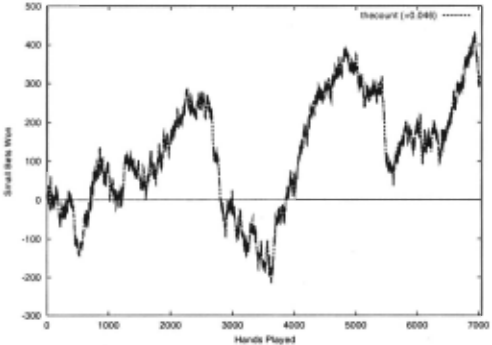
Mr. Rao agreed to play an exhibition match against PsOptil, playing more than 7000 hands over the course of several days. The graph in Figure 4 shows the progression of the match.
The pseudo-optimal player started with some good fortune, but lost at a rate of about -0.2 sb/h over the next 2000 hands. Then there was a sudden reversal, following a series of for tuitous outcomes for the program. Although "thecount" is renown for his mental toughness, an uncommon run of bad luck can be very frustrating even for the most experienced players. Mr. Rao believes he played below his best level dur ing that stage, which contributed to a dramatic drop where he lost 300 sb in less than 400 hands. Mr. Rao resumed play the following day, but was unable to recover the losses, slipping further to -200 sb after 3700 hands. At this point he stopped play and did a careful reassessment.
It was clear that his normal style for maximizing income against typical human opponents was not effective against the pseudo-optimal player. Whereas human players would nor mally succumb to a lot of pressure from aggressive betting, the bot was willing to call all the way to the showdown with as little as a Jack or Queen high card. That kind of play would be folly against most opponents, but is appropriate against an extremely aggressive opponent. Most human players fail to make the necessary adjustment under these atypical condi tions, but the program has no sense of fear.
Mr. Rao changed his approach to be less aggressive, with immediate rewards, as shown by the +600 sb increase over the next 1100 hands (some of which he credited to a good run of cards). Mr. Rao was able to utilize his knowledge that the computer player did not do any opponent modeling. Knowing this allows a human player to systematically probe for weak nesses, without any fear of being punished for playing in a methodical and highly predictable manner, since an oblivious opponent does not exploit those patterns and biases.
Although he enjoyed much more success in the match from that point forward, there were still some "adventures", such as the sharp decline at 5400 hands. Poker is a game of very high variance, especially between two opponents with sharp styles, as can be seen by the dramatic swings over the course of this match. Although 7000 games may seem like a lot, Mr. Rao's victory in this match was still not statistically conclusive.
We now believe that a human poker master can eventu ally gain a sizable advantage over these pseudo-optimal pro totypes (perhaps +0.20 sb/h or more is sustainable). However, it requires a good understanding of the design of the program and its resulting weaknesses. That knowledge is difficult to learn during normal play, due to the good information hiding provided by an appropriate mixture of plans and tactics. This "cloud of confusion" is a natural barrier to opponent learning. It would be even more difficult to learn against an adaptive program with good opponent modeling, since any methodical testing by the human would be easily exploited. This is in stark contrast to typical human opponents, who can often be accurately modeled after only a small number of hands.
6 Conclusions and Future Work
The pseudo-optimal players presented in this paper are the first complete approximations of a game-theoretic optimal strategy for a full-scale variation of real poker.
Several abstraction techniques were explored, resulting in the reasonably accurate representation of a large imperfect information game tree having 0(10 18 ) nodes with a small collection of models of size 0(10 7 ). Despite these massive reductions and simplifications, the resulting programs play respectably. For the first time ever, computer programs are not completely outclassed by strong human opposition in the game of 2-player Texas Hold'em.
Useful abstractions included betting tree reductions, trun cation of betting rounds combined with EV leaf nodes, and bypassing betting rounds. A 3-round model anchored at the root provided a pseudo-optimal strategy for the preflop round, which in tum provided the proper contextual informa tion needed to determine conditional probabilities for post flop models. The most powerful abstractions for reducing the problem size were based on bucketing, a method for parti tioning all possible holdings according to strategic similarity. Although these methods exploit the particular structure of the Texas Hold' em game tree, the principles are general enough to be applied to a wide variety of imperfect information do mains.
Many refinements and improvements will be made to the basic techniques in the coming months. Further testing will also continue, since accurate assessment in a high variance domain is always difficult.
The next stage of the research will be to apply these tech niques to obtain approximations of Nash equilibria for N player Texas Hold'em. This promises to be a challenging ex tension, since multi-player games have many properties that do not exist in the 2-player game.
Finally, having reasonable approximations of optimal strategies does not lessen the importance of good oppo nent modeling. Learning against an adaptive adversary in a stochastic game is a challenging problem, and there will be many ideas to explore in combining the two different forms of information. That will likely be the key difference between a program that can compete with the best, and a program that surpasses all human players.
Quoting "thecount":
"You have a very strong program. Once you add opponent modeling to it, it will kill everyone."
Acknowledgments
The authors would like to thank Gautam Rao, Sridhar Mutyala, and the other poker players for donating their valu able time. We also wish to thank Daphne Koller, Michael Littman, Matthew Ginsberg, Rich Sutton, David McAllester, Mason Malmuth, and David Sklansky for their valuable in sights in past discussions.
This research was supported in part by grants from the Nat ural Sciences and Engineering Research Council of Canada (NSERC), the Alberta Informatics Circle of Research Excel lence (iCORE), and an Izaak Walton Killam Memorial post graduate scholarship.
@inproceedings{ijcai2003p97,
  title     = {Approximating Game-Theoretic Optimal Strategies for Full-scale Poker},
  author    = {Billings, Darse and Burch, Neil and Davidson, Aaron and Holte, Robert C. and Schaeffer, Jonathan and Schauenberg, Terence and Szafron, Duane},
  booktitle = {Proceedings of the Eighteenth International Joint Conference on
               Artificial Intelligence, {IJCAI-03}},
  publisher = {International Joint Conferences on Artificial Intelligence},
  editor    = {Georg Gottlob and Toby Walsh},
  pages     = {661--667},
  year      = {2003},
  url       = {https://ijcai.org/proceedings/2003/97},
}
TY - CPAPER TI - Approximating Game-Theoretic Optimal Strategies for Full-scale Poker AU - Billings, Darse AU - Burch, Neil AU - Davidson, Aaron AU - Holte, Robert C. AU - Schaeffer, Jonathan AU - Schauenberg, Terence AU - Szafron, Duane T2 - Proceedings of the Eighteenth International Joint Conference on Artificial Intelligence, IJCAI-03 PB - International Joint Conferences on Artificial Intelligence PY - 2003 SP - 661 EP - 667 UR - https://ijcai.org/proceedings/2003/97 ER -Copied
Machine-readable versions of this paper, for tools and AI agents:





