
Does a New Simple Gaussian Weighting Approach Perform Well in Text Categorization?
Proceedings of the Eighteenth International Joint Conference on Artificial Intelligence. Pages 581-585.
© 2003 International Joint Conferences on Artificial Intelligence
Abstract
A new approach to the Text Categorization problem is here presented. It is called Gaussian Weighting and it is a supervised learning algorithm that, during the training phase, estimates two very simple and easily computable statistics which are: the Presence P, how much a term tis present in a category c; the Expressiveness E, how much t is present outside c in the rest of the domain. Once the system has learned this information, a Gaussian function is shaped for each term of a category, in order to assign the term a weight that estimates the level of its importance for that particular category. We tested our learning method on the task of single-label classification using the Reuters-21578 benchmark. The outcome of the result was quite impressive: in different experimental setups, we reached a microaveraged F1-measure of0 .89, with a peak of0 .899. Moreover, a macro-averaged Recall and Precision was calculated: the former reported a 0.72, the latter a 0.79. These results reach most of the stateof-the-art techniques of machine learning applied to Text Categorization, demonstrating that this new weighting scheme does perform well on this particular task.
- [Chickering eta!., 1997] D. Chickering, D. Heckerman, and C. Meek. A bayesian approach for learning bayesian net- works with local structure. In Proceedings of Thirteenth Conference on Uncertainty in Artificial Intelligence, pages 307-315. Springer Verlag, Heidelberg, DE, 1997.
- [Dumais eta!., 1998] S. Dumais, J. Platt, D. Heckerman, and M. Sahami. Inductive learning algorithms and representa- tions for text categorization. In Proceedings of the Seventh International Conference on Information and Knowledge Management, pages 148-155. ACM Press, 1998.
- [Hull, 1994] D.A. Hull. Information Retrieval Using Statis- tical Classification. PhD thesis, University of Stanford, 1994.
- [Joachims, 1998] T. Joachims. Text categorization with sup- port vector machines: learning with many relevant fea- tures. In C. Nedellec and C. Rouveirol, editors, Proceed- ings of ECML-98, 1Oth European Conference on Machine Learning, number 1398, pages 137-142, Chemnitz, DE, 1998. Springer Verlag, Heidelberg, DE.
- [Kohavi and John, 1997] R. Kohavi and G. H. John. Wrap- pers for feature subset selection. Artificial Intelligence, 97(1-2):273-324, 1997.
- [Lewis, 1998] D. D. Lewis. Naive (Bayes) at forty : The independence assumption in information retrieval. In C. Nedellec and C. Rouveirol, editors, Proceedings of ECML-98, lOth European Conference on Machine Learn- ing, number 1398, pages 4-15, Chernnitz, DE, 1998. Springer Verlag, Heidelberg, DE.
- [Rocchio, 1971] J.J. Rocchio. Relevance feedback in infor- mation retrieval. In The SMART Retrieval System: Exper- iments in Automatic Document PRocessing, pages 313- 323 .
- G.Salton editor, 1971.
- [Sahami, 1996] M. Sahami. Learning limited dependence Bayesian classifiers. In Second International Conference on Knowledge Discovery in Databases, 1996.
- [Sebastiani, 2002] F. Sebastiani. Machine learning in auto- mated text categorization. ACM Computing Surveys, Vol. 34, No.1, pp.l-47, 2002.
- [Yang and Liu, 1999] Y. Yang and X. Liu. A re-examination of text categorization methods. In 22nd Annual Interna- tional SIGIR, pages 42--49, Berkley, 1999.
- [Yang and Pedersen, 1997] Y. Yang and J. 0. Pedersen. A comparative study on feature selection in text categoriza- tion. In Douglas H. Fisher, editor, Proceedings of ICML- 97, 14th International Conference on Machine Learning, pages 412--420, Nashville, US, 1997.
References were extracted automatically from the PDF and may contain errors.
Full text extracted automatically from the PDF; figures, tables and equations may differ. The PDF is the version of record.
1 Introduction
Consider the problem of automated classification of text doc uments. This problem is of great importance as the accessible textual information increases and the volume of online texts available through the Internet expands rapidly. One solution is to categorize documents according to their topics before hand or in real time.
A number of different Machine Learning methods have been applied and to Text Categorization (TC), including prob abilistic classifiers, decision trees, regression methods, neu ral networks and support vector machines (see [Sebastiani, 2002]). Most of these methodologies share a common factor of high level complexity, that, often, makes a classifier design difficult to understand.
The question addressed in this paper is if it is possible to find a simple learning algorithm that uses naive, human com prehensible parameters, in such a way as to act like a non- Dip. di Informatica e Automazione Universita degli Studi "Roma Tre" micarel@dia.uniroma3 .it expert human being in front of the problem of classifying new unknown documents.
Starting from this idea of simplicity, we decided to design a training algorithm that corresponds to the action of finding two information parameters: given a set of categories C of documents, for each term t of a category c E C we calcu late its Presence P, that is, the percent of documents of the category c in which the term t appears at least once; and its Expressiveness E, that is, how much the term t is absent in the other categories of the domain. Then, we model a Gaus sian Function with the two parameters above, whose value in the abscissae equal to 1 is used as the weight of the term t. We called this learning approach Gaussian Weighting. It is important to stress the fact that we don't use any stemming algorithm or Feature Selection function (see [Yang and Peder sen, 1997]). An eventual reduction of the number of features per category is done using only two thresholds named ThresP and ThresE, relative to the parameters P and E.
To make the evaluation of Gaussian Weighting comparable to most of the published results on TC, we chose the Reuters215781 corpus as benchmark for the single-label classifica tion task. Three different tests have been performed with a complete automated learning approach: the first run has been done without the use of a Gaussian Function, but simply giv ing a weight proportional toP and E; the second and the third test runs have been done with the Gaussian Weighting ap proach proposed here.
The outcome of the results was quite surprising: through out the different experimental setups, we repeatedly reached a micro-averaged F1-measure around the 0.89, with a peak of 0.899. Then, since the micro-average is known to be highly influenced by frequent categories (see [Yang and Liu, 1999]), we decided to compute the macro-averaged Recall and Pre CISion. Again, the results reached a satisfactory macro Recall around 0.72 and a macro-Precision of 0.79. These results reach most of the state-of-the-art techniques of ma chine learning applied to Text Categorization (see [Dumais eta/., 1998]), demonstrating that this new weighting scheme does perform well on this particular task. Moreover, the low computational cost of the algorithm we propose, makes this approach particularly preferable when the computing power is low.
1 www.daviddlewis.com/resources/testcollection/reuters21578
2 The Algorithm
In this section we present our supervised algorithm. First, we will analytically define the two parameters: Presence P and Expressiveness E. Then, we will explain how the training al gorithm works and how the system classifies new documents at run-time.
2.1 Presence P and Expressiveness E
A central key of this naive approach is the computation of two easy human understandable parameters that we call: Pres ence P, and Expressiveness E. The former captures how much a term t appears at least once in the documents belonging to a category c, the latter estimates how much the same term t does not appear in the documents of the other cat egories. Given a set of categories C = {c1, c2, ... , Ci, ... , en}, each category having a number of documents m, (e.g. c1 = {di,l,dl,2, ... ,dl,j,···,dl,m}), we give the following definitions:
- The number of documents Di of the i-th category is:
- the number of documents of category i in which the term t is present:
Note that we use the symbol 'I' to denote the presence of a term inside a category or a document. This is not to be confused with the same symbol when used for the conditional probability (P(xly)).
Then, the Presence P of a term t in the i-th category is, using (I) and (2):
while, the Expressiveness E of term t in the i-th category is calculated using 1, 2):
It is important to stress that the same term in different cat egories has different values of expressiveness. This fact is better explained in Table 1. A term t is present in all the three categories with presence Pilt shown in the first row. The sec ond row is the expressiveness Eilt of the same term for each category. Note how t of category c1 has a greater expressive ness given the relatively smaller presence of the term in the rest of the domain.
| C1 | C2 | CJ | |
|---|---|---|---|
| pilt | 0.9 | 0.4 | 0.2 |
| Eilt | 0.7 | 0.45 | 0.35 |
Locality of Presence and Expressiveness
The approach uses a weighting method for terms per each class, which is in a sense a local type of weighting/modeling scheme of classes. This idea is similar to the Local LSI rep resentation [Hull, 1994] where, in order to characterize the term space, the singular value decomposition is applied to a matrix consisting only of the known relevant documents (in our case the documents belonging to a class).
There are substantial differences with the Tf!df weight ing scheme. Tf counts the number of occurrences of a term t in a document, while P counts the documents in which t ap pears at least once. Idf computes the number of documents in which t appears over the whole collection, meanwhile E calculates, according to which class we are computing the weights, the partial averaged Presence oft in the domain.
2.2 Learning the Gaussian Weights (GW)
In this paragraph we explain how we shape a Gaussian func tion using the values P and E. Starting from the definition of a generic Gaussian function:
we estimate the parameters jl and & 2 as follows:
Then, the Gaussian Weighting GW for a term t of a cate gory i is defined, substituting (6) and (7) in (5), as:
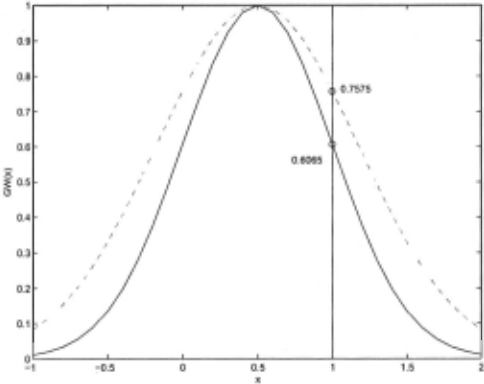
The GW calculated for x = 1, returns a real value belonging to the (0,1] interval. In particular, the maximum weight can be reached only when the Presence of a term is equal to I, that is to say, when it appears in each document of the category of interest. Figure I shows an example of a GW with P = 0.5 and E = 0.5 (continuous), and another one with P = 0.5 and E = 0.9 (dashed); when two terms have the same Presence, the one with a higher Expressiveness has a higher weight too.
Computing the parameter P
The algorithm to compute P is the following:
- For each category Ci E C
- Di = 0
- For each document di,j E Ci
- Di = Di + 1
- For each unique term tin di,j
- ift is in Dilt
- then Dilt = Dilt + 1
- else Add Dilt = 1
- end For
- end For
- For each term in Dilt
- .0.1!. 12. Pijt = D;
- end For
- end For
If we assume we can use a HashMap HM to store the results of Dilt , such that any update or search in the HM has a con stant cost k, in the worst case the algorithm to compute the parameter P has a computational cost of 0( C x D x T x k ).
Computing the parameter E
The algorithm to compute E is the following:
- For each category Ci E C
- sum= 0
- For each term tin Pilt
- For each category Cj E C where i =f. j
- ift in P j lt
- then sum= sum+ Pjlt
- end For
- E _ 1 sum *- - ICI-1
- end For
- end For
Again, if we assume that Pjlt is a HashMap with a constant cost k of access and search, the computational cost of this second algorithm is 0(0 2 x T x k), which is quadratic cost with respect to the number of categories C.
2.3 Categorizing a new document
Once the system has been trained and the parameters P and E have been found for each term of the domain, it is possible to feed the system with an unknown document and, according to the value of a couple of optional thresholds ThresP and ThresE, classify it with the following algorithm:
- For each ci E C
- outputci = 0, N term = 0
- For each term in Pilt
- ift is in test And Pilt > ThresP And Eilt > ThresE
- then outputci = outputci + GW(l, t, c) Nterm = Nterm + 1
- end For
- outputci = outputc; n
- end For
- Assign the document to the ci with the highest outputci
For each category, the algorithm calculates, the mean of the activated Gaussian functions of the terms whose Pilt and Eilt are greater than two fixed thresholds, respectively ThresP and ThresE. The computational cost of this algorithm is 0( C x T X k).
3 Experimental Setup
3.1 Test Collection
To make the evaluation of GW comparable to most of the published results on TC, we chose the Reuters-21578 corpus as benchmark. During the last few years this corpus has been used as a standard benchmark on which many TC methods have been evaluated, although the results are sometimes dif ficult to compare as slightly different version have been used. For this paper we used the ModApte split of Reuters-21578 in which 75% of the stories (9603) are used as training doc uments to build the classifier and the remaining 25% (3299) to test the accuracy of our single-label classifier. Now, the Reuters-21578 is known to be quite unbalanced on the distri bution of stories per category. Therefore, of the 135 poten tial topics categories only the 10 most frequent are here used; these 10 categories account for almost the 75% of the training instances, while the remainder is distributed among the other 115. Table 2 shows the number of training and test samples for each category.
| Category | #Training | #Test |
| Earn | 2877 | 1087 |
| Acquisitions | 1650 | 719 |
| Money-fx | 538 | 179 |
| Grain | 433 | 149 |
| Crude | 389 | 189 |
| Trade | 369 | 118 |
| Interest | 347 | 131 |
| Ship | 197 | 89 |
| Wheat | 212 | 71 |
| Corn | 182 | 56 |
3.2 Parameters Setting
We performed three different test runs on our system:
- The 'what if?' test run: what if we didn't use a Gaus sian function? we tried to run our system with the most simple function we could use: GW = P · E
- The GW test run: uses the GW function defined in equa tion (8)
- The simple GW test run: we simplified the Gaussian function with a variance equal to 0" 2 = Pt,l
All the tests maintained ThresE equal to 0.6, that is to say, a term in a category should have an Expressivity value greater than 0.6. This value permitted to achieve the highest perfor mance during the test phase. ThresP has been varied in the range between 0.0 (all the terms of the categories were used) and 0.5 (only the terms present in the 50% of the training documents were used).
The number of terms per category according to the value P is reported in Table 3.
| 0,0 | 0,1 | 0,2 | 0,3 | 0,4 | 0,5 | |
|---|---|---|---|---|---|---|
| acq | 11115 | 65 | 15 | 7 | 6 | 3 |
| com | 3257 | 82 | 20 | 12 | 7 | 3 |
| crude | 6126 | 99 | 24 | 12 | 4 | 1 |
| earn | 10455 | 46 | 19 | 12 | 9 | 6 |
| gram | 5448 | 64 | 17 | 10 | 5 | 3 |
| interest | 3863 | 92 | 20 | 9 | 6 | 4 |
| money-fx | 5545 | 116 | 30 | 13 | 4 | 2 |
| ship | 4084 | 80 | 17 | 3 | 0 | 0 |
| trade | 5795 | 149 | 37 | 17 | 6 | 3 |
| wheat | 3543 | 75 | 17 | 10 | 4 | 4 |
| feat/cat | 592.3 | 87.8 | 21.6 | 10.5 | 5.1 | 2.9 |
A stoplist of 331 terms has been used to remove the most frequent words of the English Language, but no stemming or Feature Selection have been performed.
In order to evaluate the accuracy of the classifier we have computed the standard IR measures, such as Recall and Pre cision, and the following averaging measures: micro-Recall (pRe), micro-Precision (pPr) and micro-averaged F1 mea sure (micro-F1):
In particular we have reported the values of the F1-measure in order to directly compare our results with the ones in the literature. But, since the micro-averaged measure is known to be highly influenced by the most frequent category (see
[Yang and Pedersen, 1997]), we have decided to calculate the Macro-Recall (MRe) and the Macro-Precision (MPr)), as well:
4 Results
4.1 The 'What if?' test run
In this test, the weight of each term t of a category i is com puted as:
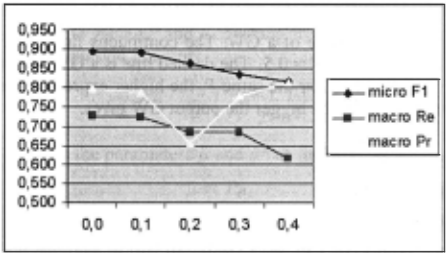
The 'What if?' test run results are shown in Figure 2.
| 0.0 | 0.10 | 0.20 | 0.30 | 0.40 | 0.50 | |
|---|---|---|---|---|---|---|
| micro F1 | 0.894 | 0.891 | 0.862 | 0.836 | 0.816 | * |
| macro Re | 0.727 | 0.725 | 0.682 | 0.684 | 0.615 | * |
| macro Pr | 0.797 | 0.789 | 0.656 | 0.778 | 0.814 | * |
In this particular test we did nOt expect so remarkable a performance. Considering the weight of a term proportional to the parameters P and E seems to be another possible solu tion to investigate. The performance of the system seems not to be influenced significantly when the threshold ThresP is set either to 0.0 or 0.1. It is worth stressing that this test per formed better when all the terms (except those belonging to the stoplist) were used.
4.2 The GW test run
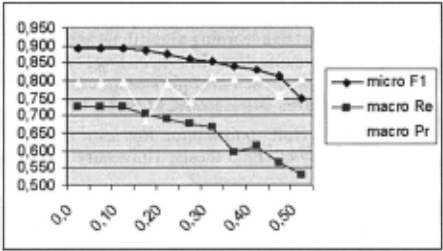
The results of this run are shown in Figure 3, while numerical values are reported in Table 5.
This test has been performed using equation (8) to calcu late the weight of each term of the category. The best results have been obtained with ThresP = 0.1. Macro-Recall and macro-Precision are quite high, and they indicate that the sys tem works well for every category. The performance of the system starts to decrease sensibly when ThresP > 0.2
| 0.0 | 0.10 | 0.20 | 0.30 | 0.40 | 0.50 | |
|---|---|---|---|---|---|---|
| micro Fl | 0.892 | 0.893 | 0.876 | 0.856 | 0.832 | 0.748 |
| macro Re | 0.726 | 0.725 | 0.692 | 0.666 | 0.613 | 0.532 |
| macro Pr | 0.794 | 0.797 | 0.789 | 0.810 | 0.809 | 0.804 |
4.3 The Simple GW test run
The results of this second run are shown in Figure 4. Numer ical values are reported in Table 6.
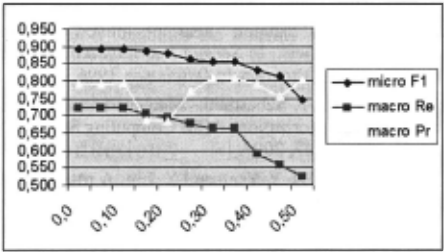
This test has been performed using a simplified version of equation (8) to calculate the weight of each term of the cat egory. The variance of the Gaussian function is set to a 2 = Pt ,l· The best results have been obtained with ThresP = 0.1, there does not seem to be any particular difference with the GW test run, except in cases when ThresP equals 0.2, where the macro Precision is sensibly lower.
4.4 Discussion
The results reported above are satisfactory. In many situa tions the system reached an accuracy comparable to the ones in the state-of-the-art systems. Some aspects need to be dis cussed here: the performance of the system in all the test runs decades when ThresP exceeds the 0.2, that is to say, looking back to Table (3 ), when the number of features per category decreases from almost 90 to almost 20. This sharp decay influences the macro-averaged performance of the sys tem. In fact, while the macro-Recall retains the same values, the macro-Precision is cut-off by almost 10%. This fact in dicates that the system is incorrectly assigning the stories to all the categories of the domain rather that to the biggest ones only. As the ThresP gets bigger, the performance of the sys tem shows the classic behavior in which the Recall tends to 0 and the Precision to 1.
| 0.0 | 0.10 | 0.20 | 0.30 | 0.40 | 0.50 | |
|---|---|---|---|---|---|---|
| micro Fl | 0.891 | 0.893 | 0.877 | 0.855 | 0.830 | 0.747 |
| macro Re | 0.722 | 0.720 | 0.693 | 0.662 | 0.588 | 0.524 |
| macro Pr | 0.791 | 0.793 | 0.685 | 0.806 | 0.791 | 0.802 |
For the 'what if?' test run we didn't expect such good re sults. The simple proportional weight assignment performed as well as the other approaches, nevertheless the performance decays slightly more rapidly. This test was very important for us to confirm the idea of using a simplified learning approach to solve the problem ofTC.
The second and the third test runs show almost the same values. The one-per-thousand differences are not to be con sidered relevant. At the moment, we cannot draw any con clusion about which of the three learning approaches will perform better in general. We plan to investigate this mat ter testing on the complete Reuters-21578 and on other test collections.
Comparative Results
Dumais et al. tested a number of inductive learning algo rithms on the same Reuters-21578 ModApte split we used ([Dumais et al., 1998]). These results are briefly summi rized in Table 7 for the 10 most frequent categories. The
| Method | Performance |
|---|---|
| FindSim | 0.64 |
| Naive Bayes | 0.81 |
| BayesNets | 0.85 |
| Tree | 0.88 |
| Linear SVM | 0.92 |
FindSim method is a variant of Rocchio's method for rele vance feedback([Rocchio, 1971]). The Naive Bayes classifier is constructed by using the training data to estimate the prob ability of each category given the document feature values of a new instance. A discussion of the indipendence assump tion of naive bayes classifier can be found in ([Lewis, 1998]). BayesNets is a bayesian network, that uses 2-dependence Bayesian (see [Sahami, 1996] for another example of Bayes nets for classification). Tree is a Decision Tree approach de scribed in ([Chickering et al., 1997]). Meanwhile, Linear SVM is a linear hyperplane that separates a set of positive examples from a set of negative ones ([Joachims, 1998]).
Both SVMs and Decision Trees produce very high overall classification accuracy. As the results of Table 7 are directly comparable with ours, our Gaussian Weighting approach is placed just behind the SVMs, which are known to be the best machine learning method in the field of text classification, with a micro-averaged F1-measure of 0.893 of the first two test runs. This result is important for two reasons: it demon strates that this new learning method does perform well on this particular task, and encourage us to further investigate other fields of application, in which GW's simplicity could perform as well as other state-of-the-art machine learning methods.
5 Future Work
Two are the most compelling issues that we are going to com plete in the future work are two:
- Incorporate a wrapper phase [Kohavi and John, 1997] to run systematically varying experiments with (i) using Expressiveness or not, (ii) varying values ofThresP and ThresE, (iii) varying values of GW variance, and (iv) using a Gaussian function or not;
- Test the full Reuters benchmark data rather than restrict ing ourselves to only the 10 most frequent categories, and on other collections like 20 Newsgroups 2 or Med Line 3 ·
6 Conclusions
In this paper we addressed the problem of finding a simple learning algorithm that uses naive, human comprehensible parameters. A very accurate text classifier can be learned au tomatically by using only two information parameters: pres ence P and expressivity E. The algorithm proposed here has, in the worst case, a quadratic computational cost, with respect to the number of categories of documents. We tested GW on the Reuters-21578 benchmark and calculated the micro averaged F1-measure to directly compare our results with the ones of the literature, and the macro-Recall and macro Precision. The results achieved are satisfactory and can be compared to most state-of-the-art machine learning methods applied to TC.
Acknowledgments
We are grateful to the anonymous reviewers for their insight ful and helpful comments. The authors would also like to thank Prof. Maristella Agosti for her valuable comments and suggestions to improve the paper.
@inproceedings{ijcai2003p86,
  title     = {Does a New Simple Gaussian Weighting Approach Perform Well in Text Categorization?},
  author    = {Di Nunzio, Giorgio Maria and Micarelli, Alessandro},
  booktitle = {Proceedings of the Eighteenth International Joint Conference on
               Artificial Intelligence, {IJCAI-03}},
  publisher = {International Joint Conferences on Artificial Intelligence},
  editor    = {Georg Gottlob and Toby Walsh},
  pages     = {581--585},
  year      = {2003},
  url       = {https://ijcai.org/proceedings/2003/86},
}
TY - CPAPER TI - Does a New Simple Gaussian Weighting Approach Perform Well in Text Categorization? AU - Di Nunzio, Giorgio Maria AU - Micarelli, Alessandro T2 - Proceedings of the Eighteenth International Joint Conference on Artificial Intelligence, IJCAI-03 PB - International Joint Conferences on Artificial Intelligence PY - 2003 SP - 581 EP - 585 UR - https://ijcai.org/proceedings/2003/86 ER -Copied
Machine-readable versions of this paper, for tools and AI agents:





