
Bayesian Information Extraction Network
Proceedings of the Eighteenth International Joint Conference on Artificial Intelligence. Pages 421-425.
© 2003 International Joint Conferences on Artificial Intelligence
Abstract
Dynamic Bayesian networks (DBNs) offer an elegant way to integrate various aspects of language in one model. Many existing algorithms developed for learning and inference in DBNs are applicable to probabilistic language modeling. To demonstrate the potential ofDBNs for natural language processing, we employ a DBN in an information extraction task. We show how to assemble wealth of emerging linguistic instruments for shallow parsing, syntactic and semantic tagging, morphological decomposition, named entity recognition etc. in order to incrementally build a robust information extraction system. Our method outperforms previously published results on an established benchmark domain.
- [Califf and Mooney, 1999] Mary Elaine Califf and Ray- mond J. Mooney. Relational learning of pattern-match rules for information extraction. In Proceedings of the Sixteenth National Conf on Artificial Intelligence, pages 328-334, 1999.
- [Chamiak, 1999] Eugene Charniak. A maximum-entropy- inspired parser. Technical Report CS-99-12, Brown Uni- versity, 1999.
- [Ciravegna, 2001] F. Ciravegna. Adaptive information ex- traction from text by rule induction and generalisation. In Proceedings of the Seventeenth International Joint Conf on Artificial Intelligence, 2001. IJCAI
- [Fellbaum, 1998] Christiane Fellbaum, editor. WordNet: An Electronic Lexical Database. MIT Press, 1998.
- [Freitag and McCallum, 1999] Dayne Freitag and Andrew McCallum. Information extraction with HMMs and shrinkage. In Proceedings of the AAAI-99 Workshop on Machine Learningfor Information Extraction, 1999.
- [Freitag, 1998] Dayne Freitag. Machine Learning for In- formation Extraction in Informal Domains. PhD thesis, Carnegie Mellon University, 1998.
- [Friedman, 1998] Nir Friedman. The bayesian structural EM algorithm. In Proceedings of the Fourteenth Conf on Un- certainty in Artificial Intelligence, 1998.
- [Manning and Schutze, 2001] Christopher D. Manning and Hinrich Schutze. Foundations of Statistical Natural Lan- guage Processing. MIT Press, 2001 .
- [Marcus et a/. , 1994] M. Marcus, Beatrice Santorini, and M.A. Marcinkiewicz. Building a large annotated corpus of English: The Penn treebank. Computational Linguis- tics, 19(2):313-330, 1994.
- [McCallum et al., 2000] Andrew McCallum, Dayne Freitag, and Fernando Pereira. Maximum entropy Markov models for information extraction and segmentation. In Proceed- ings of the Seventeenth International Conf on Machine Learning, pages 591-598, Stanford, CA, 2000.
- [Mikheev et al., 1998] Andrei Mikheev, Claire Grover, and Marc Moens. Description of the LTG system used for MUC-7. In Seventh Message Understanding Conference (MUC-7), 1998.
- [Murphy et al., 1999] Kevin Murphy, Yair Weiss, and Michael Jordan. Loopy-belief propagation for approxi- mate inference. In Proceedings of the Fifteenth Conf on Uncertainty in Artificial Intelligence, 1999.
- [Murphy, 2002] Kevin Murphy. Dynamic Bayesian Net- works: Representation, Inference and Learning. PhD the- sis, UC Berkeley, 2002. [Muslea eta/., 2001]
- Ion Muslea, Steven Minton, and Craig A. Knoblock. Hierarchical wrapper induction for semistructured information sources. Autonomous Agents and Multi-Agent Systems, 4(1/2):93-114, 2001.
- [Ratnaparkhi, 1999] Adwait Ratnaparkhi. Learning to parse natural language with maximum entropy models. Machine Learning, 34(1-3):151-175, 1999.
- [Ray and Craven, 2001] Souyma Ray and Mark Craven. Representing sentence structure in hidden Markov models for information extraction. In Proceedings of the Seven- teenth International Joint Conf on Artificial Intelligence, 2001.
- [Riloff, 1996] Ellen Riloff. An empirical study of automated dictionary construction for information extraction in three domains. Artificial Intelligence, 85(1-2):101-134, 1996.
- Roth and Yih, 200 1
- Dan Roth and Wen-tau Yih. Relational learning via propositional algorithms: An information ex- traction case study. In Proceedings of the Seventeenth In- ternational Joint Conf on Artificial Intelligence, 2001. IJCAI
- [Roth and Yih, 2002] Dan Roth and Wen-tau Yih. Proba- bilistic reasoning for entity & relation recognition. In The 20th International Conference on Computational Linguis- tics, 2002.
- [Soderland, 1999] Stephen Soderland. Learning information extraction rules for semi-structured and free text. Machine Learning, 34(1-3 ):233-272, 1999.
References were extracted automatically from the PDF and may contain errors.
Full text extracted automatically from the PDF; figures, tables and equations may differ. The PDF is the version of record.
1 Information Extraction
Information extraction (IE) is the task of filling in template information from previously unseen text which belongs to a pre-defined domain. The resulting database is suited for for mal queries and filtering. IE systems generally work by de tecting patterns in the text that help identify significant in formation. Researchers have shown [Freitag and McCallum, 1999; Ray and Craven, 200 I] that a probabilistic approach allows the construction of robust and well-performing sys tems. However, the existing probabilistic systems are gen erally based on Hidden Markov Models (HMMs). Due to this relatively impoverished representation, they are unable to take advantage of the wide array of linguistic information used by many non-probabilistic IE systems. In addition, ex isting HMM-based systems model each target category sepa rately, failing to capture relational information, such as typ ical target order, or the fact that each element only belongs to a single category. This paper shows how to incorporate a wide array of knowledge into a probabilistic IE system, based on dynamic Bayesian networks (DBN)-a rich probabilistic representation that generalizes HMMs.
Let us illustrate IE by describing seminar announcements which got established as one of the most popular bench mark domains in the field [Califf and Mooney, 1999; Freitag and McCallum, 1999; Soderland, 1999; Roth and Yih, 2001; Ciravegna, 2001]. People receive dozens of seminar an nouncements weekly and need to manually extract information and paste it into personal organizers. The goal of an IE system is to automatically identify target fields such as lo cation and topic of a seminar, date and starting time, ending time and speaker. Announcements come in many formats, but usually follow some pattern. We often find a header with a gist in the form "PostedBy: j ohn®host. domain; Who: Dr. Steals; When: 1 am;" and so forth. Also in the body of the message, the speaker usually precedes both location and starting time, which in turn precedes end ing time as in: ' 'Dr. Steals presents in Dean Ha 11 at one am. ' ' The task is complicated since some fields may be missing or may contain multiple values.
This kind of data falls into the so-called semi-structured text category. Instances obey certain structure and usually contain information for most of the expected fields in some order. There are two other categories: free text and structured text. In structured text, the positions of the information fields are fixed and values are limited to pre-defined set. Conse quently, the IE systems focus on specifying the delimiters and order associated with each field. At the opposite end lies the task of extracting information from free text which, although unstructured, is assumed to be grammatical. Here IE systems rely more on syntactic, semantic and discourse knowledge in order to assemble relevant information potentially scattered all over a large document.
IE algorithms face different challenges depending on the extraction targets and the kind of the text they are embedded in. In some cases, the target is uniquely identifiable (single slot), while in others, the targets are linked together in multi slot association frames. For example, a conference schedule has several slots for related speaker, topic and time of the pre sentation, while a seminar announcement usually refers to a unique event. Sometimes it is necessary to identify each word in a target slot, while some benefit may be reaped from par tial identification of the target, such as labeling the beginning or end of the slot separately. Many applications involve pro cessing of domain-specific jargon like Internetese-a style of writing prevalent in news groups, e-mail messages, bulletin boards and online chat rooms. Such documents do not follow a good grammar, spelling or literary style. Often these are more like a stream-of-consciousness ranting in which ascii art and pseudo-graphic sketches are used and emphasis is pro vided by all-capitals, or using multiple exclamation signs. As we exemplify below, syntactic analysers easily fail on such corpora.
| Position | 1 | 2 | 3 | 4 | 5 | 6 | 7 | 8 I | 9 | 10 |
|---|---|---|---|---|---|---|---|---|---|---|
| Tag | I < speaker> | I < location> | < s-time> | |||||||
| Phrase | Doctor | Steals | Presents | in | Dean | Hall | at | 1 | am | |
| Lemma | Dr. | present | in | hall | at | am | ||||
| PoS | NNP | NNP(VB) | VB(NNS) | IN | NNP | NN(NNP) | IN | CD | NN(RB) | |
| Syn.segm. | NP | NP (VP) | VP | pp | NP | NP | pp | NP | NP(VP) | |
| Semantic | Title | LstName | LstName | Location | Time | |||||
| Length | 3 | 6 | 8 | 2 | 4 | 4 | 2 | 1 | 2 | 1 |
| Case | Upper | Upper | Upper | lower | Upper | Upper | lower | lower | ||
Other examples of IE application domains include job advertisements [Califf and Mooney, 1999] (RAPIER), ex ecutive succession [Soderland, 1999] (WHISK), restaurant guides [Muslea et a/. , 2001] (STALKER), biological pub lications [Ray and Craven, 2001] etc. Initial interest in the subject was stimulated by ARPA's Message Under standing Conferences (MUC) which put forth challenges e.g. parsing newswire articles related to terrorism (see e.g. Mikheev [ 1998]). Below we briefly review various IE systems and approaches which mostly originated from MUC compe titions.
Successful IE involves identifying abstract patterns in the way information is presented in text. Consequently, all pre vious work necessarily relies on some set of textual fea tures. The overwhelming majority of existing algorithms operate by building and pruning sets of induction rules de fined on these features (SRV, RAPIER, WHISK, LP 2 ). There are many features that are potentially helpful for extracting specific fields , e.g. there are tokens and delimiters that sig nal the beginning and end of particular types of informa tion. Consider an example in table 1 which shows how the phrase "Doctor Steals presents in Dean Hall at one am." is represented through feature values. For example, the lemma "am" designates the end of a time field, while the semantic feature "Title" signals the speaker, and the syntactic category NNP (proper noun) often corresponds to speaker or location. Since many researchers use the semi nar announcements domain as a testbed, we have chosen this domain in order to have a good basis of comparison.
One of the systems we compare to (specifically designed for single-slot problems) is SRV [Freitag, 1998]. It is built on three classifiers of text fragments. The first classifier is a simple look-up table containing all correct slot-fillers en countered in the training set. The second one computes the estimated probability of finding the fragment tokens in a cor rect slot-filler. The last one uses constraints obtained by rule induction over predicates like token identity, word length and capitalization, and simple semantic features.
RAPIER [Califf and Mooney, 1999] is fully based on bottom-up rule induction on the target fragment and a few to kens from its neighborhood. The rules are templates specify ing a list of surrounding items to be matched and potentially, a maximal number of tokens for each slot. Rule generation begins with the most specific rules matching a slot. Then rules for identical slots are generalized via pair-wise merging, until no improvement can be made. Rules in RAPI ER are for mulated as lexical and semantic constraints and may include PoS tags. WHISK [Soderland, 1999] uses constraints similar to RAPIER, but its rules are formulated as regular expressions with wild cards for intervening tokens. Thus, WHISK encodes a relative, rather than absolute position of tokens with respect to the target. This enables modeling long distance dependen cies in the text. WHISK performs well on both single-slot and multi-slot extraction tasks.
Ciravegna [200 1] presents yet another rule induction method (LP) 2 · He considers several candidate features such as lemma, lexical and semantic categories and capitalization to form a set of rules for inserting tags into text. Unlike other approaches, (LP) 2 generates separate rules targeting the be ginning and ending of each slot. This allows for more flexi bility in subjecting partially correct extractions to several re finement stages, also relying on rule induction to introduce corrections. Emphasizing the relational aspect of the domain, Roth and Yoh [2001] developed a knowledge representation language that enables efficient feature generation. They used the features in a multi-class classifier SNOW-IE to obtain the desired set of tags. The resulting method (SNOW-IE) works in two stages: the first filters out the irrelevant parts of text, while the second identifies the relevant slots.
Freitag & McCallum [1999] use hidden Markov models (HMM). A separate HMM is used for each target slot. No pre processing or features is used except for the token identity. For each hidden state, there is a probability distribution over tokens encountered as slot-fillers in the training data. Weakly analogous to templates, hidden state transitions encode reg ularities in the slot context. In particular prefix and suffix states are used in addition to target and background slots to capture words frequently found in the neighborhood of tar gets. Ray&Craven [2001] make one step further by setting HMM hidden states in a product space of syntactic chunks and target tags to model the text structure. The success of the HMM-based approaches demonstrate the viability of proba bilistic methods for this domain. However, they do not take advantage of the linguistic information used by the other ap proaches. Furthermore, they are limited by using a separate HMM for each target slot, rather than extracting data in an integrated way.
The main contribution of this paper is in demonstrating how to integrate various aspects of language in a single prob abilistic model, to incrementally build a robust information extraction system based on a Bayesian network. This systern overcomes the following dilemma. It is tempting to use a lot of linguistic features in order to account for multiple as pects of text structure. However, deterministic rule induction approaches seem vulnerable to the performance of feature extractors in pre-processing steps. This presents a problem since syntactic instruments that have been trained on highly polished grammatical corpora, are particularly unreliable on weakly grammatical semi-structured text. Furthermore incor porating many features complicates the model which often has to be learned from sparse data, which harms performance of classifier-based systems.
2 Features
Our approach is statistical, which generally speaking means that learning corresponds to inferring frequencies of events. The statistics we collect originates in various sources. Some statistics reflect regularities of the language itself, while oth ers correspond to the peculiarities of the domain. With this in mind we design features which reflect both aspects. There is no limitation on the possible set of features. Local fea tures like part-of-speech, number of characters in the token, capitalization and membership in syntactic phrase are quite customary in the IE. In addition one could obtain such char acteristics of the word as imagibility, frequency ofuse, famil iarity, or even predicates on numerical values. Since there is no need for features to be local, one might find useful includ ing frequency of a word in the training corpus or number of occurrences in the document. Notice that the same set of fea tures would work for many domains. This includes semantic features along with orthographic and syntactic features.
Before we move on to presenting our system for proba bilistic reasoning, let us discuss in some detail notation and methods we used in preliminary data processing and feature extraction. To use the data efficiently, we need to factor the text into "orthogonal" features. Rather than working with thousands of listems (generic words 1 ) in the vocabulary, and combining their features, we compress the vocabulary by an order of magnitude by lemmatisation or stemming. Ortho graphic and syntactic information is kept in feature variables with just a few values each.
Tokenization
Tokenization is the first step of textual data processing. A to ken is a minimal part of text which is treated as a unit in sub sequent steps. In our case tokenization mostly involves sepa rating punctuation characters from words. This is particularly non-trivial for separating a period [Manning and Schutze, 2001] since it requires identifying sentence boundaries. Con sider a sentence: Speaker: Dr. Steals, Chief Exec. of rich. com, worth $10.5 mil.
Lemmatisation
We have developed a simple lemmatiser which combines out come of some standard lematisers and stemmers into a look up table. Combined with lemmatisation is a step of spell checking to catch misspelled words. This is done by inter facing with the UNIX ispell utility.
1 A word is a sequence of alphabetical characters, which has some meaning assigned to it. This would cover words found in general and special vocabulary as well abbreviations, proper names and such.
Gazetteer
Our original corpus contai1,1s about 11,000 different listems. This does not take into account tokens consisting of punc tuation characters, numbers and such. About 10% are proper nouns. The question of building a vocabulary auto matically was previously addressed in IE literature(see e.g. Riloff [ 1996]). We use the intersection of two sets. The first set consists of words encountered as part of target fields and in their neighborhood. The second set consists of words fre quently seen in the corpus. Aside from vocabulary there are two reserved values for Out-of-Vocabulary (Oo V) words and Not-a-Word (Na W). For example see blank slots in the lemma row of Table 1. The first category encodes rare and unfa miliar words, which are still identified as words according to their part of speech. The second category is for mixed alpha numerical tokens, punctuation and symbolic tokens.
Syntactic Categories
We used LTChunk software from U.of Edinburgh NLP group [Mikheev et al., 1998]. It produces 47 PoS tags from UPenn TreeBank set [Marcus et al., 1994]. We have clus tered these into 7 categories: cardinal numbers (co), nouns (NN), proper nouns (NNP), verbs (VB), punctuation(.), prepo sition/conjunction (IN) and other (SYM). The choice of clus ters seriously influences the performance, while keeping all 4 7 tags will lead to large CPTs and sparse data.
Syntactic Chunking
Following Ray&Craven [2001], we obtain syntactic seg ments (aka syntactic chunks) by running the Sundance sys tem [Riloff, 1996] and flattening the output into four cate gories corresponding to noun phrase (NP), verb phrase (VP), prepositional phrase (PP) and other (N/ A). Table 1 shows a sample outcome. Note that both the part-of-speech tagger and the syntactic chunker easily get confused by non-standard capitalization of a word "Presents" as shown by incorrect la bels in parenthesis. "Steals" is incorrectly identified as a verb, whose subject is "Doctor" and object is "Presents". Remark ably, other state-of-the-art syntactic analysis tools [Chamiak, 1999; Ratnaparkhi, 1999] also failed on this problem.
Capitalization and Length
Simple features like capitalization and length of word are used by many researchers (e.g. SRV [Freitag and McCallum, 1999]) Case representation process is straightforward except for the choice of number of categories. We found useful intro ducing an extra category for words which contain both lower and upper case letters (not counting the initial capital letter) which tend to be abbreviations.
Semantic Features
There are several semantic features which play important role in a variety of application domains. In particular, it is useful to be able to recognize what could be a person's name, geo graphic location, various parts of address, etc. For example, we are using a list of secondary location identifiers provided by US postal service, which identifies as such words like hall, wing, .floor and auditorium. We also use a list oflOOOOO most popular names from US census bureau; the list is augmented by rank which helps to decide in favor of first or last name for cases like "Alexander". In general this task could be helped by using a hypernym feature ofWordNet project [Fell baum, 1998]. The next section presents probabilistic model which makes use of the aforementioned feature variables.
3 BIEN
We convert the IE problem into a classification problem by assuming that each token in the document belongs to a target class corresponding to ether one of the target tags or the back ground (compare to Freitag [1999]). Furthermore, it seems important not to ignore the information about interdependen cies of target fields and document segments. To combine ad vantages of stochastic models with feature-based reasoning, we use a Bayesian network.
A dynamic Bayesian network (DBN) is ideal for represent ing probabilistic information about these features. Just like a Bayesian network, it encodes interdependence among various features. In addition, it incorporates the element of time, like an HMM, so that time-dependent patterns such as common or ders of fields can be represented. All this is done in a compact representation that can be learned from data. We refer to a re cent dissertation [Murphy, 2002] for a good overview of all aspects of Dynamic Bayesian Networks.
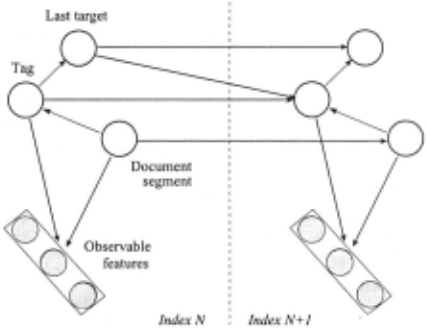
Each document is considered to be a single stream of to kens. In our DBN, called the Bayesian Information Extraction Network (BIEN), the same structure is repeated for every in dex. Figure 1 presents the structure of BIEN. This structure contains state variables and feature variables. The most im portant state variable, for our purposes, is "Tag" which corre sponds to information we are trying to extract. This variable classifies each token according to its target information field, or has the value "background" if the token does not belong to any field. "Last Target" is another hidden variable which reflects the order in which target information is found in the document. This variable is our way of implementing a mem ory in a "memory-less" Markov model. Its value is determin istically defined by the last non-background value of "Tag" variable. Another hidden variable, "Document Segment", is introduced to account for differences in patterns between the header and the main body of the document. The former is close to the structured text format, while the latter to the free text. "Document Segment" influences "Tag" and together these two influence the set of observable variables which rep resent features of the text discussed in section 2. Standard inference algorithms for DBNs are similar to those for HMMs. In a DBN, some of the variables will typically be observed, while others will be hidden. The typical inference task is to determine the probability distribution over the states of a hid den variable over time, given time series data of the observed variables. This is usually accomplished using the forward backward algorithm. Alternatively, we might want to know the most likely sequence of hidden variables. This is accom plished using the Viterbi algorithm. Learning the parameters of a DBN from data is accomplished using the EM algorithm (see e.g. Murphy [2002]). Note that in principle, parts of the system could be trained separately on independent corpus to improve performance. For example, one could learn in dependently the conditional vocabulary of emaillnewsgroup headers, or learn a probability of part-of-speech conditioned on a word, to avoid dependence on external PoS taggers. Also prior knowledge about the domain and the language could be set in the system this way. The fact that etime almost never precedes stime as well as the fact that speaker is never a verb could be encoded in a conditional probability table (CPT). In large DBNs, exact inference algorithms are intractable, and so a variety of approximate methods have been developed. However, the number of hidden state variables in our model is small enough to allow exact algorithms to work. Indeed, all hidden nodes in our model are discrete variables which assume just a few values. "DocumentSegment" is binary in {Header, Body} range; "LastTarget" has as many values as "Tag"-four per number of target fields plus one for the back ground.
4 Results
Several researchers have reported results on the CMU sem inar announcements corpus, which we have chosen in order to have a good basis of comparison. The CMU seminar an nouncements corpus consists of 485 documents. Each an nouncement contains some tags for target slots. On average starting time appears twice per document, while location and speaker 1.5 times, with up to 9 speaker slots and 4 loca tion slots per document. Sometimes multiple instances of the same slot differ, e.g. speaker Dr. Steals also appears as Joe Steals 2 · Ending time, speaker and location are miss ing from 48%, 16% and 5% of documents correspondingly. In order to demonstrate our method, we have developed a web site which works with arbitrary seminar announcement and reveals some semantic tagging. We also make available a list of errors in the original corpus, along with our new derivative seminar announcement corpus 3 .
2 0btaining 100% performance on the original corpus is impos sible since some tags are misplaced and in general the corpus is not marked uniformly- sometimes secondary occurrences are ignored.
3 The corpus and demo for this paper are available from http://www.eecs.harvard.edu/-pesha/papers.html
| System | stime | etime | location | speaker |
|---|---|---|---|---|
| SNOW-I E | 99.6 | 96.3 | 75.2 | 73.8 |
| RAPI ER | 95.9 | 94.6 | 73.4 | 53.1 |
| SRV | 98.5 | 77.9 | 72.7 | 56.3 |
| HMM | 98.5 | 62.1 | 78.6 | 76.6 |
| WHISK | 92.6 | 86.1 | 66.6 | 18.3 |
| (LP) 2 | 99.0 | 95.5 | 75.0 | 77.6 |
| BI EN | 96.0 | 98.8 | 87.1 | 76.9 |
The performance is by precision P = R = correct answers total correct calculated in the usual way, correct answers and recall answers produced combined into F measure geometrical average F = ;;:~ . We report results usin.g the same ten-fold cross validation test as other publi cations concerning this data set [Roth and Yih, 2001 ; Ciravegna, 2001]. The data is split randomly into training and testing set. The reported results are averaged over five runs. Table 2 presents a comparison with numerous previous attempts at the CMU seminar corpus. The figures are taken from Roth and Yih [2001]. BIEN performs comparably to the best system in each category, while notably outperforming other systems in finding location. This is partly due to the "LastTarget" variable. "LastTarget" variable turns out to be generally useful. Here is the learned conditional probability table (CPT) for P(TargetiLastTarget), where the element (I , J) corresponds to the probability to. g~~ target .tag ~ after target tag I was seen. We learn that 1mt1al tag IS stzme or speaker with 2:1 likelihood ratio; etime is naturally the most likely follower to stime and in turn forecasts location.
| Current Tag | |||||
|---|---|---|---|---|---|
| stime | etime | location | speaker | ||
| none | .66 | 0 | .01 | .33 | |
| LastTarget | stime | .07 | .46 | .32 | .14 |
| etime | .19 | .002 | .63 | .18 | |
| location | .37 | .004 | .02 | .61 | |
| speaker | .64 | .002 | .13 | .22 | |
Other variables tum out to be useless, e.g. the number of characters does not add anything to the performance, and nei ther does the initially introduced "SeenTag" variable which kept track of all tags seen up to the current position. Ta ble 3 presents performance of BIEN with various individual features turned off. Note that figures for complete BIEN are slightly better than in Table 2 since we pushed the fraction of the training data to the maximum. Capitalization helps iden tify location and speaker, while losing it ~oe~ not dama~e performance drastically. Although information 1s reflected m syntactic and semantic features, most names in documents do not identify a speaker. One would hope to capture all relevant information by syntactic and semantic categories, however BIEN does not fare well without observing "Lemma". Losing the semantic feature seriously undermines performance in lo cation and speaker categories-ability to recognize names is rather valuable for many domains.
| BIEN | stime | I etime | location | speaker |
|---|---|---|---|---|
| no semantic | 92.0 | 95.0 | 73.0 | 57.0 |
| no memory | 99.0 | 95.5 | 75.0 | 74.6 |
| no lemma | 54.5 | 53.4 | 29.0 | 18.4 |
| no length | 98.1 | 98.6 | 87.9 | 79.8 |
| no case | 98.1 | 98.5 | 78.3 | 71.8 |
| complete | 98.0 | 98.8 | 88.5 | 79.7 |
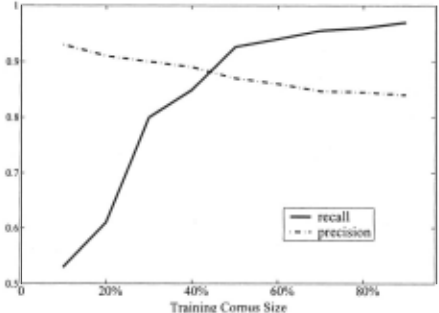
Reported figures are based on 80%-20% split of the co~ pus. Increasing the size of training corpus did not dramati cally improve the performance in terms ofF measure, as fur ther illustrated by Figure 2, which presents a learning curve precision and recall averaged over all fields, as a function of training data fraction. Trained on a small sample, BIEN ~cts very conservatively rarely picking fields, therefore sconng high precision and poor recall. Having seen hundreds of tar get field instances and tens of thousands of negative samp~es, BIEN learns to generalize, which leads to generous taggmg i.e. lower precision and higher recall.
So far we provide results obtained on the original CMU seminar announcements data, which is not very challeng ing. Most documents contain the header section with all ~he target fields easily identifiable right after the correspondmg key word. We have created a derivative dataset in which documents are stripped of headers and two extra fields are sought: date and topic. Indeed this corpus turned ou.t to be more difficult, with our current set of features we obtam only 64% performance on speaker and 68% performance on topic. Date does not present a challenge except for cases of regular weekly events or relative dates like "tomorrow". Admittedly, the bootstrapping test performance is not a guarantee of sys tems performance on novel data since preliminary processing, i.e. tokenization and gazetteering, as well as choice for PoS tag set, lead to a strong bias towards the training corpus.
5 Discussion
We have described how to integrate various aspects of lan guage into a single probabilistic model, and to incremen tally build a robust IE system based on a Bayesian network. Currently, we are working on learning the structure of BIEN automatically. It seems to subject itself nicely to structural EM [Friedman, 1998; Murphy, 2002]. The first step is auto matic selection of relevant features. Another direction of cur rent work is using approximate inference. We have tried LBP (Loopy-belief Propagation) [Murphy eta/., 1999; Murphy, 2002], but for the current structure of BIEN it seems to give no gain. More challenging applications which require larger, stronger connected networks, will benefit from approximate inference algorithms. It will enable quick on-line inference on the network learned off-line with exact methods, as well as learning for cases where exact inference is infeasible. One such network will result from integrating a PoS tagger and other feature extractors into BIEN. This is a natural exten sion of BIEN since various text processing routines are mutu ally dependent. Consider for example PoS tagging, sentence boundary detection and named entities recognition. Another complex BIEN structure will result if we try to better reflect complex relational information [Califf and Mooney, 1999; Roth and Yih, 2001; 2002] e.g. to process cases like seminar cancellations and rescheduling; and handle multi-slot extrac tion, e.g. multiple seminar announcements and conference schedules.
Acknowledgments
Kevin Murphy provided BNT, Kobi Gal helped to handle the corpus, anonymous reviewers gave helpful feedback.
@inproceedings{ijcai2003p63,
  title     = {Bayesian Information Extraction Network},
  author    = {Peshkin, Leonid and Pfeffer, Avi},
  booktitle = {Proceedings of the Eighteenth International Joint Conference on
               Artificial Intelligence, {IJCAI-03}},
  publisher = {International Joint Conferences on Artificial Intelligence},
  editor    = {Georg Gottlob and Toby Walsh},
  pages     = {421--425},
  year      = {2003},
  url       = {https://ijcai.org/proceedings/2003/63},
}
TY - CPAPER TI - Bayesian Information Extraction Network AU - Peshkin, Leonid AU - Pfeffer, Avi T2 - Proceedings of the Eighteenth International Joint Conference on Artificial Intelligence, IJCAI-03 PB - International Joint Conferences on Artificial Intelligence PY - 2003 SP - 421 EP - 425 UR - https://ijcai.org/proceedings/2003/63 ER -Copied
Machine-readable versions of this paper, for tools and AI agents:





