
Intelligent Multimedia Indexing and Retrieval through Multi-source Information Extraction and Merging
Proceedings of the Eighteenth International Joint Conference on Artificial Intelligence. Pages 409-413.
© 2003 International Joint Conferences on Artificial Intelligence
Abstract
This paper reports work on automated meta-data creation for multimedia content. The approach results in the generation of a conceptual index of the content which may then be searched via semantic categories instead of keywords. The novelty of the work is to exploit multiple sources of information relating to video content (in this case the rich range of sources covering important sports events). News, commentaries and web reports covering international football games in multiple languages and multiple modalities is analysed and the resultant data merged. This merging process leads to increased accuracy relative to individual sources.
- [Abney, 1996] Steven Abney. Partial parsing via finite- state cascades. In Workshop on Robust Parsing, 8th Eu- ropen Summer School in Logic, Language and Information (ESSLLI), 1996.
- [Bagga and Baldwin, 1999] A. Bagga and B. Baldwin. Cross-document coreference: Annotations, Experiments, and Observations. In Proceeding of the Workshop on Coreference and its Applications (ACL99), 1999.
- [Chang eta/., 1998] S.F. Chang, W. Chen, H.J. Meng, H. Sundaram, and D. Zhong. A Fully Automated Content- based Video Search Engine Supporting Spatio Temporal Queries. IEEE Transactions on Circuits and Systems for Video Technology, 8(5), 1998, pp. 602-615.
- [Cunningham eta/., 2002] H. Cunningham, D. Maynard, K. Bontcheva, and V. Tablan. GATE: A framework and graphical development environment for robust NLP tools and applications. In ACL2002, 2002.
- [Declerck, 2002] Thierry Declerck. A set of tools for inte- grating linguistic and non-linguistic information. In Pro- ceedings ofSAAKM 2002, ECAI-2002, Lyon, 2002.
- [Gaizauskas et a/., 1997] R. Gaizauskas, K. Humphreys, S. Azzam, andY. Wilks. Concepticons vs. lexicons: An ar- chitecture for multilingual information extraction. In M.T. Pazienza, editor, SCIE-97, LNCS/LNAI, Springer-Verlag, 1997,pp. 28-43 .
- [Grishman and Sundheim, 1996] R. Grishman and B. Sund- heim. Message understanding conference-6: A brief his- tory. In Proceedings of the 16th International Conference on Computational Linguistics, Copenhagen, June 1996.
- [DeJong eta/., 2000] F.M.G. de Jong, J.-L. Gauvain, D. Hiemstra, K. Netter, Language-Based Multimedia Infor- mation Retrieval". In Proceedings of RIAO, 2000, Paris, pp. 713-725.
- [Radev and McKeown, 1998] R. Radev and K.R. McKeown. Generating Natural Language Summaries froni Multi- ple On-Line Sources. Computational Linguistics, 24(3), September 1998, pp. 469-500.
- [Sable and Hatzivassiloglou, 1999] C. Sable and V. Hatzi- vassiloglou. Text-based approaches for the categorization of images. In Proceedings of ECDL, 1999.
- [Schank and Abelson, 1977] R. Schank and R. Abelson. Scripts, Plans, Goals and Understanding. Lawrence Erl- baum Associates, Publishers, 1977.
- [Srihari, 1995] R.K. Srihari. Automatic Indexing and Content-Based Retrieval of Captioned Images. Computer, 28(9), September 1995, pp. 49-56.
- [Steinbiss eta/., 1993] V. Steinbiss, H. Ney, R. Haeb- Umbach, B.-H. Tran, U. Essen, R. Kneser, M. Oerder, H.-G. Meier, X. Aubert, C. Dugast, and D. Geller. The Philips Research System for Large-Vocabulary Continuous-Speech Recognition. In Proc. of Eurospeech '93, Berlin, Germany, 1993, pp. 2125-2128.
References were extracted automatically from the PDF and may contain errors.
Full text extracted automatically from the PDF; figures, tables and equations may differ. The PDF is the version of record.
1 Introduction
Multimedia repositories of moving images, texts, and speech are becoming increasingly available. This together with the needs for 'video-on-demand' systems requires fine-grain in dexing and retrieval mechanisms allowing users access to specific segments of the repositories containing specific types of information. Annotation of video is usually carried out by humans following strict guidelines. Video material is usually annotated with 'meta-data' such as names of the people in volved in the production of the visual record, places, dates, and keywords that capture the essential content of what is depicted. Still, there are a few problems with human annota tion. Firstly, the cost and time involved in the production of fine-grained semantic "surrogates" of the programme is ex tremely high; secondly, humans are rather subjective when assigning descriptions to visual records; and thirdly, the level of annotation required to satisfy a user's needs can hardly be achieved with the use of mere keywords. In order to tackle these problems, indexing methods based on image process ing have been developed [Chang eta/., 1998]. Content-based indexing and retrieval of visual records is based on features such as colour, texture, and shape. Yet visual understanding is not well advanced and is very difficult even in closed do mains. As a consequence, various ways to explore the use of collateral linginstic material have been studied for tasks such as automatic indexing [De long eta/., 2000], classifi cation [Sable and Hatzivassiloglou, 1999], or understanding [Srihari, 1995] of visual records.
*Funded by EC's 5th Framework HLT Programme under grant number IST-1999-1 0651
In this paper, we present an integrated solution to the problem of multimedia indexing and search: the MUMIS 1 concept. Our solution consists of using information ex tracted from different sources (structured, semi-structured, free, etc.), modalities (text, speech), and languages (English, German, Dutch) all describing the same event to carry out data-base population, indexing, and search. The novelty of our approach is not only the use of these 'heterogeneous' sources of information but also the combination or cross source fusion of the information obtained from the separate sources. Single-document, single-language information ex traction is carried out by independent systems that share a semantic model and multi-lingual lexicon of the domain. The results of all information extraction systems are merged by a process of alignment and rule-based reasoning that also uses the semantic model. In the rest of this paper we describe in detail the context of the project, and each of the modules in volved in the automatic derivation of annotations. However, the emphasis is on the merging component.
2 The MUMIS Project
In MUMIS various software components operate off-line to generate formal annotations from multi-source linguistic data in Dutch, English, and German to produce a composite time coded index of the events on the multimedia programme. The domain chosen for tuning the software components and for testing is football.
A corpus of collected textual data in the three languages was used to build a multi-lingual lexicon and shared ontol ogy of the football domain. Based on this shared model, three different off-line Information Extraction components, one per language, were developed (see section 3). They are used to extract the key events and actors from football re ports and to produce XML output. A merging component or cross-document co-reference mechanism has been developed to merge the information produced by the three IE systems (see section 4). Audio material is being analysed by Phicos [Steinbiss eta/., 1993], an HMM-based recognition system, in order to obtain transcriptions of the football commentaries (spontaneous speech). It uses acoustic models, word-based language models (unigram and bigram) and a lexicon. For Dutch, English, and German different recognition systems have been developed (i .e., different phone sets, lexicons, and language models are used) .
1 Multimedia Indexing and Searching Environment, see http : //parlevink . cs .utwente . nl / projec ts / mumis/
| Formal text |
|---|
| England I - 0 Germany Shearer (52) Bookings Beckham (42) ... |
| Ticker |
| 41 mins: Beckham is shown a ye llow card for retaliating on Ulf Kirsten sec- onds after he is denied a free-kick. |
| 40' Hoekschop Engeland met David Beckham. Slecht getrapt. Meteen maakt Beckham daama een fout en krijgt een gele kaart. |
| Match |
| David Beckham - a muted force in attack - was shown a yellow card for a late challenge on Kirsten ... |
| Transcription |
| .. .it's gonna be a card here for David Beckham it is yellow mmm well again his was the name in the post match headlines ... |
| David Beckham hielt die Sohle noch druber schauen Sie mit dem Hinterteil auch harter Einsatz gegen Kirsten und Collina zeigt ihm Gelb eine der Unarten Ieider von David Beckham |
| Beckham met•x Kirsten dat is nou weer Uom wat die Beckham doet ja zal ie dat dan nooit leren Kirsten overdrijft nu hoor maar Kirsten gaat 't duel in geeft een zet en dan reageert Beckham op deze manier in ieder geval krijgt ie dan weer geel |
JPEG keyframe extraction from MPEG movies around a set of pre-defined time marks - result of the information ex traction component - is being carried out to populate the database. The on-line part of MUMIS consists of a state of the art user interface allowing the user to query the multime dia database. The interface makes use of the lexica in the three target languages and domain ontology to assist the user while entering his/her query. The hits of the query are indi cated to the user as thumbnails in the storyboard together with extra information about each of the retrieved events. The user can select a particular fragment and play it.
2.1 Domain and Ontology
An analysis of the domain and a user study led us to propose 31 types of event for a football match (kick-off, substitution, goal ,foul, red card, yellow card, etc.) that need to be identi fied in the sources in order to produce a semantic index. The following elements associated with these events are extracted: players, teams, times, scores, and locations on the pitch.
An ontology has been developed for these events and their actors, it contains some 300 concept nodes related as an 'is-a' hierarchy. The link between the concepts and the three lan guages consists of a flexible XML format which maps con cepts into lexical entries.
Sources used for information extraction are: formal texts, tickers, commentaries, and audio transcriptions (see Table 1). Ticker reports are particularly important in the generation of formal annotations. These texts are a verbal account of events over time stamps. They also follow a specific text structure consisting of a 'ticker header', in which information about lists of players and the result of the game is usually stated, and 'ticker sections' grouping together sentences describing events under single time stamps. Another very valuable source for the generation of the annotations are the spoken transcriptions that, even with the many errors they contain, still provide exact temporal information.
3 Extracting Information from Heterogeneous Sources
Information extraction is the process of mapping natural lan guage into template-like structures representing the key (se mantic) information from the text. These structures can be used to populate a database, used for summarization pur poses, or as a semantic index as in our approach. Key to the information extraction process is the notion of".domain", sce nario or template that represents what information should be extracted. IE has received a lot of attention in the last decade, fuelled by the availability of on-line texts and linguistic re sources and the development of the Message Understanding Conferences [Grishman and Sundheim, 1996]. Traditionally, IE applications have tended to concentrate on a small number of events (typically one), MUMIS addresses the challenge of multi-event extraction.
Multi-lingual IE has been tried in the M-LaSIE system [ Gaizauskas et a!. , 1997], where the same underlying com ponents and a bi-lingual dictionary are used for two different languages (English and French). MUMIS differs from that system in that it operates with three different off-line infor mation extraction components, one per language, that pro duce the same "language-free" representation. In this paper we give only a brief description of the English and German IE systems.
3.1 Extraction from English Sources
IE from English sources is based on the combination of GATE 2 components for finite state transduction [Cunning ham et a!., 2002] and Pro log components for parsing and discourse interpretation. The components of the system are: tokeniser, segmenter, gazetteer lookup (based on lists of entities of the domain), semantic tagger, shallow pronom inal co-referencer, part-of-speech tagger, lemmatiser, chart parser, discourse interpreter (ontology-based co-referencer), and template extractor. These components are adapted and combined to produce four different system configurations for processing different text-types and modalities (transcriptions, formal texts, semi-formal texts, and free texts). The analy sis offormal texts and transcriptions is being done with finite state components because the very nature of these linguistic descriptions make appropriate the use of shallow natural lan guage processing techniques. For example, in order to recog nise a substitution in a formal text it is enough to identifY players and their affiliations, time stamps, perform shallow co-reference and identification of a number of regular expres sions to extract the relevant information. In our system, reg ular expressions operate on annotations (not on strings) and produce semantic information. We make use of the Java An notation Pattern Engine (JAPE) formalism [Cunningham et a!., 2002] to code our regular grammar. Below, we present one example of the use of JAPE that accurately identify sub stitutions in speech transcriptions:
2 GATE is a free architecture for natural language engineering.
Rule : Subsl (({Player}) ({Token . string == ''is'' j) ({Replace}) ({Player})) :annotate --> :annotate.SubsEvent = {rule = "Subsl"}Complex linguistic descriptions are fully analysed because of the need to identify logical subjects and objects as well as to solve pronouns and definite expressions (e.g., "the Barcelona striker") relying on domain knowledge encoded in the ontology of the domain. Domain knowledge establishes, for example, that the two players involved in a substitution belong to the same team. This semantic constraint is used in cases such as "he is replaced by Ince" to infer that the antecedent of the pronoun "he" belongs to the "English" team (because "Ince" does).
Logic-based information extraction rules operate on log ical forms produced by the parser and enriched during dis course interpretation. They rely on the ontology to check con straints (e.g., type checking, ontological distance, etc.). The following logic-based rule is used to extract the participants of a substitution when syntactic and semantic information is available:
replace_event(E) & lsubj (E,Pl) & lobj (E,P2) & player(Pl) & player(P2) =>substitution event(E) & player_l(E,Pl) & player_2(E,P2) -'lsubj' and 'lobj' represent the logical subject and object of an event. Note that, contrary to the regular case, the 'lsubj' and 'lobj' relations, being semantic in nature, are long distance relations.
3.2 Extraction from German Sources
The German IE system is based on an integrated set of lin guistic tools called SCHUG: Shallow and Chunk based Uni fication Grammar [Declerck, 2002]. The chunking proce dure of SCHUG consists of a rule-based sequence of cas cades (based on the work by [Abney, 1996]), which pro duces a rich linguistic representation, including grammatical functions and resolution of co-reference and ellipsis. In or der to detect these accurately, an analysis of the clauses of a sentence is required. Clauses are subparts of a sentence that correspond to a (possibly complex) semantic unit. Each clause contains a main verb with its complements (grammat ical functions) and possibly other chunks (modifiers).
Applied to the football domain, SCHUG inspects the com mon MUMIS ontology and enriches the linguistic annotation produced with domain-specific information encoded in the ontology. Below (see Table 2) we show one example of the semantic annotation generated by SCHUG when applied to an on-line ticker text (game England-Germany). Here, vari ous relations (player, location, etc.) and events (jree-kick,fail to score a goal) that are relevant to the football domain are recognised.
Some relations are not explicitly mentioned, but can still be inferred by the MUMIS system. For example, the team for which "Ziege" is playing can be inferred from the ontological information that a player is part of a team and the instance of
7. Ein Freistoss von Christian Ziege aus 25 Metern geht ueber das Tor . ''A 25-meter free-kick by Christian Ziege goes over the goal . '' <events> <event id="el" clause= 11 Clsl" event-name::: "free-kick"> <relations> <relation id= 11 rl" reltype="player', player-name="Christian Ziege" in-team="Germany"/> </relations> </event> <event id="e2" clause==="clsl" event-name= "goal-scene-fail"> </event> </events>this particular team can be extracted from additional texts or meta-data. In this way, information not present in the text di rectly can be added by additional information extraction and reasoning.
Since formal texts require only little linguistic analysis, but rather an accurate domain-specific interpretation of the jargon used, a module has been defined within SCHUG, which in a first step maps the formal texts onto an XML annotation, giv ing the domain semantic of the expressions in the text (the approach taken for formal texts is similar to the one followed by the English IE system). In a second step SCHUG merges all the XML annotated formal texts about one game. Those merged annotations are generated at a level that requires only little linguistic analysis, and basically reflect domain specific information about actors and events involved in the text. The SCHUG module applied at this level also extracts meta-data information: name of the game, date and time of the game, in termediate and final scores etc. This is quite important, since the meta-data can guide the use of the annotations produced so far for supporting linguistic analysis and information ex traction applied to more complex documents.
4 Merging
Merging, also known as cross-document co-reference [Bagga and Baldwin, 1999], is the process of deciding whether two linguistic descriptions from different sources refer to the same entity or event. The merging component in MUMIS combines the partial information as extracted from various sources, such that more complete annotations can be ob tained. Radev and McKeown [1998] developed a knowledge based multi-document summarization system based on in formation extraction and merging of single 'terrorist' events. The novelty of our approach consists in applying merging to multiple events extracted from multiple sources.
As is to be expected, complete recognition of events in nat ural language sentences is extremely difficult. Often, events will be only partially recognised. The merging component of the MUMIS project aims to fill in missing aspects of events with information gathered from other documents. For exam ple, the Dutch information extraction system recognised in document A on the match Netherlands-Yugoslavia from the European championships 2000 that a save was performed in the 31st minute. In addition, it recognised the names of two players: Vander Sar (the Dutch goalkeeper) and Mihajlovic (a Yugoslavian player), but it could not figure out which of these two players performed the save. In document B it recognised a free-kick in the 30th minute, and the names of the same two players. Again, it did not succeed in finding out which player took the free-kick.
The fact that the same two players are involved, plus the small difference between the time-stamps, strongly suggests that both descriptions are about the same event in reality. The merging part of the MUMIS project matches these partial data together, and concludes that it was Mihajlovic who took the free-kick, followed by a save by Van der Sar.
The merging component consists of several parts which will be described in more detail below.
4.1 Scenes
Given the example above, it is clear that matching together in dividual events from two different documents is not the right approach: a save event cannot be matched with a free-kick event, they are two totally different events. Besides, it is clear that players' names will play an important role in the match ing of information from one document with information from another document. In order to take players' names into con sideration, an unknown event was introduced, such that if it was not clear what a player did, this could be represented by letting that player perform this unknown event (the informa tion extraction systems provide this information).
Now the event is still the fundamental concept, but the merging process aims at matching together groups of events instead of single events. Such a group of events is called a scene. The author of a text is considered as a "semantic fil ter", which determines which events should be taken together in the same scene. If events are mentioned in the same text fragment, they belong to the same scene. In the ticker doc uments this does not give rise to ambiguities, since their text fragments are clearly distinguished from each other (see Ta ble 1).
4.2 Two Document Alignment
The merging algorithm compares all the scenes extracted from document A with all the scenes extracted from docu ment B, and examines whether or not a scene from docu ment A might be matched with a scene from document B. There are several aspects to be taken into account: players in volved in the scenes, distance between time stamps, whether the scenes contain the same events or not, etc.
A scene from document A may match more than one scene from document B (see Figure 1).
The strength of a matching can be calculated in different ways, and it will not be surprising that the number of players involved in both scenes will be of great influence. This in fluence is that great, that taking only the number of common players' names as a measure of the strength of a binding, gave the best results. We restricted matching of scenes to those scenes which were not further than (arbitrarily) five minutes apart.

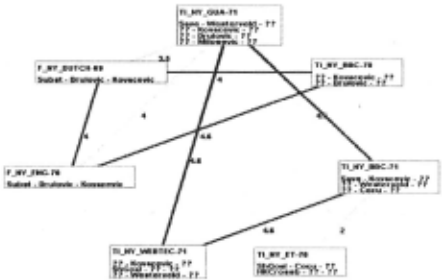
In order to choose the best matchings, the algorithm starts by selecting two scenes 8 1 and 8 2 such that the binding be tween 81 and 82 is (one of) the strongest. In general, such a choice will remove other bindings, in particular the bind ings between 8 1 and 82 with other scenes. Since these two describe the same fragment of the game, scenes before 8 1 can now no longer match scenes after 82 (and vice versa). That is to say, bindings which "cross" the matching of 8 1 and 8 2 are removed. Thus the possible bindings are cut in two parts, and the algorithm continues recursively with both halves, un til all choices have been made. This two document algorithm is applied to every pair of documents.
4.3 Multi Document Alignment
The next step is to join connected scenes from various docu ments together. Start with a set consisting of one (arbitrary) scene, and extend this set by those scenes which are con nected to the starting scene. Repeat this for all the scenes added to the set until no further extension is found. This set of scenes, together with the bindings between the scenes (chosen by the two document algorithm) naturally form a connected graph.
Repeat this graph building procedure for the remaining scenes, until all scenes are included in a graph. Notice, that such a graph may consist of one scene only. Notice also, that a graph may contain more scenes than there are documents, since scenes may be connected through a sequence of two document matches.
4.4 Complete Sub-graphs
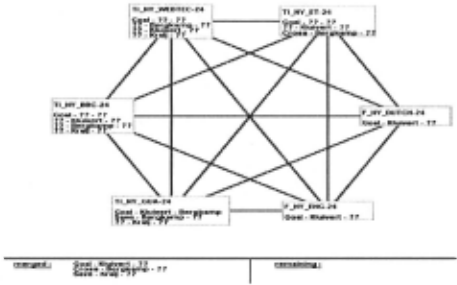
Ideally, a graph should be complete, expressing that every two scenes in the graph do match, and thus all scenes do contain some common information. That is to say, the scenes in a complete graph are all about the same fragment during the football game which is described in the documents. However, in practice not every graph which results from the procedure above, is complete (see Figure 2).
Scenes may partially overlap, and thus give rise to se quences of connections where the first and the last are no longer connected. We isolate the strongest complete sub graphs from every non-complete graph, since such a sub graph describes one fragment in reality. A given (non complete) graph is divided into its strongest complete sub graphs by going through all the bindings in the graph, ordered by their strength (starting with the strongest one), and adding scenes and edges to a sub-graph whenever possible without violating the completeness of this sub-graph. If that is not possible, a new sub-graph is started, and some bindings may be removed. The final result is a set of complete graphs of matching scenes from many documents, such that the scenes inside a graph describe the same fragment in reality.
4.5 Rules
Consider the example given before, about the save event and the free-kick event, with the players Van der Sar and Miha jlovic. These scenes are now in the same graph, and thus may be combined (see Figure 3). However, not every combina tion will be correct, for example, Mihajlovic and Van der Sar will not both take the free-kick. Also, it will not be correct to let Vander Sar (the Dutch keeper) take the free kick, and Mihajlovic perform the save. In order to combine this partial information into scenes containing complete events, rules are needed. In the MUMIS project several kinds of rules, all ex pressing some domain knowledge, have been developed. A first kind are the event internal rules, for example, rules say ing that the two players involved in a substitution event be long to the same team, or that a keeper typically will not take a corner.
A second kind of rule takes into account the role of the teams in the fragment, i.e., whether a team is attacking or defending at that moment. To determine whether a team is attacking or defending, all players involved in the scene are checked for their normal position in the field. Then events are characterised as offensive events (such as corner, shot on goa[), defensive events (save, clearance), and neutral events (throw-in, yellow card). The second kind of rule makes sure that offensive events are performed by players from the at tacking team, and defensive events are combined with payers from the defending team.
A third kind of rule makes sure that players will not per form impossible combinations of events, e.g., the player who takes a comer will (unless he's very fast) not deliver a shot on-goal as well.
To apply these rules, a background database of player in formation is created, containing names of players, their nor mal position in the field, the team they belong to, etc.
Yet another kind of rule is based on an ontolgy of events and is used to unify certain events which according to the chosen semantics in MUMIS are not the same. For example, a clearance and a save are two different events according to the MUMIS semantics, but an author may well use these terms in a way different from the MUMIS semantics. Therefore the relationships between such concepts are expressed in an ontology, such that rules may use sub-typing or super-typing relationships between concepts.
4.6 Scenarios
After merging the scenes extracted from the various docu ments into more complete scenes, the order of the events within a scene may be incorrect with respect to the order as it was in reality. The merging process itself does not take the ordering of events into account, and besides, authors often mention events in the opposite order. For example, a player scores after a comer- but the scoring is mentioned first.
Based on the original texts in the source documents, a se ries of scenarios is extracted, describing typical orders in which events occur [Schank and Abelson, 1977].
4. 7 Evaluation
Given the limited availability of background information on players (to which team they belong, on what position they play, etc.), the merging component could only be tested in a case study. The match Netherlands-Yugoslavia from the Eu ropean championships in 2000 to perform such a case study. Based on this example, the results of the merging approach are very promising.
The result of the alignment process applied to this match produced 63 complete graphs, of which 28 consist of only one node (a scene), containing information from one source text only. Looking at the original texts, only five of these one scene graphs might have been combined with other graphs, the main problem being that some texts mention some in formation in one scene, whereas other documents divide the same information over several scenes. In such cases the align ment algorithm chooses the best match, leaving the other part unmatched.
Of the remaining 35 multi scene graphs, no graph con tained unjustified bindings. This seems to be a very promising aspect, since the rules used in the graph forming part of the algorithm are formulated in a very general way, without using any specific information on the concrete football match.
The result of the merging process consisted partly of the elimination of several errors caused by syntactical ambigui ties in the single document information extraction, and partly of joining together partial events into more complete events. Like the alignment process, this merging process is also based on general semantical rules, which do not use any concrete details about the specific football match taken as a case study. There were no errors introduced by these merging rules, and in many cases the quality of the extracted information im proved considerably.
5 Conclusions and Future Work
The development of huge multimedia databases and the need for accurate navigation of its content require a new generation of"intelligent" tools for producing fine-grained surrogates or indices of the multimedia content. By taking advantage of on tology, domain lexica, and a "language-free" representation of the contents, MUMIS facilitates conceptual search over coming the keyword barrier.
MUMIS takes advantage of reliable, but coarse-grained content, obtained from formal texts and fine-grained, but sometimes partial, content obtained from free texts and tran scriptions. It indirectly solves problems of incomplete infor mation found in any source by combining results from mul tiple sources. By relying on the analysis of textual instead of visual sources, MUMIS makes possible the derivation of fine-grained semantic indices.
Cross-document co-reference is still in its infancy, MUMIS advances research in that direction by providing a methodol ogy that uses robust named entity alignment from multiple sources together with domain specific, semantic rules.
There are still many points on which the merging algorithm may be improved. For example, some documents are more re liable than other documents. Furthermore, not all texts are of the same type, so-called formal texts differ from ticker texts, and from more free texts. As yet, differences in quality of the source documents has not been taken into account, and a weighted integration of formal texts and other texts still has to be performed. A related point of improvement is to check the consistency of certain elements of information in comparison to other elements of information, and in particular to the state on the football field as may be derived from all previously mentioned events. Finally we mention the improvements in connection to overlapping scenes, where events mentioned in one text fragment in one document may be spread over sev eral text fragments in another document. At this point im provements are also possible.
Acknowledgements
We wish to thank Eduard Hoenkamp and Marco Puts for many useful discussions.
@inproceedings{ijcai2003p61,
  title     = {Intelligent Multimedia Indexing and Retrieval through Multi-source Information Extraction and Merging},
  author    = {Kuper, Jan and Saggion, Horacio and Cunningham, Hamish and Declerck, Thierry and de Jong, Franciska and Reidsma, Dennis and Wilks, Yorick and Wittenburg, Peter},
  booktitle = {Proceedings of the Eighteenth International Joint Conference on
               Artificial Intelligence, {IJCAI-03}},
  publisher = {International Joint Conferences on Artificial Intelligence},
  editor    = {Georg Gottlob and Toby Walsh},
  pages     = {409--413},
  year      = {2003},
  url       = {https://ijcai.org/proceedings/2003/61},
}
TY - CPAPER TI - Intelligent Multimedia Indexing and Retrieval through Multi-source Information Extraction and Merging AU - Kuper, Jan AU - Saggion, Horacio AU - Cunningham, Hamish AU - Declerck, Thierry AU - de Jong, Franciska AU - Reidsma, Dennis AU - Wilks, Yorick AU - Wittenburg, Peter T2 - Proceedings of the Eighteenth International Joint Conference on Artificial Intelligence, IJCAI-03 PB - International Joint Conferences on Artificial Intelligence PY - 2003 SP - 409 EP - 413 UR - https://ijcai.org/proceedings/2003/61 ER -Copied
Machine-readable versions of this paper, for tools and AI agents:





