
Incremental Utility Elicitation with the Minimax Regret Decision Criterion
Proceedings of the Eighteenth International Joint Conference on Artificial Intelligence. Pages 309-317.
© 2003 International Joint Conferences on Artificial Intelligence
Abstract
Utility elicitation is a critical function of any automated decision aid, allowing decisions to be tailored to the preferences of a specific user. However, the size and complexity of utility functions often precludes full elicitation, requiring that decisions be made without full utility information. Adopting the minimax regret criterion for decision making with incomplete utility information, we describe and empirically compare several new procedures for incremental elicitation of utility functions that attempt to reduce minimax regret with as few questions as possible. Specifically, using the (continuous) space of standard gamble queries, we show that myopically optimal queries can be computed effectively (in polynomial time) for several different improvement criteria. One such criterion, in particular, empirically outperforms the others we examine considerably, and has provable improvement guarantees.
- Jim Blythe. Visual exploration and incremental utility elicitation. In Proceedings of the Eighteenth National Conference on Artificial Intelligence, pages 526-532, Ed- monton, 2002.
- Craig Boutilier. A POMDP formulation of preference elicitation problems. In Proceedings of the Eighteenth 316 National Conference on Artificial Intelligence, pages 239-246, Edmonton, 2002.
- Craig Boutilier, Fahiem Bacchus, and Ronen I. Braf- man. UCP-Networks: A directed graphical representa- tion of conditional utilities. In Proceedings of the Sev- enteenth Conference on Uncertainty in Artificial Intelli- gence, pages 56-64, Seattle, 2001.
- Urszula Chajewska, Daphne Koller, and Ronald Parr. Making rational decisions using adaptive utility elicita- tion. In Proceedings of the Seventeenth National Con- ference on Artificial Intelligence, pages 363-369, Austin, TX, 2000.
- Simon French. Decision Theory. Halsted Press, New York, 1986.
- Ralph L. Keeney and Howard Raiffa. Decisions with Multiple Objectives: Preferences and Value Trade-offs. Wiley, New York, 1976.
- Edward A. Sykes and Chelsea C. White, III. Multiob- jective intelligent computer-aided design. IEEE Trans- actions on Systems, Man and Cybernetics, 21 ( 6): 1498- 1511, 1991.
- Chelsea C. White, III, Andrew P. Sage, and Shigeru Dozono. A model of multiattribute decisionmaking and trade-off weight determination under uncertainty. IEEE Transactions on Systems, Man and Cybernetics, 14(2):223-229, 1984.
References were extracted automatically from the PDF and may contain errors.
Full text extracted automatically from the PDF; figures, tables and equations may differ. The PDF is the version of record.
1 Introduction
As software for decision making under uncertainty becomes increasingly common, the process of utility elicitation takes on added importance. Tailoring decisions to a specific user requires knowledge of the user's utility function, information that generally cannot be built into software in advance. In domains as varied as travel planning, product configuration, and resource allocation, to name but a few, assessing a user's utility function is an integral part of interactive decision mak ing. Unfortunately, as is well-known among decision ana lysts, utility functions are unwieldy, complex, and difficult for users to articulate [5]. To mitigate these difficulties, ana lysts have developed many techniques for easing the burden of elicitation. For example, structuring of multiattribute util ity functions reduces the number of parameters that need to be assessed [6]; and the use of standard gamble queries and sen sitivity analysis allows users to calibrate utilities more easily [5].
More recently, emphasis has been placed on decision mak ing with incomplete utility information. The principle of maximum expected utility (MEU) cannot be used directly in such cases, since the utility function is unknown; thus
Craig Boutilier
Department of Computer Science University of Toronto Toronto, ON, M5S 3H5, CANADA cebly@cs.toronto.edu
new decision criteria are needed. In addition, methods for the automatic generation of queries have been devel oped that reduce uncertainty or incompleteness in the util ity function with minimal effort. Within AI, probabilistic models of utility function uncertainty have been used [4; 2]. By assuming a density over possible utility functions, expectations over this density can be taken to determine the value of a decision; and standard Bayesian updating tech niques can be used to account for the responses to queries. A different perspective is taken in work on imprecisely spec ified multiattribute utility theory (ISMAUT) [8; 7] in which linear constraints on multiattribute utility functions are re fined, allowing the set of Pareto optimal decisions to be iden tified; these constraints are often refined until one action can be proven optimal. Boutilier, Bacchus and Brafman [3] and Blythe [ 1] adopt a somewhat related perspective, also reason ing with linear constraints on utility functions.
In this work, we adopt a distribution-free model, work ing with linear constraints on utility functions, much like ISMAUT. Unlike ISMAUT, we allow for decisions to be made (or recommended) even when the incompleteness in utility knowledge prevents us from proving a decision is op timal. In such circumstances, we adopt the minimax regret decision criterion. We also propose and examine several methods for generating queries that reduce regret quickly, in contrast to work on ISMAUT (where query generation strategies have not been studied in depth). In this sense, our model more closely resembles probabilistic models [4; 2], which rely on the fact that decisions of good expected quality can be made with uncertain utility information. Using the minimax regret criterion, we generate decisions whose quality (difference from optimal) can be bounded in the face of incomplete utility information. These bounds can be traded off against query cost or minimum error requirements to guide the query process.
The paper is organized as follows. We outline relevant background in Section 2 and define the minimax regret crite rion for decision making with incomplete utility information. We show how decisions of minimax regret can be computed using simple linear programs (LPs) if utility constraints are linear. We also discuss incremental elicitation, focusing on standard gamble queries (SGQs) [5], the responses to which impose one-dimensional, linear utility constraints that can be easily handled using LPs. Our key contribution is described in Section 3, where we develop several myopic elicitation strategies. Assuming linear constraints in each utility dimen sion (an assumption consistent with the use of SGQs), we show that the minimax regret improvement offered by any response to a SGQ, as a function of the (continuous) query parameter, is piecewise linear (PWL) and weakly monotonic (decreasing or increasing, depending on the response) . This fact allows optimal queries under each query strategy to be computed efficiently, in time linear in the number of utility attributes, despite the fact that query space is continuous. We present empirical results comparing the different strategies in Section 4, demonstrating the effectiveness, in particular, of the maximum expected improvement strategy.
2 Minimax Regret with Incomplete Utility Information
We assume a system charged with making a decision on be half of a user in a specific decision scenario. By a decision scenario, we refer to a setting in which a fixed set of choices (e.g., actions, policies, recommendations) are available to the system, and the (possibly stochastic) effects of these choices are known. For example, the decisions could be courses of medical treatment with known probabilities for specific out comes [4]. The system's task is to take the optimal decision with respect to the user's utility function over outcomes, or some approximation thereof. The system may have little in formation about the user's utility function, so to achieve this, it must find out enough information about this utility function to enable a good decision to be made. We assume that The system has available to it a set of queries it can ask of the user that provide such information. We make these concepts more precise below.
2.1 The Minimax Criterion
Formally, a decision scenario consists of a finite set of possi ble decisions D, a finite set of n possible outcomes (or states) S, and a distribution function Prd E i::l.(S), for each dE D. 1 The term Prd(s) denotes the probability of outcome s be ing realized if the system takes decision d. A utility function u : S --> [0, 1] associates utility u(s) with each outcome s. We often view u as a n-dimensional vector u whose ith component u; is simply u(s;). We assume that utilities are normalized in the range [0, 1] for convenience. The expected utility of decision d with respect to utility function u is:
Note that EU(d, u) is linear in u. The optimal decision d* w.r.t. u is that with maximum expected utility (MEU) .
In general the utility function u will not be known with cer tainty at the start of the elicitation process, nor at its end. As in ISMAUT [8; 7], we model this uncertainty by assuming a set of linear constraints C over the set of possibly utility func tions U = [0, 1]n. More precisely, we assume that constraints over unknown utility values u; are linear. We use C <;;;; U to denote the subspace of U satisfying C.
1 The extension of our elicitation methods to a set of possible decision scenarios is straightforward.
If a system makes a decision d under such conditions of incomplete utility information, some new decision criterion must be adopted to rank decisions. Following [3], we adopt the minimax regret decision criterion. 2 Define the optimal decision dit, with respect to utility vector u to be
If the utility function were known, dit, would be the correct decision. The regret of decision d; with respect to u is
i.e., the loss associated with executing d; instead of acting optimally. Let C <;;;; U be the feasible utility set. Define the maximum regret of decision d; with respect to C to be
and the decision d(: with minimax regret with respect to C:
The (minimax) regret level of feasible utility set C is
If the only information we have about a user's utility function is that it lies in the set C, then d(: is a reasonable decision. Specifically, without distributional information over the set of possible utility functions, choosing (or recommending) d(: minimizes the worst case loss with respect to possible real izations of the utility function (e.g., if the true u were chosen by an adversary) .
If C is defined by a set C of linear constraints, then d(: as well as MMR( C) can be computed using a set of linear programs [3]. We can compute the pairwise max regret, for any pair of decisions d; and dj,
using an LP (i.e., maximizing a linear function of the un known outcome utilities subject to C). Solving O(IDI 2 ) such LPs, one for each ordered pair of actions, allows us to iden tify the decision d(: that achieves minimax regret and to de termine the minimax regret level MMR(C) .
2.2 Incremental Elicitation
Given partial knowledge of a utility function in the form of constraint set C, the optimal decision d(: may have an unac ceptable level in regret. In such a case, a user could be queried in order to reduce this level of uncertainty, thus generally im proving decision quality. 3
2 Minimax regret is often used for decision making under strict or unquantified uncertainty [5] , but its application to imprecisely known utility functions appears not to have been considered in the decision analysis literature.
3 Note that max regret cannot increase with additional utility in formation: ifC ~ C', then MMR(C)::; MMR(C') .
A common type of query is a standard gamble w.r.t. out come Si, where the user is asked if she prefers Si to a gam ble in which the best outcome ST occurs with probability l and the worst s .L occurs with probability 1 - l [6]. We will designate this query qi (l) and focus our attention on such standard gamble queries or SGQs. 4 Given a response yes to query qi(l) , the constraint Ui > l can be imposed on the user's utility function, thus (in general) refining our knowl edge; similarly, a no response corresponds to the constraint ui :::; l . A response to any standard gamble query imposes a one-dimensional (i.e., axis parallel) linear constraint on the utility set. Thus if our initial constraint set Cis linear, comput ing the minimax optimal decision after a sequence of SGQs can be accomplished using the LP method above. Further more, ifC consists of a set ofbounds on utility values in each dimension-i.e., C forms a hyper-rectangle within [0, l]n then after any sequence of SGQs, the feasible utility set re tains thisform.
The interactive decision making context we consider is one in which queries are asked repeatedly until the minimax re gret level falls to some acceptable value. At that point the "optimal" decision, that with minimax regret given the cur rent constraints, is recommended. Termination can be based on simple thresholding, or can take into account the cost of a query (which can be weighed against the predicted im provement in decision quality) . 5 Generally, queries will be asked that offer the greatest predicted improvement in deci sion quality.
Both query selection and termination rely critically on the way in which "predicted improvement in decision quality" is defined for a query. For example, when asking a query qi (l ) with respect to current constraint set C, we obtain two constraint sets Cno and Cyes , respectively, given responses, no and yes. We might then define the improvement in de cision quality associated with the query as some function of MMR(Cno ) and MMR(Cyes )· Such a method of evaluating queries is myopic: the query is evaluated in isolation, without consideration of its impact on the value or choice of future queries.
It is important to note that optimal query choice is inher ently nonmyopic-in general, a sequence of several queries may offer much more value than the aggregate myopic values of the component queries. Unfortunately, nonmyopic meth ods require some form of lookahead, and thus often impose severe computational costs on the process of query selec tion. For this reason, we focus on the development of several myopic query selection strategies in the next section. This is analogous to the use of myopic methods for the approx imation of value of information in cases where uncertainty is quantified probabilistically; while the computation of true value of information requires some form of sequential reasoning, myopic approximations tend to be used frequently in practice [5; 4].
40ther types of queries could be considered, though we rely on the special nature of SGQs in some of our results. SGQs are used widely in decision analysis [5], and have been the main query type studied in recent Bayesian elicitation schemes [4; 2].
5 Qf course, elicitation can continue until a zero-regret (i.e., opti mal) decision is identified: this occurs whenever C C Rd for some decision d, the region of utility space for which d is optimal. The regions R d are convex polytopes within U.
3 Myopic Elicitation Strategies
In this section we describe three myopic strategies for query selection under the minimax regret criterion. Throughout this section we make the following assumptions:
- (a) The initial constraints have the form of upper and lower bounds in each utility dimension (these may be trivial bounds, 0, 1).
- (b) SGQs are asked, assuming some known best and worst outcome. These ensure that each constraint set (after any query) has the same form as the initial set (i.e., a hyper rectangle). We denote by ubi and lbi the current bounds on the utility Ui of outcome Si·
- (c) For simplicity, we assume a threshold Tis used to imple ment termination; that is, when the predicted improve ment of a query falls below r, we terminate the process.
We discuss the impact of relaxing these assumptions later.
3.1 Characterization of Regret Reduction
Query selection is complicated by the fact that, in general, there are n types of SGQs that can be asked--one per out come Si-and a continuous set of instances of each type i qi ( l) for each l E [ lbi, ubi]· Whatever criterion is used to select queries, it must distinguish among queries in this n dimensional continuous space.
Before describing the three strategies, we characterize the reduction in minimax regret offered by a response to a SGQ. Assume current constraint set C, with bounds ubi and lbi in dimension i . Given query qi (l), with lbi < l < ubi, a nega tive response will provide us with a refined set of constraints Cno = C U { Ui :::; l}-i.e., it reduces the upper bound ubi on ui-with (ideally) reduced regret. A positive response gives us a similarly refined constraint set Cyes·
Focusing on the negative response, note that we'll end up with different Cno sets depending on the query point l. Nat urally, the closer the query point l is to lbi , the more infor mative a negative response is (since it constrains Ui to be in the interval [lbi , l]). Intuitively, we'd expect minimax regret to be smaller given a tighter query. In fact, we can say more. Define MMRno(C, i , l) to be MMR(Cno) where the no is in response to query qi(l) . We have:
Theorem 1 For any i :::; n, MMRno(C , i, l) is a PWL, non decreasingfunction ofl.
Proof: For space reasons, we provide only an intuitive proof sketch. DefinePMR(d,d',C,i,l) = PMR(d, d',CU{ui = l} ); that is, PMR(d, d', C, i, l) is the pairwise max regret of d w.r.t. d' given the current constraints plus knowledge that Ui = l. It is not hard to see that PMR(d, d', C, i, l) is a linear function of l: maximizing the regret of d w.r.t. d' is effected by setting each component Uj of the utility func tion to either its upper bound (if Prd(sj ) :::; Prd' (sj )) or lower bound (if Prd(sj) > Prd'(sj)). Since this max is achieved independently in each dimension, the contribution to max regret in dimensions other than i is constant while the contribution to regret in dimension i given u; = i is lin ear in l, with coefficient Prd'(s;)- Prd(s;). It follows that MR(d, C, i, l) = maxd' PMR(d, d', C, i, l) is a PWL convex function of l, since it is the max of these pairwise regret func tions (see Figure l(a)).

Now define MRna(d, C, i, l) = MR(d, C U { u; :::; l} ), the max regret of d after obtaining a negative response to query q;(l). (Note that this differs from MR(d, C, i, l), which is de fined by assuming u; = l, not u;:::; l.) MRna(d,C,i,l) is also a PWL convex function, obtained from the set of lin ear PMR-functions that make up MR(d, C, i, l) as follows: we replace any linear components with negative slope by the constant line MR(d, C, i, lb;). Intuitively, if the regret of d w.r.t. .d' after learning u; = l decreases with l, then simply learnmg that u; :::; l cannot reduce pairwise max regret, since this weaker constraint does not rule out the maximum regret at l = lbi (see Figure I (a) for this intuitive flattening of the regret line for d2- d1) . This ensures that MRna(d, C, i, l) is also nondecreasing in l, as illustrated in Figure l(a).
Finally, note that, by definition of minimax regret, MMRna(C, i, l) = mind MRna(d, C, i, l). The minimum of a collection of PWL, convex, nondecreasing functions is also PWL and nondecreasing (though not necessarily convex) (see Figure l(b)). <111
Note that this proof sketch shows how to construct a finite representation of the function MMRna(C, i, l) as a finite col lection of linear functions and inflection points. By entirely analogous reasoning, we also have:
Theorem 2 For any i :::; n, MMRyes(C, i, l) is a PWL, non increasing function ofl.
3.2 Maximin Improvement
One goal of any query strategy is to determine utility informa tion that r~duces regret as quickly as possible. Unfortunately, for any giVen SGQ Qi(l), the exact reduction in regret can ?ot typically be predicted in advance, since it differs depend mg on whether a yes or no response is obtained. The max imin improvement (MMI) query strategy myopically selects queries with the best worst-case response. More precisely, let C be our current constraint set. We define the minimum improvement of query q;(l):
At each stage, the query q;(l) is asked whose minimum im provement with respect to the current constraint set is max imum. The process stops when no query has minimum im provement greater than threshold T.
To compute the optimal MMI query point, we find the optimal query point in each dimension i, and ask the SGQ corresponding to the dimension with greatest MMI. The PWL representation of the functions MMRyes (C , i, l) and MMRna(C, i, l) described above allows the optimal point in each dimension to be computed readily. The point l that of ~ers MM! in dimension i can be determined by computing the mtersectwn of the two functions: since one is nondecreas ing a?d the other nonincreasing, the maximum point of the function max{ MMRyes, MMRno} must lie at the intersec tion. Note that the intersection must exist since each has the same maximum value MMR(C) (see Figure l(c)). 6 Finally, the value of the improvement in regret is the difference be tween the original minimax regret level and this value.
Computation of the intersection of these functions is straightforward, requiring only the computation of the inter section .of the linear segments whose bounds overlap. As such, th1s can be accomplished in linear time in the maximum number of segments in either function. The number of seg ~ents in these functions is (very loosely) bounded by ID! 2 . 7 Smce we must compute the optimizing point for each util ity dimension, the complexity of this algorithm is O(n!DI 2 ) . The algorithm thus scales linearly in the number of outcomes and quadratically with the number of decisions.
3.3 Average and Expected Improvement
One difficulty with the MMI criterion for query selection is that, due to its worst-case nature, we can often find situations in which no query offers positive (minimum) improvement (we will see evidence of this in the next section), despite the fact that the current regret level is positive. This occurs when at least one of the responses for every query offers no im provement, thus stalling the query process. Intuitively, just because one response to a query qi (l) offers no improvement is no reason not to ask the query: the opposite response may still offer immediate improvement. 8 This suggests an alterna tive criterion called maximum average improvement (MAl) : SGQs are ranked according to the average improvement of fered by both positive and negative responses.
6 If the intersection occurs where both functions are "flat," any query point in the intersection can be used.
. 7 In practice, the number of segments appears to grow sublinearly m the number of decisions IDI.
Computing the optimal query point according to MAl can also exploit the PWL nature of the functions MMRyes (C , i , l) and MMRno (C , i, l) . As with MMI, we compute the optimal query point l in each dimension i independently. It is not hard to see that the point of maximum average improvement must occur at an inflection point of one of the two functions. Thus, each dimension can be optimized in time linear in the number of segments in the two functions.
The MAl criterion is not subject to stalling in the sense that MMI is: if MMR(C) is positive, then there exists some query with positive MAl (this will follow from a result discussed below). However, it is subject to a different form of stalling: it may well be the case that the query qi(l) with MAl occurs at one of the boundary points ubi or lbi . In such a case, only one (consistent) response is possible, imposing no additional constraints on the utility function. As such, the constraint set C will remain unchanged, meaning that the same query remains MAl-optimal at the next stage.
This second type of stalling can be prevented. Suppose that a query qi ( l) is optimal, where l = ubi. We know that MMRyes (C, i , ubi ) < MMRno(C, i , ubi) (i.e. , a yes offers greater improvement at the point ubi); but since Ui cannot exceed ubi, the probability of receiving a yes response is zero, so the yes-improvement cannot be realized. We can thus make the query qi ( l) appear to be less desirable by accounting for the odds of receiving a specific response. The maximum expected improvement (ME!) criterion does just this. We de fine the expected improvement of a query:
At each stage, we ask the query with maximum EI.
Computation of expected improvement requires some dis tribution over responses. For simplicity, we assume a uni form distribution over utility functions and noise-free re sponses: thus, Pr(yeslqi (l) , C) = (ubi -l)/ (ubi- lbi ) (with the negative probability defined similarly). This assumption also allows for the ready computation of the MEl-optimal query. Again, we optimize each dimension separately. The optimization in dimension i can be effected by doing sep arate optimizations in the regions defined by the union of the inflection points in the functions MMRyes (C, i, l) and MMRno (C , i, l). We defer the details, but note that the func tion being optimized within each region is a simple quadratic function of l that can be solved analytically. Thus the compu tational complexity of this criterion is similar to that ofMMI and MAL Fortunately, MEl is not subject to stalling:
8 Note that, since MMI is myopic, even a nonimproving response may offer information that can be exploited in the future.
Proposition 1 If MMR(C) > 0, then there exists some query qi(l) with positive expected improvement; and at least one response to the MEl-optimal query reduces minimax regret.
The MEl criterion could be adopted using other distri butional assumptions, though the optimization required by query selection could become more complicated. It is worth noting that the manner in which we use distributional in formation is consistent with the worst-case perspective im posed by the minimax criterion. With some distribution over utility functions, we could adopt the perspective of [4; 2], and make decisions by taking expectations with respect to this distribution. However, even in this case, minimax re gret allows one to offer guarantees on decision quality that a Bayesian approach does not address. The MEl criterion ex ploits distributional information only to guide the querying process, hoping to reach a point more quickly where accept able guarantees can be provided; the distribution is not used to evaluate decisions per se.
While other prior distributions will generally require a dif ferent approach to the optimization problem for query selec tion, it is interesting to observe that queries associated with a mixture of uniform distributions can be determined in exactly the same manner. The derivation of the optimal query given such a mixture is straightforward, and these models have the desirable property (like uniform priors) that they are closed under update by query responses. Thus, if our prior beliefs can be approximated well using a mixture of uniforms with a small number of components, MEl-querying can be used directly as described here, without distribution-specific opti mization. It is important to note, however, that, even if the approximate priors are used, the decision quality of the MEl strategy is unaffected--only the number of queries required may be adversely impacted.
4 Empirical Results
We evaluated the MMl, MAl, and MEl query criteria on a number of elicitation problems in two different domains. With the MEl criterion, we have also tested its robustness to different assumptions about the prior over utility functions.
We first tested our methods in two bidding scenarios in volving simultaneous auctions and combinatorial preferences [2]. In the first scenario, a bidding agent must offer bids for four different goods auctioned simultaneously in four differ ent markets. To discretize the decision space, we assume that the agent can offer three distinct bids-low, medium, and high- for each good. Each of these bid levels corresponds to a precise cost: should the bid win, the user pays the price associated with each bid (with, of course, higher prices as sociated with higher bid levels). To suppress the need for strat~gi~ reasoning, the agent has a fixed, known probability of wmmng a good associated with each of the three bid lev els. The probabilities of winning each good are independent, and increasing in the bid level. With four goods and three bid levels, there are 81 possible decisions (mappings from markets to bids) and 16 outcomes (subsets of goods the user might obtain). The user's utility function need not be addi tive with respect to the goods obtained. For instance, the user might value goods 91 and 92 in conjunction, but may value neither individually. Thus utility is associated with each of the 16 outcomes. We assume that the overall utility function ~accounting for price paid) is quasi-linear; so the price paid Is subtracted from the utility of the subset of goods obtained. A smaller scenario with three goods was also run: this has 27 decisions and 8 outcomes.
We first discuss the smaller (3-good) scenario. For each query criterion, we run elicitation using that criterion for 40 steps (or until no query has positive value). For each cri terion, 40 trials using random utility functions drawn from [0, 1r were run, with elicitation simulated using responses based. on that function. For each query in a run, we record: (a) predicted MMR-the MMR level that is predicted to hold after asking the optimal query; 9 (b) actual MMR-the MMR level realized once the actual query response is obtained; and (c) the true regret-the difference in utility between the mini max decision and the true optimal decision for the underlying utility function. While our algorithms don't have access to true regret, this measure gives an indication of true decision quality, not just the quality guarantees the algorithms provide.
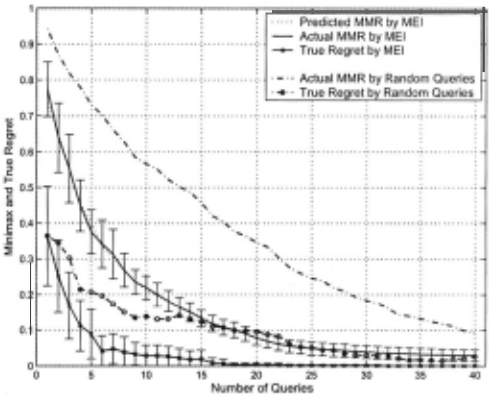
Figure 2 shows the performance of the MEl criterion (std. error bars are shown on actual MMR and true regret, but are excluded from predicted MMR for legibility). We see that the algorithm quickly converges to a point where the mini max regret guarantees are quite tight: within 20 queries, the a~er~ge regret guarantee falls below 0.1 (less than 10% ); and w1thm forty queries, decision quality is guaranteed to be with 4% of optimal. More interesting, we see that true regret falls to under 10% with 5 queries, and to near zero within 20 queries. Thus the actual decision quality associated with act ing according the decision with MMR is generally far better than the MMR guarantee. The MEl criterion seems to select suitable queries, allowing optimal decisions and tight regret guarantees to be identified with few interactions. For refer ence, we also include the performance of randomly selected queries (where both dimension i and query point l are chosen uniformly at random from the feasible region). Because the problem is of relatively low dimension, random queries per form reasonably well, though they have difficulty reducing regret to zero, and do not compete with MEl queries.
9 For example, MMI predicts the maximum regret over all re sponses, while MEl predicts the expected regret.
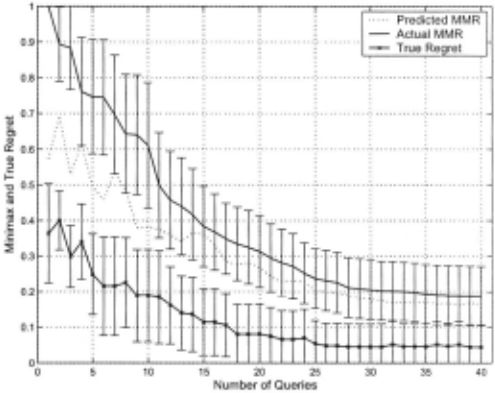
Figure 3 shows the same measurements for the MAl crite rion. We note that this query strategy does not reduce regret bounds nearly as quickly as the MEl strategy, reaching only an average regret guarantee of0.18 after 40 queries. True re gret is generally much better, but still does not approach the performance of MEl (or even random queries). We note that the MAl criterion often stalls: in such a case, we complete the data with the last minimax regret value. Finally, it is worth noting that the MMl criterion performs extremely badly. We don't plot its performance, but note that in all runs, it stalls after a maximum of five queries; its average minimax regret bound is 0.8, and average true regret level is 0.3 when it stalls.
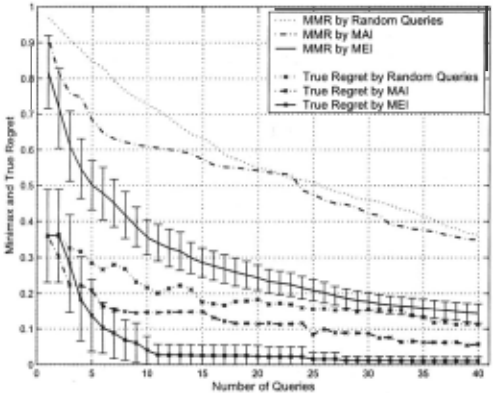
The MEl criterion appears to offer much better perfor mance than MAl, MMl, or random querying. Figure 4 shows t~e performance of MEl, MAl and random querying strate gies on the larger four-good (16-outcome, 81-decision) sce nario. Again we see that MEl converges quickly and outper forms the other strategies. With the increase in dimensional ity, random queries fare worse than MAl-optimal queries. We note that in all experiments, the optimal query (regardless of criterion) can be computed very quickly.
We have also tested the MEl criterion on a travel plan ning domain (as in the previous tests, MEl seems to domi nate the other criteria, so we focus on it). In this domain, an agent must choose a collection of flight segments from a flight database to take a user from a source to a destina tion city [1]. To make the elicitation problem interesting, we added the following information to the DB: the probability of any flight arrival being delayed by specific amount of time;
the probability of missing a connecting flight as a function of connection time and airport; a distribution over ground travel times to a hotel in the destination city as a function of arrival time (reflecting, e.g., arrival in rush hour or off-peak); and the probability of losing a hotel room as a function of arrival time at the hotel. As a result, for any specific flight combination (decision), a joint distribution over these variables (outcome) is obtained. A user's utility function is quasi-linear, given by her utility for a specific outcome over these four attributes less the flight price. The specific formulation discretizes these attributes, so the outcome space is of size 64. In our exper iments, the flight DB was designed to allow 20 flights (both direct and indirect) between pairs of cities.
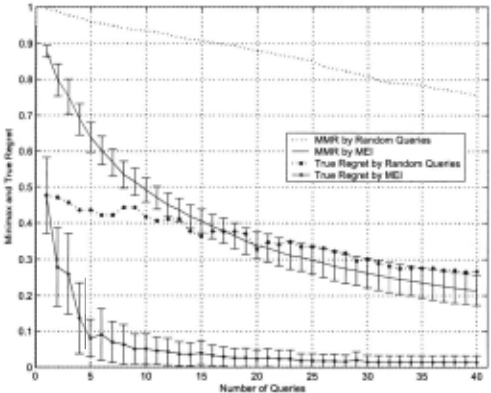
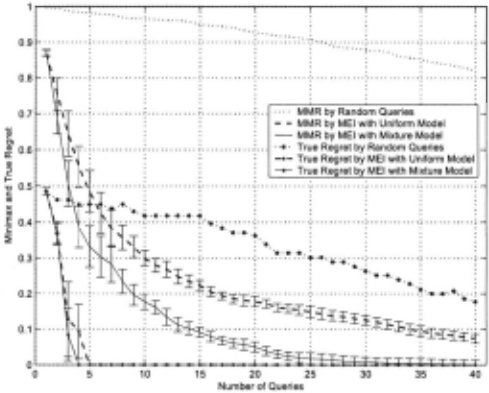
We tested the MEl strategy using a uniform prior over util ity space to select queries, with user utility functions drawn from the same uniform distribution. The results for a specific source-destination pair (Toronto-San Francisco) are shown in Figure 5. As before, we see that the MEl strategy easily out performs random querying, both in terms of the regret guar antees, and the true regret of the decisions it would recom mend at each stage. These results are representative of those obtained in other decision scenarios.
We also explored the use of strong prior knowledge to guide the querying process. We repeated the test above, draw ing user utility functions from a strongly peaked (truncated) Gaussian distribution over utility space (with diagonal covari ance matrix, and variance 0.03 in each dimension). We tested the MEl-criterion using a (hand-chosen) mixture of three uni form distributions over subregions of utility space that very roughly approximated the Gaussian. 10 To test the robustness of MEl to inaccurate priors, we also used MEl using a single uniform prior over all of utility space (despite the fact that the true utility function is drawn from the Gaussian). The re sults illustrated in Figure 6 demonstrate that MEl can benefit considerably from strong prior information. Indeed, minimax regret is reduced very quickly when a reasonable prior is used to select queries; and true regret is reduced to zero in every instance of this scenario within four queries. Random query ing does very poorly, indicating that this problem is not easy to solve without sufficient utility information. The robustness of MEl to inaccurate priors is also in evidence. We see that minimax regret and true regret are also reduced very quickly when an uniformative uniform prior is used to guide the MEl querying process.
10 In principle, this mixture could have been fit to the actual prior using, say, EM; but our goal is not accurate modeling of the prior.
5 Concluding Remarks
We have presented a new procedure for decision making with incomplete utility information which recommends decisions that minimize maximum regret. We defined several different myopic query selection criteria, and showed that myopically optimal queries under each criterion can be computed effec tively, in polynomial time. The empirical performance of one such criterion, maximum expected improvement, proved to be rather attractive: not only did it provide strong guarantees after few queries, but true decision quality tended to exceed these guarantees significantly.
Our work differs from existing approaches to preference elicitation in several important ways. Like recent Bayesian approaches [4; 2], our approach identifies a concrete decision in the face of utility function uncertainty. Unlike these meth ods, for the purposes of decision making, we assume only constraints on possible utility functions, not distributions. As a result, the minimax regret criterion is used to identify de cisions with guaranteed error bounds on quality. Our use of constraints on utility functions is more closely related to work on ISMAUT [8; 7]. However, the focus in ISMAUT is the identification of Pareto optimal decisions in the face of utility function uncertainty, as opposed to the choice of a specific de cision that maximizes some decision criterion. Furthermore, little attention has been paid to query strategies in ISMAUT, which, in contrast, is our main focus.
There are a number of directions in which this work can be extended. Obviously, scaling issues are of paramount importance. We are currently exploring pruning techniques for removing decisions from consideration that can never be minimax optimal, thus reducing the quadratic dependence on the number of decisions. We are also exploring meth ods for dealing with more general linear constraints (apart from one-dimensional bounds), as well as more expressive query types. Also of interest are methods for dealing with noisy/inconsistent query responses, and visualization tech niques. Finally, we are developing heuristics that simulate some of the effects of nonmyopic elicitation without explicit lookahead. One such technique involves enumerating the ver tices of the regions nd of utility space in which each decision d is optimal (the regions are convex polytopes). Queries at those points can quickly help rule out suboptimal actions. We hope to combine the computationally attractive methods de vised in this paper with more intensive techniques like this to help reduce the number of required queries even further.
Acknowledgements
This research was supported by the Natural Sciences and En gineering Research Council (NSERC) and the Institute for Robotics and Intelligent Systems (IRIS).
@inproceedings{ijcai2003p46,
  title     = {Incremental Utility Elicitation with the Minimax Regret Decision Criterion},
  author    = {Wang, Tianhan and Boutilier, Craig},
  booktitle = {Proceedings of the Eighteenth International Joint Conference on
               Artificial Intelligence, {IJCAI-03}},
  publisher = {International Joint Conferences on Artificial Intelligence},
  editor    = {Georg Gottlob and Toby Walsh},
  pages     = {309--317},
  year      = {2003},
  url       = {https://ijcai.org/proceedings/2003/46},
}
TY - CPAPER TI - Incremental Utility Elicitation with the Minimax Regret Decision Criterion AU - Wang, Tianhan AU - Boutilier, Craig T2 - Proceedings of the Eighteenth International Joint Conference on Artificial Intelligence, IJCAI-03 PB - International Joint Conferences on Artificial Intelligence PY - 2003 SP - 309 EP - 317 UR - https://ijcai.org/proceedings/2003/46 ER -Copied
Machine-readable versions of this paper, for tools and AI agents:





