
Sensible Agent Technology Improving Coordination and Communication in Biosurveillance Domains
Proceedings of the Eighteenth International Joint Conference on Artificial Intelligence. Pages 1631-1631.
© 2003 International Joint Conferences on Artificial Intelligence
Abstract
- Barber, K. S., McKay, R. M., MacMahon, M. T., Martin, C. E., Lam, D. N., Goel, A., Han, D. C., and Kim, J. 2001. Sensible Agents: An Implemented Multi-Agent System and Testbed. In Proc. of the Fifth Int. Conference on Autonomous Agents (Agents-200I), Montreal, QC, Canada: 92-99.
- Barber, K. S. and Martin, C. E. 2001 . Dynamic Reorganization of Decision-Making Groups. In Proc. of the Fifth Int. Conference on Autonomous Agents (Agents- 2001), Montreal, QC, Canada: 513-520.
- Barber, K. S. and Kim, J. "Belief Revision Process based on Trust: Simulation Experiments," Autonomous Agents 2001, Workshop for Fraud, Deception and Trust in Agent Societies, pp. 1-12, May 28-June I, 2001, Montreal, Canada.
References were extracted automatically from the PDF and may contain errors.
Full text extracted automatically from the PDF; figures, tables and equations may differ. The PDF is the version of record.
Sensible Agent Technology Improving Coordination and Communication in Biosurveillance Domains
K. S. Barber, D. Faith, K. Fullam, T. Graser, D. C. Han, J. Jeong, J. Kim, D. Lam, R. McKay,
M. Pal, J. Park, M. Vanzin
The Laboratory for Intelligent Processes and Systems Electrical and Computer Engineering The University of Texas at Austin
{barber, daniel, kfullam, graser, dhan, jeongjh, joonoo, dnlam, rmckay, monti, jisun, vanzin} @lips.utexas.edu
Protecting the population from chemical-biological attacks and outbreaks of infectious disease is a fundamental goal of government entities such as the Center for Disease Control (CDC), as well as state and local health agencies. Early warning is critical for saving lives and implementing an effective response, including characterizing disease sources, preventing proliferation, and treating patients. However, such biosurveillance activities are inherently challenging due to a number of complications:
- Coordinating participants and disseminating information: Biosurveillance requires coordination between local, state, and federal authorities. Local entities such as treatment facilities must collect information and disseminate to decision-making entities, constrained by communicatio.n costs as well as time.
- Determining the relevance and reliability of information.· The ability of a treatment facility to offer a diagnosis with high confidence is in part a function of resources and expertise at their disposaL Thus, entities receiving symptom and diagnosis information must determine information relevance qualified by source reliability.
- Drawing epidemiological conclusions from symptoms and diagnoses: Significant expertise is required to analyze symptoms and diagnoses to assess public risk. Such assessments consider an entire region, drawing together information from all contributing sources. Often few epidemiologists are responsible for monitoring a large area, resulting in analysis and communication overload.
To support epidemiologists and increase the effectiveness of biosurveillance activities, the Laboratory for Intelligent Processes and Systems at the University of Texas at Austin (UT:LIPS) is applying its Sensible Agent (SA) multi-agent system (MAS) technology to the biosurveillance domain. Specific SA features and their applicability to the biosurveillance domain follow:
- Evaluation of Information and Information Source Trustworthiness by considering 1) level of uncertainty of symptom and diagnosis information and 2) reliability of sources (e.g., treatment facilities) transmitting that information to agents responsible for epidemiological analysis [3].
- Adaptive Decision-Making Organization Formation (ADMF) to establish collaborations among agents associated with epidemiologists, treatment facilities, pharmacies, schools, and other entities. ADMF capabilities involve searching for potential partner agents, evaluating those partners and ranking their capabilities, selecting one or more partners, and determining the "best" distribution of decision-making control and execution obligations among selected partners [2].
- Coordinated Planning and Execution among distributed decision-making agents, allowing them to share preferences and constraints during the planning process. For example, agents may coordinate interrogation of information sources, motivated by reduced overall communication cost.
In Texas, biosurveillance is conducted by the Texas Department of Health (TDH) in cooperation with local and federal authorities. Resident epidemiologists gather patient symptom and diagnostic information from hospitals, clinics, and other treatment facilities from throughout the state. TDH is currently a single point of contact, and has solicited approaches for other network configurations that allow them to reduce burden and provide more rapid response. UT:LIPS has suggested a variety of options for distributing decision-making and information monitoring using agent technology.
Figure 1 depicts one configuration of agent roles suggested by UT:LIPS and characterized in this demonstration. The existing two-layer network is expanded to three layers, where an interim layer consists of Sensible Agents acting as "Disease Agents," each dedicated to the analysis of a particular disease being monitored. Symptom and diagnosis data is sent from information sources (e.g., hospitals and clinics) to disease agents, which evaluate the information and send appropriate epidemiological assessments to a centralized TDH agent. In making an assessment, disease agents incorporate source reliability and the confidence values associated with information assigned by those sources. Disease agents may also collaborate in acquiring and evaluating symptom and diagnosis data. This demo illustrates the application of the Sensible Agent Testbed to how information will ultimately be shared. Preferences may involve agreements whereby one disease agent acquires information from selected case agents, while a collaborating agent acquires information from a second, disjoint set of case agents In exchange. In summary, we aim to demonstrate better performance (i .e. quicker and more reliable) response in the biosurveillance domain through various scenarios, each emphasizing one of the SA features described above. The Testbed offers a suite of tools to assist in the experimental testing of multi-agent systems. Tool facilities include execution visualization and configuration of repeatable experimental runs, allowing the user to specify what parameters to test and what data to record [ 1] .
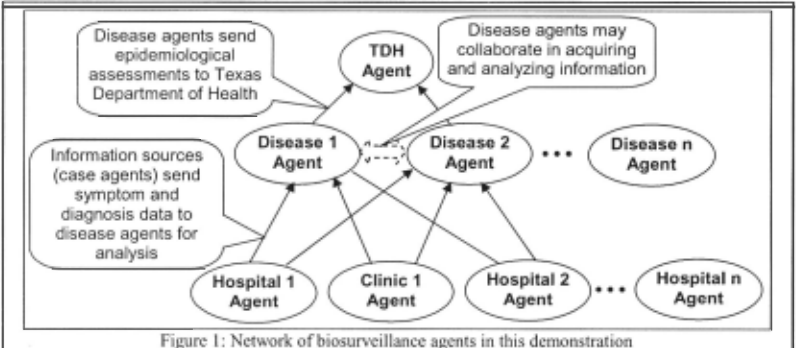
In one scenario, case agents consisting of local hospitals send patient case symptom and diagnosis information to disease agents. It should be noted that case agents are simple reactive agents responsible for period reporting and are not endowed with Sensible Agent capabilities such as trust evaluation and ADMF. The disease agent assigns an initial reputation to case agents based on the case agent's quality of facilities, available resources (e.g. , equipment and staff expertise) and history for providing reliable/unreliable data. Disease agents collect information on a given patient from multiple case agents, generating a "net belief' about patient symptoms and diagnoses, qualified by confidence values on respective data and the reputations of the case agents. The number of patients with a given disease is calculated from net beliefs and compared to a series of threshold values associated with standard degrees of epidemiological alarms: None, Low, Guarded, Elevated, High, Severe. Generated alarms are passed to the TDH agent and reflected on a simulation visualization.
Other scenarios involve collaboration between disease agents in acquiring and analyzing case information. Motivation for collaboration is based on reducing communication costs, where collaborators can benefit by (i) sharing information acquired previously; (ii) leveraging lower communication costs such as time to communicate between selected disease agents and case agents; and (iii) applying economies of scale by "bundling" multiple queries, thereby amortizing the cost of query initiations across multiple requests. Disease agents agree to establish collective decision-making frameworks that impact which agents will perform planning (i .e. plans to acquire and evaluate case data) on behalf of framework members and biosurveillance technology. scenanos usmg Sensible Agent
Acknowledgments
This research is sponsored in part by the Defense Advanced Research Project Agency (DARPA) Taskable Agent Software Kit (TASK) program, agreement number F30602-00-2-0588. Additionally, the research reported in this document/presentation was performed in connection with Contract/Cooperative Agreement number DAAD 1701-D-0001 with the U.S. Army Research Laboratory. The views and conclusions contained in this document/presentation are those of the authors and should not be interpreted as presenting the official policies or position, either expressed or implied, of the U.S. Army Research Laboratory or the U.S. Government unless so designated by other authorized documents.
@inproceedings{ijcai2003p285,
  title     = {Sensible Agent Technology Improving Coordination and Communication in Biosurveillance Domains},
  author    = {Barber, Kathleen Suzanne and Faith, Daniel and Fullam, Karen and Graser, Thomas J. and Han, David C. and Jeong, J. and Kim, Joonoo and Lam, Dung N. and McKay, Ryan and Pal, M. and Park, Jisun and Vanzin, Marcelo M.},
  booktitle = {Proceedings of the Eighteenth International Joint Conference on
               Artificial Intelligence, {IJCAI-03}},
  publisher = {International Joint Conferences on Artificial Intelligence},
  editor    = {Georg Gottlob and Toby Walsh},
  pages     = {1631--1631},
  year      = {2003},
  url       = {https://ijcai.org/proceedings/2003/285},
}
TY - CPAPER TI - Sensible Agent Technology Improving Coordination and Communication in Biosurveillance Domains AU - Barber, Kathleen Suzanne AU - Faith, Daniel AU - Fullam, Karen AU - Graser, Thomas J. AU - Han, David C. AU - Jeong, J. AU - Kim, Joonoo AU - Lam, Dung N. AU - McKay, Ryan AU - Pal, M. AU - Park, Jisun AU - Vanzin, Marcelo M. T2 - Proceedings of the Eighteenth International Joint Conference on Artificial Intelligence, IJCAI-03 PB - International Joint Conferences on Artificial Intelligence PY - 2003 SP - 1631 EP - 1631 UR - https://ijcai.org/proceedings/2003/285 ER -Copied
Machine-readable versions of this paper, for tools and AI agents:
 Welcome
 Future Conferences
 AI Journal Division
 IJCAI Proceedings
 About IJCAI
 IJCAI Awards