
Neural Executive Attentional Control in Robots
Proceedings of the Eighteenth International Joint Conference on Artificial Intelligence. Pages 1501-1501.
© 2003 International Joint Conferences on Artificial Intelligence
Abstract
We have developed a robot controller based upon a neural implementation of Norman and Shallice's model of executive attentional control in humans. A simulation illustrates how attentional control leads to the suppression of action selection errors in neurally controlled robots. A related demonstration illustrates how lesioning of the control architecture leads to behavioural pathologies that resemble those seen in human patients with damage to the prefrontal cortex.
- [Baddeley and Weiskrantz, 1993] A.Baddeley and L. Weiskrantz. Attention: Selection, Awareness, & Control. Oxford University Press, 1993.
- [Dudek and Jenkin, 2000] Gregory Dudek and Michael Jenkin. Computational Principles of Mobile Robotics. Cambridge University Press, 2000.
- [Mataric, 1996] Maya Mataric. Designing and Understand- ing Adaptive Group Behaviour. Adaptive Behaviour 4(1): 51-80, 1996.
- [Prescott eta!, 1999] T.J. Prescott, P. Redgrave and K. Gur- ney. Layered control architectures in robots and vertebrates. Adaptive Behaviour, 7( 1 ):99-127. 1999.
- [Robbins, 1991] T. W. Robbins. Cognitive Defecits in Schizophrenia and Parkinson's Disease: Neural basis and the Role of Dopamine. In P. Willner and J. Scheel-Kruger (eds) The Mesolimbic Dopamine System: From Motivation to Action. pages 497-526, John Willey, 1991
- [Shallice, 1988] Tim Shallice. From Neuropsychology to Mental Structure. Cambridge University Press, 1988.
References were extracted automatically from the PDF and may contain errors.
Full text extracted automatically from the PDF; figures, tables and equations may differ. The PDF is the version of record.
1 Introduction
Selecting the right action at the right time IS Important for machines exhibiting higher-level behaviours. How ever, many researchers have found that robots exhibit behavioural pathologies in relation to action selection. Common examples include excessively frequent and in appropriate changes of behaviour (appearing either as distractedness or as indecision); inappropriate persistence of a behaviour; repetitive behaviour in which the robot appears to lack awareness of failure.
Humans suffering similar behavioural pathologies are often found to have suffered damage to an area of the pre-frontal cortex which is functionally labeled the ex ecutive [Parkin, 1996]. The executive initiates, monitors and modulates higher level behaviours. Several models of the executive exist, notably those of Baddeley and Weiskrantz [ 1993] and Norman & Shall ice [Shallice, 1998]. Both these models contain an executive called the Supervisory System or Supervisory Attentional System (SAS), respectively.
We have developed a neural implementation of the Norman & Shallice architecture as a controller for a simulated robot with the aim of demonstrating that such an architecture can reduce action selection errors.
2 Architecture
The control network (ca. 700 neurons) features clusters of highly interconnected neurons within functional blocks corresponding to those of the original Norman and Shallice model (see below). These clusters are sparsely connected to other clusters within the same functional block or to clusters in neighbouring blocks. The inter block connections are based on known neuroanatomical structures and pathways.
The functional architecture features a Perception Layer which fuses sensor signals before distributing these to an Associative Layer which maps perceptions to a behaviour layer. The Behaviour Layer holds a number of distinct networks which individually exhibit basis behaviours such as 'wander safely', 'aggregate', 'disperse' [Mataric, 1996]. Basis behaviours can be combined to provide higher-level behaviours. A Contention Scheduler takes input from stimulated behaviours in the behaviour net work requesting access to the robots effector systems and selects which behaviors are granted expression in the real world. (Our contention scheduler is an independent im plementation of that given by Prescott et al. [ 1999] .)
Two SAS functions are currently implemented. The monitor network compares the currently intended behav iour with the currently expressed behaviour, generating an arousal stimulus if a disparity occurs. Arousal causes the modulator network to modulate the behavioral signals into the contention scheduler from the behaviour layer such that the intended behaviour is potentiated and the other behaviours are attenuated. It is important to recog nise that this does not guarantee the selection of the in tended behaviour as this risks overriding behaviours de signed to prevent undesirable outcomes such as collision.
3 Simulation
This section illustrates the operation of the simulated robot which has both sonar and olfactory sensors and is equipped with independent drive wheels and a gripper for picking up objects of interest. The dynamics of the robot motion and the sensor are based techniques prescribed by Dudek and Jenkin [2000]. We use foraging behaviour (wander until detect food, collect food, take food to home) , to illustrate the normal functioning of the SAS.
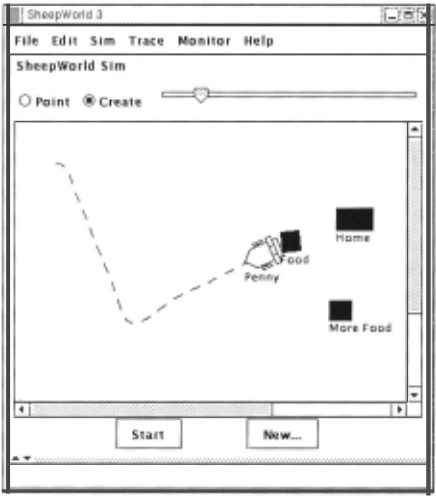
In Figure 1. the robot (Penny) has detected food in a re gion near the bottom of the world, oriented itself and then moved towards that food, collected it, and is now taking it towards 'home'.
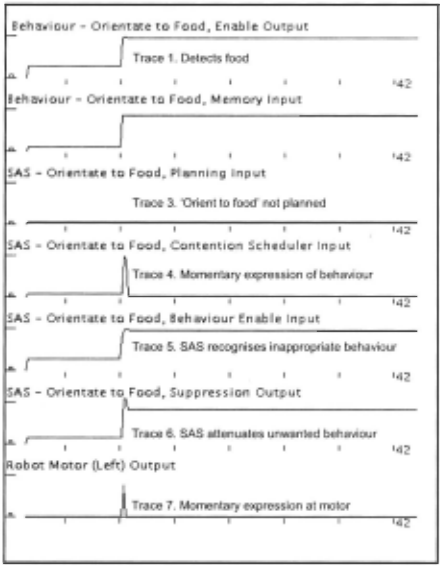
The successful operation of the SAS is illustrated in Figure 2. which provides a sequence of traces which are the outputs of clusters and/or functional units of the neu ral architecture. Whilst the robot is currently taking food home (as in Figure 1) an additional, distracting, food source is introduced into the environment. This occurs some 2 seconds into the trace. The top trace shows that the robot detects the new food and the 'orient to food' behaviour requests expression via the contention sched uler. Trace 3 shows that this is not the currently planned behaviour (planning input for this behaviour is 'low'). However, the strength of the conditioning to the 'orient to food' stimulus leads the Contention Scheduler to select (inappropriately) the 'orient to food' behaviour (rising spike in trace 4). But, the SAS monitor sees this (trace 5), and correctly generates a modulatory signal to suppress the level of excitation of this behaviour as seen by the Contention Scheduler (trace 6). This results in the falling spike of trace 4. Trace 7 illustrates that there was a mo mentary expression of the inappropriate behaviour at one of the motors.
4 Conclusion
We have demonstrated that a neural controller based upon the Norman and Shallice model of executive atten tional control can express willed behaviour required sup press otherwise inappropriate behavior. In a related dem onstration of this simulation, lesion studies are used to reproduce robot behaviour that appears to correspond to similar pathologies exhibited by human patients .
@inproceedings{ijcai2003p250,
  title     = {Neural Executive Attentional Control in Robots},
  author    = {Garforth, Jason P. and McHale, Sue L. and Meehan, Anthony},
  booktitle = {Proceedings of the Eighteenth International Joint Conference on
               Artificial Intelligence, {IJCAI-03}},
  publisher = {International Joint Conferences on Artificial Intelligence},
  editor    = {Georg Gottlob and Toby Walsh},
  pages     = {1501--1501},
  year      = {2003},
  url       = {https://ijcai.org/proceedings/2003/250},
}
TY - CPAPER TI - Neural Executive Attentional Control in Robots AU - Garforth, Jason P. AU - McHale, Sue L. AU - Meehan, Anthony T2 - Proceedings of the Eighteenth International Joint Conference on Artificial Intelligence, IJCAI-03 PB - International Joint Conferences on Artificial Intelligence PY - 2003 SP - 1501 EP - 1501 UR - https://ijcai.org/proceedings/2003/250 ER -Copied
Machine-readable versions of this paper, for tools and AI agents:





