
Improving Word Sense Disambiguation in Lexical Chaining
Proceedings of the Eighteenth International Joint Conference on Artificial Intelligence. Pages 1486-1487.
© 2003 International Joint Conferences on Artificial Intelligence
Abstract
Previous algorithms to compute lexical chains suffer either from a lack of accuracy in word sense disambiguation (WSD) or from computational inefficiency. In this paper, we present a new lineartime algorithm for lexical chaining that adopts the assumption of one sense per discourse. Our results show an improvement over previous algorithms when evaluated on a WSD task.
- [Al-Halimi and Kazman, 1998] R. Al-Halimi and R. Kaz- man . Temporal indexing of video through lexical chaining. In WordNet: An electronic lexical database. MIT Press , 1998.
- [Barzilay and Elhadad, 1997] R. Barzilay and M. Elhadad. Using lexical chains for text summarization. In Proc. of the Intelligent Scalable Text Summarization Workshop (ISTS'97), ACL, 1997.
- [Barzilay, 1997] R. Barzilay. Lexical chains for summariza- tion. Master's thesis, Ben-Gurion University, 1997.
- [Gale et al., 1992] W. Gale, K. Church, and D. Yarowsky. One sense per discourse. In Proc. of the DARPA Speech and Natural Language Workshop, 1992.
- [Green, 1998] S. Green. Automated link generation: Can we do better than term repetition? In Proc. of the 7th International World-Wide Web Conference, 1998.
- [Halliday and Hasan, 1976] M. Halliday and R. Hasan. Co- hesion in English. Longman, London, 1976.
- [Hirst and St-Onge, 1998] G. Hirst and D. St-Onge. Lexical chains as representations of context for the detection and correction of malapropisms. In WordNet: An electronic lexical database. MIT Press, 1998.
- [Hoey, 1991] M. Hoey. Patterns of texis in text. Oxford University Press, 1991.
- [Kan et al., 1998] M.-Y. Kan, 1. Klavans, and K. McKeown. Linear segmentation and segment significance. In Proc. of the 6th Workshop on Very Large Corpora (WVLC-98), 1998.
- [Miller, 1990] G. Miller. WordNet: cal database. International Journal 3(4):235-312, 1990. An on-line lexi- of Lexicography, [Silber and McCoy, 2003]
- G. Silber and K. McCoy. Ef- ficiently computed lexical chains as an intermediate representation for automatic text summarization. Compu- tational Linguistics, 29(1), 2003.
References were extracted automatically from the PDF and may contain errors.
Full text extracted automatically from the PDF; figures, tables and equations may differ. The PDF is the version of record.
1 Introduction
Passages from spoken or written text have a quality of unity that arises in part from the surface properties of the text; syntactic and lexical devices can be used to create a sense of connectedness between sentences, a phenomenon known as textual cohesion [Halliday and Hasan, 1976]. Of all cohesion devices, lexical cohesion is probably the most amenable to automatic identification [Hoey, 1991]. Lexical cohesion arises when words are related semantically, for example in reiteration relations between a term and a synonym or superordinate.
Lexical chaining is the process of connecting semantically related words, creating a set of chains that represent different threads of cohesion through the text. This intermediate representation of text has been used in many natural language processing applications, including automatic summarization [Barzilay and Elhadad, 1997; Silber and McCoy, 2003 ], infor mation retrieval [Al-Halirni and Kazman, 1998], intelligent spell checking [Hirst and St-Onge, 1998], topic segmentation [Kan et al., 1998], and hypertext construction [Green, 1998].
A first computational model of lexical chains was in troduced by Hirst and St-Onge [1998]. This linear-time algorithm, however, suffers from inaccurate WSD, since their greedy strategy immediately disambiguates a word as it is first encountered. Later research [Barzilay and Elhadad, 1997] significantly alleviated this problem at the cost of a worse running time (quadratic); computational inefficiency is due to their processing of many possible combinations of word senses in the text in order to decide which assignment is the most likely. More recently, Silber and McCoy [2003] pre sented an efficient linear-time algorithm to compute lexical chains, which models Barzilay's approach, but nonetheless has inaccuracies in WSD.
In this paper, we further investigate the automatic identifi cation of lexical chains for subsequent use as an intermediate representation of text. In the next section, we propose a new algorithm that runs in linear time and adopts the assumption of one sense per discourse [Gale et al., 1992]. We suggest that separating WSD from the actual chaining of words can increase the quality of chains. In the last section, we present an evaluation of the lexical chaining algorithm proposed in this paper, and compare it against [Barzilay and Elhadad, 1997; Silber and McCoy, 2003] for the task of WSD. This evaluation shows that our algorithm performs significantly better than the other two.
2 Lexical Chaining with a Word Sense Disambiguation Methodology
Our algorithm uses WordNet [Miller, 1990] as a knowledge source to build chains of candidate words (nouns) that are related semantically. We assign a weight to each semantic relation; in our work semantic relations are restricted to hypemyms/hyponyms (e.g. between cat and feline) and siblings (hyponyms of hypemyms, e.g. dog and wolf). Distance factors for each type of semantic relation prevent the linkage of words that are too far apart in the text; these factors are summarized in Table 1.
The algorithm can be decomposed into three steps: build ing a representation of all possible interpretations of the text, disambiguating all words, and finally building the lexical chains. First, similarly to [Silber and McCoy, 2003], we process the whole text and collect all semantic relations between candidate words under any of their respective senses. No disambiguation is done at this point; the only purpose is to build a representation used in the next stages of the algorithm. Note that this is the only stage where the text is read; all later stages work on this implicit representation of possible interpretations, called a disambiguation graph (Figure 1). In this kind of graph, nodes represent word instances and weighted edges represent semantic relations. Since WordNet doesn't relate words but senses, each node is divided into as many senses as the noun has, and each edge connects exactly two noun senses.
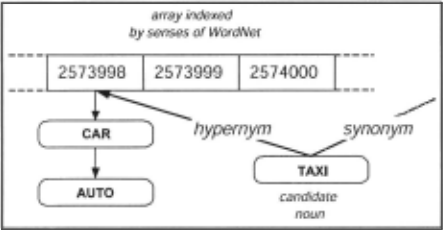
This representation can be built in linear time by first build ing an array indexed by senses of WordNet and processing a text sequentially, inserting a copy of each candidate word into all entries that are valid senses of this word (for example, in Figure 2, the instances car and auto have been inserted under the same sense in the array). Then, we check whether the noun instance that was just inserted is semantically related to other nouns already present in the array. We do so by looking at hypemyms, hyponyms, and siblings, and if any of these related senses have non-empty entries in the array, we create the appropriate links in the disambiguation graph. For example, in Figure 2, the algorithm finds an hyponymy relation between the noun taxi (under its unique sense in the array) and another entry in the array containing car and auto, so semantic links are added to the disambiguation graph between these two words and taxi (shown here attached to the array). Processing all nouns this way, we can create all semantic links in the disambiguation graph in time O(n) (where n is the number of candidate words.)
| Semantic relation | 1 sent. | 3 sent. | 1 par. | other |
|---|---|---|---|---|
| synonym | 1 | 0.5 | 0.5 | |
| hypernym/hyponym | 0.5 | 0.3 | 0.3 | |
| sibling | 0.3 | 0.2 | 0 |
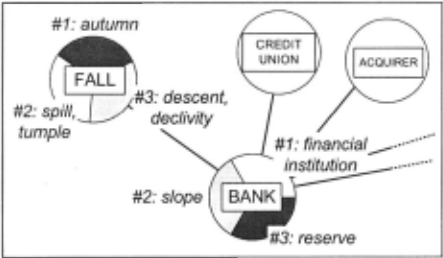
In the second step, we use the disambiguation graph to perform WSD, enforcing the constraint of one sense per discourse. We perform the disambiguation of every word, instead of disambiguating word occurrences as in e.g. [Hirst and St-Onge, 1998; Silber and McCoy, 2003 ]. We process all occurrences (nodes) of one word at a time, and sum the weight of all edges leaving these nodes under their different senses. The one sense of the word that is assigned the highest score (sum of weights) is considered the most probable sense. For example in Figure 1, the sense of bank that has the highest score is financial institution. That sense is assigned to all occurrences of the word; in other words, we impose the constraint of one sense per discourse. In case of a tie between two or more senses, we select the one sense that comes first in WordNet, since WordNet orders the senses of a word by decreasing order of frequency.
The final step is to build the actual lexical chains by processing the entire disambiguation graph. At this point, we have already assigned a sense to each word, so the last step is to remove from the disambiguation graph all semantic links that connect words taken under their (assumed) wrong senses. Once all such edges have been removed, we are left with the semantic links corresponding to a unique interpretation of the text, and the edges that remain in the graph are the actual lexical chains of our algorithm. 1
The separation of WSD and lexical chaining into two different sub-tasks is important. All semantic relations, whether correct or incorrect, can be investigated in WSD without necessarily creating incorrect semantic relations in the chaining process. Words are disambiguated by summing weights of semantic relations, but mistakenly counting edges relating words under wrong senses (as in Figure 2 between fall and bank) doesn't necessarily have the undesirable effect of linking the two words in the same chain. Our assumption is that summing edge weights generally helps in selecting the right senses, e.g. bank is disambiguated as a financial institu tion, and fall and bank are thus prevented from appearing in the same chain.
3 Evaluation
The evaluation of lexical chains is generally difficult. Even if they can be effectively used in many practical applica tions like automatic summarization, topic segmentation, and others, lexical chains are seldom desirable outputs in a real world application, and it is unclear how to assess their quality independently of the underlying application in which they are used. For example, in summarization, it is hard to determine whether a good or bad performance comes from the efficiency of the lexical chaining algorithm or from the appropriateness of using lexical chains in that kind of application. In this section, we evaluate lexical chaining algorithms on the basis of WSD. This arguably is independent of any targeted application, since any lexical chaining algorithm has to deal with the problem of WSD. We do not attempt to further evaluate other aspects of chains.
1 0ur algorithm has some similarities with Silber and McCoy's algorithm, but it is actually quite different. First, they process each noun instance separately; thus, nothing prevents a noun from having different senses in the same discourse. Second, they process the entire text twice instead of once. In the second pass of their algorithm, they perform WSD and the actual chaining at the same time, whereas we postpone the chaining process until each word has been fully disambiguated.
| Algorithm | Accuracy |
|---|---|
| Barzilay and Elhadad Silber and McCoy | 56.56% |
| 54.48% | |
| Galley and McKeown | 62.09% |
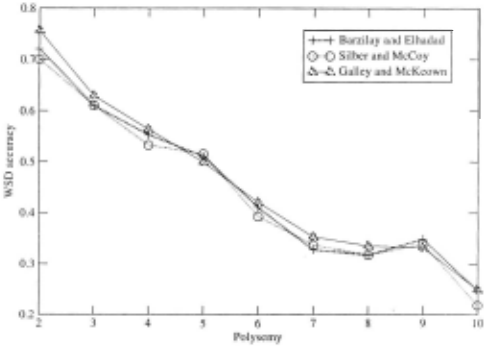
We tested three lexical chaining algorithms on the semantic concordance corpus (semcor), a corpus that was extracted from the Brown Corpus and semantically tagged with Word Net senses. We limited our evaluation to a set of 74 documents of that corpus; this represents about 35,000 nouns. WSD was evaluated on nouns, since all three algorithms that were tested (Barzilay and Elhadad; Silber and McCoy, and ours) build lexical chains with nouns only. We used the original implementation of Barzilay and Elhadad's algorithm, but had to implement Silber and McCoy's algorithm since we didn't have access to their source code. We tested the accuracy of WSD on the set of 35,000 nouns and obtained the results presented in Table 2; 2 accuracy by polysemy is displayed in Figure 3. We can see that our algorithm outperforms Barzilay and Elhadad's, and a one-sided t-test 3 of the null hypothesis of equal means shows significance at the .001level (p = 4.52 -10- 4 ). Barzilay and Elhadad in tum outperform Silber and McCoy, but this result is not significant at the basic .05 level (p = 0.0537) .
4 Conclusions
In this paper, we presented an efficient linear-time algo rithm to build lexical chains, showing that one sense per discourse can improve performance. We explained how the separation of WSD from the construction of the chains enables a simplification of the task and improves running time. The evaluation of our algorithm against two known lexical chaining algorithms shows that our algorithm is more accurate when it chooses the senses of nouns to include in lexical chains. The implementation of our algorithm is freely available for educational or research purposes at http://www.cs.columbia.edurgalley/research.html.
Acknowledgments
We thank Regina Barzilay, the three anonymous reviewers, and the Columbia natural language group members for help ful advice and comments.
2 Jn Barzilay and Elhadad's algorithm, a word can sometimes belong to two different chains. In order to map each word to one single sense, we applied the strong chain sense disambiguation strategy described in [Barzilay, 1997] (i .e. picking the word sense used in the strongest chain).
3 The samples in the t-test are the WSD accuracies on each individual documents.
@inproceedings{ijcai2003p245,
  title     = {Improving Word Sense Disambiguation in Lexical Chaining},
  author    = {Galley, Michel and McKeown, Kathleen R.},
  booktitle = {Proceedings of the Eighteenth International Joint Conference on
               Artificial Intelligence, {IJCAI-03}},
  publisher = {International Joint Conferences on Artificial Intelligence},
  editor    = {Georg Gottlob and Toby Walsh},
  pages     = {1486--1487},
  year      = {2003},
  url       = {https://ijcai.org/proceedings/2003/245},
}
TY - CPAPER TI - Improving Word Sense Disambiguation in Lexical Chaining AU - Galley, Michel AU - McKeown, Kathleen R. T2 - Proceedings of the Eighteenth International Joint Conference on Artificial Intelligence, IJCAI-03 PB - International Joint Conferences on Artificial Intelligence PY - 2003 SP - 1486 EP - 1487 UR - https://ijcai.org/proceedings/2003/245 ER -Copied
Machine-readable versions of this paper, for tools and AI agents:





