
Dynamic Bayesian modeling of the cerebral activity
Proceedings of the Eighteenth International Joint Conference on Artificial Intelligence. Pages 169-175.
© 2003 International Joint Conferences on Artificial Intelligence
Abstract
Conventional methods used for the interpretation of activation data provided by functional neuroimaging techniques provide useful insights on what the networks of cerebral structures are, and when and how much they activate. However, they do not explain how the activation of these large-scale networks derives from the cerebral information processing mechanisms involved in cognitive functions . At this global level of representation, the human brain can be considered as a dynamic biological system. Dynamic Bayesian networks seem currently the most promising modeling paradigm. Our modeling approach is based on the anatomical connectivity of cerebral regions, the information processing within cerebral areas and the causal influences that connected regions exert on each other. The capabilities of the formalism's current version are illustrated by the modeling of a phonemic categorization process, explaining the different cerebral activations in normal and dyslexic subjects. The simulation data are compared to experimental results [Ruff eta/., 2001].
- Alexander, eta/., 1992)
- G. E. Alexander, M. R. Delong, and M. D. Crutcher. Do cortical and basal ganglionic motor area use "motor programs" to control movement? BBS, 15:656-65, 1992.
- [Bressler, 1995] S. L. Bressler. Large-scale cortical net- works and cognition. Brain Res Rev, 20(3):288-304, 1995.
- [Bilchel and Friston, 1997] C. Bilchel and K. J. Friston. Modulation of connectivity in visual pathways by at- tention: Cortical interactions evaluated with structural equation modelling and fMRI. Cereb Cortex, 7(8):768- 78, 1997.
- [Cohen, eta/., 1990] J. D. Cohen, K. Dunbar, and J. L. McClelland. On the control of automatic processes: A parallel distributed processing account of the Stroop effect. Psycho! Rev, 97(3):332-61, 1990.
- [Dean and Kanazawa, 1988] T. Dean and K. Kana- zawa. Probabilistic temporal reasoning. Proceedings of AAAI, Pages 524-528, 1988.
- Demonet, eta/., 1994)
- J. F. Demonet, C. Price, R. Wise, and R. S. Frackowiak. A PET study of cognitive strate- gies in normal subjects during language tasks. Influ- ence of phonetic ambiguity and sequence processing on phoneme monitoring. Brain, 117 (Pt 4):671-82, 1994.
- [Fox and Raichle, 1985] P. T. Fox and M. E. Raichle. Stimulus rate determines regional brain blood flow in striate cortex. Ann Neural, 17(3):303-5, 1985.
- [Ghahramani and Wolpert, 1997] Z. Ghahramani and D. M. Wolpert. Modular decomposition in visuomotor learning. Nature, 386(6623):392-395, 1997.
- Giard, et al., 1995)
- M.H. Giard, J. Lavikainen, K. Reinikainen, F. Perrin, 0 . Bertrand, J. Pernier, and R. Niiiitiinen. Separate representation of stimulus fre- quency, intensity and duration in auditory sensory memory: An event-related potential and dipole-model analysis. J Cogn Neurosci, 7(2): 133-143, 1995.
- [Goldman-Rakic, 1988] P. S. Goldman-Rakic. Topog- raphy of cognition: Parallel distributed networks in pri- mate association cortex. Annu Rev Neurosci, 11: 13 7- 56, 1988.
- [Grossberg, eta/., 2002] S. Grossberg, S. Hwang, and E. Mingolla. Thalamocortical dynamics of the McCollough effect: Boundary-surface alignment through perceptual learning. Vision Res, 42(10):1259- 86, 2002.
- Herbster, et al., 1996) A. N. Herbster, T. Nichols, M. B. Wiseman, M. A. Mintun, S. T. DeKosky, and J. T. Becker. Functional connectivity in auditory-verbal short-term memory in Alzheimer's disease. Neuroi- mage, 4(2):67-77, 1996.
- Hume, 1740)
- D . Hume. Treatise of human nature, Oxford University Press (2000), 1740.
- Jensen, 1996)
- Finn V. Jensen. An introduction to Bayesian networks, Springer, New York, 1996.
- [Julier and Uhlmann, 1997] S. J. Julier and J. K. Uhlmann. A new extension of the Kalman filter to nonlinear systems. Proceedings of Int. Symp. Aero- space/Defense Sensing, Simul. and Controls, Orlando (FL), 1997.
- [Labatut and Pastor, 2001] V. Labatut and J. Pastor. Bayesian modeling of cerebral information processing. Proceedings of AIME, Bayesian models in medicine Workshop, Cascais (Po), 2001.
- [Leiner and Leiner, 1997] H. C. Leiner and A. L. Leiner. How fibers subserve computing capabilities: Similari- ties between brains and machines. lnt Rev Neurobiol, 41:535-53, 1997.
- Murphy, 1999)
- K. Murphy. Filtering, smoothing and the junction tree algorithm. Technical Report, U.C. Berke- ley, Dept. Comp. Sci, 1999.
- [Norgaard, eta/., 2000] Magnus Norgaard, Niels K. Poulsen and Ole Ravn. Advances in derivative-free state es;imation for nonlinear systems. Technical Rep- port IMM-REP-1998-15, Technical University of Danemark, Lyngby, 2000.
- [Pastor, eta/., 2000] J. Pastor, M. Lafon, L. Trave- Massuyes, J. F. Demonet, B. Doyon, and P. Celsis. In- formation processing in large-scale cerebral networks : The causal connectivity approach. Bioi Cybern , 82(1):49-59, 2000.
- [Pearl, 1988] J. Pearl. Probabilistic reasoning in intelli- gent systems: Networks of plausible inference, Morgan Kaufmann, 1988.
- Pearl, 2001)
- J. Pearl. Bayesianism and causality, or, why I am only a half-Bayesian. In Foundations of Bayesianism, K1uwer, 2001.
- [Ruff, eta/., 2001] S. Ruff, K. Boulanouar, D. Carde- bat, P. Celsis, and J. F. Demonet. Brain correlates of impaired categorical phonetic perception in adult dys- lexics. Neuroimage, 13(6):S595-S595 , 2001.
- [VanDer Merwe and Wan, 2001] R. van der Merwe and E. A. Wan. Efficient derivative-free Kalman filters for online learning. Proceedings of ESANN, Pages 205-210, Bruges, Belgium, 2001 .
- [Wang and Buzsaki, 1996] X. J. Wang and G. Buzsaki. Gamma oscillation by synaptic inhibition in a hippo- campal interneuronal network model. J Neurosci, 16(20):6402-13, 1996.
References were extracted automatically from the PDF and may contain errors.
Full text extracted automatically from the PDF; figures, tables and equations may differ. The PDF is the version of record.
1 Introduction
In Neurology and Neuropsychology, the diagnosis of the neurological causes of cognitive disorders, as well as the understanding and the prediction of the clinical outcomes of focal or degenerative cerebral lesions, necessitate knowing the link between brain and mind, that is what the cerebral substratum of a cognitive or a sensorimotor function is and how the substratum's activity can be in terpreted in cognitive terms, i.e. in terms of information process mg.
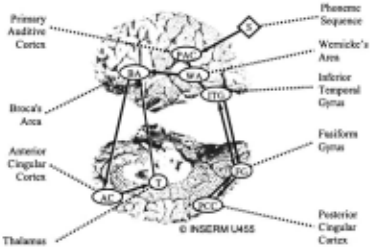
Studies in humans and animals [Bressler, 1995; De monet et a!., 1994] have shown that sensorimotor or cog nitive functions are the offspring of the activity of ori ented large-scale networks of anatomically connected cerebral regions (Figure 1 ). In humans, functional neuro imaging techniques provide activation data, which are indirect measures of the brain's electrical or metabolic activity during a task performance. Statistical analyses of the activation data allow determining where [Fox and Raichle, 1985], i.e. in which areas, and/or when [Giard et a!., 1995] during the task performance, the activation reaches local extrema. Through the study of covariation between local activations, they give a sketch of what the network of cerebral areas involved in the cognitive func tion is [Herbster et a!., 1996]. A known oriented ana tomical link between 2 areas allows determining why the activation of one area can affect the other one [Biichel and Friston, 1997]. Above methods allow identifying the substratum of a cognitive function and the activation level and dynamics of the substratum during the function performance. They do not give any clue of how the cog nitive processes participating in the function are imple mented by the substratum and how the activation derives from the processing. That is, they do not allow interpret ing neuroimaging data as the result of information proc essing at the integrated level of large-scale networks.
Interpretative models, linking a networked structure activity to the realization of a function, are at the core of Computational Neurosciences. Most existing works in the domain are based on formal neural networks, with vary ing levels of biological plausibility, from physiology [Wang and Buzsaki, 1996], hardly interpretable in terms of information processing, to more or less biologically plausible models of how basic cogmhve functions emerge from neuronal activation [Grossberg eta/., 2002] , and to purely functional models [Cohen et a!., 1990], not concerned with cerebral plausibility. Although these models answer the how, they do not meet two major re quirements for an interpretative approach of functional neuroimaging data. The models are not explicit enough to be directly used for clinical purpose, and they cannot evolve quickly and easily with new findings in neurosci ence, such as the integration of more detailed knowledge on the substratum, which often necessitates a complete rebuilding of the formal network.
The causal connectivity approach [Pastor et al., 2000] aims at answering the how and satisfying the constraints. However, the underlying formalism, causal qualitative networks based on interval calculus, limits severely the biological plausibility of the models, since it cannot rep resent major cerebral features, such as learning or the non-linearity and the uncertainty of cerebral processes. Dynamic Bayesian networks only meet the three major constraints: temporal evolution, uncertainty and nonlin earity [Labatut and Pastor, 200 1]. The utility of graphical probabilistic formalisms for cognitive modeling has also been demonstrated in the representation of visuomotor mechanisms with Bayesian networks [Ghahramani and Wolpert, 1997].
Hereafter, we describe how the interpretation of func tional images for a clinical purpose can be tackled. Sec tion 2 presents our viewpoint on large-scale cerebral networks. After a short introduction to dynamic Bayesian networks, section 3 describes the characteristics of our formalism. Section 4 illustrates the formalism's capabili ties by an example. We conclude with some perspectives.
2 Representation of Large-Scale Cere bral Networks
2.1 Structural and Functional Nodes
The function implemented by a large-scale network de pends on three properties: the network's structure [Goldman-Rakic, 1988], the functional role of each node (E.g. Wernicke's area (Figure 1), which is supposed to realize the early stages of phoneme processing), and the properties of the links (length, role: inhibitory or excita tory, ... ). In each network, regions, which are the struc tural nodes, are information processors and connecting oriented fibers are information transmitters [Leiner and Leiner, 1997].
All neurons in a region do not have the same structure or the same role. Similar neurons constitute generally local populations that realize a specific function. For ex ample, the inhibitory role of GABAergic neurons on other neuronal populations may explain the fact that every visual stimulus is not perceived in high frequency stimulation [Pastor, et a/., 2000]. Therefore, each region is itself a network of smaller neuronal populations (junc tional nodes), connected through neuronal fibers. These nodes are information processors that implement func tional primitives, which may all be different.
A large-scale network has therefore neurophysiologi cally constrained, oriented edges and possibly differenti ated nodes. The explicit representation of the nodes' function allows the direct expression of hypotheses on cerebral processing, and their easy modification in order to follow the evolution of knowledge in neurosciences. This cannot be dealt with by formal neural networks' implicit modeling that requires modifying the whole net work architecture to implement functional changes. Hereafter, a structural or a functional structure will be indifferently named a cerebral zone.
2.2 Information Representation and Processing
The cerebral information processed by a neuronal popula tion can be seen as the abstraction of the number and the pattern of the neurons firing for this information. It can be represented both by an energy level and by a category. En ergy is indirectly represented by the imprecise activation data provided by neuroimaging techniques. The category representation is in agreement with the "topical" organiza tion of the brain, which reflects category maps of the input stimuli, and can persist from primary cortices to nonprimary cortices and subcortical structures [Alexander et al., 1992], through transmission fibers [Leiner and Leiner, 1997]. The energy and the category of a stimulus can also be easily extracted from its psychophysical properties.
Modeling cerebral processes necessitates an explicit and discrete representation of time, both for taking into account the dynamics of cerebral mechanisms (transmission delays, response times ... ), and for complying with sampled func tional neuroimaging data.
According to a definition of causality inspired by Hume [Hume, 1740] and consistent with Pearl's probabilistic cau sality [Pearl, 2001 ], information processing in a large-scale network can be considered as mediated through causal mechanisms. Causality is defined by three properties: spatial and temporal contiguity, temporal consistency, and statisti cal regularity [Labatut and Pastor, 2001]. In other words, two entities A and B are causally linked if they are contigu ous relatively to the system they belong to, if the beginning of A precedes temporally the beginning of B, and if most of the times, A provokes B. In the brain, oriented anatomical links provide spatial and temporal contiguity between cere bral nodes, cerebral events are temporally consistent (a fir ing zone provokes the activation of downstream zones), and there is a statistical regularity in the response of a specific neuronal population to a given stimulus.
3 Description of the Formalism
3.1 Dynamic Bayesian Networks
In summary, the brain can be viewed as a network whose nodes are differentiated dynamic and adaptive information processors and oriented edges convey causality. Moreover, cerebral mechanisms, which are the abstrac tion, at the level of a neuronal population, of the chemi cal and electrical mechanisms at the cell levels, are often nonlinear. Causal dynamic Bayesian networks are the paradigm that meets best the constraints derived from these properties [Labatut and Pastor, 200 1).
A causal Bayesian network consists of a directed acyclic graph where nodes represent random variables and edges represent causal relationships between the variables [Pearl, 1988]. A conditional probability is asso ciated with each relationship between a node and its par ents. If the node is a root, the probability distribution is a prior. When some nodes' values are observed, posterior probabilities for the hidden nodes can be computed thanks to inference algorithms such as the junction tree algorithm [Jensen, 1996].
In a dynamic Bayesian network (DBN), the evolution of random variables through time is considered. Time is seen as a series of intervals called time slices [Dean and Kanazawa, 1988]. For each slice, a submodel represents the state of the modeled system. DBNs are used to model Markovian processes, i.e. processes where a temporally limited knowledge of the past is sufficient to predict the future. The choice of the inference algorithm, generally an extension of the junction tree algorithm [Murphy, 1999], depends on the DBN's structure, the nature of its variables (discrete or continuous), and relationships (lin ear or nonlinear).
Activation data and/or the subject's responses to the stimuli are the only observable variables we have. There fore, they must be integrated in our models. One may reasonably consider that the hidden variables, describing the successive states of the cerebral network, constitute a Markov chain, and that observable variables depend only on them. Moreover, the variables are continuous and their relationships may be nonlinear. This is typically the de scription of a type of DBNs called fully nonlinear state space models. Specific and recent algorithms allowing dealing with nonlinearity exist for this type of structures. Their general principle is to linearize the model in order to apply the classic Kalman filter. These algorithms differ on the used linearization method: first-order Taylor ap proximations for the extended Kalman filter [Julier and Uhlmann, 1997; Norgaard et a!., 2000] or polynomial approximations for the unscented Kalman filter [Julier and Uhlmann, 1997], the divided difference filter (DDF) [Norgaard, eta!., 2000], and others [VanDer Merwe and Wan, 2001]. The algorithms based on polynomial ap proximations seem to give more reliable results [Norgaard, eta!., 2000]. Their computational complexity is O(L 3 ) , where L is the state dimension [VanDer Merwe and Wan, 2001]. They offer equivalent qualities, but those of the DDF are more accurate according to its au thor [Norgaard, eta!., 2000).
3.2 Formal definition
Static and Dynamic Networks
A static network is the graphical representation of a large-scale network, whose nodes are cerebral zones and edges are the oriented axon bundles connecting zones. Due to anatomical loops, it is often cyclic. The DBN is the acyclic temporal expansion of the static network. Each node of the DBN is the processing entity related to a cerebral zone, i.e. the mathematical expression, at a given time slice, of information processing in the zone. Each edge is the propagation entity, whose orientation is its corresponding axon bundle's orientation. When deriv ing the DBN from the static network, values are given to the temporal parameters, according to known physiology results (e.g. the transmission speed in some neural fi bers). That is, the length of the time slices is fixed, and a delay representing the average propagation time in the bundle's fibers is associated to the propagation entity.
Information Representation
Cerebral information is the flowing entity that is com puted at each spatial (cerebral zone) and temporal (time slice) step, by a processing entity. It is a two dimensioned data. The first part, the magnitude, stands for the cerebral energy needed to process the information in the zone. It is represented by a real random variable in the DBN. For the second part, the type, which represents the cerebral category the zone attributes to the informa tion, the representation is based on the symbol and cate gorical field concepts.
A symbol represents a "pure" (i.e. not blurred with noise or another symbol) category of information. For example, when the information represents a linguistic stimulus, a symbol may refer to a non ambiguous pho neme. For cerebral information, the symbol represents, in each zone, the neuronal subpopulation being sensitive to (i.e. that fires for) the corresponding category. It may be, in the primary auditory cortex, the subpopulation sensi tive to a specific frequency interval. A categorical field is a set of symbols describing stimuli of the same seman tic class. The "color" categorical field contains all the color symbols, but it cannot contain phonemes.
A type concerns several symbols, due to the presence of noise or because of some compound information. Let § be the set of all existing symbols. We assume that a type T is defined for only one categorical field. Let Sr be the subset of §, corresponding to this categorical field. The type T is an application from Sr to [0,1], with
tion for a specific categorical field. In a stimulus, this repartition corresponds to the relative importance of each symbol compounding the information carried by the stimulus. Inside the model, T(s) stands for the proportion of s-sensitive neurons in the population that fired for the information whose type is T. Unlike the magnitude, the type is not represented by a random variable. Indeed, it is not necessary to represent its uncertainty (and hence to make the computational complexity harder) since we cannot compare it to neuroimaging data.
At time t and node X, the information is represented by the type r; and the magnitude M~ at the output of X.
Propagation and Processing
For a zone X, both the cerebral propagation mecha nisms (i.e. the relationships towards the zone) and the processing (spatial and temporal integration of the inputs, and processing as such) are described by a pair of func tions, the type frx and the magnitude functions jMx . In the general case where n zones J-;, ... ,Y, are inputs to X, let 0" ... , 0" be the corresponding delays of these rela tionships. In the DBN, the general form of the magnitude functions is:
where fM can be a nonlinear function. The random vari able u x - N(o, cr 2 ) models uncertainty in the cerebral processing.
The type function is any combination of the incoming types and of the previous type that respects our type defi nition. If all types are defined on the same categorical field S, the type function can be the linear combination:
The functions' definition, as well as the setting of the parameters' values (e.g. the value of a firing threshold), utilize mostly results in neuropsychology or in neuro physiology. The existence of generic models, that is, non instantiated, reusable, models of functional networks, is assumed. For example, primary cortices may implement the same mechanisms, although they are parameterized so that they can process different types of stimuli [Pastor, et a/., 2000].
4 Example
The model, presented hereafter, is based on an experi mental study [Ruff, et a/., 2001] that focused on the dif ferences between normal and dyslexic subjects during a passive phonemic categorization process.
Six patients and six controls were submitted to a pas sive hearing of stimuli that are mixes of the two phoneti cally close syllables /pa/ and /ta/. The pivot is noted devO and the deviants are 4 different mixes of /pa/ and /ta/, noted dev2M, devlM, devlP, dev2P (Table 1). The meas urements were made with fMRI. An experiment is consti tuted of 5 blocks, corresponding to the pivot and the deviants. Each block contains 6 sequences of 4 sounds, 3 pivots and the block's deviant, in a random order.
We focus on a single region, a part of the right tempo ral superior gyrus involved in the early processing of auditory stimuli and activated differently in controls and dyslexic subjects. Phylogeny is in favor of the existence of specialized phonemic processors in this area (Figure 2). Since their location is unknown, they cannot consti tute separate structural nodes. They are supposed to have the same building functional nodes. According to our genericity hypothesis, the processors' structure and pa rameters are based on a previously released visual cortex model [Pastor, et a/., 2000]. The Input Gating Nodes (JGN.) express the phoneme processors' sensitivity to the stimulus. The Output Gating Nodes ( OGN.) send infor mation to the downstream areas. Intra and inter (lateral) inhibitions (IN. and LIN.) are assumed between the /pa/ and /ta/ processors. LIN. make the activation of an IGN. cause an inhibition in the opposite JGN ·. Each Firing Threshold Node (FTN.) is modulated by an OGN. that can lower it. Since only one activation measure is pro vided by fMRI for the area, it is represented by the sole AN node in the static model. Stirn stands for the stimulus .
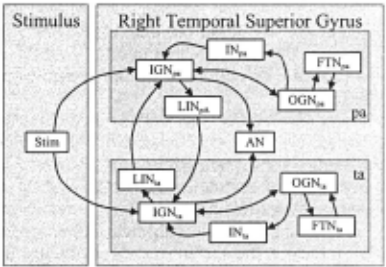
Except for the parameterization of the IGN. nodes, which reflects the specialization of each phonemic proc essor to the phoneme category (/pa/ or /ta/), the functions for both the /pa/ and /ta/ parts share exactly the same structure and parameters. Thus, only the pa part will be presented. In the following equations, the fh parameter of the function of a node X is noted ayl.
The refractory period of the processor's neurons is modeled in IGNpa by a sigmoid function '-PtcN that makes the node sensitive to the incoming stimulus only if the magnitude of the output is already close to zero:
The categorical field contains two symbols (pa and ta). The type of a stimulus represents the proportions of the two symbols (Table 1).
| name | dev2M | dev/M | devO | dev/P | dev2P | senspo | sens~a |
|---|---|---|---|---|---|---|---|
| pa value | 0.7 | 0.55 | 0.4 | 0.25 | 0.1 | 0.8 | 0.2 |
| Ia value | 0.3 | 0.45 | 0.6 | 0.75 | 0.9 | 0.2 | 0.8 |
The sensitivity of each IGN. to the received type is de fined by a constant type sens ·. IGNpa is more sensitive to the symbol pa, and JGN1a to ta. The function gtGN,. in
equation (3) is used with the constant senspa and the in coming stimulus' type r;,7~ in order to modulate the magnitude of IGNpa:
The types are used only for the input gating; they do . not intervene in the rest of the model. The sigmoid rp 0 GN in OGNpa's magnitude function allows it to fire only if the magnitude coming from the JGNpa is greater than the firing threshold's (FTNpa) one:
AN consists in the sum of the successive JGNs' activa tions during one experimental block:
'" This is a gross approximation of the fMRI data, which models only the part of the information processing mecha nisms in the activation building and neglects metabolic processes at the level of the cerebral blood flow. Since, ex cept the Stirn and the AN nodes, all nodes represent neu ronal activities, the time unit is set to 1 ms. We used the DD2 algorithm [Norgaard, eta/., 2000) to perform the simu lations.
The hypothesis is that the difference of processing be tween normal and dyslexic subjects is caused by a disorder in the inhibitory mechanisms. Thus, the two models, one for the average patient and the other for the average control, use the same functions and share the same parameters, except for the inhibition nodes (IN. and LIN.). There are no lateral inhibitions in the dyslexic model. It can be interpreted in cognitive terms as the fact that all the processors compete for each stimulus and that no clear category can be built. Also, the dyslexic model's internal inhibitions are slightly stronger than in the normal one, leading to a slowing in the stimulus perception. These two tentative interpretations are good starting points for new experiments.
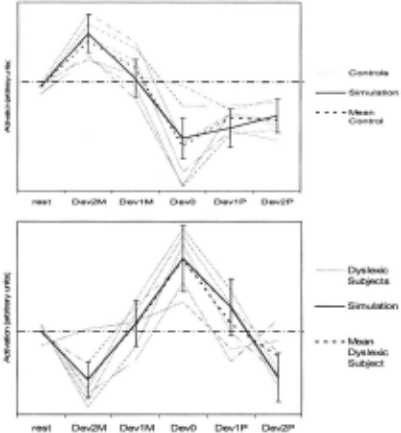
The differences in the inhibition parameters are suffi cient to obtain very different activation data. For controis, the more distant (from the pivotal stimulus, cate gorically speaking) the deviant is, the stronger the activa tion is (Figure 3). This is supposed to be caused by aha bituation mechanism that lowers the activation, followed by an activation the force of which depends on the "sur prise" caused by the deviant. Dyslexic subjects do not correctly categorize the different phonemes, both the pa and the ta parts of the gyrus activate for each block. This illustrates how activation data can be explained thanks to the understanding of the cerebral information processing mechanisms expressed in the models.
5 Conclusion
Instead of building a specialized model, designed for a specific function or cerebral network, we have presented a general framework, allowing the interpretation of func tional neuroimaging data. This framework has been de signed to be open to evolutions of the knowledge in neu ropsychology and neurophysiology. Using DBNs allows modeling the brain as a dynamic causal probabilistic network with nonlinear relationships . We have illustrated this with an example concerning a language-related proc ess. Currently, our framework is adapted to automatic processing, which is dominant in cerebral functioning. In function of the stimulus type, nodes can react differently and different networks may be activated, thus implement ing different functions. Our future work will focus on the integration of more biological plausibility in the frame work. The representation of complex relationships be tween and inside the zones will allow the representation of controlled processes and contextual modulation of the cerebral activity. The combination of types from different categorical domains and the search for regularities in the combinations will allow the implementation of learning mechanisms. Another essential topic is to make our models independent of the used data acquisition technique, thanks to interface models, able to translate cerebral in formation processing variables into neuroimaging results . Our long-term goal is to progressively include in our framework various validated models and to build a con sistent and general brain theory based on large-scale net works .
@inproceedings{ijcai2003p24,
  title     = {Dynamic Bayesian modeling of the cerebral activity},
  author    = {Labatut, Vincent and Pastor, Josette and Ruff, Serge},
  booktitle = {Proceedings of the Eighteenth International Joint Conference on
               Artificial Intelligence, {IJCAI-03}},
  publisher = {International Joint Conferences on Artificial Intelligence},
  editor    = {Georg Gottlob and Toby Walsh},
  pages     = {169--175},
  year      = {2003},
  url       = {https://ijcai.org/proceedings/2003/24},
}
TY - CPAPER TI - Dynamic Bayesian modeling of the cerebral activity AU - Labatut, Vincent AU - Pastor, Josette AU - Ruff, Serge T2 - Proceedings of the Eighteenth International Joint Conference on Artificial Intelligence, IJCAI-03 PB - International Joint Conferences on Artificial Intelligence PY - 2003 SP - 169 EP - 175 UR - https://ijcai.org/proceedings/2003/24 ER -Copied
Machine-readable versions of this paper, for tools and AI agents:





