
Collaborative Web Search
Proceedings of the Eighteenth International Joint Conference on Artificial Intelligence. Pages 1417-1418.
© 2003 International Joint Conferences on Artificial Intelligence
Abstract
Web search engines struggle to satisfy the needs of Web users. Users are notoriously poor at representing their needs in the form of a query, and search engines are poor at responding to vague queries. However progress has been made by introducing context into the search process. In this paper we describe and evaluate a novel approach to using context in Web search that adapts a generic search engine for the needs of a specialist community of users. This collaborative search method enjoys significant performance benefits and avoids the privacy and security concerns that are commonly associated with related personalization research.
- [Bradley et al., 2000] K. Bradley, R. Rafter, and B. Smyth. Case-based User Profiling for Content Personalization. In 0. Stock P. Brusilovsky and C. Strapparava, editors, Pro- ceedings of the International Conference on Adaptive Hy- permedia and Adaptive Web-based Systems, pages 62-72. Springer-Verlag, 2000.
- [Budzik and Hammond, 2000] J. Budzik and K. Hammond. User Interactions with Everyday Applications as Con- text for Just-In-Time Information Access. In Proceedings International Conference on Intelligent User Interfaces., pages 44-51. ACM Press, 2000.
- [Dreilinger and Howe, 1997] D. Dreilinger and A. Howe. Experiences with Selecting Search Engines Using Meta Search. ACM Transactions on Information Systems, 15(3):195-222, 1997.
- [Glover eta/., 2001] E. Glover, S. Lawrence, M.D. Gordon, W. P. Birmingham, and C. Lee Giles. Web Search -Your Way. Communications of the ACM, 44(12):97-102, 2001.
- [Haveliwala, 2002] T. H. Haveliwala. Topic-Sensitive PageRank. In Proceedings of the World-Wide Web Con- ference. ACM Press, 2002.
- [Lawrence and Giles, 1998] S. Lawrence and C. Lee Giles. Context and Page Analysis for Improved Web Search. IEEE Internet Computing, July-August:38-46, 1998.
- [Lawrence and Giles, 1999] S. Lawrence and C. Lee Giles. Accessibility of Information on the Web. Nature, 400(6740):107-109, 1999.
- [Mitra eta/., 1998] M. Mitra, A. Singhal, and C. Buckley. Improving Automatic Query Expansion. In Proceedings of ACM SIGIR, pages 206-214. ACM Press, 1998.
- [Selberg and Etzioni, 1997] E. Selberg and 0 . Etzioni. The Meta-Crawler Architecture for Resource Aggregation on the Web. IEEE Expert, Jan-Feb: 11-14, 1997.
References were extracted automatically from the PDF and may contain errors.
Full text extracted automatically from the PDF; figures, tables and equations may differ. The PDF is the version of record.
1 Introduction
It is a tragic irony of the information age that users are find ing it increasingly difficult to benefit from access to unprece dented amounts of information. Even with the help of modem search engines we regularly fail to locate relevant information in a timely manner. Many factors contribute to this informa tion overload problem. Certainly, the sheer quantity of in formation, and its growth rate, tax even the most advanced search engines. For example, various estimates indicate that even the largest search engines often cover only a fraction of the available information space [Lawrence and Giles, 1999].
However, search engine coverage is just the tip of the ice berg, and can be greatly enhanced by using meta-search meth ods [Dreilinger and Howe, 1997; Selberg and Etzioni, 1997]. A more pressing problem is the limited degree to which those pages that are covered can be accurately ranked with re spect to a given query. Part of this problem lies with the users. Search engines work very well for properly formu lated queries, but they come up short when presented with an average Web user's query, which typically contains about 2 query terms [Lawrence and Giles, 1998]. The inevitable outcome is long lists of apparently relevant results, with gen uinely useful results (for the target user) few and far between. Moreover, these problems are exacerbated by the new gen eration of mobile computing devices (eg. WAP phones and PDAs). Their restricted input capabilities and limited screen real-estate mean that mobile users are even less likely to pro vide well formulated queries or tolerate long result lists.
*The support of the Informatics Research Initiative of Enterprise Ireland is gratefully acknowledged.
For the most part, recent search engine advances have fo cused on better ways to handle vague queries by improving existing page analysis, indexing and ranking methods. How ever a critical shortcoming still remains: a query might in clude terms that identify the primary information target, but rarely includes terms that usefully describe the search con text. For example, a simple query for ''jaguar" does not indicate whether the user is interested in cars or cats, and queries for "Michael Jordan" do not distinguish between the basketball star and the Berkeley professor. Consequently, researchers have recently focused on ways to exploit con text during search, either by explicitly establishing context up-front or by implicitly inferring it. For example, the In quirus 2 meta-search engine [Glover et a!., 2001] supple ments keyword-based queries with a context category; users explicitly select from a set of categories such as "research pa per", "homepage" etc. Alternatively, implicit context can be automatically inferred. For example, systems such as Watson [Budzik and Hammond, 2000] take advantage of user activ ity prior to search to judge context; Watson monitors a user's word processing activity and uses document text as the basis for query terms. In contrast, relevance feedback techniques attempt to use actual search results to inform context. For example, [Mitra eta!., 1998] extract correlated terms from top-ranking search results to focus context on the most rele vant search results as opposed to the entire set.
In this paper we describe a novel technique for exploiting context during search: collaborative search acts as a front end for existing search engines and re-ranks results based on the learned preferences of a community of users. We describe and evaluate its implementation in the I-SPY sys tem and highlight how I-SPY achieves personalization in an anonymous fashion, without storing individual user profiles.
2 Collaborative Search
Collaborative search is motivated by two key ideas. First, spe cialised search engines attract communities of like-minded users and naturally limited context variations. For example, a motoring search engine is likely to attract queries with a motoring theme; here ''jaguar" queries are more likely to re late to cars than cats. Second, by capturing the selections of a community of users it is possible to estimate query-page relevance as the probability that a page Pj will be selected for query qi. Collaborative search combines both ideas in a meta-search engine called I-SPY (Figure 1 ).
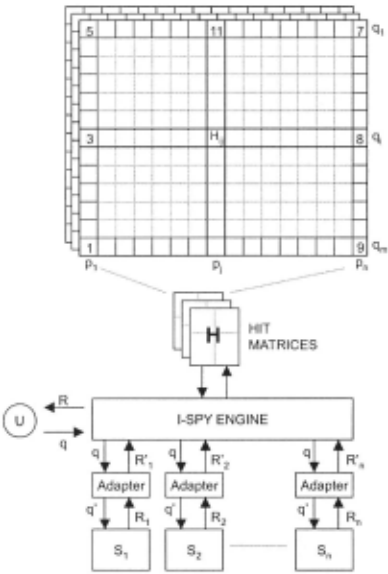
The unique feature of collaborative search is its ability to personalize search results for a community of users, but with out relying on traditional context-analysis (eg. [Lawrence and Giles, 1998]) or personalization (eg. [Bradley et al., 2000]) techniques. I-SPY achieves this by storing the usage patterns of users as a hit matrix, H. Each element, Hi1, equals the number of times that page p1 was selected for query qi. This matrix is a powerful source of relevancy information; after all its data reflect query-page relevancy judgments by users. The relevancy of p 1 to query qi is estimated by the probability that p 1 will be selected for query qi; see Equation 1.
This relevancy metric is tuned to the preferences of a commu nity of users, and the queries and pages that they tend to pre fer. Deploy I-SPY on a motoring web site and its hit matrix will become populated with queries and pages that are rele vant to car fans. For example, over time queries for "jaguar" will tend to result in the promotion of car sites because users submitting this query term will tend to select Jaguar car sites, ignoring the wild cat pages. The wild cat pages may still be returned but will be relegated to the bottom of the result list.
In fact I-SPY can deploy multiple I-SPY search agents, each with its own separate hit table. Thus the central I-SPY
engine can be used to service many different search services across a range of portals, for example, each one adapted for the needs of a particular user group through its associated hit matrix. Alternatively, different hit matrices could be associ ated with different regions of the same site to bias search with respect to different topics. For instance, the work of [Haveli wala, 2002] biases PageRank with respect to different topic groups in an Internet directory by generating category-biased PageRank vectors from the URLs contained in top-level di rectory categories. A similar strategy can be supported by I SPY. Placing a search box on the Programming Languages directory page will naturally capture queries from this do main. And the behaviour of the users providing these queries, will gradually adjust !-SPY's relevancy metric and ranking function in favour of Programming Languages pages.
3 Evaluation
For our evaluation we focus on a specific user community and search domain: computer science students and program ming languages. A set of 60 queries is produced from the programming languages listed in Yahoo. I-SPY is configured to query two underlying search engines, Yahoo (which uses Google) and Splat!, and each of the 60 queries is submitted to obtain up to 30 results based on a standard meta-search ranking function. A group of 20 computer science students are asked to identify relevant results, based on the summary result descriptions returned by I-SPY.
A leave-one-out evaluation methodology is employed so that each user is designated to be a test user with the re maining 19 serving as training users. The relevancy results of the training users are used to populate I-SPY's hit matrix and the results for each query are re-ranked using I-SPY's relevancy metric. Next, we count the number of these results listed as relevant by the test user for various result-list sizes (k = 5 .. 30). Finally, we make the equivalent relevancy mea surements by analysing the results produced by the untrained version ofl-SPY (Standard), which serves as a benchmark.
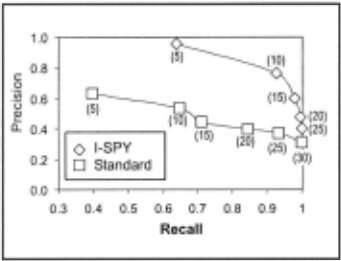
Figure 2 presents the results for I-SPY and the benchmark search engine as a graph of precision versus recall for each result-list size; these are really bounded versions of the stan dard precision and recall metrics and the measures for each engine converge once a complete result-list is returned. The results indicate a significant and consistent benefit for I-SPY over the standard meta-search benchmark. For example, for result-lists of 5 items, I-SPY achieves a precision of just over 96% compared to the standard meta-search precision of only 63%. Similarly, at the same result-list size, we find an av erage recall for I-SPY of 64% compared to just under 40% for the standard method. Indeed we see that I-SPY achieves I 00% recall at just over 20 items whilst it takes the bench mark 30 items to achieve the same level of recall. The fact that larger relative benefits are available at smaller result-list sizes is important. Users rarely sift through large result-lists and so, the more relevant items that can be presented earlier on, the better. This means that I-SPY is likely to be espe cially valuable in situations where large result lists must be truncated for other reasons, such as the small screen sizes of mobile devices.
4 Discussion
There are number of problems with collaborative search that need to be addressed to guarantee its applicability across a broad range of search tasks. Perhaps the most important prob lem is the so-called cold-start problem. This refers to the fact that newly indexed Web pages find it difficult to attract user attention since they will have a low relevancy score using 1SPY's metric and thus appear far down in result-lists, limiting their ability to attract the hits they deserve for a given query. Essentially there is an in-built bias towards older pages.
There are a number of ways that this problem might be dealt with. One is to look at ways to normalize the relevancy of pages with respect to their age. For example, we might measure the age of a page by the time (or number of queries) since its first hit and amplify the relevancy of young pages relative to older pages.
Indeed there is another side to this problem. Just as new pages find it difficult to attract hits, so too older pages may find it easy to attract hits. In the worst case scenario this could even bias 1-SPY's result-lists towards pages that are likely to be out of date and thus less relevant to current users than they were to past users. Once again, biasing relevance towards new pages should help to cope with this problem.
Of course in general there are many factors that can, and probably should, be taken into account when ranking search results. We have focused primarily on 1-SPY's relevancy fac tor, but other factors such as the age of a page and its meta search ranking are also appropriate. As part of our future work we will explore how best to combine these factors to produce optimal result rankings. This may or may not involve a direct combination of the rankings. For example, one op tion is to present search results not as a single list of results, as is normally the case, but perhaps as two or more lists of results in order to emphasise the different qualities of the re turned pages. For instance, in general only a subset of search results are likely to have non-zero I-SPY relevance scores; that is, a subset of results will have been selected in the past for the current query. Therefore, it is practical to present the I-SPY results with relevancy scores as special recommenda tions (ranked by their relevancy). The remaining results can be presented separately, ranked by their meta-score. In turn a third list of new pages, ranked by meta-search score or rele vancy, can also be separately presented.
5 Conclusions
Improving the accuracy of Web search engines by introducing context into the search process is an important and challeng ing research problem. We have described a generic search engine that can be adapted or personalized to fit the context and needs of a community of users by using the collaborative search technique. The benefits include superior precision and recall characteristics when compared to a benchmark search engine. In addition, this level of personalization is achieved without the need to store individual user profiles, leading to superior security and privacy benefits when compared to al ternative approaches.
In closing it is worth highlighting that collaborative search makes no strong assumptions about the form of the underly ing search engines and is generally applicable across a range of content types including Web pages, graphics and photos, audio and video. Finally, its proposed ranking metric is com putationally efficient (O(k) in the number of search results) and requires no additional parsing of result pages.
@inproceedings{ijcai2003p221,
  title     = {Collaborative Web Search},
  author    = {Smyth, Barry and Balfe, Evelyn and Briggs, Peter and Coyle, Maurice and Freyne, Jill},
  booktitle = {Proceedings of the Eighteenth International Joint Conference on
               Artificial Intelligence, {IJCAI-03}},
  publisher = {International Joint Conferences on Artificial Intelligence},
  editor    = {Georg Gottlob and Toby Walsh},
  pages     = {1417--1418},
  year      = {2003},
  url       = {https://ijcai.org/proceedings/2003/221},
}
TY - CPAPER TI - Collaborative Web Search AU - Smyth, Barry AU - Balfe, Evelyn AU - Briggs, Peter AU - Coyle, Maurice AU - Freyne, Jill T2 - Proceedings of the Eighteenth International Joint Conference on Artificial Intelligence, IJCAI-03 PB - International Joint Conferences on Artificial Intelligence PY - 2003 SP - 1417 EP - 1418 UR - https://ijcai.org/proceedings/2003/221 ER -Copied
Machine-readable versions of this paper, for tools and AI agents:





