
Proactive Dialogue for Interactive Knowledge Capture
Proceedings of the Eighteenth International Joint Conference on Artificial Intelligence. Pages 1398-1398.
© 2003 International Joint Conferences on Artificial Intelligence
Abstract
Current tools for interactive knowledge capture have little or no learning aptitude. They are mostly oblivious to the process or strategy that the user may be following in entering new knowledge, unaware of their progress during a session, and ignorant of typical skills expected from a good student. We present an approach to make acquisition interfaces more proactive by extending them with: 1) goals that represent what remains to be learned, 2) strategies to achieve these goals and acquire further knowledge, and 3) awareness of the current status of the body of knowledge learned. The resulting interaction shows that the system is aware of its progress towards acquiring the new knowledge, and moves forward by understanding what acquisition goals and strategies to pursue.
- [Gil and Kim, 2002] Yolanda Gil and Jihie Kim Interac- tive Knowledge Acquisition Tools: A Tutoring Perspective. Proceedings of CogSci-2002.
- [Kim and Gil, 2002] Jihie Kim and Yolanda Gil Deriving Acquisition Principles from Tutoring Principles. Proceed- ings ofiTS-2002.
References were extracted automatically from the PDF and may contain errors.
Full text extracted automatically from the PDF; figures, tables and equations may differ. The PDF is the version of record.
1 Introduction
The goal of our work is to develop acquisition interfaces that are proactive learners, able to reason about learning activities and with initiative in participating in the process accordingly. Our approach is to enable acquisition tools to have acquisition and learning goals represented explicitly and declaratively and be aware of the level of competence and confidence of the knowledge they are acquiring. This would enable acqui sition tools to reason in terms of the learning/teaching process and to make interaction with the user dynamically generated given the situation at hand. We present our design and imple mentation of a new acquisition dialogue tool called SLICK (Skills for Learning to Interactively Capture Knowledge) that is built based on the tutoring and learning principles we have compiled so far[Kim and Gil, 2002]. SLICK makes acqui sition tools more proactive by maintaining 1) goals that rep resent what remains to be learned, 2) strategies to achieve these goals and acquire further knowledge, and 3) aware ness of the current status of the body of knowledge learned. The tool has been used for acquiring two very different types of knowledge: biological process models and military plans. The resulting interactions show that the system is aware of its progress towards acquiring the new knowledge, and moves forward by understanding what acquisition goals and strate gies to pursue.
| I Teaching/Learning principle | Tutoring literature |
|---|---|
| Introduce lesson topics and goals | Atlas-Andes, Meno-Tutor Human tutorial dialog, human learning |
| Use topics of the lesson as a guide | BE&E, UMFE |
| Subsumption to existing cognitive structure | human learning, WHY, Atlas-Andes |
| Immediate feedback | SOPHIE, Auto-Tutor, LISP tutor Human tutorial dialog, human learning |
| Generate educated guesses | Human tutorial dialog QUADRATIC, PACT |
| Keep on track | GUIDON, SCHOLAR, TRAIN-Tutor |
| Indicate lack of understanding | Human tutorial dialog, WHY |
| Detect and fix "buggy" knowledge | SCHOLAR, Meno-Tutor, WHY Buggy, CIRCSIM, human learning |
| Learn deep models | PACT, Atlas-Andes |
| Learn domain language | Atlas-Andes, Meno-Tutor |
| Keep track of correct answers | Atlas-Andes |
| Prioritize learning tasks | WHY |
| Limit the nesting of the lesson to a handful | Atlas |
| Summarize what was learned | EXCHECK, TRAIN-Tutor, Meno-Tutor |
| Assess learned knowledge | WEST, Human tutorial dialog |
2 Thtoring and Learning Principles for Proactive Learning
We have investigated various tutoring principles used by hu man tutors and instructional software that are relevant to ac quisition tasks (Figure 1). They helped us understand the nature of good teacher-student interactions. We noticed that many useful learning principles could be seen as learning goals and teaching goals that students and teachers seem to pursue at different points throughout a lesson[Kim and Gil, 2002].
We also have investigated how these principles would ben efit current acquisition tools [Gil and Kim, 2002]. We have found that the principles have only been used in some aspects of the functionality of acquisition tools, and are exhibited by some but not all the tools.
3 Declarative Representation of Thtoring and Learning Principles
We have used the above principles in the context of build ing proactive acquisition interfaces. Acquisition tools can be seen as students learning new knowledge from the user (teacher) and they should be able to use some of the strate gies that good learners pursue during a tutoring dialogue. The following presents the capabilities we provide to acquisition interfaces based on these principles.
- Acquisition interfaces should be able to represent acqui sition goals explicitly. Many of the tutoring principles suggest a more goal-oriented behavior for acquisition in terfaces. Having acquisition goals explicitly and declar atively is key to making a tool truly proactive because it could then steer the dialogue with the user to work to wards those goals. The goals that are achieved at each point during the dialogue represent the progress made towards acquiring the desired body of knowledge.
- Acquisition interfaces should have acquisition strategies in order to understand and actively pursue what is in volved in learning about a new topic. Acquisition strate gies outline how to achieve acquisition goals. Because so many things are unknown to the system during the lesson, these strategies can only be pursued under the user's guidance and in a mixed-initiative interaction.
- Acquisition tools should have awareness of what they have learned already and what they do not know about yet, so that they can better assess their competence and confidence in specific topics, and steer the dialogue with the user in directions that improve their body of knowl edge on both counts.
SLICK is developed as a front-end to existing basic ac quisition tools by embodying these capabilities. For exam ple, tools that acquire different forms of knowledge (such as problem-solving knowledge vs. concepts) may need different operational goals because they have different subcomponents and functions to build up knowledge bases. Actions done by the user through the basic acquisition tool are intercepted by our system. While the backend tool will update the backend knowledge base and its own user interface, SLICK will up date its own structures and user interface.
4 An Implementation of SLICK
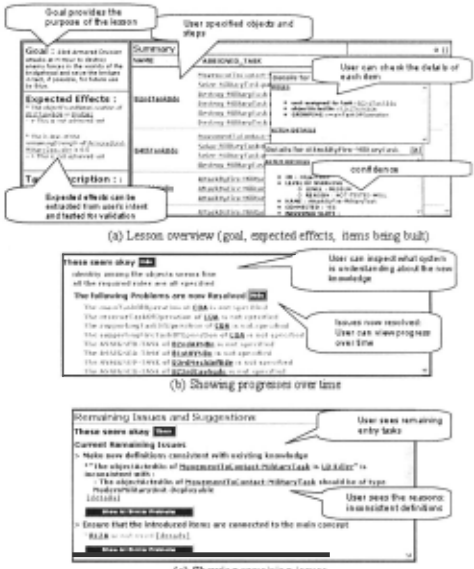
SLICK have been used for acquiring two very different types of knowledge: biological process models and military plans. Figure 1 shows the SLICK interface for acquiring military plans (army courses of actions). SLICK is presenting a report on a plan being entered by a military officer, pointing out how the system is understanding the plan. Users describe their plans in terms of the steps (such as attack, seize, destroy, etc.) and the objects involved (military units, terrain features, etc.). As shown in Figure 1-(a), SLICK keeps track of the lesson goal and the user's intention (e.g., expected effect), which can be used to guide the user and to check ifthe plan is valid. The summary window illustrates the list of involved objects and their tasks, which are essential in viewing how the plan is being built. It highlights the objects with potential problems (such as unassigned units) in red and confident subtopics are shown in blue. The user can check details of each item by clicking on it, as shown in Figure 1-(a). For example, SLICK presents confidence on knowledge items based on the number of times they were involved in test problems.
The user can view progress by checking the issues resolved over time. Towards the end of the lesson (i.e., building a
(c) Showing remaining is sues
Figure 1: Acquiring military plans with SLICK.
plan), SLICK confirms that all the required roles (such as the information that existing knowledge indicates it must be pro vided) are specified, and identity among the objects are fine (none of the existing objects appear to be the same) (Figure 1-(b )). When SLICK notices remaining issues, it also collects the sources of the problems to help users understand the prob lems better. For example, Figure 1-(c) shows that there is an inconsistency between the plan and existing definitions in the KB because in the existing definitions, the 'objectActedOn' should be a military unit (ModernMilitaryUnitDeployable), but currently the user has assigned a terrain feature to it.
Note that SLICK's learning principles have derived this output. For example, in the figure, SLICK reports its under standing of the lesson and the remaining issues in terms of its goals such as "Make new definitions consistent with existing knowledge", "Ensure that the introduced items are connected to the main concept", "Ensure that the required roles are all specified", "Establish identity among the items", etc.
We plan to extend the work with dialogue planning for ac quisition tasks, and incorporate a plan recognition module that relates individual user changes with multi-step plans.
@inproceedings{ijcai2003p213,
  title     = {Proactive Dialogue for Interactive Knowledge Capture},
  author    = {Kim, Jihie and Gil, Yolanda},
  booktitle = {Proceedings of the Eighteenth International Joint Conference on
               Artificial Intelligence, {IJCAI-03}},
  publisher = {International Joint Conferences on Artificial Intelligence},
  editor    = {Georg Gottlob and Toby Walsh},
  pages     = {1398--1398},
  year      = {2003},
  url       = {https://ijcai.org/proceedings/2003/213},
}
TY - CPAPER TI - Proactive Dialogue for Interactive Knowledge Capture AU - Kim, Jihie AU - Gil, Yolanda T2 - Proceedings of the Eighteenth International Joint Conference on Artificial Intelligence, IJCAI-03 PB - International Joint Conferences on Artificial Intelligence PY - 2003 SP - 1398 EP - 1398 UR - https://ijcai.org/proceedings/2003/213 ER -Copied
Machine-readable versions of this paper, for tools and AI agents:





