
Sampling Combinatorial Spaces Using Biased Random Walks
Proceedings of the Eighteenth International Joint Conference on Artificial Intelligence. Pages 1376-1379.
© 2003 International Joint Conferences on Artificial Intelligence
Abstract
For probabilistic reasoning, one often needs to sample from a combinatorial space. For example, one may need to sample uniformly from the space of all satisfying assignments. Can state-of-the-art search procedures for SAT be used to sample effectively from the space of all solutions? And, if so, how uniformly do they sample? Our initial results find that on the positive side, one can find all solutions to a given instance. Nevertheless, sampling can be highly biased. This research provides a starting point for the development of more balanced procedures.
- [Bayardo and Pehoushek, 2000] R.J. Bayardo and J.D. Pehoushek. Counting models using connected components. In Proc. AAA/-00. 1378 [McAIIesteret a/., 1997]
- D. McAIIester, B. Selman, and H. Kautz. Evidence for invariants in local search. In Proc. of AAAI-97, pp 321 - 326, 1997.
- [Roth, 1996] D. Roth, On the Hardness of Approximate Reason- ing, In Artificial intelligence Journal, Vol. 82, 1-2, pp 273-302, 1996. IJCAI
- [Selman et at., 1994] B. Selman, H. Kautz, and B. Cohen. Noise Strategies for Local Search. In Proc. AAAI-94, pp 337-343, 1994.
References were extracted automatically from the PDF and may contain errors.
Full text extracted automatically from the PDF; figures, tables and equations may differ. The PDF is the version of record.
1 Introduction
There has been much recent progress in the area of algorithms for solving Boolean satisfiability problems. Current methods can handle problem instances with up to a million variables. The emphasis in this work has been on the decision version of the satisfiability problem. A problem instance is either shown satisfiable by producing a satisfiable assignment or by prov ing that no such solution exists. A natural extension of this problem, for the satisfiable case, is to consider whether one can sample from the set of all satisfying assignments. An ef fective sampling procedure would be of use in a large range of probabilistic reasoning tasks. In the worst-case, the sampling problem is even harder than the satisfiability problem [Roth, 1996]. However, this leaves open the question how of hard it is to sample solutions from practical problem instances. In particular, can state-of-the-art random walk style procedures for SAT, such as WalkSAT [Selman et al., 1994], be used to sample from the space of satisfying assignments?
We investigated this question, and our key findings are as follows. On reasonable size problem instances, the WalkSAT procedure does reach all satisfying assignments. However, the sampling can be highly non-uniform (several orders of magnitude in the probability of reaching solutions). Quite unexpectedly, we found that sampling on our structured prob lem instance is much more uniform than on our hard random problem instance. This shows that, in a sense, the search on a random problem instance is more complex. We also con sidered the question of how to improve the uniformity of our sampling approach. Our results show, again somewhat sur prisingly, that coverage does not become more uniform with more noise injected in the random walk. (Of course, the ef fectiveness of finding solutions degrades, but apparently, this degradation is proportional for all solutions.)
·Research supported in part by AFOSR, Darpa, and NSF
Because of space limitations, we present only some of our key data. We hope this work will lead to a better understand ing of random walk style procedures for sampling solutions, including possible ways for getting more uniform sampling.
Our work should be contrasted with the more standard Markov Chain Monte Carlo (MCMC) approaches, such as simulated annealing (SA). For MCMC methods, one can show that the underlying Markov Chain eventually reaches an equilibrium distribution (although this can take exponen tial time). Unfortunately, formal guarantees are of little prac tical value. For example, even for finding a single satisfiable assignment, SA has been shown to be orders of magnitude slower than WalkSAT [Selman et al., 1994] (even ignoring the issue of whether SA reaches the stationary distribution). The new class of local search methods for SAT are based on ideas from biased random walks. These methods are designed to reach some solution as quickly as possible. Such strategies have proven to be quite effective, but they inherently exploit the fact that they operate far away from equilibrium. Never theless, as our results show, they can reach all solutions on non-trivial problem instances. Moreover, our work may sug gest ways of making the sampling more uniform, possibly leading to a new more powerful class of sampling methods.
2 Sampling Experiments
We consider a hard random 3-SAT instance and a more struc tured problem from a planning application. In order to gen erate a random 3-SAT instance, we first created 100 uniform random 3-SAT instances, with 70 variables and 301 clauses. We chose an instance with 2531 solutions for our detailed experiments. (Relsat [Bayardo and Pehoushek 2000] was used to systematically generate all solutions.) For the logis tics planning formula, we started with logistics.d.cnf avail able from Satlib with over lOelO solutions. To facilatate so lution set sampling experiments, we added 52 unit clauses, constraining the instance to 1600 solutions.
| INSTANCE | RUNS | HITS RAREST | HITS COMMON | COM. -RARE RATIO |
|---|---|---|---|---|
| RANDOM | 50*10 6 | 53 | 9*10 5 | 1.7*10 4 |
| LOGISTIC | 1 *10 6 | 84 | 4*10 3 | 50 |
For the 3-SAT and logistic instances, we performed 50e6 and 1 e6 runs of WalkS AT, respectively. All of these runs suc cessfully found a solution, and WalkSAT ultimately found ev ery solution for both instances. Summary statistics for these experiments are available in Table 1.
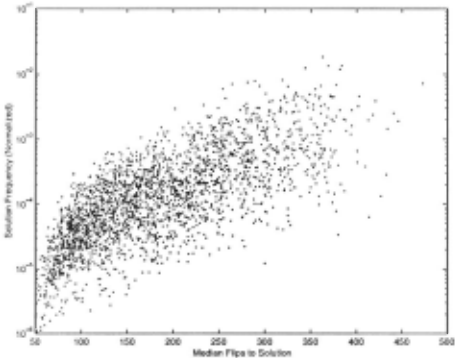
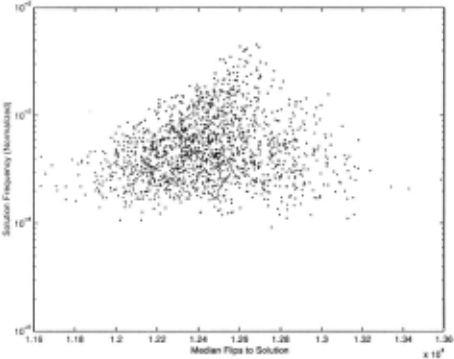
Figures 1 and 2 display the relationship between "solu tion frequency" (how often a particular solution is reached) and "speed" (the median number of flips to reach that solu tion). Each point represents a unique solution. The figure further confirms the results from Table 1: WalkSAT's solu tion sampling can be highly non-uniform. Notice the scale on the y-axis. For the random instance we see a range over 4 orders of magnitude. For the logistic problem, we see that the solution sampling is also biased, albeit much less than on the 3-SAT problem. The figure also indicates that on the 3-SAT problem, rare solutions are typically found with fewer flips than common solutions. No such relation is evident for the logistic problem in Figure 2B.
3 Solution Space Structure
In this section, we attempt to gain insight into the structure of the solution space by analyzing hamming distances be tween solutions. For both the logistics and 3-SAT problems, we computed the hamming distance between all solutions. Thus, we generated O(n 2 ) distances per problem, where n is the number of problem solutions.
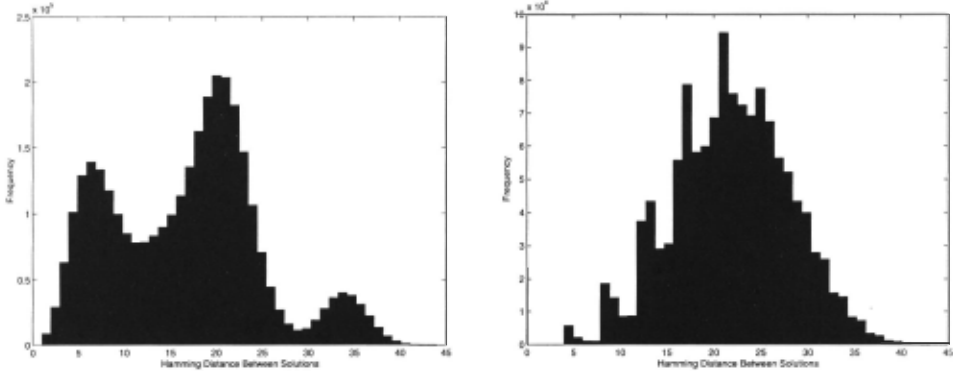
Figures 3A and B show histograms of these distances for the 3-SAT and logistics problem, respectively. The 3-SAT hamming distance distribution is trimodal, while the logistics problem gives a unimodal distribution. These distributions suggest that the 3-SAT instance's solution space has multi ple clusters of solutions, while the logistic problem's solution space has only a single cluster of solutions .
Of course, it is inherently difficult to analyze structure within these 70+ dimension solution spaces, and many other underlying structures could explain the results seen in Fig ure 3. Nevertheless, we believe that these figures are highly suggestive.
4 Obtaining More Uniform Coverage
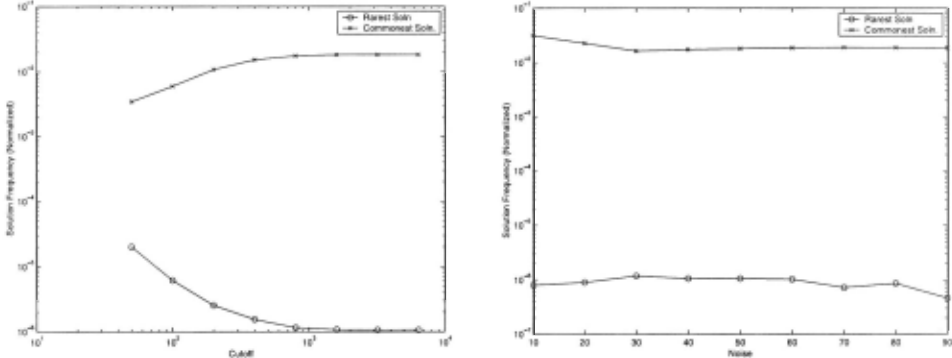
In the previous experiment with the 3-SAT instance, we ob served that rare solutions are generally found with fewer flips than common solutions. Intuitively, one needs to start rela tively close to such a rare solution to find it. Following up on this observation, we decreased the cutoff value (number of flips until restart) for Walksat. As shown in Figure 4A, our experiments indicate that a lower cutoff indeed makes the sampling more uniform on the 3-SAT instance. Unfor tunately, as a side effect, the median number of flips to reach a solution goes up. Thus, there appears to be a tradeoff be tween speed and uniformity on the 3-SAT instance. Note that theoretically, a cutoff of 0 (no flips) gives us purely uniform sampling. However, such a strategy is clearly infeasible for any instance of practical interest. (A cutoff below 40 makes it practically infeasible to find all solutions for our random problem instance.) Varying the cutoff used for the logistic problem did not have an observable effect on uniformity of sampling, as expected.
Intuitively, increasing WalkSAT's noise level would lead to a less greedy and more "erratic" search. It would therefore be reasonable to expect more uniform sampling of solutions. Quite surprisingly however, as shown in Figure 4B, the fre quency of the most common and the rarest solution is hardly affected by the noise level. This unexpected finding requires further study. It also means that we need to develop other ways to improve WalkSAT's sampling. We obtained similar results for the logistic problem, which are not shown due to space constraints.
go
5 Summary
- WalkSAT is able to find all solutions for the 3-SAT and constrained logistic problem, within a reasonable num ber of trials.
- Solution sampling can be highly non-uniform, particu larly for the 3-SAT problem.
- The 3-SAT instances appear to have a more complicated solution space than the logistic problem.
- Increasing WalkSAT's noise does not appear to in crease the solution sampling uniformity, while it de grades WalkSAT's speed.
- Challenge: Devise ways to obtain more uniform sam pling.
@inproceedings{ijcai2003p204,
  title     = {Sampling Combinatorial Spaces Using Biased Random Walks},
  author    = {Erenrich, Jordan and Selman, Bart},
  booktitle = {Proceedings of the Eighteenth International Joint Conference on
               Artificial Intelligence, {IJCAI-03}},
  publisher = {International Joint Conferences on Artificial Intelligence},
  editor    = {Georg Gottlob and Toby Walsh},
  pages     = {1376--1379},
  year      = {2003},
  url       = {https://ijcai.org/proceedings/2003/204},
}
TY - CPAPER TI - Sampling Combinatorial Spaces Using Biased Random Walks AU - Erenrich, Jordan AU - Selman, Bart T2 - Proceedings of the Eighteenth International Joint Conference on Artificial Intelligence, IJCAI-03 PB - International Joint Conferences on Artificial Intelligence PY - 2003 SP - 1376 EP - 1379 UR - https://ijcai.org/proceedings/2003/204 ER -Copied
Machine-readable versions of this paper, for tools and AI agents:





