
Layered Mereotopology
Proceedings of the Eighteenth International Joint Conference on Artificial Intelligence. Pages 1269-1273.
© 2003 International Joint Conferences on Artificial Intelligence
Abstract
In fields such as medicine, geography, and mechanics, spatial reasoning involves reasoning about entities-for example cavities and invading particles-that may coincide without overlapping. The purpose of this paper is to develop a mereotopology for domains that include coincident entities, such as material objects, holes, geopolitical entities and spatial regions. In addition , I construct mathematical models of this mereotopology in which nontrivial coincidence relations are defined.
- [Asher and Vieu, 1995] N. Asher and L. Vieu. Towards a Geometry of Commonsense: A Semantics and a Com- plete Axiomatization of Mereotopology. Proceedings of IJCAJ'95, 846-852, Morgan Kaufmann, San Mateo, CA, 1995.
- [Bennett, 2001] B. Bennett. Space, Time, Matter, and Things. In C. Welty & B. Smith (Eds.), Proceedings of FOIS'O 1, 105-116, ACM Press, New York, 200 I.
- [Biacino and Gerla, 1991] L. Biacino and G. Gerla . Con- nection Structures. Notre Dame Journal of Formal Logic. 32: 242-247, 1991.
- [Borgo et al., 1996] S. Bargo, N. Guarino, and C. Ma- salo. A Pointless Theory of Space Based on Strong Con- nection and Congruence. In L. C . Aiello & S. Shapiro (Eds.), Proceedings of KR'96, 220-229, Morgan Kauff- mann, San Mateo, CA, 1996.
- [Borgo et al., 1997] S. Bargo, N. Guarino, and C . Ma- salo. An Ontological Theory of Physical Objects . In L. Ironi (Ed.), Proceedings of QR '97, 223-231, Cortona, Italy, 1997.
- [Casati and Varzi, 1994] R. Casati and A. C. Varzi . Holes and Other Superficialities. MIT Press, Cambridge, MA, 1994.
- [Casati and Varzi, 1999] R. Casati and A. C . Varzi . Parts and Places. The Structures of Spatial Representation. MIT Press, Cambridge, MA, 1999.
- [Cohn, 2001] A. G . Cohn. Formalizing Bio-Spatial Knowledge. In C . Welty & B. Smith (Eds.), Proceedin gs ofFOIS'Ol, 198-209, ACMPress, New York, 2001.
- [Cohn and Varzi, 1998] A. G. Cohn and A. C. Varzi . Connection Relations in Mereotopology. In H. Prade (Ed.), Proceedings of ECA1'98, 150-154, Wiley 1985 .
- [Gotts et al., 1996] N. M . Gotts, J. M . Gooday, and A. G. Cohn. A Connection Based Approach to Commonsense Topological Description and Reasoning. The Monist, 79: 51-75, 1996.
- [Schulz and Hahn, 2001] S. Schulz and U. Hahn. Mereotopologica1 Reasoning about Parts and (W)Holes in Bio-Ontologies. In C. Welty & B. Smith (Eds.), Proceed- ings of FOIS'OI, 210-221, ACM Press, New York, 2001.
- [Smith, 1996] B. Smith. Mereotopo1ogy: A Theory of Parts and Boundaries. Data & Knowledge Engineering. 20: 287-303, 1996.
References were extracted automatically from the PDF and may contain errors.
Full text extracted automatically from the PDF; figures, tables and equations may differ. The PDF is the version of record.
1 Introduction
Two objects coincide when they occupy overlapping re gions of space. 1 My hand and my body (partially) coin cide. The Mississippi River and Minnesota (partially) coincide. Note that the objects in both pairs actually stand in a stronger relation than coincidence. The objects in each pair overlap (i .e. share parts). My hand is a part of both itself and my body. The first ten kilometers of the Mississippi River are part of both the river and the state. Any two overlapping entities are, trivially, coincident their locations are identical at their common parts.
It is an assumption of this paper that the relation of co incidence is broader than that of overlap. In other words, I assume that there are pairs of coincident objects which do not share parts. The food that is currently being di gested in my stomach cavity coincides with, but does not overlap, my stomach cavity. The U.S. Embassy in Paris coincides with, but does not overlap, France. Any object coincides with, but does not overlap, the spatial region at which it is located at a given point oftime.
A mereotopology is a formal theory of parthood and connection relations. It has long been recognized that mereotopology forms an essential part of formal ontol ogy. Several different mereotopologies have been pro posed in recent literature, including [Asher and Vieu,
1 Note that with this usage, coincident objects need only oc cupy overlapping spatial regions. I will use the term "com plete coincidence" for the stronger relation that holds between objects that occupy identical spatial regions.
1995; Borgo et al., 1996; Gotts et al., 1996; Smith, 1996] . These theories are ultimately intended for reason ing about spatial relations among material objects. How ever, it is assumed in nearly all of this work that the im mediate domains of application are restricted to spatial regions. 2 When material objects are introduced, as in [Cohn, 2001], mereotopological relations are still re stricted to regions . Each object's spatial properties are determined by those of the region at which it is located. Thus, distinctive coincidence relations are not usually introduced into standard mereotopologies: on domains of regions, coincidence is just overlap.
Likewise, mathematical models for these theories typi cally use domains consisting of subsets of a topological space. See, for example, [Biacino and Gerla, 1991; Asher and Vieu, 1995; Cohn and Varzi, 1998]. On these do mains, there is no natural way of defining a coincidence relation that is distinct from overlap.
The goal of this paper is to construct a mereotopology for domains that include coincident but non-overlapping entities. In particular, domains for the theory may include both material objects and the regions at which they are located, in addition to other types of entities, such as holes or geopolitical entities, which may coincide with material objects. My theory allows mereotopological re lations to apply directly to all entities within the domain, be they regions, material objects, holes, or what have you. It also extends mereotopology by adding coinci dence relations and by making explicit the relation be tween an object and the region at which it is located. To guide the development of the formal theory, I construct mathematical models in which a coincidence relation distinct from overlap is defined.
The formal theory presented in this paper borrows much from the theory of location of [Casati and Varzi, 1999]. It differs in that it divides the domain into different layers, each of which is mereotopologically inde pendent of the others, and also in providing mathe_matical models that allow distinct members of the domam to be located at the same region. Additional work on combin ing either coincidence or location relations with other spatial relations can be found in [Bennett, 2001; Borgo et al., 1997; Cohn, 2001; Schulz and Hahn, 2001].
2 Here and throughout this paper the term "region" designates any part of an immaterial space in which objects are located. I leave open the question of whether these parts may be of mixed dimensionalities. This contrasts with the usage in, for example [Gotts eta!., 1996], where the term "region" does not apply to lower-dimensional entities, such as boundaries or points.
2 Layered Models
I introduce a class of mathematical structures in which members of the domain can coincide without overlap ping. I call these structures Layered Models because their domains are partitioned into equivalence classes, called layers. Members of the same layer coincide only when they overlap. Members of different layers never overlap and cannot be parts of the same object, though they may coincide. Examples of types of entities assigned to dis tinct layers are: 1. spatial regions, 2. material objects, 3. holes within these material objects. All regions are parts of a special layer that covers the entire space.
Layered Models are the target models of Layered Mereotopology, the formal theory developed in §3- §5.
Layered Models are defined as follows. Let T = <X, cl> be a topological space, where X is the set of points and ci is the closure operator. Let I be either, N, the set of all natural numbers or an initial segment of N. The ele ments of the domain, D, of a Layered Model are ordered pairs, xi= <x, i > where x <;;;; X and i E I. (I will generally use the abbreviation, Xi for <x, i>. All variables referring to objects in Layered Models appear in Aria! font to dis tinguish them from the variables of the formal theory.) The second component of each ordered pair determines the layer to which the pair belongs. All pairs of the form <X, 0> (i.e. x0) belong to a special layer, called the region layer.
I require that the domain, D, of any Layered Model satisfy the following conditions:
- For any nonempty subset, x (0 *- X <;;;; X), Xo E D.
- For any i E I and any Y <;;;; p(X), ifyi ED for ally E Y, then (uyEY(Y))i E D.
- For any i E I and any Xi, Yi E D, if~ (x <;;;; y), then there is a zi E D such that z <;;;; X and z n y = 0.
- If Xi , Yi E D and x n y *- 0, then (X n Y)i E D.
It follows from 2 that for any i E I, the sum of all members of D of the form Xi is also in D. More precisely, for any i E I, let Yi = {x : x <;;;;X & Xi ED}. Then, by 2,_ Li = (uyEYi(Y))i E D. I will call Li the Layer i of D. Not_tce that it follows from condition 1 that Layer 0, the regwn layer, is X0. The other layers need not cover that entire topological space. In other words, for i > 0, Layer i may be equal to Xi where x c X.
The parthood relation, P, is defined on a Layered Mod el, D, as follows :
PXiYi =:X<;;;; Y & i = j.
Notice that it follows from this definition of parthood that any Xi E Dis part of Layer i. Also, when overlap, 0, is defined in terms of P in the usual way,
O(xi, Yi) =: 3z(P(z, Xi) & P(z, Yi)), then it follows that only objects which are parts of the same layer can overlap: O(Xi, Yi) iffx n y *- 0 and i = j. Ifunderlap, U, is defined in the usual way, U(xi, Yi) =: 3z(P(xi. z) & P(yj, z)) . then it follows that, since all objects are parts of their layer, objects underlap if and only if they are parts of the same layer: U(xi. Yi) iff i = j .
A connection relation, C, is defined on D as :
CXiYi =: cl(x) n y * 0 or x n cl(y) * 0 and i =j. As with parthood, only objects residing on the same layer can be connected to each other.
Other mereotopological relations, such as external connection and tangential parthood, can be defined in terms of P and C in the usual way. For example, an ex ternal connection relation, EC, can be defi.ned as follows:
EC(xi. Yi) =: ~O(xi, Yi) and C(xi, Yi) .
In contrast to parthood and connection relations, coin cidence relations can hold between objects from different layers. Three different coincidence relations are defined on D.
| Coin(Xi, Yi) =: X n y * 0 | (coincidence) |
| CCoin(xi, Yi) =: x = y | (complete coincidence) |
| Cov(xi. Yi) =: X<;;;; y | (covering) . |
.
Another relation that can hold among objects from different layers is abutment, A.
A(xi. Yi) =: x n y = 0 & (cl(x) n y * 0 or x n cl(y) *- _0) Finally, I add the function, r, from D to Layer 0 which assigns each member of the domain to its representative on the region layer:
r(xi) = Xo
Notice that, when restricted to Layer 0, r is the identity function: for any x0 E D, r(x0) = Xo. Also notice that two objects abut if and only if their regions are externally connected.
I will give a simple example of a Layered Model de signed to illustrate the way in which the mo~els can be used to represent spatial relations among regiOns, mate rial objects, and immaterial entities such as holes. The background topological space for this model is 91 3 with its standard topology. The region layer in this model has as parts the members of the set {xa: 0 *- x <;;;; 91 3 } .
Suppose that we wish to represent relations holding among a vase, a portion of water in the vase, a flower standing in the vase, and the interior of the vase. The vase, water, and flower are represented, respectively, by parts, v 1, w1, and f1, of Layer 1 where the subsets, v, w, and f of 91 3 are disjoint. The interior of the vase, a hole, is represented by h2 on Layer 2 where h and v are dis joint, but connected, w is a proper subset of h (w c h) , and h and f have a nonempty intersection (h n f *- 0 ). According to this representation, the water is not part of the hole, but the fact that the water is contained in the interior of the vase is represented in the model by the covering relation, Cov(w1, h2), holding between W1 and h2. Similarly, the flower does not overlap the interior of the vase, but the fact that the flower is partially contained in the interior of the vase is represented by the coinci dence relation: Coin(f1, h2). The vase and its interior do not coincide. Nor are they connected. But the fact that the vase touches its interior is represented by the abutment relation: A(v 1, h2) . Finally, every object is exactly co located with its spatial region. This is represented in the model by the complete coincidence of the object and its region. For example, CCoin(v1, Vo) .
3 Layered Mereology
A mereology is a formal theory of the binary parthood relation. My aim in this section is to develop a mereol ogy, called Layered Mereology, that is satisfied by the parthood relation, P, defined on Layered Models . Lay ered Mereology is extended in §4 and §S to Layered Mereotopology, a theory that also includes coincidence and connection relations.
Layered Mereology (and also its extension, Layered Mereotopology) is formulated in first-order logic. Rela tions and functions are represented in the formal theory with plain text letters to distinguish them from the rela tions and functions defined in Layered Models. Layered Mereology assumes one primitive, the binary relation P, which, on the intended interpretation, represents parthood.
The following relations are defined in the formal the ory in terms of P:
(Dl)PPxy =: Pxy & -Pyx (xis a proper part ofy)
(D2)0xy =: 3z (Pzx & Pzy) (x andy overlap)
(D3)Uxy =: 3z (Pxz & Pyz) (x any underlap)
It is trivial to see that, if P is interpreted as P in Lay ered Models, the defined relations 0 and U will be inter preted as U and 0, respectively.
The axioms of Layered Mereology will be somewhat nonstandard. For example, they cannot require that any pair of objects, x and y, have a mereological sum. My goal is to axiomatize P in such a way that, . when re stricted to a single layer, it satisfies the axwms (and axiom schema) of General Extensional Mereology (GEM): 3
(PI) Pxx (P2) Pxy & Pyx --t x = y (P3) Pxy & Pyz --t Pxz (P4) -Pxy --t 3z(Pzx & -Ozy) (GEMS) ::Jx <!> --t 3z'v'w (Owz <-> 3x (<!> & Owx))
.
The <!> in (GEMS) stands for any first-order formula m which z does not occur free. (GEMS) states that if any member of the domain satisfies the formula <j>, then there must be a sum of all objects satisfying <!> in the domain. (GEMS) must be altered for Layered Mereology because Layered Models only include the sums of objects that are parts of the same layer. .
I will discuss summation in Layered Models m more detail shortly. For now, notice that the relation Pin Lay ered Models satisfies each of the first four axioms of GEM. They are therefore used in their original forms as axioms for Layered Mereology. 4
3 Throughout this paper, initial universal quantifiers are sup pressed unless they are needed for clarity.
The first three axioms require that P is a partial order ing. (PI) says that P is reflexive. (P2) says that P is anti symmetric. (P3) says that Pis transitive. That (Pl)-(P3) are satisfied by P in Layered Models follows immedi ately from the fact that P is just the subset relation re stricted to the separate layers.
(P4) says that, ifx is not a part ofy, then there is some part, z, of x that does not overlap y. (P4) is satisfied in Layered Models by virtue of condition 3 of §2.
It follows from (Pl) - (P4) that overlap, 0, is exten sional. This means that any two members of the domain that overlap the same objects are identical.
Because 0 is extensional, for any formula<!> in which z does not occur free, if we can assign z to a member of the domain that satisfies
then this object is the unique sum of all <1>-ers . However, for any such formula <j>, there need not be an object satis fying (*) even if some member of the domain satisfies <j>. For example, Jet <!>be x = x and Jet D be the domain of a Layered Model. Then every member of D satisfies <j>. But if there are X;, Yi ED with it:. j, then no member of D sat isfies (*). This is because such an object would have to overlap every member of D and there can be no member of D that overlaps both X; and Yi fori* j.
Thus we need a restricted version of (GEMS) that re quires ;urns to exist only if all summands are part of the same layer. Such an axiom schema will be satisfied in all Layered Models by virtue of condition 2 of §2. Given that two objects in a Layered Model are parts of the same layer if and only if they underlap, the restricted summa tion axiom schema can read as follows:
(PS) (3x <!> & Vx,y( <!> & <j>/y --t Uxy)) --t 3z Vw(Owz <-> 3x (<!> & Owx))
Here, <j>/y is the formula <!> with all free instances of x replaced by y (and where variable substitution is per formed as necessary soy is free in <j>/y where x is free in <j>). (PS) says that if there is some object that satisfies .<1> and any two objects that satisfy <!> underlap, then there 1s a sum of all objects satisfying <j>.
For convenience, when <!> is any formula in which z does not occur free, I will use the abbreviation zSMx[ <!>] for the substitution instance of the formula (*).
We would like to be able to say more things about lay ers within the mereology. So far, we can only say that two objects are on the same layer. We would like to be able to say that a certain object is a layer or is the layer of a particular object. (D4) defines a relation holding between y and z when z is the sum of all objects that y underlaps (i .e. y' s layer).
(D4) Lyz =: zSMx[Uxy]
(z is y's layer)
4 All axioms of Layered Mereology are labeled with a "P".
"PT" is used for theorems of Layered Mereology.
It is easy to see that when P is interpreted as P in Lay ered Models, LXiYi holds if and only if Yi =Layer i. How ever, axioms (Pl)-(P5) do not allow us to infer that for any object, y, there is some object that is the sum of all objects that underlap y. In other words, our axioms so far do not allow us to infer that every object has a layer. This would follow from (P5) if we knew that any two objects that underlap y must underlap each other (i.e. that U is transitive). Notice that the underlap relation for Layered Models, U, is an equivalence relation (reflexive, symmet ric, and transitive) and that the sets consisting of all ob jects from a single layer are the equivalence classes de termined by the U relation. It follows from (Pl)-(P5) that U is reflexive and symmetric, but not that U is transitive.
I, therefore, add a final axiom to Layered Mereology: (P6) (Uxy & Uyz) -+ Uxz (underlap is transitive)
It follows immediately that every object has a layer: (PT2) Vy ::Jz Lyz (every object has a layer)Thus the relation, L, is a function. I will use the func tional term l(x) to stand for the layer of x.
The following theorems can also be derived:
(PT3) Pxl(x) (every object is part of its layer) (PT4) Uxy ~ l(x) = l(y)
(two objects underlap iff they have the same layer) (PT5) Uxy ~ Pyl(x)
(x underlaps y iffy is part ofx's layer)
The unary predicate, LY, distinguishes certain mem bers of the domain as layers.
(D5) LYz =: ::Jx Lxz(z is a layer)
It follows easily from (PT3), (PT4), and (D5) that: (PT6) L Yz ~ Lzz (z is a layer iff z is its own layer)
(PT6) tells us that layers are those members of the do main which are the mereological sums of all objects that they underlap.
When P is interpreted as P in Layered Models, L Yxi if and only if Xi = Layer i.
We can use the formula schema zSMx[<j>] to introduce more useful relations. (D6) - (D8) are the standard defini tions of the sum, product, and difference relations. (D9) defines a relative complement relation.
(D6) +(v, y, z) =: zSMx[Pxv v Pxy] (z is the binary sum ofv andy) (D7) x(v, y, z) =: zSMx(Pxv & Pxy) (z is the binary product of v and y) (D8) -(v, y, z) =: zSMx(Pxy & ~Oxv) (z is the difference ofv in y) (D9) -(v, z) =: zSMx(Uxv & ~Oxv)(z is the relative complement ofv)
The following theorems concerning the relative com plement can be derived:
(PT7) ::Jz( -(x, z)) ~ ~LYx (x has a relative complement iffx is not a layer)
(PT8) -(x, z) ~ -(x, l(x), z)(z is x's relative comple ment iffz is the difference ofx in x's layer)
Using (PT4) it is easy to prove that, when they exist, sums, products, and relative complements belong to the same layer as the original object(s).
It is straightforward to show that any layer of a model of Layered Mereology is a model of General Extensional Mereology (GEM). More precisely, we can prove the following:
(Meta-Theorem)Let M be any model of Layered Mereol ogy with domain, D. Note that M need not belong to the class of Layered Models defined in §2. Let w E D and let Dw = {y : y E D & l(y) = l(w)}. Let Mw be the structure whose domain is Dw with P interpreted as in M (i.e. Pyz holds in Mw iffy, z E Dw and Pyz holds in M) . Then Mw satisfies axioms (Pl)- (P4) and axiom schema (GEMS) .
4 The Region Function
In Layered Mereology, we have no way of stating that two objects coincide. Layered Mereology lets us describe the parthood relations between objects. It does not let us describe the (relative) locations of objects. To do this, I extend Layered Mereology by adding the unary function, r. On the intended interpretation r assigns each object, x, to the region, r(x), at which x is exactly located. In Lay ered Models, r is interpreted as the function r.
Using r, we can define a one-place predicate, R, which distinguishes the sub-domain of regions.
(DlO) Ry =: ::Jx(r(x) = y) (y is a region)
When r is interpreted as r in Layered Models, Rxi if and only ifi = 0.
The axioms for rare added to axioms (Pl)- (P6). 5 It is easy to check that they are satisfied in Layered Models.
(Rl) Ry & Rz-+ Uyz (all regions are located in the same layer)
(R2) Ry & Uyz-+ r(z) = z (every member of the region layer is its own region)
The theorems below are immediate consequences of (Rl) and (R2).
(RTl) Ry-+ r(y) = y (every region is located at itself) (RT2) Ry & Uyz-+ Rz (every member of a region's layer is a region)
(RT3) ::Jx <!> & Vx (<j>-+ Rx) & zSMx[<J>]-+ Rz
(every sum of regions is a region)
Additional axioms relate the region function to parthood.
(R3) Pxy-+ Pr(x)r(y) (if x is part of y, then x's re gion is part ofy's region)
Notice that the converse of (R3) is not generally satis fied in Layered Models. r(xi) may be part of r(yj) even though Xi is not part ofYi· This will be the case whenever x ~ y, but i ;t j.
On the other hand, in Layered Models, ifO(r(Xi), r(yj)) and i = j, then O(xi> Yi) must also hold.
5 All axioms specific to the r function are marked with "R". Theorems specific to the r function are marked with "RT".
(R4) Uxy & O(r(x), r(y)) ~ Oxy (if x andy are on the same layer and x's region overlaps y's re gion, then x overlaps y)
The coincidence relations are defined in terms of the region function, r.
(D II) CCoin(x, y) =: r(x) = r(y)(x and y completely coincide)
(Dl2) Cov(x, y) =: P(r(x), r(y)) (y covers x)
(Dl3) Coin(x, y) =: O(r(x), r(y)) (x andy coincide)
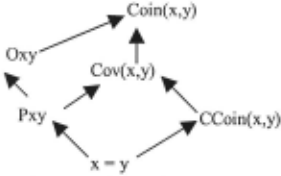
It is easy to check that when P is interpreted as P and r as r in Layered Models, CCoin, Cov, and Coin are, re spectively, CCoin, Cov, and Coin.
The following theorems can be derived from (Pl)-(P6) and (Rl)-(R4).
(RT4) Cov(x, y) & Cov(y, x) ~ CCoin(x, y) (y covers x and x covers y iff x andy completely coincide)
(RT5) CCoin(x, y) & CCoin(x, z) & Uyz ~ y = z (any object can completely coincide with at most one object in any layer)
(RT6) CCoin(x, y) & Uxy ~ x = y (if x and y com pletely coincide and are on the same layer, then x = y)
(RT7) Cov(x, y) & Uxy ~ Pxy (if y covers x and x andy are on the same layer, then xis part ofy)
(RTS) Coin(x, y) & Uxy ~ Oxy (if x and y coincide and are on the same layer, then x andy overlap)
In addition, the implications illustrated in the diagram below can be derived. The arrow indicates that the atomic formula at the start of the arrow implies the atomic for mula at the end of the arrow.
5 Layered Mereotopology
The base theory can be extended to Layered Mereotopol ogy in a straightforward way by adding a connection relation, C, where Cxy means "xis connected toy". Cis interpreted as C in Layered Models. 6
(Cl) Cxx
(connection is reflexive)
(C2) Cxy ~ Cyx
(connection is symmetric)
(C3) Pxy ~ 'v'z(Czx ~ Czy) (if x is part of y, every thing connected to x is connected to y)
(C4) Cxy ~ Uxy (if x andy are connected, then they are parts of the same layer)
(C5) Cxy ~ C(r(x), r(y)) (if x and y are connected, their regions are also connected)
6 Axioms specific to Layered Mereotopology are marked with
a "C". Theorems are marked with "CT"
(C6) Uxy & C(r(x), r(y)) ~ Cxy (ifx andy are mem bers of the same layer and their regions are connected, then x andy are connected)
External Connection and Abutment are defined as fol lows.
(D14) ECxy =: Cxy & ~ Oxy (x and y are externally connected)
(D15) Axy =: EC(r(x), r(y)) (x andy abut)
When C is interpreted as C in Layered Models, EC is the relation , EC and A is the relation , A.
The following theorems are easily derived:
(CTl) ECxy ~ Axy (if x and y are externally connected, then x and y abut)
(CT2) Uxy ~ (Axy ~ ECxy) (ifx andy are on the same layer, then they abut iff they are externally connected)
(CT3) Axy ~ ~Coin(x, y) (ifx andy abut, then they do not coincide)
The tangential part relation, TP, is usually defined in terms of external connection as follows:
TPxy =: Pxy & 3z(ECzx & ECzy) (**)
This definition is not appropriate for layered models. To see why, consider the Layered Model whose underly ing topological space is 9i with its standard topology and whose layers have the members of the following sets as parts:
Layer 0: {x0 : 0 ot- x ~ 9i}
Layer 1: {x1 : 0 ot- x ~ [0, 1]}
It would follow from the standard definition ofTP that [0, 1] 1 has no tangential parts, since it is not externally connected to any member of the domain. For example, it would follow that [0, 0] 1 and [ 1, 1] 1 are not tangential parts of[O, 1] I ·
I will therefore use the following definition of tangen tial part:
(D16) TPxy =: Pxy & 3z(Azx & Azy) (xis a tangential part ofy)
Applying this definition to the previous model, it turns out that any part of [0, 1] 1 that contains either [0, 0] 1 or [ 1, 1] 1 is a tangential part of [0, 1] 1· More generally, it follows from (D16) that, for objects x andy on the same layer, xis a tangential part ofy if and only ifx's region is a tangential part ofy's region.
(CT5) Uxy ~ (TPxy ~ TP(r(x), r(y)))
Interior parthood is then defined as usual.
(D 17) IPxy =: Pxy & ~ TPxy (x is an interior part of y)
Relational counterparts of topological operators can now be defined in the usual way. For instance, an ob ject's interior can be defined as the sum of its interior parts:
(DIS) INT(y, z) =: zSMx[IPxy] (z is the interior of y) Since each layer of any model of Layered Mereology is a model of GEM, it is easy to show that each layer of any model of Layered Mereotopology is a model of the standard mereotopology which uses(**) as the definition of tangential parthood and includes axioms (C I )-(C3) in addition to those of GEM.
6 Conclusions and Further Work
The goal of this paper was to construct a mereotopology for domains that include coincident but non-overlapping entities. The result is an extension ofmereotopology that includes coincidence relations and a region function in addition to mereotopological relations.
These additional elements of the theory make it par ticularly appropriate for applications that involve reason ing about objects that are located in holes. Reasoning about holes is crucial in a wide variety of domains, in cluding medicine (body cavities and orifices) and me chanics (valves, pathways formed by piping). For more examples, see [Casati and Varzi, 1994].
The particular theory presented in this paper allows the same mereotopological relations to apply directly to all spatial entities, including regions, material objects, and holes. This approach is an alternative to that of [Cohn, 200 I] in which spatial relations apply to material objects only indirectly, via the spatial regions at which they are located. One advantage of allowing direct descriptions of the spatial properties of material objects is that this leaves open the possibility of attributing different spatial structures to material objects and the regions at which they are located. For example, we may wish to represent material objects as having only closed, regular, divisible parts, but represent spatial regions as sums of points . Slight changes in the conditions on the domains of Lay ered Models (specifically, condition 4) and in the axioms of Layered Mereotopology (specifically, (R4)) would allow models in which the parts of different layers are restricted to different granularities.
One other project for further work is to relax the re strictions on the underlap relation so that members of the domain that properly coincide (i.e. coincide without over lapping) can be parts of the same object. An organism has both material parts, such as a heart and a liver, and immaterial parts, such as an abdominal cavity. It has been argued in [Schulz and Hahn, 2001] that material and immaterial parts of the body may properly coincide: the brain is located in the cranial cavity, but it is not part of the cranial cavity. It is possible to define models similar Layered Models in which properly coincident members of the domain may under lap. It remains to develop a for mal theory of coincidence and mereotopological relations for these kinds of models.
Acknowledgements
I am grateful for the helpful comments of Jonathan Simon, Barry Smith, Thomas Bittner, and three anony mous reviewers on previous drafts of this paper. This work was supported by the Alexander von Humbolt Foundation under the auspices of its Wolfgang Paul Pro gram.
@inproceedings{ijcai2003p180,
  title     = {Layered Mereotopology},
  author    = {Donnelly, Maureen},
  booktitle = {Proceedings of the Eighteenth International Joint Conference on
               Artificial Intelligence, {IJCAI-03}},
  publisher = {International Joint Conferences on Artificial Intelligence},
  editor    = {Georg Gottlob and Toby Walsh},
  pages     = {1269--1273},
  year      = {2003},
  url       = {https://ijcai.org/proceedings/2003/180},
}
TY - CPAPER TI - Layered Mereotopology AU - Donnelly, Maureen T2 - Proceedings of the Eighteenth International Joint Conference on Artificial Intelligence, IJCAI-03 PB - International Joint Conferences on Artificial Intelligence PY - 2003 SP - 1269 EP - 1273 UR - https://ijcai.org/proceedings/2003/180 ER -Copied
Machine-readable versions of this paper, for tools and AI agents:





