
Backbone Guided Local Search for Maximum Satisfiability
Proceedings of the Eighteenth International Joint Conference on Artificial Intelligence. Pages 1179-1185.
© 2003 International Joint Conferences on Artificial Intelligence
Abstract
Maximum satisfiability (Max-SAT) is more general and more difficult to solve than satisfiability (SAT). In this paper, we first investigate the effectiveness of Walksat, one of the best local search algorithms designed for SAT, on Max-SAT. We show that Walksat is also effective on Max-SAT, while its effectiveness degrades as the problem is more constrained. We then develop a novel method that exploits the backbone information in the local minima from Walksat and applies the backbone information in different ways to improve the performance of the Walksat algorithm. We call our new algorithm backbone guided Walksat (BGWalksat). On large random SAT and Max-SAT problems as well as instances from the SATLIB, BGWalksat significantly improves Walksat's performance.
- K. D. Boese. Models for Iterative Global Optimization. PhD thesis, UCLNComputer Science Department, 1996. 1184
- P. Cheeseman, B. Kanefsky, and W. M. Taylor. Where the real!) hard problems are. In Proc. IJCAI-91 , pages 331 -337.
- P. Codognet and F. Rossi. Notes for the ECAI2000 tutorial on Solving and Programming with Son Constraints: Theory and Practice. ava ilable at http: //www.math.unipd.it/ frossi /papers.html . Link
- M. Davis, G. Logemann, and D. Loveland. A machine program for theorem proving. CACM, 5:394-397, 1962.
- Dubois and G. Dequen. A backbone-search heuristic for ef• ficient solving of hard 3-SAT formula. In Proc. IJCAI-0 I, pages 248-253, 2001.
- E. C. Freuder and R. J. Wallace. Partial constraint satisfaction. Artificial Intelligen ce, 58 :21 -70, 1992. IJCAI
- M. R. Garey and D. S. Johnson. Computers and Intractability. Freeman, 1979.
- H. H. Hoos. An adaptive noise mechanism for walksat. In Proc. AAAI-02.
- H. H. Hoos and T. Stuzle. SATLIB -the satisfiability library. http://www.informatik.tu-darmstadt.de/ AI/SATLIB, 1999. Link
- Y. Jiang, H. Kautz, and B. Selman. Solving problems with hard and soft constraints using a stochstic algorithm for MAX-SAT. In Proc. I st Workshop on AI and OR, Timberine, OR, 1995.
- D. McAllester, B. Selman, and H. Kautz. Evidence for invariants in local search. In Proc. AAA!-97, pages 321 -326, 1997.
- D. Mitchell, B. Selman, and H. Levesque. Hard and easy distri• butions of SAT problems. In Proc. AAAI-92, 1992.
- R. Monasson, R. Zecchina, S. Kirkpatrick, B. Selman, and L. Troyansky. Determining computational complexity from characteristic 'phase transitions' . Nature, 400: 133-13 7, 1999.
- D. J. Patterson and H. Kautz. Auto-Walksat: A self-tuning im• plementation of Walksat. Electronic Notes in Discrete Mathe• matics, 9, 2001.
- J. C. Pemberton and W. Zhang. Epsilon-transformation: Ex• plaiting phase transitions to solve combinatorial optimization problems. Artificial Intelligence, 81:297-325, 1996.
- B. Selman, H. Kautz, and B. Cohen. Noise strategies for local search. In Proc. AAA!-94.
- J. Slaney and T. Walsh. Backbones in optimization and approx• imation. In Proc. IJCA!-01, 2001.
- Telelis and P. Stamatopoulos. Heuristic backbone sampling for maximum satisfiability. In Proc. 2nd Hellenic Conj on AI, pages 129-139, 2002.
- W. Zhang. Phase transitions and backbones of3-SAT and Max• imum 3-SAT. In Proc. 7th Intern. Conj on Principles and Practice of Constraint Programming (CP-2001), pages 153- 167, 2001.
References were extracted automatically from the PDF and may contain errors.
Full text extracted automatically from the PDF; figures, tables and equations may differ. The PDF is the version of record.
1 Introduction
Satisfiability or SAT is an archetypical combinatorial problem. A SAT involves a set of Boolean variables and a set of clauses in the form of a disjunction of literals (variables or their nega tions). A clause is satisfied if one of its literals is set to true, and the problem is satisfied if all clauses are satisfied. The problem is to decide if a variable assignment exists that sat isfies all the clauses. When not all clauses are satisfiable, the goal is to maximize the satisfied clauses, and the problem be comes maximum SAT or Max-SAT, an optimization problem. A SAT (Max-SAT) with k literals per clause is denoted ask-SAT (Max-k-SAT). It is known that k-SAT with k greater than two is NP-complete and Max-k-SAT with k being at least two is NP hard [7]. Max-SAT is more general and difficult to solve than SAT. Many real-world problems, such as scheduling, pattern recognition, and multi-agent cooperation and coordination [3; 6], can be formulated and solved as SAT or Max-SAT.
Recent years have witnessed significant progress made on SAT and Max-SAT along two directions. The first is the un derstanding of properties such as phase transitions and back bones [2; 12; 13; 17; 19]. Phase transitions refer to dramatic changes in a problem property when a critical parameter of a problem changes. The most important phase transition re sults on random 3-SAT are that when the ratio of the number of clauses to the number of variables (CN ratio) increases be yond a critical value, around 4.3, random 3-SATs begin to be come unsatisfiable, and the computational cost of the problem increases abruptly [2; 12; 13]. The backbone of a problem is a set of variables that have fixed values in all optimal solutions to the problem. The hardness of a SAT or Max-SAT is deter mined by the backbone size of the problem [13]. In addition, the backbones of random SAT and Max-SAT also have small to large phase transitions [ 19]. The second direction is focused on developing efficient SAT solvers. The most noticeable re sults along this line are the Walksat local search algorithm [16] and its variants [11], which are among the best SAT solvers used in practice for problems such as planning.
*This research was supported in part by NSF grants IIS-0196057 and ITR!EIA-0113618, and in part by DARPA Cooperative Agree ments F30602-00-2-0531 and F33615-0 1-C-1897.
A problem of fundamental interest and practical importance in algorithm design is how to utilize problem structure proper ties such as phase transitions and backbones to cope with high complexity and improve algorithm performance. The current research on this problem is limited. [15] developed a trans formation method to exploit phase transitions of tree search. [5] designed a method to incorporate estimated backbone vari ables in a systematic search for SAT. [18] proposed a heuristic backbone sampling method for generating initial assignments for a local search using an estimated backbone. This sampling scheme will also be studied in this research.
In this paper, we develop a novel method to exploit the struc ture of local minima reached by an effective local search algo rithm, and an effective approach to utilize the structure infor mation to improve the performance of a local search algorithm. We focus on Max-SAT in this research.
To develop our new method, we first study the performance of Walksat, which was designed for SAT, on Max-SAT (Sec tion 3). We show that Walksat is effective on random Max SAT, finding many high quality local minima close to optimal. In addition, the local minima reached by Walksat appear to form large clusters around optimal solutions. Our results also show that the performance ofWalksat degrades when the con strainedness of Max-SAT increases. Although we carry out this analysis for the purpose of developing a new method, the result is of interest and significance on its own. To our knowl edge, Walksat has only been analyzed on some overconstrained Steiner tree problems [10].
The main contribution of this paper is an innovative method that exploits the solution structure of a combinatorial problem to improve the performance of a local search algorithm such as Walksat (Section 4 ). It was inspired by the recent research on phase transitions and backbones of SAT and Max-SAT [13;
19] and the performance results of Walksat in the first part of the paper. We directly apply the new method to Walksat. Nevertheless, the ideas and techniques developed here are gen eral and applicable to other combinatorial problems and local search algorithms.
Briefly, our main ideas are to use backbone information to make biased moves in a local search, and use local minima to approximate optimal solutions for extracting backbone in formation. The frequencies of literals appearing in all local minima are called pseudo-backbone frequencies . Our new ap proach applies pseudo-backbone frequencies as a heuristic for selecting a variable to flip in each step of the Walksat algo rithm. Such biased moves guide the search toward regions possibly having optimal solutions. The effectiveness of this method is partially due to the effectiveness of Walksat on find ing optimal and high quality approximate solutions. We call the resulting algorithm backbone guided Walksat or BGWalk sat. We demonstrate and evaluate experimentally the effective ness of BGWalksat on large random Max-SAT instances and real problems from SATLIB [9] (Section 5).
2 The Walksat Algorithm
Walksat is a randomized algorithm. It starts by creating an initial random variable assignment (which we call assignment generation). It then repeatedly makes a move by selecting a variable and flipping its value from True' to False or vice versa, until it finds a satisfying assignment or reaches a predefined maximal number of flips. Each such attempt is called a try or restart. The procedure repeats until a maximal number of tries has been executed.
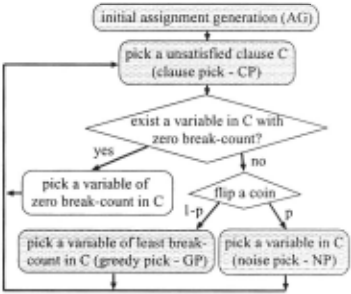
To select a variable, the effect of flipping a variable is as sessed. Flipping a variable may make some unsatisfied clauses satisfied. The number of clauses being made unsatisfied by flipping a variable is call the break-count of the variable at the current assignment. Walksat attempts to flip a variable with zero break-count, trying not to make the next assignment worse than the current. To find a variable with zero break-count Walksat first selects an unsatisfied clause C, randomly, from all unsatisfied clauses. This is called clause pick. If C has a vari able of zero break-count, Walksat then picks such a variable, randomly, from the ones that qualify. If no zero break-count variable exists in C, Walksat then makes a random choice. With probability p it chooses, randomly, a variable from the ones involved in C (called noise pick); and with probability 1 - p it picks a variable with the least break-count, breaking the tie arbitrarily if multiple choices exist (called greedy pick).
A flow chart of one try of Walksat is in Figure 1. The four shaded rectangles contain the random choices we will analyze. Walksat takes three parameters to run, the number of tries, the maximal number of flips in each try or cutoff parameter, and a probability or noise ratio for noise pick.
3 Performance of Walksat
We now turn to the effectiveness ofWalksat on Max-SAT, par ticularly Max-3-SAT. We measure a local minimum in two ways. The first is the cost difference between a local mini mum and an optimal solution (which may have non-zero cost). The second measure is the Hamming distance between a local minimum and the optimal solution nearest to it. We introduce the nearest Hamming distance to capture the minimal number of flips required to turn a local minimum into an optimal so lution. Furthermore, to make these two quality measures on two Max-SAT instances of different sizes comparable, we nor malize them. For a given problem, we divide the Hamming distance by the number of variables, resulting in the Hamming distance per variable, and divide the cost difference by the number of clauses, giving the cost difference per clause. We then use these two normalized quality measures to construct the landscape of local minima reached by Walksat.
To find the nearest optimal assignment, all optimal solutions are required, which are found by an extended DPLL al gorithm [4] for SAT. Since finding all optimal solutions is ex pensive, we restricted ourselves to relatively small Max-SAT problems. In our experiments, we used problems of I 00 vari ables and CN ratios of 2.0, 4.3, 6.0 and 8.0 to capture prob lems in different constrainedness regions. The problems were randomly generated by uniformly picking three literals with out replacement for a clause, discarding duplicate clauses. For Walksat, we set the noise ratio at 0.5, the number of tries per problem at 100, and the cutoff parameter at 10,000. Wegener ated 1,000 problems at each CN ratio.
The quality of local minima from Walksat are summarized in Figure 2. The X-Y planes show the correlation between the normalized Hamming distance and the normalized cost differ ence. The origins of the figures correspond to global minima. Each point on the X-Y plane represents a possible local mini mum that may be visited by Walksat. The vertical Z axis mea sures the number of local minima reached by Walksat, aver aged over 1,000 instances on each of which 100 tries were run.
As shown in Figures 2(a) and (b), Walksat performs well on underconstrained and critically constrained problems, in that it can find global minima very often. This is shown by the points on Z axes indicated by the arrows in the figures. There fore, Walksat is effective at finding optimal solutions on un derconstrained and critically constrained problems. However, the number of local minima which are also global minima de creases from 66,677 to 8,616, on average, as the CN ratio increases from 2.0 to 4.3, indicating that the effectiveness of Walksat decreases. This number decreases further to 201 and 0 on overconstrained problems with CN ratios equal to 6.0 and 8.0 (Figures 2(c) and (d)). This result indicates that Walksat becomes less effective in finding optimal solutions as problem constraints increase.
The distribution of local minima of Walksat exhibits a bell surface on overconstrained problems (Figures 2(c) and (d)). More importantly, the summit of such a bell surface shifts away from optimal solutions, the (0,0) point on the X-Y plane, as the problems are more constrained. As the CN ratio increases, the number of optimal solutions decreases [19], which can become indistinguishable from a large number of suboptimal solutions. As a result, the search space becomes rugged, with more local minima in which Walksat may be trapped.
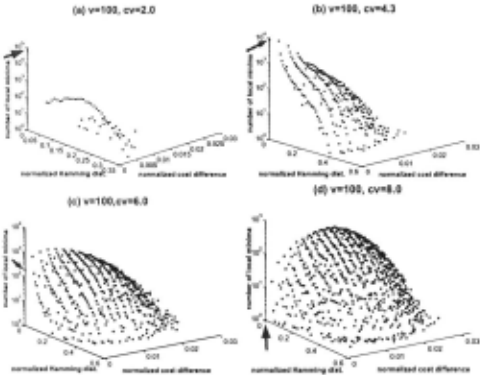
Despite the difficulty of overconstrained problems, Walksat is still fairly effective in that it is able to reach local minima close to optimal solutions. For a CN ratio of8.0 (Figure 2(d)), for instance, a large number of local minima landed on by Walksat (the peak point of the bell surface) have a normalized cost difference to optimal solutions of 0.014 for 100 variable problems, which is equivalent to approximately eleven more constraints violated than an optimal solution on such overcon strained problems. Since Walksat is normally executed in mul tiple tries, the best local minimum it can reach is usually much better than such most frequent local minima.
A closer examination of the results in Figures 2(c) and (d) indicates a nearly linear correlation between the cost differ ence and the Hamming distance. This observation implies that a local minimum with a small cost is more likely to share a larger common structure with an optimal solution. A similar phenomenon on the Traveling Salesman Problem was called the "big valley" [1]. We will exploit this in our new search algorithm described in the next section.
4 Backbone Guided Local Search
4.1 The main idea
If all optimal solutions to a problem were known, they could provide a useful clue to how a variable should be set. For ex ample, if a variable is a part of the backbone, i.e., it has a fixed value in all optimal solutions, obviously the variable should be set to that value. In fact, we can extend the concept of back bone to backbone frequency. The frequency of a variable-value pair (or literal in SAT) in all optimal solutions is an indication of how often the variable should take that particular value. This can be exploited as a heuristic for selecting variables and val ues in a local search such as Walksat. In general, a variable value pair will be less likely to be swapped out of the current state if it has a higher backbone frequency than another pair.
Unfortunately, exact backbone frequencies are hard to come by without finding at least one optimal solution. The idea to bypass this problem was inspired by the effectiveness of high performance local search algorithms, such as Walksat. Our analysis on the performance of Walksat (Section 3) showed that Walksat can find optimal solutions very often on under constrained and critically constrained Max-SAT, and can also reach near optimal solutions very close to the optimal. Such near optimal local minima also form large clusters around op timal solutions. Thus, the local minima of Walksat must have common structures, which may also be shared by optimal so lutions. Therefore, we can use the local minima as if they were optimal solutions to compute pseudo-backbone frequencies as an estimation of the true backbone frequencies. We call this general approach backbone guided local search or BGLS.
The above ideas can be applied to almost all local search algorithms. However, actual application is problem and algo rithm specific, since local search algorithms operate very dif ferently on different problems. In this research, we consider Max-SAT and the Walksat algorithm.
4.2 Backbone guided Walksat: BGWalksat
The application of BGLS to Max-SAT and Walksat leads to the backbone guided Walksat (BGWalksat) algorithm. Similar to Walksat, BGWalksat runs a total K tries. In addition, BG Walksat splits the total of K tries into two phases. The first, estimation phase, runs K1 tries of original Walksat to collect local minima and compute pseudo-backbone frequencies (see Section 4.3). The second, backbone guided search phase runs K2 = K - K1 tries, in which variable selection is guided by pseudo-backbone frequencies. The newly discovered local minima can also be added to the pool of all local minima to update the pseudo-backbone frequencies.
We now consider backbone guided moves or biased moves. As discussed in Section 2 and shown in Figure 1, Walksat makes five uniformly random choices. The first is the ran dom initial assignment generation. Instead of uniformly ran domly choosing a variable and setting it to an arbitrary value, we can view the pseudo-backbone frequencies as an approxi mate probability distribution of variable assignments and take samples of variable assignments as initial assignments from this distribution. This scheme was called heuristic backbone sampling in [18].
The second random choice in Walksat is the random clause pick for choosing an unsatisfied clause. To apply the idea of backbone frequencies, we extend it to the concept of pseudo backbone clause frequencies, which measure the frequencies that clauses are satisfied in all local minima. When picking a clause from the set of unsatisfied clauses, we choose one based on its pseudo-backbone clause frequency. For example, given three unsatisfied clauses cl' c2 and c3 with pseudo-backbone frequencies 0.3, 0.05 and 0.15, respectively, we choose cl with probability 0.3/ (0.3 +0.05+0.15) = 0.6, c2 with proba bility 0.05/0.5 = 0.1 and c3 with probability 0.15/0.5 = 0.3.
The remaining three random choices involved selecting a variable, uniformly, from a particular set. The first choice picks a variable from the set of zero break-count variables in the cho sen clause C (the unshaded rectangle in Figure 1), the second directly from the variables involved in C, and the third from the set of variables in C with the least break-count. Rather than picking one variable uniformly from a particular set, we make a biased selection based on variables' pseudo-backbone frequencies. Consider an example of three literals Xt, ...,X2 and x3 in the chosen clause C with backbone frequencies 0.1, 0.3 and 0.6, respectively. We want to flip x1 more than X3 because literal -,x1 appears more often than ...,X3 in all local minima (frequency 0.9 versus 0.4). Therefore, we pick Xt, ...,x2 and X3 with frequencies 0.9/ (0.9 + 0. 7 + 0.4) = 0.45, 0. 7/2.0 = 0.35 and 0.4/2.0 = 0.2, respectively.
4.3 Pseudo-backbone frequencies
The performance of backbone guided local search depends largely upon the quality of pseudo-backbone frequencies. There are at least two ways to compute pseudo-backbone fre quencies. The first and simplest method is to consider all the available local minima as if they were global optima, and take the frequency of a variable-value pair l = (xi, vi) that ap pears in all local minima S as its pseudo-backbone frequency. Specifically, we have frequency p(l) = Lvs;ES,IEs; 1/ISI. We call this method average counting.
It is imperative to note that not all local minima are of equal quality. A lower quality local minimum usually con tains Jess backbone variables than one of a higher quality. Therefore, the former is less reliable and should contribute less to the pseudo-backbone frequencies than the latter. Thus, we must discount the contribution of a local minimum based on its cost. If a local minimum Si has cost Ci, we can compute the pseudo-backbone frequency of l = (xi, Vi) as p(l) = (Lvs;ES,IEs; 1/ci)/(Lvs;ES 1/ci)- In other words, the pseudo-backbone frequency of l is reciprocally weighted by the costs of the local minima that l was involved with. We call this method cost reciprocal average counting.
4.4 Walksat and BGWalksat with Dynamic Noise
One limitation of the Walksat family of algorithms is their dependence on a manually set noise parameter. So far, two mechanisms have been proposed to resolve this issue in SAT. Auto-Waksat [ 14] uses a preliminary probing stage to estimate the optimal value for the noise parameter, while Walksat with dynamic noise [8] automatically adjusts the noise level as the search progresses. We have successfully combined our method with the dynamic noise strategy, for SAT and Max-SAT.
The idea of dynamic noise is simple: start search with the noise parameter equal to zero, and examine the number of vi olations in the current state every () · m flips, where m is the number of clauses in the instance. If the number of violations has not decreased since the last time we checked (n flips ago), the search is assumed to have stagnated, and the noise level is increased to wp + (1 - wp) ·¢,where wp is the current noise level. Otherwise, the noise level is decreased to wp - wp · 2¢. The discrepancy between the formulas for increasing and de creasing the noise level are based on the observations of how Walksat behaves when the noise parameter is too high, com pared with how it behaves when the parameter is too low [8]. Following [8], we have set() = 1/6 and </J = 0.2, which have been found to be effective over a wide range of SAT and Max SAT instances.
Dynamic noise was designed and tested with Walksat's cut off parameter set to infinity; i.e., no random restarts. This is the setting we use for Walksat with dynamic noise for all of our experiments in the next section. Unfortunately, this setting is incompatible with backbone guided Walksat, which requires random restarts in order to construct the pseudo-backbone. To overcome this, we have devised "compromise" parameter set tings, which allow dynamic noise to function effectively, while still constructing the pseudo-backbone. Specifically, we run Walksat with dynamic noise for 30 short runs to construct the pseudo-backbone, followed by 7 long runs of backbone guided local search, each of which is I 0 times as long as a short run.
5 Experimental Results
We now analyze the performance of BGWalksat on Max SAT. The benchmark suite for empirical evaluation consists of two different types of problems: randomly generated prob lems and problems converted from real-world applications in SATLIB [9]. We included satisfiable and unsatisfiable prob lem instances. We used Walksat implementation from Henry Kautz and developed BGWalksat on top of it.
5.1 Random ensembles
In these experiments, we investigate the effects of biased moves on random choices in Walksat (Section 2). There are five places where Walksat makes uniformly random choices (the five rectangles in Figure 1). Our experimental results showed that the biased random choice of picking a variable of zero break-count in a selected clause C (the unshaded rectan gle in Figure 1) has almost no effect. The reason is that when a zero break-count variable exists, there is usually one available, meaning that a very few such biased moves occur. We will not consider this biased random choice in the rest of the paper.
In our experiments, we generated random MAX-3-SAT in stances with 2,000 variables and three different C/V ratios of 2.0, 4.3 and 8.0. We generated 100 instances for each of the C/V ratios. We also tested various noise ratios, from 0 to 0.9 with an increment of 0.1, as well as Walksat with dynamic noise. Each run, regardless of its configuration, was allowed a total of one million flips.
For Walksat with static noise, the cutoff parameter was set to 10,000 flips (so the algorithm was run from 100 different starting points). We tested different ratios of the lengths of the backbone estimation phase and the actual backbone search phase in BGWalksat. We found that a ratio of about 0.3 seems to provide the best results. In the results shown below, Walksat was run on the first 30 tries to collect the initial set oflocal min ima and obtain the pseudo-backbone frequencies. BGWalksat was run on the remaining 70 tries. New local minima were added to update pseudo-backbone frequencies every 5 tries.
We experimentally compared the two methods for comput ing pseudo-backbone frequencies (Section 4.3). The average counting (AC) method is generally worse than the cost recip rocal average counting (CRAC) method on random problems. Due to space limitations here, we will only report the results from the CRAC method below.
There is little impact of biased moves when the C/V ratio is 2.0, because Walksat is able to find optimal solutions in the first 30 tries in almost all problems. Figure 3 shows the results on random Max-SAT with 2,000 variable and C/V ratios of 4.3 and 8.0, comparing Walksat and BGWalksat with biased noise pick, biased greedy pick, and bias moves combining biased noise pick, greedy pick, clause pick, and assignment genera tion. The error bars in the figures correspond to 95% confi dence intervals. As shown, biased greedy pick is effective at low noise levels, but leads to degraded performance on higher noise levels. Biased noise pick, on the other hand, has a greater effect as the noise level increases, due to the direct relationship between the noise level and the frequency of noise picking. Bi ased assignment generation and clause pick on their own, have little effect of Walksat's performance (data not shown). How ever, when combined with other strategies, they can provide improvements, as shown.
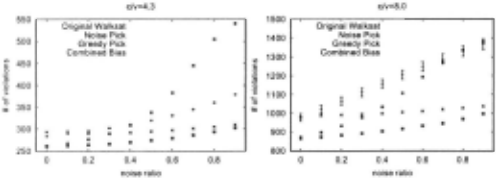
We also tested Walksat and BGWalksat with dynamic noise on the same instances, with good results. This is fairly un surprising, since on this class of instances, Walksat performs best with a low noise ratio, and dynamic noise begins with the noise ratio set to zero, and only raises it as needed. We found that the noise parameter fluctuated at low levels, with an av erage of 0.2 for both CN=8 and CN=4.3. The noise level never exceeded 0.6 at any time. The solutions found by Walk sat with dynamic noise were as good as the best solutions found by Walksat with static noise for CN=8, and only about 3.5% worse for CN =4.3. When combining dynamic noise with BG Walksat, the average noise level was slightly lower, giving 0.13 for CN=8 and 0.15 for CN=4.3, due to the increased number of random restarts. This is because after every restart there is a period of rapid improvement, when the noise level remains at zero. The performance of BGWalksat with dynamic noise is similar to that of BGWalksat with best static noise for CN=8 and slightly worst than that for CN=4.3.
5.2 Real problem instances
We now investigate how BGWalksat improves upon Walksat on the problems from SATLIB [9], when used in conjunction with dynamic noise. The test problems include SAT-encoding instances from a random hard graph coloring problems and SAT-encoded blocks world planning, bounded model check ing, and the all interval series problem. The details of these problems can be found on the website. We only chose prob lems with more than 350 variables, and discarded those that can be easily solved by Walksat and BGWalksat.
We considered satisfiable and unsatisfiable problems. We ran both Walksat and BGWalksat, both using dynamic noise, with a total of 10 million flips (compared with 1 million for our results for random instances). Interestingly, BGWalksat exhibited superior performance, over a wide range of real in stances, with some of the methods of biased-moves utiliz ing the pseudo-backbone disabled. For the results presented here, we use backbone-guided noise pick and backbone-guided clause pick, with the average-counting (AC) method. Results are for twenty runs for each algorithm and instance. Experi ments with the best static noise (not shown) produced similar results.
In viewing the results, we found it useful to divide the satis fiable instances into two categories, the easier instances, which were solved at least once (Table 1 ), and the harder ones, which were not solved by either method, in any of their runs (Table 2). Results for unsatisfiable instances are presented in Table 3.
| I problem | I #Var I | #Clause | II Walksat | II BGWalksat |
|---|---|---|---|---|
| bwJarge.c bwJarge.d | 3016 6325 | 50457 131973 | 1 I | 2 6 |
| par8-1 par8-2 par8-3 par8-4 par8-5 qg1-08 qg2-08 qg3-08 qg6-09 qg?-09 | 350 350 350 350 350 512 512 512 729 | 1149 1157 1171 1155 1171 148957 148957 10469 21844 | 6 6 7 0 1 8 1 11 0 4 | !2 !2 !1 .!! 15 11 ~ 20 ~ 5 |
| g125.17 g250.29 | 729 2125 | 22060 66272 | 0 | |
| 7250 | 454622 | ~ | ||
| 4 | 2 |
As the results show, BGWalksat significantly outperforms Walksat in most cases. On easier satisfiable instances (Table I) , BGWalksat finds more satisfying solutions than Walksat for all parity (par) and quasigroup (qg) classes, and produces similar results to Walksat on blocksworld instances. On harder satis fiable instances (Table 2), BGWalksat outperforms Walksat in all but two of 34 instances, where it is less than half a percent worse. In contrast, the overall average gain is 30%, and is over 50% in 11 of them. On unstatisfiable instances (Table 3), BG Walksat produces impressive gains on longmult instances, and on ssa6288-04 7, with an overall average gain of 20%. On un satisfiable quasigroup instances (not shown), performance was similar to that ofWalksat. Performance of BGWalksat is never more than 10% worse than Walksat on any of the unsatisfiable instances we have studied.
The most glaring failure of BGWalksat is on the instances g125.17 and g250.29. These instances are SAT-encoded graph coloring problems, and serve to illustrate an important point. As described in Section 3, we believe that our method is effec tive because it exploits the "big valley" structure of the solution space. However, graph coloring problems exhibit a particular type of symmetry in their solution structures which is opaque to local search methods such as Walksat. For example, color ing all red nodes green, and all green nodes red, results in an identical solution, with a radically different encoding. Thus, there is not a single "big valley", but several, which can bury the true backbone information and thus lead to degraded per formance. Presumably, BGWalksat's performance will suffer on all instances with this type of symmetry.
6 Conclusions
We developed a novel and general method that exploits back bone information for improving the performance of a local search algorithm. We demonstrated and analyzed the new method, called BGWalksat, on Max-SAT using the Walksat algorithm, with both static and dynamic noise strategies. The main ideas are to extract backbone information from local min ima and use it directly to fix the discrepancy between the cur rent state and optimal solutions, so as to guide Walksat toward the regions of the search space more likely to contain optimal solutions. In comparison, almost all existing local search meth ods focus on the costs of the states in the search space. Therefore, the new algorithm focuses more on where the current state is within the search space and tries to fix possible problems in the structures of the state directly.
| I problem | I #Var I | #Clause | II Walksal | II BGWalksal | II gain(%) |
|---|---|---|---|---|---|
| bmc-ibm-1 | 9685 | 55870 | 25.3 | 4.15 | 83.60 |
| bmc-ibm-2 | 3628 | 14468 | 5.4 | ~ | 77.78 |
| bmc-ibm-3 | 14930 | 72106 | 115.25 | 19.7 | 82.91 |
| bmc-ibm-4 | 28161 | 139716 | 118.15 | 38.9 | 67.08 |
| bmc-ibm-5 | 9396 | 41207 | 12.95 | 1.25 | 90.35 |
| bmc-ibm-6 | 51654 | 368367 | 358.25 | 103.6 | 71.08 |
| bmc-ibm-7 | 8710 | 39774 | 17.4 | 6.4 | 63.22 |
| bmc-galileo-8 | 58074 | 294821 | 65.65 | 15.5 | 76.39 |
| bmc-galileo-9 | 63624 | 326999 | 95.95 | 17.3 | 81 .97 |
| bmc-ibm-10 | 61088 | 334861 | 406.15 | 162.45 | 60.00 |
| bmc-ibm-11 | 32109 | 150027 | 439.8 | 358.45 | 18.50 |
| bmc-ibm-12 | 39598 | 19477 | 554.65 | 445.25 | 19.72 |
| bmc-ibm-13 | 13215 | 6572 | 88.05 | 2.7 | 96.93 |
| f2000 | 2000 | 8500 | 2.2 | 2.05 | 6.82 |
| par16-1-c | 317 | 1264 | 5.45 | 5.35 | 1.83 |
| par16-1 | 1015 | 3310 | 10.45 | 9.45 | 9.57 |
| par16-2-c | 349 | 1392 | 6.2 | 5.9 | 4.84 |
| par16-2 | 1015 | 3374 | 10.6 | 10.4 | 1.89 |
| par16-3-c | 334 | 1332 | 6 | 5.65 | 5.83 |
| par16-3 | 1015 | 3344 | 10.45 | 9.75 | 6.70 |
| par16-4-c | 324 | 1292 | 6.15 | 5.5 | 10.57 |
| par16-4 | 1015 | 3324 | 10.4 | 9.55 | 8.17 |
| par16-5-c | 341 | 1360 | 6.25 | 6.05 | 3.20 |
| par16-5 | 1015 | 3358 | 10.45 | 9.85 | 5.74 |
| par32-1-c | 1315 | 5254 | 21 .7 | 20.85 | 3.92 |
| par32-1 | 3176 | 10277 | 30.95 | 30.25 | 2.26 |
| par32-2-c | 1303 | 5206 | 21.15 | 21 .2 | -0.24 |
| par32-2 | 3176 | 10253 | 32.1 | 28.35 | 11.68 |
| par32-3-c | 1325 | 5294 | 22.05 | 21.3 | 3.40 |
| par32-3 | 3176 | 10297 | 32.95 | 28.55 | 13.35 |
| par32-4-c | 1333 | 5326 | 21.3 | 21 .4 | -0.47 |
| par32-4 | 3176 | 10313 | 33.65 | 29.4 | 12.63 |
| par32-5-c | 1339 | 5350 | 23.15 | 22.05 | 4.75 |
| par32-5 | 3176 | 10325 | 32.9 | 30.3 | 7.90 |
| Average | 29.82 |
BGWalksat can significantly outperforms Walksat on SAT and Max-SAT, with both static and dynamic noise. On random Max-3-SAT problems, the more constrained the problems, the more improvement BGWalksat can provide. Specifically, on random Max-3-SAT with 2,000 variables and a CIV ratio of 8.0, BGWalksat can satisfy approximately 10% more clauses on average than Walksat (using dynamic noise). On satisfi able problems from the SATLIB, BGWalksat almost always significantly improves on Walksat's results, with the exception of graph coloring problems which contains a type of symme try (see Section 5). On unsatisfiable SATLIB problems, BG Walksat substantially reduces the number of unsatisfied clauses across several instance classes.
In the process of developing BGWalksat, we also carried out a systematic experimental analysis of Walksat on Max-SAT (again with both static and dynamic noise) . Our results show that although designed originally for SAT, Walksat is also ef fective on Max-SAT, even though its effectiveness degrades as the problem becomes more constrained.
@inproceedings{ijcai2003p168,
  title     = {Backbone Guided Local Search for Maximum Satisfiability},
  author    = {Zhang, Weixiong and Rangan, Ananda and Looks, Moshe},
  booktitle = {Proceedings of the Eighteenth International Joint Conference on
               Artificial Intelligence, {IJCAI-03}},
  publisher = {International Joint Conferences on Artificial Intelligence},
  editor    = {Georg Gottlob and Toby Walsh},
  pages     = {1179--1185},
  year      = {2003},
  url       = {https://ijcai.org/proceedings/2003/168},
}
TY - CPAPER TI - Backbone Guided Local Search for Maximum Satisfiability AU - Zhang, Weixiong AU - Rangan, Ananda AU - Looks, Moshe T2 - Proceedings of the Eighteenth International Joint Conference on Artificial Intelligence, IJCAI-03 PB - International Joint Conferences on Artificial Intelligence PY - 2003 SP - 1179 EP - 1185 UR - https://ijcai.org/proceedings/2003/168 ER -Copied
Machine-readable versions of this paper, for tools and AI agents:





