
Approximating Optimal Policies for Agents with Limited Execution Resources
Proceedings of the Eighteenth International Joint Conference on Artificial Intelligence. Pages 1107-1111.
© 2003 International Joint Conferences on Artificial Intelligence
Abstract
An agent with limited consumable execution resources needs policies that attempt to achieve good performance while respecting these lim_itation~. Otherwise, an agent (such as a plane) mtght fat! catastrophically (crash) when it runs out of resources (fuel) at the wrong time (in midair). We present a new approach to constructing policies_ for agents with limited execution resources that bmlds on principles of real-time AI, as well as resear~h in constrained Markov decision processes. Specifically, we formulate, solve, and analyze the ~ol icy optimization problem where constraints are Imposed on the probability of exceeding the resource limits. We describe and empirically evaluate our solution technique to show that it is computationally reasonable, and that it generates policies that sacrifice some potential reward in order to make the kinds of precise guarantees about the probability of resource overutilization that are crucial for missioncritical applications.
- [Altman, 1999] Eitan Altman. Constrained Markov Deci- sion Processes. Chapman and HALLICRC, 1999.
- [Boutilier et al., 1999] Craig Boutilier, Thomas Dean, and Steve Hanks. Decision-theoretic planning: Structural as- sumptions and computational leverage. Journal of Artifi- cial Intelligence Research, 11: 1-94, 1999.
- [Dean et al., 1993] Thomas Dean, Leslie Pack Kaelbling, Jak Kirman, and Ann Nicholson. Planning with deadlines in stochastic domains. In Proc. of the Eleventh National Conf on Artificial Intelligence, pages 574-579, CA, 1993.
- [Howard, 1960] R. Howard. Dynamic Programming and Markov Processes. MIT Press, Cambridge, 1960.
- [Huang and Kallenberg, 1994] Y. Huang and L.C.M. Kallen- berg. On finding optimal policies for Markov decision chains. Math. of Operations Research, 19:434-448, 1994.
- [Kallenberg, 1983] L.C.M. Kallenberg. Linear Program- ming and Finite Markovian Control Problems. Mathema- tisch Centrum, Amsterdam, 1983.
- [Musliner et al., 1995] David John Musliner, James Hendler, Ashok K. Agrawala, Edmund H. Durfee, Jay K. Stros- nider, and C. J. Paul. The challenges of real-time AI. IEEE Computer, 28(1), 1995.
- [Puterman, 1995] M. L. Puterman. Markov decision pro- cesses. New York, 1995. John Wiley & Sons.
- [Ross and Chen, 1988] K.W. Ross and B. Chen. Optimal scheduling of interactive and non-interactive traffic in telecommunication systems. IEEE Transactions on Auto Control, 33 :261-267, 1988.
- [Ross and Varadarajan, 1989] K.W. Ross and R. Varadara- jan. Markov decision processes with sample path con- straints: the communicating case. OR, 37:780-790, 1989.
- [Ross and Varadarajan, 1991] K.W. Ross and R. Varadara- jan. Multichain Markov decision processes with a sam- ple path constraint: A decomposition approach. Math. of Operations Research, 16:195-207, 1991.
- [Russell and Subramanian, 1995] S. J. Russell and D. Subra- manian. Provably bounded optimal agents. lAIR, 2:575- 609, 1995. IJCAI
- [Sobel, 1985] M.J. Sobel. Maximal mean/standard deviation ratio in undiscounted mdp. OR Letters, 4:157-188, 1985.
References were extracted automatically from the PDF and may contain errors.
Full text extracted automatically from the PDF; figures, tables and equations may differ. The PDF is the version of record.
1 Introduction
Optimality is the gold standard in rational decision making (e.g., [Russell and Subramanian, 1995]), and, consequently, the problem of constructing optimal policies for autonomous agents has received considerable attention over the years. Traditionally, this problem has been viewed separately from the problem of actually carrying out the policies. However, real agents have limitations as to what they can execute, and, clearly, a policy is Jess useful if an agent might run out of resources while carrying out the policy.
In this paper, we present a new approach for construct ing policies for agents that have limited consumable re sources where running out of the resources can have neg ative consequences. Whereas AI research has mostly fo cused on (PO)MDP [Boutilier eta!., 1999; Dean eta!., 1993; Howard, 1960; Puterman, 1995] methods for formulating policies for agents without emphasizing constraints on their execution resources, the Operations Research literature has developed constrained MDP (CMDP) [Altman, 1999; Put erman, 1995] techniques that can account for resource c~n straints. CMDP methods are particularly useful for domams where the current resource amounts are unobservable and cannot be easily estimated by the agent, or where modeling resource amounts in the state description is computationally infeasible. In an aircraft scenario, some resources and situa tions where such methods are beneficial could include an air plane with a broken fuel gauge (fuel amount is unobser~able), pilot fatigue (attention is a resource that cannot be eas!ly es timated), or a combination of non-critical resources (ex. var ious refreshments) that should nevertheless not be exhausted, but explicit modeling of which unnecessarily complicates the optimization problem and increases policy_ size. In the res_t ~f the paper, we will use the fuel example, s1mply because 1t IS a very intuitive instance of a consumable resource ..
However, as we will explain later, standard nsk-neutral CMDP optimization techniques are not applicable to pro? lems where violating the constraints can have negat1ve or, m the limit, catastrophic 1 consequences. The main contrib~tion of this work is that it extends the standard CMDP techmques to handle the types of hard constraints that naturally arise in problems involving critical resources. In partic~lar, we ~or mulate an optimization problem where constramts are Im posed on the probability of resource overutilization, and show how the problem can be solved using standard linear pro gramming algorithms. Our formulation yiel?s su~-optimal solutions to the constrained problem because 1t sacnfices po tential reward to make guarantees about the probability of violating the resource constraints. As we later show, when violating constraints incurs dire costs, these guarantee~ are worthwhile ([Musliner eta!., 1995] and references therem).
We introduce our model in section 2, where we review Markov models, introduce notation, and specify our assump tions about the problem domain. Section 3 describes and compares several candidate solutions for addressing aspects of our problem. We then present in section 4 our new met~od, and empirically evaluate it in section 5. We conclude w1th a discussion about the strengths and limitations of our results, and about our future directions.
2 The Model
The stochastic properties of the environments in the prob lems that we are addressing lead us to formulate our optimization problem as a stationary, discrete-time, Markov decision process. In this section, we review some well known facts from the theory of standard [Puterman, 1995; Boutilier eta/., 1999] and constrained [Altman, 1999] fully observable Markov decision processes and also discuss the assumptions that are particular to the class of problems that we address in this work. This section provides the neces sary background for the subsequent sections, where we dis cuss resource-constrained optimization problems.
1 The term catastrophic is, of course, relative. We assume that the system designer is willing to accept certain risks to receive payoff.
2.1 Markov Decision Processes
A standard Markov decision process can be defined as a tuple (S, A, P, R), where Sis a finite set of states that the agent can be in, A is a finite set of actions that the agent can execute, P = [pii] : S x S x A ---+ lR defines the transition function (pi.J is the probability that the agent will go to state j if it executes action a in state i), and R = [ria] : S x A ---+ lR is the reward function (agent receives a reward of ria for executing action a in state i).
Clearly, the total probability of transitioning out of a state, given a particular action, cannot be greater than 1, i.e. L:j Pij :::; 1. As we discuss below, we are actually interested in domains where there exist states for which L:i Pij < 1.
A policy is defined as a procedure for selecting an ac tion in each state. A policy that makes its choices accord ing to a probability distribution over the set of actions is called randomized and can be described as a mapping of states to probability distributions over actions: 1r = [7ria] : S x A ---+ JR. A deterministic policy that always chooses the same action for a state is, of course, a special case of a randomized policy. It can be seen (similarly to the case of standard CMDPs, as described in [Kallenberg, 1983; Puterman, 1995]) that under our optimization criterion and constraints (section 4), deterministic policies can be subop timal. Therefore, in this work, we focus on approximating optimal policies in the class of randomized ones.
If, at time 0, the agent has an initial probability distribution a = [ai] over the state space, a Markov system follows the following trajectory:
where pt = [p~] is the probability distribution at timet .
2.2 Assumptions
Typically, Markov decision processes are divided into two categories: finite-horizon problems, where the total number of steps that the agent spends in the system is finite and is known a priori, and infinite-horizon problems, where the agent is assumed to stay in the system forever (see [Puterman, 1995] for a detailed discussion of both types of models).
In this work we concentrate on dynamic real-time domains, where agents have tasks to accomplish. For example, con sider an agent flying a plane, whose goal is to safely get to its destination and land there. This example does not naturally correspond to a finite-horizon problem, because the duration of executing various policies is not predetermined (unless we artificially impose such a finite duration, which is not easily justifiable). On the other hand, the problem does not natu rally fit the definition of the infinite-horizon model, because the plane obviously cannot keep on flying forever.
This leads us to make a slightly different and less common (although, certainly, not novel) assumption about how much time the agent spends executing its policy. We assume that there is no predefined number of steps that the agent spends in the system, but that optimal policies always yield transient Markov processes (decision problems of this type were exten sively studied by Kallenberg [1983]). A policy is said to yield a transient Markov process if the agent executing that policy will eventually leave the corresponding Markov chain, after spending a finite number of time steps in it. Given a finite state space, this assumption implies that there has to be some "leakage" of probability out of the system, i.e. there have to exist some state-action pairs ( i, a) for which L:i Pij < 1. One particular case where the above assumption holds is in a system in which all trajectories lead to absorbing states. Once an agent enters an absorbing state, it has finished (or failed to finish) some task and has nowhere else to go, i.e. the probability of transitioning out of an absorbing state i is zero: L:j L:a Pij = 0. 2 In the plane-flying example, all trajectories lead to either a safe landing or a crash, and once the agent enters one of these states, the probability of transitioning to other states is zero.
The transient nature of our problems leads us to adopt the expected total reward as the policy evaluation criterion. Given that an agent receives a reward whenever it executes an action, the total expected utility of a policy can be expressed as:
where T is the number of steps during which the agent accu mulates utility. For a transient system with bounded rewards, the above sum converges for any T.
3 Related Work
In this section, we briefly survey several approaches (based on well-known techniques) to solving the problem of finding optimal policies for agents with limited resources, and point out the assumptions, strengths, and limitations of these meth ods. This establishes a landscape of solution algorithms, to which we can compare our method (presented in the next sec tion) in terms of complexity, efficiency, and solution quality.
3.1 Fully Observable MDPs
The most straightforward way of handling resource con straints in a MDP framework is to explicitly model the re sources by making their current amounts a part of the state description. This yields a standard FOMDP, which can be solved by a wide variety of efficient methods. The benefit of this approach is that it allows one to make use of all rele vant information to construct the best possible policy, as the agent is able to base its action choice on the current state and resource amounts. The downside of this approach is that it requires an a priori discretization of resource amounts to be made when the world model is constructed. Also, there is an additional burden of specifying the rewards and state transi tions as functions of current resource amounts. Furthermore, in this model, the size of the state space and, consequently, the policy size, explodes exponentially in the number of re sources, as compared to the state space where the resource amounts are not folded into the state description.
2 An alternative way of handling these states is to treat them as infinitely-recurrent, i.e. once the agent gets there, it infinitely tran sitions back to itself. We do not adopt this model, because it is less natural for our domains and also leads to unnecessary complications in the optimization problems.
The FOMDP approach relies on the fact that the agent can observe the exact amounts of all resources at runtime. How ever, this may not hold, especially in multiagent domains with shared resources, when an agent does not know what other agents have been doing and how much of the shared resources they have been consuming.
3.2 Constrained MDPs
An alternative to the FOMDP approach described above is to treat the problem as a constrained Markov decision process [Altman, 1999], where the resources are not explicitly mod eled, but rather are treated as constraints that are imposed on the space offeasible solutions (policies).
A constrained MDP for a resource-limited agent differs from a standard MDP in that the agent, besides getting re wards for executing actions, also incurs resource costs. Con sequently, a constrained MDP (CMDP) can be described as a tuple (S , A, P , R, C, Q), where C = [ciak] : S x A---+ JRK defines a vector of actions' costs (Ciak units of resource k E [1 , K] are used when action a is executed in state i), and Q = [qk] E JRK is the vector of amounts of available resources (there is qk units of resource k initially available).
The benefit of the CMDP is that it does not require one to explicitly model how the resources affect the world. In deed, if all policies satisfy the resource constraints, one does not have to worry about what happens when the resources are overutilized. Consequently, the state space and the re sulting policies are exponentially smaller than the ones in the FOMDP model. The standard CMDP formulation constrains the expected usage of all resources to be below a certain limit and can be formulated as the following linear program:
where the variables Xia have the interpretation of the expected number of times action a is executed in state i.
A weakness of this approach is that it yields policies that can be suboptimal, as compared to the ones constructed by the FOMDP method, because the agent does not base its de cision on the current resource amounts, but rather completely ignores that aspect of the state. However, as mentioned in the previous section, in domains where the resources are not ob servable, or if the policy size is of vital importance (for exam ple if the agent's architecture imposes constraints on policies that it can store), this approach could prove fruitful.
However, the biggest problem with this approach (as pointed out, for example, by Ross and Chen in the telecommunication domain [1988]) is that a standard CMDP imposes constraints on the expected amounts. Clearly, this method does not work for critical resources, whose overutilization has negative consequences. Indeed, an agent that pilots aircraft would not be satisfied with a policy that on average uses an amount of fuel that does not exceed the tank capacity.
3.3 Sample Path MDPs
As just mentioned, Ross and Chen pointed out the weak ness of the CMDP approach with constraints on the expected amounts. As a possible solution, Ross and Varadarajan [ 1989; 1991] propose an approach where constraints are placed on the actual sample-path costs. In their work, the space of feasi ble solutions is constrained to the set of policies whose proba bility of violating the constraints (overutilizing the resources) in the long run is zero. However, their work concentrates on the average per-step costs and rewards, whereas we are inter ested in the total amounts, whose distributions are not easily calculable. The approach of Ross and Varadarajan has the same benefits as the standard CMDP method, i.e. no explicit modeling of resources is required, and the state space and policies are small. In addition, unlike the standard CMDP, this method is suitable for problems with critical resources. However, a weakness of this approach is that for some prob lems it might be too restrictive, in that it allows no possibility of overutilizing the resources. Indeed, policies produced by the sample path method might have significantly lower pay off, as compared to policies that have some probability of resource overutilization. Furthermore, for some domains it might be desirable for the system designer to be able to con trol the probability of resource overutilization, as a means of balancing optimality and risk.
3.4 MDPs With Constraints on Variance
Another approach to handling deviations from the expecta tion in Markov models is to impose additional constraints on (or to assign additional cost to) the variance. Sobel [1985] proposed to constrain the expected cost and to maximize the mean-variance ratio of the reward. Huang and Kallenberg [1994] proposed a unified approach to handling variance via an algorithm based on parametric linear programming. These approaches have the same benefits as the standard CMDP and the sample-path methods (compared to the FOMDP formula tion) in terms of state space and policy size, as well as the complexity of constructing the initial world model. Addi tionally, they allow one to somewhat balance payoff and the deviation from the expected. However, these methods do not allow one to make hard guarantees about the probability of overutilizing the resources.
4 Linear Approximation
As hinted at in the previous sections, we would like to be able to constrain the feasible solution space to the set of policies whose probability of overutilizing the resources is below a user-specified threshold (Po = [p0k]). In other words, we would like to be able to solve the following math program:
where Ck is the total amount of resource k that is used by the policy, and qk is the upper bound on that resource (as before).
The trouble is that the optimization is in the space of Xia, which can be interpreted as the expected number of times for executing the actions in the corresponding states. However, it is difficult to express P(ck > qk) as a simple function of the optimization variables (Xia), because the latter contain no information about the probability distribution of the random variable of the number of times the action is actually executed in the corresponding state - only the expected values. 3 In this section, we present a linear approximation to the above program, based on the Markov inequality: 4
Using this inequality and the fact that the expected resource usage can be expressed as E[ck] = LiLa XiaCiak. the opti mization problem can be formulated as a linear program:
A potential weakness of this approach is that the Markov inequality gives a very rough upper bound, and the policies that correspond to solutions to this LP can be too conserva tive, in that their real probability of overutilizing the resources can be significantly lower than p0 . However, if making hard guarantees about the probability of overutilizing the resources is of vital importance, this method might prove valuable, as it yields policies that, in general, would have higher payoff than the ones obtained by the sample-path method (as the latter is often too restrictive). On the other hand, unlike the standard CMDPs that impose constraints on the expected resource us age, and the MOPs that constrain the variance, this method allows one to explicitly bound the allowable probability of re source overutilization, and to make precise guarantees about the behavior of the system in that respect.
It is also worth noting that, unlike the sample-path method or the methods that constrain on variance, this method re lies on solving a standard linear program, whereas the for mer require solving quadratic or parametric linear programs. Therefore, the above formulation appears to be a reasonable approximation, because it should be no harder to solve than the standard CMDP (see section 5 for experimental results), while providing a means of balancing solution quality with the precisely quantifiable risk of resource overutilization.
5 Evaluation
To verify our hypotheses about the properties of the approxi mation described in the previous section, we have performed a set of numerical experiments that compare its behavior to a standard CMDP with constraints on the expected resource amounts (section 3), and to an unconstrained MOP.
3 Generally speaking, the total cost is a sum of a random num ber of differently-distributed random variables, and calculating its probability distribution is a nontrivial task.
4 This inequality only holds for nonnegative random variables. However, for a transient system, we can make the assumption that all costs are nonnegative, without any loss of generality.
To reduce the bias that might arise from using a small num ber of hand-crafted test cases, we have instead used a large number of randomly-generated constrained MOPs. All of the generated problems shared some common properties, among which the most interesting ones are the following (the values for our main experiments are given in parentheses):
- Ns, Na, Nr The total number of states, actions, and re sources, respectively. (20, 20, 2)
- MR = max(R) Maximum reward. Rewards are assigned from a uniform distribution on [0, MR]· (10)
- Me = max(C) Maximum action cost. Resource costs are assigned to state-action pairs from [0, Me] based on a distribution of Rand p(C, R) (described below). (10)
- p = p( C, R) Correlation between rewards and resource costs; better actions are typically more costly. ([0.8, I])
- Ok [minQk, maxQk] Upper bounds on resource amounts are assigned according to a uniform distribu tion from this range. ([200, 300])
- 1 Dissipation of probability- the probability that the agent exits the system at each time step. ([0.95,0.99])
The last parameter was used to ensure a transient chain. In stead of providing a small number of sink states, we have chosen to use a uniform dissipation of probability, in order to avoid additional randomization in our experiments, as the latter choice provides a more stable domain.
Our main concern was the behavior of our approxima tion, as a function of the probability threshold p0 . Therefore, we have run a number of experiments for various values of Po E [0, 1]. To be more precise, we have gradually increased Po from 0 to 1 in increments of0.05, and for each value, gen erated 50 random models and solved them using the three methods: 1) an unconstrained MOP without any regard for resource limitations, 2) a standard CMDP with constraints on the expected usage of resources, and 3) our CMDP with con straints on the probability of overutilizing the resources (eq. 6). We then evaluated (using a Monte-Carlo simulation) each of the three solutions (policies) in terms of expected reward and probability of overutilizing the resources.
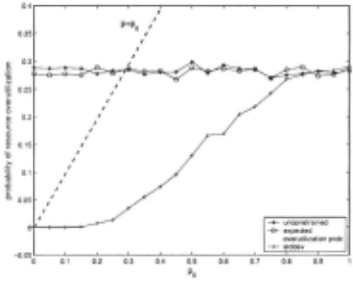
Figure 1 shows a plot of the actual probability of overuti lizing the resources for the policies obtained via the three methods as a function of the probability threshold p0 . The data points are averaged over the runs for a particular value of p0 . The curve that corresponds to the method that bounds the overutilization probability also shows the standard devia tion for the runs. The other data have very similar variance, so we will use the plots of means (averaged over the runs for a given Po) for our analyses.
Obviously, Po has no effect on the unconstrained and the standard CMDP (which maintain more or less a constant probability of overutilization), but it does affect to a large ex tent the solutions to the problem with constraints on overuti lization probability. One can see that the overutilization prob ability for the solutions produced by our approach is always below Po (as it should be). Also, it is worth noting that when Po approaches 1, our approximation yields the same results as the other methods, which is good, since setting p0 = 1 should not constrain the space of feasible solutions.
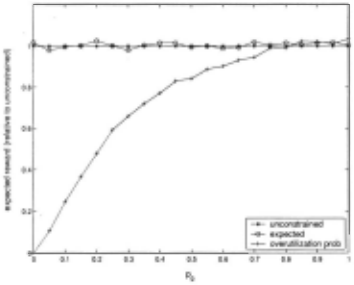
The rewards obtained by these policies are shown in Fig ure 2. These actual rewards do not necessarily equal the ex pected rewards (which are used during the optimization pro cess). This is because only the runs that did not overutilize the resources were included in the average, and policies were not penalized for violating the resource constraints. This also explains why the total rewards received by solutions to the standard CMDPs were sometimes greater than the ones ob tained by solutions to the unconstrained problems.
However, realistically, an agent always incurs a penalty for overutilizing a critical resource, where the penalty amount is based on the consequences of overutilization. For example, if the agent is flying a plane, and the resource in question is fuel, the consequences of trying to use too much of that re source are catastrophic, so the penalty is very high. If we take this into account by assigning a fixed penalty to poli cies that overutilize the resources, we can update the graph in Figure 2 to get a more realistic picture. Figure 3 shows the average rewards for solutions obtained via the three meth ods, recalculated to reflect the penalties: new rewards are R' = (1 - Pou)R + Pou W, where Pou is the overutilization probability, R is the average reward for successful runs of the given policy (as in Figure 2), and W is the penalty for overuti lization. We see that, if we take the penalty into account, there is an interval of p0 where the conservative policy produced by our linear approximation outperforms the other policies.
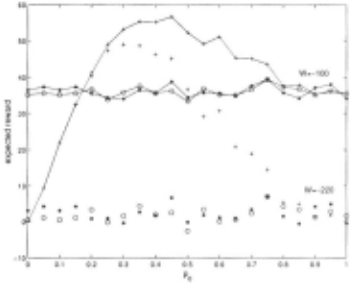
Moreover, for large penalties (W = -220), the conservative policy outperforms the others for all values of PO · Note that here, the policy is re-evaluated post-factum. Section 6 briefly discusses an approach that explicitly models the penalties in the optimization program.
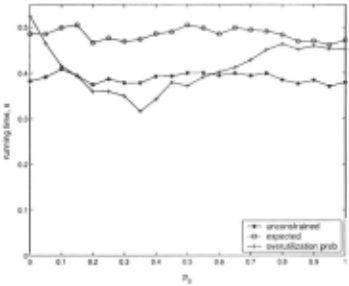
As we mentioned in section 4, the linear approximation should be no harder to solve than the standard constrained MDP, because both are formulated as linear programs with the same number of constraints. To experimentally verify this, we have timed the runs of all our experiments. Figure 4 contains a plot of the times that it took to solve the prob lems in all our experiments. One can see that the running times for all three methods are not appreciably different. 5 Jn particular, the average ratio of the running time for the stan dard CMDP to the running time of the unconstrained method is 1.25; the ratio of the running time of our linear approxi mation with constraints on overutilization probability to the running time of the unconstrained method is 1.06. The slight downward curvature of the plot of the running time of our approximation method appears to be a consequence of the specific implementation of the linear programming algorithm that we used in our experiments.
6 Discussion and Future Work
Our experiments substantiate the claims that our approxima tion provides an effective and efficient method that agents can use to formulate policies that not only consider limita tions on execution resources, but that also explicitly bound the probability of resource overutilization. Our new approxi mation achieves the constraints on overutilization, and is es sentially no more expensive to use than more standard CMDP and unconstrained MDP methods. Because our method con structs policies that are more careful about avoiding resource overutilization, the rewards associated with its policies when resources are not overutilized tend to be less than the re wards for the other methods' policies when resources are not overutilized. However, as we illustrated in Figure 3, when overutilization incurs penalties our new method can outperform previous techniques. Thus, our new method is particu larly suited to agents engaged in mission-critical domains.
5 Here we have to note that we used the linear programming ap proach to solving the unconstrained problem. A different algorithm such as value or policy iteration might be more efficient.
Furthermore, if penalties for resource overutilization are known at design-time and can be expressed in the same units as the rewards, an interesting modification of our LP formu lation is to include the penalties in the policy evaluation cri terion, as opposed to modeling the constraints on the overuti lization probability. This would yield an LP with the follow ing objective function:
where wk is the penalty (in units of '~'ia) incurred for overuti lizing resource k. The maximization is subject to just the standard "conservation of probability" constraints as in (eq. 3). A benefit of this formulation is that, for certain initial probability distributions, deterministic policies are optimal. A downside is that the formulation does not allow one to ex plicitly control the acceptable overutilization probabilities.
As can be seen in Figure 1, our linear approximation is in general overly conservative. For example, given permission to overutilize the resource 20% of the time (p0 = 0.2), the method generates a policy that overutilizes the resource only about 1% of the time. Since rewards and resource usage are typically correlated, we would expect that a policy that under shoots the permitted resource overutilization probability by a lower amount would also yield a higher expected reward. To ward this end, we have formulated a quadratic programming approximation, based on the Chebyshev inequality, which al lows us to put a better upper bound on the probability of re source overutilization:
where 0'~ = VAR[ck] = E[c~]- E [ckf is the variance in the amount of used resource ck , and b.k specify the widths of the allowable regions for the amounts of used resources.
We are also investigating another formulation of the opti mization program that should give a more accurate estimate of the resource overutilization probability. The method is based on a polynomial approximation of the pdf of the to tal resource-usage cost and uses the moments of the cost as the optimization variables. This approximation and the one based on the Chebyshev inequality are more costly to com pute than the linear one. Our current efforts are to encode the approximations and evaluate their strengths and weaknesses.
7 Acknowledgments
This paper is based upon work supported by DARPA/ITO and the Air Force Research Laboratory under contract F3060200-C-OO 17 as a subcontractor through Honeywell Laborato ries. The authors thank Kang Shin, Haksun Li , and David Musliner for their valuable contributions, as well as one of the anonymous reviewers whose comments inspired (eq. 7).
@inproceedings{ijcai2003p158,
  title     = {Approximating Optimal Policies for Agents with Limited Execution Resources},
  author    = {Dolgov, Dmitri A. and Durfee, Edmund H.},
  booktitle = {Proceedings of the Eighteenth International Joint Conference on
               Artificial Intelligence, {IJCAI-03}},
  publisher = {International Joint Conferences on Artificial Intelligence},
  editor    = {Georg Gottlob and Toby Walsh},
  pages     = {1107--1111},
  year      = {2003},
  url       = {https://ijcai.org/proceedings/2003/158},
}
TY - CPAPER TI - Approximating Optimal Policies for Agents with Limited Execution Resources AU - Dolgov, Dmitri A. AU - Durfee, Edmund H. T2 - Proceedings of the Eighteenth International Joint Conference on Artificial Intelligence, IJCAI-03 PB - International Joint Conferences on Artificial Intelligence PY - 2003 SP - 1107 EP - 1111 UR - https://ijcai.org/proceedings/2003/158 ER -Copied
Machine-readable versions of this paper, for tools and AI agents:





