
Describing Additive Fluents in Action Language C+
Proceedings of the Eighteenth International Joint Conference on Artificial Intelligence. Pages 1079-1083.
© 2003 International Joint Conferences on Artificial Intelligence
Abstract
An additive fluent is a fluent with numerical values such that the effect of several concurrently executed actions on it can be computed by adding the effects of the individual actions. We propose a method for describing effects of actions on additive fluents in the declarative language C+. An implementation of this language, called the Causal Calculator, can be used for the automation of examples of commonsense reasoning involving additive fluents.
- [Gelfand and Lifschitz, 1998] Michael Gelfond and Vladimir Lifschitz. Action languages. 3 Electronic Transactions on AI, 3: 195-210, 1998.
- [Giunchiglia and Lifschitz, 1998] Enrico Giunchiglia and Vladimir Lifschitz. An action language based on causal explanation: Preliminary report. In Proc. AAAI-98, pages 623-630. AAAI Press, 1998.
- [Giunchiglia et al., 2003] Enrico Giunchiglia, Joohyung Lee, Vladimir Lifschitz, Norman McCain, and Hudson Turner. Nonmonotonic causal theories. 4 Artificial Intelligence, 2003. To appear.
- [Koehler, 1998] Jana Koehler. Planning under resource con- straints. In Proc. ECA!-98, pages 489-493, 1998.
- [Lifschitz, 2000] Vladimir Lifschitz. Missionaries and can- nibals in the Causal Calculator. In Principles of Knowl- edge Representation and Reasoning: Proc. Seventh Int'l Conf,pages85-96,2000.
- [McCarthy, 1999] John McCarthy. Elaboration tolerance. 5 In progress, 1999.
References were extracted automatically from the PDF and may contain errors.
Full text extracted automatically from the PDF; figures, tables and equations may differ. The PDF is the version of record.
1 Introduction
Action languages [Gelfond and Lifschitz, 1998] serve to de scribe effects of actions on the states of the world. For in stance, the expression
is a proposition, or "causal law," of action language C+ [Giunchiglia et al., 2003] that describes an effect of ac tion Walk(x, l) : this action causes the location of x to be come l. The semantics of action languages is defined in terms of "transition systems"-directed graphs whose ver tices correspond to the states of the world, and whose edges correspond to the execution of actions. The execution of a sequence of actions can be represented by a path in such a graph.
Some action languages, including C+, allow us to talk about the effects of the concurrent execution of ac tions. Causal law (1) is understood in C+ to imply that Location( x) = l holds after any event that involves the exe cution of Walk(x, l), even if other actions are executed con currently. To distinguish the events involving the concurrent execution of actions a1 and a 2 from the events that involve a1 but not a2 , we can write
a1 1\ az causes ... ,
a1 1\ ·az causes ... .
In this paper we investigate the possibility of using C+ to represent the effects of actions on fluents of a special kind, called "additive." An additive fluent is a fluent with numer ical values such that the effect of several concurrently exe cuted actions on it can be computed by adding the effects of the individual actions. For example, the gross receipts of a store are represented by an additive fluent: when several customers pay to different cashiers simultaneously, the gross receipts will increase by the sum of the "contributions" of the individual customers. The voltage of a battery is an addi tive fluent: the increase in voltage obtained by adding several cells to a battery can be computed by addition. In mechan ics, the velocity of a particle is an additive fluent, because the net effect of several forces on this fluent over a time interval equals the sum of the effects of the individual forces. Addi tive fluents are ubiquitous; this may be the reason why adding numbers is such a useful operation.
Unfortunately, the causes construct of C+ and similar lan guages is not directly applicable to describing the effects of actions on additive fluents. Consider, for instance, the effect of the action Buy(x, n) (customer x buys n books) on the number of books available at the bookstore. The causal law
is applicable in the case when no customer other than x is buying books at the same time: k - n books are available after the event if there were k books in the store before the event. But (2) is not acceptable if we are interested in the concurrent execution of such actions.
We introduce here a syntactic construct, increments, that allows us to describe the effects of actions on additive fluents. Semantically this construct is treated as "syntactic sugar" on top of C+: the propositions involving that construct are viewed as abbreviations for causal laws of C+. The interpre tation of increments described below has been used to ex tend the implementation of C+, called the Causal Calculator (CCALC), to cover additive fluents.
After a review of transition systems and of the syntax of C+ in the next two sections, we describe the syntax of increment laws (Section 4), define their semantics by showing how to treat them as abbreviations (Section 5), and illustrate the use of additive fluents in the language of CCALC by formalizing an example that involves buying and selling (Section 6). Two other examples of commonsense reasoning related to addi tive fluents are discussed in Sections 7 and 8. A proposition stated in Section 9 confirms that additive fluents behave as one would expect on the basis of the informal discussion of additivity above, and thus provide a justification for the ap proach to formalizing additive fluents proposed in this paper.
2 Transition Systems
Consider a set of symbols, called constants, along with a non empty finite set of symbols Dom(c) assigned to each con stant c. We call Dom(c) the domain of c.
The constants are divided into two groups-fluent con stants and action constants. Intuitively, a fluent constant rep resents a fluent, and the elements of its domain are the possi ble values of that fluent. A state of the world is characterized by a function that maps each fluent constant to an element of its domain. In [Giunchiglia et al., 2003, Section 4.2], fluent constants are further subdivided into simple and statically de termined; in the examples below, only fluent constants of the first kind will be used.
A function that maps each action constant to an element of its domain characterizes an event occurring over a time interval between two successive states. In many examples of the use of C+ the domain of every action constant is the set of truth values {f, t}; constants with this domain are called Boolean. Intuitively, a Boolean action constant represents an action; the value of such a constant is t if the action is one of those that are executed as part of the event.
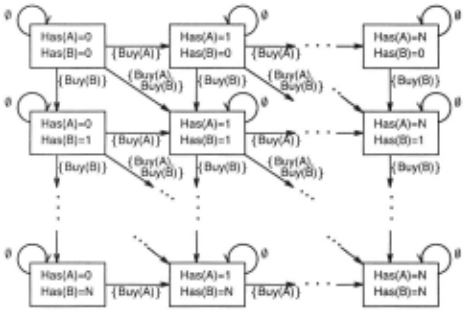
A transition system is a directed graph whose vertices are functions that map every fluent constant to an element of its domain, and whose edges are labeled by functions that map every action constant to an element of its domain. The ver tices of a transition system are called its states. The functions labeling the edges of a transition system are called events. As an example, consider a transition system representing the effect of buying a book on the number of books that the per son owns (Figure 1). It uses two fluent constants-Has(A) (the number of books that Alice has) and Has( B) (the num ber of books that Bob has)-with the domain {0, ... , N}, where N is a fixed nonnegative integer, and two Boolean action constants-Buy(A) (Alice buys a book) and Buy(B) (Bob buys a book). Every state is represented by two equa tions showing the values of the fluent constants. Every event is represented by the set of action constants that are mapped to t. The loops are labeled by the trivial event 0 (no actions are executed). The horizontal edges are labeled by the event in which Alice buys a book and Bob doesn't; along each of the vertical edges, Bob buys a book and Alice doesn't. The diagonal edges correspond to Alice and Bob buying books concurrently.
3 Syntax of C+
The review of the syntax of C+ in this section follows [Giunchiglia et al., 2003, Section 4.2]. An atom is an expres sion of the form c=v, where cis a constant and v E Dom(c). For instance, the equalities in Figure 1 are atoms. A formula is a propositional combination of atoms. By a fluent formula we mean a formula such that all constants occurring in it are fluent constants. An action formula is a formula that contains at least one action constant and no fluent constants.
A static Jaw is an expression of the form
where F and G are fluent formulas. An action dynamic law is an expression of the form (3) in which F is an action formula and G is a formula. A fluent dynamic law is an expression of the form
where F and G are fluent formulas and H is a formula, pro vided that F does not contain statically determined constants. A causa/law is a static law, or an action dynamic law, or a flu ent dynamic law.
Here are two examples. The expression
where x E {A, B} and k E {0, ... , N -1}, is an abbreviation for the fluent dynamic law
(T is the 0-place connective "true"). The expression
is an abbreviation for the fluent dynamic law
(1_ is the 0-place connective "false").
Causal laws (5) and (6) describe an effect of action Buy(x) and a restriction on its executability. To get a complete de scription of Figure 1 in language C+, we need two more pos tulates. First, we should specify that the edge labels of the transition system may assign truth values to the action con stants Buy(x) arbitrarily. This is expressed by
which stands for the pair of action dynamic laws
Action Buy( x) is exogenous in the sense that the action de scription does not determine whether that action is executed. If it is not executed then there is a cause for this; if it is ex ecuted then there is a cause for that too. Second, we need to say that the fluent constant Has( x) satisfies the "common sense law of inertia": in the absence of evidence to the con trary, its value after an event is assumed to be the same as its value before the event. This is expressed by
which stands for N + 1 fluent dynamic laws
(k E {0, ... , N} ). If the value of Has(x) after an event is the same as the value before the event then there is a cause for this. Intuitively, inertia is the cause.
An action description is a set of causal laws. The semantics of C+, described in [Giunchiglia et al., 2003, Section 4.4], specifies the transition system represented by any given ac tion description. For instance, action description (5)-(8) rep resents the transition system shown in Figure 1.
This action description does not say explicitly that the triv ial event 0 has no effect on the values of Has( A) and Has( B), or that event {Buy(A)} does not affect the value of Has(B) . Nevertheless, every edge of the transition system labeled 0 is a loop, and every edge labeled {Buy(A)} is horizontal, be cause of the postulates (8) that express, under the semantics of C+, the persistence property of Has(x) .
Similarly, causal laws (5)-(8) do not say anything about the concurrent execution of actions Buy( A) and Buy( B). But the edges labeled {Buy( A), Buy( B)} in Figure 1 are directed di agonally, in accordance with our commonsense expectations. This fact illustrates the convenience of the approach to con currency incorporated in the semantics of C+.
However, . as discussed in the introduction, this built-in mechanism is not directly applicable to the effects of actions on additive fluents . We are now ready to turn to the main sub ject of this paper-extending C+ with the additional notation that resolves this difficulty.
4 Increment Laws
In our proposed extension of C+, some of the simple fluent constants can be designated as additive. The domain of every additive fluent constant is assumed to be a finite set of num bers. We understand "numbers" as (symbols for) elements of any set with an associative and commutative binary operation + that has a neutral element 0. 1 Effects of actions on additive fluents are described in extended C+ by causal laws of a new kind-"increment laws." Accordingly, we modify the defi nition of a causal law reproduced in Section 3 in two ways. First, in causal laws (3) and (4) formula F is not allowed to contain additive fluent constants. Second, we extend the class of causal laws by including increment Jaws-expressions of the form
where
- a is a Boolean action constant,
- c is an additive fluent constant,
- n is a number, and
- G is a formula that contains no Boolean action constants.
1 The additive group of integers is the main example we are inter ested in, and this is the case that has been implemented. The max operation on an ordered set with the smallest element is another in teresting case.
| Notation: x ranges over {A, B}. Action constants: Buy(x) | Domains: Boolean Domain: |
| Additive fluent constant: InStore | {0, ... ,N} |
| Causal laws: Buy(x) increments InStore by -1 exogenous Buy( x) |
We will drop 'if G' in (9) if GisT. In extended C+, an action description is a set of causal laws that contains finitely many increment laws.
In the next section we define the semantics of extended C+ by describing a translation that eliminates increment laws in favor of additional action constants.
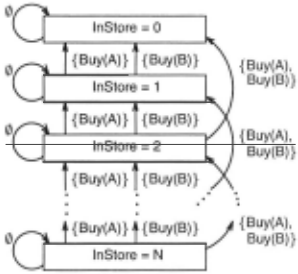
As an example, consider the effects of actions Buy(A), Buy( B) on the number of books available in the bookstore where Alice and Bob are buying books. A description of these effects in extended C+ is shown in Figure 2 (as before, N is a fixed nonnegative integer). The transition system rep resented by the translation of Figure 2 into the non-extended language C+ is depicted in Figure 3 (with the auxiliary action constants dropped from the edge labels). The causal laws in Figure 2 do not say explicitly that the trivial event 0 has no effect on the value of lnStore, or that the concurrent execution of actions Buy(A) and Buy(B) decrements the value of this fluent by 2. Nevertheless, every edge of the corresponding transition system labeled 0 is a loop, and every edge labeled {Buy(A),Buy(B)} goes up 2 levels, in accordance with our commonsense expectations. This happens because Figure 2 classifies lnStore as an additive fluent constant.
The causal laws in this action description do not say explic itly that actions Buy( x) are not executable when InS tore= 0, and that actions Buy( A), Buy( B) cannot be executed concur rently when InStore = 1. This is taken care of by our seman tics of increment laws, in view of the fact that the domain of InStore does not contain negative numbers.
5 Translating Increment Laws
Let D be an action description in extended C+. In connection with the increment laws (9) in D, the following terminology will be used: about the Boolean action constant a, the additive fluent constant c and the number n in (9) we will say that a is a c-conlribuling constant, and that n is a contribution of a to c.
The auxiliary action constants introduced in the translation are expressions of the form Contr( a, c), where c is an additive fluent constant, and a is a c-contributing action constant. The domain of Contr(a, c) consists of all contributions of a to c and number 0.
To translate the increment laws from D, we
- (i) replace each increment law (9) in D with the action dy namic law
- (ii) for every auxiliary constant Contr(a, c), add the action dynamic law
- (iii) add the fluent dynamic laws
for every additive fluent constant c, every v E Dom(c), and every function a H Va that maps each c contributing constant a to an element of the domain of Contr(a, c) so that v + I:a Va is in the domain of c.
The sum and the multiple conjunction in (12) range over all c-contributing constants a.
Causal law (I 0) interprets increment law (9) as the as sertion that executing a (possibly along with other actions) causes constant Contr(a, c) to get the value n, under some conditions characterized by formula G. Causal laws (II) say that the value of this constant is 0 by default, that is to say, when another value is not required by any increment law. Causal laws ( 12) say that the value of an additive fluent con stant after an event can be computed as the sum of the value of this constant prior to the event and the contributions of all actions to this constant.
The result of translating increment laws from Figure 2 is shown in Figure 4. In this case, the translation de scribed above introduces two auxiliary action constants: Contr(Buy(A), lnStore) and Contr(Buy(B),InStore). The domain of each of them has 2 elements: the contribution -1 of Buy(x) to lnStore and numberO.
The edges of the transition system described by Figure 4, and the corresponding events, can be computed using the methods presented in [Giunchiglia et al., 2003, Sections 4.2, 2.6]. (This calculation involves turning the action descrip tion into a definite causal theory and computing the mod els of the completion of this theory.) Every event assigns values to each action constant, including the auxiliary con stants Contr(Buy(x),lnStore). For instance, the label
Notation: x ranges over {A, B}.
| Action constants: Buy(x) Contr(Buy(x), lnStore) | Domains: Boolean {-1,0} |
| Additive fluent constant: InStore exogenous Buy(x) | Domain: {O, ... ,N} |
| Causal laws: caused Contr(Buy(x),InStore) = -1 if Buy(x) =t caused Contr(Buy(x), lnStore) = 0 if Contr(Buy(x) , JnStore)= caused InStore=v+v1 +v2 if T after lnStore=v A Contr(Buy(A), lnStore) = v1 A Contr(Buy(B), InStore) = v2 forallv E {O, ... ,N}andv1 ,v2 E {-1,0} such that v + v1 + vz 2: 0 | |
Figure 4: The result of translating increment laws from Fig ure 2.
in Figure 3 represent the following event E:
The Causal Calculator, which implements C+ with incre ment laws, can be downloaded from
6 Reasoning about Money
As an application of these ideas to automated commonsense reasoning, consider the following example:
I have $6 in my pocket. A newspaper costs $1, and a magazine costs $3. Can I buy 2 newspapers and a magazine? A newspaper and 2 magazines?
These questions are about the executability of some concur rently executed actions, and the answers are determined by the effect of these actions on an additive fluent-the amount of money that I have.
Figure 5 describes the relevant properties of buying and selling in the input language of CCALC. There are objects of four sorts in this domain: agents, resources, items (to be purchased) and (nonnegative) integers; items are a subset of resources. The buyer and the seller are agents; money is a resource; 0, ... , maxlnt are integers. The price of an item is an integer. The number of units of a resource that an agent has is an integer-valued additive fluent. Buying is an exoge nous action. The four causal laws that follow these declara tions are self-explanatory; decrements is an abbreviation defined in terms of increments. The last causal law ex presses that the number of units that are being purchased is uniquely defined.
Figure 6 expresses the first of the two questions stated at the beginning of this section. The line maxstep : : 1 tells CCALC that the query is about paths of length 1 in the transition system. The question is whether the transition sys tem contains an edge that begins in a state in which the buyer
:- sorts agent; resource >> item; nn!nteger. : - variables Ag . . agent; It :: item; : -objects buyer,seller money 0 .. maxint :- constants Res .. resource; M,N .. nninteger. agent; .. resource; . . nninteger. price(item) :: nninteger; has(agent,resource) :: additiveFluent(nninteger); buy(item,nninteger) :: exogenousAction. buy(It,N) increments has(buyer,It) by N. buy(It,N) decrements has(seller,It) by N. buy(It,N) increments has(seller,money) by M*N if price(It)=M where M*N =< maxint. buy(It,N) decrements has(buyer,money) by M*N if price(It)=M where M*N =< maxint. nonexecutable buy(It,M) & buy(It,N) where M\=N.:- objects newspaper,magazine :: item. price(newspaper)=l. price(magazine)=3. : - query max step : : 1; 0: has(buyer,money)=6, buy(newspaper,2), buy(magazine,l).has $6, and whose label includes buying 2 newspapers and 1 magazine. CCALC responds to this query by finding such an edge. 2 Its reply to a similar question about I newspaper and 2 magazines is negative.
7 Reasoning about Motion
Some additive fluents mentioned in the introduction-for in stance, the velocity of a particle-are real-valued, rather than integer-valued. CCALC cannot deal with real numbers yet, and its input language does not allow us to express properties of such fluents.
But let's imagine a movable object that is immune to this complication-the spacecraft Integer. Far away from stars and planets, the Integer is not affected by any external forces. As its proud name suggests, the mass of the spacecraft is an integer. For every integer t, the coordinates and all three com ponents of the Integer's velocity vector at timet are integers; the forces applied to the spacecraft by its jet engines over the interval (t, t + 1), for any integer t , are constant vectors whose components are integers as well. If the crew of the In teger attempts to violate any of these conditions, the jets fail to operate!
2 This example involves the concurrent execution of two actions, but in general the CCALC implementation of additive fluents does not impose any specific restriction on the number of actions that can be executed concurrently.
Our formalization of the motion of the Integer uses the flu ents Pos(a), where a ranges over {X, Y, Z}, to represent the current position of the Integer along the a axis. The additive fluents Vel( a) are the components of its velocity. According to Newton's Second Law, the acceleration created by firing a jet can be computed by dividing the force by the mass of the spacecraft. This relationship can be expressed without men tioning the acceleration explicitly-in terms of the change in the velocity over a unit time interval:
Fire(j) increments Vel( a) by nj Mass if Force(j, a) = n.To test our representation, we instructed CCALC to answer the following question:
The mass of the Integer is 1. The Integer has two jets, and the force that can be applied by each jet along each axis is at most 2. The current position of the Integer is ( -1, 0, 1), and its current velocity is (0, 1, 1). How can it get to (0, 3, 1) within 1 time unit?
One of the solutions found by CCALC is to apply the forces (2, 2, 0) and (0, 2, - 2).
8 Missionaries and Cannibals with Two Boats
In the Missionaries and Cannibals Problem (MCP), three mis sionaries and three cannibals come to a river and find a boat that can hold two people. If the cannibals ever outnumber the missionaries on either bank, the missionaries will be eaten. How shall they cross? The shortest solution involves 11 steps.
Lifschitz [2000] showed how to express this puzzle and some of its elaborations due to McCarthy [1999] in the lan guage of CCALC. Some simple elaborations of MCP in the spirit of this work require that the number of members of a group (missionaries or cannibals) at a given location be treated as an additive fluent. This is the case, for instance, when several boats are available and are allowed to operate concurrently.
Using the ideas of this paper, we formalized the modifica tion of MCP in which the travelers find two boats: a small boat that holds one, and a bigger boat that holds two. Using our formalization, CCALC has determined that the modified problem can be solved in 7 steps.
9 Properties of Additive Constants
By examining Figure 3 in isolation from its symbolic descrip tion in Figure 2 we can see that the constant InStore exhibits some features typical for additive fluent constants.
Consider, for instance, the edges that start at the vertex InStore = 2 and are labeled by the events {Buy(A)} and
{Buy(B)}. Each of them leads to the vertex lnStore = 1, so that each of these two events, when it occurs in the state lnStore = 2, increments the value of lnStore by -1. In accordance with the intuitive idea of an additive fluent, we can expect that the "union" of these events, when it oc curs in the same state, will increment the value of lnStore by ( -1) + ( -1). And this is true, because the edge in Fig ure 3 that starts at the vertex InStore = 2 and is labeled {Buy(A), Buy( B)} leads to the vertex lnStore=O.
Proposition 1 below generalizes this observation to a class of action descriptions in the language C+ extended as de scribed in Sections 4, 5. By D we denote any action descrip tion in this language.
About events e0, e1 , ... ,en (n 2: 0) in the transition system represented by D we say that e0 is a disjoint union of e1 , ... ,en if, for every Boolean action constant a,
- if e0 (a) = t then there exists a unique i > 0 such that e;(a) = t; for this i, e0 (a') = e;(a') for every non Boolean action constant a';
- if e0 (a) =f then, for all i > 0, e;(a) =f.
In the rest of this section we assume that the set of numbers is a commutative group.
Proposition 1 Let c be an additive fluent constant, let s, s0, ... , Sn (n 2: 0) be states, and let eo, ... , en be events such that e0 is a disjoint union of e1 , ... , en. If, for all i E {0, ... , n }, the transition system represented by D con tains an edge that leads from s to s; and is labeled e; then
The special case corresponding to n = 0 tells us that ad ditive fluent constants are not affected by "trivial" events. In this sense, they are similar to the fluent constants for which inertia is postulated:
Corollary 1 Let e be an event such that for every Boolean action constant a, e(a) =f. If the transition system repre sented by D contains an edge that leads from a state s to a state s' and is labeled e then, for any additive fluent con stante, s'(c) = s(c).
The special case corresponding to n = 1 implies that the effects of any set of actions on an additive fluent is determin istic:
Corollary 2 If the transition system represented by D con tains an edge that leads from a state s to a state s0 and is labeled e, and an edge that leads from s to a state s1 and is also labeled e, then, for any additive fluent constant c, so(c) = s1(c).
10 Discussion
In this paper we showed how an implemented, declarative language for describing actions can be used to talk about the effects of actions on additive fluents. This was accom plished by extending the syntax of the action language C+ from [Giunchiglia et al., 2003] by increment laws and by showing how to treat these laws as abbreviations.
It is interesting to note that this treatment of additive fluents would have been impossible if, instead of C+, we used its predecessor C from [Giunchiglia and Lifschitz, 1998]. Non-Boolean, non-exogenous action constants such as Contr( a, c), and action dynamic laws such as (1 0) and (II ) are among the features of C+ that were not available inC.
In literature on planning, fluents with numerical values are often referred to as "resources" [Koehler, 1998]. The concur rent execution of the actions that involve resources is usually limited to the "serializable" case, when all ways of sequenc ing the concurrent actions are well-defined and equivalent. This condition is not satisfied, however, for many uses of ad ditive fluents, including the space travel example (Section 7) and the modified MCP (Section 8). Consider, for instance, the state with two cannibals and three missionaries on the first bank, and imagine that the missionaries are using both boats to cross simultaneously. The concurrent execution of the ac tions cannot be replaced by the larger boat crossing first and the smaller boat crossing after that-in the state between the two actions, the missionaries on the first bank would be out numbered by the cannibals. This example shows that crossing the river in the modified MCP is not serializable.
Acknowledgements
We are grateful to Yuliya Babovich, Jonathan Campbell, Esra Erdem, Selim Erdogan, Paolo Ferraris and Wanwan Ren for useful discussions related to the subject of this paper. This work was partially supported by the National Science Foun dation under Grant IIS-9732744 and by the Texas Higher Ed ucation Coordinating Board under Grant 003658-0322-200 I .
@inproceedings{ijcai2003p154,
  title     = {Describing Additive Fluents in Action Language C+},
  author    = {Lee, Joohyung and Lifschitz, Vladimir},
  booktitle = {Proceedings of the Eighteenth International Joint Conference on
               Artificial Intelligence, {IJCAI-03}},
  publisher = {International Joint Conferences on Artificial Intelligence},
  editor    = {Georg Gottlob and Toby Walsh},
  pages     = {1079--1083},
  year      = {2003},
  url       = {https://ijcai.org/proceedings/2003/154},
}
TY - CPAPER TI - Describing Additive Fluents in Action Language C+ AU - Lee, Joohyung AU - Lifschitz, Vladimir T2 - Proceedings of the Eighteenth International Joint Conference on Artificial Intelligence, IJCAI-03 PB - International Joint Conferences on Artificial Intelligence PY - 2003 SP - 1079 EP - 1083 UR - https://ijcai.org/proceedings/2003/154 ER -Copied
Machine-readable versions of this paper, for tools and AI agents:





