
GRAEL: an agent-based evolutionary computing approach for natural language grammar development
Proceedings of the Eighteenth International Joint Conference on Artificial Intelligence. Pages 823-831.
© 2003 International Joint Conferences on Artificial Intelligence
Abstract
This paper describes an agent-based evolutionary computing technique called GRAEL (Grammar Evolution), that is able to perform different natural language grammar optimization and induction tasks. Two different instantiations of the GRAELenvironment are described in this paper: in GRAEL1 large annotated corpora are used to bootstrap grammatical structure in a society of agents, who engage in a series of communicative attempts, during which they redistribute grammatical information to reflect useful statistics for the task of parsing. In GRAEL-2, agents are allowed to mutate grammatical information, effectively implementing grammar rule discovery in a practical context. A combination of both GRAEL-1 and GRAEL-2 can be shown to provide an interesting all-round optimization for corpus-induced grammars.
- [Antoni sse, 1991] H. James Antonisse. A grammar-based genetic algorithm. In Gregory 1. E. Rawlings, editor, Foundations of genetic algorithms, pages 193-204.
- Mor- gan Kaufmann, San Mateo, 1991 .
- [Araujo, 2002] Lourdes Araujo. A parallel evolutionary algorithm for stochastic natural language parsing. In Proceedings of The Seventh International Conference on Parallel Problem Solving From Nature, pages 700-709, Granada, Spain, 2002. [Batali, 2002]
- Batali. The negotiation and acquisition of recursive grammars as a result of competition among ex- emplars. In Ted Briscoe, editor, Linguistic Evolution through Language Acquisition: Formal and Computa- tional Models, chapter 5. Cambridge University Press, 2002.
- Belz, 200 l
- A. Belz. Optimisation of corpus-derived prob- abilistic grammars. In Proceedings of Corpus Linguistics 2001, pages 46-57, Lancaster University, UK, 2001.
- [Bod, 1998] R. Bod. Beyond Grammar-An Experience- Based Theory of Language. Cambridge University Press, Cambridge, England, 1998.
- [Briscoe, 1998] E. Briscoe. Language as a complex adap- tive system: co-evolution oflanguage and of the language acquisition device. In Proceedings of the 8th Meeting of Camp. Linguistics in the Netherlands, pages pp. 3-40., Amsterdam, 1998. Rodopi.
- [Chappelier and Rajman, 1998] J.-C. Chappelier and M. Ra- jman. A generalized cyk algorithm for parsing stochastic cfg. In Proceedings of Tabulation in Parsing and Deduc- tion (TAPD'98), pages 133-137, Paris (FRANCE), 1998.
- [Charniak, 2000] Eugene Charniak. A maximum-entropy- inspired parser. In Proceedings of NAACL '00, pages 132- 139, Seattle, USA, 2000.
- [Collins, 1999] M. Collins. Head-driven Statistical Models for Natural Language Parsing. PhD thesis, University of Pennsylvania, Pennsylvania, USA, 1999.
- [Collins, 2000] Michael Collins. Discriminative reranking for natural language parsing. In Proc. 17th Interna- tional Conf on Machine Learning, pages 175-182.
- Mor- gan Kaufmann, San Francisco, CA, 2000.
- [De Pauw, 2000] G. De Pauw. Aspects of pattern-matching in dop. In Proceedings of the 18th International Confer- ence on Computational Linguistics, pages 236-242, 2000.
- G. DePauw. An Agent-Based Evolutionary Computing Approach to Memory-Based Syntactic Parsing of Natural Language. PhD thesis, University of Antwerp, Antwerp, Belgium, 2002. [Goodman, 1998]
- Goodman. Parsing Inside-Out. PhD thesis, Harvard University, Massachusetts, USA, 1998. [
- [Henderson and Brill, 2000] Henderson and E. Brill. Bag- ging and boosting a tree bank parser. In Proceedings of the 1st Meeting of the North American Chapter of the Associ- ation for Computational Linguistics (NAACL-2000), pages 34-41' 2000.
- [Kirby, 2001] S. Kirby. Spontaneous evolution of linguistic structure: an iterated learning model of the emergence of regularity and irregularity. IEEE Transactions on Evolu- tionary Computation, 5(2): 102-110, 2001.
- [Klein and Manning, 2001] Dan Klein and Christopher D. Manning. Parsing with treebank grammars: Empirical bounds, theoretical models, and the structure of the penn treebank. In Prodeedings of ACL-EACL 2001, pages 330- 337,2001.
- [Losee, 1995] R.M. Losee. Learning syntactic rules and tags with genetic algorithms for information retrieval and filter- ing: An empirical basis for grammatical rules. Information Processing and Management, 32(2): 185-197, 1995.
- [Marcus et a!., 1993] M. P. Marcus, B. Santorini, and M.A. Marcinkiewicz. Building a large annotated corpus of english: the penn treebank. Computational linguistics, 19:313-330, 1993. Reprinted in Susan Armstrong, ed. 1994, Using large corpora, Cambridge, MA: MIT Press, 273-290.
- [Smith and Witten, 1996] T. C. Smith and I. H. Witten. Learning language using genetic algorithms. In Stefan Wermter, Ellen Riloff, and Gabriele Scheler, editors, Con- nectionist, Statistical, and Symbolic Approaches to Learn- ing for Natural Language Processing, volume 1040 of LNAI, pages 132-145. Springer Verlag, Berlin, 1996.
- [Wyard, 1991] P. Wyard. Context-free grammar induction using genetic algorithms. In R. Belew and L.B. Booker, editors, Proceedings of the Fourth International Confer- ence on Genetic Algorithms, pages 514-518, San Mateo, 1991 .
- ICGA, Morgan Kaufmann.
References were extracted automatically from the PDF and may contain errors.
Full text extracted automatically from the PDF; figures, tables and equations may differ. The PDF is the version of record.
1 Introduction
Evolutionary computing has seen many interesting applica tions on a broad range of research domains over the years. Its ability to overcome the problem of local maxima in finding a solution to a particular problem, by recombining and mu tating individuals in a society of possible solutions, has made it an attractive technique for problems involving large, com plicated and non-linearly divisible search spaces. The evo lutionary computing paradigm has however always seemed reluctant to deal with natural language syntax, probably be cause it is essentially a recursive, non-propositional system, dealing with complex issues such as long-distance dependen cies and constraints. This has made it difficult to incorporate it in typically propositional evolutionary systems such as ge netic algorithms.
A limited amount of GA-related syntactic research has fo cused on linguistic data [Smith and Witten, 1996; Wyard, 1991; Antonisse, 1991; Araujo, 2002], but none of these sys tems are suited to a generic (treebank) grammar optimization task, mainly because the grammatical formalism and evo lutionary processes underlying these systems are designed to fit a particular task, such as information retrieval [Losee, 1995]. Other work on syntax in the evolutionary comput ing paradigm has either been involved in studying the origins of grammar in a computational context [Batali, 2002; Kirby, 2001] or the co-ordinated co-evolution of grammatical principles [Briscoe, 1998]. Yet so far, little or no progress has been achieved in evaluating evolutionary computing as a tool for the induction or optimization of data-driven parsing techniques.
The GRAEL 1 environment provides a suitable framework for the induction and optimization of any type of grammar for natural language in an evolutionary setting. In this pa per we hope to provide an overview of GRAEL as a grammar optimization and induction technique. We will first outline the basic architecture of the GRAEL environment in Section 2 on the basis of a toy example. Next, we introduce GRAEL1 (Section 3) as a grammar optimization technique that can enhance corpus-induce grammars. By adding an element of mutation in GRAEL-2 we implement a method to extend the coverage of a corpus-induced grammar. We will also describe a combination of both GRAEL-1 and GRAEL-2 which can be shown to provide an interesting all-round optimization tech nique for corpus-induced grammars.
2 GRAEL - Grammar Evolution
A typical GRAEL society contains a population of agents in a virtual environment. Each of these agents holds a number of structures that allows it to produce sentences as well as induce a probabilistic grammar to analyze other agents' sen tences. During an extended series of error-driven inter-agent interactions, these grammars are updated over time. While the evolutionary computing approach ofGRAEL is able to de fine the quality of the grammars that are developed over time, the agent-based aspect of GRAEL ensures that the grammar optimization is grounded in the practical task of parsing it self. From an engineering point of view, GRAEL provides a general framework for grammar optimization and induction, but from a more theoretical point of view, GRAEL can also help us to understand the dynamics of grammar emergence and evolution over time.
In the data-driven GRAEL experiments described in this pa per, the grammatical knowledge of the agents in the society is bootstrapped by using an annotated natural language cor pus [Marcus et a/., 1993]. At the onset of such a data-driven GRAEL society, the syntactic structures of a treebank are ran domly distributed over the agents, so that each agent holds a number of tree-structures in memory. These structures enable them to generate sentences, as well as provide grammars that allow them to analyze other agents' sentences.
1 GRAmmar EvoLution
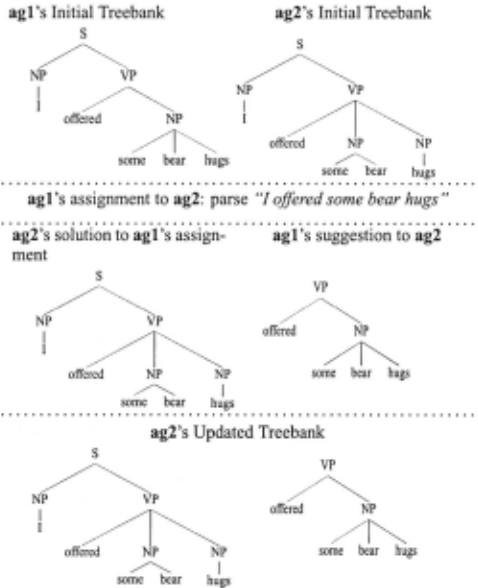
The actual interaction between agents is implemented in language games: an agent (agl) presents a sentence to an other agent (ag2). If ag2 is able to correctly parse agl 's sen tence, the communication is successful. If on the other hand, ag2 is lacking the proper grammatical information to parse the sentence correctly, agl shares the necessary information for ag2 to arrive at the proper solution.
Figure 1 displays a toy example of such a language game. In this example, a "treebank" of two structures has been dis tributed over a society of two agents. The two agents engage in a language game, in which agl presents the sentence "I offered some bear hugs" to ag2 for parsing. At this point in time, ag2 's grammar does not contain the proper grammatical information to interpret this sentence the way agl intended and so ag2 will return an incorrect parse, even though it is consistent with its own grammar.
Consequently, agl will try and help ag2 out by reveal ing the minimal correct substructure of the correct parse that should enable ag2 to arrive at a better solution. This informa tion is incorporated in ag2 's grammar, who will try to parse the sentence again with the updated knowledge. When ag2 is able to provide the correct analysis (or is not able to after a certain number of attempts) either agl 's next sentence will be parsed, or two other agents in the GRAEL society will be randomly selected to play a language game.
These interactions, which introduce a concept of error driven knowledge sharing, extend the agents' grammars fast, so that the datasets can grow very large in a short period of time. A generation-based GRAEL society can be used to al low the society to purge itself of bad agents and build new generations of good parser agents, who contain a fortuitous distribution of grammatical knowledge. This involves the use of fitness functions that can distinguish good agents from bad ones. For a full overview of all the evolutionary parameters in the GRAEL environment, many of which have a significant impact on processing, we would like to refer to [De Pauw, 2002]. In this paper, we will describe the most relevant subset of experiments that allows us to evaluate GRAEL as a gram mar induction and optimization technique.
3 GRAEL-1: Probabilistic Grammar Optimization
Historically, most syntactic parsers for natural language have made use of hand-written grammars, consisting of a labo riously crafted set of grammar rules. But in recent years, a lot of research efforts employ annotated corpora to au tomatically induce grammars [Bod, 1998; Collins, 1999; De Pauw, 2000]. Yet, data-analysis of the output gener ated by these parsers still brings to light fundamental limi tations to these corpus-based methods [Klein and Manning, 2001]. Even though generally providing a much broader cov erage than hand-built grammars, corpus-induced grammars may still not hold enough grammatical information to pro vide parses for a large number of sentences, as some rules that are needed to generate the correct tree-structures are not induced from the original corpus ( cf. Section 4 ).
But even if there were such a thing as a full-coverage corpus-induced grammar, perfommnce would still be limited by the probabilistic weights attributed to its rules. A typi cal data-driven parser provides a huge collection of possible parses for any given sentence. Fortunately, we can also in duce useful statistics from the annotated corpus that provides a way to order these parse forests to express a preference for a particular parse. These statistics go a long way in provid ing well ordered parse forests, but in many other cases, it can be observed that the ranking of the parse forest is sometimes counter-intuitive in that correct constructs are often overtaken by obviously erroneous, but highly frequent structures.
This can easily be explained by the inherent nature of corpus-based grammars: the initial probabilistic values at tached to the grammar rules induced from the annotated data are equal to their relative frequency in the corpus. It might be the case however that, even though they are directly induced from the annotated corpus, the probabilities of these rules are not suited to the disambiguation task as yet. It may therefore be useful to have the parser use the grammar to practice the task of parsing and adjust the probabilistic weights of partic ular structures according to these test cases. We then need to consider the initial grammar as basic raw material in need of optimization, as it is merely a reflection of the original data set and is not yet optimized for the task of parsing (unseen)
sentences itself.
Typical methods of probabilistic grammar opt1m1zation include, among others, bagging and boosting [Henderson and Brill, 2000; Collins, 2000], re-estimation of the con stituents probabilities [Goodman, 1998; Chamiak, 2000] and including extra information sources [Belz, 2001; Collins, 1999]. But we propose an agent-based evolutionary comput ing method to resolve this issue. Grammar optimization us ing a GRAEL environment is in this vein related to the afore mentioned bagging approach to grammar optimization, albeit with some notable differences. By distributing the knowl edge over a group of agents and having them interact with each other, we basically create a multiple-route model for probabilistic grammar optimization. Grammatical structures extracted from the training corpus, will be present in differ ent quantities and variations throughout the GRAEL society. While the agents interact with each other and in effect prac tice the task on each other's grammar, a varied range of prob abilistic grammars are optimized in a situation that directly relates to the task at hand. The evolutionary aspects of the system make sure that, while marginally useful grammatical information is down-toned, common constructs are enforced, providing a better balanced model for statistical parsing.
The way GRAEL accomplishes a re-distribution of the orig inal probabilistic values is by using the default GRAEL archi tecture described in Section 2. This type of error-driven learn ing makes sure that mistakes are being dealt with by transfer ring difficult grammatical constructs, thereby increasing their probabilistic value in the other agent's grammar. This prob abilistic adjustment will be taken into account during subse quent parsing attempts by this agent, hopefully triggering the correct grammatical structure in the future.
3.1 Experimental Setup
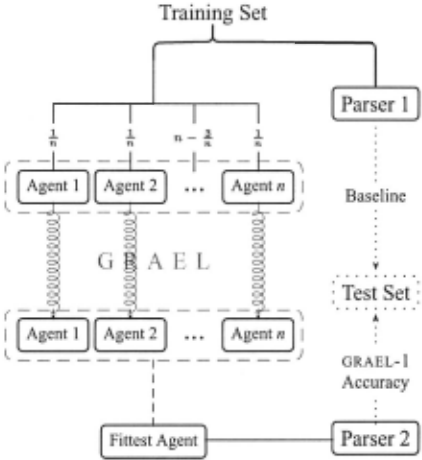
The overall setup of the GRAEL experiments is displayed in Figure 2. Baseline accuracy is measured by directly induc ing a grammar from the training set to power Parser 1, which disambiguates the test set. This grammar takes on the form of a PMPG as outlined in [De Pauw, 2000] (cf. infra). The same training set is also randomly and equally distributed over a number of agents in the GRAEL society, who will con sequently engage in a number of language games. At some point, established by the halting procedure ( cf. infra), the so ciety is halted and the fittest agent is selected from the society. This agent effectively constitutes a redistributed and proba bilistically optimized grammar, which can be used to power Parser 2. GRAEL-1 accuracy is achieved by having this parser disambiguate the same test set.
We used two data sets from the Penn Treebank [Marcus et a/., 1993]. The main batch of experiments was conducted on the small, homogeneous ATIS-corpus, which consists of a collection of annotated sentences recorded by a spoken dialogue system. The larger Wall Street Journal Corpus (henceforth WSJ), a collection of annotated newspaper arti cles, was used to test the system on a larger scale corpus. The common division between training set (Section 02-21) and test set (Section 23) was used. Semantically oriented flags and numeric flags indicating internal relations were removed to allow for more streamlined syntactic processing.
For syntactic processing, the agents use the parsing sys tem PMPG described in [De Pauw, 2000], which integrates a CKY parser [Chappelier and Rajman, 1998] and a parse forest ranking scheme that employs probabilistic information as well as a memory-based operator to maximize for each parse the number of nodes that can be retrieved from mem ory. A PMPG takes the form of a simple PCFG-type gram mar, enriched with numerical indices that encode contextual information previously observed in a tree bank. This memory based instantiation of Data-Oriented Parsing [Bod, 1998] en sures that larger syntactic structures are used as the basis for parsing, with a minimal loss of computational efficiency over regular PCFGs. The PMPG approach can therefore be con sidered to introduce a psycho-linguistically relevant memory based operator in the parsing process.
The full experimental run varied society sizes, generation methods, fitness functions and halting procedures [De Pauw, 2002]. The subset of experiments described in this paper em ployed the sexual procreation method to introduce new gen erations by combining the grammars of two fit agents in the society to create new generations of parser agents. The fitness of an agent is defined by recording a weighted average of the F-score during inter-agent communication (also see Figure 3) and the F-score of the agent's parser on a held-out validation set. This information was also used to try and halt the so ciety at a global maximum and select the fittest agent from the society. For computational reasons, the experiments on the WSJ-corpus were limited to two different population sizes and used an approximation of G RAEL that can deal with large datasets in a reasonable amount of time. The test set was not used in any way during actual GRAEL-processing in agree ment with blind-testing procedures.
3.2 Results
Table 1 displays the exact match accuracy and F-scores for the baseline model, a standard PMPG parser using a grammar induced from the training set (cf. Figure 2). It also displays scores of the GRAEL system for different population sizes. We notice a significant gain for all GRAEL models over the baseline model on the ATIS corpus, but increasing population size over 20 agents seems to decrease exact match accuracy on the ATIS corpus. Likewise, the small society of 5 agents achieves only a very limited improvement over the baseline method. Data analysis showed that the best moment to halt the society and select the fittest agent from the society, is a relatively brief period right before actual convergence sets and grammars throughout the society are starting to resem ble each other more closely. The size of the the society seems to be the determining factor controlling the duration of this period.
Preliminary tests on a subset of the WSJ corpus had shown that society sizes of 20 agents and less to be unsuitable for a large-scale corpus, again ending up in a harmful premature convergence. The gain achieved by the GRAEL society is less spectacular than on the ATIS corpus, but it is still statistically significant. Larger society sizes and full GRAEL processing on the WSJ corpus should achieve a more significant gain.
The experiments do show however, that GRAEL-1 is in deed an interesting method for probabilistic grammar redis tribution and optimization. Data analysis shows that many of the counter-intuitive parse forest orderings that were appar ent in the baseline model, are being resolved after GRAEL1 processing. It is also interesting to point out that we are achieving an error reduction rate of more than 26% over the baseline method, without introducing any new grammatical information in the society, but solely by redistributing what is already there. These experimental results indicate that anno tated data can indeed be considered as raw material that can be optimized for the practical use of parsing unseen data.
[De Pauw, 2002] also describes experiments that directly compare GRAEL to the similar methods of bagging and boost ing [Henderson and Brill, 2000], which are summarized in the bottom two lines of Table 1. Bagging and boosting were shown to obtain significantly lower accuracy figures on al most all accounts. Only the F-score for the bagging experi ment exceeded that of the optimal GRAEL configuration, but this can be attributed to the fact that an approximation of GRAEL was used for full processing on the extensive WSJ
| A TIS | WSJ | |||
|---|---|---|---|---|
| Exact Match | F /3=1-score | Exact Match | F /3=1-score | |
| Baseline | 70.7 | 89.3 | 16.0 | 80.5 |
| GRAEL (5) | 72.4 | 90.9 | - | - |
| GRAEL (10) | 77.6 | 92.1 | - | - |
| GRAEL (20) | 77.6 | 92.1 | - | - |
| GRAEL (50) | 75.9 | 92.2 | 22.2 | 80.7 |
| GRAEL (100) | 75.9 | 92.0 | 22.8 | 81.1 |
| bagging ( l 5) | 75.9 | 91.8 | 20 0 | 81.4 |
| boosting ( 15) | 75.9 | 91.7 | 21.0 | 81.0 |
dataset.
4 GRAEL-2: Grammar Rule Discovery
The functionality ofGRAEL-1 can be extended by only apply ing minor alterations to the GRAEL system. With GRAEL-2 we wish to provide a grammar rule discovery method which can deal with the problem of grammar sparseness. Hand written and corpus-induced grammars alike have to deal with the fundamental issue of coverage. [Collins, 1999] for exam ple reports that when using sections 2-21 of the WSJ-corpus as a training set and section 23 as a test set, 17.1% of the sen tences in the test set require a rule not seen in the training set. Even for a large corpus such as the WSJ, sparse grammar is indeed a serious accuracy bottleneck.
It would therefore be useful to have a method that can take a corpus-induced grammar and extend it by generating new rules. But doing so in a blind manner, would provide huge, over-generating grammars, containing many nonsensi cal rules. The GRAEL-2 system described in this section, in volves a distributed approach to this type of grammar rule dis covery. The original (sparse) grammar is distributed among a group of agents, who can randomly mutate the grammatical structures they hold. The new grammatical information they create is tried and tested by interacting with each other. The neo-darwinist aspect of this evolutionary system will make sure that any useful mutated grammatical information is re tained throughout the population, while noise is filtered out over time. This method provides a way to create new gram matical structures previously unavailable in the corpus, while at the same time evaluating them in a practical context, with out the need for an external information source.
To accomplish this, we need to implement some minor al terations to the GRAEL-1 system. The most important adjust ment occurs during the language games. We refer back to the toy example of the language game in Figure 1 to the point where agl suggests the minimal correct substructure to ag2. In GRAEL-1 this step introduced a form of error-driven learn ing, making sure that the probabilistic value of this grammati cal structure is increased. The functionality ofGRAEL-2 how ever is different: in this step, we assume that there is a noisy channel between agl and ag2 which may cause ag2 to misun derstand agl 's structure. Small mutations on different levels of the substructure may occur, such as the deletion, addition and replacement of nodes. This effectively introduces previ ously unseen grammatical data in the GRAEL society, which will consequently be optimized over time.
| (~~~Match | I~~~ | |||
|---|---|---|---|---|
| II F/3=1 | II F/3=1 | Match | ||
| Baseline | 69.8 | 0 | 80.5 | 16 |
| grael-1 | 73.8 | 0 | 81.4 | 22.8 |
| grael-2 | 83.0 | 7.2 | 76.5 | 19.3 |
| grael2+1 | 85.7 | 11.3 | 81.6 | 23.4 |
Preliminary experiments however showed that this does not work as such, since the newly created structures were largely being ignored in favor of the gold-standard corpus structures. We therefore implemented another alteration to the GRAEL-1 system. Instead of just presenting the tree-structure originally assigned by the training set, we now require agl to parse the string-only sentence using the grammar acquired during lan guage games, replacing the tree-structure from the training set, with a possibly different tree-structure that incorporates some of the mutated information. This alteration makes sure that the mutated grammatical structures are actively being used, so that their usefulness as grammatical constructs can be measured in a practical context.
Experimental Setup and Results
The setup for the GRAEL-2 experiments is the same as for the GRAEL-1 experiments (cf. Figure 2). To test the grammar rule discovery capabilities of GRAEL-2 we have compiled a special worst-case scenario test set for the ATIS corpus, con sisting of the 97 sentences in the ATIS that require a grammar rule that cannot be induced from the training set. For the WSJ-experiment the normal test set was used. A 20-agent and a 100-agent society were respectively used for the ATIS and WSJ experiments.
The baseline and GRAEL-1 methods for the ATIS experi ments trivially have an exact match accuracy of 0%, which also has a negative effect on the F-score (Table 2). GRAEL-2 is indeed able to improve on this significantly, proving that it is indeed an effective grammar rule discovery method. Data analysis shows however that it has lost the beneficial proba bilistic optimization effect of GRAEL-1.
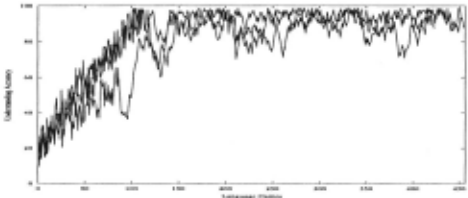
We therefore performed another experiment, in which we turned the GRAEL-2 society into a GRAEL-1 society after the former's halting point. In other words: we take a society of agents using mutated information and consequently ap ply GRAEL-1 's probabilistic redistribution properties on these grammars. Figure 3 shows the course of the GRAEL2+ 1 ex periment. In this figure we see the F-scores recorded during inter-agent communicative attempts. After an almost linear increase during GRAEL-2 processing, the society is halted af ter an extended period of convergence. Next, GRAEL-1 pro cessing resumes, which negatively affects F-scores for a brief period of time, until the society reconverges. Even though the F-scores do not seem to improve over those observed before the transition to GRAEL-1, Table 2 shows that the fittest agent selected from the society after the transition performs better on the held-out test set. The results on the WSJ-corpus are also interesting in this respect. GRAEL-1 outperforms GRAEL-2 on this data set, but the combination of the two seems to be quite beneficial for parsing accuracy.
Evaluating a grammar rule discovery method poses an em pirical problem in that it can never be clear what grammar rules are missing until we actually need them. The test set we compiled to perform the GRAEL-2 ATIS-experiments goes a long way in providing a touchstone to see how well GRAEL2 performs as a supervised grammar induction method. And results indicate it performs quite well: mutated information becomes available that is able to create parses for difficult constructions, while the number of structures that constitute noise is limited and is attributed a small enough portion of the probability mass as not to stand in the way of actual use ful mutated structures.
5 Concluding Remarks
This paper has presented one of the first research efforts that introduces agent-based evolutionary computing as a machine learning method for data-driven grammar optimization and induction. In recent years, many researchers have employed ensemble methods to overcome any negative bias their train ing data might impose on their classifiers. It is indeed im portant to view (annotated) data, not as an optimally dis tributed set of examples but as raw material that needs to be pre-processed before it can be used by a machine learning classifier. The bagging and boosting approach for instance, tries to create resamplings of the original data, to overcome the local maxima the data might restrict the classifier to, but we believe G RAEL adds an extra dimension to the task: by splicing the data and incorporating it in a society of commu nicating agents, we allow for the parallel development of sev eral grammars at once, enhanced in a practical context that mirrors the goal itself: parsing unseen data.
We described two instantiations of the GRAEL environ ment. The basic GRAEL-1 system aims to provide a beneficial re-distribution of the probability mass of a probabilistic gram mar. By using a form of error-driven learning in the course of language games between agents, probabilistic values are adjusted in a practical context. This optimizes the grammars for the task of parsing data, rather than reflecting the prob ability mass of the initial data set. This method favorably compares to established grammar optimization methods like bagging and boosting.
By adding an element of mutation to the concept of GRAEL-1 we were able to extend its functionality and ex periment on GRAEL-2 as a grammar rule discovery method. The results showed that GRAEL-2 could produce a broader coverage grammar, but that GRAEL-1 's ability to optimize the distribution of the probability mass of a grammar was coun teracted. A grammar obtained from a GRAEL-2 society is therefore unsuited to be directly applied to parsing. But com bining it again with a GRAEL-1 society however, goes a long way in resolving this issue, providing a grammar that has a broader coverage, as well as a better tuned probability mass distribution over the structures contained therein. We there fore believe the combination of GRAEL-2 and GRAEL-1 to be an interesting optimization toolkit for any given grammar, and corpus-induced grammars in particular. It can achieve a significant optimization over the baseline method, without using an external information source, simply on the basis of knowledge transfer and mutation in a practical and evolution ary context.
Acknowledgments
The research described in this paper was financed by the FWO (Fund for Scientific Research) .
@inproceedings{ijcai2003p119,
  title     = {GRAEL: an agent-based evolutionary computing approach for natural language grammar development},
  author    = {De Pauw, Guy},
  booktitle = {Proceedings of the Eighteenth International Joint Conference on
               Artificial Intelligence, {IJCAI-03}},
  publisher = {International Joint Conferences on Artificial Intelligence},
  editor    = {Georg Gottlob and Toby Walsh},
  pages     = {823--831},
  year      = {2003},
  url       = {https://ijcai.org/proceedings/2003/119},
}
TY - CPAPER TI - GRAEL: an agent-based evolutionary computing approach for natural language grammar development AU - De Pauw, Guy T2 - Proceedings of the Eighteenth International Joint Conference on Artificial Intelligence, IJCAI-03 PB - International Joint Conferences on Artificial Intelligence PY - 2003 SP - 823 EP - 831 UR - https://ijcai.org/proceedings/2003/119 ER -Copied
Machine-readable versions of this paper, for tools and AI agents:





