
Simultaneous Adversarial Multi-Robot Learning
Proceedings of the Eighteenth International Joint Conference on Artificial Intelligence. Pages 699-703.
© 2003 International Joint Conferences on Artificial Intelligence
Abstract
Multi-robot learning faces all of the challenges of robot learning with all of the challenges of multiagent learning. There has been a great deal of recent research on multiagent reinforcement learning in stochastic games, which is the intuitive extension of MDPs to multiple agents. This recent work, although general, has only been applied to small games with at most hundreds of states. On the other hand robot tasks have continuous, and often complex, state and action spaces. Robot le~rn ing tasks demand approximation and generahzation techniques, which have only received extensive attention in single-agent learning. In this paper we introduce GraWoLF, a general-purpose, scalable multiagent learning algorithm. It combines gradient-based policy learning techniques with the WoLF ("Win or Learn Fast") variable learning rate. We apply this algorithm to an adversarial multirobot task with simultaneous learning. We show results of learning both in simulation and on the real robots. These results demonstrate that GraWoLF can learn successful policies, overcoming the many challenges in multi-robot learning.
- [Baxter and Bartlett, 2000] Johnathan Baxter and Peter L. Bartlett. Reinforcement learning in POMDP's via direct gradient ascent. In Proceedings of the Seventeenth Inter- national Conference on Machine Learning, pages 41-48, Stanford University, June 2000.
- Morgan Kaufman. [Bowling and Veloso, 2002a] Michael Bowling and Manuela Veloso. Multiagent learning using a vari- able learning rate. Artificial Intelligence, 136:215-250, 2002.
- [Bowling and Veloso, 2002b] Michael Bowling and Manuela M. Veloso. Existence of multiagent equilibria with limited agents. Technical report CMU-CS-02- 1 04, Computer Science Department, Carnegie Mellon University, 2002.
- [Claus and Boutilier, 1998] Caroline Claus and Craig Boutilier. The dynamics of reinforcement learning in cooperative multiagent systems. In Proceedings of the Fifteenth National Conference on Artificial Intelligence, Menlo Park, CA, 1998. AAAI Press.
- [Greenwald and Hall, 2002] Amy Greenwald and Keith Hall. Correlated Q-learning. In Proceedings of the AAAI Spring Symposium Workshop on Collaborative Learning Agents, 2002.
- [Littman, 1994] Michael L. Littman. Markov games as a framework for multi-agent reinforcement learning. In Pro- ceedings of the Eleventh International Conference on Ma- chine Learning, pages 157-163.
- Morgan Kaufman, 1994.
- [Nash, Jr., 1950] John F. Nash, Jr. Equilibrium points in n- person games. PNAS, 36:48-49, 1950.
- [Singh eta!. , 2000] Satinder Singh, Michael Kearns, and Yishay Mansour. Nash convergence of gradient dynam- ics in general-sum games. In Proceedings of the Sixteenth Conference on Uncertainty in Artificial Intelligence, pages 541-548.
- Morgan Kaufman, 2000.
- [Sutton and Barto, 1998] RichardS. Sutton and Andrew G. Barto. Reinforcement Learning. MIT Press, 1998.
- [Sutton eta!. , 2000] Richard S. Sutton, David McAllester, Satinder Singh, and Yishay Mansour. Policy gradient methods for reinforcement learning with function approx- imation. In Advances in Neural Information Processing Systems I2, pages 1057-1063. MIT Press, 2000.
- [Williams, 1992] R. Williams. Simple statistical gradi- ent following algorithms for connectionisht reinforcement learning. Machine Learning, 8:229-256, 1992.
References were extracted automatically from the PDF and may contain errors.
Full text extracted automatically from the PDF; figures, tables and equations may differ. The PDF is the version of record.
1 Introduction
Multi-robot learning is the challenge of learning to act in an environment containing other robots. These other robots, though, have their own goals and may be learning as well. Other adapting robots make the environment ~~ long~r sta tionary, violating the Markov property that tr~ditional sm~le agent behavior learning relies upon. . Multi-robot le~rnmg combines all of these multiagent learnmg challenges with the problems of learning in robots, such as continuous state and action spaces and minimal training data.
A great deal of recent work on multiagent learn ing has looked at the problem of learning in st?chastic games [Littman, 1994; Singh et a!., 2000; Bow~mg and Veloso, 2002a; Greenwald and Hall, 2002]. Stochastic games are a natural extension of Markov decision processes (MDPs) to multiple agents and have been well studied in the field of game theory. The traditional sol~tion co~~ept. for the prob lem of simultaneously finding optimal pohcies IS that of Nash equilibria. An equilibrium is simply a policy for all of the players where each is playing optimally with respect to the others. This concept is a powerful solution for these games even in a learning context, since no agent could learn a better policy when all the agents are playing an equilibrium.
Multiagent learning in stochastic games, thus far, has o~ly been applied to small games with enumerable stat.e and act10n spaces. Robot learning tasks though have contmuous state and action spaces, and typically with more than just a couple dimensions. Discretizations of this space into an enumerable state set also do not typically perform well. In addition, data is considerably more costly to gather, and millions of training runs to learn policies is not feasible. Typical solutions to this robot learning problem is to use approximation to make the learning tractable and generalization for more efficient use of training experience.
In this paper we introduce a new algorithm, GraWoLF 1 , that combines approximation and generalization techniques with the WoLF multiagent learning technique. We show em pirical results of applying this algorithm to a problem ?f si multaneous learning in an adversarial robot task. In Section 2, we give a brief overview of key concepts from ~ultiagent learning along with the the formal model of stochastic games. In Section 3, we describe a particular adversarial robot task and its challenges for learning. In Section 4, we present the main components of GraWoLF: policy gradient ascent and the WoLF variable learning rate. In Section 5, we present experimental results of applying this algorithm to our adver sarial robot task, and then conclude.
2 Multiagent Learning
Multiagent learning has focused on the game theor~tic frame work of stochastic games. A stochastic game IS a tuple (n, S, A1...n, T, Rl...n), where n_is the n~mberofagent~, Sis a set of states Ai is the set of act10ns available to agent l (and A is the joint action space A1 x . .. x An), T is a transition functionS x Ax S ~ [0, 1], and Ri is a reward function for the ith agentS x A ~ ~. This looks very similar t.o the ~DP framework except we have multiple agents selectmg act10ns and the next state and rewards depend on the joint action of the agents. Another important difference is that each agent has its own separate reward function. The goal for each agent is to select actions in order to maximize its discounted future rewards with discount factor I·
1 GraWoLF is short for "Gradient-based Win or Learn Fast", and the 'a' has the same sound as in "gradient".
Stochastic games are a very natural extension of MDPs to multiple agents. They are also an extension of matrix games to multiple states. Each state in a stochastic game can be viewed as a matrix game with the payoffs for each joint action determined by the matrices R; ( s, a). After playing the matrix game and receiving their payoffs the players are transitioned to another state (or matrix game) determined by their joint action. We can see that stochastic games then contain both MDPs and matrix games as subsets of the framework.
Stochastic Policies. Unlike in single-agent settings, deter ministic policies in multiagent settings can often be exploited by the other agents. Consider the children's game rock-paper scissors. If one player were to play any action determinis tically, the other player could win every time by selecting the action that de(eats it. This fact requires the considera tion of mixed strategies and stochastic policies. A stochastic policy, 1r : S ---> P D(A;), is a function that maps states to mixed strategies, which are probability distributions over the player's actions. We later show that stochastic policies are also useful for gradient-based learning techniques.
Nash Equilibria. Even with the concept of stochastic poli cies there are still no optimal policies that are independent of the other players' policies. We can, though, define a notion of best-response. A policy is a best-response to the other play ers' policies if it is optimal given their policies. The major ad vancement that has driven much of the development of matrix games, game theory, and even stochastic games is the notion of a best-response equilibrium, or Nash equilibrium [Nash, Jr., 1950].
A Nash equilibrium is a collection of strategies for each of the players such that each player's strategy is a best-response to the other players' strategies. So, no player can do bet ter by changing strategies given that the other players also don't change strategies. What makes the notion of equilib rium compelling is that all matrix games and stochastic games have such an equilibrium, possibly having multiple equilib ria. Zero-sum, two-player games, like the adversarial task explored in this paper, have a single Nash equilibrium. 2
Learning in Stochastic Games. Stochastic games have been the focus of recent research in the area of reinforcement learning. There are two different approaches being explored. The first is that of algorithms that explicitly learn equilibria through experience, independent of the other players' policy, e.g., [Littman, 1994; Greenwald and Hall, 2002]. These al gorithms iteratively estimate value functions, and use them to compute an equilibrium for the game. A second approach is that of best-response learners, e.g., [Claus and Boutilier, 1998; Singh eta/., 2000; Bowling and Veloso, 2002a]. These learners explicitly optimize their reward with respect to the other players' possibly changing policies. This approach, too, has a strong connection to equilibria. If these algorithms con verge when playing each other, then they must do so to an equilibrium [Bowling and Veloso, 2002a].
2 There can actually be multiple equilibria, but they all have equal payoffs and are interchangeable.
Neither of these approaches, though, have been scaled be yond games with a few hundred states. Games with a very large number of states, or games with continuous state spaces, make state enumeration intractable. Since previous algo rithms in their stated form require the enumeration of states either for policies or value functions, this is a major limita tion. In this paper we examine learning in an adversarial robot task, which can be thought of as a continuous state stochas tic game. Specifically, we build on the idea of best-response learners using gradient techniques [Singh eta/., 2000; Bowl ing and Veloso, 2002a]. We first describe our robot task and then describe our algorithm and results.
3 An Adversarial Robot Task
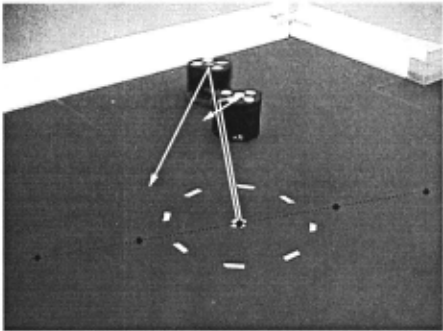
Consider the adversarial robot task shown in Figure 1. The robot at the top of the figure, the attacker, is trying to reach the circle in the center of the field, while the robot closer to the circle, the defender, is trying to prevent this from hap pening. If the attacker reaches the circle, it receives a re ward of one and the defender receives a reward of negative one. These are the only rewards in the task. When the at tacker reaches the circle or ten seconds elapses, the trial is over and the robots reset to their initial positions, where the attacker is a meter from the circle and the defender half-way between. The robots simultaneously learn in this environment each seeking to maximize its own discounted future reward. For all of our experiments the discount factor used was 0.8 for each full second of delay.
The robots themselves are part of the CMDragons robot soccer team, which competes in the RoboCup small-size league. There are two details about the robot platform that are relevant to this learning task. First, the learning algorithm itself is situated within a large and complex architecture of existing capability. The team employs a global vision system mounted over the field. This input is processed by an elab orate tracking module that provides accurate positions and velocities of the robots. These positions comprise the input state for the learning algorithm. The team also consists of ro bust modules for obstacle avoidance and motion control. The actions for the learning algorithm then involve providing tar get points for the obstacle avoidance module. Situating the learning within the context of this larger architecture focuses the learning. Rather than having the robot learn to solve well understood problems like path planning or object tracking, the learning is directed at the heart of the problem, the multi robot interaction.
Second, the system control loop that is partially described above has inherent, though small, latency. Specifically, after an observed change in the world I OOms will elapse before the robot's response is executed. This latency is overcome for each robot's own position and velocity by predicting through this latency using knowledge of the past, but not yet executed, actions. Since the actions of the opponent robots are not known, this prediction is not possible for other robots. La tency effectively adds an element of partial observability to the problem, since the agents do not have the complete state ofthe world, and in fact have separate views of this state. No tice, that this also adds a tactical element to successful poli cies. A robot can "fake" the opponent robot by changing its direction suddenly, knowing the other robot will not be able to respond to this change for a full latency period.
This task involves numerous challenges for existing multi agent learning techniques. These challenges include continu ous state and action spaces, elements of partial observability due to system latency, and violation of the Markov assump tion since many of the system components have memory, e.g., the tracking and the obstacle avoidance modules. In fact, these limitations may even make equilibria cease to exist alto gether [Bowling and Veloso, 2002b]. This is a further reason for exploring best-response learning techniques, which don't directly seek to learn an equilibrium. We now present Ora WoLF, a best-response learning algorithm that can handle the challenges of multi-robot learning.
4 GraWoLF
Gra WoLF, or Gradient-based WoLF, combines two key ideas from reinforcement learning: policy gradient learning and the WoLF variable learning rate. Policy gradient learning is a technique to handle intractable or continuous state spaces. WoLF is a multiagent learning technique that encourages best-response learning algorithms to converge in situations of simultaneous learning. We briefly describe these techniques and how they are combined.
4.1 Policy Gradient Ascent
We use the policy gradient technique presented by Sutton and colleagues [2000]. Specifically, we define a policy as a Gibbs distribution over a linear combination of features of a candi date state and action pair. Let e be a vector of the policy's parameters and let ¢sa be an identically sized feature vector for state s and action a, then the Gibbs distribution defines a stochastic policy according to,
Sutton and colleagues' main result was a convergence proof for the following policy iteration rule that updates a policy's parameters in a Gibbs distribution according to,
fwk (s , a) is an independent approximation of Q.,. 0 k (s, a) with parameters w, which is the expected value of taking ac tion a from state s and then following the policy 1rek. For the Gibbs distribution, Sutton and colleagues showed that for convergence this approximation should have the following form,
As they point out, this amounts to fw being an approximation of the advantage function, A.,.(s, a) = Q.,.(s, a) - V.,.( s), where V.,. ( s) is the value of following policy 1r from state s. It is this advantage function that we estimate and use for gradient ascent.
Using this basic formulation we derive an on-line version of the learning rule, where the policy's weights are updated with each state visited. The summation over states can be re moved by updating proportionately to that state's contribution to the policy's overall value. Since we are visiting states on policy then we only need to weight later states by the discount factor to account for their smaller contribution. If t time has passed since the trial start, this turns Equation I into,
Since the whole algorithm is on-line, we do the policy im provement step (updating B) simultaneously with the value estimation step (updating w). We do value estimation using gradient-descent Sarsa(?.) [Sutton and Barto, 1998] over the same feature space as the policy. This requires maintaining an eligibility trace vector, e. The update rule is then, if at time k the system is in state s and takes action a transitioning to state s' in time t and then taking action a', we update the trace and the weight vector using,
where >. is the Sarsa parameter and ak is an appropriately de cayed learning rate. The addition of raising 1 to the power t allows for actions to take differing amounts of time to execute, as in semi-Markov decision processes [Sutton and Barto, 1998].
The policy improvement step then uses Equation 3 where s is the state of the system at time k and the action-value es timates from Sarsa, Qwk, are used to compute the advantage term. We then get,
This forms the crux of Gra WoLF. What remains is the selec tion of the learning rate, 8k . This is where the WoLF variable learning rate is used.
4.2 Win or Learn Fast
WoLF ("Win or Learn Fast") is a method by Bowling and Veloso [2002a] for changing the learning rate to encourage convergence in a multiagent reinforcement learning scenario. Notice that the policy gradient ascent algorithm above does not account for a non-stationary environment that arises with simultaneous learning in stochastic games. All of the other agents actions are simply assumed to be part of the envi ronment and unchanging. WoLF provides a simple way to account for other agents through adjusting how quickly or slowly the agent changes its policy.
Since only the rate of learning is changed, algorithms that are guaranteed to find (locally) optimal policies in non stationary environments retain this property even when us ing WoLF. In stochastic games with simultaneous learning, WoLF has both theoretical evidence (limited to two-player, two-action matrix games), and empirical evidence (experi ments in games with enumerated state spaces) that it en courages convergence in algorithms that don't otherwise con verge. The intuition for this technique is that a Ieamer should adapt quickly when it is doing more poorly than expected. When it is doing better than expected, it should be cautious, since the other players are likely to change their policy. This implicitly accounts for other players that are learning, rather than other techniques that try to explicitly reason about the others' action choices.
The WoLF principle naturally lends itself to policy gradi ent techniques where there is a well-defined learning rate, O:k . With WoLF we replace the original learning rate with two learning rates a:k' < a:~ to be used when winning or los ing, respectively. One determination of winning and losing that has been successful is to compare the value of the cur rent policy v1r ( s) to the value of the average policy over time V* ( s). So, if v1r ( s) > V* ( s) then the algorithm is consid ered winning, otherwise it is losing. With the policy gradient technique above, we cannot easily compute the average pol icy. Instead we examine the approximate value, using Qw, of the current weight vector e with the average weight vector over time 1J. Specifically, we are "winning" if and only if,
When winning in a particular state, we update the parameters for that state using a: k', otherwise a:~.
4.3 OurTask
Returning to the robot task shown in Figure 1, in order to apply GraWoLF we need to select a policy parameterization. Specifically we need to find a mapping from the continuous space of states and actions to a useful feature vector, i.e., to define ¢sa for a givens and a. The filtered positions and ve locities of the two robots form the available state information, and the available actions are points on the field for navigation. By observing that the radial angle of the attacker with respect to the circle is not relevant to the task we arrive at a seven dimensional input space. These seven dimensions are shown by the white overlaid lines in Figure 1.
We chose to use tile coding [Sutton and Barto, 1998], also known as CMACS, to construct our feature vector. Tile cod ing uses a number of large offset tilings to allow for both a fine discretization and large amount of generalization. We use 16 tiles whose size was 800mm in distance dimensions and 1600mrnls in velocity dimensions. We simplify the ac tion space by requiring the attacker to select its navigation point along a perpendicular line through the circle's center. This is shown by the dark overlaid line in Figure 1. This line, whose length is three times the distance of the attacker to the circle, is then discretized into seven points evenly distributed. The defender uses the same points for its actions but then nav igates to the point that bisects the line from the attacker to the selected action point. The robot's action is also included in the tiling as an eighth dimension with a tile size for that di mension of the entire line, so actions are distinguishable but there is also generalization. Agents select actions every tenth of a second, or after every three frames, unless the feature vector has not changed over that time. This keeps the robots from oscillating too much during the initial parts of learning.
5 Results
Before presenting results on applying GraWoLF to this prob lem we first consider some issues related to evaluation.
5.1 Evaluation
Evaluation of multi-robot learning algorithms present anum ber of challenges. The first is the problem of data gathering on a real robot platform. Learning often requires far more trials than is practical to execute in the physical world. We believe and demonstrate that the Gra WoLF technique is prac tical for the time constraints of real robots. Yet, from a re search standpoint, we want thorough and statistically signifi cant evaluation, which requires far more trials than just those used for learning. We solve this problem by usirig both a sim ulator of our robot team as well as the robots themselves to show that the approach is both practical for robots while still providing an extensive analysis of the results.
The second challenge is the problem of evaluating the suc cess of simultaneous learning. The traditional single-agent evaluation that shows performance over time converging to some optimal value is not applicable. Multiagent domains have no single optimal value independent of the other agents' behavior. The optimal value is changing over time as the other agents also learn. This is especially true of self-play experiments where both agents are using an identical learn ing algorithm, and any performance success by one agent is necessarily a performance failure for the other.
On the other hand we would still want learning robots, even in self-play, to improve their policy over time. In this paper, our main evaluation compares the performance of the learned policy with the the performance of the initial policy before learning. The initial policy is a random selection of the avail able actions, and by design of the available actions is actually a fairly capable policy for both agents. We also use the eval uation technique of challengers, which was first examined by Littman [1994]. This technique trains a worst-case opponent, or challenger, for a particular policy to see the generality of the learned policy. In this paper we present challenger results demonstrating that the learned policies are indeed robust, and that the WoLF variable learning rate plays a critical role in keeping the learning away from easily exploited policies.
5.2 Experiments
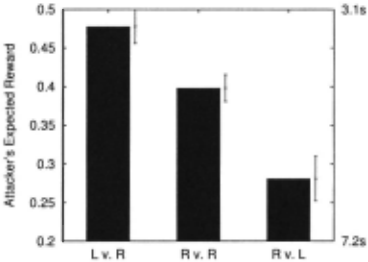
In all of the performance graphs in this section, the y axis shows the attacker's expected discounted reward, which roughly corresponds to the expected time it takes for the at tacker to reach the circle. On the right of the graph the range is shown in seconds. All measurements of expected dis counted reward are gathered empirically over the course of 1000 trials. All training occurred over 4000 trails, and takes approximately 6-7 hours of training time on the robot plat form or in simulation. Unless otherwise noted, the training was always done with a simultaneously learning opponent, both using Gra WoLF. The experiments in simulation were re peated nine times and the averages are shown in the graphs. We first examine the performance of the policies learned in simulation, and then examine the performance of learning on the robot.
Figure 2 shows the results of various learned policies when playing against an opponent following the random policy, which was the starting point for learning. The middle bar, "R v. R", corresponds to the expected value of both players following the random policy. "L v. R" corresponds to the value of the attacker following the policy learned in self-play against a random defender. "R v. L'' corresponds to the value of a random attacker against the defender policy learned in self-play.
Notice that, as was desired, learning does improve perfor mance over the starting policy. The learned attacker policy against random does far better than the random attacker pol icy against the learned defender. These experiments demon strate that GraWoLF improves considerably on its starting policy. The next experiment explores how robust the learned policy is and the effect of the WoLF component.
Figure 3 shows results of challenger experiments. Poli cies are trained using simultaneous learning. The policy is then fixed and a challenger policy is trained for 4000 trails, to specifically measure the policy's worst-case performance. The better the worst-case performance, the less exploitable and more robust the policy is to unknown opponents. We trained a challenger against the policies learned after 3000, 3500, and 4000 trials, averaging together the results. We used this experiment to investigate the robustness of the learned policy and the affect of the WoLF variable learning rate on the Gra WoLF algorithm. The left side of the graph shows the worst-case performance of learned defender policies, while the right side shows the worst-case performance for attacker policies. "WoLF" corresponds to the described GraWoLF algorithm, "Slow" does not use a variable learning rate but rather always uses the WoLF's winning rate, while "Fast" al ways uses its losing rate.
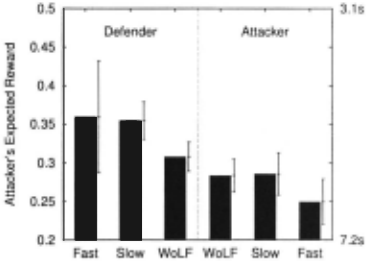
First, notice that the distance between the worst-case per formance of the defender and the worst-case performance of the attacker (the third and fourth column of Table 3, respec tively) is quite small. This demonstrates that the learned poli cies are quite close to the equilibrium policy, if one exists. This also means that the learned policies are robust and diffi cult to exploit.
Second, notice that the WoLF learned defender policy per forms better against its challenger, i.e., keeps its challenger to a lower reward, than either of the two learning rates it switches between. For the attacker, the learned policy per forms better against its challenger than the fast learning rate, but is not significantly different than the slow learning rate. There are a couple of possible reasons for this. One expla nation is due to the initialization of values. Since all values were intialized to zero for both sides, this amounts to an opti mistic initialization for the defender, and a pessimistic one for the attacker (as all rewards are non-negative for the attacker.) This may mean the attacker considers itself winning far more often than the defender, causing the slower learning rate to be employed most of the time. There is evidence to this effect when examining the percentage of updates that use bw versus bt. During training, the attacker used the slower, winning rate for 92.3% of its updates, while the defender used the winning rate for only 84.2%. The effect of value initialization on Gra WoLF is an interesting top to be explored further. Overall, although the results are certainly not as dramatic as the unap proximated results [Bowling and Veloso, 2002a], WoLF still seems to be providing a converging effect.
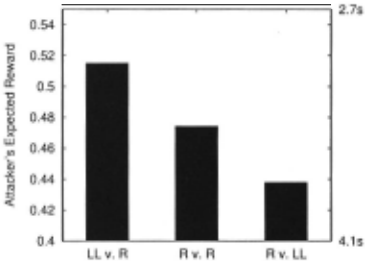
Finally, we examine results of using Gra WoLF on the real robots. We took policies that were trained for 2000 trials in simulation and then did an additional 2000 trials of training on the robots. We evaluated the resulting policies against the random policy as we did with the simulator results in Fig ure 2. These results are shown in Figure 4
In the real robots the attacker is nearly impossible to keep from reaching the circle. The defender can at best only slow down its progress, and this is even true for a random attacker policy. This can be seen in Figure 4 by the much higher rewards as compared to the simulator results. Despite this, these results are qualitatively identical to the results produced in simulation. Simultaneous learning improves the perfor mance for both the attacker and defender over their initial policies.
Finally, as an adversarial environment we would expect good policies to be stochastic in nature. This is true of all of the learned policies in both simulation and on the robots. For example, the most probable action in any given state has probability on average around 40% in the attacker's learned policy, and 70% in the defender's. In some states, though, the learned policies are nearly deterministic. So, the learned policies are indeed stochastic to avoid exploitation, while still learning optimal actions in states that don't depend on the other agent's behavior.
6 Conclusion
We have introduced, GraWoLF, a general-purpose multiagent learning algorithm capable of learning robot tasks in multi robot, and even adversarial, environments. We showed re sults of this algorithm learning in one particular adversarial robot task, both in simulation and from actual robot experi ence. These results both demonstrated the effectiveness of the policy gradient learner, and the importance of the WoLF variable learning rate. It should be noted that the use of Sut ton and colleagues' particular policy gradient formulation is not critical. It would be interesting to combine WoLF with other policy gradient techniques, such as [Williams, 1992; Baxter and Bartlett, 2000].
Acknowledgements
This research was sponsored by Grants F30602-00-2-0549 and DABT63-99-l-0013. The content of this publication does not necessarily reflect the position of the funding agen cies and no official endorsement should be inferred. The au thors also thank Brett Browning and James Bruce for the de velopment of the CMDragons'02 robots used in this work.
@inproceedings{ijcai2003p102,
  title     = {Simultaneous Adversarial Multi-Robot Learning},
  author    = {Bowling, Michael H. and Veloso, Manuela M.},
  booktitle = {Proceedings of the Eighteenth International Joint Conference on
               Artificial Intelligence, {IJCAI-03}},
  publisher = {International Joint Conferences on Artificial Intelligence},
  editor    = {Georg Gottlob and Toby Walsh},
  pages     = {699--703},
  year      = {2003},
  url       = {https://ijcai.org/proceedings/2003/102},
}
TY - CPAPER TI - Simultaneous Adversarial Multi-Robot Learning AU - Bowling, Michael H. AU - Veloso, Manuela M. T2 - Proceedings of the Eighteenth International Joint Conference on Artificial Intelligence, IJCAI-03 PB - International Joint Conferences on Artificial Intelligence PY - 2003 SP - 699 EP - 703 UR - https://ijcai.org/proceedings/2003/102 ER -Copied
Machine-readable versions of this paper, for tools and AI agents:





