
Automatically Extracting and Comparing Lexicalized Grammars for Different Languages
Proceedings of the Seventeenth International Joint Conference on Artificial Intelligence. Pages 1321-1329.
© 2001 International Joint Conferences on Artificial Intelligence
Abstract
In this paper, we present a quantitative comparison between the syntactic structures of three languages: English, Chinese and Korean. This is made possible by first extracting Lexicalized Tree Adjoining Grammars from annotated corpora for each language and then performing the comparison on the extracted grammars. We found that the majority of the core grammar structures for these three languages are easily inter-mappable.
- [Comrie, 1987] Bernard Comrie. The World's Major Lan- guages. Oxford University Press, New York, 1987.
- [Dorr, 1993] B. J. Dorr. Machine Translation: a View from the Lexicon. MIT Press, Boston, Mass., 1993.
- [Han et al., 2001] Chunghye Han, Na-Rae Han, and Eon-Suk Ko. Bracketing Guidelines for the Penn Korean Treebank (forthcoming), 2001. www.cis.upenn.edu/˜xtag/koreantag. Link
- [Joshi and Schabes, 1997] Aravind Joshi and Yves Schabes. Tree Adjoining Grammars. In A. Salomma and G. Rosen- berg, editors, Handbook of Formal Languages and Au- tomata. Springer-Verlag, Herdelberg, 1997.
- [Joshi et al., 1975] Aravind K. Joshi, L. Levy, and M. Taka- hashi. Tree Adjunct Grammars. Journal of Computer and System Sciences, 1975.
- [Marcus et al., 1993] M. Marcus, B. Santorini, and M. A. Marcinkiewicz. Building a Large Annotated Corpus of English: the Penn Treebank. Computational Lingustics, 1993.
- [Sarkar, 2001] Anoop Sarkar. Applying Co-Training Meth- ods to Statistical Parsing. In Proc. of the 2nd NAACL, 2001.
- [Xia et al., 2000a] Fei Xia, Martha Palmer, and Aravind Joshi. A Uniform Method of Grammar Extraction and its Applications. In Proc. of Joint SIGDAT Conference on Empirical Methods in Natural Language Processing and Very Large Corpora (EMNLP/VLC), 2000.
- [Xia et al., 2000b] Fei Xia, Martha Palmer, Nianwen Xue, Mary Ellen Okurowski, John Kovarik, Shizhe Huang, Tony Kroch, and Mitch Marcus. Developing Guidelines and Ensuring Consistency for Chinese Text Annotation. In Proc. of the 2nd International Conference on Language Resources and Evaluation (LREC-2000), Athens, Greece, 2000.
- [Xia, 1999] Fei Xia. Extracting Tree Adjoining Grammars from Bracketed Corpora. In Proc. of 5th Natural Language Processing Pacific Rim Symposium (NLPRS-99), Beijing, China, 1999.
References were extracted automatically from the PDF and may contain errors.
Full text extracted automatically from the PDF; figures, tables and equations may differ. The PDF is the version of record.
1 Introduction
The comparison of the grammars extracted from annotated corpora (i.e., Treebanks) is important on both theoretical and engineering grounds. Theoretically, it allows us to do a quantitative testing of the Universal Grammar Hypothesis. One of the major concerns in modern linguistics is the establishment of an explanatory basis for the similarities and variations among languages. The working assumption is that languages of the world share a set of universal linguistic principles and the apparent structural differences attested among languages can be explained as variation in the way the universal principles are instantiated. Comparison of the extracted syntactic trees allows us to quantitatively evaluate how similar the syntactic structures of different languages are. From an engineering perspective, the extracted grammars and the links between the syntactic structures in the grammars are valuable resources for NLP applications, such as parsing, computational lexicon development, and machine translation (MT), to name a few.
In this paper we first briefly discuss some linguistic characteristics of English, Chinese, and Korean, and introduce the Treebanks for the three languages. We then describe a tool that extracts Lexicalized Tree Adjoining Grammars (LTAGs) from the Treebanks and the results of its application. Next, we describe our methodology for automatic comparison of the extracted Treebank grammars, which consists primarily of matching syntactic structures (namely, templates, sub-templates and context-free rules) in each pair of Treebank grammars. The ability to perform this type of comparison for different languages enables us to distinguish languageindependent features from language-dependent ones. Therefore, our grammar extraction tool is not only an engineering tool of great value in improving the efficiency and accuracy of grammar development, but it is also very useful for investigating theoretical linguistics.
2 Our Annotated Corpora
In this section, we briefly discuss some linguistic characteristics of English, Chinese, and Korean, and introduce the Treebanks for these languages.
2.1 Differences between the Three Languages
These three languages belong to different language families: English is Germanic, Chinese is Sino-Tibetan, and Korean is Altaic [Comrie, 1987]. There are several major differences between these languages. First, both English and Chinese have predominantly subject-verb-object (SVO) word order, whereas Korean has underlying SOV order. Second, the word order in Korean is freer than in English and Chinese in the sense that argument NPs are freely permutable (subject to certain discourse constraints). Third, Korean and Chinese freely allow subject and object deletion, but English does not. Fourth, Korean has richer inflectional morphology than English, whereas Chinese has little, if any, inflectional morphology.
2.2 Treebank Description
The Treebanks that we used in this paper are the English Penn Treebank II [Marcus et al., 1993], the Chinese Penn Treebank [Xia et al., 2000b], and the Korean Penn Treebank [Han et al., 2001]. The main parameters of these Treebanks are summarized in Table 1. 1 The tagsets include four types of tags: Part-Of-Speech (POS) tags for head-level annotation, syntactic tags for phrase-level annotation, function tags for grammatical function annotation, and empty category tags for dropped arguments, traces, and so on.
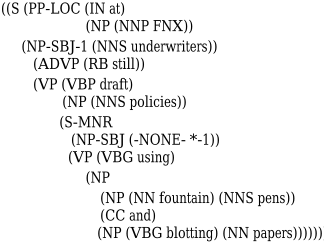
We chose these Treebanks because they all use phrase structure annotation and their annotation schemata are similar, which facilitates the comparison between the extracted Treebank grammars. Figure 1 shows an annotated sentence from the English Penn Treebank.
1 The reason why the average sentence length for Korean is much shorter than those for English and Chinese is that the Korean Treebank includes dialogues that contain many one-word replies, whereas English and Chinese corpora consist of newspaper articles.
| Language | corpus size (words) | ave sentence length | tagset size |
| English | 1,174K | 23.85 words | 94 |
|---|---|---|---|
| Chinese | 100K | 23.81 words | 92 |
| Korean | 54K | 10.71 words | 61 |
3 Extracting Grammars
In this section, we give a brief introduction to the LTAG formalism and to a system named LexTract, which was built to extract LTAGs from the Treebanks [Xia, 1999; Xia et al., 2000a].
3.1 The Grammar Formalism
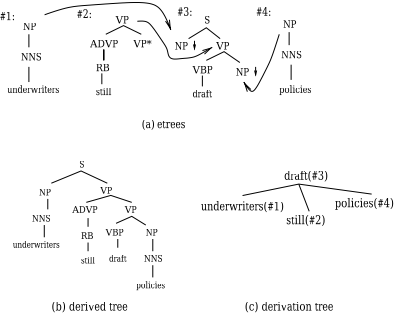
LTAGs are based on the Tree Adjoining Grammar formalism developed by Joshi and his colleagues [Joshi et al., 1975; Joshi and Schabes, 1997]. The primitive elements of an LTAG are elementary trees (etrees). Each etree is associated with a lexical item (called the anchor of the tree) on its frontier. LTAGs possess many desirable properties, such as the Extended Domain of Locality, which allows the encapsulation of all arguments of the anchor associated with an etree. There are two types of etrees: initial trees and auxiliary trees. An auxiliary tree represents a recursive structure and has a unique leaf node, called the foot node, which has the same syntactic category as the root node. Leaf nodes other than anchor nodes and foot nodes are substitution nodes. Etrees are combined by two operations: substitution and adjunction. The resulting structure of the combined etrees is called a derived tree. The history of the combination process is expressed as a derivation tree. Figure 2 shows the etrees, the derived tree, and the derivation tree for the sentence underwriters still draft policies. Foot and substitution nodes are marked by #03 and #23, respectively. The dashed and solid lines in the derivation tree are for adjunction and substitution operations, respectively.
3.2 The Target Grammars
Without further constraints, the etrees in the target grammar (i.e., the grammar to be extracted by LexTract) could be of various shapes. LexTract recognizes three types of relations between the anchor of an etree and other nodes in the etree; namely, predicate-argument, modification, and coordination relations. It imposes the constraint that all the etrees to be extracted should fall into exactly one of the three patterns (as in Figure 3): 2
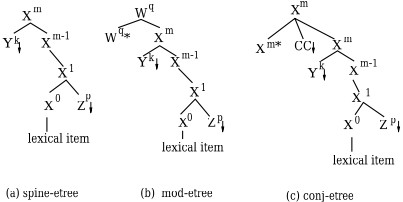
Spine-etrees for predicate-argument relations: X 0 is the head of X m and the anchor of the etree. The etree is formed by the spine X m ! X m,1 ! :: ! X 0 and the arguments of X 0 .
Mod-etrees for modification relations: The root of the etree has two children, one is a foot node with the same label W q as the root node, and the other node X m is a modifier of the foot node. X m is further expanded into a spine-etree whose head X 0 is the anchor of the whole mod-etree.
Conj-etrees for coordination relations: In a conj-etree, the children of the root are two conjoined constituents and a node for a coordinating conjunction. One conjoined constituent is marked as the foot node, and the other is expanded into a spine-etree whose head is the anchor of the whole tree.
Spine-etrees by themselves are initial trees, whereas modetrees and conj-etrees are auxiliary trees.
3.3 The LexTract Algorithm
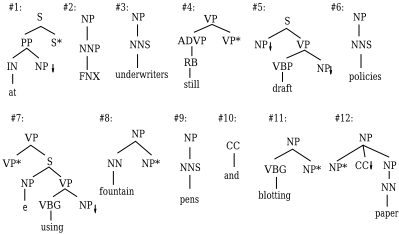
The core of LexTract is an extraction algorithm that takes a Treebank sentence such as the one in Figure 1 and Treebankspecific information provided by the user of LexTract, and produces a set of etrees as in Figure 4 and a derivation tree. LexTract's extraction algorithm has been described in [Xia, 1999] and is completely language-independent. It has been successfully applied to the development of language processing tools such as SuperTaggers [Xia et al., 2000a] and statistical LTAG parsers [Sarkar, 2001].
2 The precedence relation between the children of the nodes in these three patterns is unspecified, and may vary from language to language.
3.4 Extracted Grammars
The results of running LexTract on English, Chinese, and Korean Treebanks are shown in Table 2. Templates are etrees with the lexical items removed. For instance, #3, #6, and #9 in Figure 4 are three distinct etrees, but they share the same template. LexTract is designed to extract LTAGs, but simply reading context-free rules off the templates in an extracted LTAG will yield a context-free grammar. The last column in the table shows the numbers of the non-lexicalized contextfree rules.
In each Treebank, a small subset of template types, which occur very frequently in the Treebank and can be seen as members of the core of the Treebank grammar, covers the majority of template tokens in the Treebank. For instance, the top 100 (500, 1000 and 1500, respectively) template types in the English Penn Treebank cover 87.1% (96.6%, 98.4% and 99.0%, respectively) of the tokens, whereas about half (3440) of the template types occur once, accounting for only 0.32% of the template tokens in total.
| template types | etree types | word types | context-free rules | |
|---|---|---|---|---|
| English | 6926 | 131,397 | 49,206 | 1524 |
| Chinese | 1140 | 21,125 | 10,772 | 515 |
| Korean | 632 | 13,941 | 10,035 | 152 |
4 Comparing Treebank Grammars for Different Languages
In this section, we describe our methodology for comparing Treebank grammars and the experimental results.
4.1 Methodology
To compare Treebank grammars, we need to ensure that the Treebank grammars are based on the same tagset. To achieve that, we first create a new tagset that includes all the tags from the three Treebanks. Then we merge several tags in this new tagset into a single tag. 3 Next, we replace the tags in the original Treebanks with the tags in the new tagset, and then re-run LexTract to build Treebank grammars from those Treebanks.
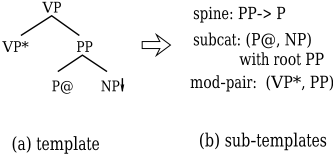
Now that the Treebank grammars are based on the same tagset, we can compare them according to the templates, context-free rules, and sub-templates that appear in more than one Treebank - that is, given a pair of Treebank grammars, we first calculate how many templates occur in both grammars; 4 Second, we read context-free rules off the templates and compare these context-free rules; Third, we decompose each template into a list of sub-templates (e.g., spines and subcategorization frames) and compare these sub-templates. A template is decomposed as follows: A spine-etree template is decomposed into a spine and a subcategorization frame; a mod-etree template is decomposed into a spine, a subcategorization frame, and a modifier-modifiee pair; a conj-etree template is decomposed into a spine, a subcategorization frame, and a coordination tuple. Figure 5 shows the decomposition of a mod-etree template.
4.2 Initial Results
After the tags in original Treebanks have been replaced with the tags in the new tagset, the numbers of templates in the new Treebank grammars decrease by about 50%, as shown in the second column of Table 3 (cf. the second column in Table 2). Table 3 also lists the numbers of context-free rules and sub-templates(e.g., spines and subcategorization frames) in each grammar.
The third column of Table 4 lists the numbers of template types shared by each pair of Treebank grammars and the percentage of the template tokens in each Treebank that are covered by these common template types. For example, there are 237 template types that appear in both English and Chinese Treebank grammars. These 237 template types account for 80.1% of the template tokens in the English Treebank, and 81.5% of the template tokens in the Chinese Treebank. The table shows that, although the numbers of matched templates are not very high, most of these templates have high frequency and therefore account for the majority of the template tokens in the Treebanks. For instance, in the (Eng, Ch) pair, the 237 template types that appear in both grammars is only 7.5% of all the English template types, but they cover 80.1% of the template tokens in the English Treebank.
3 This step is necessary because certain distinctions among some tags in one language do not exist in another language. For example, the English Treebank has distinct tags for past tense verbs, past participals, gerunds, and so on; however, no such distinction is morphologically marked in Chinese and, therefore, the Chinese Treebank uses the same tag for verbs regardless of the tense and aspect. To make the conversion straightforward for verbs, we use a single tag for verbs in the new tagset.
4 Ideally, to get more accurate comparison results, we would like to compare etrees, rather than templates (which are non-lexicalized); however, comparing etrees requires bilingual parallel corpora, which we are currently building.
| templates | context-free rules | subtemplates | |||||
|---|---|---|---|---|---|---|---|
| spines | subcat frames | mod-pairs | conj-tuples | total | |||
| Eng | 3139 | 754 | 500 | 541 | 332 | 53 | 1426 |
| Ch | 547 | 290 | 108 | 180 | 152 | 18 | 458 |
| Kor | 256 | 102 | 43 | 65 | 54 | 5 | 167 |
| templates | context-free rules | sub-templates | ||
|---|---|---|---|---|
| (Eng, Ch) | type (#) token (%) | 237 80.1/81.5 | 154 88.0/85.2 | 246 91.4/85.2 |
| (Eng, Kor) | type (#) token (%) | 54 47.6/85.6 | 61 53.4/92.2 | 96 58.9/98.4 |
| (Ch, Kor) | type (#) token (%) | 43 55.9/81.0 | 44 63.2/89.3 | 69 65.7/96.0 |
If we compare sub-templates, rather than templates, the percentages of matched sub-template tokens (as shown in the last column in Table 4) are higher than the percentages of matched template tokens. This is because two distinct templates may have common sub-templates. Similarly, the percentages of matched context-free rules (see the fourth column in Table 4) are higher than the percentages of matched template tokens.
4.3 Results Using Thresholds
The comparison results shown in Table 4 used every template in the Treebank grammars regardless of the frequency of the template in the corresponding Treebank. One potential problem with this approach is that some annotation errors in the Treebanks could have a substantial effect on the comparison results. One such scenario is as follows: To compare languages A and B, we use Treebanks T A for language A and Treebank T B for language B. Let G A and G B be the grammars extracted from T A and T B , respectively, and let t be a template that appears in both grammars. Now suppose that t is a linguistically valid template for language A and it accounts for 10% of the template tokens in T A , but t is not a valid template for language B and it appears once in Treebank B only due to annotation errors. In this scenario, if G B excluding template t covers 50% of the template tokens in Treebank A, then G B including t covers 60% of the template tokens in Treebank A. In other words, the single error in Treebank B, which results in template t being included in G B , changes the comparison results dramatically.
Because most templates that are due to annotation errors occur very infrequently in the Treebanks, we used a threshold to discard from the Treebanks and Treebank grammars all the templates with low frequency in order to reduce the effect of Treebank annotation errors on the comparison results, Table 5 shows the numbers of templates in the Treebank grammars when the threshold is set to various values. For example, the last column lists the numbers of templates that occur at least 40 times in the Treebanks.
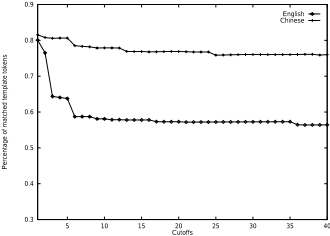
Table 6 shows the numbers of matched templates and the percentages of matched template tokens when the low frequency templates are removed from the Treebanks and Treebank grammars. As the value of the threshold increases, for each language pair the number of matched templates decreases. The percentage of matched template tokens might decrease a fair amount at the beginning, but it levels off after the threshold reaches a certain value. This tendency is further illustrated in Figure 6. In this figure, the X-axis is the threshold value, which ranges from 1 to 40; the Y-axis is the percentage of matched template tokens in each Treebank when the templates with low frequency are discarded. The curve on the top is the percentage of template tokens in the Chinese Treebank that are covered by the English grammar, and the curve on the bottom is the percentage of template tokens in the English Treebank that are covered by the Chinese grammar. Both curves become almost flat once the threshold value reaches 6 or larger. This result implies that most templates due to annotation errors occur less than six times in the Treebanks.
To summarize, in order to get a better estimate of the percentage of matched template tokens, we should disregard the low frequency templates in the Treebanks. We have shown that this strategy reduces the effect of annotation errors on the comparison results (see Table 6 and Figure 6). This strategy also makes the difference between the sizes of our three Treebanks less important because once Treebanks reach a certain size, the new templates extracted from additional data tend to have very low frequency in the whole Treebank.
| 1 | 2 | 3 | 4 | 5 | 10 | 20 | 30 | 40 | |
|---|---|---|---|---|---|---|---|---|---|
| English | 3139 | 1804 | 1409 | 1209 | 1065 | 762 | 524 | 444 | 386 |
| Chinese | 547 | 341 | 272 | 226 | 210 | 155 | 122 | 110 | 100 |
| Korean | 256 | 181 | 146 | 132 | 122 | 94 | 67 | 57 | 53 |
| threshold | 1 | 2 | 3 | 4 | 5 | 10 | 20 | 30 | 40 | |
|---|---|---|---|---|---|---|---|---|---|---|
| (Eng, Ch) | type (#) token (%) | 237 80.1/81.5 | 165 76.5/80.8 | 128 64.3/80.6 | 111 64.1/80.6 | 100 63.8/78.5 | 73 58.1/77.9 | 54 57.3/76.9 | 47 57.3/76.0 | 42 56.4/76.0 |
| (Eng, Kor) | type (#) token (%) | 54 47.6/85.6 | 47 47.5/81.0 | 37 47.2/81.0 | 35 47.3/80.7 | 32 47.3/80.7 | 29 47.3/80.4 | 23 47.5/79.3 | 21 47.5/79.4 | 19 47.6/79.3 |
| (Ch, Kor) | type (#) token (%) | 43 55.9/81.0 | 36 56.0/81.0 | 34 56.0/77.0 | 29 56.1/76.0 | 27 55.8/76.1 | 22 56.0/74.3 | 18 56.1/74.5 | 18 56.3/74.9 | 17 56.5/74.9 |
4.4 Unmatched Templates
Our experiments (see Table 4 and 6) show that the percentages of unmatched template tokens in three Treebanks range from 14.4% to 52.4%, depending on the language pairs and the threshold value. Given a language pair, there are various reasons why a template appears in one Treebank grammar, but not in the other. We divide those unmatched templates into two categories: spuriously unmatched templates and truly unmatched templates.
Spuriously unmatched templates Spuriously unmatched templates are those that either should have found a matched template in the other grammar or should not have been created by LexTract in the first place if the Treebanks had been complete, uniformly annotated, and error-free. A spuriously unmatched template might exist because of one of the following reasons:
(S1) Treebank coverage: The template is linguistically sound in both languages, and, therefore, should belong to the grammars for these languages. However, the template appears in only one Treebank grammar because the other Treebank is too small to include such a template. Figure 7(S1) shows a template that is valid for both English and Chinese, but it appears only in the English Treebank, not in the Chinese Treebank.
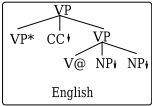
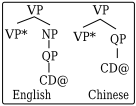
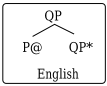
Figure 7: Spuriously unmatched templates
(S2) Annotation differences: Treebanks may choose different annotations for the same constructions; consequentially, the templates for those constructions look different. Figure 7(S2) shows the templates used in English and Chinese for a VP such as "surged 7 (dollars)". In the template for English, the QP projects to an NP, but in the template for Chinese, it does not.
(S3) Treebank annotation errors: A template in a Treebank may result from annotation errors in that Treebank. If no corresponding mistakes are made in the other Treebank, the template in the first Treebank will not match any template in the second Treebank. For instance, in the English Treebank the adverb about in the sentence About 50 people showed up is often mis-tagged as a preposition, resulting in the template in Figure 7(S3). Not surprisingly, that template does not match any template in the Chinese Treebank.
Truly unmatched templates A truly unmatched template is a template that does not match any template in the other Treebank even if we assume both Treebanks are perfectly annotated. Here, we list three reasons why a truly unmatched template might exist.
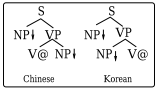
(T1) Word order: The word order determines the positions of dependents with respect to their heads. If two languages have different word orders, the templates that include dependents of a head are likely to look different. For example, Figure 8(T1) shows the templates for transitive verbs in Chinese and Korean grammars. They do not match because of the different positions of the object of the verb.
(T2) Unique tags: For each pair of languages, some Partof-speech tags and syntactic tags may appear in only one

(T2) unique tags
(T3) unique relation
Figure 8: Truly unmatched templates
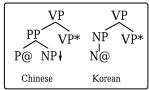
language. Therefore, the templates with those tags will not match any templates in the other language. For instance, in Korean the counterparts of preposition phrases in English and Chinese are noun phrases (with postpositions attaching to nouns), as shown in the right figure in Figure 8(T2); therefore, the templates with PP in Chinese, such as the left one in Figure 8(T2), do not match any template in Korean.
(T3) Unique syntactic relations: Some syntactic relations may be present in only one of the pair of languages being compared. For instance, the template in Figure 8(T3) is used for the sentence such as "You should go," said John, where the subject of the verb said appears after the verb. No such template exists in Chinese.
| S1 | S2 | S3 | T1 | T2 | T3 | total | |
|---|---|---|---|---|---|---|---|
| type(#) | 1 | 70 | 53 | 22 | 99 | 65 | 310 |
| token(%) | 0.0 | 3.2 | 0.2 | 0.7 | 12.3 | 2.1 | 18.5 |
So far, we have listed six possible reasons for unmatched templates. We have manually classified templates that appear in the Chinese grammar, but not in the English grammar. 5 The results are shown in Table 7. The table shows that for the Chinese-English pair, the main reason for unmatched templates is (T2); that is, the Chinese Treebank has tags for particles (such as aspect markers and sentence-ending particles), which do not exist in English. For other language pairs, the distribution of unmatched templates may be very different. For instance, Table 4 indicates that the English grammar covers 85.6% of the template tokens in the Korean Treebank. If we ignore the word order in the templates, that percentage increases from 85.6% to 97.2%. In other words, the majority of the template tokens that appear in the Korean Treebank, but not in the English Treebank, are due to the word order difference in the two languages. Note that the word order difference only accounts for a small fraction of the unmatched templates in the Chinese-English pair (see the fifth column in Table 7). This contrast is not surprising considering that English and Chinese are predominantly head-initial, whereas Korean is head-final.
5 Conclusion
We have presented a method of quantitatively comparing grammars extracted from Treebanks. Our experimental results show a high proportion of easily inter-mappable structures, providing support for the Universal Grammar hypothesis. We have also described a number of reasons why a particular template does not match any templates in the other languages and tested the effect of word order on matching percentages.
5 For this experiment, we used all the templates in the grammars; that is, we did not throw away low frequency templates.
There are two natural extensions of this work. First, running an alignment algorithm on parallel bracketed corpora would produce word-to-word mappings. Given such wordto-word mappings and our template matching algorithm, we can automatically create lexicalized etree-to-etree mappings, which can be used for semi-automatic transfer lexicon construction. Second, LexTract can build derivation trees for each sentence in the corpora. By comparing derivation trees for parallel sentences in two languages, instances of structural divergences [Dorr, 1993] can be automatically detected.
@inproceedings{ijcai2001p174,
  title     = {Automatically Extracting and Comparing Lexicalized Grammars for Different Languages},
  author    = {Xia, Fei and Han, Chung-hye and Palmer, Martha Stone and Joshi, Aravind K.},
  booktitle = {Proceedings of the Seventeenth International Joint Conference on
               Artificial Intelligence, {IJCAI-01}},
  publisher = {International Joint Conferences on Artificial Intelligence},
  editor    = {Bernhard Nebel},
  pages     = {1321--1329},
  year      = {2001},
  url       = {https://ijcai.org/proceedings/2001/174},
}
TY - CPAPER TI - Automatically Extracting and Comparing Lexicalized Grammars for Different Languages AU - Xia, Fei AU - Han, Chung-hye AU - Palmer, Martha Stone AU - Joshi, Aravind K. T2 - Proceedings of the Seventeenth International Joint Conference on Artificial Intelligence, IJCAI-01 PB - International Joint Conferences on Artificial Intelligence PY - 2001 SP - 1321 EP - 1329 UR - https://ijcai.org/proceedings/2001/174 ER -Copied
Machine-readable versions of this paper, for tools and AI agents:





