
Domain-Specific Keyphrase Extraction
Proceedings of the Sixteenth International Joint Conference on Artificial Intelligence. Machine Learning. Pages 668-672.
© 1999 International Joint Conferences on Artificial Intelligence
Abstract
Keyphrases are an important means of document summarization, clustering, and topic search. Only a small minority of documents have author-assigned keyphrases, and manually assigning keyphrases to existing documents is very laborious. Therefore it is highly desirable to automate the keyphrase extraction process. This paper shows that a simple procedure for keyphrase extraction based on the naive Bayes learning scheme performs comparably to the state of the art. It goes on to explain how this procedure's performance can be boosted by automatically tailoring the extraction process to the particular document collection at hand. Results on a large collection of technical reports in computer science show that the quality of the extracted keyphrases improves significantly when domain-specific information is exploited.
- [Breiman, 1996] Leo Breiman. Bagging predictors. Ma- chine Learning, 24(2):123-140, 1996.
- [Domingos and Pazzani, 1997] P. Domingos and M. Pazzani. On the optimality of the simple bayesian classifier under zero-one loss. Ma- chine Learning, 29(2/3):103-130, 1997.
- [Dumais et al., 1998] S. T. Dumais, J. Platt, D. Hecker- man, and M. Sahami. Inductive learning algorithms and representations for text categorization. In Pro- ceedings of the 7th International Conference on Infor- mation and Knowledge Management, 1998.
- Fayyad and Irani, 1993)
- Usama M. Fayyad and Keki B. Irani. Multi-interval discretization of continuous- valued attributes for classification learning. In Pro- ceedings of the 13th International Joint Conference on Artifical Intelligence, pages 1022-1027.
- Morgan Kauf- mann, 1993.
- [Lovins, 1968] J.B. Lovins. Development of a stemming algorithm. Mechanical translation and computational linguistics, 11:22-31, 1968.
- [Quinlan, 1992] J.R. Quinlan. C4.5: Programs forMa- chine Learning.
- Morgan Kaufmann, Los Altos, CA, 1992.
- [Turney, 1999] P.D. Turney. Learning to extract keyphrases from text. Technical Report ERB-1057, National Research Council, Institute for Information Technology, 1999.
References were extracted automatically from the PDF and may contain errors.
Full text extracted automatically from the PDF; figures, tables and equations may differ. The PDF is the version of record.
1 Introduction
Keyphrases give a high-level description of a document's contents that is intended to make it easy for prospec tive readers to decide whether or not it is relevant for them. But they have other applications too. Because keyphrases summarize documents very concisely, they can be used as a low-cost measure of similarity between documents, making it possible to cluster documents into groups by measuring overlap between the keyphrases they are assigned. A related application is topic search: upon entering a keyphrase into a search engine, all doc uments with this particular keyphrase attached are re turned to the user. In summary, keyphrases provide a powerful means for sifting through large numbers of doc uments by focusing on those that are likely to be rele vant.
Unfortunately, only a small fraction of documents have keyphrases assigned to them- mostly because authors only provide keyphrases when they are explicitly in structed to do so-and manually attaching keyphrases
Craig G. Nevill-Manning
Department of Computer Science Rutgers University Piscataway, New Jersey, USA
to existing documents is a very laborious task. There fore, ways of automating this process using artifi cial intelligence-more specifically, machine learning techniques-are of interest. There are two different ways of approaching the problem: keyphrase assignment and keyphrase extraction. In keyphrase assignment, also known as text categorization [Dumais et al., 1998), it is assumed that all potential kephrases appear in a prede fined controlled vocabulary_:_the categories. The learn ing problem is to find a mapping from documents to cat egories using a set of training documents, which can be accomplished by training a classifier for each category, using documents that belong to it. as positive examples and the rest as negative ones. A new document is then processed by each of the classifiers and assigned to those categories whose classifiers identify it as a positive exam ple. The second approach, keyphrase extraction, which we pursue in this paper, does not restrict the set of pos sible keyphrases to a selected vocabulary. On the con trary, any phrase in a new document can be identified extracted- as a keyphrase. Using a set of training doc uments, machine learning is used to determine which properties distinguish phrases that are keyphrases from ones that are not.
Turney [1999] describes a system for keyphrase ex traction, GenEx, based on a set of parametrized heuris tic rules that are fine-tuned using a genetic algorithm. The genetic algorithm optimizes the number of cor rectly identified keyphrases in the training documents by adjusting the rules' parameters. Turney compares GenEx to the straightforward application of a stan dard machine learning technique- bagged decision trees [Breiman, 1996]- and concludes that it gives superior performance. He also shows that GenEx generalizes well across collections: when trained on a collection of jour nal articles it successfully extracts keyphrases from web pages on a different topic. This is an important feature because training GenEx on a new collection is computa tionally very expensive.
This paper briefly summarizes the Kea keyphrase ex traction algorithm, and goes on to show that it gen eralizes as well as GenEx across collections. In contrast to GenEx, however, it does not employ a special purpose genetic algorithm for training and keyphrase extraction: it is based on the well-known naive Bayes machine learning technique. Training is therefore much quicker. The main finding of this paper is that perfor mance can be boosted significantly if Kea is trained on documents that are from the same domain as those from which keyphrases are to be extracted. This allows us to capitalize on speedy training, because deriving domain specific models would be less practical with the original lengthy genetic algorithm approach.
Section 2 summarizes the Kea algorithm for keyphrase extraction, and shows that it performs comparably to GenEx if used in the same domain-independent set ting. Section 3 explains a simple enhancement that en ables Kea to exploit collection-specific information about keyphrases, and shows how this addition boosts perfor mance on a large collection of computer science technical reports. The main findings of this paper are summarized in Section 4.
2 Keyphrase Extraction using Naive Bayes
Keyphrase extraction is a classification task: each phrase in a document is either a keyphrase or not, and the prob lem is to correctly classify a phrase into one of these two categories. Machine learning provides off-the-shelf tools for this kind of situation. In machine learning termi nology, the phrases in a document are "examples" and the learning problem is to find a mapping from the exam ples to the two classes "keyphrase" and "not-keyphrase" . Machine learning techniques can automatically generate this mapping if they are provided with a set of training examples, that is, examples with class labels assigned to them. In our context, these are simply phrases which have been identified as either being keyphrases or not. Once the learning method has generated the mapping given the training data, it can be applied to unlabeled data, in other words, it can be used to extract keyphrases from new documents. ·
2.1 Generating Candidate Phrases
Not all phrases in a document are equally likely to be keyphrases a priori. In order to facilitate the learn ing process, most phrases that appear can be eliminated from the set of examples that are presented to the learn ing scheme.
First, the input text is split up according to phrase boundaries (punctuation marks, dashes, brackets, and numbers). Non-alphanumeric characters (apart from in ternal periods) and all numbers are deleted. Kea takes all subsequences of these initial phrases up to length three as candidate phrases. It then eliminates those phrases that begin, or end, with a stopword. It also deletes phrases that consist merely of a proper noun. In the next step, all words are case-folded and stemmed using the iterated Lovins stemmer [Lovins, 1968], and stemmed phrases that occur only once in the document are removed.
2.2 Building the Model
So far we have shown how candidate phrases are gener ated. However, in conventional machine learning terms, phrases by themselves are useless- it is their properties, or "attributes," that are important. Several plausible attributes immediately spring to mind: the number of words in a phrase, the number of characters, the position of the phrase in the document, etc. However, in our ex periments, only two attributes turned out to be useful in discriminating between keyphrases and non-keyphrases: the TFxiDF score of a phrase, and the distance into the document of the phrase's first appearance. In the follow ing we explain how these attributes are computed and how a naive Bayes model [Domingos and Pazzani, 1997] is built from them.
The TFxiDF score of a phrase is a standard metric in information retrieval. It is designed to measure how specific a phrase Pis to a given document D:
The first probability in this equation is estimated by counting the number of times the phrase P occurs in the document D, and the second one by counting the number of documents in the training corpus that contain P (excluding D).l
The distance of a phrase from the beginning of a doc ument is calculated as the number of words that precede its first appearance, divided by the number of words in the document. The resulting feature is a number be tween 0 and 1 that represents the proportion of the doc ument preceding the phrase's first appearance.
Both these attributes are real numbers. The naive Bayes learning method can process numeric attributes by assuming, for example, that they are normally dis tributed. However, we obtained better results by dis cretizing the attributes prior to applying the learning scheme [Domingos and Pazzani, 1997]. This indicates that the normal distribution is not appropriate in this application. Discretization quantizes a numeric attribute into ranges so that the resulting new attribute can be treated as a nominal one: each value represents a range of values of the original numeric attribute. Kea uses Fayyad and Irani's [1993] discretization scheme, which is based on the Minimum Description Length principle. It recursively splits the attribute into intervals, at each stage minimizing the entropy of the class distribution. It stops splitting when the total cost for encoding both the discretization and the class distribution cannot be reduced further.
The naive Bayes learning scheme is a simple applica tion of Bayes' formula. It assumes that the attributes in this case TFx IDF and distance-are independent given the class. Making this assumption, the probability that a phrase is a keyphrase given that it has discretized TFxiDF value T and discretized distanceD is:
1 The counters are initialized to one to avoid taking the logarithm of zero.
where Pr[TJkey] is the probability that a keyphrase has TFxiDF score T, Pr[DJkey] the probability that it has distanceD, Pr[key] the a priori probability that a phrase is a keyphrase, and Pr[T, DJ a normalization factor that makes Pr[keyJT, D] lie between zero and one. All these probabilities can be estimated reliably by counting the number of times the corresponding event occurs in the training data. 2
It has been shown that naive Bayes can be a very accurate classification method even if the independence assumption is not correct [Domingos and Pazzani, 1997]. However, it can be argued that the two attributes we use, TFx IDF and distance, are close to being independent given the class. This implies that naive Bayes is close to being the optimum classification method for this appli cation, and might be the reason why it performs better than all other learning methods that we have investi gated. (In particular it performs better than bagged decision trees, as we show in Section 2.4.)
2.3 Extracting Keyphrases
Kea uses the procedure described above to generate a naive Bayes model from a set of training documents for which keyphrases are known (typically because the au thor provided them). The resulting model can then be applied to a new document from which keyphrases are to be extracted.
First, Kea computes TFx IDF scores and distance val ues for all phrases in the new document using the pro cedure described above, taking the discretization ob tained from the training documents. (Both attributes can be computed without knowing whether a phrase is a keyphrase or not.) The naive Bayes model is then ap plied to each phrase, computing the estimated probabil ity of it being a keyphrase. The result is a list of phrases ranked according to their associated probabilities. As suming that the user wants to extract r keyphrases, Kea then outputs the r highest ranked phrases.
There are two special cases that have to be addressed in order to achieve optimum performance. First, if two phrases have equal probability-which is quite likely to happen due to the discretization- they are ranked ac cording to their TFxiDF score (in its pre-discretized form). Second, if a phrase is a subphrase of another phrase, it is only accepted as a keyphrase if it is ranked higher; otherwise it is deleted from the list before the r top-ranking phrases are output.
2.4 Experimental Results
We have evaluated Kea on several different document collections with author-assigned keyphrases. Our criterion for success is the extent to which Kea produces the same stemmed phrases as authors do. 3 Because this method of evaluation is the same as used by Turney [1999], we can directly compare Kea's performance to his results.
2The naive Bayes implementation used by Kea initializes all counts to one.
Comparison to GenEx
We compared Kea and GenEx using two experimental settings from Turney's paper. 4 The first one involves training and testing on journal articles. In this setting, 55 articles are used for training (6 from the Journal of the International Academy of Hospitality Research, 2 from The Neuroscientist, 14 from the Journal of Computer Aided Molecular Design, and 33 from Behavioral and Brain Sciences), and 20 for testing (all from Psycoloquy). In the second setting, the same documents are used for training but 35 FIPS web pages are used for testing.
Table 1 shows the number of correctly identified author-provided keyphrases among the five and fifteen top-ranking phrases output by the extraction algorithms. Four extraction algorithms are represented: GenEx, fifty bagged C4.5 decision trees [Quinlan, 1992] as used by Turney, Kea, and Kea using fifty bagged C4.5 trees in stead of the naive Bayes learning scheme. Results for the first two methods are from Turney's paper. 5 The third scheme is the standard Kea algorithm that we have described. In the fourth, bagged C4.5 trees were used instead of discretization and naive Bayes, with all the standard pre- and post-processing done by Kea. This variation of Kea is computationally much more expen sive (by a factor of at least fifty).
Turney found bagged C4.5 trees to perform universally worse than GenEx, but in only one of the four experi mental settings from Table 1, Journal/FIPS with cutoff of five, was the difference statistically significant. Kea sometimes performs worse than GenEx and sometimes better; the differences are not statistically significant (at the 5% level, according to at-test). Moreover, Kea-C4.5 performs much better than Turney's C4.5 in the case where the latter does significantly worse than GenEx. We conclude that GenEx and Kea perform at about the same level, Kea-C4.5 seems slightly worse but the dif ference is not statistically significant on these datasets. The only statistically significant result is the poor per formance that Turney observed in one case with C4.5.
The difference between Turney's findings for bagged C4.5 trees and ours deserves some explanation. Tur ney uses many more attributes-among them distance- but he does not use TFxiDF. Moreover, he performs no post-processing for C4.5- although he does for GenExwhereas we remove subphrases if they do not perform better than their superphrases. These appear to be the main differences between his way of applying C4.5 and ours.
3 Author-assigned keyphrases are, of course, deleted from the documents before they are given to Kea.
4 We could not compare Kea on the other document col lections used by Turney because we did not have access to his corpus of email messages, which contains confidential information.
5 To get the number of correctly identified keyphrases, Tur ney's "precision" figures were multiplied by the cutoff em ployed (five or fifteen) .
| Experimental conditions | Turney (1999] 's results | Kea results | |||
|---|---|---|---|---|---|
| Training/testing | Cutoff | GenEx | C4.5 | Kea | Kea-C4.5 |
| Journal/ Journal | 5 | 1.45±1.24 | 1.40±1.28 | 1.35±0.93 | 1.20±0.83 |
| 15 | 2.65±1.95 | 2.55±1.70 | 2.75±1.25 | 2.70±1.38 | |
| Journal/FIPS | 5 | 1.43±0.85 | 0.77±0.81 | 1.46±0.98 | 1.40±0.95 |
| 15 | 2.46±1.17 | 2.12±0.99 | 2.20±1.35 | 2.26±1.32 | |
Changing the Amount of Training Data
An interesting question is how Kea's performance scales with the amount of training data available. In order to investigate this, we performed experiments with a large collection of computer science technical reports ( CSTR) from the New Zealand Digital Library (www.nzdl.org). The documents in CSTR are fairly noisy, partly be cause the source files have been extracted automati cally from PostScript. Also, they contain on average fewer keyphrases than the other collections. This makes keyphrase extraction in this domain more difficult than in the other corpuses.
There are two potential ways in which the corpus of documents that is available can influence Kea's perfor mance on fresh data. First, training documents are used when computing both the discretization of the at tributes, and the corresponding counts for the naive Bayes model. It is essential that these documents have keyphrases assigned to them because the learning method needs labeled examples. Second, the document corpus supports the learning process when each phrase's "document frequency" is calculated-this is used for de riving its TFx IDF score. In this case the documents need not be labeled. Our experiments showed that no further performance improvement was gained by increas ing the number of documents used to compute the doc ument frequencies beyond 50.
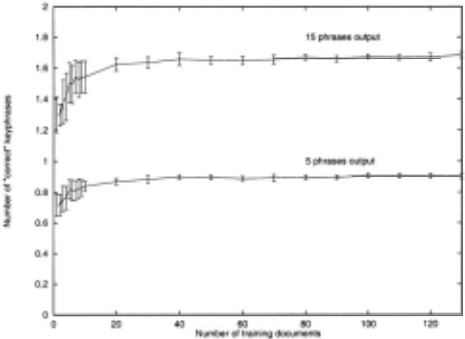
To illustrate the effect of training set size, Figure 1 shows Kea's performance on an independent set of 500 test documents. It plots the number of "correct" keyphrases, for both five and fifteen phrases extracted, against the number of documents used for training, from 1 through 130 files. The error bars give 99% confidence intervals derived by training Kea on ten different train ing sets of the same size. We used the same independent 100 documents for calculating the document frequencies throughout this particular experiment. It can be seen from Figure 1 that if more than twenty documents are used for training, little is gained by increasing the num ber further. With 50 documents, there is no further performance improvement.
These results show that Kea's performance is close to optimum if about 50 training documents are used; in other words, 50 labeled documents are sufficient to push performance to the limit . However, Section 3 demonstrates that this is not the case if domain-specific infor mation is exploited in the learning and extraction pro cess. In that case, much larger amounts of labeled train ing documents prove beneficial.
Subject Area of Training Documents
Now we investigate the extent to which models formed by Kea transfer from one subject domain to another. To this end we use the collection of journal articles de scribed above, and two collections of web pages also used by Thrney [1999), Aliweb, and NASA, all of which have keyphrases assigned. The basic procedure was to train on one of the collections and test on another, produc ing nine combinations. For each collection we chose 55 training documents at random and used the rest for test ing, 20 for the journal articles, 35 for Aliweb, and 86 for NASA. The training documents were used to compute the document frequencies; thus the entire keyphrase as signment model was based on the training documents alone. For the journal articles, as well as the randomly chosen test set, we ran experiments with the same train ing/testing division that Thrney [1999] used, the test set comprising 20 articles in the journal Psycoloquy.
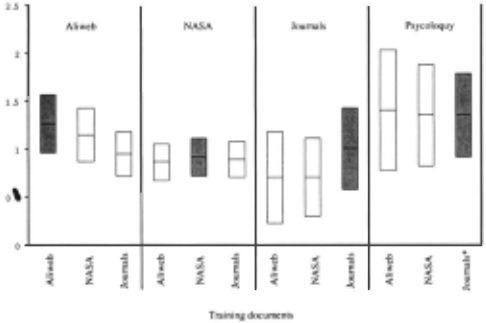
Figure 2 shows the average number of correct keyphrases returned when five keyphrases are retrieved, for twelve cases. The first nine represent every combina tion of training and testing sets drawn from one of the three collections, and the last represents the Psycolo quy test set with the same three training sets (except that all but Psycoloquy articles were used for the Jour nal training set, so it has a different composition from the Journal training set used for the other three cases). The bars give 95% confidence intervals for the mean per formance over the test sets. The dark bars highlight the cases where the test and training documents are drawn from the same population.
Note first that none of the four cases shown in Figure 2 show any statistically significant difference between the results for the three training sets- the confidence inter vals overlap substantially. However, in the first three cases, slightly better results seem to be obtained when test and training documents are drawn from the same population (dark bars). The fourth case (which cor responds to Turney's [1999] experiment) is anomalous in this regard, which suggests that the test set, in this case Psycoloquy journals, differs in character from the training set, in this case the other journals. Also, the Psycoloquy test set produces considerably (though not statistically significantly) better results whatever set it is trained on. This is because authors specified more keyphrases for these papers (an average of 8.4).
We conclude that although it makes little difference whether the training and testing documents come from different subject areas (certainly, the differences we have found are not statistically significant, perhaps because the test sets are too small), to be on the safe side we recommend using documents from the same subject area if that is possible.
This finding leads to the idea of directly exploiting the fact that different keyphrases are used in different subject areas. We explore this, using Kea, next.
3 Exploiting Domain-Specific Information
A simple modification of Kea enables it to exploit collection-specific knowledge about the likelihood of a particular phrase being a keyphrase. All that is neces sary is to keep track of the number of times a candidate phrase occurs as a keyphrase in the training documents, and use this information in the form of an additional, third attribute during the learning and extraction pro cesses.
3.1 Extending the Model
For a given phrase Pin document D, the new attribute which we call keyphrase-frequency--is simply the num ber of times P occurs as an author-assigned keyphrase in all training documents other than D. Because this new attribute is integer-valued, we discretize it using the procedure from Section 2.2. Making the naive Bayes as sumption of independence, with K being the discretized value of the keyphrase-frequency attribute, the probabil ity of a phrase being a keyphrase becomes:
where Pr[Kikey] is the probability that a keyphrase has discretized keyphrase-frequency value K. Like the other probabilities-discussed in Section 2.2- Pr[Kikey] can be estimated reliably by counting the number of times the corresponding event occurs in the training data.
The new attribute only makes sense if the documents for which keyphrases are to be extracted come from the same domain as the training documents. Otherwise, there is no reason to bias the extraction algorithm to wards choosing phrases that have occurred as author assigned keyphrases during training. In order to make use of the information provided by the new attribute, it is necessary to re-train the extraction algorithm if keyphrases are to be extracted from documents on a dif ferent topic. Training time becomes a critical factor.
Kea can generate a model for a new set of training documents far faster than GenEx because of the simple learning methods it employs. 6 Asymptotically, it spends most of the time sorting the attribute values for dis cretization. Since sorting is O(n log(n)) in the number· of values, Kea is O(n log(n)) in the number of phrases con tained by the training documents. On the collection of journal articles from Section 2.4, Kea needs 8 minutes for training, whereas GenEx needs approximately 48 hours [Turney, 1999]. Note that these times are measured on different computers. However, Kea is implemented in a combination of Perl and Java, whereas GenEx is written in C: we expect that the difference would be even more pronounced if the systems were compared on a level foot ing.
3.2 Experimental Evaluation
We empirically verified that exploiting domain-specific information increases the number of correctly extracted keyphrases by performing experiments with the CSTR collection described above. In order to isolate the effect of changing the number of documents for computing the keyphrase-frequency attribute, we used a separate set of documents- the keyphrase frequency corpus- for count ing the number of times a phrase occurs as a keyphrase. The actual set of 130 training documents was held con stant . Also, the same set of 500 test documents was used throughout this experiment.
6 However, GenEx and Kea both extract keyphrases very quickly once a model has been generated.
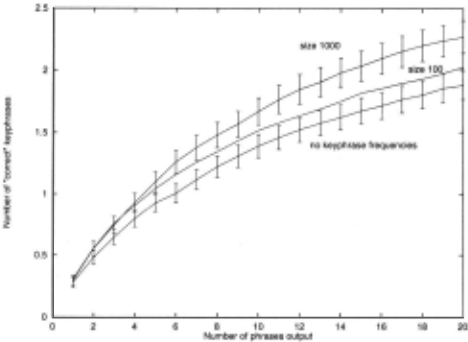
Figure 3 shows how the number of correctly identified keyphrases varies with the amount of domain-specific in formation available. The worst performance is obtained when this information is not used- in other words, the keyphrase-frequency attribute is excluded from the model. The performance improves as more documents are included in the keyphrase frequency corpus. Re sults are shown for corpuses of size 100 and 1000. Error bars are included for the case where no keyphrase fre quency corpus is used, and for a corpus of size 1000: these give 95% confidence intervals on the number of keyphrases correctly extracted from a test document, and show that it is indeed possible to get significantly better results by exploiting domain-specific information about keyphrases. In contrast to the results from Sec tion 2.4, it pays to have more than 50 documents with author-assigned keyphrases available- in fact, moving from 100 to 1000 documents improves results remark ably.
4 Conclusions
We have evaluated a simple algorithm for keyphrase ex traction, called Kea, which is based on the naive Bayes machine learning method, and shown that it performs comparably to the state of the art, represented by Tur ney's GenEx algorithm. We then proceeded to show how Kea's performance can be boosted by exploiting domain specific information about the likelihood of keyphrases.
Kea is particularly well suited for making use of this in formation because it can be trained very quickly in a new domain. Experiments on a large collection of computer science technical reports confirm that the modification significantly improves the quality of the keyphrases ex tracted.
Making use of knowledge about which keyphrases are used frequently in a particular domain has the additional advantage that the extracted keyphrases are more uni form. This property makes it easier to categorize doc uments using the keyphrases extracted, and should be beneficial if they are used for topic search or document clustering.
5 Acknowledgments
Many thanks to Peter Turney for making his document collections and drafts of his paper available to us, and to John Cleary for independently suggesting the use of the keyphrase-frequency attribute.
@inproceedings{ijcai1999p95,
  title     = {Domain-Specific Keyphrase Extraction},
  author    = {Frank, Eibe and Paynter, Gordon W. and Witten, Ian H. and Gutwin, Carl and Nevill-Manning, Craig G.},
  booktitle = {Proceedings of the Sixteenth International Joint Conference on
               Artificial Intelligence, {IJCAI-99}},
  publisher = {International Joint Conferences on Artificial Intelligence},
  editor    = {Thomas Dean},
  pages     = {668--672},
  year      = {1999},
  note      = {Machine Learning},
  url       = {https://ijcai.org/proceedings/1999/95},
}
TY - CPAPER TI - Domain-Specific Keyphrase Extraction AU - Frank, Eibe AU - Paynter, Gordon W. AU - Witten, Ian H. AU - Gutwin, Carl AU - Nevill-Manning, Craig G. T2 - Proceedings of the Sixteenth International Joint Conference on Artificial Intelligence, IJCAI-99 PB - International Joint Conferences on Artificial Intelligence PY - 1999 SP - 668 EP - 672 UR - https://ijcai.org/proceedings/1999/95 ER -Copied
Machine-readable versions of this paper, for tools and AI agents:





