
SAT-Encodings, Search Space Structure, and Local Search Performance
Proceedings of the Sixteenth International Joint Conference on Artificial Intelligence. Challenge Papers. Pages 296-302.
© 1999 International Joint Conferences on Artificial Intelligence
Abstract
Stochastic local search (SLS) algorithms for propositional satisfiability testing (SAT) have become popular and powerful tools for solving suitably encoded hard combinatorial from different domains like, e.g., planning. Consequently, there is a considerable interest in finding SAT-encodings which facilitate the efficient application of SLS algorithms. In this work, we study how two encodings schemes for combinatorial problems, like the well-known Constraint Satisfaction or Hamilton Circuit Problem, affect SLS performance on the SAT-encoded instances. To explain the observed performance differences, we identify features of the induces search spaces which affect SLS performance. We furthermore present initial results of a comparitive analysis of the performance of the SAT-encoding and -solving approach versus that of native SLS algorithms directly applied to the unencoded problem instances.
- [Cheeseman et al., 1991] P. Cheeseman, B. Kanefsky, and W. Taylor. Where the Really Hard Problems Are. In Proc. /JCA/ '91, pages 331-337, 1991. IJCAI
- [Clark et al., 1996] D. Clark, J. Frank, I. Gent, E. Macintyre, N. Tomov, and T. Walsh. Local Search and the Number of Solutions. In Proc. CP'96, LNCS, vol. 1118, pages 119- 133. Springer Verlag, 1996.
- [Dubois et al., 1993] Dubois, P. Andre, Y. Boufkhad, and J. Carlier. SAT versus UNSAT. In 2nd DIMACS Imple- mentation Challenge, 1993.
- [de Kleer, 1989] J. de Kleer. A Comparison of ATMS and CSP Techniques. In Proc. IJCA/'89. Morgan Kaufmann, 1989. IJCAI
- [Ernst et al., 1997] M. Ernst, T. Millstein, and D. Weld. Au- tomatic SAT-Compilation of Planning Problems. In Proc. /JCAI-97, 1997. IJCAI
- [Frank and Martel, 1995] J. Frank C. Martel. Phase Tran- sitions in the Properties of Random Graphs. In CP'95 Workshop on Studying and Solving Really Hard Problems, 1995.
- [Frank et al., 1997] J. Frank, P. Cheeseman, and J. Stutz. When Gravity Fails: Local Search Topology. lAIR, 7:249- 281 , 1997.
- [Galinier and Hao, 1997] P. Galinier and J. Hao. Tabu Search For Maximal Constraint Satisfaction Problems. In Proc. CP'97, LNCS, vol. 1330, pages 196--208. Springer Verlag, 1997.
- [Gu, 1992] J. Gu. Efficient Local Search for Very Large- scale Satisfiability Problems. ACM SIGART Bulletin, 3(1):8-12, 1992.
- [Hoos, 1998] Hoos, H. H. 1998. Stochastic Local Search- Methods, Models, Applications. Ph.D. Dissertation, Fach- bereich Informatik, Technische Universitiit Darmstadt.
- [Hoos and Sttitzle, 1998] H. H. Hoos and T. Sttitzle. Eval- uating Las Vegas algorithms -pitfalls and remedies. In Proc. UA/'98, 1998.
- [Iwama and Miyazaki, 1994] K. Iwama and S. Miyazaki. SAT-Variable Complexity of Hard Combinatorial Prob- lems. In Proc. IFIP World Computer Congress, pages 253-258. Elsevier Science B.V., North Holland, 1994. 302 CHALLENGE PAPERS [Kautz and Selman, 1996]
- H. Kautz and B. Selman. Pushing the Envelope: Planning, Propositional Logic, and Stochas- tic Search. In Proc. AAA/'96, volume 2, pages 1194-120 I, 1996.
- [Kautz and Selman, 1998] H. Kautz and B. Selman. The role of Domain-specific Knowledge in the Planning as Satisfi- ability Framework. In . Proc. AIPS-98, 1998.
- [McAllester et al., 1997] D. McAllester, B. Selman, and H. Kautz. Evidence for Invariants in Local Search. In Proc. AAA/'97, pages 321-326, 1997.
- [Minton et al., 1992] S. Minton, M.D. Johnston, A.B. Philips, and P. Laird. Minimizing Conflicts: A Heuri stic Repair Method for Constraint Satisfaction and Scheduling Problems. Artificial Intelligence, 52:161-205, 1992.
- [Prosser, 1996] P. Prosser. An Empirical Study of Phase Transitions in Binary Constraint Satisfaction Problems. Artificial Intelligence, 81:81-109, 1996.
- [Selman et al., 1992] B. Selman, H. Levesque, and D. Mitchell. A New Method for Solving Hard Satisfiability Problems. In Proc. AAA/'92, pages 440-446, 1992.
- [Selman et al., 1997] B. Selman, H. Kautz, and D. McAllester. Ten Challenges in Propositional Reasoning and Search. In Proc. /JCAI-97, 1997. IJCAI
- [Smith and Dyer, 1996] B. Smith and M . Dyer. Locating the Phase Transition in Binary Constraint Satisfaction Prob- lems. Artificial Intelligence, 81 :155-181, 1996.
- [Steinmann et al., 1997] Steinmann, A. Strohmaier, and T. Sttitzle. Tabu Search vs. Random Walk. In Advances in Artificial Intelligence (KI-97), LNAI, vol. 1303, pages 337-348. Springer Verlag, 1997.
- [Yokoo, 1997] M. Yokoo. Why Adding More Constraints Makes a Problem Easier for Hill-Climbing Algorithms: Analyzing Landscapes of CSPs. In Proc. CP'97, LNCS, vol. 1330, pages 357-370. Springer Verlag, 1997.
References were extracted automatically from the PDF and may contain errors.
Full text extracted automatically from the PDF; figures, tables and equations may differ. The PDF is the version of record.
1 Introduction
In the past few years, the development of extremely fast stochastic algorithms for the propositional satisfiability prob lem (SAT) have stirred considerable interest in the AI com munity. Modern stochastic local search algorithms, like WalkSAT and its more recent variants [McAllester et al., 1997], can solve hard instances with several thousand vari ables and ten thousands of clauses within minutes of comput ing time. While only a very few "real-world" problems come as instances of SAT, many of these are combinatorial prob lems with quite natural CSP-like formulations, which can be easily encoded into SAT. In practice, however, for solving problems by encoding them into SAT and applying state-of the-art SAT solvers, one has to find encodings which cannot only be efficiently generated, but which are also efficiently solvable by the respective SAT-solvers. While recent suc cesses in solving SAT-encoded planning problems suggest that such efficient encodings can be found, our understand ing of how encodings affect the performance of modern SAT algorithms and how good encodings can be found is very lim ited. "Characterizing the computational properties of differ ent encodings of a real-world problem domain, and/or giv ing general principles that hold over a range of domains" has We approach this problem by studying the impact of en coding strategies on search space structure and the perfor mance of stochastic local search (SLS) algorithms. In par ticular, we investigate the following questions:
- Does it pay off to minimise the number of propositional variables, i.e., are compact encodings which achieve small search spaces preferable to the bigger, but concep tually simpler sparse encodings?
- Is the generic problem solving approach using SAT encodings and modern SLS algorithms for SAT compet itive with applying SLS algorithms to the un-encoded problem instances?
Our investigation is based on two case-studies, covering sets of hard instances of the NP-hard Constraint Satisfac tion Problem (CSP) and Hamilton Circuit Problem (HCP). Building on earlier work on search space structure and SLS performance [Clark et al., 1996; Yokoo, 1997; Frank et al., 1997] and SAT encodings [Ernst et al., 1997], we empiri cally analyse the impact of different encoding strategies on SLS performance and provide explanations for our observa tions by identifying search space features correlated with the observed SLS performance. Furthermore, we compare the performance of SLS algorithms on the best SAT-encoding of hard random binary CSP encodings with the performance of the best known native CSP algorithm based on stochastic lo cal search.
As a preview of the results presented in the next sec tions, we briefly summarise our answers to the questions from above - however, given the general nature of these ques tions and the limited scope of the underlying empirical evi dence these answers are tentative and should be understood as testable hypotheses.
- According to our results for CSP and HCP, it seems to be much more advisable to use sparse rather than compact encodings, as the search spaces produced by the com pact encodings are smaller but have characteristic fea tures which impede local search.
- When comparing the performance of SLS algorithms for CSP and SLS-based SAT algorithms applied to SAT encoded CSPs, we observe a surprisingly small ad vantage for the direct CSP solving approach, which is outweighed by other advantages of the generic SAT-
encoding and solving approach such as the availability of very efficient implementations.
The remainder of this paper is structured in the following way. Section 2 gives some background on SLS algorithms for SAT and introduces the problems classes and test-sets used for our empirical analysis. Section 3 reviews previous work on search space structure and its impact on SLS performance and presents our approach to search space structure analysis. Sections 4-6 present the empirical investigations of the three questions from above, and Section 7 contains some conclu sions and points out directions for future research.
2 Background
Stochastic local search approaches for SAT became promi nent in 1992, when independently Selman, Levesque, and Mitchell [Selman et al., 1992] as well as Gu [Gu, 1992] in troduced algorithms based on stochastic local hill-climbing which could be shown to outperform state-of-the-art sys tematic SAT algorithms on a variety of hard subclasses of SAT. Since then, numerous other SLS schemes for SAT have been proposed. To date, state-of-the-art SLS algorithms can solve hard SAT problems up to several thousand vari ables, including SAT-encoded problems from other domains. In the recent past, especially the successful applications of SLS-based SAT algorithms for solving SAT-encoded plan ning problems, have stirred considerable interest in the AI community [Kautz and Selman, 1996; Ernst et al., 1997; Kautz and Selman, 1998].
The algorithms considered here are model finding algo rithms for CNF formulae. The underlying state space is al ways defined as the set of all assignments for the variables appearing in the given formula. Local search steps modify at most the value assigned to one of the propositional variables appearing in the formula; such a move is called a variable flip . The objective function is generally defined as the number of clauses which are unsatisfied under a given variable assign ment; thus, the models of the given formula correspond to the global minima of this function. The general idea for finding these is to perform stochastic hill-climbing on the objective function , starting from a randomly generated initial assign ment.
The main difference between the individual algorithms lies in the strategy used to select the variable to be flipped next. In this paper, we focus on the well-known WalkSAT family of algorithms [McAllester et al., 1997], which provided a sub stantial driving force for the development of SLS algorithms for SAT and have been extremely successful when applied to a broad range of problems from different domains. WalkSAT algorithms start from a randomly chosen variable assignment and repeatedly select one of the clauses which are violated by the current assignment. Then, according to some heuristic a variable occurring in this clause is flipped using a greedy bias to increase the total number of satisfied clauses. For the orig inal WalkSAT algorithm, in the following referred to simply as WalkSAT, the following heuristic is applied. If in the se lected clause variables can be flipped without violating other clauses, one of these is randomly chosen. Otherwise, with a fixed probability p a variable is randomly chosen from the clause and with probability 1-p a variable is picked which minimises the number of clauses which are currently satis fied but would become violated by the variable's flip (number of breaks). The walk probability p (also called the noise pa rameter) has an important influence on the algorithms' over all performance. In this paper, we always use approximately optimal noise parameter settings for evaluating SLS perfor mance; these settings are experimentally determined such that they minimise the expected number of flips for solving the given problem instance.
For the empirical study presented here, we use two well known classes of combinatorial problems: Random bi nary Constrained Satisfaction Problems (CSPs) and Random Hamilton Circuit Problems (HCPs). Both binary CSPs and HCPs form NP-complete problem classes. Random binary CSPs have been studied extensively by various researchers, especially in the context of phase transition phenomena and their impact on the performance of CSP algorithms [Smith and Dyer, 1996; Prosser, 1996]. To obtain a test-set of hard problem instances, CSP instances with 20 variables and do main size 10 were sampled from the phase transition region characterised by a constraint graph density of a: = 0.5 and a constraint tightness of /3 = 0.38. Filtering out the insoluble instances with a complete CSP algorithm, test-set csp2 010, containing 100 soluble instances from this problem dis tribution, was generated.
For empirically investigating SLS performance for differ ent SAT-encodings of the HCP, we focussed on the Hamil ton Circuit Problem in directed random graphs. For a given graph, the HCP is to find a cyclic tour (Hamilton Circuit) us ing the edges of the graph which visits every vertex exactly once. In earlier work, when investigating the dependence of the existence of Hamilton Circuits on the average connectiv ity (edges per vertex), a phase transition phenomenon was observed [Cheeseman et al., 1991]. The associated peak in hardness for backtracking algorithms was located between "' = e/(nlogn) ~ 0.9 and 1.2, where n is the number of vertices and e the number of edges [Frank and Martel, 1995]. Based on these results, we created a test-set by randomly sam pling soluble HCP instances from distributions of directed random graphs with n = 10 and "' = 1. The test-set was generated using a HCP generator and solver developed and provided by Joe Culberson; insoluble instances were filtered out using the integrated systematic HCP solver, such that the final test-set hcplO contains 100 soluble instances.
3 Search Space Structure and SLS Performance
Obviously, the behaviour of SLS algorithms is determined by the topology of the search space, i.e., the objective function induced by a specific problem instance. Recently, a grow ing number of researchers have been investigating the nature of this dependency for SLS-based SAT algorithms [Clark et al., 1996; Yokoo, 1997; Frank et al., 1997]. However, all of the studies we are aware of are restricted to Random-3-SAT, a widely used class of randomly generated SAT problems, while SAT-encoded problems from other domains have not been addressed. In [Clark et al., 1996], it has been shown that for a given problem instance, its number of solutions is strongly negatively correlated with the performance of some SLS algorithms for SAT and CSP based on hill-climbing. This confirms the intuition that instances with a high solution density, i.e. , a large number of solutions, tend to be much eas ier to solve for SLS algorithms than instances with very few solutions. [Yokoo, 1997] explains the peak in local search cost observed at the phase-transition region of Random-3SAT in terms of the number and size of local minima re gions in the search space. His analysis, however, relies on an · exhaustive analyses of the search space and is therefore re stricted to very small problem instances. [Frank et al., 1997] analyse the topology of search spaces induced by Random3-SAT formulae, but do not investigate the concrete impact of these features (such as the size of local minima) on SLS performance.
The approach taken here is to compare both the impact of encoding strategies on SLS performance as well as to provide explanations of the observed correlation in terms of search space features induced by the different encodings. To be not restricted to very small problem instances which possibly do not reflect the typical situation as encountered for realistic problems (i.e., instances which can be solved with state-of the art SLS algorithms), we restrict our analysis to features with can be determined without exhaustive search of large parts of the search space. The features we measure are:
- the solution density (number of solutions/search space size);
- the standard deviation of the objective function (sdnclu);
- the local minima branching along SLS trajectories (blmin).
As the solution density is known to be an important factor for SLS performance, it should be taken into account although it is generally time-consuming to measure. For counting the number of solutions of a given problem instance, we applied a modified version of the ASAT algorithm [Dubois et at., 1993] to the SAT-encoded instances. To our best knowledge, both sdnclu and blmin have not been studied before in the context of search space structure.
Intuitively, large sdnlcu values should indicate a rugged search space structure for which SLS approaches based on hill-climbing are more effective than for featureless, flat search spaces with many plateaus. To measure sdnclu val ues, we determine the objective function value (number of unsatisfied clauses) for a sample of 100,000 randomly chosen assignments. To improve comparability of the results for dif ferent numbers of clauses, we scale objective function values to the interval [0, 1) (by division by the number of clauses). The sdnclu value is then computed as the empirical stan dard deviation over this sample. Although compared to the search space sizes of our test instances the sample size is very small, we get meaningful results - presumably because of the global effects of the encoding strategies on search space topology.
Since it is known that the number and size of local minima plays an important role for SLS performance on Random3-SAT [Yokoo, 1997], we extended these results by study ing the structure of local minima regions. We do this by measuring the average branching of local minima states, i.e., for a given variable assignment, the number of neighbouring assignments 1 with the same objective function value. The underlying intuition is that highly branched local minima re gions are more difficult to escape from, as there are fewer es cape routes for random walk and similar plateau escape tech niques, but more possibilities for non-deterministic loops to occur in the search trajectory. Local minima states are typi cally quite rare for the problem instances studied here; thus, blmin cannot be measured by randomly sampling the search space. Instead we sampled the local minima states along SLS trajectories, using a sample size of 100,000. Again, to im prove comparability of the results between different problem instances, we scale the values thus obtained to the interval [0, 1) (by division by the number of variables).
1 The neighbourhood relation is the same as used by all GSAT type algorithms, i.e., two assignments are neighbours if and only if they differ in the truth value of exactly one variable.
For a given problem instance, WalkSAT's performance (denoted as lsc- local search cost) is measured as the ex pected number of flips per solution, determined from 1001,000 runs per instance using an approximately optimal noise setting (see above) and a cutoff parameter high enough to guarantee that in every run a solution was found . 2
4 Compact versus Sparse Encodings
Many combinatorial problems, such as Number Partitioning, Bin Packing, or Hamilton Circuit, can be quite naturally for mulated as discrete constraint satisfaction problems. When encoding such CSP formulations into SAT, perhaps the most intuitive way is to encode each assignment of a value to a CSP variable by a different propositional variable [de Kleer, 1989]. We call this the sparse encoding, since it results in rel atively sparse constraint graphs 3 for the resulting CNF formu lae. This encoding strategy requires IDI · n variables, where IDI is the domain size and n the number of CSP variables. 4
Given the intuition that high solution densities should fa cilitate local search (see above), it seems to be worthwhile to consider encodings which minimise the number of propo sitional variables, and therefore the potential search space size without affecting the number of solutions. One encod ing strategy which achieves that is the compact encoding obtained by representing each value assignment to a CSP variable binarily using a set of flog2 IDil propositional vari ables.Compared to the sparse encoding, this strategy signifi cantly reduces the search space by a factor of O(n · (IDI - logiDI) ), while the number of clauses is usually similar, as it is usually dominated by clauses encoding the constraint rela tions (the number of which is identical for both encodings). The compact encoding is well-known from the literature; it has been proposed in the context of SAT variable complexity by [Iwama and Miyazaki, 1994] and is also used in the SAT based MEDIC planning system, where it is called "factored representation" [Ernst et at., 1997].
To investigate the impact of these two encoding schemes on SLS performance we measured WalkSAT's performance on the test-sets of Random Binary CSP and HCP instances described above. The HCP instances are encoded as CSPs by focussing on vertex permutations of the given graph as solu tion candidates (this idea has been proposed in [lwama and Miyazaki, 1994]); in particular, for each vertex v we intro duce a CSP variable the value of which represents v's posi tion in the permutation. The constraint relations ensure that each vertex appears exactly once (type 1 constraints), i.e., the candidate solution corresponds to a valid permutation of the vertices, and that each pair of neighbouring vertices in this (cyclic) permutation is connected by an edge in the given graph (type 2 constraints).
2 0ur actual experimental methodology is based on measuring run-time distributions (RTDs) as outlined in [Hoos and Stiitzle, 1998]; the RTD data is not reported here, but can be obtained from the author. A more detailed description .of the empirical study and its results can be found in [Hoos, 1998] and will be presented in more detail in an extended version of this paper.
3 The constraint graph consists of one node for each propositional variable and edges between nodes corresponding to variables which occur together in some clause of the given CNF formula.
4 For simplicity's sake we assume that the domain sizes for all CSP variables are identical.
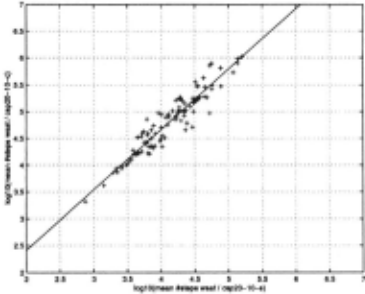
Figure I shows the correlation of the average local search cost (lsc) between the different encodings across the test set c sp2 0-10; each data point corresponds to the lsc for the sparse vs the compact encoding for one problem instance from the original test-set. As can be seen from the scatter plot, there is a strong linear correlation between the loga rithm's average local search cost for both encodings (corre lation coefficient r = 0.95), i.e.; instances which are rela tively hard for WalkSAT when sparsely encoded also tend to be hard when using the compact encoding. But this analysis also shows that the compact encoding results in instances for which the lsc is generally ca. 7 times higher than for the cor responding sparsely encoded instances, although the compact encoding requires less then half the number of variables and significantly fewer clauses than the sparse encoding (cf. Ta ble 1 ). This confirms earlier observations [Ernst et al., 1997] that the compact encoding generates problem instances which are typically extremely hard for stochastic local search.
But what exactly makes this encoding so ineffective? Ta ble I shows the solution density, sdnclu, and blmin values for the easiest, median, and hardest (w.r.t. their lsc values for WalkSAT) problem instance from the test-set csp20-10. The data confirms that within the test-set, the solution density is the predominant factor affecting local search cost, as ear lier observed for Random-3-SAT test-sets [Clark et at., 1996]. However, between the two encodings, this does not hold. Instead, the sdcnlu and the blmin values indicate that the compact encoding induces a flatter, featureless search space topology characterised by considerably higher branched local minima states. As argued above, intuitively this makes local search more difficult, which is consistent with the consider ably higher local search cost observed for WalkSAT on the correspondingly encoded CSP instances. Interestingly, this explanation is also quite consistent with the (relatively big) differences in local search cost within the corresponding test sets, although the relatively small differences in sdcnlu and blmin seem to confirm the predominant role of the solution density.
Applying the same analysis to sparsely and compactly en coded versions ofthe HCP test-set hcp1 0 gives exactly anal ogous results (cf Table 1); the correlation coefficient for the correlation between log(lsc) for -s and -c is 0.85) and thus confirms our observations and interpretation given above. Apparently, the compact encoding induces rather flat, feature less search spaces which impede local search and local min ima escape to such an extent that WalkSAT's performance is significantly reduced despite the much higher solution den sity achieved by reducing the number of variables.
There is, however, another factor to be considered. The CPU-time required for each single flip performed by Walk SAT is roughly constant for a given problem instance; it depends, however, considerably on the syntactical features of the given formula (especially number and length of clauses). Comparing the CPU-time per variable flip between the formulae generated by the sparse and compact encoding schemes reveals that for the compact encoding also the CPU time per flip is significantly higher (for both, csp20-10-c and hcp10-c instances approximately by a factor of 3) than for the sparse encoding. This can be explained by the fact that the compact encoding produces longer and more tightly con nected clauses (in terms of number of clauses which share at least one variable with any given clause), such that each vari able flip affects potentially more clauses (by breaking or fix ing them). So the compact encoding induces both, a syntac tic structure (the longer and more tightly connected clauses) and a semantic structure (the search space features discussed above) which reduce WalkSAT's performance by increasing the CPU-time per search step and decreasing the efficiency of these search steps.
5 To Encode or Not to Encode?
The results presented in the preceeding sections suggest that when solving combinatorial problems by encoding them into SAT and applying powerful SLS algorithms, there might be a tradeoff between the size of the representation and SLS per formance. Apparently compact encodings can be used to generate formulae with small search spaces; however, these have characteristic features which impede the performance of WalkSAT and similar SAT algorithms. One obvious question therefore is the following. Given a formulation of a combi natorial problem as a CSP, should we encode into SAT at all, or rather apply SLS algorithms for CSP to directly solve the unencoded problem?
Here, we present some initial results on this question. Specifically, we analyse the correlation between the per formance of WalkSAT and an WMCH, an analogous algo rithm for CSP which is based on the Min Conflicts Heuristic [Minton et at., I992] and has been introduced in [Steinmann et at., 1997]. Like WalkS AT, WMCH is a SLS algorithm which iteratively repairs violated constraints following the steepest gradient, but also allows to escape from local minima of the objective function by allowing occasional, randomised uphill moves (for details, see [Steinmann et al., 1997]). Like for WalkSAT, the local search cost (lsc) for WMCH was mea sured as the expected number of local search steps to find a solution, based on 100 runs of the algorithm for each given problem instance. Generally, we always used approximately optimal noise parameter settings and a cutoff parameter high enough to guarantee that in every run a solution was found.
| instance | encoding | variables | clauses | avg. lsc | num sin | sin density | sdnclu | blmin |
|---|---|---|---|---|---|---|---|---|
| csp20-1 0-s/easy | sparse | 200 | 3,661 | 775.80 | 37,297 | 2.01 . 10 56 | 0.0366 | 0.015 |
| csp20-1 0-s/med | sparse | 200 | 4,367 | 11,162.69 | 6 | 3.73. 10- 60 | 0.0361 | 0.017 |
| csp20-1 0-s/hard | sparse | 200 | 4,412 | 134,777.38 | 2 | 1.24 . 10- 60 | 0.0356 | 0.017 |
| csp20-1 0-c/easy | compact | 80 | 2,861 | 2,249.19 | 37,297 | 3.09 . 10 20 | 0.0011 | 0.131 |
| csp20-1 0-c/med | compact | 80 | 3,555 | 77,883.52 | 6 | 4.96. 10- 24 | 0.0011 | 0.157 |
| csp20-1 0-c/hard | compact | 80 | 3,612 | 1,000,456.82 | 2 | 1.65 . 10- 24 | 0.0011 | 0.161 |
| he 1 0-s/easy | sparse | 100 | 1,060 | 215.97 | 60 | 4.73 ·10 29 | 0.0504 | 0.059 |
| hc10-slmed | sparse | 100 | 1,060 | 781.28 | 20 | 1.58 ·10- 29 | 0.0502 | 0.056 |
| he 1 0-s/hard | sparse | 100 | 1,060 | 2,562.18 | 20 | 1.58 ·10- 29 | 0.0502 | 0.047 |
| he 1 0-c/easy | compact | 40 | 1,110 | 548.37 | 60 | 5.46 ·10 11 | 0.0017 | 0.187 |
| hc10-c/med | compact | 40 | 1,110 | 1,258.55 | 20 | 1.82 ·10- 11 | 0.0017 | 0.181 |
| he 1 0-c/hard | compact | 40 | 1,110 | 3,294.71 | 20 | 1.82 ·10- 11 | 0.0016 | 0.172 |
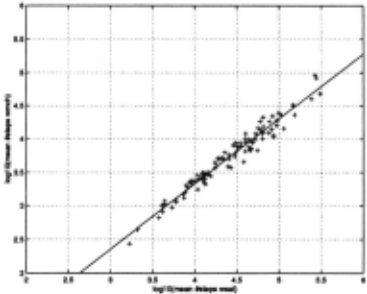
Analysing the correlation between the average local search cost for WalkSAT (using the sparse encoding) and WMCH across the test-set csp2 0-10 reveals an extremely strong linear correlation between the logarithms of the average lo cal search cost for both algorithms (cf Figure 2; correlation coefficient r = 0.98), i.e., instances which are relatively hard for WalkSAT also tend to be hard for WMCH and vice versa. A linear regression analysis of this data shows that WalkSAT tends to require ca. 5 times more steps than WMCH for solv ing the problem instances from our test-set (the coefficients of the regression analysis are a= 0.98 and b = -0.57).
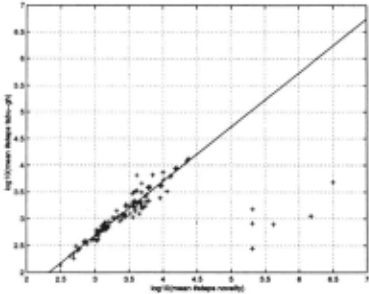
However, neither WalkSAT nor WMCH are the best known SLS algorithms for SAT and CSP, respectively. We therefore performed the same analysis for the best-performing SLS based SAT algorithm and the best SLS-based CSP algorithm we are aware of- Novelty [McAllester et al., 1997], one of the most recent variants of WalkS AT, and the tabu search al gorithm by Galinier and Hao [Galinier and Hao, 1997]. 5 Us ing optimal noise parameters for both algorithms, we find that when measuring the average number of local search steps per solution, Galinier's and Hao's CSP algorithm has generally only an advantage of a factor between 2 and 4 over Novelty. The correlation between both algorithm's performance is very strong (cf Figure 3; correlation coefficient= 0.96); however, Novelty occasionally gets stuck in local optima which it can not escape (causing the outliers in the scatter plot 7 instances), while the CSP algorithm shows no such behaviour. But this happens only for 7 of our 100 instances and for these only in a small number of the multiple tries we performed. We conjecture that by exending Novelty with a stronger stochas tic escape mechanism, this phenomenon can be eliminated. But except for these outliers, the regression analysis indicates that both algorithms show approximately the same scaling be haviour w.r.t. instance hardness. This is somewhat surprising, since Galinier's and Hao's algorithm and Novelty are con ceptually significantly less closely related than WMCH and WalkSAT. When performing an exactly analogous analysis for instances with 30 constraint variables and 10 values, we find a similar situation; only now, the performance advantage of the native CSP algorithm over Novelty is only a factor of ca. 1.7 on average (comparing the number of local search steps). Also, we observe no increased occurence of the out liers mentioned above. This suggests that when increasing the problem size, the SAT-based approach might have a slight scaling advantage over the native CSP algorithm.
Generally, our results from comparing the performance of SLS-based algorithms for CSP and SAT indicate that when measuring the average number of steps per solution, the differences are rather surprisingly small. We deliberately re frained from comparing CPU-times for these algorithms, be cause the implementations for the SAT algorithms are signif icantly more optimised. The SAT algorithms generally have the advantage that they are conceptually easier, which facil itates their efficient implementation, evaluation, and further development. Of course, our analysis is too limited to give a conclusive answer, but the results reported here suggest that for solving hard CSP instances, encoding them into SAT and using a state-of-the-art SLS algorithm for SAT to solve the SAT-encoded instances might be very competitive compared to using more specialised SLS-based CSP solvers.
5The considerably more complicated R-Novelty algorithm [McAllester et al., 1997] for SAT, which shows an even better per formance than Novelty on Random-3-SAT, is inferior to Novelty for the random binary CSPs used here.
6 Conclusions and Future Work
In this paper we presented an initial investigation of how SAT encoding strategies affect the topological structure of the in duced search spaces and SLS performance. Our empirical re sults show that for two well-known classes of NP-hard com binatorial problems, random binary CSPs and HCPs in ran dom directed graphs near the solubility phase transition, com pact SAT-encodings, which minimise the number of proposi tional variables for the encoded problem instances, exhibit structural features which impede local search algorithms like WalkSAT. This observation is consistent with earlier obser vations for planning problems and HCPs, that compact en codings are extremely hard to solve for SLS algorithms. At the same time, it shows that the influence of solution den sity on SLS performance which has been observed for CSP and SAT, is of minor significance compared to features like the overall ruggedness of the search space (as measured by the standard deviation of the objective function) or the lo cal minima branching. However, consistently with earlier re sults, it plays an important role in explaining the differences in SLS performance observed across test-sets of randomly generated instances, when using a fixed SAT-encoding. As a consequence of these results, compact encodings should be avoided in the context of using SLS algorithms for solving SAT-encoded combinatorial problems.
Furthermore, when comparing the performance of SLS al gorithms directly applied to test-sets of random binary CSP
instances to with the performance of SLS-based algorithms for SAT using the sparse encoding, we found that there is a strong correlation of the expected number of search steps required for finding a solution across the test-set. Although when comparing the best known SLS algorithms for CSP and SAT in this way, the direct CSP algorithm requires fewer local search steps per solution, we feel that this might very well be outweighed by other advantages of the SAT-encoding and solving approach, like the availability of extremely fast implementations or its conceptual simplicity. Also, due to the restrictions of the implementatins of the SAT-based CSP algorithms available for this preliminary study only binary CSP instances could be analysed. For more structured, none binary CSP instance, one might encounter a different situa tion; although it is not clear that (a) existing CSP algorithms can exploit this structure, and (b) even if they could, the same would not also be possible without too much effort for the SAT-encoded problem instances.
It should also be noted that, according to the results re ported here and elsewhere [Ernst et at., 1997; Kautz and Sel man, 1996], it seems that finding efficient SAT-encodings could very well be significantly easier than developping spe cialised algorithms for the respective domains. We do not believe that the generic problem solving approach based on SAT-encodings and extremely optimised SAT-algorithms will generally be competitive with specialised algorithms which make use of domain knowledge. However, it is quite possi ble that it can be established as another generic method for attacking problems for which domain-specific knowledge is not (yet) available or which are too specific and limited in their application to make the development of specialised al gorithms worthwhile. In this sense, the SAT-encoding and -solving approach could be compared to other generic prob lem solving methods, like, e.g., Mixed Integer Programming (MIP), which has become a standard generic solving tech nique for combinatorial problems in Operations Research.
The novel tools and techniques presented here can be eas ily applied to other hard combinatorial problems and SAT encoding schemes. Out investigation can be extended in var ious directions; in particular, it provides a basis for studying the following research questions:
- Based on the knowledge of the search space structure induced by specific encoding schemes, can we design SAT algorithms which exploit these features?
- Given the knowledge about which features affect SLS performance, can we devise efficient encoding strategies which improve SLS performance?
- For which problem classes is the SAT-encoding and - solving approach, using SLS algorithms for SAT, com petitive with analogous, generic SLS algorithms directly applied to the unencoded problem instances?
Thus, while this study does certainly not provide the final answers to the challenge or the more specific questions stated in Section 1, it shows a way for systematically investigating the relation between encodings, search space structure, and SLS performance which will hopefully lead to improved en codings and SAT algorithms, as well as, in the long run, to a realistic assessment of the generic SAT-encoding and -solving approach for solving hard combinatorial problems.
Acknowledgements
The CSP instances used for the experimental part of this paper were generated using software provided by Thomas Stiitzle whom I also wish to thank for many interesting and stimulating discussions. Fur thermore, I thank Bart Selman for his encouraging comments on an earlier version of this paper as well as Wolfgang Bibel and the Intellectics Group at TU Darmstadt for their support during a signif icant part of this work. Finally, I gratefully acknowledge valuable input by David Poole and the members of the Laboratory of Com putational Intelligence at the University of British Columbia. This research was partially supported IRIS Phase-III Project BOU, "Pref erence Elicitation and Interactive Optimization."
@inproceedings{ijcai1999p44,
  title     = {SAT-Encodings, Search Space Structure, and Local Search Performance},
  author    = {Hoos, Holger H.},
  booktitle = {Proceedings of the Sixteenth International Joint Conference on
               Artificial Intelligence, {IJCAI-99}},
  publisher = {International Joint Conferences on Artificial Intelligence},
  editor    = {Thomas Dean},
  pages     = {296--302},
  year      = {1999},
  note      = {Challenge Papers},
  url       = {https://ijcai.org/proceedings/1999/44},
}
TY - CPAPER TI - SAT-Encodings, Search Space Structure, and Local Search Performance AU - Hoos, Holger H. T2 - Proceedings of the Sixteenth International Joint Conference on Artificial Intelligence, IJCAI-99 PB - International Joint Conferences on Artificial Intelligence PY - 1999 SP - 296 EP - 302 UR - https://ijcai.org/proceedings/1999/44 ER -Copied
Machine-readable versions of this paper, for tools and AI agents:





