
The Multilingual Generation Game: Authoring Fluent Texts in Unfamiliar Languages
Proceedings of the Sixteenth International Joint Conference on Artificial Intelligence. Invited Speakers. Pages 1407-1410.
© 1999 International Joint Conferences on Artificial Intelligence
Abstract
There are obvious reasons for trying to automate the production of multilingual documents. Among them are the rapidly growing need for such documents, the high cost and low availability of good translators, and the fact that translators often need more time than is available to produce good multilingual versions. These problems are compounded when equivalent versions of a document are needed in not just two or three, but many, languages - as is often the case in Europe, where there are now eleven official languages in the European Community. This talk presents some recent developments in Multilingual Natural Language Generation (MNLG). These allow the automatic production of high-quality multilingual documents, while avoiding many of the well-known pitfalls of the more familiar alternative of Machine Thanslation (MT) - for example, the difficulty of information extraction from a source document and the danger of source-language bias.
- [Caldwell and Korelsky, 1994] D. Caldwell and T. Ko- relsky. Bilingual generation of job descriptions from quasi-conceptual forms. In Proceedings of the Fourth Conference on Applied Natural Language Generation, 1994.
- [Frank and Szekely, 1998] M.R. Frank and P. Szekely. Adaptive forms: an interaction technique for entering structured data. Knowledge-Based Systems, 11:37-45, 1998.
- [Kim, 1990] Y. Kim. Effects of conceptual data mod- elling formalisms on user validation and analyst mod- elling of information requirements. PhD thesis, Uni- versity of Minnesota, 1990.
- [Paley, 1996] S. Paley. Generic knowledge-base editor user manual. Technical report, SRI International, Cal- ifornia, 1996.
- [Paris et al., 1995] Cecile Paris, Keith Vander Linden, Markus Fischer, Anthony Hartley, Lyn Pemberton, Richard Power, and Donia Scott. A support tool for writing multilingual instructions. In Proceedings of the 14th International Joint Conference on Artificial In- telligence, pages 1398-1404, Montreal, Canada, 1995. IJCAI
- [Petre, 1995] M. Petre. Why looking isn't always seeing: readership skills and graphical programming. Commu- nications of the ACM, 38(6):33-42, 1995. .
- [Power and Cavallotto, 1996] R. Power and N. Caval- lotto. Multilingual generation of administrative forms. In Proceedings of the 8th International Workshop on Natural Language Generation, pages 17-19, Herst- monceux Castle, UK, 1996.
- R. Power and D. Scott. Multi- lingual authoring using feedback texts. In Proceed- ings of the 17th International Conference on Com- putational Linguistics and 36th Annual Meeting of the Association for Computational Linguistics, pages 1053-1059, Montreal, Canada, 1998.
- [Power et al., 1998] R. Power, D. Scott, and R. Evans. What you see is what you meant: direct knowledge editing with natural language feedback. In Proceedings of the 13th Biennial European Conference on Artificial Intelligence, pages 675-681, Brighton, UK, 1998.
- [Scott et al., 1998] D. Scott, R. Power, and R. Evans. Generation as a solution to its own problem. In Pro- ceedings of the 9th International Workshop on Natural Language Generation, pages 256-265, Niagara-on-the- Lake, Canada, 1998.
- [Sheremetyeva et al., 1996] S. Sheremetyeva, S. Niren- burg, and I. Nirenburg. Generating patent claims from interactive input. In Proceedings of the Eighth Inter- national Workshop on Natural Language Generation, pages 61-70, Herstmonceux, Sussex, June 1996.
- [Skuce and Lethbridge, 1995] D. Skuce and T. Leth- bridge. CODE4: A unified system for managing con- ceptual knowledge. International Journal of Human- Computer Studies, 42:413-451, 1995.
- [Tenant et al. , 1983] H. Tenant, K. Ross, R. Saenz, C. Thompson, and J. Miller. Menu-based natural lan- guage understanding. In Proceedings of the Associa- tion of Computational Linguistics, 1983.
- [van Deemter and Power, 1998] K. van Deemter and R. Power. Coreference in knowledge editing. In Pro- ceedings of the COLING-ACL workshop on the Com- putational Treatment of Nominals, pages 56-60, Mon- treal, Canada, 1998.
References were extracted automatically from the PDF and may contain errors.
Full text extracted automatically from the PDF; figures, tables and equations may differ. The PDF is the version of record.
1 Introduction
Solutions from computational linguistics have long been applied to the problem of multilingual document gen eration - an issue of growing concern to governments and international agencies, companies marketing multi nationally and global information providers. Despite the success of machine-aided translation, however, the prob lem of achieving high quality versions of documents in several languages within a reasonable time and at rea sonable cost remains outstanding.
The need for (at least partially) automated multilin gual documentation is to a large extent driven by the high cost and inherently slow production of professional manual translation. In dynamic global markets the re ality often is that delays introduced by the extra time needed for translation can cost a company many thou sands of dollars in lost sales. Human translation has two further drawbacks: (a) the strong potential for in troducing source language bias, and (b) the poor sup port for management and maintenance for manually produced multilingual versions of the same document.
·The work described in this paper is part of an ongoing collaboration at the ITRI between the author and her col leagues Richard Power and Roger Evans.
Machine-aided translation brings a number of known advantages over human translation: lower production costs, higher translation speed, and improved ~ainte nance support. Nevertheless, the quality of multllmgual documents achieved through machine translation is of an undeniably inferior standard than those produced man ually and the problem of source language bias remains.
The root of the problems with the MT approach lies primarily in the underlying representations of the text. First, it is rarely an accurate reflection of the content of the source text; this makes it extremely difficult for the target texts to contain the same information as its source. Second, it is very closely tied to the linguistic structure of the source text; this means that the struc ture of the target text is often more appropriate to the .source language than to the target language.
2 Symbolic Authoring of multilingual documents
Symbolic Authoring is a recent approach to the pro duction of good-quality multilingual documents. The main difference between it and machine translation can be seen by comparing Figures 1 and 2: Instead of writ ing a document in one language and submitting it to translation into other languages, the 'author' uses a spe cial editor to create the underlying meaning of the doc ument, and it is this symbolic source that is rendered into text. The advantage of symbolic editors coupled with multilingual natural language generation systems is that , as with machine translation, the document pro duction costs are lower and the production speeds are higher than for human translation. The advantage over machine translation is that it provides good support for document management and maintenance, the problem of source language bias is removed (since there is no source natural language text involved) and the resulting texts are high quality drafts.
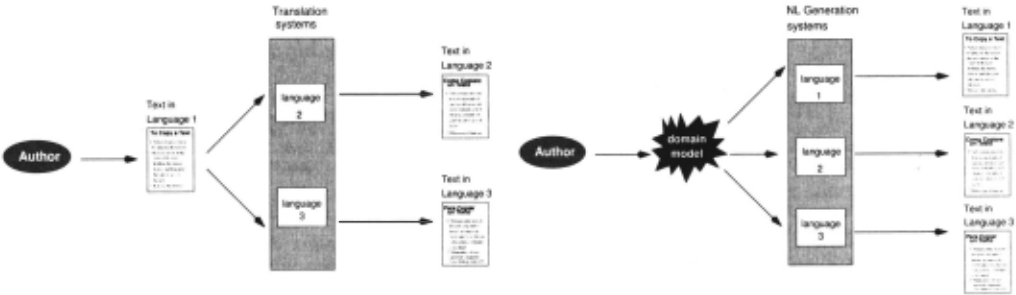
Symbolic editing allows the author to construct a non linguistic knowledge source which can be used for a vari ety of purposes. It is particularly attractive for natural language generation since it gives the author of the docu ment explicit control over the meaning of generated text, leaving the rendition of this meaning up to the NL gener ator that receives it as input. This method of automati cally generating text is especially useful for multilingual documents, since all language versions are derived from the same non-linguistic source and multilinguality can be achieved without language translation.
With this approach the author can guarantee that all language versions will have identical content. Consis tency is also guaranteed not only between documents but within them. Although the same information may be mentioned in various different parts of the same doc ument and its various language versions, it will have a single representation in the domain model; updating the texts becomes a matter of editing the domain model. By then regenerating the model, the updated texts are both internally consistent and pragmatically congruent across language versions. A growing number of systems make use of this new approach.
- EXCLASS is an intelligent support tool for person nel officers writing (bilingual English and French) job descriptions. The user builds the job descrip tion by composing and editing conceptual repre sentations; these representations are trees of con cepts from a structured conceptual dictionary. Con cepts are presented to the user through diagram matic trees with natural language labels [Caldwell and Korelsky, 1994].
- DRAFTER-I is an authoring tool to support technical authors and software developers in writing (bilin gual English and French) software manuals. The user directly builds the domain model (semantic knowledge base) describing the procedures for using a selected software application. As it is being con structed, the model is presented to the user through diagrams and fragments of text [Paris et al., 1995].
Figure 2: Multilingual documents through symbolic au thoring
- GIST is an authoring tool to support forms designers. It generates (multilingual English, German, Italian) forms in the domain of social administration. The user's interaction with GIST is very similar to that with DRAFTER-I. [Power and Cavallotto, 1996].
- A tool to support inventors in the authoring of (En glish only) patent claims allows the user to build a semantic model of the invented apparatus by select ing (via multiple-choice menu options) the appara tus parts, their functions and relations to each other [Sheremetyeva et al., 1996].
These systems all comprise one or more natural lan guage generators coupled to an interface that sup ports the manual creation of the generator's input (i.e. , the authoring of the symbolic (conceptual) content of the output document). This interface is a type of knowledge-editing tool with a graphical browser, similar to the Generic Knowledge-Base Editor [Paley, 1996] and the CODE4 Knowledge Management System [Skuce and Lethbridge, 1995]. Graphical knowledge-editing tools have the advantage of allowing the author to edit knowl edge directly rather than indirectly via text editing.
In principle, writers of symbolically-authored docu ments should be experts in the subject of the document , but they should not have to be linguists or computer sci entists. Although the systems described above do not re quire knowledge of linguistics or familiarity in any of the languages of the output texts, they do however require the user to be fairly highly skilled in areas of computer science and AI. For example, the graphical representa tion of the knowledge is often a network diagram; these cannot be understood and developed without training in such technical notions as 'object', 'attribute' and 'value restriction'. Equivalent drawbacks hold for plan-based representations. Empirical studies have shown that do main experts typically produce high error rates when us ing such graphical object-oriented modelling tools [Kim, 1990].
Obviously, for symbolic authoring to be an effective al ternative to machine translation, the author must be of fered a more familiar representation of the knowledge being constructed. Despite the well-known disadvantages of natural language as a knowledge representation lan guage, there is strong evidence to suggest that text offers a clear advantage over graphics for understanding com plex knowledge structures [Petre, 1995]. This problem thus becomes one of how to achieve symbolic author- ~ ing with the advantage of a textual interface but with - none of the disadvantages of textual interpretation that continue to hound Machine Translation.
3 Authoring multilingual documents
with WYSIWYM
This talk presents a new method of symbolic authoring we have developed that can be used by anyone famil iar with menus and hypertext browsing, which we call WYSIWYM editing 1 [Scott et al., 1998; Power and Scott, 1998; Power et al., 1998]. Using this method, the 'au thor' constructs the symbolic source (i.e. , the domain model) by selecting and expanding portions of a natural language text that is generated in his or her language of choice; each expansion updates the domain model, which is then regenerated in one of two modes:
- a feedback text: this is a specially constructed text with hypertext-like anchors that are the entry points to further expansion of the domain model.
an output text: this is the polished text that the author is aiming to achieve.
While in feedback mode, the author can perform routine editing operations such as cut, copy, and paste. In doing this, the author appears to be editing text, but this is illusionary: the operations are taking place on the do main model, which is then immediately re-described in generated text.
This method of editing a knowledge base kills two birds with one stone: the source is still a knowledge base, not a text, so no problem of interpretation arises; but the source is presented as a text, and so is easily understandable to the author.
Figure 3 shows the architecture of WYSIWYM author ing of multilingual documents. The basic WYSIWYM sys tem consists of three components:
- A module for building and maintaining knowledge bases. 2
- Natural language generators for the languages re quired.
- A user interface which presents the feedback and output texts to the author.
At any point in the authoring process, and in ei ther mode, the author can switch to another language.
1 WYSIWYM stands for "what you see see is what you meant". This method of knowledge base editing is patent pending.
2 This includes a 'T-box' which defines the concepts and relations from which assertions in the knowledge base, the 'A-box', will be formed.
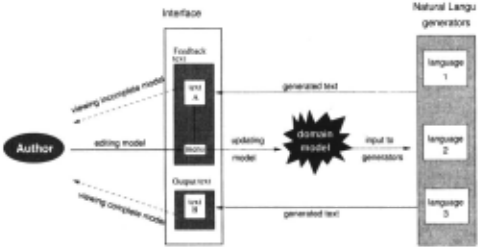
Switching languages is equivalent to changing font in a text editor: it simply re-presents the very same content in a different way.
We have developed three authoring tools of multilin gual documentation using WYSIWYM, in the domains of software applications (DRAFTER- II), patient information leaflets to accompany pharmaceutical products (PILLS) and explanations of legal reasoning in the field of mar itime law (CLIME).
4 Significance of WYSIWYM editing
This method of writing multilingual documents pro vides several advantages over human translation, ma chine translation and over previous methods of symbolic authoring:
- WYSIWYM authoring allows a writer speaking one of the supported languages, but with no technical knowledge of linguistics or computation, to produce good output texts in all of them without the need for translation.
- Authors can understand feedback texts much bet ter than they understand alternative methods of presenting knowledge bases, such as network dia grams. They require no formal knowledge of spe cialised knowledge representation languages or of the target languages, or any special training in a controlled language.
- Since the knowledge base is presented as a docu ment, large knowledge bases can be navigated by the methods familiar from books and from hyper text documents (e.g., content page, index, hyper text links) obviating any need for special training in navigation.
- Our experience has been that people can learn to write documentation with WYSIWYM within a few minutes. 3
3 We are now embarking on formal usability trials.
- Since the knowledge base is presented in natural language, it becomes immediately accessible to any one peripherally concerned with the documentation project (e.g., management, public relations, domain experts from related project) . System documenta tion, often a tedious and time-consuming task, be comes automatic.
- The knowledge base can be viewed and edited in any natural language supported by the system; further languages can be added as needed. When supported by multilingual generators, WYSIWYM editing obvi ates the need for all but the most trivial aspects of traditional language localisation of the interface to the knowledge base.
- In contrast to typical expert systems, the knowledge base constructor need no longer be a knowledge en gineer engaging in knowledge elicitation with a do main expert. In contrast to typical documentation scenarios, the author of multilingual documentation need no longer be a technical writer or translator. Instead, the 'author' using WYSIWYM can now be the domain expert himself.
- The style of the output text is achieved by tuning of the generators. New styles can be added at any time (e.g., company house styles, terminology suitable for novices rather than experts).
- WYSIWYM editing is ideal for facilitating knowledge sharing and transfer within a multilingual project. Speakers of different languages can view and modify the knowledge base in his or her own language.
- In many fields, documents (whether initially or after version updates) are the result of several authors. This makes it difficult to maintain consistency of content and style. With WYSIWYM authoring, such consistency is guaranteed both within and across all documents, whatever the target audience (e.g., soft ware maintenance manuals vs user manuals, drug leaflets for patients, doctors or pharmacists) and whatever the target language.
The crucial advantage of this method of automating the production of multilingual documents compared to machine translation is that it eliminates the usual prob lems associated with parsing and semantic interpreta tion. Feedback texts with menus have been used before in the NL-menu system [Tenant et al., 1983], but only as a means of presenting syntactic options, guiding the user by listing the extension of the current sentence that are covered by its grammar. A similar approach has been used in the Adaptive Forms system [Frank and Szekely, 1998]. Both make parsing more reliable by enforcing ad herence to a sublanguage, but parsing and interpretation are still required.
Of course, text-based interfaces to knowledge bases do not always provide the clarity of expression that can be achieved with knowledge representation languages. One of the questions we are currently exploring is what is the appropriate style for the feedback texts; since they are not required to be as elegant and fluent as the out put texts, it seems appropriate to, for example, expect them to be free of ambiguity where possible, even at the expense of elegance. Obvious places to start are co-reference specification (i.e., should the feedback text clearly show all co-references by artificial means, e.g., subscript indices, colour etc.; or should they be restricted to natural language, e.g., using pronouns etc.) [van Deemter and Power, 1998]. Similar issues apply to the well known problem of scope of quantifiers, which can be difficult to express unambiguously in text. Some of these problems, however, may not be easily resolvable in the feedback text without adding new non-textual interface devices which may eventually lead to such a complicated interface that we are no better off than if we had stuck to graphics in the first place. Just where the boundaries of this tradeoff between clarity and ease of use lie remains an open issue.
@inproceedings{ijcai1999p199,
  title     = {The Multilingual Generation Game: Authoring Fluent Texts in Unfamiliar Languages},
  author    = {Scott, Donia},
  booktitle = {Proceedings of the Sixteenth International Joint Conference on
               Artificial Intelligence, {IJCAI-99}},
  publisher = {International Joint Conferences on Artificial Intelligence},
  editor    = {Thomas Dean},
  pages     = {1407--1410},
  year      = {1999},
  note      = {Invited Speakers},
  url       = {https://ijcai.org/proceedings/1999/199},
}
TY - CPAPER TI - The Multilingual Generation Game: Authoring Fluent Texts in Unfamiliar Languages AU - Scott, Donia T2 - Proceedings of the Sixteenth International Joint Conference on Artificial Intelligence, IJCAI-99 PB - International Joint Conferences on Artificial Intelligence PY - 1999 SP - 1407 EP - 1410 UR - https://ijcai.org/proceedings/1999/199 ER -Copied
Machine-readable versions of this paper, for tools and AI agents:





