
Lemma Generation for Model Elimination by Combining Top-Down and Bottom-Up Inference
Proceedings of the Sixteenth International Joint Conference on Artificial Intelligence. .
© 1999 International Joint Conferences on Artificial Intelligence
Abstract
- Astrachan and D. Loveland. The Use of Lemmas in the Model Elimination Procedure. Journal of Automated Reasoning, 19(1):117-141, 1997.
- L. Bachmair and H. Ganzinger. Rewrite-based equational theorem proving with selection and sim- plification. Journal of Logic and Computation, 4(3):217-247, 1994.
- D. Fuchs. Cooperation of Top-Down and Bottom- Up Theorem Provers by Subgoal Clause Transfer. In Proceedings of AISC-98, pages 157-169. Springer, LNAI 1476, 1998.
- M. Fuchs. An Evolutionary Approach for Com- bining Top-down and Bottom-up Proof Search. AR-Report AR-98-04, 1998, Technische Universitii.t Miinchen, Institut fiir Informatik, 1998.
- M. Fuchs. Relevancy-Based Lemma Selection for Model Elimination using Lazy Tableaux Enumer- ation. In Proceedings of ECAI-98, pages 346-350.
- John Wiley & Sons, Ltd., 1998.
- J. Holland. Adaptation in natural and artificial sys- tems. Ann Arbor: Univ. of Michigan Press, second edition, 1992.
- J . Koza. Genetic Programming: On the Program- ming of Computers by Means of Natural Selection. MIT Press, Cambridge, MA, 1992.
- R. Letz, K. Mayr, and C. Goller. Controlled Inte- gration of the Cut Rule into Connection Tableau Calculi. Journal of Automated Reasoning, 13:297- 337, 1994.
- D. Loveland. Automated Theorem Proving: a Logi- cal Basis. North-Holland, 1978.
- D. Loveland, D. Reed, and D. Wilson. SATCH- MORE: SATCHMO with RElevancy. Journal of Automated Reasoning, 14:325-351, 1995.
- M. Moser, 0 . Ibens, R. Letz, J. Steinbach, C. Goller, J. Schumann, and K. Mayr. The Model Elimination Provers SETHEO and E-SETHEO. Journal of Au- tomated Reasoning, 18(2), 1997.
- J . Schumann. Delta -a bottom-up preprocessor for top-down theorem provers. system abstract. In Proceedings of CADE-12, pages 774-777. Springer, LNAI 814, 1994.
- M. Stickel. A prolog technology theorem prover: Implementation by an extended prolog compiler. Journal of Automated Reasoning, 4:353-380, 1988.
- M. Stickel. Upside-Down Meta-Interpretation of the Model Elimination Theorem-Proving Procedure for Deduction and Abduction. Journal of Automated Reasoning, 13:189-210, 1994.
- G. Sutcliffe, C. Suttner, and T. Yemenis. The TPTP Problem Library. In Proceedings of CADE- 12, pages 252-266. LNAI 814, 1994.
References were extracted automatically from the PDF and may contain errors.
Full text extracted automatically from the PDF; figures, tables and equations may differ. The PDF is the version of record.
1 Introduction
Top-down and bottom-up approaches for automated the orem proving in first-order logic each have specific ad vantages and disadvantages. Top-down approaches (like model elimination (ME) [9) or the connection tableau calculus (CTC) [8)) are goal oriented but suffer from long proof lengths and the lack of an effective redun ~ancy control. Bottom-up approaches (like superposi tion [2)) provide more simplification power but lack in their purest form any kind of goal orientation. Thus an integration of these two paradig"ls is desirable. '
Two approaches have been in the focus of interest in the last years. The methods from [14; 10) are bottom ~p theorem proving approaches. There, the bottom-up mferences are restricted to the use of relevant clauses ~hich are detected by additional top-down computa tions. Thus, goal orientation is combined with redun dancy control. In other approaches top-down provers are assisted by lemmas ([12; 1; 5)) . Also these meth ods combine goal orientation with redundancy control provided by the lemmas. The use of additional clauses can also reduce the proof length which may lead to large search reductions. But this has to be paid for by an in crease of the branching rate of the search space. Thus, mechanisms for selecting relevant clauses are needed.
Our integration approach is based on [12; 5) where lemmas have been used in the CTC. There, in order to refute a set of input clauses with the CTC in a preprocessing phase the input clauses are aug~ented by bottom-up generated clauses (lemmas) . Then, the prover tries to refute this augmented clause set. Lem mas are obtained by creating a pool of possible lemmas which are able to shorten the proof length (generation step) . Then, in the selection step some possibly rele vant lemmas are selected which are then used for re futing the given proof task. ·In [5) it is concentrated on the selection of lemmas and rather simple lemmas have successfully been used. In order to speed-up the proof search in a more effective manner harder lemmas are needed. The generation approaches as used in [12; 5), however, have severe difficulties in generating harder lemmas in a controlled way. They suffer from the earlier mentioned problems of saturation based proving.
Thus, we focus now on the aspect of the generation of possible lemmas and propose two new approaches for a controlled generation of lemmas for top-down provers based on the combination of top-down and bottom-up searc~. The first technique generates lemmas in a sys ~ematic way based on some kind of level saturation (as m [12; 5)). The lemma generation, however, is combined with a decomposition of generalized proof goals which represent possibly solvable subgoals in a compact way. !hese generalized goals are used for detecting possibly urelevant lemmas. The other approach uses genetic pro gramming [7). In the evolution process simultaneously top-down and bottom-up inferences are performed which are controlled by a fitness function which measures the similarity between open subgoals and derived lemmas. Thus, lemma generation and goal decomposition are fo cused on promising clauses in a self-adaptive way. We evaluate the usefulness of the new methods at hand of experiments performed with the prover SETHEO [11).
2 Connection Tableau Calculus
In order to refute a set C of clauses the CTC works on connected {clause) tableaux for C (see [8)). The in ference rules are start, extension, and reduction. The start rule allows a so-called tableau expansion that can only be applied to a trivial tableau, i.e., one consisting of only one node. An expansion step means se lecting a variant of a clause from C and attaching for each of its literals a node (labeled with the respec tive literal) to a leaf node of an open branch, i.e., a branch that does not contain two complementary lit erals. The start rule can be restricted to some start clauses, e.g., the set of negative clauses may be used (see [11]). Tableau reduction closes a branch by unify ing a subgoal s (the literal at the leaf of the open branch) with the complement of a literal r (denoted by -r) on the same branch, and applying the substitution to the whole tableau. For defining extension we need the no tion of a contrapositive. If C = l1 V . . . V ln is a clause then each sequence li +- "'l1, ... , ,...zi-1, ,...zi+l, ... , "'ln, 1 ~ i ~ n, is a contrapositive of C with head li and tail "'l1, . .. , ,...zi-1, -li+l, ... , -ln. Extension with a contra positive h +- t1, . . . , tn of a clause from C is performed by selecting a subgoal s, unifying sand -h with a, instan tiating the tableau with a, attaching ha, -t1a, ... , "'tna below sa, and closing the branch which ends with ha.
We say T 1-c T' if and only if tableau T' can be de rived from T by applying a start rule (if T is the trivial tableau) or an extension/reduction rule to a subgoal in T . In order to refute an inconsistent clause set C, a search tree has to be examined in a fair way (each tree node must finally be visited) until a closed tableau oc curs. A search tree Tc defined by a set of clauses C is a tree, whose root is labeled with the trivial tableau. Each node in Tc labeled with tableau T has as immediate suc cessors the maximal set of nodes { v1, .. . , Vn}, where Vi is labeled with Ti and T 1-c Ti, 1 ~ i ~ n.
In order to enumerate a search tree implicit enumera tion procedures are normally in use that apply iterative deepening search with backtracking. Iteratively increas ing finite initial parts of the search tree are explored in depth-first search (cp. [13]) . For instance, for clause sets v and s, rv.s,n denotes the finite initial part of rvus where all tableaux are obtained by using only clauses from S for the start expansion, only the clauses from V for extensions, and where the tree depth of each tableau does not exceed a value of n E IN. (The root node has depth 0, its successor nodes depth 1, and so on).
3 Goal Decomposition and Saturation
We provide some basic notions regarding the decompos ing and saturating capabilities of the CTC which will be used in the following. We start by demonstrating how to extract query and lemma clauses from a given connection tableau. At first we introduce a method for extracting valid clauses from a connection tableau.
Definition 3.1 (subgoal clause) Let C be a set of clauses. Let T be a connection tableau for C. Let s1, . .. , sn, n 2: 1, be the subgoals ofT. Then we call s1 V . .. V Sn the subgoal clause ofT.
The subgoal clause of a connection tableau T for a clause set C is a logical consequence of C (see e.g., [8]). Subgoal clauses may be considered to be top-down gener ated queries or bottom-up generated lemmas depending on the form of the tableaux they are derived from. First, we consider the analytic character of sub~oal clauses and define query clauses as follows (see also [3]).
Definition 3.2 (query tableau, query clause) Let C be a set of clauses. Let T be a connection tableau for C. Let S ~ C be a set of start clauses. Let S be the clause below the unlabeled root of T. If S is an instance of a clause from S we call T a query tableau (w.r.t. S) and the subgoal clause ofT a query clause (w.r.t. S).
Essentially CTC based proof procedures implicitly enumerate query clauses w.r.t. the chosen start clauses S ~ C until the empty query clause is derived. Lem mas introduce a bottom-up element into the top-down oriented CTC. We employ the following definition of a lemma which extends and generalizes the notions of lem mas used in [12; 1; 5].
Definition 3.3 (lemma tableau, lemma clause)
Let C be a clause set. Let T be a connection tableau for C. Let C = s1 V ... V sn be the subgoal clause of T. Let 1i be the set of subgoals which are immediate successors of the root. If 1i 'I 0 we call T a lemma tableau. Then, let si, 1 ~ i ~ n, be the element of 1i which is left-most in T. We call the contrapositive Si +- "'S1, ... , "'Si-1, "'Si+1, ... , "'Sn of C the lemma clause ofT.
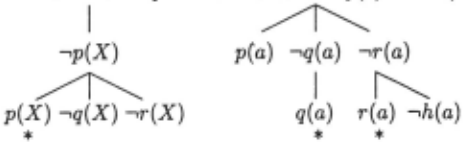
Example 3.1 Let C = { -,p(X),p(X) V -,q(X) V -,r(X), r(X) V -,h(X), q(a)} . Let S = { -,p(X)} be the set of start clauses. The left tableau is a query tableau representing the query -,q(X) V -,r(X) (w.r.t. S), the right tableau is no query tableau but a lemma tableau which represents the lemma p(a) +- h(a).
* * * A lemma application transforms a subgoal into a (pos sibly empty) set of new subgoals. An application of a lemma L to a subgoal s can be viewed as attaching the instantiated lemma tableau of L below s. Thus, it works as a macro operator in the search space. The use of a bottom-up created lemma can close a subgoal by an ex tension with the lemma and performing reduction steps into the introduced subgoals (tail literals) and thus re duces the proof length. In the following we will always employ such a purely bottom-up oriented view on lem mas, i.e., they replace deductions at the "tableau front". Extension steps to instantiated tail literals of lemmas are forbidden. This provides a controlled use of lemmas and prevents a nesting of lemma applications when dealing with non-unit lemmas.
4 Pattern Controlled Level Saturation
Our first method for generating lemmas is based on a combined systematic goal decomposition and lemma sat uration. The basic idea is to employ iterative top-down and bottom-up generation procedures which produce in iteration step (level) i > 1 all query and lemma tableaux of depth i by the decomposition or saturation of the queries and lemmas of the previous level, respectively. Initial queries and lemmas (created in step 1) are the start clauses and the contrapositives of the input clauses, respectively. Then, after each iteration step subsumed tableaux are deleted (a notion of tableau subsumption can be found, e.g., in [8]). Thus, a proof of depth d can be obtained in r~l top-down and bottom-up iter ation steps. It is obtained by closing a query tableau generated in step r~l using bottom-up lemmas (by ex tension of the query literals with lemmas and closing the introduced subgoals with reductions) which have been created in the steps 1' 0 0 0 ' r ~ 1- This combined bottom-up and top-down proof search has several theoretical advantages compared to a pure bottom-up or top-down search. The top-down search is improved by bottom-up processing which avoids the re computation of solutions for multiple occurring subgoals in query clauses. Moreover, the method improves on a pure bottom-up computation because it is more goal oriented and thus the production of a large number of irrelevant clauses may be avoided.
In practice, however, such an approach does not ap pear to be reasonable (for "harder problems"). An ex plicit storage of all generated tableaux is not sensible when dealing with ME based provers because of the huge increase of the number and size of the generated tableaux. Thus, we have to focus only on some few rele vant query tableaux (or query clauses when dealing with Horn problems) and lemmas which are maintained af ter each level for further decomposition or saturation in the next iteration, respectively. Heuristic selection cri teria for query tableaux and lemma clauses are needed. When using such normally fuzzy criteria, however, it is not guaranteed any longer that a query tableau which can be closed with lemmas can be produced after r~l it erations. It is probable that useful queries or lemmas are discarded such that more than r~l iterations are needed. Then, the process may be more costly than conventional top-down or bottom-up deduction. Because of the dele tion of query tableaux and lemmas it is even possible that no proof can be found by clc ing a maintained query tableau with derived lemma clauses.
Thus, we employ a slightly different (lemma oriented) method which we will explain only for Horn clauses and unit lemmas for simplicity reasons. Instead of employ ing a complete top-down enumeration of all query clauses we work in an abstracted top-down search space. Liter als of specific query clauses are generalized to so-called patterns. Patterns are literals which cover the form of several subgoals. Specifically, we try to guarantee that subgoals occurring in a proof are subsumed by some pat terns. Patterns are created in d- 1 steps. As initial pat terns, in step 1, the literals occurring in start clauses are created. Then, in each step i > 1 we successively decom pose patterns of the previous step i-1 into new sub goals and generalize then the subgoals to new patterns. Thus, patterns created in step i generalize subgoals of depth i which occur in query clauses. These top-down gener ated patterns cannot be used for finishing a proof task (with the help of lemmas) . However, they provide rel evancy criteria for lemmas. If a lemma is not unifiable with the complement of a specific pattern it can be dis carded. Thus, we can work with a conventional iterated lemma generation procedure whose maintenance criteria for lemmas are assisted by top-down inferences. Finally, the lemmas are used in a top-down proof run for refuting the input clauses.
We make our method more concrete. We start with the top-down goal decomposition. First, we show how to generalize literals occurring in a set Q of subgoa:l clauses to patterns. We use as patterns N E IN literals from the set LikL for L E IN. LikL is the set of all literals where each literal has a length {no. of symbols) l ~ Land cannot be specialized to a literal with length l 1 > l and l 1 ~ L. Patterns should generalize the sub goals of clauses from Q which are the most likely to occur in a proof. In order to determine the literals to be used as patterns we employ a function qualQ on literals. This function is based on a notion of quality qual89 on subgoals. qual59 is used to estimate whether a subgoal may occur in a proof. Then, qualQ expresses how many subgoals from Q of a high quality are generalized by a pattern.
qual89 (s) of a subgoal s is a value which represents the "generality" of s since we assume that more general subgoals can more easily be solved. For instance, small subgoals with many variables may get large values by qual 89 (cp. [5]). qualQ is defined using qual89 as follows.
Definition 4.1 (pattern quality) For a literal l let Inst(l) be the multi-set {s: C1 VsVC2 E Q, 3J.L: lJ.L = s} . We define the pattern quality qualQ(l) of a literall w.r.t . Q by qualQ(l) = LsElnst(l) quals9 (s).
The best N literals from LikL w.r.t . qualQ form the set patL,N(Q) of patterns for Q. Patterns which gen eralize subgoals which are part of a proof provide an exact criterion for discarding irrelevant lemmas. A pat tern must be unifiable with the complement of a lemma. L and N are responsible for providing a compromise between a large pruning effect of the patterns on the number of generated lemmas (L large, N small) or a high probability that no useful lemmas are discarded (L small, N large). We employ a query generation algo rithm which gets as input a clause set C, start clauses S, and an iteration number I 2:: 1. As output the sets of patterns P 1 , . · . , P1 are delivered.
Procedure 4.1 (query generation}
1. P1:={l:C1VlVC2ES}.
2. fori := 2 to I do:
- (a) let Q be the set of the most general query clauses of query tableaux from Tc,p,_ 1 ' 2 which are not part of Tc,p,_ 1 · 1 .
- {b) pi:= patL,N(Q) .
The lemma generation algorithm enumerates lemma tableaux in a similar way as in [12; 5] but additionally uses the generated patterns. It can be applied after the generation of the query pattern sets PI, ... , Pr. A fur ther input of the algorithm is again an iteration number J :::; I and the set of input clauses C. As output a lemma set C is delivered.
Procedure 4.2 (lemma generation)
3. for i := 2 to J do:
- (a) let Mi be the set of the most general lemma clauses of lemma tableaux from TCUC,C, 2 which . ui-I M are not m j=I j·
The chance for easy lemmas to be maintained is higher than for hard lemmas since more patterns are used. This is because easy lemmas may be applicable in more depth levels of a proof. The pattern-based criterion dis cards lemmas immediately after their generation and thus saves space. The set C forms the set of possible lemmas which may finally be used in the proof run in ad dition to the input clauses. We consider a closed tableau for a Horn clause set of a depth of d. If I 2': d - 1 and the patterns from Pi cover the form of the subgoals with depth i which are needed to find the closed tableau, the lemma generation method is complete. This means that it can be guaranteed that C contains all lemmas needed to reduce the proof depth by an amount of J- 1. Specif ically, it is also possible to reduce the proof length. In practice after the execution of the generation procedure lemmas are selected from C with a selection function <I> (see [5]). These lemmas are used in a final proof run.
5 Evolutionary Lemma Generation
The pattern-based method has the pleasant property that it provides a systematic generation of lemmas which can guarantee the generation of useful lemmas under cer tain conditions. A practical advantage is that highly efficient model-elimination provers can be employed for top-down as well as bottom-up inferences.
But if the choice of the patterns is not optimal the method works as a local optimization method because lemmas are discarded. Lemma tableaux whose deriva tions require the use of (small quality) lemmas which are discarded at a certain moment cannot be generated later. Thus, it is rather probable that the generation of useful and also well judged lemmas is prevented because the generation of such lemmas may require the use of other discarded clauses.
Our solution to this problem is the use of evolutionary techniques for lemma generation which are based on the genetic programming (GP) paradigm. For a detailed in troduction to genetic algorithms or genetic programming we refer to [6) or [7), respectively. Our application of GP combines the evolution of query and lemma tableaux. The abstract principles of our method are as follows. An individual corresponds to a connection tableau which represents a lemma or a query clause. Thus, we work with (possibly) partial solutions (lemmas) of our initial problem and with goal decompositions which represent problems which are still open. The fitness of one lemma is given by its ability to solve or "almost" solve an open subproblem. A tableau which represents a query is the fitter the more subgoals are solvable (almost solvable) by lemmas. The genetic operators are based on the ex change of subtableaux. Thus, good subdeductions which may be part of a proof are used in order to create new (and possibly fitter) individuals. Building blocks (sub tableaux) of the fittest individuals persist with a high probability and can contribute to a generation of lem mas or query clauses which appear in a proof.
Thus, the lemma and query tableaux used for GP are used in a deductive sense by producing new lemma and query clauses in order to solve the original problem or at least to generate useful lemmas. FUrther, they play a role as control elements. The lemma production influ ences the query decomposition and vice versa. This is similar to our first pattern-based approach. But now also the top-down decomposition is influenced by some kind of distance to given valid lemmas. Hence the search is concentrated on "interesting" regions of the search space in a self-adaptive way. FUrthermore, the probabilistic character of GP offers the chance to avoid a naive hill climbing based search and can produce needed lemmas although ancestors are judged by low fitness values.
The technical realization of these ideas is as follows. As already mentioned we use a fixed sized population of tableaux. Each tableau represents a query or a lemma. The population is initialized using the given input clauses to be refuted. Each query tableau obtain able by applying the start rule with a clause allowed as a start clause is added to the population. Analogously for each contrapositive of an input clause a lemma tableau is built. Additionally, it is possible to use some further selected lemma or query clauses in the initial population (see Section 6) .
We employ three genetic operators, namely reproduc tion, and variants of crossover and mutation. Reproduc tion copies one element from the old population to the next. Our crossover operator differs from standard GP where two randomly chosen subtrees of two ancestor in dividuals are exchanged. Since such an operation would normally not result in a connection tableau crossover has to be constrained. One approach is to allow crossover at nodes VI and v2 (labeled with li and l2) of two indi viduals TI and T2, respectively, only if J.L = mgu(li, l2) exists. Then, an exchange of the subtrees could take place and the resulting tableaux are instantiated with J.L. As appealing as this sounds it neglects the fact that a re-use of a subdeduction below VI in tableau TI may be possible below v2 in T2 although the above criterion is · not applicable. This is because the subdeduction may be more general when viewed in an isolated way and is "over-instantiated" in T1 . Consider following example.
Example 5.1 Let C 2 {q(a) V --,p(j(a)),p(f(X)),p(a), --,p(X) v --,r(X)} . The following figure shows two connection tableaux for C. The arrow (which is also called link) shows that the sub deduction below --,p(j(a)) which represents a proof for p(f(X)) can be used below the goal --,p( a) which would take the form --,p(Y) when deleting the subproof below the subgoal.
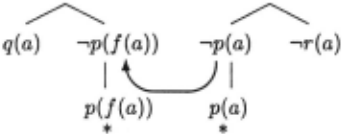
* * Thus, asymmetric link relations between tableaux can be built which show which subdeductions can replace others (see also [4]). Our crossover variant produces one new individual. Consistently with the link relation in a destination tableau a (possibly empty) subdeduction is replaced by a subdeduction in a source tableau. Then, the modified destination tableau is instantiated in an ap propriate manner (more details can be found in [4]). In the above example the left and the right tableau serve as source and destination tableau, respectively. The tableau resulting from crossover represents the query --,r(j(X)) . The crossover operator can be viewed as a generalized extension step which allows us to attach sub deductions and not only clauses to (inner) nodes. We use a mutation operator which serves as a generalized reduc tion step (see [4]). It is needed in the non-Horn case to preserve the completeness of the genetic operators in order to create each useful lemma.
The genetic operators are applied to individuals cho sen probabilistically proportionate to their fitness. We use a similarity measure between query and lemma tableaux for computing fitness. In the Horn case only the query and lemma clauses are considered. In the non Horn case we may also consider open branches for judg ing the similarity. We use a similarity measure which considers certain syntactic properties of literals (cp. [4]).
The evolutionary search stops if a query tableau can be extended to a closed tableau using the lemma tableaux or a given maximal number of generations is reached. In the latter case a selection function 4> (see [5]) chooses lemma clauses of the current population which are used in the final proof run. In summation the GP approach cannot guarantee that useful lemmas are generated during the search. But at least one can show that when fulfilling weak conditions each needed lemma can be created with a probability greater than 0 [4]. The self-adaptation ca pabilities and randomized effects can allow the solution of problems which are out of reach of conventional search techniques (see Section 6).
6 Experimental Results
We want to analyze the performance of the newly devel oped lemma generation procedures. We have chosen the high performance model elimination prover SETHEO for the final top-down proof run as well as for the pattern based lemma generation procedure.
| I domain | II | SETHEO | I SETHEO/PAT | I SETHEO/GP |
|---|---|---|---|---|
| BOO | ~5 ~10 < 15 | 6 10 11 | 12 14 14 | 12 14 14 |
| CAT | ~5 ~10 < 15 | 3 3 3 | 5 5 5 | 5 5 5 |
| COL | ~5 ~ 10 < 15 | 10 27 28 | 29 32 33 | 27 32 33 |
| GRP | ~5 ~ 10 < 15 | 9 9 9 | 11 11 11 | 15 15 15 |
| SET | ~5 ~ 10 < 15 | 36 39 41 | 48 50 50 | 50 52 54 |
As test set domains of the problem library TPTP v2.0.0 [15] are used. The domains BOO, CAT, COL, GRP, and SET have been chosen. BOO, COL, and GRP mostly contain Horn problems whereas in the other do mains often non-Horn problems occur. We tackled only "hard problems". These problems cannot be solved with the conventional SETHEO system within 10 seconds. We have used a SUN Ultra 2 and a run time limit of 15 min utes for each problem. This includes the time for the lemma generation and the final refutation run.
In Table 1 one can find the performance of the newly developed systems in comparison with SETHEO. SETHEO is configured as described in [11] . Specifically, this includes the use of folding-up (see [8)) in the proof run. SETHEO/PAT generates lemmas based on our first method. The lemmas are then added to SETHEO. The final proof run is done with the same version of SETHEO which is used without lemmas. We restrict the lemma generation to unit lemmas which are sufficient to obtain good results in the considered domains. The lemma gen eration Procedure 4.2 is employed with iteration number J = 3. The iteration number for the pattern generation was set to I= 6. We used for the pattern length Land the pattern number N the combinations (L, N) = (3, 3) and (L, N) = (7, 10) . We depict for each example the best result which could be obtained with a configura tion. The selection function 4> is defined using the lemma delaying method as introduced in [5] . SETHEO/GP is based on genetic programming. We have initialized the evolutionary lemma generation in such a manner that the lemmas which are produced by the pattern based method with two bottom-up iteration steps are used in the initial population. Furthermore, we use some se lected queries (see [4]). Thus, the procedure can start at an interesting point in the search space. Unit lemmas are selected from the final population using the lemma delaying method. We show the best results obtained in 5 runs for each problem. The exact configuration of our genetic algorithm can be found in [4].
In the table we have depicted the number of problems which can be solved by the considered approaches after 5, 10, and 15 minutes. We can see that all lemma meth ods improve on the conventional SETHEO system in a stable way. Often lemma tableaux of a proof depth of 2, sometimes of a depth of 3 and 4, can be used in a proof. The use of these lemmas leads to a proof length reduc tion and significantly smaller search spaces which have to be traversed by the iterative deepening search proce dure. In comparison with the already successful conven tional lemma generation approaches (without top-down assistance) as described in [12; 5] all of our methods im prove on results obtained with these methods. The level saturation procedure can be improved by the top-down generated patterns. E.g., in the SET domain where a lot of predicate and function symbols occur the pattern use is indispensable. In domains like BOO, however, the pat terns cannot incorporate additional potential for deleting lemmas. The GP approach significantly improves on the level saturation method. A not fitness controlled ran domized method achieves worse results (see [4]).
Considering the pattern based method and GP one can recognize that with GP generated lemmas the proof length can often be reduced in a more effective manner. The pattern based method has some difficulties in pro ducing sufficiently specific patterns well-suited for the first iteration steps since the probability that such pat terns match needed query literals decreases from itera tion to iteration. GP can overcome the problem that in its initial population some useful lemmas may be miss ing. It can re-compute these lemmas. Furthermore, we could observe that GP sometimes generates well-suited rather hard lemmas (with depth 4).
7 Conclusion and Future Work
We presented two methods for combining top-down and bottom-up proof search aiming at generating a set of well-suited lemmas. The lemmas are then used in a fi nal top-down proof run in addition to the given input clauses. We have seen that an evaluation of an ab stracted top-down search space (with patterns) and a partial evaluation of interesting regions of the complete top-down search space (by genetic programming) is in deed able to provide sufficient information in order to control bottom-up inferences. As the experiments show the criteria are strong enough to generate interesting hard lemmas which provide large search reductions.
The study reveals that the use of our techniques in a parallel proof environment is desirable. The pattern based approach can work with different parameters for L, N, I, and J in parallel. Also the GP algorithm can profit when different incarnations run in parallel. Specif ically, the evolutionary approach offers the possibility to develop high performance parallel systems which may scale up to a large number of processors.
@inproceedings{ijcai1999p1,
  title     = {Lemma Generation for Model Elimination by Combining Top-Down and Bottom-Up Inference},
  author    = {Fuchs, Marc},
  booktitle = {Proceedings of the Sixteenth International Joint Conference on
               Artificial Intelligence, {IJCAI-99}},
  publisher = {International Joint Conferences on Artificial Intelligence},
  editor    = {Thomas Dean},
  year      = {1999},
  url       = {https://ijcai.org/proceedings/1999/1},
}
TY - CPAPER TI - Lemma Generation for Model Elimination by Combining Top-Down and Bottom-Up Inference AU - Fuchs, Marc T2 - Proceedings of the Sixteenth International Joint Conference on Artificial Intelligence, IJCAI-99 PB - International Joint Conferences on Artificial Intelligence PY - 1999 UR - https://ijcai.org/proceedings/1999/1 ER -Copied
Machine-readable versions of this paper, for tools and AI agents:





