
An Expert System Using Nonmonotonic Techniques for Beneefits Inquiry in the Insurance Industry
Proceedings of the Fifteenth International Joint Conference on Artificial Intelligence. Expert Systems. Pages 655-660.
© 1997 International Joint Conferences on Artificial Intelligence
Abstract
This paper describes Benlnq, an expert system for benefits inquiry in the insurance industry. Benlnq is designed to be used by both customer service representatives, who answer customers' questions in real time, and policy modifiers, who update insurance products. The main challenges were the design of the KR structure -in particular, representing a huge knowledge base at varying levels of granularity, and the development of the reasoning methods - in particular, developing a method that determines which insurance regulations apply to an insurance service. This required nonmonotonic reasoning, which we modeled using an extension of inheritance methods. Benlnq represents one of the few large scale industrial applications that explicitly uses formal nonmonotonic reasoning techniques.
- [Horty et al., 1990] J . Horty, R . Thomason, and D. Touret- zky. A Skeptical Theory of Inheritance in Nonmonotonic Semantic Networks. Artif. lntell. 42, 311-349.
- [Morgenstern, 1996] L. Morgenstern. Inheriting Well-formed Formulae in a Formula-Augmented Semantic Network. Proc. KR-96, 268-279.
- [Morgenstern, 1997] L. Morgenstern. Inheritance Comes of Age. Invited Talk, IJCAI-97.
- [Reiter, 1980] R. Reiter. A Logic for Default Reasoning. Ar- tif. Intell. 13, 81-132.
- [Selman and Kautz, 1993] B. Selman and H. Kautz. Domain-Independent Extensions to GSAT. Proc IJCAI.
- [Stein, 1992] L. Stein. Resolving Ambiguity in Nonmonoto- nic Inheritance Hierarchies, Artif. Intell., 259-310.
References were extracted automatically from the PDF and may contain errors.
Full text extracted automatically from the PDF; figures, tables and equations may differ. The PDF is the version of record.
1 Introduction
Benefits inquiry, the process of querying an insurance company to determine one's benefits, is becoming in creasingly complex. Whereas years ago, a medical in surance company would offer only a small number of products, today companies have thousands of different insurance products, each of which contains a myriad of services and regulations. Furthermore, these products are always changing. The amount of information is diffi cult to keep up with; thus, the need for an expert system.
The expert system described in this paper, Benlnq, was created for the application of benefits inquiry in the medical insurance domain. The paper is structured as follows. We first describe the existing technology for ben efits inquiry. We next list the desiderata for our expert system. Subsequently, we discuss the knowledge repre sentation and reasoning issues, focusing on the nonmo notonic techniques used. We then present Benlnq, eval uate its usefulness, and discuss how the techniques can be generalized.
Moninder Singh
Department of Computer & Information Science University of Pennsylvania Philadelphia, PA 19104-6389 msingh@gradient.cis.upenn.edu
2 Existing Technology
Benefits inquiry has traditionally been performed by cus tomer service representatives (CSRs) who rely on basic charts, detailed manuals, and implicit knowledge gained through common sense and job experience. As insurance products have proliferated, there have been attempts to harness computing power to help with the benefits in quiry task. Often, such efforts are limited to placing charts and manuals on-line. Other efforts include text based and code-based systems, discussed below.
Text-based Systems: Text-based systems allow for some search and indexing of subject areas. The medical insurance company for which we consulted had a rudi mentary text-based system. Information is divided into chunks or subject areas. A piece of text is associated with each subject area. Subject areas might include pre ventive care, immunizations, and maternity. The text associated with preventive care lists the different types of preventive care available, such as routine physicals and standard immunizations, as well as coverage rates and allowed frequency of services. Another screen may deal with one of the topics described in one screen; e.g., there may be a screen devoted to immunizations, a topic described in the preventive care screen. The CSR uses this system by pulling down a menu of topics, clicking on a topic, and reading the information on the associated screen which comes up.
The advantages to this system over on-line manuals are first, the system allows rudimentary search, and sec ond, the information is partly organized in a modular fashion. But there is no reasoning; the system has merely pruned the amount of information to be read. Second, the system does not make explicit the many intercon nections between subject areas. For example, nothing in the system indicates a connection between the screens on immunization and preventive care. The CSR must reason, e.g., that the schedule rate for preventive care most likely applies to routine immunizations. The lack of connection between related screens makes updating the system difficult . If both the preventive care and im munization screens do have schedule rate information and this schedule rate changes, the individual modifying the system must make changes on both screens. Third, there are a small number of screens relative to the numher of types of questions a CSR may have to answer. Thus, the CSR may not get the level of information that she needs. This is not an artifact particular to this appli cation but is due to the logistical difficulties of creating and continually modifying a large number of screens.
Making inquiries via codes: Many insurance com panies have a code-based scheme for answering cus tomers' questions. Whether automated or not such schemes operate using a table-lookup methoclology. When a customer calls to inquire if a particular service is covered, he is asked to provide the CSR with the proce dural (CPT) code, which represents the service which is to be performed, and the diagnostic (ICD-9) code, which represents the diagnosis that is the reason for the service that is to be performed. The CSR then feeds this pair of codes into the system, which responds with the infor mation that the service is or is not covered, along with the appropriate cost of the service.
The advantage of code-based inquiry is that often customers' question can be answered quickly and un ambiguously. The disadvantages are: First, customers must know complete code information before they can call their CSRs; this slows down the inquiry process. Second, the code-based scheme only allows questions at a detailed level of granularity. But customers of ten wish to ask general questions, such as Are routine immunizations covered?. Third, code-based systems do not allow questions that rely on information in ad dition to codes such as If a 44-year-old woman had a mammogram two years ago, will she be covered for a routine mammogram now?, in which the treat ment history of the patient is relevant. Fourth, updating code-based systems is an exceedingly difficult process. There are tens of thousands of CPT codes and tens of thousands of ICD-9 codes, and a large subset of the pos sible pairings of these codes must be considered. 1
Desiderata - Toward Replacing Existing Tech nology: We aimed to develop an expert system that supports benefits inquiry but avoids the problems of both the text-based and code-based systems. In par ticular, we wished to develop a system that
- allows questions at varying levels of granularity
- gives clear, unambiguous answers to commonly asked questions
- allows representation of very large amounts of material and navigation around a large information space
- supports connections among related topics
- supports easy updates and modifications
The ability to modify is important because products change so frequently; an outdated benefits inquiry sys tem is useless. Thus, the system had to be usable not ?nly by CSRs but also by policy modifiers (PMs), the msurance company employees responsible for making changes within a particular insurance product.
1 The nightmarish prospect of updating millions of code pairs is somewhat mitigated by the fact that CPT and ICD-9 codes have their own structure and support some rudimen tary abstraction.
3 Knowledge Rep and Reasoning
Insurance employees such as CSRs and PMs must rea son. about services, be~efits, coverage information, and busmess rules. A servtce represents some class of med ical services, such as Surgery or X-rays. A benefit is some component of an insurance product which covers or excludes a particular service. For example, the Drug Benefit may generally cover Prescription Drugs, though it may exclude certain classes of prescription drugs, such as Experimental Drugs. Coverage information indicates which services are covered or excluded by which ben efit, as in the above example. Business rules limit or modify the ways in which services are covered by ben efits. Rules include cost-share rules, which specify the deductible and co-pay of a covered service, access rules, specifying whether it is required to go to a network provider, and administrative and medical rules specify ing other restrictions. For example, there is a cost-share rule specifying a 20% co-pay for surgical services, and an administrative rule stating that patients in drug re habilitation programs lose all rehab benefits for a year if they are non-compliant.
CSRs and PMs must deal with a large amount of in formation. There are tens of thousands of services of interest. There may be several thousand business rules for an insurance product; many of these rules (such as cost-share) will apply to a great number of services.
In developing Beninq, we needed to focus on the ex ternal representation-the representation that the CSRs and the PMs see, as well as the internal representation which the inner workings of the system use. Since Ben~ Inq would be used primarily to answer questions about service coverage and applicable business rules, the in ternal representation had to facilitate efficient reasoning about these issues. In addition, to ease use by CSRs and PMs, the external representation had to be perspicuous to employees of the insurance company. Moreover, PMs needed to directly manipulate knowledge in the system in order to modify products. The easiest way to achieve this was to have a direct mapping between the inter nal and external knowledge representations. A complete direct mapping is not always possible. ·
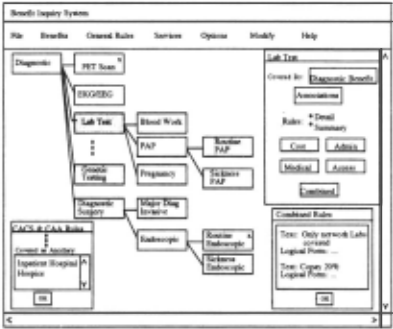
The choice of representation resulted from the obser vation that many services can be organized in a taxo nomic manner (see Figure 1). For example, the services of PET Scans, Lab Tests, EKG/EEG, and Genetic Test ing are all subtypes of Diagnostic Services. The taxon omy generally is at least several layers deep. Benefits likewise can be arranged taxonomically (see Figure 2) .
The structure, however, is not purely taxonomic. Cer tain services have multiple supertypes. For example, Ge netic Testing is both a subtype of Diagnostic Services and of Family Planning Services. Thus, the structure is a dag rather than a tree.
The quasi-taxonomic structure led us to consider a se mantic network-in particular, an inheritance network with exceptions-as our KR structure. There are effi cient algorithms for reasoning with a semantic network.
Moreover such networks are natural to laypersons such as CSRs 'and PMs; this naturalness guarantees a di rect mapping between the external and internal knowl edge representations. We needed to determine, ho~ever, whether a semantic network was capable of encodmg all the knowledge that was needed for the benefits inquiry system, specifically, (1) coverage or exclusion of medic~! services and (2) rules limiting or modifying the ways m which a service was covered.
3.1 Representing Coverage Information
Coverage and exclusion information can easily be en coded in the semantic network. In addition to the sub type link, one introduces covers and excludes link which connect benefit and service nodes. Thus, to represent the information that Diagnostic Services are covered by the Diagnostic Benefit, one places a covers link between Diagnostic Benefit and Diagnostic Services; to represe~t the information that PET Scans are ezcluded by the DI agnostic Benefit, one places an excludes link between Diagnostic Benefit and PET Scans. The covers and excludes links propagate along the taxonomy, so that, e.g., we can reason that Diagnostic Benefit covers Blood Work since Blood Work is a subtype of Diagnostic Ser vices.' The propagation is relative to specificity consid erations, so we do not use propagation to conclude that PET Scans are covered by the Diagnostic Benefit: the path from PET Scans to Diagnostic Benefit along the ex cludes link is more direct than the path from Pet Scans to Diagnostic Benefit along the covers link . .
It is obvious that there is a close connection between this structure and a standard inheritance network with exceptions [Horty et al., 1990], an? in fact w~ can m~ke this connection (an example of a duect mappmg) precise in the following way: Replace each benefit node by a ser vice node which represents all services covered by that particular benefit (so that, e.g., the Diagnostic Benefit node would be replaced by the node Services Covered by Diagnostic Benefit). Repla,ce each covers link by a subtype (isa) link, and each excludes link by ~ cancels link. One then uses a standard traversal algonthm for inheritance networks with exceptions [Horty et al., 1990; Stein, 1992] to determine whether or not services are c~v ered. Both representations are useful: the standard m heritance network with exceptions representation allows us to use well-documented algorithms without modifica tion, while the explicit use of covers and excludes links is more accessible to CSRs and PMs.
The importance of the cancels links in the standard inheritance representation points out that much of the relevant information for benefits inquiry is nonmonot onic. It is rarely the case that a class of services is covered or excluded by some benefit; there are almost always exceptions. This nonmonotonicity is hardly sur prising; proponents of nonmonotonic logic [Reiter'. 1980] have argued since its inception that nonmonotomc rea soning is common in everyday reasoning (including the business world). · What is surprising is how rarely non monotonicity has entered commercial applications, even in well-understood forms such as inheritance with excep tions. Nonmonotonicity is also present in this applica tion in the regulations that apply to a node; we discuss this further in section 3.4.
3.2 Representing Rules
Certain rules lend themselves to representation within a semantic network. Consider the rule:
There is a co-pay of 20% for diagnostic services
To represent this rule using the standard inheritance network model one could have a node representing the 1 · services which have a 20% co-pay, and a subtype lmk between the Diagnostic Services node and this node.
On the other hand, a more complex rule such as
Patients in Drug Rehabilitation programs lose all rehab benefits for a year if they are non-compliant
cannot be so easily represented. One could posit a node that represents the services which have the property that if patients are non-compliant wrt that service, then they lose all rehab benefits for a year, and then have a sub type link between the Drug Rehab Services node and this node. But such a node appears quite artificial, and well outside of the spirit of a semantic network, where nodes are supposed to represent easily understood and expressible concepts.
Instead, we choose to represent rules as well-formed formulae in some classical logic. For example, the rule above could be translated as
Drug-rehab(p) 1\ enrolled(x,p,i) 1\ 3 j sub(j ,i) 1\ non compliant(x,pj) => ((Drug-rehab(p2) 1\ enrolled(x,p2,i2) 1\ time(start(i2))- time(end(j)) ~ lyear) => .., covered(x, p2)). The wff translation of business rules exists in the internal representation.
These rules seem to be attached to specific nodes in the net. For example, the rule specifying that the diagnostic co-pay is 20% ought to be attached to the Diagnostic Ser vices node in the network. This observation prompted the development of FANs (formula-augmented semantic networks). A FAN is a structure which allows attachi~g wffs to nodes in a semantic network. Formally, a FAN IS a tuple consisting of a set of nodes, a set of wffs, a set of links (subtypes) on nodes, a (possibly empty) set of partial orderings on these links, allowing the prioritiza tion of links in cases of multiple supertyping, and links connecting nodes and sets of wffs. Details are given in [Morgenstern, 96] . .
The semantics of a rule attached to a node IS roughly: the rule attached to a node usually applies to the ser vices represented by the node. Nonmonotonicity is again present; the rule may not apply to all subtypes of the node. Thus, a natural question is: are rules inherited along taxonomic lines? We discuss this issue in sec. 3.4.
3.3 Categorizing Nodes
Benefit nodes correspond to the types of benefits pro vided by a particular insurance product. There are about twenty to thirty benefit nodes in a semantic net work representing a typical insurance product.
In contrast to benefit nodes, which are few in number, there are many service nodes. Medical care providers speak of tens of thousands of medical services. Even if we do not represent all of these, we need to have some broad classification of services. A first cut at classifica tion is provided by the insurance industry, which cat egorizes services according to (professional) procedure, condition or setting. Examples of professional procedure services, which are categorized according to the profes sional who provides the services, are Surgical services, Therapy, and Diagnostic services. Examples of condi tion services, which are categorized according to a par ticular class of conditions, include Maternity and Mental Health. Examples of setting services are Hospital Ancil lary services or Inpatient Hospice Room and Board.
Each of these classes of services itself contains a few major classifications, roughly corresponding to the way laymen speak of medical services. Formally, a classifica tion is considered major if it is a root node in the service taxonomy. Examples are Surgical, Diagnostic, Preven tive, and Hospital Services. There are between 30 and 40 major classifications for a typical insurance product.
If we decide to explicitly represent tens of thousands of services in the semantic network, each major classi fication will have a very large number of nodes, much too large to display or for a CSR to comprehend. We are faced with a trade-off of ease of display, navigation, and comprehensibility, versus granularity and compre hensiveness. Achieving arbitrarily fine levels of granu larity for all types of services will result in a system that may be too unwieldy for a CSR to use.
Our approach is to generate nodes in the (external representation of the) semantic network according to the following principle. A subtype is explicitly given only if there is a reason: for example, a particular subtype may not be covered, or different rules may attach to the sub type. Thus, Endoscopic Surgery is given as a subtype of Surgery because there are different rules for Endoscopic Surgery than for standard Surgery; Routine Endoscopic Surgery is given as a subtype of Endoscopic Surgery be cause Routine Endoscopic Surgery is not covered. On the other hand, there are no explicit nodes for appendec tomy or gall bladder surgery, because these are standard surgeries; one can always just look at the Surgery node to determine coverage and the rules.
Indeed, a fully comprehensive network would have considerably more than tens of thousands of nodes. As indicated above, insurance companies often speak of procedure/condition or procedure/setting pairs or even procedure/condition/setting triples. For example, Lab Tests performed in a hospital are generally paid in a dif ferent manner (different schedule of payment and differ ent regulations) than Lab Tests performed in a doctor's office or home. Expanding the network to include these pairs and triples would mean that the network would have millions of nodes. This would not only yield an un wieldy network, but would also be extremely wasteful: most pairs and triples are not of interest. We deal with this problem in several ways. First, sometimes a pair or triple, if common enough, is given its own node. Thus we have Routine Endoscopic and Sickness Endoscopic. 2 Second, each node is associated with a (possibly empty) list of settings which change the coverage or regulations of that node. For example, the node Lab Tests would have associated with it a list of settings including Hospi tal and Hospice, since payment for Lab Tests is different in those settings. We discuss this further in section 4.1.
3.4 Reasoning Methods
Two types of reasoning are needed for the semantic net work:
1. Determining if a node is covered or excluded by some benefit.
2. Determining which rules apply to a node.
The first problem has been studied extensively in the literature [Horty et al., 90; Stein 92]. Benlnq implements Stein's (92) algorithm to solve the problem.
The second problem has been studied extensively by [Morgenstern, 96]. A short summary follows. The rules that apply to a node are not merely the rules that are attached to a node. For example, the rules that are at tached to Diagnostic Services should also apply to the node Lab Tests. It might seem that given a node of in terest (which we call the focus node), we can collect all rules attached to supertypes of that node 3 · But such an approach could lead to rampant inconsistency; it is very possible that one of the rules at Lab Tests is inconsistent with the rules at Diagnostic Services.
The issue of which rules apply to a node in a FAN is known as the wff-inheritance problem. The solution is to compute a mazimally consistent subset (mcs) of all the rules attached to nodes to which there is a positive undefeated path from the focus node. Since there may be many such maximally consistent subsets, one prefers the preferred mazimally consistent subsets (pmcs's) based on criteria of specificity and path preference. For example, if there are two mcs's at a focus node, and they differ in that the first has a wff from a more specific node than the second, than the first is preferred to the second.
2 Of course, these are really sets of pairs; Sickness Endo scopic is the set of pairs (Sickness Endoscopic, x) where x stands for one of a large number of conditions for which en doscopic surgery is considered appropriate.
3 0r more precisely to nodes to which there is a positive undefeated path [Horty et al. , 90] from the focus node.
The algorithm to determine a pmcs at a focus node is given in [Morgenstern, 96]. It calls for first prepro cessing the semantic network to remove conflicted and pre-empted edges. Then the network is traversed up ward, starting at the focus node. As each node is vis ited, the node is marked, and a pmcs of the collected wffs along with the new wffs is computed. At each upward branching point, the branches are ordered according to the given prioritization, and the branches are recursively traversed according to that order.
The most computationally intensive part of this process is computing the pmcs, and in particular, de termining if a set of wffs is consistent. 4 Our system uses the method of Selman and Kautz (1993) to randomly produce a valid truth assignment to a set of wffs. If it is consistent, this procedure generally works very rapidly. Thus, if after a short time no valid assignment has been produced, the system tries to show inconsistency in a more traditional manner.
4 System Description
Benlnq has been implemented in VisualAge Small talk on an OS/2 platform. The system incorporates two tools: the inquiry tool which is used by CSRs to answer cus tomers' questions, and the authoring tool which is used by PMs to modify products. Benlnq has two main com ponents, a graphical user interface and a reasoning en gine, which are used by both tools. The graphical user interface is used to navigate through the large number of nodes and to display the dags that are rooted at specific benefit or service nodes. It consists mainly of functions to search through the network, draw nodes in the net work structure, and display dialog boxes. We exploited the power of VisualAge Smalltalk, which comes with a li brary of drawing tools (particularly for menus and dialog boxes) and facilitates the creation of graphical interfaces.
The reasoning engine consists of two components: one for performing standard attribute inheritance and one for performing wff inheritance. The attribute inheritance component uses the algorithm described in [Stein, 1992]. The wff inheritance component uses the algorithm described in [Morgenstern, 1996] and summa rized in section 3.4.
The authoring tool uses both components of the rea soning engine as well as the graphical interface. The graphical interface is used to search for the node or por tion of the network to be modified. If a node is inserted or deleted, or inheritance information is changed, the attribute-inheritance component recomputes the cover age or exclusion of the relevant nodes. If a wff is added, deleted, or modified at a node, the wff-inheritance com ponent recomputes the wffs that apply to that node and the nodes beneath it in the dag.
·Determining consistency is only semi-decidable for the predicate case; it is decidable but intractable for the propo sitional case.
The inquiry tool uses the attribute-inheritance compo nent of the reasoning engine in addition to the graphical interface. Since the wff-inheritance component is by far the most computation-intensive portion of Benlnq, we try to restrict its use within the system as much as pos sible. It is therefore not used by the inquiry tool. Thus, the set of wffs that apply to a node are stored during the authoring process.
Below, we briefly discuss how Benlnq is used by its two classes of users, CSRs and PMs.
4.1 A CSR's view of Benlnq
Benlnq gives a CSR the ability to view various benefits and services by either selecting the appropriate item in one of several pull-down menus (organized by node type) or by using a node search mechanism. This allows the CSR to view all the subtypes of a chosen service or ben efit, and to view all top-level services that are either cov ered or excluded by a chosen benefit. The system also gives the CSR the ability to determine which services are covered or excluded, and by which benefit. More over, the CSR can easily determine all the rules that apply to a particular service, including those inherited from its ancestors. The CSR can choose to view rules of a particular sort (e.g., cost-share or access) or all rules. Benlnq also allows the CSR to view the associations at a particular node. Such associations allow the CSR to see how a procedure's coverage may change depending on the setting in which the procedure is performed.
Figure 1 illustrates how a CSR would use the system to answer questions concerning different Lab Tests. The CSR can view the relevant portion of the network either by first selecting Diagnostic Services using the pulldown menu and then clicking on Lab Tests, or by using the node search mechanism. The screen displayed provides the CSR with much useful information at a single glance. First, it is immediately apparent which nodes are not covered; they have an x in the upper right corner. All other nodes are covered. There are visual cues indicating that a node is not covered by the expected benefit (in this example, Diagnostic Benefit). Thus, for example, the CSR finds out that Routine Pap (which is a different color than other nodes), although a lab test, is not cov ered by the Diagnostic benefit. To find out which benefit covers a particular node, the CSR clicks on that node. In Figure 1, since Lab Tests is currently selected, a dialog box shows, among other things, that Lab Tests is covered by Diagnostic Benefit. If the CSR clicks on the Routine Pap node, a similar dialog box comes up indicating that it is covered by the Preventive Benefit. Moreover, the CSR is given the option to switch views to a tree rooted at the Preventive benefit so that all information relevant to Routine Pap becomes visible.
In addition, the CSR may view various rules applic able to the node by clicking on the appropriate button. In Fig. 1, the CSR has selected the Combined button, indicating that all rules applying to the service should be displayed. The lower right portion of the screen shows the dialog box that pops us when the Combined button is selected. Note that both the text and logical forms of the rules are given. Similarly, the CSR can view the associa tions at a particular node by clicking on the appropriate button. The lower left portion of Figure 1 displays the dialog box which pops up when the CSR clicks on the associations button. 5 This box lets the CSR know that if lab tests are performed in an inpatient hospital (resp. hospice) setting, the procedure is covered by the Inpa tient Hospital (resp. Hospice) Benefit and is subject to those rules. If the CSR wishes to see these rules, she clicks on the desired setting in the dialog box and the appropriate regulations appear.
5 1n reality, only one of the rules/associations dialog boxes can be shown at one time. Both dialog boxes are shown for explanatory purposes.
4.2 A Policy Modifier's view of Benlnq
The authoring tool provides the Policy Modifier with several features to effectively modify benefits and ser vices. The PM can add new benefits or services, modify existing services and benefits, and delete existing prod ucts. The PM can add a node either before or after an existing node in the network. She can also spec ify other supertypes, subtypes, and the rules that apply to the new node. For service nodes, the PM can spec ify whether the service is covered (or excluded), and by which benefit, or whether coverage/exclusion is inherited from another service node. Similarly, the PM can mod ify various attributes of any existing benefit or service including name, list of supertypes, prioritization of the supertypes, list of subtypes, set of rules that apply to that node, and for service nodes, the coverage/exclusion information and service classification. Finally, the PM can delete services or benefits from the system.
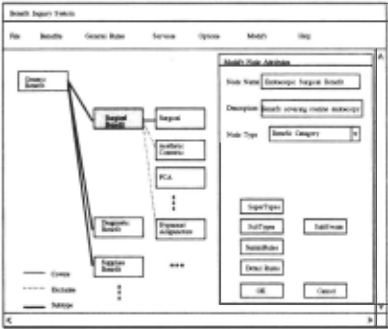
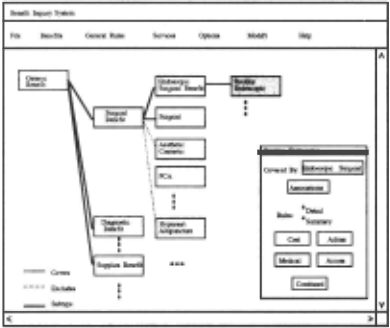
Figures 2 and 3 demonstrate how the authoring tool would be used by the PM to add a new benefit, Endo scopic Surgical Benefit, to explicitly cover the previously excluded Routine Endoscopic Services. Since the new benefit is a form of Surgical Benefit, she adds it as a subtype of Surgical Benefit. Figure 2 shows a portion of the dag displaying the Surgical Benefit. The PM adds a new node as a subtype of Surgical Benefit (by choosing the appropriate option from the Modify menu), and the dialog window pops up. She can then specify the name, type, subtypes, and supertypes as well as the rules that apply to the new node. Figure 3 shows the situation in which the new benefit, Routine Endoscopic Benefit has been added as a subtype of Surgical Benefit. The service node Routine Endoscopic has also been modified to change its coverage/exclusion information so that it is now covered by the new benefit (as opposed to being excluded by Diagnostic Benefit).
5 Discussion
5.1 Evaluating the System
Benlnq represents a significant advance in existing tech nology for benefits inquiry. The departure from a code based system to a knowledge-based system is a big change for the insurance industry. This is, as far as we know, one of the few large-scale industry applica tions that explicitly models nonmonotonicreasoning and uses formal nonmonotonic reasoning techniques. This is clearly an advance for the insurance industry, which previously could deal with exceptions only in an ad-hoc manner. It also validates the work of the nonmonotonic reasoning community, which has often been accused of being insular and producing no useful results for the real world.
Benlnq allows CSRs to immediately determine whether or not a service is covered and which rules ap ply to that service. It further provides PMs with an easy method of updating and modifying insurance prod ucts. The current version of Benlnq was completed after our consulting engagement had ended. The medical insurance company received an earlier version of Benlnq, which incorporated some but not all of the reasoning methods described in this paper. This version supported standard inheritance with exceptions and attaching wffs to a node, but did not perform wff-inheritance. Thus PMs who modified the rules at a node had to modify the rules at all subtypes of the node as well in order to ensure integrity. Despite this drawback, the earlier ver sion of Benlnq received excellent reviews from the CSRs and PMs who used it. They needed virtually no train ing, surpassing our most optimistic expectations. They were delighted with the ease of finding out information and modifying products.
The desiderata outlined in section 2 were largely sat isfied, although the last desideratum, supporting easy updates and modification, was only partly satisfied. In particular, while it is easy for a PM to add, delete, or modify links and nodes in the network, it is not always easy to modify or add wffs. The PM may easily modify the text version of business rules, but cannot modify the logical form of business rules.
This is a direct consequence of the fact that there is no direct mapping between the internal (logical form) and external (text) representations of business rules, as discussed in section 3. This is in direct contrast to all other parts of the semantic network, in which there is a natural, direct mapping between the internal and ex ternal representations. Fixing the problem requires the construction of a mapping between the text and logical form representations; this problem is in general difficult and beyond the scope of this work. However, one can identify certain types of rules for which there is a rea sonable mapping. We have sketched out mappings for cost-share and access rules, as well as for administra tive rules involving temporal and spatial (setting) con straints. The aim is the construction of templates which will allow the PM to directly enter rules in logical form, and will generate a reasonable text equivalent.
What were the alternatives? The success of Benlnq was due to two facts: first, the realization that the bulk of the information was taxonomic, but that a significant chunk was not, and second, the construction of a knowl edge structure, the FAN, which allowed the representa tion of both taxonomic and non-taxonomic information, and linkage between the two. Existing benefits inquiry systems had ignored the taxonomic nature of the medical insurance domain. This resulted in systems that were extremely spotty in their coverage (text-based systems) or were unwieldy (codes). Even a more sophisticated rule-based (or production) system that ignored the tax onomic nature of the domain would run into the problem of redundant information and the need for multiple up dates. On the other hand, any attempt to force all of the information into a taxonomy would have resulted in highly artificial nodes with no clear semantics.
5.2 Generalizations and Extensions
The techniques described in this paper, while developed specifically for benefits inquiry in medical insurance, can be generalized to other domains as well. The construct of a FAN and its associated algorithms may prove useful in other domains which satisfy the following criteria:
- there exists a large amount of taxonomic information
- there exists a significant amount of non-taxonomic in formation, conceptually linked to the taxonomic infor mation
- the non-taxonomic information can be mapped into wffs
The construction of an internal representation which closely parallels the external representation is a useful technique for domains where there is a non-technical class of users who must directly manipulate the knowl edge structure. This technique is best suited to domains in which there is a natural translation behveen the user's conceptual model and a knowledge structure which lends itself to efficient reasoning methods.
Examples of such domains include other parts of the insurance industry, such as life, property, and casualty insurance; legal reasoning, especially case law (cases are often organized taxonomically, and different legal rulings are associated with cases); and medical reasoning.
We are currently using these techniques in the devel opment of a system to dynamically configure property and casualty insurance products. In this system, the constructs of composition and subtYI)ing are both im portant. The methods developed to reason with sub types are also applicable for reasoning with composition, with appropriate modifications. This indicates that the techniques described in this paper are useful not only in domains in which taxonomic information is central but in domains in which composition is a useful construct. This has the potential to expand the applicability of this work. We hope to report on this research in the future.
Acknowledgements: We are grateful to Lynn Brick ing, Kathleen Jamison, Bill Wynne, Tracy Edmonds, Terry Brown, and Kay Krimmer for their assistance in the knowledge engineering phase. An earlier version of Benlnq was implemented with the assistance of Mike Ashwell and Jason Springer. Thanks also to Ernie Davis and Benjamin Grosof for helpful suggestions.
@inproceedings{ijcai1997p96,
  title     = {An Expert System Using Nonmonotonic Techniques for Beneefits Inquiry in the Insurance Industry},
  author    = {Morgenstern, Leora and Singh, Moninder},
  booktitle = {Proceedings of the Fifteenth International Joint Conference on
               Artificial Intelligence, {IJCAI-97}},
  publisher = {International Joint Conferences on Artificial Intelligence},
  editor    = {Martha E. Pollack},
  pages     = {655--660},
  year      = {1997},
  note      = {Expert Systems},
  url       = {https://ijcai.org/proceedings/1997/96},
}
TY - CPAPER TI - An Expert System Using Nonmonotonic Techniques for Beneefits Inquiry in the Insurance Industry AU - Morgenstern, Leora AU - Singh, Moninder T2 - Proceedings of the Fifteenth International Joint Conference on Artificial Intelligence, IJCAI-97 PB - International Joint Conferences on Artificial Intelligence PY - 1997 SP - 655 EP - 660 UR - https://ijcai.org/proceedings/1997/96 ER -Copied
Machine-readable versions of this paper, for tools and AI agents:





