
An Achievement Test for Knowledge-Based Systems: QUEM
Proceedings of the Fifteenth International Joint Conference on Artificial Intelligence. Cognitive Modeling. Pages 288-292.
© 1997 International Joint Conferences on Artificial Intelligence
Abstract
This paper describes QUEM, a method for assessing the skill level of a knowledge-based system based on the quality of the solutions it produces. QUEM is demonstrated by using it to assess the performance of a particular knowledge-based system, P 3 . QUEM can be viewed as an achievement or job placement test given to knowledge-based systems to help system designers determine how the system should be used , and in what capacity by what level of users . In general, it is difficult to find useful metrics for assessing a system's overall performance . Most literature on evaluation deals with validation, verification and testing in which the primary concern is the correctness and consistency in the databases and rulebases . However, these properties alone may not be sufficient to determine how well a system performs its task. QUEM allows software developers to assess their system's performance by constructing a skill function based on human performance data that relates experience and solution quality. QUEM can be used to gauge the experience level of an individual system, compare two systems , or compare a system to its intended users . This represents an important advance in quantitative measures of over-all system performance that can be applied to a broad range of systems .
- [Aikins, 1981] J . S. Aikins. Representation of control knowledge in expert systems. In Proceedings of the First AAAI, pages 121-123, Stanford, CA., 1981.
- [Clancey, 1993] W. J . Clancey. Acquiring, represent- ing and evaluating a competence model of diagnostic strategy. In et al Buchanan, Bruce G., editor, Read- ings in Knowledge Acquisition, pages 178-215.
- [Dixon et al., 1987] J . R Dixon, A. Howe, P.R. Cohen, and M. K . Simmons. Dominic 1: Progress toward domain independence in design by iterative redesign. Engineering with Computers, 2:137-145, 1987.
- [Fiebig, 1997] C. Fiebig. The development of expertise in complex domains. Master's thesis, University of Illinois, Urbana, Illinois, May 1997.
- [Hayes, 1996] C . C . Hayes. p 3 : A process planner for manufacturability analysis . IEEE Transactions on Robotics and Automation, 12(2):220-234, April 1996.
- [Lane, 1986] N. E . Lane. Global issues in evaluation of expert systems. Proceedings of the 1986 IEEE Inter- national Conference on Systems, Man and Cybernet- ics , pages 121-125, 1986 .
- Liebowitz, 1 986]
- J . Liebowitz . Useful approach for eval- uating expert systems. Expert Systems, 3(2):86-96, 1986.
- [MacMillan et a/., 1993] J. MacMillan, E. B. Entin, and D . Serfaty. Evaluating expertise in a complex domain -measures based on theory. In Proceedings of the Human Factors and Ergonomics Society, pages 1152- 1155, 1993.
- [Nazareth and Kennedy, 1993] D . L. Nazareth and M. H. Kennedy. Knowledge-based system verification, validation and testing . International Journal of Expert Systems, 6(2) :143-162, 1993 .
References were extracted automatically from the PDF and may contain errors.
Full text extracted automatically from the PDF; figures, tables and equations may differ. The PDF is the version of record.
1 Introduction
When evaluating knowledge-based systems (KBSs) it is oft.en difficult to find useful metrics for assessing a system's overall performance. Most literature on KBS ~valuation deals with validation, verification and test ing [Nazareth and Kennedy, 1993] in which the primary concern is with the correctness and consistency in the databases and rule-bases. Other systems address mod ifiability, ease .of use and cost of the system. However, these properties alone may not be sufficient to deter mine how well a system performs its task . For example, Michael I. Parzen University of Chicago Graduate School of Business 1101 East 58th Street, Chicago, Illinois, 60637 U.S.A.
a complete and consistent KBS may not .necessarily cre ate high quality solutions. It would be useful to have a method to estimate how well a KBS's performs its task on some absolute scale that would allow comparisons between systems to be made. However, it is not imme diately obvious what type of scale should be used. In this paper we present QUEM (Quality and I;.xperience Metric, pronounced "kwem" ), ~ethod for evaluating the experience level of a knowledge-based system and the quality of its solutions. In other words, QUEM esti mates the performance of a system in terms of the years of experience a human would require to generate solu tions of the same quality; experience level is the scale on which quality is assessed . QUEM can be considered to be an achievement test for KBSs since it estimates the level that a KBS has achieved. We use expert judges to assess the quality of solutions generated by human experts and KBS's. We then construct a "skill function" for the hu man data relating experience and solution quality. This skill function is used to estimate KBS experience level.
QUEM provides a quantitative way to estimate the ex perience level of a KBS, compare two KBS's, or compare the experience level of a KBS to that of its users . This type comparison is of particular importance if a KBS is to be used as an aid to human users. Understanding the skill level of the KBS relative to its users is important in determining how the system should be used and in predicting whether users will accept it. For example, it is often necessary that the skill level of the KBS equal or exceed that of its users. If the KBS produces solutions of lower sophistication and quality than the user can pro duce on his or her own, the user may consider the system to be a hindrance. Additionally, estimation of a KBS 's experience level is one measure of how well developers have succeeded in capturing the domain expertise.
The development of QUEM arose from our desire to measure the quality of various knowledge-based systems which were under development. We were particularly interested in having a way to assess the quality of the problem solving abilities of prototype systems because it would be of great assistance in making development decisions . Before continuing a large programming effort to improve a given system, we wanted to have some as surance that the approach used in the prototype was a reasonable one. If evaluation were to show that the best solutions produced by a given system were of low qual ity, then we would conclude that the approach was not a reasonable one and our efforts should be focused on re-structuring the approach and problem solving archi tecture. On the other hand, if the solutions produced proved to be of high quality then we could feel more confident that the approach was reasonable and that it would be worthwhile to put efforts into further develop ment of the current system architecture.
In this paper we will outline the QUEM method de veloped for assessing average solution quality in terms of experience level, and demonstrate the use of QUEM to estimate the solution quality and experience level of a KBS for creating manufacturing plans. We used these results to assess the competence of our KBS problem solving approach, and to determine if we should continue on the same approach in future developments.
1.1 Challenges
Our first challenge was to identify a method for assessing solution quality in complex domains. Quality is the per ceived utility that an artifact has to some set of people in a given context. A utility function is often used to pro vide a precise number to estimate quality, just as a watch provides a precise number to estimate the true time. So lution quality is in general hard to measure because it can be hard to quantify. This is particularly true in do mains that are very rich such as architectural design, military battle planning, and manufacturing. There are usually many, sometimes conflicting factors that deter mine solution quality such as cost and accuracy, and esthetics. Even if one can generate a utility function to describe quality in a given domain, it may be hard to quantify the component factors that determine quality.
In our initial attempts to estimate solution quality for the manufacturing domain, we tried to construct a qual ity utility function composed of factors which our experts believed to be important . In the manufacturing domain, important factors included plan cost, feasibility and reli ability. We attempted to generate a quality function for this domain based on these factors. However, we soon found this approach to be inadequate; it was not feasible to construct an accurate mathematical quality function because some important component factors, such as re liability, were very difficult to quantify.
To describe the example further, plan reliability is the likelihood that the operations within the plan will fail or will produce marginal results . Plans can fail in catas trophic ways resulting in physical damage to agents or equipment executing the plans, or in subtler ways, such as when the resulting product does not meet require ments. Predicting reliability requires knowledge of a wide variety of situations which are hard to capture with out a large body of empirical data. Because of these diffi cult to quantify component factors, the task of construct ing a reasonably accurate mathematical quality metric for KBS solutions js very difficult in practice, for many (if not. most) rich and complex domains .
However, after some initial disappointment on finding that a good mathematical quality function was not feasi ble in our domain, it occurred to us that we did not actu ally need a quality function because we had a number of fairly robust quality measuring devices readily available to us: human experts. Human experts can succeed in as sessing quality where a quality function may fail because experts are able to estimate hard-to-quantify quality fac tors, such as reliability, based on their broad empirical experience. Additionally, we found that although there was some variation in how judges assessed quality, their quality assessments were usually fairly close. Experts with similar experience tend to make similar quality as sessments of a given solution. Furthermore, those as sessments correlate very strongly·with the experience of the problem solver. Thus, although there is a percep tion that humans are unreliable, we found that human experts were fairly consistent in assessments, and that their variability can be measured (for example, by hav ing several experts independently rate the same solution) and taken into account . We decided look for a way to use the solution quality assessments produced by human experts to assess KBS solution quality.
Our second challenge was to devise a scoring system in which human judges could report their quality assess ments. The scoring system must allow the quality as sessments of different judges to be compared: Initially, we considered having the judges assign quality scores be tween 1 and 10, like Olympic sports judges, indicating the absolute quality of each plan. However, we decided against such an approach because experts do not have a standard or agreed upon method for assigning qual ity measures to plans. We were concerned that it might be difficult to compare scores assigned by two judges; if 10 is the best quality score, an enthusiastic judge might give many 10's while a conservative judge may rarely give a score better than 6. However, the first judges's 10 may mean the same thing as the second judges's 6. We decided that it would be more appropriate to have the judges rank order solutions from best to worst, rather than to assign them scores.
2 Related Work
As mentioned earlier, most literature on knowledge based system (KBS) evaluation deals with validation, verification and testing (VVT) [Nazareth and Kennedy, 1993] in which the primary concern is with correctness, circularity, inconsistency, redundancy, modifiability, ease of use and cost [Lane, 1986], [Liebowitz, 1986]. How ever, these properties alone may not be enough to de scribe a system's competence in solving problems effec tively. [Clancey, 1993] describes four perspectives useful for evaluating a system's competence: performance, ar ticulation, accuracy and completeness. Other parame ters important to system competence are: solution feasi bility, solution quality, problem solving range, computer effort, and user effort.
Most. competence evaluations provide relative measures of system performance. These evaluations provide the information that system x works better than system y, or human z. For example, when Aikins [Aikins, 1981] evaluated her system, Puff, a medical diagnostic system for cardio-pulmonary diseases, she compared the perfor mance of her system against the diagnostic performance of three human doctors. She found that Puff's diagnosis agreed with the average diagnosis more often than did any of the individual doctors. From this she concluded that not only could Puff perform competently, but it was also more accurate on average than any of the individ ual experts in the study. Dixon, et al. evaluated their system, Dominic [Dixon et al., 1987], by comparing its results against those of two other KBS's and a human expert. From this comparison they concluded that "Do minic is a reasonably capable designer .. . although the two domain specific programs produced slightly superior performance."
However, simply knowing that one KBS produces bet ter quality solutions than another does not necessarily tell the KBS developers if either produces particularly good solutions. For this reason we also felt it was neces sary to develop a quantitative measure of KBS experience level which would allow one to make statements such as, ··My KBS is estimated to have captured n years of expe rience." Such measures can better aid system developers in assessing whether their KBS is sophisticated enough for their purposes.
3 General Method
The QUEM procedure requires one or more knowledge based systems for comparison, a set of problems, several subjects of various experience levels, and two or more expert judges. The expert subjects should have differ ing levels of experience. The expert judges should have experience equal to or greater than that of all subjects. The judges should not double as subjects in order for t.his test to produce meaningful results. Additionally, the domain of experience for the KBS, judges and sub jects, must all be very similar, otherwise they may judge quality by very different criteria. The QUEM procedure for rating KBS experience level is:
- Solve. Have all subjects and all KBSs each solve all problems in the problem set .
- Sort. For each problem, put all solutions together in a group. If there are 3 problems, there will be 3 solution groups.
- Rank. Have the expert judges independently rank order all of the solutions in each group from worst quality to best quality. Label the worst solution in each group as number 1. Successively number each solution, assigning the highest number to the best solution.
- Adjust Ranks . If a judge ranks several solutions as having equal quality, the ranks must be normal ized so that they can be compared to other rankings. For example, suppose Judge I is given 6 solutions
which he ranks 1 through 6, while Judge 2 is given the same six solutions but she ranks two solutions as worst, three as intermediate, and one as best, pro ducing the ranks of 1, 1, 2, 2, 2, and 3. The rankings of Judge 2 must be adjusted if they are to be com pared to Judge 1 's rankings. To adjust the rankings, they must be divided in to tied groups. Judge 2's rankings would be divided into three groups: (1, 1) (2, 2, 2) (3). All data points must be renum bered starting from the lowest number, such that each has a separate consecutive rank: (1, 2) (3, 4, 5) (6). Next, the average rank of each group is com puted, and each member of a group is assigned the value of its group average. Thus, Judge 2's adjusted rankings would be: 1.5, 1.5, 4, 4, 4, and 6.
- Compute subject averages. Compute the aver age quality ranking for each subject and KBS across all problems using the adjusted rankings.
- Plot subject averages. Put the KBS data aside for a moment. Plot each human subject's experience on the y axis and his or her average quality ranking ·on the x axis.
- Fit a skill function to the data. Fit a line or curve to these data using linear regression or other method appropriate to the data. Call this the skill function.
- Construct confidence bands to indicate the amount of variation one can expect in individual performances at any given experience level. A point estimate of experience is not useful without some idea how accurate the estimate is. To compute these bands let Xm denote the average quality rank of a KBS. Using the linear regression model de scribed above, our experience estimate of the KBS is Ym = bo + bt Xm . A 95% confidence interval for this estimate is given by
where t(n- 2,.025) is the 95%confidence coefficient based on the t-distribution and s; is an estimate of the amount of variability in the relationship between experience level and average quality rank. All these quantities are standard output re5ults from statis tics packages.
- Construct an experience estimate and inter val. For each KBS in the study,
- (a) Plug the KBS's average quality ranking (x) into the skill function to obtain the experience esti mate for the KBS.
- (b) Plug the KBS's average quality ranking (x) into the equation for the upper confidence band. Repeat for the lower confidence band. The two numbers produced represent the experience in terval for the KBS .
The results of this process are:
- A skill function for humans, relating length of ex perience to solution quality.
- Confidence bands around the skill function showing the expected range of skill for practitioners having a given length of experience.
- An experience estimate for the KBS. This value in dicates the most likely value for the experience-level of the KBS.
- An experience interval showing the range of human experience levels expected to achieve the same av erage quality as the KBS, with 95% confidence.
3.1 Applications of QUEM
QUEM can be used in a variety of ways:
- l . Estimate the experience level of a single KBS. When applied in this way, solutions created by a single KBS are ranked along with solutions cre ated by a range of humans.
- Identify a change in experience level between an old and a new version of a KBS. Solutions of two or more versions of the same KBS are ranked along with solutions created by humans.
- Compare two or more KBSs in the same do main using the same method described in (2) .
- Compare two unrelated KBSs that operate in different domains. In order to compare two unre lated KBS's, two separate QUEM tests must be performed, and the resulting experi.ence levels com pared . A separate group of judges and subjects with appropriate domain knowledge must be selected for each test .
- Estimate the amount by which a computer assistant raises the skill level of a user. Run two problem solving sets of the same difficulty on the same user: one set without the aid of the KBS and one with the KBS. A separate problem set must be used for each trial to avoid learning effects. Use the same analysis method as (2) - treat the user's two trials as one would treat two different versions of the same K BS.
'3.2 Selecting judges, subjects, problems
In order to perform a test., the experimenter will need to t.ake some care in selecting judges and a range of sub jects. Selection of problems turned out to be a less diffi cult issue. We found that in the domains which we stud ied (manufacturing and software development) even very simple problems were of sufficient complexity to s.how strong differences between practitioners ranging between 0 and 10 years of experience. This is probably true for most complex domains, although it may not be true for very simple or toy domains.
Subject and judge selection. The judges should preferably have 10 or more years of experience. (MacMil lan [MacMillan e.t a/., 1993] refers to such experts as "super experts.") However, given the rarity of highly experienced experts, one may have to settle for what one can get . The subjects' and the judges' experience area should closely match the domain of the KBS being evaluated.
Range of subjects. Ideally, one would like to select subjects so that the experience level of the KBS falls within the subjects' experience range. The method will still work even if the KBS falls slightly outside the range of the subjects' experience, however if it falls too far out side their range then the experience interval may become too broad to supply a useful experience estimate. For ex ample, if the experience level of the KBS is 5 years, one may want to select subjects ranging from 2 to 10 years of experience. Unfortunately, before applying QUEM, one does not know the experience level of the KBS, so one must make an initial educated guess as to what the range of experience levels should be for the subjects. It may be necessary to conduct 1 or more pilot studies to identify the appropriate experience range for the subjects. The first time we tested the manufacturing KBS (described in the later example), we did not guess the subject range correctly. We selected subjects having between 2 and 5 years of experience, but found that the KBS's experience level was above the range of these subjects. This pro vided useful information, but it did not allow us to put an upper bound on the system's experience level. Af ter two additional years of development on the system, we conducted a second test in which we selected sub jects between 2 and 24 years of experience. This time we found that our KBS's experience level did fall inside the range of the subjects (approximately at the 8 year mark). These two previous studies enabled us to select the correct range of subjects (2- 10 years) for the study in this paper.
Graceful degradation. There are many sources of variation in the data. Variations may arise from differ ences in the way judges make assessments, motivation levels of the subjects, and other factors. The total vari ation in the data from all such sources is reflected in the width of the confidence bands and experience interval. This representation of variability makes QUEM robust to noise to an extent, and provides QUEM with the prop erty of graceful degradation. Thus, if the experimenter accidentally introduces additional variation by poor se lection of one judge or subject, it may broaden the ex perience interval (reducing the precision of the answer) but it will not greatly change the result .
3.3 Limitations of the method
QUEM can provide useful information for a domain only when practitioners in the field show a distinct improve ment in solution quality over time. An example of a do main where this relationship is known to exist is manage ment planning of software development projects[Fiebig, 1997]. However, experience may not bring quality im provements in all domains . The existence of such a rela tionship can easily be determined by testing if a simple function can be found which fits the data well. The con verse, that no relation exists, is harder to determine. If no clear relationship is found in the data, it does not necessarily mean that one does not exist . It could also mean that the subjects or judges were not chosen well, the range of experience levels was too narrow, or in creased skill manifests itself in ways other than through increased solution quality (such as increased speed in j.>roducing a solution) .
| E Q,l :c 0 | .. Q,l | Q,l CJ ... c:: 0 Q,l ·;: ~ Q,l Q. | Judge I | Judge 2 | ~6 C!l ·-.¥ ~ == < ~~ | ||||
|---|---|---|---|---|---|---|---|---|---|
| ct | > 0 ~ | :1 r!l ... | PI | P2 | P3 | PI | P2 | P3 | |
| Subject 1 | 2 | 2 | 2 | 8 | 1 | 1 | 1 | 2.50 | |
| Subject2 | 2 | 1 | 1 | 5 | 2 | 5 | 5 | 3.17 | |
| Subject3 | 5 | 3 | - | 4 | 7 | - | 2 | 4.00 | |
| Subiect4 | 5 | 5 | 3 | 7 | 4 | 4 | 4 | 4.50 | |
| Subiect5 | 7 | 4 | 5 | 6 | 3 | 3 | 3 | 4.50 | |
| Subject6 | 8 | 8 | 8 | 1 | 8 | 8 | 7 | 6.67 | |
| Subject? | 10 | - | 7 | 9 | - | 6 | - | 7.33 | |
| KBS | * | 7 | 4 | 2 | 6 | 7 | 8 | 5.67 | |
4 Example: Evaluation of a KBS
QUEM was used to evaluate a manufacturing KBS, MA CHINIST (later called P 3 [Hayes, 1996]) . Experts in this domain are highly skilled and require as much as 8 to 10 years of intensive practice to achieve master level status. Seven subjects and two judges were selected . The sub jects ranged between 2 and 10 years of experience. They had 2, 2, 5, 5, 7, 8, and IO years of experience respec tively. The two expert judges had I5 and 18 years of experience respectively. We prepared 3 problems for the subjects to solve, PI, P2 and P3, all of approximately t.he same difficulty level.
4.1 Evaluating a KBS with QUEM
- I . Solve: We had each of the subjects and the KBS solve all three problems. We wrote up all solutions in a uniform format and handwriting (to disguise their source) .
- Sort: We sorted the solutions into 3 groups: each group contained all solutions to a specific problem.
- Rank: We had two expert judges independently rank the plans in each group, from worst to best. The worst plan was given a score of 1. The ranks assigned to each plan are shown in Figure 1. PI, P2 and P3 are problems I, 2 and 3. The missing data points resulted when subjects were unable to complete all three problems when they called away due t.o immediate job demands.
- Adjust Ranks . This step was not necessary for these data because each plan had a unique rank.
- Compute Subject Averages. The average qual ity ranking received ·by each subject across all three problems was compl,lted . These values are shown in the last column of Figure 1. The lowest average score, 2.50, was received by the subject 1 who had only two years of experience. The highest average score of 7.33 was received by subject 7 who had 10 years of experience. The KBS received a quality ranking of 5.67. A factorial analysis performed on the data showed experience to be statistically sig nificant, but not judge nor part (which confirmed our expectations).
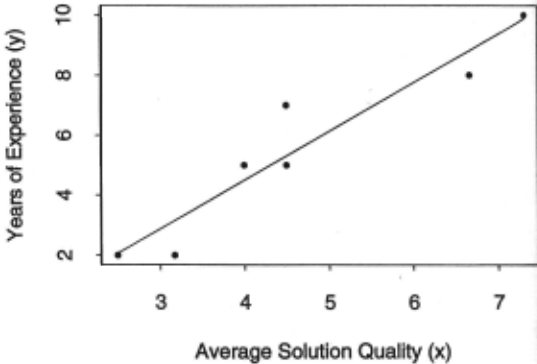
- Plot . The average quality rankings or the human subjects were plotted on the graph shown in Figure 2.
- Fit a Skill Function to the Data. Several types of curves were fit to these data, including a loga rithmic function and several types of polynomials. However, a simple linear regression fit the data best . The regression yielded the following equation for the model: y = -1.97 + 1.67x. We use this as the skill function, shown in Figure 2 as a heavy diagonal line.
- Construct confidence bands. 95% confidence bands are shown in Figure 3 as curved bands flank ing the skill function.
- Plot the KBS average quality rank. The aver age quality rank for the KBS, x{m) , was plotted on the quality (x) axis.
- Construct an experience estimate and inter val. The average plan quality rating of the KBS, 5.67, is plugged into the skill function . This pro duces a value which estimates the KBS's experience level at·7.20 years of experience. This is the expe rience estimate. Using the equations for the confi dence bands, it was determined that the experience interval is 6.03 to 8.36 years of experience. This means that the true experience level of the KBS lies
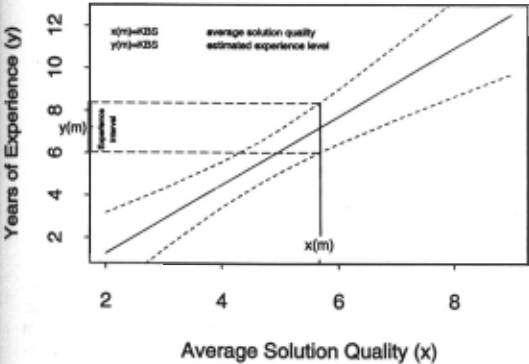
somewhere between 6.03 and 8.36 years, with 95% confidence.
Figure 3 1 shows the experience estimate and expe rience interval for the KBS on the y axis. From this evaluation we concluded that our system exhibits a very high experience level. On the basis of these results we confirmed that our problem solving approach was a rea sonable and effective one. We decided that our basic approach was sound and that we should proceed with development along the same lines. Information on how to change the system to improve it further was derived from further knowledge engineering and protocol analy SIS.
5 Summary and Conclusions
In this paper we present QUEM, a general method for measuring the experience level of a KBS, and assessing the quality of its solutions relative to human practitioner . This method allows researchers to answer the question, ;,How expert is my expert system?" Assessing the so lution quality and experience level of a KBS system is important. in helping developers decide if their approach is sufficient, how the system should be used, and with what lt>vel of user it should interact .
The method utilizes expert judges to rank order solu tions produced by both KBSs and human subjects. The rankings for the human subjects are used to construct a skill function describing the relationship between experi ence and solution quality. Lastly this skill function, and its confidence bands can be used to estimate the KBSs' experience level, and to bound the true value .
Previous methods for evaluating a KBS performance involve qualitative comparisons, such as "system x per forms better than system y,'' which does not say if either system performs well at all. The QUEM procedure al lows a system developer to make a quantitative assess ment. of the solution quality and experience level of a KBS. This measure allows system developers to answer the questions such as, "How much better is system x than system y?" or "How many years of experience does my KBS capture?"
1 Figure 3 couri.es.v of M. C. P. Dorneich .
QUEM can be used in any domain in which increased experience leads to measurably increased solution qual ity (which is presumably most complex domains). Ad ditionally, it can be used to assess a partially complete KBS which can construct solutions but which may not be complete or correct in all aspects. It can be used to mea sure the experience level of an individual KBS, to com pare several KBSs which operate in the same domain, or to compare the experience levels of several KBS's that operate in unrelated domains. QUEM represents an im portant advance in providing quantitative measures of system performance that can be applied to a broad range of complex domains in which solution quality may oth erwise be hard to quantify.
@inproceedings{ijcai1997p43,
  title     = {An Achievement Test for Knowledge-Based Systems: QUEM},
  author    = {Hayes, Caroline C. and Parzen, Michael I.},
  booktitle = {Proceedings of the Fifteenth International Joint Conference on
               Artificial Intelligence, {IJCAI-97}},
  publisher = {International Joint Conferences on Artificial Intelligence},
  editor    = {Martha E. Pollack},
  pages     = {288--292},
  year      = {1997},
  note      = {Cognitive Modeling},
  url       = {https://ijcai.org/proceedings/1997/43},
}
TY - CPAPER TI - An Achievement Test for Knowledge-Based Systems: QUEM AU - Hayes, Caroline C. AU - Parzen, Michael I. T2 - Proceedings of the Fifteenth International Joint Conference on Artificial Intelligence, IJCAI-97 PB - International Joint Conferences on Artificial Intelligence PY - 1997 SP - 288 EP - 292 UR - https://ijcai.org/proceedings/1997/43 ER -Copied
Machine-readable versions of this paper, for tools and AI agents:





